Category: National

  • Dem NJ Gov Appoints State’s First Openly Gay AG

    PBS reports:

    New Jersey Gov. Phil Murphy announced Wednesday that Andrew Bruck would be appointed acting attorney general for the remainder of Murphy’s term. Bruck, who is first assistant attorney general, has been part of the office’s executive leadership since outgoing Attorney General Gurbir Grewal was confirmed in January 2018.

    The announcement comes one day after the Securities and Exchange Commission named Grewal the new head of its enforcement division. Grewal’s last day with the state is July 16. Murphy also noted that Bruck will be the first openly gay attorney general in state history.

    Inside New Jersey reports:

    Before joining the Office of the Attorney General, Bruck spent five years at the U.S. Department of Justice. During that time, he served as an Assistant U.S. Attorney at the U.S. Attorney’s Office for the District of New Jersey, and held several roles in the office of Deputy Attorney General Sally Yates, including Senior Counsel, Deputy Chief of Staff, and Acting Chief of Staff.

    Before joining the Department of Justice, Bruck worked as a litigation associate in the New York office of Davis Polk & Wardwell and clerked for Chief Justice Stuart Rabner of the New Jersey Supreme Court. He is a graduate of Princeton University and Stanford Law School. Bruck is a New Jersey native who grew up in Montclair and Mendham. He currently resides in Trenton with his husband Adam and 8-month-old daughter, Libby.

  • Fort Lauderdale Gay Men’s Chorus reeling after horrific Pride crash that killed one of their own

    The leader of the Fort Lauderdale Gay Men’s Chorus has spoken of their shock and grief after one of their members killed another in a horrific crash at a Florida Pride.

    James “Jim” Fahy, 75, was killed and two others were injured when a pickup truck driven by a fellow chorister suddenly accelerated and rammed into spectators at Pride parade in Wilton Manors, Florida on 19 June.

    Speaking to Local 10 News on Tuesday (29 June), chorus director and founder Dr Gary Keating recalled the horrifying moment when tragedy struck.

    “The truck took off, it knocked me down, I saw it go across the street and then when I recovered from that, that’s when I got up and went and saw what had happened with the truck,” he said.

    “I saw people on the ground, that’s what I remember. Jim was without question one of the most positive, energetic, alive people I’ve known in my lifetime, and I’ve known some pretty amazing people.”

    The truck, part of the procession, was driven by 77-year-old Fred Johnson, a longtime member of the Fort Lauderdale Gay Men’s Chorus who was unable to walk in the march because of unspecified “ailments”.

    Police say Johnson’s foot slipped and got stuck under the brake, pushing down to accelerate and fatally striking Fahy.

    Local 10 News spoke with Chuck Gregory, a friend of Johnson’s, who says he is “devastated” by the tragic accident. “It just keeps going through his mind. He keeps seeing it like a movie,” he said.

    Johnson hasn’t spoken publicly since the incident but has offered a statement of apology.

    “This was a horrible accident and I offer my sincere regrets to all those who were impacted by this tragic event,” he said.

    “I love my Chorus family and the community and would never do anything to intentionally harm anyone. Please know that I hold my fellow Chorus member, Jim Fahy, in my heart forever and offer my condolences to his friends and family.”

    The choir are said to be united in their grief, but relying on one another to get them through their darkest hour. They plan to hold a celebration of life for Fahy on Wednesday (30 June), to remember his dedication to service and his volunteer work.

  • Boy Scouts of America reaches pivotal agreement with victims

    The Boys Scouts of America have reached an agreement with attorneys representing some 60,000 victims of child sex abuse in what could prove to be a pivotal moment in the organization’s bankruptcy case.

    Attorneys for the BSA filed court papers late Thursday outlining a restructuring support agreement, or RSA, with attorneys representing abuse victims. The agreement includes both the official tort claimants committee, which is charged with acting as a fiduciary in the bankruptcy case for all abuse victims, as well as a separate plaintiffs group called the Coalition of Abused Scouts for Justice. It also includes attorneys representing local Boy Scouts councils and lawyers appointed to represent victims who might file future claims.

    “After months of intensive negotiations, the debtors have reached resolution with every single official and major creditor constituency in these Chapter 11 cases,” BSA attorneys wrote.

    The agreement signals the BSA’s acknowledgment that the gulf between attorneys representing abuse victims and those representing the BSA’s insurers is currently too broad to be resolved. They may very well be left to resolve their differences in future court battles, a prospect that the BSA had sought to avoid.

    The Boy Scouts of America, based in Irving, Texas, sought bankruptcy protection in February 2020, moving to halt hundreds of lawsuits and create a compensation fund for men who were molested as youngsters decades ago by scoutmasters or other leaders.

    But BSA attorneys have been unable to get attorneys for victims, the BSA’s local councils and sponsoring organizations, and insurers to agree on a global resolution that would compensate abuse victims while allowing the Boy Scouts of America to continue operating.

    In an earlier court filing Thursday, attorneys for certain insurance companies accused the BSA of allowing attorneys for abuse victims to rewrite the BSA’s restructuring plan to include terms favorable to their clients.

    “With only the fox guarding the henhouse, the outcome is utterly at odds with what BSA itself asserted was necessary for a confirmable plan and is permissible under the bankruptcy code,” the insurers wrote.

    Attorneys for insurers appear to be particularly concerned that the BSA’s liability for abuse claims would be adjudicated under proposed trust distribution procedures in an effort decide insurance coverage issues.

    Meanwhile, in connection with the restructuring support agreement, attorneys for the Boy Scouts are asking for U.S. Bankruptcy Judge Laurie Selber Silverstein to declare that they have no obligation to seek court approval of a previously announced settlement with The Hartford, one of the BSA’s insurers.

    The Hartford agreed to pay $650 million into the victims’ trust in exchange for being released from any further obligations under policies dating to 1971. The agreement allowed The Hartford to pay a lesser amount if the BSA or the settlement trust reaches an agreement with another major BSA insurer, Century Insurance Group, and Century’s settlement amount is less than two times The Hartford’s, or $1.3 billion. 

    The Hartford settlement was roundly criticized by attorneys for abuse victims, who estimate the insurer’s liability exposure at several billion dollars. They made it clear that victims would not support any plan that includes the Hartford settlement.

    The Boy Scouts have said that between $2.4 billion and $7.1 billion, including insurance rights, might be available for abuse victims. Attorneys for the tort claimants committee, or TCC, have estimated the value of some 82,500 sexual abuse claims at about $103 billion.

    “All plaintiff representatives, who represent the vast majority of the holders of direct abuse claims, have indicated that any plan containing the Hartford Settlement would be categorically rejected,” BSA attorneys wrote in Thursday’s court filing. “Without their support, to be forced to pursue a plan that incorporates the Hartford settlement appears futile.”

    In a joint statement, the Coalition, the TCC, and the future claimants representative said the restructuring support agreement will allow the Boy Scouts to emerge from bankruptcy “while providing meaningful compensation to the victims, and holding the Boy Scouts’ insurers to the terms of the insurance policies purchased by the Boy Scouts and their affiliates over many decades.”

    In a revised plan submitted barely two weeks ago, the BSA offered to issue an $80 million unsecured promissory note to a trust fund for abuse victims. It also proposed using restricted assets to help cover post-bankruptcy operational expenses, which would make up to $50 million in unrestricted cash available for abuse survivors. With the changes, the BSA’s proposed contribution to the trust fund would increase from about $120 million under a previous plan to as much as roughly $250 million.

    Under a new plan expected to be filed Friday, the BSA’s 250-odd local councils would contribute $600 million into the fund for abuse victims, double an offer of $300 million from earlier this year. At least half of the councils’ contribution would be in cash.

    In return for their contributions to the trust fund and the transfer of insurance rights, the BSA and local councils would be released from liability. Sponsoring organizations such as churches and civic groups also could be released from further liability in exchange for contributing to the fund and transferring insurance rights.
  • Ohio governor signs bill allowing doctors to refuse care to LGBT+ people

    The governor of Ohio has signed a bill that allows doctors to refuse medical care to LGBT+ patients if they have an objection based on “moral” grounds.

    The provision was buried in a 700-page document of last-minute amendments to the state’s two-year budget bill, which governor Mike DeWine approved last Wednesday (30 June).

    t allows any medical provider – from doctors and nurses to researchers, lab techs and insurance companies – “the freedom to decline to perform, participate in, or pay for any health care service which violates the practitioner’s, institution’s, or payer’s conscience as informed by the moral, ethical, or religious beliefs”.

    This sweeping religious exemption raised major red flags for LGBT+ and women’s rights groups, with multiple advocates in the state expressing serious concern.

    “Today governor DeWine enshrined LGBTQ discrimination into law, threatening the medical well being of more than 380,000 LGBTQ people in Ohio, one of the largest LGBTQ populations anywhere in the country,” said Human Rights Campaign president Alphonso David in a statement.

    “Medical practitioners in Ohio can deny care or coverage for basic, medically-necessary, and potentially life-saving care to LGBTQ people simply because of who they are.”

    The sinister religious exemption came as a surprise to many, as it wasn’t one of the many initiatives in the budget bill that were highlighted on the governor’s website.

    “They know that they couldn’t pass this on its merits as a standalone bill, because literally no one is asking for this to be passed,” Dominic Detwiler of Equality Ohio told the Columbus Dispatch.

    Sure enough, the law is overwhelmingly opposed by the state’s medical community, as underlined in a letter to budget negotiators signed by the Ohio Hospital Association, the Ohio Children’s Hospital Association, the Ohio State Medical Association, and the Ohio Association of Health Plans.

    “The implications of this policy are immense and could lead to situations where patient care is unacceptably compromised,” they warned.

    Yet governor DeWine defended the bill, pointing out that it only permits a refusal of care in cases of “conscience-based objections to a particular health care service”.

    He insisted the conscience clause will change very little, and claimed that no one in Ohio will be discriminated against.

    “This simply puts in statute what the practice has been anyways,” he said. “Let’s say the doctor is against abortion, the doctor is not doing abortion. If there’s other things that maybe a doctor has a conscience problem with, it gets worked out, somebody else does those things.”

    Here he referred to a loosely-written clause which requires that the medical professional – when possible – “attempt to transfer the patient to a colleague who will provide the requested procedure,” as long as making that referral doesn’t violate their conscience as well.

    But Dr Todd Kepler, southwest medical director of Equitas Health, said the “widely broad” language in the bill will exacerbate existing barriers to care for many marginalised groups, like drug addicts, people living with HIV, and the LGBT+ community.

    It’s people like these, already living with few options for healthcare in their community, that would be hit the hardest.

    “Say I happen to be a gay patient and I wanted to see a provider in my town, and there weren’t really any other providers in town. But they find that morally unacceptable, they could turn me away,” he said to WCPO.

    “And the language is so broad that that could even be done at an institutional level. So, if you have a hospital that perhaps has an affiliation with a religious institution, and again, that happens to be the only institution in town, theoretically they could turn that patient away for health care.”

    As Randy Phillips of the Greater Dayton LGBT Centre added, “It begins a slippery slope when we start picking and choosing who we can treat and who we don’t want to treat.”

    He asked: “How many are going to be denied care simply because they are living authentically?”

  • 20-year-old hero stabbed in the back in possible anti-gay hate crime

    A trip to Manhattan took a dark turn for Dylan Spinosa and his friend upon their return home via the Staten Island ferry. While waiting for their taxi, a drunken stranger stabbed Dylan in the back while spewing anti-gay slurs.

    Spinosa, 20, and his friends had gone into the city to celebrate pride and enjoy a day out now that COVID-19 restrictions have lifted. While they waited for their ride home, Spinosa and his friends noticed a drunken man harassing women with sexual remarks.

    Spinosa told the New York Daily News that the suspect was “harassing every girl that he passed by, talking to them sexually.” Spinosa and another passerby tried to pressure the man to leave and stop bothering the women. When they did, the man replied that he had a gun, ignored their request, and began harassing another female.

    Related: Police arrest machete-wielding teen in possible antigay hate crime

    “He was in her ear, sexually harassing her, saying he was going to have sex with her,” Spinosa described. “Me and this other guy were like, ‘Dude, leave her alone. Go home. You’re drunk. This doesn’t have to get any further.’ ”

    Then things turned violent. The drunken suspect attacked the stranger by punching him in the face. Spinosa reacted by putting the assailant in the headlock and wrestling him to the ground. When Spinosa released him, he heard his friends scream.

    “I turn around and the guy’s charging us,” Spinosa said of the moment. “I didn’t realize that he had a knife. It felt like he punched me. I thought he threw a beer on me.”

    “He stabbed me in the back,” Spinosa elaborated.

    The suspect then began yelling anti-gay slurs as Spinosa slumped to the ground, blood pouring down his back. Police arrived shortly thereafter and arrested Eric Shields, 47, while an ambulance rushed Spinosa to the hospital. Medics there treated his wound and discovered that the knife had scraped his scapula. He will need to keep his arm in a sling for some time. He is, however, expected to make a full recovery.

    Police have charged Eric Sheilds with assault, weapons possession, menacing and harassment. The District Attorney has also not ruled out hate crime charges, pending an investigation.

    The attack follows a recent rash of assaults on LGBTQ people this year. Earlier this month, police in Washington, DC arrested a man for harassing gay diners at a restaurant with a machete. In May, police in New York opened a hate crime investigation following the murder of a 24-year-old transgender woman.

  • Supreme Court won’t overturn ruling against business that refused service for gay weddings

    The Supreme Court on Friday declined to wade into the contentious issue of whether businesses have a right to refuse service for same-sex wedding ceremonies despite state laws forbidding them from discriminating on the basis of sexual orientation.

    The court dodged the wedding question three years ago in a case involving a Colorado baker who said baking a cake to celebrate a same-sex marriage would violate his right of free expression and religious beliefs. The issue came back in an appeal brought by Barronelle Stutzman, owner of Arlene’s Flowers and Gifts in Richland, Washington.

    The court said Friday that it would not take up her appeal, leaving the state court rulings against her intact and again ducking the hot-button issue. Justices Clarence Thomas, Samuel Alito and Neil Gorsuch said the court should have taken the case.

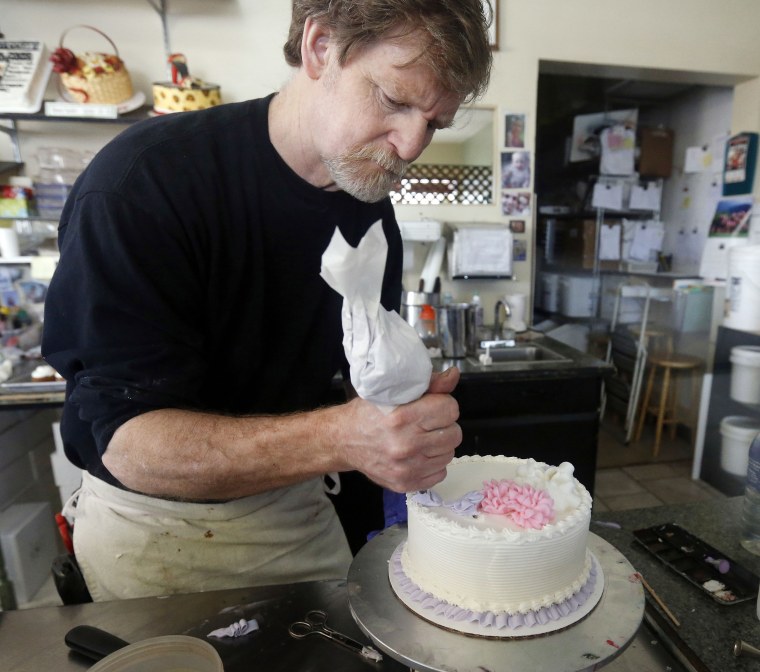
    Image: Masterpiece Cakeshop owner Jack Phillips decorates a cake inside his store in Lakewood, Colo., on March 10, 2014.
    Masterpiece Cakeshop owner Jack Phillips decorates a cake inside his store in Lakewood, Colo., on March 10, 2014.Brennan Linsley / AP file

    Stutzman refused to provide flowers for the wedding of two longtime male customers in 2013, explaining that as a Southern Baptist, it would violate her religious beliefs and her “relationship with Jesus Christ.” Like the Colorado baker, she said her floral arrangements were works of art and that having to create them for same-sex weddings would trample on her freedom of expression.

    The florist’s lawyer, Kristen Waggoner of the Alliance Defending Freedom, said other judges have ruled in favor of businesses claiming that they cannot be forced to create works that violate their religious beliefs.

    “We are confident that the Supreme Court will eventually join those courts in affirming the constitutionally protected freedom of creative professionals to live and work consistently with their most deeply held beliefs,” she said.

    Robert Ingersoll, who requested the flowers for his wedding ceremony, praised the Supreme Court for denying the florist’s appeal. He said he hopes the court’s action “sends a message to other LGBTQ people that no one should have to experience the hurt that we did.”

    Ria Tabacco Mar, an American Civil Liberties Union lawyer who represented the gay couple, said the denial is a reminder that “no one should walk into a store and have to wonder whether they will be turned away because of who they are. Preventing that kind of humiliation and hurt is exactly why we have nondiscrimination laws. Yet 60 percent of states still don’t have express protections for LGBTQ people like the kind in Washington State. Our work isn’t over.”

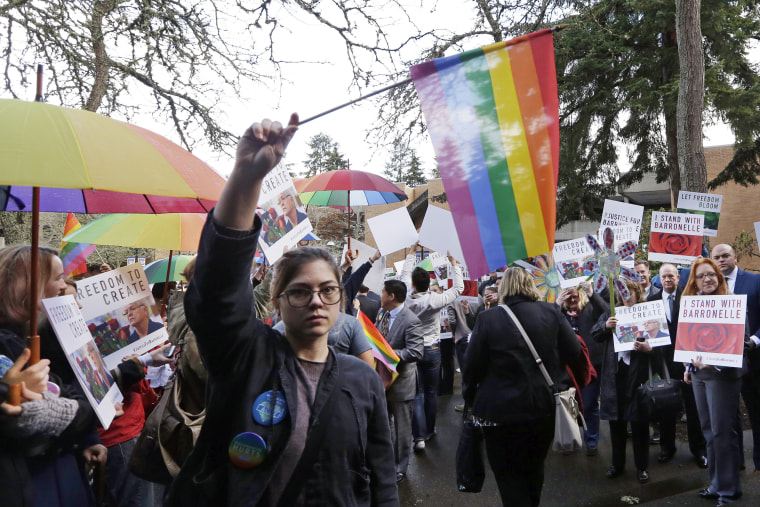
    Image: Supporters on both sides of the case line a walkway following a hearing before Washington's Supreme Court about a florist, Barronelle Stutzman, who was sued for refusing to provide services for a same sex-wedding on Nov. 15, 2016, in Bellevue, Wash
    Supporters on both sides of the case line a walkway following a hearing before Washington’s Supreme Court about a florist, Barronelle Stutzman, who was sued for refusing to provide services for a same sex-wedding on Nov. 15, 2016, in Bellevue, Wash.Elaine Thompson / AP file

    State courts ruled that Stutzman broke a Washington law forbidding businesses to discriminate on the basis of several factors, including sexual orientation. The Washington Supreme Court said providing or refusing to provide flowers for a wedding “does not inherently express a message about that wedding.”

    After ducking the issue in the Colorado case, the U.S. Supreme Court sent Stutzman’s case back for another round in the Washington courts, where she lost a second time and again appealed.

    Recommended

    LATINOPuerto Rico could start losing Medicaid funding in two months

    LATINOSupreme Court upheld Trump’s ‘Big Lie’ in Ariz. voting laws ruling, Latino group says 

    “Religious people should be free to live out their beliefs about marriage,” her lawyers said in urging the Supreme Court to hear the case. They said states have taken action against calligraphers, videographers and other business that refuse to serve same-sex weddings because of their religious beliefs.

    “These First Amendment violations must stop,” they said.

    But the ACLU, representing Washington state, said Stutzman is not required to participate in any actual same-sex wedding ceremony.

    The state also told the court that the florist refuses to prepare any flower arrangement for the wedding of a gay or lesbian couple, even if the arrangement is identical to one the shop’s employees would prepare for a heterosexual couple.

    “It is thus clear that their objection is not to any ‘message’ sent by the flowers themselves, but rather to the message they perceive would be sent by serving a gay couple,” lawyers for the state said.

    The ACLU said courts have repeatedly ruled that there is no right to be exempt, on religious freedom grounds, from general laws that are not enacted to disfavor religious beliefs.

    “All people, regardless of status, should be able to receive equal service in American commercial life,” it said.

  • His principal tried to stop this gay valedictorian from giving his speech. It didn’t work.

    Meet Bryce Dershem, the 18-year-old valedictorian of Eastern Regional High School in New Jersey. While giving his graduation speech, his principal cut his mic after he referred to his queer identity. Undeterred, Dershem gave his uncensored speech to the crowd anyway.

    The incident occurred during Eastern Regional High School’s commencement ceremony on June 17. Dershem, who identifies as gay, had an ongoing debate with the school principal, Robert Tull, over the content of his speech. Dershem had loaded his initial draft with references to his coming out as queer and his struggles with anorexia and mental health. Tull, however, forbade him to mention either. Finally, Tull gave Dershem an “approved” version of the speech, which scrubbed all references to sexuality and mental health. According to Dershem, Tull thought referring to either would alienate members of the audience.

    “I felt like I was faced with this choice where I could either honor all the belief systems and virtues that I cultivated,” Dershem revealed, “or I could just follow the administration.”

    Related: Governor tells Matt Gaetz never to return to New Jersey after he attends superspreader party

    With a bit of encouragement from his family, Dershem memorized the full speech and opted to give it on graduation day over Tull’s objections. Just one minute in, Dershem made reference to coming out, Tull pulled the plug.

    “As it was happening, passion was surging through my veins that, yes, I need to give this speech,” told The Chicago Tribune, “because this is the exact kind of stigma that I want to fight against.”

    Video of the graduation ceremony shows Tull pulling cords out of the sound system to silence Dershem. He then walked to the podium, took the mic and Dershem’s notes, and pointed to the approved speech on the podium. When the sound returned, a terrified Dershem opted to continue his speech from memory.

    “I tried my very best to give the speech from memory, and I was just a mess throughout the whole speech and I was just so vulnerable,” he added.

    When he finished, the audience gave Dershem a standing ovation. One woman in the crowd approached him in tears to thank him for his honesty.

    “She told me her son hadn’t survived the pandemic due to mental health struggles and she started to cry,” Dershem recalled. “I thought, ‘This was the one person I made feel less alone,’ and I knew I did the right thing.”

    It would appear Dershem is not alone in that sentiment, either. In the aftermath of the censorship debacle, New Jersey Gov. Phil Murphy issued a statement commending Dershem for “speaking truth to power, and for your resilience and courage.” Video of the entire speech posted by Dershem’s father has also nabbed more than 147,000 views on YouTube.

    At the time of this writing, neither Principal Robert Tull nor administrators for Eastern Regional High School have commented further on the incident.

  • Marjorie Taylor Greene says talking about homosexuality in schools is “child abuse”

    Another day and another Pride Month attack from Rep. Marjorie Taylor Greene (R-GA).

    When she’s not bashing Dr. Anthony Fauci and Rep. Alexandria Ocasio-Cortez, or engaging in a double-act with fellow Rep. Matt Gaetz at pro-Trump rallies, Greene has had plenty to say about LGBTQ people.

    Following earlier attacks on embassies flying Pride flags, she yesterday took to Twitter to lambast what may or may not be on the school curriculum.

    Greene shared a video of a 14-year-old girl recently testifying before a school board meeting in a suburb of Indianapolis. The girl has not been named.

    In the clip, the youngster, who has certainly had a difficult upbringing in her formative years, talks of being a “trauma child” and of being adopted from a foster home when she was four.

    She complains about being taught about sexuality at school, which she believes should be a private matter. She also says she cannot see how she has white privilege, given her own background.

    Related: WATCH: Marjorie Taylor Greene: “I don’t believe in evolution”

    The clip was first shared on Twitter last week and went viral. Greene re-shared it yesterday and used it to attack schools talking about Critical Race Theory, gender identity of sexuality.

    Critical race theory (CRT) has been talked about for the last 40 years in academic circles but has only more recently entered mainstream debate. It explores the idea that racism and patterns of discrimination in the US have shaped its society, legal systems and institutions.

    In recent months, CRT has become an increasing lightning rod for some on the right of the GOP to attack anti-racism campaigners or those on the left.

    Related: Matt Gaetz thought he could get one over on the military. He was wrong.

    Many educators and advocates believe talking about sexuality in school, and teaching kids that it’s OK to be gay, will reduce anti-LGBTQ bullying and would support many LGBTQ youngsters struggling with mental health issues. LGBTQ youth are at a far greater risk of attempting suicide than their straight peers. They contemplate suicide roughly three times as often as straight youth.

    As explained by The Trevor Project, “All young people deserve access to safe and supportive public education, free from harassment and discrimination on the basis of sexual orientation or gender identity.

    “However, policies known as ‘No Promo Homo’ and ‘Don’t Say Gay’ laws ban educators from talking about LGBTQ people, issues and history entirely, or they only allow negative discussion. These laws keep supportive teachers from speaking out in the classroom, eliminating vital safe spaces for LGBTQ students.”

  • Gay historian files lawsuit against Trump fans over “attack” of Biden campaign bus

    Civil rights organizations have filed two lawsuits in federal court against dozens of individuals for harassing and “ambushing” a Biden-Harris campaign bus in October. They are also suing the San Marcos Police Department, City Marshal’s Service, and the Director of Public Safety “who turned a blind eye to the attack.”

    They are working with four individuals who were in or by the bus as named plaintiffs. One name plaintiff is Dr. Eric Cervini, an out historian and author of the book The Deviant’s War: The Homosexual vs. the United States of America, which was chosen as a finalist for the 2021 Pulitzer Prize in History.

    With his last name coming first in alphabetical order among his co-plaintiffs, Cervini is the first name on all legal paperwork and the lawsuits are legally known as Cervini v. Cisneros and Cervini v. Stapps.

    “Everyone on the campaign bus was doing what good citizens of any political party should do — engaging in the electoral process,” Cervini said in a statement. “The intimidation and harassment we experienced is unacceptable, and we want to make sure it doesn’t happen in future elections.”

    The non-profit pro-democracy group Protect Democracy announced that they are bringing the lawsuit alongside the Texas Civil Rights Project and Willkie Farr & Gallagher LLP. The four plaintiffs they are representing are Cervini, Wendy Davis, David Gins, and Timothy Holloway. Davis and Gins were passengers, Holloway was driving, and Cervini was driving alongside the bus.

    “We filed this lawsuit because everyone should be able to engage in peaceful political activity free from fear, intimidation, or threats of violence,” Davis stated with the announcement.

    The bus was traveling to Austin from San Antonio for a last-minute campaign stop on October 30, a week before the election concluded. The Biden-Harris campaign had hoped to sway voters in the Lone Star State after polling had showed that the ticket had better chances at winning the state in the election than previously believed.

    The campaign bus, only carrying campaign staff and not the then-candidates, was then stopped outside of San Marcos, Texas, by a group of vehicles on Interstate 35. That led to a blockade by pro-Trump demonstrators and a confrontation “well beyond safe limits,” said Texas Rep. Sheryl Cole (D).

    Cervini tweeted at the time, “These Trump supporters, many of whom were armed, surrounded the bus on the interstate and attempted to drive it off the road. They outnumbered police 50-1, and they ended up hitting a staffer’s car.”

    He added, “The police refused to help. When I flagged down one officer, he said his hands were tied: ‘not my jurisdiction.’ He was wearing a blue stripe bandana.

    “…As a historian who studied the rise of the Third Reich, I can tell you: this is how a democracy dies,” he said.

    The Daily Beast reported that staffers saw the swarm of demonstrators (by car and truck) surround the bus and were either trying to prevent it from proceeding, or lead it off the road. The bus and accompanying vehicles were forced to park, and the pro-Trump demonstrators circled it with their cars, bullhorns, and signs. At least one collision occurred during the incident, which was captured on video.

    The convoy of demonstrators eventually left, but the police made no arrests, and Texas Democrats and the Biden-Harris campaign cancelled multiple events that weekend.

    Right before those events, the President’s son, Donald Trump Jr., released a video encouraging Trump supporters in Texas to attend events that then-Vice Presidential candidate Kamala Harris was at.

    “It’d be great if you guys would all get together, head down to McAllen and give Kamala Harris a nice Trump Train welcome,” he said.

    Then-President Donald Trump retweeted video of part of the incident the day after and said, “I LOVE TEXAS!”

    The state of Texas ended up giving its 38 electoral votes to Donald Trump, as the then-President took approximately 52 percent of the state’s popular vote, and Biden earned just under 47 percent.

    Joe Biden would still win the presidential election without Texas, although Trump would not concede and instead attempted to overturn the election results. That culminated in a pro-Trump mob storming the U.S. Capitol Building on January 6, 2021, in attempts to prevent certification of the election — although their efforts ultimately failed and the election was certified.

  • Georgia Boy Placed In Protective Custody After Family Shaves “Gay” Into His Hair And Films Physical Abuse

    Metro Weekly reports:

    A boy in Georgia who had “gay” shaved into his head by family members has been placed in protective custody.

    Video of the 12-year-old youth being berated by his family went viral on social media earlier this month. In the video, the boy — identified only as Tyler — is surrounded by family members, who call him a “gay ass bitch” and accuse him of “doing gay shit.”

    The video zooms in on the boy’s head, showing “GAY” has been shaved into his hair. A man in the video is also shown slapping and punching the boy. The video was uploaded to Instagram Live on June 17 by the boy’s mother, where it caused outcry and demands for police intervention.

    Read the full article. Activists have saved the video, a link to which is available in the story. I don’t want to share it here though, it’s so humiliating for the child.