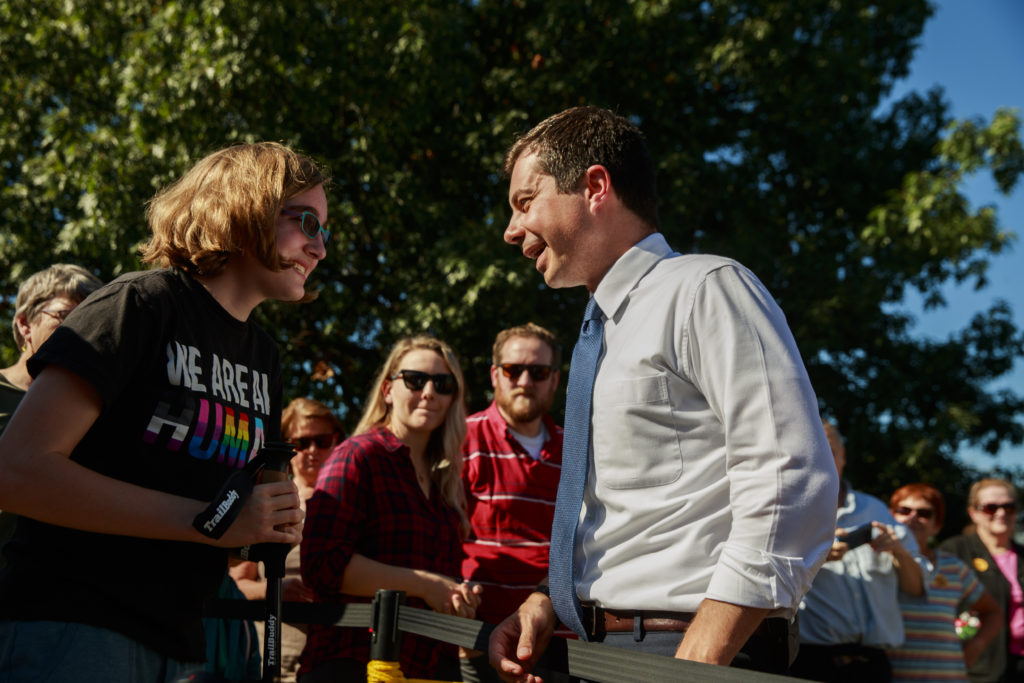
As Pete Buttigieg continues his campaign to become the first openly gay US president, a new poll has suggested that America isn’t ready for an LGBT+ commander in chief.
According to the Politico/Morning Consult poll, 44 percent of voters don’t think that the country is ready for an openly gay president, with 40 percent saying the opposite.
But for many, the problem seems to be a societal one rather than any personal prejudice. When asked if they themselves could accept a gay president, 50 percent answered with either definitely or probably, compared to 37 percent who said definitely or probably not.
The results showed that Buttigieg’s sexuality “may be an issue for some voters”, according to Morning Consult’s vice president Tyler Sinclair.
“Notably, 58 per cent of Republicans, 32 per cent of independents and 22 per cent of Democrats say they aren’t ready for a gay or lesbian president,” he continued, per Politico.
“The comparative figures not ready for a female president are 36 per cent of Republicans, 15 per cent of independents and 8 per cent of Democrats.”
Pete Buttigieg trailing Biden, Warren and Sanders in Democrat race.
Whether America is or isn’t ready for a gay president may prove moot, as Buttigeig is currently trailing three other candidates in the race for the Democratic nomination.
According to a RealClearPolitics polling average on Wednesday, October 30, Buttigieg has 7.6 per cent support among Democrats, a full 20 points behind the frontrunner Joe Biden.
At 28 per cent, Biden is currently ahead of Elizabeth Warren (21.7) and Bernie Sanders (17.3).
Researchers quizzed 24 undecided black Democrats in Columbia, South Carolina, and found that a number of men “seemed deeply uncomfortable even discussing” his gayness.ADVERTISING
A report added: “Their preference is for his sexuality to not be front and centre.”
“It feels like a slap in the face to just go directly to the white gay guy, when for decades you’ve been trying to elect a woman and it didn’t happen last time,” said one lesbian Democrat.
“If Pete Buttigieg is elected it won’t feel like a vindication of Hillary Clinton. If a woman is elected, it will.”
A new report from the Williams Institute at the UCLA School of Law found the relatively high rate of poverty in the LGBTQ community is not evenly distributed, with bisexual women and transgender people shouldering a disproportionate poverty burden.
When grouped together, almost 22 percent of lesbian, gay, bisexual and transgender people reported earning less than the federal poverty level of $12,490 per year for a single-person household. The cisgender straight community, on the other hand, reported a poverty rate of almost 16 percent.
When researchers separated the L, G, B and T, however, they found cisgender (or non-transgender) gay men and lesbians reported similar levels of poverty to their heterosexual counterparts, while bisexual women and transgender people (of all sexual orientations) had a poverty rate of almost 30 percent.
The study found gay men had the lowest rates of poverty at 12 percent, followed by cisgender lesbians at 18 percent. These percentages were statistically indistinguishable from the poverty rates of their heterosexual male and female counterparts at 13 and 18 percent respectively. Overall, for gay and straight people, women face higher rates of poverty than men. Bisexual men reported a poverty rate of almost 20 percent, significantly less than their bi women counterparts.
Bianca Wilson, one of the study’s authors, said researchers have some hypotheses for why poverty levels are elevated in these communities, including that they could be due to “experiences of discrimination, maybe the impact of minority stress, the impact of mental health concerns that come from experiencing discrimination. However, how that explains the particularly high rate among bisexual women is not clear.”
Robyn Ochs, a bisexual activist, said it doesn’t surprise her that bisexual people report higher levels of poverty, because it’s “pretty typical, historically, for bisexual people’s experience to be lumped in with gay and lesbian experience.”
“Bisexual people have a much harder time finding community and safe space,” Ochs explained, “even when there’s an established LGBTQ community, it’s often not fully inclusive of bisexual-identified people.”
During the Obama administration, Heron Greenesmith, a bisexual activist and researcher, participated in several White House summits devoted to issues specific to the bisexual community.
“The news is that we have been talking about this for years with empirical, peer reviewed data on national data sets, and nothing has increased the programs and services dedicated to alleviating poverty where it really matters in the LGBT community,” Greenesmith said.
Ochs noted that a fraction of 1 percent of all funds designated for the LGBTQ community is earmarked for bisexual issues specifically, according to a report by Funders for LGBTQ Issues. Greenesmith said that this lack of funding results in “a lack of structure in bi communities, which produces a lack of leaders” that can advocate for community needs.
Overall, Greenesmith said she thinks biphobia is a major component of many disparities the report unearthed.
“It can have different names, you can call it bi erasure,” Greenesmith said. “As I research the right as well, I am finding more and more data to show that sexual fluidity, as can be exemplified by the existence of bi folks, makes people really confused and nervous.”
As for the high rate of poverty among the transgender community, Gillian Branstetter, media relations manager for the National Center for Transgender Equality, found the Williams Institute figures “deeply unsurprising.”
“It’s quite simple: If you do not have stable access to housing, you are more likely to face violence. If you do not have gainful employment, you’re more likely to face violence. And the prejudice and bias that denies so many people access to these opportunities leaves them exposed to any number of risk factors, including poor health and positive HIV status, as well as abusive situations like intimate partner violence,” Branstetter said.
“It shows the massive potential for harm posed by the three Title VII cases before the Supreme Court to allow employers to avoid any consequences for discriminating against transgender people,” Branstetter added. “It is not merely a philosophical, etymological matter of the definition of sex — it is literally the right of equal economic opportunity for every member of society that’s in front of the Supreme Court right now.”
The burden of LGBTQ poverty is also uneven across location, according to the report. While straight people face poverty in urban and rural areas at roughly the same rate (approximately 15 percent), rural LGBTQ people have a poverty rate of 26 percent compared to their urban peers at 21 percent.
Study author Bianca Wilson says that with so many unknowns presented by the data, her next project at UCLA’s Williams Institute will be a qualitative study that will interview subjects and attempt to answer why certain groups within the LGBTQ community are so disproportionately impacted by poverty.
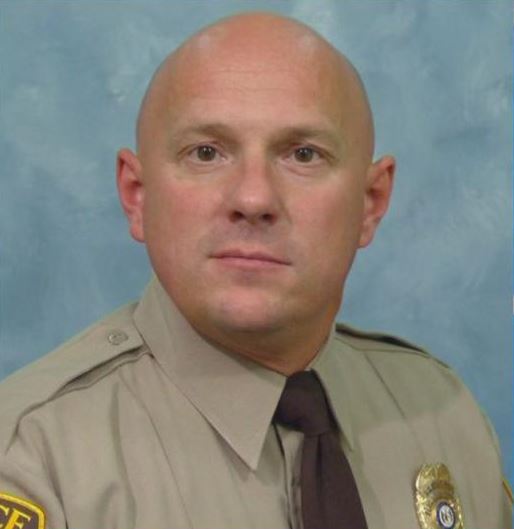
A gay police officer has won $19 million in damages from his employer, after he was told to “tone down” his sexuality.
Sgt. Keith Wildhaber, an officer within Missouri’s St. Louis County Police Department, had filed a lawsuit in 2017 after he was passed over for promotion to lieutenant despite 15 years’ service.
Police officer was told his sexuality is a ‘problem’
According to Wildhaber’s lawsuit, a member of the St. Louis County Board of Police Commissioners had told him: “The command staff has a problem with your sexuality. If you ever want to see a white shirt [be promoted], you should tone down your gayness.”
The officer alleged he was passed over 23 times for promotion, and also said that when he filed a discrimination complaint, he was transferred in retaliation.
Sgt. Keith Wildhaber, an officer within Missouri’s St. Louis County Police Department
On Friday, a jury in St. Louis County Circuit Court sided with Wildhaber, after a hearing that saw testimony from senior police officials repeatedly contradicted by other evidence.
According to the St Louis Post-Dispatch, a police captain denied having ever met one witness who accused him of making homophobic remarks about Wildhaber, before photos emerged of them in a “friendly embrace.”
Police force will see ‘changes’ after discrimination case
County Executive Sam Page said in a statement: “Our police department must be a place where every community member and every officer is respected and treated with dignity.
“Employment decisions in the department must be made on merit and who is best for the job. ”
Page said that there would be “leadership changes” on the police force, starting with “the appointment of new members to the police board, which oversees the police chief.”
The St. Louis County Police Union said: “While we are extremely embarrassed of the alleged actions of some of our Department’s senior commanders, we look forward to the healing process that can begin to take place now that this has been heard in open court.”
Pete Buttigieg has surged into third place in the key state of Iowa, according to polling.
The out South Bend mayor is proving surprisingly popular in the traditionally-conservative state, surpassing Bernie Sanders to make it into third place.
Pete Buttigieg is third in Iowa, ahead of Bernie Sanders.
According to the Suffolk University/USA Today poll, 13 percent of Iowans support Buttigieg, behind only Elizabeth Warren on 17 percent and Joe Biden on 18 percent in the crowded Democratic field.
Sanders, who has seen his left-wing support eroded by Warren, is in fourth on 9 percent, with no other candidate receiving above 3 percent in the poll.
South Bend, Indiana Mayor Pete Buttigieg, who is running for the Democratic nomination for president of the United States (Jeremy Hogan/SOPA Images/LightRocket via Getty Images)
The Iowa caucuses, set to take place on February 3, are traditionally the first event of the presidential primaries – marking the state as a key battleground for candidates hoping to show they have momentum.
Buttigieg has unveiled a bold plan for LGBT+ rights.
Buttigieg recently revealed his ambitious LGBT+ policy platform, including pledges to update US passports to recognise non-binary people, ensure access to PrEP for everyone who needs it, and provide LGBTQ+ inclusive lessons and health education.
He said: “I will press for and sign the Equality Act into law as soon as it hits my desk, making anti-discrimination the law of the land.
“I will deliver quality health care that is affordable, accessible, and equitable for all Americans, regardless of their sexual orientation, gender identity, or race.
“My administration will put us on a path to end the HIV/AIDS epidemic—which disproportionately affects gay men and transgender women of color —by 2030, and ban the dangerous practice known as ‘conversion therapy’ once and for all.
“I will use more comprehensive strategies to end hate-based violence against LGBTQ+ people, especially black transgender women; increase access to housing for LGBTQ+ Americans; and strengthen protections for LGBTQ+ immigrants and refugees.”
Buttigieg also pledged to “conduct a thorough examination of unconstitutional religious exemption policies in the federal government, especially those deployed by the Trump administration to undermine the rights of LGBTQ+ people”.
Presidential hopeful Elizabeth Warren has called on the Trump administration to protect transgender asylum seekers, who allegedly suffer “rampant” abuse while in detention.
Along with her fellow senator Tammy Baldwin, the first out LGBT+ person elected to the US Senate, Elizabeth Warren wrote a letter urging the Immigration and Customs Enforcement (ICE) to “immediately reverse policies” that harm transgender migrants seeking refuge in the US.
The senators state that the ‘Remain in Mexico’ policy is particularly harmful to trans asylum seekers as it forces them to remain in countries where their gender identity puts them at risk.
They said the administration must allow trans asylum seekers entry into the US, warning of the danger in “placing their health and safety at risk while they wait – potentially for years – for their asylum claims to be processed”.
In one case cited by Warren and Baldwin, a transgender woman’s “finger was cut off by a cartel” while her application was intentionally delayed.
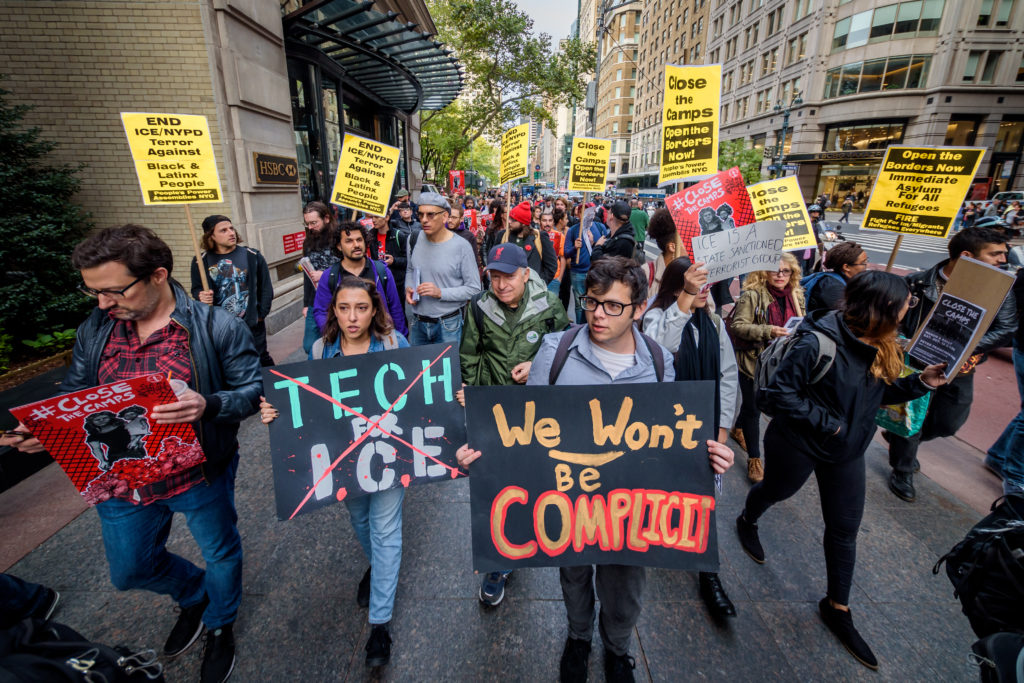
Hundreds of activists and immigration advocates took to the streets in New York City to demand an end to Salesforce and Amazon profiteering from immigrants detention camps (Erik McGregor/LightRocket/Getty)
Warren and Baldwin also drew attention to recent reports of “abuse and neglect of transgender migrants and asylum seekers”, both at the border and in US custody.
“While in detention, transgender migrants and asylum seekers are particularly vulnerable to sexual harassment, discrimination, and abuse,” the letter reads.
“The United States should protect individuals fleeing persecution and targeted violence, including persecution based on gender identity or expression — not subject them to further harm.”
Some trans women have accused ICE of housing them in barracks with heterosexual men where officers ordered them: “Walk like a man! You better sit like a man!”
They told of being forced to bathe and sleep in units with men who sexually harassed and threatened them. These men would intrude on them while they were in the shower, leering at them and offering to “help” them bathe. The women claim they were thrown into solitary if they complained.
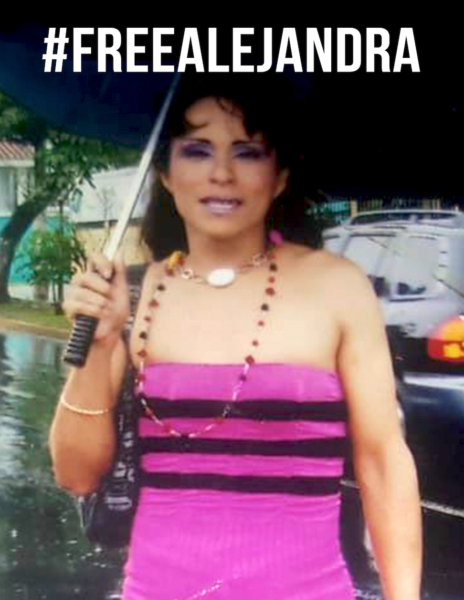
Another trans woman named Alejandra Barrera was refused treatment for a progressive medical condition, which if left untreated could cause severe complications or even death.
Alejandra Barrera, a trans asylum seeker (Facebook/Translatina@ Coalition)
After a sustained advocacy campaign by her attorney and several non-profit organisations, she was finally released after 20 months – the longest period of detainment for a trans person ever at the facility.
Activists claim her experience is representative of the widespread mistreatment of all trans women in ICE custody.
Warren and Baldwin have requested a meeting with ICE and DHS “to update our offices on your efforts to address the harm to transgender migrants” before October 30.
More than half of homeless young people in Atlanta, Georgia, have been victims of human trafficking and LGBT+ and African American youth are most at risk, according to a new study.
The Atlanta Youth Count 2018 study by Georgia State University sociology professor Eric Wright found that there were an estimated 3,372 homeless young people in Atlanta between the ages of 14 and 25.ADVERTISING
Human trafficking is defined in the report as “acquisition of people by improper means such as force, fraud or deception, with the aim of exploiting them either for sexual acts or labour services”.
Overall, 54 per cent of homeless youth had experienced some form of human trafficking in their lifetime, and 37 per cent had experienced it since becoming homeless.
African American, black and multiracial young people were at high risk of trafficking, as 56 per cent of homeless youth counted in the study were black or African American and 32 per cent were multiracial.
Looking just at LGB youth, these numbers increased. 61 per cent of lesbian, gay or bisexual homeless youth had experienced human trafficking in their lifetime and 44 per cent had been trafficked while homeless.
For trans and non-binary young people experiencing homelessness the figures jumped even more dramatically.
71 per cent had experienced trafficking during their lifetimes, and 65 per cent had been victims of it while homeless.
The report said cisgender young women are often seen as the main targets, but that is not the case.
The report states that LGBT+ homeless youth “require special attention in the provision of safe and secure services”, and that “gendered definitions of trafficking need to be expanded”.
It continues: “While cisgender female individuals are often conceptualised as the main targets of trafficking vulnerabilities, transgender respondents report significantly higher rates of trafficking than their cisgender counterparts (including both male and female cisgender respondents).
“The full spectrum of gender identity must be understood and accepted in order to fully serve transgender youth and effectively address the needs of trafficked youth.”
Of those surveyed between September and November 2018, seven per cent were trans or non-binary and 24 per cent identified as lesbian, gay or bisexual. Four per cent identified as an orientation other than LGB or straight.
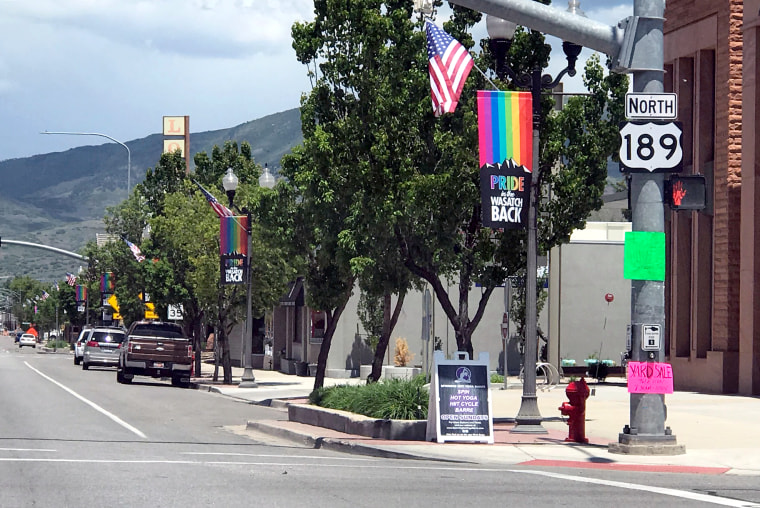
For the first time last June, residents in Heber City, Utah, saw their downtown adorned in rainbows.
Sky Elizabeth Smith, 15, remembered driving with her family through the tiny Rocky Mountain town in northern Utah where she grew up, and finding herself surrounded by dozens of rainbow banners on both sides of Main Street.
“It made me feel really, really happy,” she told NBC News.
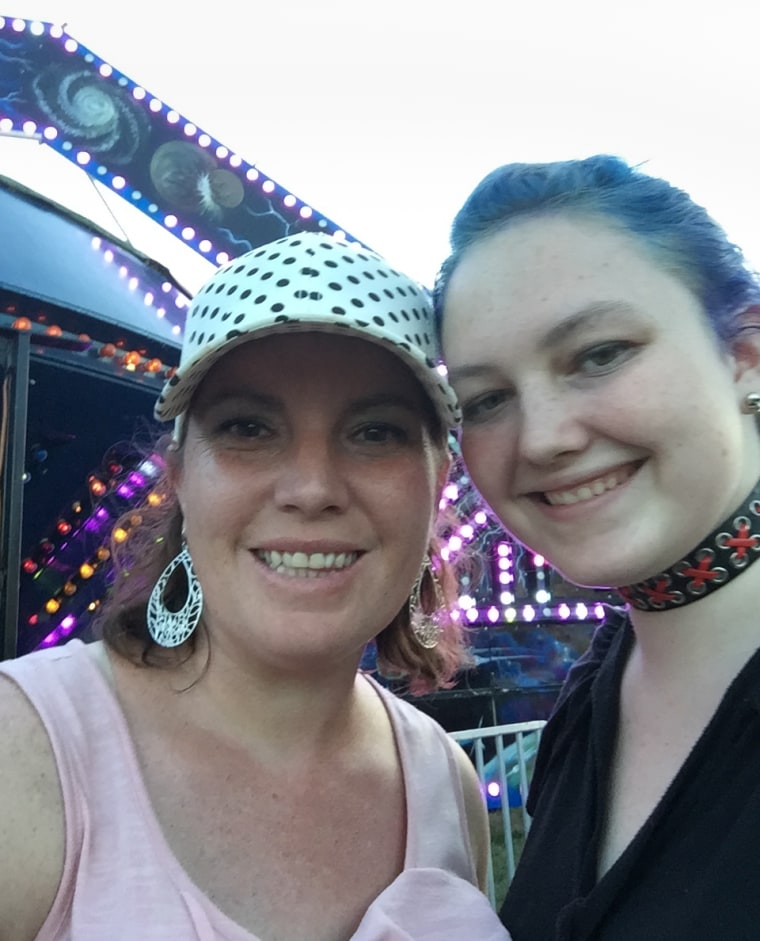
Sky Elizabeth Smith, left, and mother Elizabeth Gale Seiler at the Heber fair days in August 2019.Sky Elizabeth Smith
Smith, a high school student who identifies as pansexual, attempted suicide last year after what she described as routine bullying from classmates. Some classmates, she recalled, told her that Jesus was going to return and kill anyone who is lesbian, gay, bisexual, transgender or queer.
When Smith’s mother, Elizabeth Gale Seiler, a day care worker and lifelong member of the The Church of Jesus Christ of Latter-day Saints, commonly known as the Mormon Church, saw her daughter’s reaction to the banners, she was overcome with emotion.
“She looked at me, and she said, ‘I’m not alone here,’ and I just started to cry. In fact, I’m going to cry right now,” Seiler, 35, said. “It was the first time in this valley that she has felt accepted.”
A devastating trend
Youth suicide rates have tripled in Utah since 2007, according to the most recent data available from the Utah Department of Health. The problem is so severe that Republican Gov. Gary Herbert spearheaded a task force to combat the issue.
Nationwide, youth suicide skyrocketed 56 percent from 2007 to 2017, according to a newly released report from the Centers for Disease Control and Prevention, but it’s unclear what’s behind the increase. LGBTQ youth are almost five times as likely to attempt suicide compared to their heterosexual and cisgender peers, according to the Trevor Project, a national organization providing crisis intervention and suicide prevention services to LGBTQ youth.
Many advocates believe LGBTQ youth represent a large portion of suicides in Utah, but because public health data do not track sexuality and gender identity, there is no data that confirms their suspicions, according to Hillary McDaniel, a manager for the Utah Pride Center, Utah’s largest LGBTQ organization.
“When someone dies by suicide, their family often knows by a note or just knowing them that that was the issue, because they were gay, or lesbian, or transgender, bisexual, and they didn’t have that support or were being bullied,” McDaniel said.
Ironically, Utah’s large population of Mormons, who represent about 61 percent of the state, have become increasingly lenient on the issue, Allen said, with more and more Mormon leaders showing a willingness to work with LGBTQ advocates.
“If you look at public opinion polling, Mormons fall somewhere between white evangelical Christians and mainline Protestants on LGBTQ issues,” Allen said. “So it means that Mormons aren’t going to be quite as hard-line as maybe religious folks in the Bible Belt and parts of the Deep South, but they aren’t going to quite go to West Coast levels of LGBTQ acceptance just yet.”
In 2015, the state’s Republican-dominated Legislature passed “the Utah compromise,” a law that made Utah the only solidly conservative state to pass some protections in housing and employment for LGBTQ people. Two years later, Utah became the first of eight conservative states to repeal a “No Homo Promo” law that prohibited discussing LGBTQ issues in schools. And after an attempt to ban conversion therapy failed in the Legislature, the state’s Division of Occupational and Professional Licensing issued a draft rule to prohibit therapists from practicing conversion therapy on minors. If Herbert adopts the rule without changes, Utah will become the 19th state and the first reliably conservative state to ban the practice.
However, in a statement released last week, the politically powerful Church of Jesus Christ of Latter-day Saints opposed the proposed ban, stating that the rule would interfere with psychologists’ religious beliefs, and said the measure “does not account for important realities of gender identity in the development of children.”
Small towns divided
Not everyone in Heber City was pleased to see Main Street bedecked in rainbow banners. Like many small towns in Utah, the population is largely Mormon, and is divided over LGBTQ issues, according to Mayor Kelleen Potter.
On June 4, a day after the banners were installed, Heber City residents gathered for a City Council meeting to voice divided opinions over the flags, Potter said. Some threatened to tear them down, she added, while others were overjoyed.
“There were a lot of really tender stories of people contacting me, telling me they’ve grown up in Heber, some of the difficulty growing up as an LGBTQ person in that community, and how they never believed that they would see something like that,” Potter recalled.
Herber City, Utah.Allison Phillips Belnap
In the following weeks, Potter fielded angry phone calls and emails from community members who felt the flags were inappropriate. She said some people saw them as an attempt by LGBTQ advocates to use city-owned property to send a “political” message, an idea she dismissed.
“There is no one advocating for any legislation, or anything,” she said of her city. “This is a civil rights issue. It’s just a message of love and inclusion. It’s good for our community.”
Allison Phillips Belnap, 46, a local real estate attorney, raised $3,553 through a GoFundMe campaign to purchase the rainbow banners for Heber City. Phillips Belnap left the Mormon Church in 2017 after coming out as a lesbian. As one who had attempted suicide, she said she purchased the banners because she wanted to show other members of the local LGBTQ community they were not alone.
After the flags were installed, residents began reaching out to Phillips Belnap on social media to say thanks. One message was from Elizabeth Gale Seiler, still distraught over her daughter Sky’s suicide attempt.
“I think that’s what makes it worth it,” Phillips Belnap said. “And it meant more to me than I ever would have anticipated starting out. I didn’t realize what a big effect it would have on individuals and the community.”
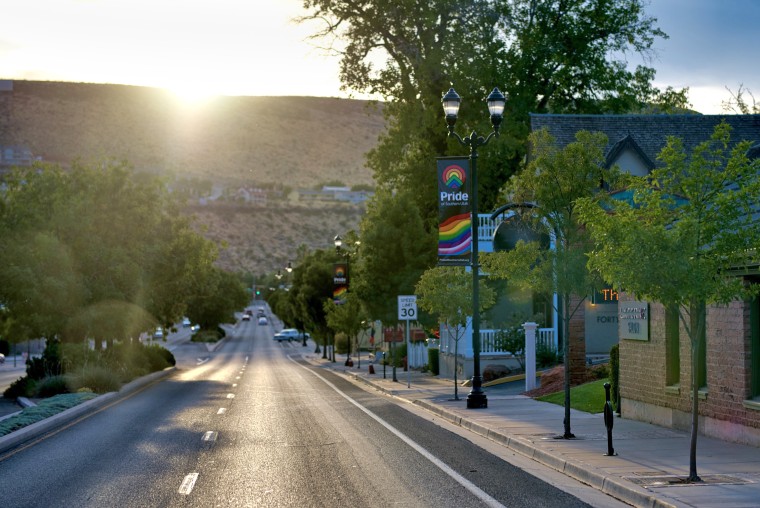
St. George, Utah.Courtesy Pride of Southern Utah
A similar debate erupted in St. George, a small desert town in Utah’s southwest corner, almost 300 miles from Heber City. During the early weeks of September, commuters there were greeted by rainbow banners on either side of St. George Boulevard, a main thoroughfare that cuts through the city center.
Pride of Southern Utah, an LGBTQ advocacy organization, paid for the banners, which were installed on about 30 lampposts along the boulevard. The group also installed banners in the towns of Cedar City and Hurricane.
Inspired by the banners in Heber City, Pride of Southern Utah raised more than $6,100 on GoFundMe to purchase the banners.
“Within 20 hours, we had more than twice as much as what we needed,” Stephen Lambert, director of Pride of Southern Utah, said. “It was very humbling.”
The group filed for a permit to install the banners, which were part of the group’s Pride Week celebration spanning a week in mid-September.
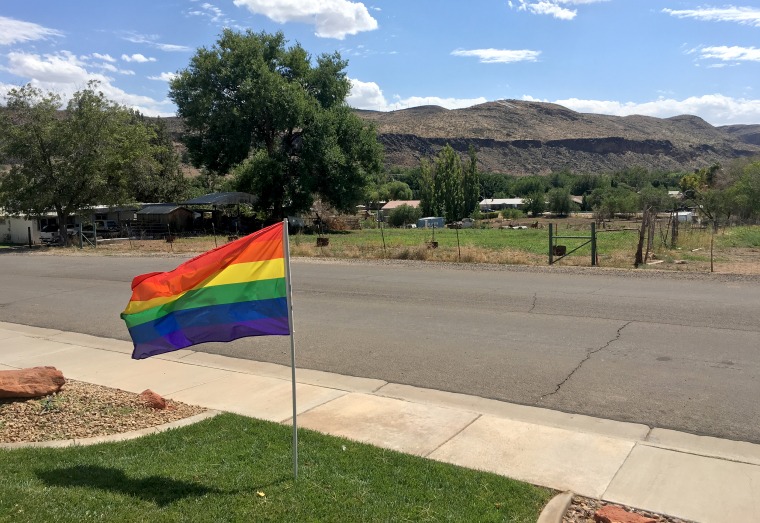
Hurricane, Utah.Project Rainbow
The banners set off waves of approval and outrage from residents of St. George. In an email circulated on social media, a councilwoman referred to the flags as “political statements,” igniting a debate over whether an ordinance surrounding public signage should be reevaluated.
Lambert refuted the idea that his group has political motivations.
“Pride of Southern Utah is not a political organization,” he said. “We are not out there trying to change policy. Our purpose is to be a support group for the LGBTQ+ community, to be a resource for them, to be a safe place for them. That’s all.”
As the controversy mounted, city officials received at least two informal inquiries from groups interested in installing their own banners on the city-owned lampposts, according to St. George Mayor John Pike. Pike declined to specify the names of the organizations, but he said one was a white supremacist group and the other was interested in installing flags with President Donald Trump’s campaign slogan “Make America Great Again.”
St. George put a moratorium on applications for city lamppost banners until officials could revisit the city’s policy around what can be displayed on city-owned property, according to Pike.
The rainbow banners in Heber City prompted similar inquiries, according to Mayor Potter. She said at least one group inquired about installing anti-abortion banners on city-owned lampposts. While Heber City has not placed a moratorium on flags, Potter said the town will likely need to create an official policy that specifies what kinds of messages can be displayed on city-owned property.
Rainbow flags vandalized
Throughout Utah this year, rainbow flags adorned more than city lampposts. From summer through fall, flags were staked in the front yards of hundreds of homes in urban and rural neighborhoods.
Behind the effort was Project Rainbow, a small Salt Lake City-based nonprofit.
For $15, Utahans could rent rainbow flags from Project Rainbow during the duration of their city’s Pride festivities, which took place at various times throughout the summer and fall. Volunteers from Project Rainbow traversed the state to stake flags in customers’ front yards on PVC poles.
This year, the group raised $17,000 for the Utah Pride Center in Salt Lake City, and several thousand more for smaller LGBTQ groups throughout the state, including Pride of Southern Utah, according to Lucas Horns, who founded Project Rainbow in 2017.
Horns, 25, a professional ballet dancer who lives in Salt Lake, said the group staked 1,400 flags in the city and hundreds more throughout Ogden, Logan, St. George and Provo — more than doubling the number from last year.
Horns said Project Rainbow received backlash in response to the flags on social media, with some people accusing the group of “forcing their beliefs” on local communities. He estimated that about 10 percent of the flags Project Rainbow staked throughout Utah were stolen or vandalized.
“It’s sad that it’s been turned into a political symbol,” Horns said. “People have roped it into the dichotomy of our nation and I don’t think it has to be.”
Shally Sorensen, 46, a hair stylist who lives in St. George, came home one day in mid-September to see that her rainbow flag had disappeared from her property.
Sorensen, a mother of four, said she ordered the flag from Project Rainbow to show support for her nephew, who is gay. A few of her neighbors’ flags had also been thrown down or vandalized, she said.
“My girls and I, all of us cried, because we had a lot of sadness that week,” Sorensen, who has teenage daughters, said.
Days later, in an empty lot next to Sorensen’s house, a friend discovered a rainbow flag in a porta potty, soiled and partially burned. Instead of calling the police, Sorensen invited family and neighbors to her home to draw “messages of love” in colorful chalk on her driveway. About 40 to 50 people showed up, she said, including the local news media.
“It was beautiful to see that many people come together just to show love and support,” she said.
Sorensen washed the flag and put it back in her yard. Six days later, the flag vanished for the last time.
“I do know that I think there was a lot of good that came from all of this despite the yucky that came out,” Sorensen said. “It caused a lot of people to have conversations about what the flag means and that was really a good thing.”
‘Then came the flags’
Despite some backlash against the flags, advocates say Utah is warming to LGBTQ rights.
Mormon families are increasingly beginning to accept their LGBTQ children, according to Allen. Driving much of the change, she said, is Mormonism’s unique focus on family togetherness.
In recent years, a burgeoning online network of Mormon mothers known as the “Mama Dragons” emerged to help parents in the Mormon community understand their LGBTQ kids. Founded in 2014, the group has grown to more than 3,000 members throughout the country.
“I think it’s really telling that Mama Dragons came out of Mormonism,” Allen said. “You have these amazing moms who decided they were going to be really vocal and stand by their kids.”
Both Potter, who has a gay son and a transgender daughter, and Elizabeth Gale Seiler are proud members of the group.
“They’ve really helped me with some struggles I have with balancing how to help Sky through the struggles she’s been having with the bullying situation,” Seiler said.
Sky Elizabeth Smith has joined a newly formed a gay-straight alliance at her high school, and is doing much better, according to her mother.
“It’s been a real struggle,” Seiler said between tears. “But we make it through. She makes it through. She’s proud of who she is. She doesn’t hide who she is.”
Smith said the bullying she endured at school last year was “really bad.” One boy, she said, told her to “kill myself.”
“Then came the flags,” Smith said, recalling that day in June when she was surrounded by rainbow banners in downtown Heber City. “It just made me realize that there are people in this town and out there that actually care about us.”
The parents of murdered gay man Matthew Shepard snubbed a Trump administration ceremony in his honour, accusing the GOP-led Department of Justice of exploiting his memory.
A ceremony was held at the Department of Justice on Thursday to mark ten years since the passage of the Matthew Shepard and James Byrd Jr. Hate Crimes Prevention Act, a law signed by president Obama that extended federal hate crime laws to cover LGBT+ people.
The law is partly named in memory of Matthew Shepard, who was murdered in Wyoming in 1998 in a homophobic attack that saw his killers escape hate crime charges.
Shepard’s parents, Judy and Dennis Shepard, skipped the ceremony, and angrily denounced the Trump administration’s attempt to take advantage of their son’s memory while fighting at the Supreme Court against protectionsfor LGBT+ employees.
Parents of Matthew Shepard blast ‘hypocritical’ attorney general William Barr.
In a letter, the couple denounced attorney general William Barr, writing: “We find it interesting and hypocritical that he would invite us to this event commemorating a hate crime law named after our son and Mr Byrd, while, at the same time, asking the Supreme Court to allow the legalised firing of transgender employees.”
“If you believe that employers should have the right to terminate transgender employees, just because they are transgender, then you believe they are lesser than and not worthy of protection.”
“If so, you need not invite us to future events at the Department of Justice that are billed as celebrating the law that protects these same individuals from hate crimes. Either you believe in equality for all or you don’t.
“We do not honour our son by kowtowing to hypocrisy.”
Attorney general Barr also did not attend the event at the Department of Justice.
Judy and Dennis Shepard thanks federal employees for fighting ‘uphill battle’ against Trump administration.
The Shepards paid tribute to employees within the Department of Justice who “truly believe in protecting all Americans from injustice”, adding: “We understand how frustrating and thankless it is when you are fighting an uphill battle under today’s political climate and with little or no support or assistance from the administration.”
The couple added: “We don’t want to see another incident or life lost as we lost Matt. Any loss of life, any loss of a job, any loss of desire to work towards fulfilling a person’s dreams and goals because of hate related words or actions is a loss to the local community where that person lives, a loss to the state where that person lives, and a loss to this country.
“We look forward to a re-focus on the causes of hate crimes and the reduction of hate crime incidents as America changes direction and moves forward towards a more equal and just country.”
Shortly after Rutgers University student Tyler Clementi died by suicide in 2010, Canadian teen Brittany McMillan decided to do something about it: She created a Facebook event calling on people to wear purple — the “spirit” color of the rainbow pride flag — on the third Thursday of October to show that they stand against anti-LGBTQ bullying.
By the time the first Spirit Day took place on Oct. 20, 2010, it was already a worldwide phenomenon.
“Since then, it has evolved into more than just wearing purple, but ‘going purple,’ which is really quite amazing,” McMillan told NBC News in 2016.
Sarah Kate Ellis, president and CEO of GLAAD, the LGBTQ media advocacy organization, said Spirit Day had become “a megaphone for allies to send a unified message of acceptance and support to LGBTQ youth each year.”
“In today’s divisive culture and political climate,” she said, “LGBTQ people and allies need to be louder than ever to outshine bullies and tell young people that they will always be supported just as they are.”
As in past years, celebrities across the U.S. and beyond — from movie stars to sports teams — have shared messages of hope and empowerment with LGBTQ youth on Thursday, Spirit Day 2019.
And as a sign of how far Brittany McMillan’s dream has come, this year, several 2020 presidential candidates also shared their messages to LGBTQ youth.
“You’re incredible, you’re as good and better than anybody else, and don’t let people try to tell you you’re not,” former Vice President Joe Biden said. “Remember that, you’re special.”
In his Spirit Day video, Mayor Pete Buttigieg of South Bend, Indiana, noted that when he was in high school, “there was literally not one out person that I knew of.”
“When you do speak up, when you are willing to be yourself — which is not an easy thing — know that you are having an impact on other people that are looking to you who you might not even realize,” Buttigieg continued. “Be strong, be yourself, and know that it gets better.”
Sen. Amy Klobuchar, D-Minn., told LGBTQ youth, “You have friends and you have people that have your back.”
Sen. Kamala Harris, D-Calif., let LGBTQ youth know they’re “not alone.”
“So do not ever silently suffer and know that you are deserving of respect and dignity and safety, and we will always fight for that,” Harris said in her video.
This year, the 10th annual Spirit Day, the event is more widely observed than ever, even as bullying remains a stubbornly common experience for LGBTQ youth. GLSEN’s 2017 National School Climate Survey found that 70 percent of LGBTQ students say they have been verbally harassed, and over half didn’t report it because they doubted adults in charge would intervene. In that same survey, 60 percent of those who did report bullying say that school staff either did nothing or told the reporting student to “ignore it.”
As awareness of the impact of bullying has spread, thanks in part to groups like the Tyler Clementi Foundation, several cases of LGBTQ suicides have made national headlines as examples of the dangerous consequences of bullying, which increasingly takes place online.
There was 9-year-old Jamel Myles from Denver who died by suicideafter classmates bullied him for being gay. He had come out to his mother the summer before fourth grade and wore false fingernails on the first days of school.
And then there was Nigel Shelby, an Alabama high school freshman who died by suicide after facing bullying from classmates and unsympathetic school administrators who allegedly told him being gay was “a choice.” His mother, Camika Shelby, said administrators knew her son was having suicidal thoughts and did not tell her. Just last month, Tennessee teen Channing Smith died by suicide after sexually explicit texts he had sent to another boy were shared on social media.
Facing growing awareness that bullying increasingly takes place in cyberspace, Instagram took a stab at reducing it on the platform with a new set of features that would use artificial intelligence to tell commenters their posts are abusive, and also allow users to discreetly mute abusers.
Some 21% of LGBTQ adults aren’t registered to vote, according to a study released this week by the University of California, Los Angeles’ Williams Institute. That’s compared to an estimated 17% of non-LGBTQ adults.
The finding, part of a larger poll of 2,237 people that measured LGBTQ voters’ demographic characteristics and political attitudes, came as LGBTQ rights have taken center stage in the national conversation. Meanwhile, Friday marked National Coming Out Day.
Some LGBTQ voters already face an uphill battle making their voices heard at the ballot box.
“Voter suppression has primarily targeted voters of color, who also happen to include LGBTQ Americans, who far too often face disproportionate barriers in accessing their right to vote,” Human Rights Campaign president Alphonso David told the Washington Post after HRC, a nonprofit that advocates for LGBTQ rights, backed a voting-rights initiative led by former Georgia gubernatorial candidate Stacey Abrams.
For instance, David said, voter-ID laws in some states requiring that a person’s documentation match their birth-assigned gender could preclude a transgender person from casting a ballot. While about 137,000 transgender people who had transitioned in the U.S. were eligible to vote ahead of the 2018 midterm elections, more than half might not have had documentation or ID that correctly reflected their gender, the Williams Institute found in August 2018.
XSEE ALSOQueen’s Speech Opens Crucial Week for Brexit
PauseUnmuteCurrent Time 0:00/Duration Time0:00Fullscreen
Half of the LGBTQ adults registered to vote next November said they were Democrats, 22% were independents and 15% were Republicans.
With that said, almost 9 million LGBTQ adults are eligible and registered to vote next November, according to the most recent poll, which was conducted by Ipsos in collaboration with the Williams Institute and Thomson Reuters. Half said they were Democrats, while 22% were independents and 15% were Republicans.
The sample included 136 registered LGBTQ voters and 1,836 registered non-LGBTQ voters.
LGBTQ rights feature in the 2020 presidential race
The analysis by the Williams Institute, a UCLA Law think tank that researches sexual orientation, gender identity and public policy, comes ahead of a high-stakes election in which civil-rights protections for LGBTQ people could hang in the balance.
The Equality Act, a bill that would shield LGBTQ individuals from discrimination in credit, housing, employment and a range of other areas, passed earlier this year in the Democrat-led House. Activists believe that turning the Republican-led Senate blue in 2020 would boost the bill’s chances of being signed into law.
Many leading Democrats vying for the 2020 nomination — including former Vice President Joe Biden and South Bend mayor Pete Buttigieg, the only openly gay candidate running — have thrown their support behind the Equality Act. Sen. Elizabeth Warren (D-Mass.) has also proposed abolishing the filibuster to clear a path for the Equality Act’s passage, should Senate Republicans block it.
‘LGBT voters differ from non-LGBT voters in several ways. For example, they are more likely to be young, male, and live in urban areas.’ —Study author Christy Mallory, the Williams Institute’s state and local policy director
Senate Majority Leader Mitch McConnell has not brought the bill to the floor, and President Trump’s administration has claimed that the bill in its current form “is filled with poison pills that threaten to undermine parental and conscience rights.”
“I’m just going to be blunt: We’ve got to have some more Democrats in the Senate,” Warren said during CNN’s Equality Town Hall on Thursday, responding to a question about how to ensure that the Equality Act passed the Senate. “I’m willing to continue to push Mitch McConnell right now, but my No. 1 goal is to make sure he is not the majority leader come January 2021.”
The Supreme Court will make critical decisions for LGBTQ protections
Separately, the U.S. Supreme Court heard arguments on Tuesday to determine whether Title VII of the 1964 Civil Rights Act, which prohibits sex discrimination, also protects LGBTQ people from discrimination in the workplace on the basis of gender identity and sexual orientation.
LGBTQ people were more likely than their non-LGBTQ counterparts (51% to 40%) to support “a career politician who knows his or her way around the political process,” the Williams Institute study found. LGBTQ voters and non-LGBTQ voters alike showed greater support for younger candidates, and both groups signaled that the race of a candidate wouldn’t impact how they voted — though LGBTQ voters were more likely than non-LGBTQ voters to back a candidate because that person was black or Latino.
Majorities of both groups said it wouldn’t matter to their vote if a candidate were gay or lesbian, but far more LGBTQ voters than non-LGBTQ voters said they were “more likely to support a gay candidate” (41% to 10%) or “more likely to support a lesbian candidate (34% to 11%). LGBTQ voters also showed greater support for hypothetical candidates who were transgender or gender-nonbinary.
“LGBT voters differ from non-LGBT voters in several ways. For example, they are more likely to be young, male, and live in urban areas,” study author Christy Mallory, the Williams Institute’s state and local policy director, added in a statement. “LGBT voters are also more likely to identify with the Democratic Party. Over four million LGBT Democrats are eligible to vote in the primaries next year.”