Arkansas’ highest court on Thursday said a city can’t enforce its ordinance banning discrimination based on sexual orientation or gender identity, saying it’s already ruled the measure violates a state law aimed at preventing local protections for LGBT people.
The state Supreme Court unanimously reversed a Washington County judge’s decision to allow Fayetteville to continue enforcing its anti-discrimination ordinance while the city challenged the constitutionality of a 2015 law preventing cities and counties from enacting protections not covered by state law. Arkansas’ civil rights law doesn’t cover sexual orientation or gender identity.
The court in 2017 ruled the ordinance violated the state law. Citing that decision, justices on Thursday reversed Judge Doug Martin’s ruling and dismissed the case. In Thursday’s ruling and the previous decision, the court did not rule on whether the state law was constitutional.
“Because the circuit court exceeded its jurisdiction on remand, its actions following remand are void,” Justice Robin Wynne wrote. “The order denying the preliminary injunction is reversed, and, because the sole issue over which the circuit court properly had jurisdiction was conclusively decided by this court in our 2017 opinion, the matter is dismissed in its entirety.”
Sixteen states and the District of Columbia have non-discrimination laws based on sexual orientation and gender identity covering employment, housing, public accommodations, credit and insurance, according to the Human Rights Campaign.
Fayetteville, the home of the University of Arkansas’ flagship campus and a gay pride parade that organizers tout as the largest in the state, is considered a liberal enclave in a conservative region of the state. It’s one of several cities that approved local protections for lesbian, gay, bisexual and transgender people in response to the 2015 state law. The court in 2017 rejected the city’s argument that it was allowed because LGBT protections are included in other parts of state law.
“Today’s unanimous decisions reaffirm the state’s authority to ensure uniformity of anti-discrimination laws statewide and to prevent businesses from facing a patchwork of nondiscrimination ordinances,” Attorney General Leslie Rutledge, a Republican who had arguedagainst the ordinance, said in a statment. “These decisions show that the city of Fayetteville is not above or immune from State law.”
Fayetteville City Attorney Kit Williams said he would likely ask the court to reconsider its decision and said the city’s argument that the law is unconstitutional remains undecided.
“The city has never had an attempt to defend a citizen-passed ordinance by showing that the state law was an unequal protection of the laws,” Williams said. “It seems very strange that they would deny us the right to at least present that constitutional argument to them for their decision.”
In a related case, justices said Martin incorrectly ruled that Arkansas’ constitution only protects lawmakers from testifying about what they say on the General Assembly floor or in committees but did not say how far that protection went. Martin had ordered sponsors of Arkansas’ law on local LGBT protections to testify and produce documents in the lawsuit.
Today, New Jersey Governor Phil Murphy signed a law requiring Boards of Education to include instruction, and adopt instructional materials, that accurately portray political, economic, and social contributions of persons with disabilities and lesbian, gay, bisexual, and transgender individuals.
This law would require that LGBTQ Americans, as well as Americans with disabilities, are included and recognized for their significant historic contributions to the economic, political, and social development of New Jersey and the United States. Specifically, this legislation would add LGBTQ people and individuals with disabilities to the existing list of underrepresented cultural and ethnic groups, which are covered by current law related to inclusion in textbooks and other instructional materials in schools.
“It’s critical that our classrooms highlight the achievements of LGBTQ people throughout history. Our youth deserve to see how diverse American history truly is—and how they can be a part of it one day, too,” said Executive Director of Garden State Equality Christian Fuscarino. “I’m thankful to Governor Murphy for making New Jersey the second state in the nation to have a law promoting LGBTQ-inclusive curriculum.”
This law would bring classroom materials into alignment with Core Curriculum Content Standards by ensuring that students receive diverse instruction in history and the social sciences, which will cultivate respect towards minority groups, allow students to appreciate differences, and acquire the skills and knowledge needed to function effectively with people of various backgrounds.
A Drag Queen Storytime protester allegedly trespassed in the Freed-Montrose Library this weekend after previously being banned from the premises. James “Doc” Greene Sr., who was issued a trespassing warning last month by the Houston Public Library (HPL) stating he could no longer visit its Montrose location, was detained, disarmed, and escorted out by police on Saturday, Jan. 26, for entering the building and refusing to leave.
Greene, a conservative radio show host for Raging Elephants Radio, recorded the incident and posted a video of his exchange with HPL staff and police on YouTube. At the start of the video, Greene is inside the library surrounded by around seven police officers. He repeatedly asks a library worker for her name and the reason why he is being asked to leave the library. “We have a bunch of homosexuals that are molesting children,” Greene says in the garage. “They are doing it with your help.”
Citing “conduct that violates civil rights,” lawyers for Gov. Matt Bevin say former Rowan County Clerk Kim Davis should be held responsible for nearly $225,000 in legal fees and court costs incurred by couples who sued her in 2015 when she refused to issue marriage licenses because of her religious opposition to same-sex marriage.
Although Bevin, a Republican, publicly has praised Davis as “an inspiration … to the children of America,” his attorneys are taking a more critical tone in court briefs, blaming the ex-clerk for failing to do her job following the U.S. Supreme Court’s June 2015 decision legalizing gay marriage.
A three-judge panel will hear arguments about the case’s expenses Thursday at the U.S. 6th Circuit Court of Appeals in Cincinnati. A district judge ruled in 2017 that the couples suing for marriage licenses clearly prevailed and that the state of Kentucky must pay their fees and costs.
CounterPunch reported Friday that students in Billings, Montana have been blocked from pro-LGBTQ sites since January 14.
An email sent to school staff from Brandon Newpher, the executive director of technology for Billings Public Schools, said the school system is blocking content “to improve network security and help protect students and staff.”
A list of “blocked keywords and subjects” was leaked to CounterPunch but did not include the terms “gay,” “homosexuality,” or “LGBT/Q.” It did, however, show that “adult content” and “dating sites” were blocked for both students and staff.
The report noted that Human Rights Watch and GLAAD, two LGBTQ advocacy websites, are currently blocked for students in Billings.
CounterPunch noted that the American Civil Liberties Union declared that “blocking all LGBT content violates students’ First Amendment rights to free speech.”
“They also violate the Equal Access Act, which requires equal access to school resources for all extracurricular clubs,” the ACLU noted, “including gay-straight alliances and LGBT support groups.”
According to the school system, such sites are blocked to “comply with filtering requirements as described by Children’s Internet Protection Act.”
A federal agency Wednesday granted Republican S.C. Gov. Henry McMaster’s request for a waiver to allow the state Department of Social Service to license faith-based child-placement agencies.
The waiver, issued by the U.S. Department and Health and Human Services, enables the Upstate’s Miracle Hill Ministries to continue its foster-care program, which caters to Christian families.
Supporters, including McMaster [photo above], say the waiver allows Social Services to license faith-based child-placement agencies without requiring them to abandon their religious beliefs. Opponents argue it allows taxpayer-funded discrimination based on religion.
Americans United reacts via press release:
Americans United for Separation of Church and State denounces the Trump administration’s decision today to sanction taxpayer-funded discrimination by allowing South Carolina foster care agencies the right to refuse to work with anyone they deem the “wrong” religion.
“This is yet another example of the Trump administration using religion to advance a regressive political agenda that harms others. And this time, the target is not only religious minorities but also our most vulnerable children – those in need of loving homes,” said Rachel Laser, president and CEO of Americans United. “It is unconscionable that this administration would use government funds to discriminate against the very populations our laws are designed to protect.
“While this waiver is specific to South Carolina, it sets a dangerous nationwide precedent that elevates the beliefs of government-funded programs over the best interests of the children in their care,” Laser continued. “Religious freedom is a fundamental American right – it should never be used to justify discrimination.”
The waiver allows Miracle Hill to reject ALL non-Christian parents, not just LGBT families.
Openly gay mayor Peter Buttigieg has announced he will be running for president in 2020.
Buttigieg, currently mayor of South Bend, Indiana, announced on Wednesday (22 January) that he is forming an exploratory committee to run for president for the Democratic Party.
He says his campaign will focus on ‘intergenerational justice’.
‘My generation is the generation that experienced school shootings beginning when I was in high school, the generation that fought in the post 9/11 wars, the first generation not to be better off than our parents materially – if nothing changes.’
He also appears to take a swipe at President Donald Trump’s mantra, Make America Great Again.
He adds: ‘There is no again the real world. We can’t look for greatness in the past. Right now our country needs a fresh start.
‘There’s a new generation of voices emerging in our country, walking away from the politics of the past and ready to deliver on our priorities. There is no again in the real world. That’s not a bad thing. We’re ready for a fresh start.’
The 37-year-old is the joint youngest candidate to enter the race, alongside Representative Tulsi Gabbard. He is a veteran of the Navy and is married to his husband Chasten.
Buttieg was elected mayor in 2011 at the age of 29, making him the youngest person ever to serve as mayor of South Bend.
In 2017, he ran for Democratic National Committee (DNC) chairman, but was unsuccessful.
Other Democrats who have expressed intent or formed exploratory committees include Senator Elizabeth Warren, Kirsten Gilibrand and Kamala Harris.
A new study shows detailed anti-bullying laws can help decrease the suicide rate among LGBTI teenagers.
Suicide prevention organization The Trevor Project stated LGBTI teens are nearly five times more likely than their straight counterparts to have attempted suicide.
The Williams Institute at the UCLA School of Law has found a connection between LGBTI-inclusive state bullying laws and lower rates of teen suicide attempts.
The report analyzed 2015 data on the leading causes of death among teens ages 14 to 18 in the US.
At the moment, all 50 states have anti-bullying laws. However, just 20 and the District of Columbia have laws explicitly protecting LGBTI kids. These states reported a lower rate of attempted suicides and sexual assaults.
The study also highlights that approximately 55% of LGBTI youth live in states that do not have laws that explicitly protect them from discrimination based on sexual orientation or gender identity.
‘Anti-bullying laws that explicitly protect youth based on sexual orientation are associated with fewer suicide attempts among all youth, regardless of sexual orientation,” the report highlights.
‘Enumeration of sexual orientation in state anti-bullying laws is a first step,’ Ilan Meyer said. Meyer is the lead author of the report and a senior public policy scholar at the Williams Institute.
A federal court on Wednesday ruled against a lesbian couple who brought a lawsuit against a Missouri retirement home that rejected the women’s apartment application because their marriage is not “understood in the Bible.”
Bev Nance, 68, and Mary Walsh, 72, married a decade ago in Massachusetts and have been in a committed relationship for roughly 40 years. Michael Adams, CEO of SAGE, which advocates for LGBTQ seniors, said “this is sex discrimination, and it is against the law.”
“Mary Walsh and Bev Nance were discriminatorily denied admission to the Friendship Village retirement community for one reason only – because they are two women in a committed relationship rather than a woman and a man,” Adams told NBC News.
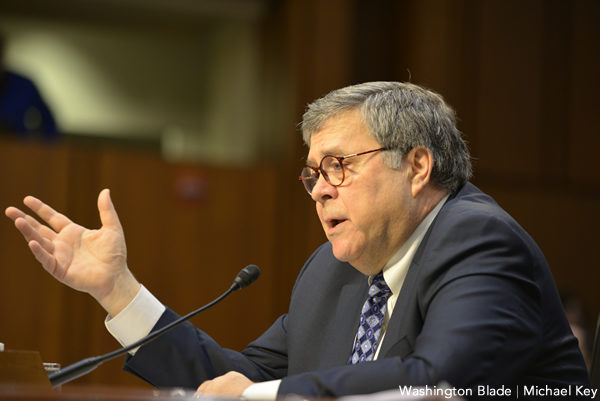
William Barr, President Trump’s pick to become the next attorney general, held his cards close to the vest on LGBT issues Tuesday during his confirmation hearing, but hinted upon confirmation he’d pursue the anti-LGBT policies of his predecessor Jeff Sessions.
The answers from Barr suggest he’d continue to uphold the Justice Department’s view that LGBT people aren’t protected under Title VII of the Civil Rights of 1964, which bars sex discrimination in the workforce. Additionally, Barr suggested he’d uphold religious freedom even at the expense of anti-LGBT discrimination.
In his opening statement before the Senate Judiciary Committee, Barr recognized the increasing number of hate crimes in the United States, including LGBT people, and pledged to address them under the Matthew Shepard & James Byrd Hate Crimes Prevention Act of 2009.
“We can only survive and thrive as a nation if we are mutually tolerant of each other’s differences, whether they be differences based on race, ethnicity, religion, sexual orientation or political thinking,” Barr said. “And yet, we see some people violently attacking others simply because of their differences. We must have zero tolerance for such crimes, and I will make this a priority as attorney general if confirmed.”
But under questioning on LGBT issues from Sens. Cory Booker (D-N.J.) and Mazie Hirono (D-Hawaii), Barr indicated enforcement of the hate crimes law would likely be the extent of his pro-LGBT advocacy at the Justice Department.
Booker initiated the questioning on LGBT issues by referencing a 1995 article Barr wrote for a conservative Catholic publication that laments growing acceptance of the LGBT movement compared to religious communities.
Asserting the 1995 article demonstrated a view being LGBT was immoral, Booker asked Barr whether he still holds those views, Barr replied “no,” but disputed the article conveyed anti-LGBT views.
After Booker insisted he was quoting the actual language, Barr said he’d inform the committee about his views. Barr reflected on the U.S. Supreme Court’s 2015 ruling for same-sex marriage.
“If I had been voting on it at the time — my view is that under the law, under the Constitution, as I originally conceived it before it was decided by the Supreme Court, marriage was to be regulated by the states, and if it was brought to me, I would have favored martial unions, single-sex,” Barr said.
When Booker interjected he was questioning Barr about his views in the 1995 article and whether the LGBT movement is immoral, Barr expressed a need for tolerance.
“In a pluralistic society like ours, there has be to a live-and-let-live attitude, and mutual tolerance, which has to be a two-way street,” Barr said. “My concern, and the rest of the article addresses this, is I am perfectly fine with the law as it is, for example, with gay marriage, perfectly fine, but I want accommodation for religion.”
When the New Jersey Democrat interjected LGBT youth are disproportionately bullied at schools, Barr interrupted to recognize anti-LGBT hate crimes. Booker acknowledged that before adding many LGBT youth report they are missing school because of fear of being bullied and are disproportionately homeless.
Booker asked Barr whether he thinks laws “designed to protect LGBT individuals from discrimination contribute to what you describe as a breakdown for traditional morality.”
Barr replied “no,” but added, “I also believe there has to be accommodation to religious communities.”
Booker acknowledged, “You and I believe in freedom of religion,” but shifted the focus to anti-gay workplace discrimination. Barr replied, “I think’s that wrong.”
When Booker asked whether that means the Justice Department should protect LGBT kids from harassment and hate crimes and pursue efforts to protect the civil rights of LGBT Americans, Barr replied. “I support that.”
Referencing his opening statement, Barr said, “As I said in the beginning, I’m very concerned about the increase in hate crimes.”
But when Booker asked Barr if he sees a role for the Justice Department in banning anti-LGBT discrimination, the nominee had a different take. Barr replied, “If Congress passes such a law.”
Barr then referenced the petitions currently before the U.S. Supreme Court seeking clarification on whether Title VII of the Civil Rights Act, which bars discrimination on the basis of sex in the workplace, applies to cases of anti-LGBT discrimination.
“I think the litigation going on now on Title VII is what the the 1964 act actually contemplated, but personally, I think —,” Barr said.
Before Barr could finish and venture an opinion on Title VII, Booker interrupted and asked to verify whether lawmakers contemplated including LGBT people in Title VII. Barr rejected that idea, saying “no.”
“I think it was male-female that they were talking about when they said sex in the ’64 act,” Barr added.
Booker then interjected again by conflating anti-LGBT discrimination with sexual harassment: “So protecting someone’s basic rights to be free from discrimination because of sexual harassment is not something the Department of Justice should be protecting?”
Playing with one of the many U.S. Senate coasters before him on the witness stand, Barr insisted the onus is on Congress to make the law.
“I’m saying Congress passes the law, the Justice Department enforces the law,” Barr said. “I think the ’64 act on its face — and this is what is being litigated, what does it cover? I think for like three or four decades, the LGBT community has been trying to amend the law.”
Booker interrupted again before Barr could finish, saying the Obama administration’s Justice Department “was working to protect LGBT kids from discrimination.” (The Justice Department in the Obama years asserted anti-trans discrimination was illegal under Title VII, but took no position with respect to the law on anti-gay discrimination despite pleas from LGBT rights supporters.)
When Booker asked if Barr would pursue the Obama administration practices, Barr replied, “I don’t know what you’re referring to.”
“I’m against discrimination against anyone because of some status, their gender or their sexual orientation or whatever,” Barr continued.
Hirono picked up where Booker left off, asking Barr directly about the Justice Department’s friend-of-the-court brief before the U.S. Second Circuit Court of Appeals arguing anti-gay discrimination isn’t covered under Title VII. As Hirono noted, both the Second Circuit and the Seventh Circuit have “rejected the department’s argument” about the law.
The Hawaii Democrat asked Barr if he’d appeal those decisions to the U.S. Supreme Court. In response, Barr seemingly referenced the petitions before justices, noting, “I think it is going up to the Supreme Court.”
When Hirono asked if DOJ will continue to argue Title VII doesn’t bar anti-gay discrimination, Barr initially declined to answer directly.
“It’s pending litigation and I haven’t gotten in to review the department’s litigation position, but the matter will be decided by the Supreme Court,” Barr said.
Hirono responded: “That sounds like a ‘yes’ to me. The department will continue to push the argument that has been rejected.”
At this point, Barr tipped his hand on his view Title VII doesn’t cover anti-gay discrimination.
“It’s not just the department’s argument,” Barr said. “It’s been sort of common understanding for almost 40 years.”
Asked by Hirono if discrimination is OK, Barr replied, “That’s not at all what I’m saying. I’m saying the question is the interpretation of the statute passed in 1964.”
“As I’ve already said, I personally, as a matter of my own personal feelings think there should be laws that prohibit discrimination against gay people,” Hirono said.
When Hirono asked Barr if he’d review the Justice Department’s position, Barr replied, “No. Because there’s a difference between law and policy.”
“I will enforce the laws as passed by Congress,” Barr said. “I’m not going to amend them. I’m not going to undercut them. I’m not going to try to work my way around them and evade them.
Hirono responded: “The DOJ doesn’t have to file an amicus brief either.”
The Hawaii Democrat wasn’t done on LGBT issues, asking Barr about an explosive report in the New York Times asserting the Department of Health & Human Services was preparing a rule to define transgender people out of existence under Title IX of the Education Amendment of 1972.
Asked by Hirono if he believes transgender people are protected from discrimination under Title IX, Barr dodged.
“I think that matter’s being litigated in the Supreme Court, too,” Barr said.
When Barr added he doesn’t know the Justice Department’s position on the issue, Hirono said she’d ask him to review the issue.
LGBT groups have raised concerns about Barr’s confirmation as attorney general, asserting he lacks a commitment to protecting civil rights. (One longtime gay friend of Barr’s, however, former Time Warner general counsel Paul Cappuccio, has defended the nominee, telling the Blade, “He’s not going to ever let people be discriminated against, OK?”)
Jon Davidson, chief counsel of Freedom for All Americans, said Barr’s testimony “did little to assuage those concerns” of LGBT rights groups.
“While he testified he is “fine” with “gay marriage,” his comments that there “has to be accommodation to religion” — something not required or even permitted for other people’s marriages — is very disturbing,” Davidson said.
Davidson also raised concerns about Barr’s response on whether Title VII should cover anti-gay discrimination.
“In addition, although he said he thinks firing someone based on their sexual orientation is ‘wrong,’ he refused to disagree with the anti-LGBTQ positions the Justice Department has been taking when it comes to Title VII and he erroneously asserted that Title VII should be limited to what Congress believed it was accomplishing in passing the Civil Rights Act of 1964,” Davidson said. “That position has already been rejected several times by the Supreme Court, which has said that what Congress had in mind at the time is not controlling.
Ultimately, Davidson had a dismal forecast for Barr’s stewardship of the Justice Department.
“It appears that he intends to carry forward the positions of former Attorney General Jeff Sessions, which have consistently opposed equal rights for LGBTQ people,” Davidson said.
Sharon McGowan, chief strategy officer for Lambda Legal, also said Barr’s testimony didn’t allay her concerns.
“I think he said absolutely nothing to alleviate any of the concerns that we have based on his record, and if anything, his comments only demonstrate that he is exactly what his record suggests that he is, which is someone who will not be a champion for civil rights generally or LGBT equality specifically,” McGowan said.
Barr’s confirmation hearing took place as the Justice Department is defending President Trump’s transgender military ban in court and has called on the U.S. Supreme Court to intervene. Barr didn’t address the policy, nor did any member of the Senate Judiciary Committee inquire about Barr’s view on the issue.