Nearly three quarters of American adults oppose businesses refusing to serve gay men and lesbians based on the owner’s religious beliefs.According to a Reuters/Ipsos opinion poll released Monday, 72 percent of respondents said that businesses whose owners are opposed to LGBT rights based on their religious beliefs should not be allowed to refuse to serve gay and bisexual men and lesbians.
The poll was released on the same day that the Supreme Court sided with a Colorado baker who refused to bake a wedding cake for a gay couple. The high court’s ruling was narrow in scope and appeared to only apply to this case.
Pollsters found that 14 percent of respondents believe that business owners, because of their religious beliefs, have the right to refuse service based on sexual orientation. Nine percent said the right existed in “certain circumstances,” while 6 percent said they do not know.
The poll also found a majority of Americans (53%) support extending marriage rights to gay couples, up 11 percent from a 2013 Reuters/Ipsos poll.
The Supreme Court today reaffirmed the core principle that businesses open to the public must be open to all in Masterpiece Cakeshop v. Colorado Civil Rights Commission. The court did not accept arguments that would have turned back the clock on equality by making our basic civil rights protections unenforceable, but reversed this case based on concerns specific to the facts here. The American Civil Liberties Union argued the case on behalf of Charlie Craig and David Mullins, who were refused service at a Colorado bakery because they are a same-sex couple.
In 2012, Mullins and Craig visited the Masterpiece Cakeshop to order a cake for their wedding. After the bakery turned the would-be customers away because they were a same-sex couple, Mullins and Craig filed a complaint with the Colorado Civil Rights Commission. The commission found that the bakery had discriminated against the couple in violation of Colorado law, a decision the Colorado courts upheld. The Supreme Court today found that members of the Commission had made statements evidencing anti-religious bias, and thus had not given a fair consideration to the bakery’s claims.
“The court reversed the Masterpiece Cakeshop decision based on concerns unique to the case but reaffirmed its longstanding rule that states can prevent the harms of discrimination in the marketplace, including against LGBT people.” said Louise Melling, deputy legal director of the ACLU.
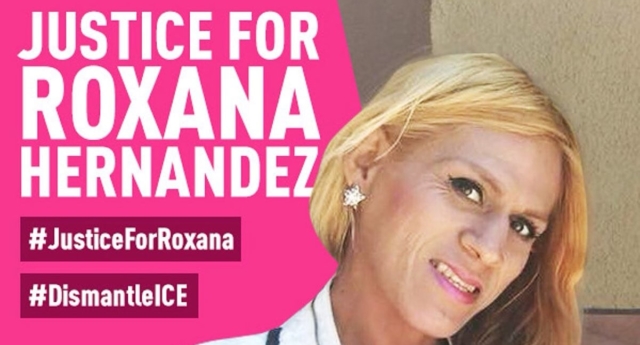
A trans woman has died in US custody, with migrant groups blaming the death on the “medical negligence” on the part of American authorities – and accusing them of “institutional murder.”
Roxana Hernández, 33, died in the custody of US Immigration and Customs Enforcement (ICE) at the Lovelace Medical Center in Albuquerque, New Mexico.
She had been seeking asylum at the San Ysidro port of entry on the US border earlier this month, when she was detained in ICE custody on 13 May.
Hernández, known simply as Roxy, had travelled to the American border as part of a ‘refugee caravan’ – a group of more than 1,300 people – organised by immigration support group Pueblo Sin Fronteras.
In a statement announcing Hernández’s death, ICE said that she had been admitted to hospital on 17 May with symptoms of pneumonia, dehydration and complications associated with HIV.
The US body said that medical staff identified the “preliminary cause of death” as cardiac arrest.
The statement also said that Hernández had entered the US illegally three times since 2005 – but was arrested and removed on her last attempt to stay in the country in 2014.
But a statement released by Pueblo Sin Fronteras, alongside other migrant groups Al Otro Lado and Diversidad Sin Fronteras, disputed ICE’s version of events and described the death as “institutional murder.”
“Roxy died due to medical negligence by US immigration authorities. In other words, she was murdered, much like Claudia Gómez González was murdered by a Border Patrol agent’s bullet less than a week ago,” it reads.
“Roxy died in the country she had sought to start a new life in, she died for being a transgender woman, a migrant who was treated neither with respect nor with dignity.”
The groups added that, in ICE custody, Hernández suffered from “cold, lack of adequate food or medical care, with the lights on 24 hours a day, under lock & key.”
“During her first week in the United States Roxy’s body and spirit quickly deteriorated,” their statement says.
Nino Starr was murdered in the US earlier this month. (Nino Starr/Facebook)
Hernández had been fleeing violence and discrimination she faced because of being transgender in her home country of Honduras.
She told Buzzfeed News last month about an attack in Honduras when a group of gang members shouted at her “we don’t want you in this neighborhood, you fucking faggot,” before gang-raping her.
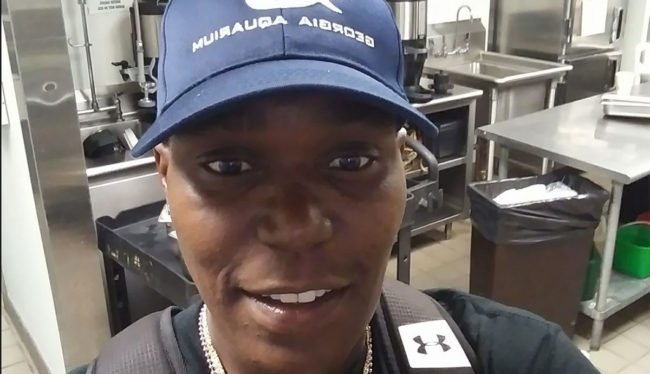
Earlier this month, a transgender person was shot and killed in Georgia.
Nino Fortson was shot multiple times following an argument in Atlanta, Georgia during the early hours of May 13.
Get ready for the rainbows. June is LGBTQ Pride Month, which means Americans around the country should expect some colorful marches throughout the month as people make a stand for equality.
In recent years, the month has been marked by celebration — over the US Supreme Court’s decision to legalize same-sex marriage nationwide, as well as some of the other progress made in LGBTQ rights in broader American politics and culture.
This year, Pride celebrations fall in a markedly different atmosphere. Although LGBTQ advocates have seen big gains in recent years, the election of President Donald Trump and state-level initiatives against LGBTQ rights — from Trump’s ban on transgender people serving in the military to bills in North Carolina and Texas to stop trans people from using the bathroom that aligns with their gender identity — have shown just how fragile these gains can be.
The less friendly political climate, however, is in line with the original Pride marches, which were often protests — not celebrations — in response to the violence and brutality that LGBTQ people faced at the hands of their fellow Americans, police, and the government. It speaks to the mixed nature of LGBTQ Pride Month: It’s a time to celebrate a person’s true identity, but it’s also a time to stake some ground in the ongoing political and cultural battles for equality.
Pride celebrations began to commemorate a pro-LGBTQ uprising
The first march came at a time when Americans were considerably less accepting of LGBTQ people. Back in the 1970s, Gallup found Americans were evenly split on whether homosexuality should be legal in the first place.
That first march, back when the events were known as Gay Pride Marches, took place in New York City in 1970 in commemoration of the Stonewall Riots.
Through the 1960s, it was fairly common for police to raid gay- and trans-friendly bars. But in June 1969, LGBTQ patrons at the Stonewall Inn in New York City decided they had enough and refused to cooperate with police. When police tried to arrest and allegedly mistreated the bar’s customers and employees (including trans women of color), four nights of rioting commenced. Police and protesters were injured, and dozens were arrested.
“Police brutality (particularly NYPD raids of gay bars, nightclubs, and bathhouses) had been documented in New York City since the beginning of the century,” Kevin Nadal, executive director at the Center for Lesbian and Gay Studies, previously wrote in an email. “So, by 1969, LGBT people were quite fed up with this unfairness and decided to fight back.”
A year after the riots, the Christopher Street Liberation Day Umbrella Committee held the first Pride March.
LGBTQ advocates show their support on the anniversary of the Stonewall Riots.New York Daily News via Getty Images
Fred Sargeant, one of the original organizers of the march, recalled his experiences in the Village Voice. The idea, Sargeant explained, was to commemorate the Stonewall Riots and move away from a conservatism that had mired LGBTQ organizations, such as the Mattachine Societies, that led the movement at the time.
“Before Stonewall, gay leaders had primarily promoted silent vigils and polite pickets, such as the ‘Annual Reminder’ in Philadelphia,” Sargeant wrote. “Since 1965, a small, polite group of gays and lesbians had been picketing outside Liberty Hall. The walk would occur in silence. Required dress on men was jackets and ties; for women, only dresses. We were supposed to be unthreatening.”
Sargeant pointed to one particular situation that inspired him and his partner, Craig Rodwell, to do away with the careful approach: “When Craig returned from Philadelphia [from the 1969 Reminder], he was blistering over an incident: Washington Mattachine’s Frank Kameny told two women holding hands that there would be ‘none of that’ and broke them apart. This physical act confirmed for Craig that we needed something much bigger and bolder than the Mattachine Society.”
Breaking through that conservatism, however, proved to be difficult. The Christopher Street Liberation Day Umbrella Committee had to negotiate with a dozen small LGBTQ organizations to give everyone a seat at the table, and the committee had to leverage the mailing list Sargeant and Rodwell had built up after they opened one of the nation’s first gay bookstores.
Sargeant recalled the first march as much more of a protest than a celebration. There were thousands of people, but there were no floats, music, or scantily dressed men. Marchers instead carried signs, chanted, and waved to reportedly surprised onlookers.
Nadal said the first march showed society that LGBTQ communities existed and included family members, friends, and neighbors. And it helped encourage other members of the LGBTQ communities to come out and be proud of who they are.
Pride celebrations spread over time
The knowledge and outrage of the Stonewall Riots gave LGBTQ advocates the momentum necessary to turn their cause into a true nationwide movement.
“Before Pride and Stonewall, there really wasn’t a comprehensive LGBT movement,” Nadal wrote. “Stonewall really was the first time that demonstrated that protesting and rioting and fighting back actually worked for the LGBT community.”
Indiana University sociologists Elizabeth Armstrong and Suzanna Crage explained that the reaction to the police raid at Stonewall Inn — the riots — resonated with LGBTQ people. After centuries of oppression, they understood why people would feel the need to react violently to yet another sign of discrimination and oppression. The Stonewall Riots, in other words, came at an exact moment in which social dissatisfaction and other political elements converged to push forward a larger LGBTQ movement.
It took just a few years for the movement to spread across the country. On the same year of the first Pride March in New York City, marches also took place in Los Angeles and Chicago. The next year, Dallas, Boston, Milwaukee, and San Jose took part. By 1972, participating locations included Ann Arbor, Atlanta, Buffalo, Detroit, the District of Columbia, Miami, and Philadelphia.
As Kameny later described, “By the time of Stonewall, we had 50 to 60 gay groups in the country. A year later there was at least 1500. By two years later, to the extent that a count could be made, it was 2500.”
Since then, the LGBTQ movement has grown even further. At first, LGBTQ Pride was typically celebrated on the last Sunday of June as Gay Pride Day or Christopher Street Gay Liberation Day. Over time, that day grew to a month of events for all LGBTQ people.
LGBTQ Pride Month is now a mix of celebration, protest, and political activism
LGBTQ Pride Marches in the US have become much more celebratory in nature over the decades, with more attendees, participants, and organizations taking part each year in the events.
There’s good reason for the positive outlook: While Americans were divided on the legality of homosexuality in the 1970s, a solid majority now support same-sex marriages, and marriage equality is legal across the US following a Supreme Court decision.
Those victories, however, have been met with a backlash in recent years. In 2016, North Carolina passed an anti-LGBTQ law that banned transgender people from using the bathroom that aligns with their gender identity and prohibited local ordinances that protect LGBTQ people from discrimination — a law that was only partially repealed after the state’s Republican governor was voted out of office later in the year. Several states, including Texas, have proposed, but not passed, similar measures.
The election of Trump and a Republican-dominated Congress have also highlighted the potential dangers that a mere change in government can present for LGBTQ rights. The Trump administration has taken all kinds of anti-LGBTQ — and particularly anti-trans — actions, from trying to ban trans people from the military to rescinding Obama-era memos that protected trans workers and students from discrimination.
But the political activism of Pride isn’t just about Trump. Even before Trump, the US has by and large turned a blind eye to discrimination against LGBTQ people: It’s not explicitly illegal in most states to discriminate against LGBTQ people in the workplace, housing, public accommodations, and schools. This means that a person can be fired from a job, evicted from a home, kicked out of a business, or denied the correct bathroom facility just because an employer, landlord, business owner, or school principal doesn’t approve of the person’s sexual orientation or gender identity.
“We don’t have full equality throughout the nation,” Jim Williams, who worked with New York City Pride, previously told me. “Although we’re very pleased with the progress that’s been made, there’s still a lot of work to be done.”
In New York City, there are also huge historical overtones going back to the Stonewall Riots. New York City Pride, after all, arguably represents the birthplace of the world’s modern LGBTQ rights movement. That’s why march organizers closely follow the advice of the Stonewall 50 Committee, a group that is working toward commemorating the 50th anniversary of the Stonewall Riots, to stay true to Pride’s original intent.
The celebration of LGBTQ Pride has also spread to many more events than just a march. New York City’s Pride group, for instance, plans to host a public rally, a street fair, and even a family movie night.
Participants “need an opportunity and a place to celebrate, to play, to feel comfortable, to dress how they want to dress, to march with their friends,” Williams said. “There’s something very empowering about walking down New York City streets with crowds of people cheering you on.”
LGBTQ Pride Marches are also international, including in countries where the public remains much less supportive of LGBTQ people. In those places, the marches still act as one of the very few ways advocates can show their solidarity and support.
If you want to participate in one of the biggest LGBTQ pride events of the year, check the list for New York City, San Francisco, Montreal, London, Sydney, Berlin, Madrid, Amsterdam, Tel Aviv, Sao Paulo, and Buenos Aires. It can be a lot of fun!
The new face of Planned Parenthood is unafraid of the current climate of hyper-conservative populism. If anything, Dawn Laguens is optimistic about the chronically besieged organization’s future.
“Planned Parenthood is happy, though, to be taking on the fight, and to be standing up against some of these outrageous attacks that we see both at the federal and state level,” Languages said in an interview with The Advocate.
The longtime VEO and president of Planned Parenthood, Cecile Richards, stepping down in January, Laguens, the executive vice president and chief brand officer, has assumed the role of acting spokesperson.
Laguens, who identifies as a “member of the gay community,” according to The Advocate, is quick to emphasize the inclusivity of Planned Parenthood, especially in regards to the LGBT community and HIV/AIDS treatment. “A really exciting thing we’re doing is offering PrEP in 44 of our states, in terms of AIDS prevention work,” she said of the HIV prevention treatment. “We now offer hormone therapy for our trans patients in 20 states and counting. And, as we have always done, we offer nonjudgmental, welcoming care, knowledgeable care for LGBTQ young people, all throughout their life.”
As an organization founded for reproductive justice, Planned Parenthood has long retained elements of its female-oriented origins. The tax-exempt corporation has taken some flak over its pink marketing, with some on the left arguing it reinforces gender stereotypes.
Laguens points to evidence that contradicts accusations of exclusivity. A recent survey indicated that 20 percent of patients identified as LGBTQ. Planned Parenthood recently rolled out an updated gender-neutral website to reflect the diverse services it offers to male-bodied and female-bodied individuals, both trans and cisgendered.
“A lot of people don’t know how many folks we serve in the LGBTQ community, but also don’t understand that we offer a wide range of services for men,” Laguens said.
Despite public perception, 12 percent of Planned Parenthood’s patients are men who take advantage of STI testing and treatment, vasectomies, and “a full range of sexual and reproductive health care,” according to Laguens.
In the era of #MeToo and #TimesUp, Laguens sees Planned Parenthood at the forefront of the renewed dialogue about agency over one’s body. While #MeToo has been driven by revelations of predatory behavior on the part of individual men, Planned Parenthood has long fought the systemic violation of physical autonomy committed by governmental and judicial forces. To Laguens, there is a direct connection between the two.
“So many people are getting the connection that it’s not like #MeToo and #TimesUp over on this side of the equation, and then [on the other side] there’s whether the government will allow you to have birth control, or access to abortion, or access to honest, accurate information in sex education – it’s all connected, because again it’s all about how do you be equal, and how do you be free?”
Planned Parenthood has withstood over 100 years of attacks, but the day it ceases to draw political ire – the day when we accept complete autonomy for women and LGBTQ folks – is the day it outlives its founding charter. Until then, Laguens is confident in the organization’s strategy: Continue helping people.
“Planned Parenthood is making a difference every day in the lives of people you know, allowing them to have control of their body, to have a shot at their dreams, to be able to complete their education, and of course to participate economically. So Planned Parenthood is actually the solution, not the problem in this country.”
Last year Trump broke with tradition and declined to issue a Pride Month proclamation although he did find time to proclaim Great Outdoors Month, National Caribbean-American Heritage Month, African-American Music Appreciation Month, National Ocean Month, and National Homeownership Month. We expect the same for 2018.
Here’s this year’s message from the Democrats:
“Pride Month is an opportunity to celebrate the vast contributions LGBTQ Americans have made to our society, to honor the generations of leaders and activists who have fought for equality, and to rededicate ourselves to the work that remains.
“We see the impact of LGBTQ Americans throughout our history. We see it in the hope of Harvey Milk and the trailblazing work of Pauli Murray. We see it in the courageous leadership of Bayard Rustin and the pioneering career of Sally Ride. We see it in the brilliant performances of Laverne Cox, the athletic dominance of Abby Wambach, and the indomitable spirit of the late Edie Windsor.
“Under President Obama, our nation continued its long march toward LGBTQ equality. We ended Don’t Ask Don’t Tell and we fought for transgender equality in schools, military service, health care, and public accommodations. Today, hospitals receiving Medicare or Medicaid funds must extend visitation rights to LGBTQ patients. Across the country, violence against LGBTQ individuals can now be prosecuted as federal hate crimes. And of course, marriage equality is now the law of the land.
“We’ve made incredible progress for LGBTQ rights, and we’ve seen LGBTQ candidates achieve historic victories up and down the ballot. But LGBTQ Americans still face hurdles to equality across our society – from bathrooms to bakeries to the ballot box. Every day, Republicans in Congress, the White House, and at the state and local level are trying to turn back the clock on LGBTQ rights.
“The Democratic Party stands with LGBTQ communities in America and around the world. We believe that no one should face discrimination, bullying, or violence because of who they are or who they love. And we will never stop fighting for the equality every human being deserves.”
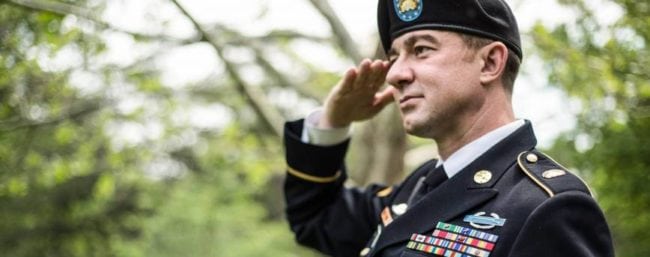
A US Army sergeant who served in Afghanistan and Kuwait is suing the Pentagon’s policies that effectively ban soldiers serving with HIV.
Sergeant Nick Harrison, who serves in the D.C. Army National Guard, says he was denied the opportunity to serve as an officer and faces possible discharge from the United States armed services because he is living with HIV.
The soldier, a veteran of two wars, says he was denied a position in the Judge Advocate General (JAG) Corps – because current Pentagon policy considers service members living with HIV “non-deployable”, and will not allow them to enlist.
Campaigners say the archaic policy does not take account of the fact that people living with HIV who are taking medication cannot pass on the virus and do not pose any risk to others if their viral load is being managed correctly.
Under a policy enacted earlier this year, service members who are considered “non-deployable” for more than 12 consecutive months are targeted with discharge from the service, which activists believe could result in HIV-positive service personnel being discharged.
Sergeant Nick Harrison (Courtesy Lambda Legal)
Lambda Legal and OutServe-SLDN filed the lawsuit in the US District Court for the Eastern District of Virginia on behalf of Sgt. Harrison.
Trump’s Secretary of Defense Jim Mattis is named in the lawsuit.
He said: “After serving in Afghanistan and Kuwait, I knew I wanted to become an officer in the U.S. Army and a leader for all of the great men and women in our armed forces.
“I spent years acquiring the training and skills to serve my country as a lawyer. This should be a no-brainer. It’s frustrating to be turned away by the country I have served since I was 23-years-old, especially because my HIV has no effect on my service.
“It was an honour to be chosen to join the JAG Corps for the DC National Guard, and I look forward to my first day on the job.”
A second lawsuit from Lambda Legal and OutServe-SLDN represents an anonymous service member living with HIV who was denied a commission in the Air Force despite advice from medical personnel.
Scott Schoettes, Counsel and HIV Project Director at Lambda Legal said: “Nick’s situation is the perfect example of just how archaic and harmful the military policies regarding people living with HIV really are.
“These oppressive restrictions are based on antiquated science that reinforces stigma and denies perfectly qualified service members the full ability to serve their country.”
“The Pentagon needs to catch up with the 21st Century. Recruitment, retention, deployment and commissioning should be based on a candidate’s qualifications to serve, not unfounded fears about HIV.
“The U.S. Department of Defense is one of the largest employers in the world, and like other employers, is not allowed to discriminate against people living with HIV for no good reason.”
Carlos del Rio, MD, professor of global health and medicine at Emory University and Co-Director of the Emory Center for AIDS Research, said: “Living with HIV today is much different than it was 25 years ago.
“Today, with appropriate treatment, there is no reason a person living with HIV shouldn’t be able to serve in any capacity in the military.”
Peter Perkowski, Legal Director of OutServe-SLDN said: “Nick has every quality Americans want in a member of our armed services: dedication, intelligence, and a burning desire to serve his country.
“The military has spent thousands of dollars training Nick to be a soldier, a lawyer, and a leader – now they are turning their backs on him.”
“The Air Force likewise spent tens of thousands educating Voe at one of the premier military academies in the country, yet then sent him packing.
“What happened to them could happen to any service member with HIV, especially given the DoD’s recent ‘Deploy or Get Out’ policy.
“It is time for the DoD to come out of the dark ages, update its HIV policies and revise its thinking on the deploy or get out mentality.”
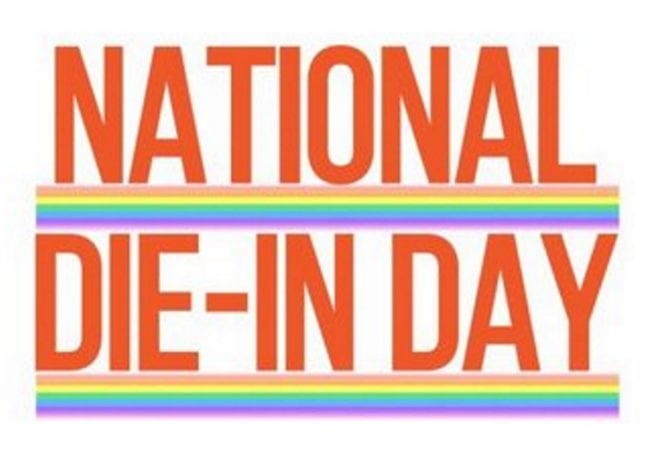
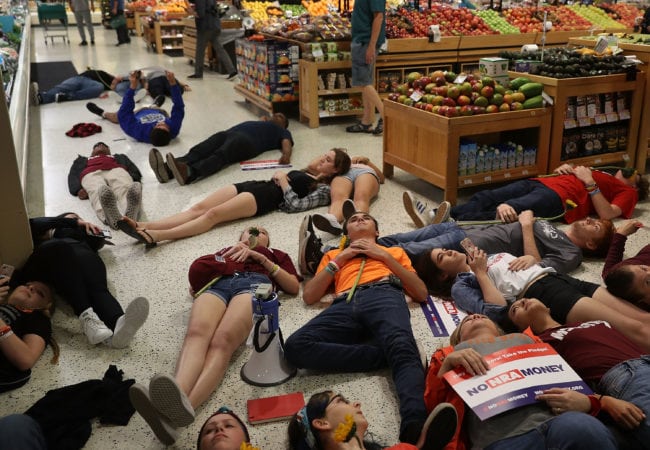
Activists are organising a dramatic die-in to commemorate the second anniversary of the Pulse massacre.
A total of 49 people were killed at Orlando’s Pulse gay club during the horrific mass shooting in June 2016 when gunman Omar Mateen, who had pledged support for ISIS, opened fire on the crowd.
At the time it was the deadliest mass shooting in recent US history, though it has since been surpassed.
The National Die-In will take place in Washington DC, at the National Mall, on June 12 – and with the help of Parkland survivors, organisers hope to attract as many as 100,000 participants.
One of the event’s founders, Orlando campaigner Amanda Fugleberg, lives 15 minutes from the site of the shooting. She said that the massacre had deeply shaken her.
(nationaldiein/twitter)
“It was the first news I saw when I woke up that day and I remember the death toll just rising,” she told Advocate.
“It brought me to tears to know something like that happened so close.”
The die-in will last for 12 minutes, with each of the 720 seconds representing a victim who has died in a mass shooting since the Pulse massacre.
She said that Hogg, who recently led a successful die-in campaign against Publix over its support of a National Rifle Association-backed candidate for Governor, had expressed strong support for the event.
Fugleberg, who is arranging the die-in with fellow activist Frank Kravchuk, started planning it less than two weeks ago, in conjunction with a march on June 11 in Orlando led by Pulse survivor Brandon Wolf.
In the space of 10 days, the campaign has attracted more than 1,000 followers on Twitter, with attention on the event expected to ramp up in the coming days.
n terms of where she stands on gun control, Fugleberg said: “I’d like to see universal background checks, which right now are not great considering the Pulse shooter was able to acquire guns when he’d been on an FBI watch list.”
A Denver gay couple was stabbed multiple times because they were holding hands.
Gabriel Roman and his boyfriend Christopher Huizar were enjoying a night out with friends when they were approached by a man yelling homophobic slurs at them just after midnight on Sunday, they claim.
In a matter of seconds, the man repeatedly stabbed both men as they tried to to run to safety. They were left with serious injuries. Huizar thinks the attack was triggered by the fact he and Roman were holding hands.
“There was blood everywhere, like so much blood,” he said.
According to Fox31, the pair were only a few blocks from home when a man addressed them with homophobic slurs, before running after them with his weapon.
“I remember him pulling me back and I think that’s when I got stabbed in my back,” recalled Roman.
Roman suffered deep stab wounds in his back and hand, while Huizar was stabbed in the throat.
“We’re running and I didn’t realise how bad it was until he’s like, ‘My hand!’ and that’s when I took my shirt off and I wrapped it around and there was blood everywhere, like so much blood,” said Huizar.
In the moment, the pair feared for both their lives.
“I’m thinking like, my boyfriend is going to die,” Huizar added.
The two finally managed to escape and collapsed in a 7/11 parking lot. Bystanders attended to their wounds and contacted 911.
Their attacker was eventually caught by the Denver police. Although he was arrested, they are still investigating the charges.
For Roman and Huizar, the wound runs deeper than the scars. Being attacked in their neighbourhood forced them to look at their community in a new, scary light.
“It’s way deeper than just the physical damage,” said Roman. “Of course we’re relieved this guy is caught or whatever, but there’s still that fright […] who else is out there like that?”
“It’s not going to stop me from being who I am or showing affection to my significant other but I will definitely be more cautious,” Roman added.
“We are not letting his define us. We love each other and wouldn’t want this to happen to anyone [else]. I’m just thankful we’re alive,” Huizar told the Gay Star News.
Roman and Huizar believe the ordeal will make them stronger as a couple.
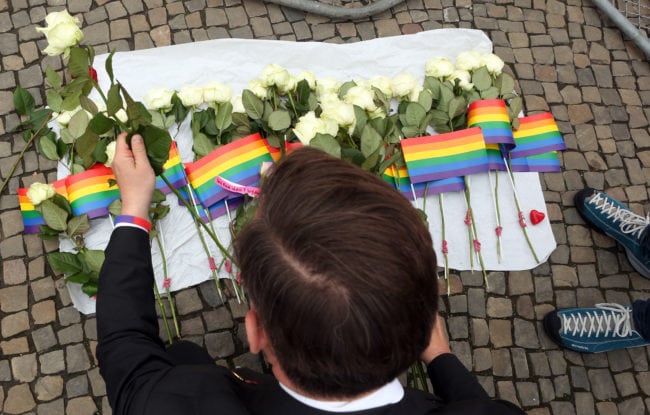
A visitor places flowers at a makeshift memorial during a vigil for victims of a shooting at a gay nightclub in Orlando, Florida the previous day, in front of the United States embassy on June 13, 2016 in Berlin, Germany. (Adam Berry/Getty)
Hate crimes like this one are on the rise in the US. A 2016 FBI report on hate crime statistics showed that while 6,121 hate crimes were reported that year, 1,076 were based on sexual orientation bias. This showed an increase of 2 percent from the 2015 numbers.
124 were based on gender identity bias, targeting trans or non binary individuals, a 9 percent increase from the 2015 numbers.
However, the report noted that these numbers only represented d a portion of the hate crimes that happened that year, as reporting them to the FBI is not compulsory.
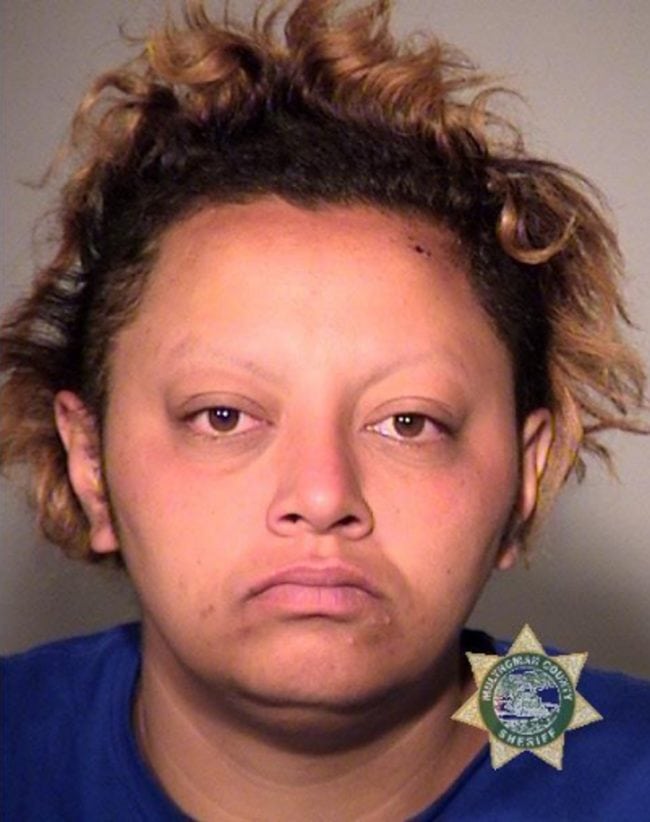
Sophia Grace Adler, 33, was arrested at the scene in downtown Portland and later charged with murder.
Sophia Adler (Multnomah County Jail)
She pleaded not guilty in court on Tuesday.
Pierce, from Boise in Idaho, was found lying wounded on the side of the street by emergency staff, but died within minutes of them getting to her, according to local TV channel KATU.
Those who knew her on the street have said that Pierce made it her mission to protect other homeless women.
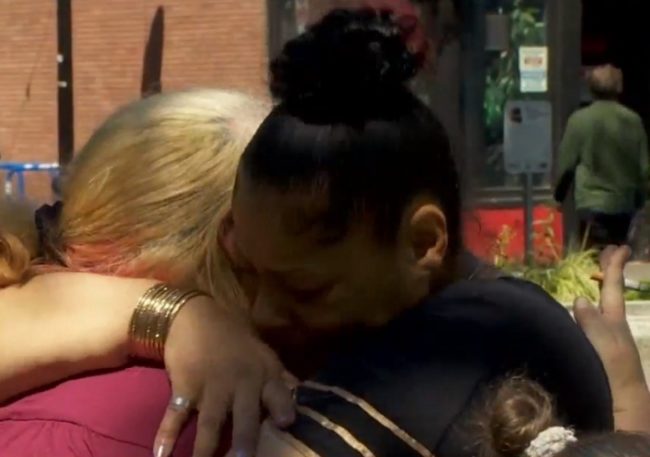
Amber, a friend of Pierce, said she was present when the shooting happened.
“She died in my arms,” she said.
Amber is comforted (KATU)
“I heard Gigi say: ‘Don’t touch me,’” added Amber. “And the woman came up and hit Gigi in the face with her purse.
“That kinda set Gigi off. Gigi went to hit her, pulled back to hit her, and the next thing I know my ear’s ringing.
“There had been a gunshot. It all happened so fast.
“It always does. It all happened so fast.”
Highline Collective Dot Matrix Camo Print Short Sleeved Polo
SHOP LORD & TAYLOR! FREE SHIPPING AT $99!
Ad by lordandtaylor.com
Sergeant Chris Burley of the Portland City Police backed up this account.
He said: “We do believe that prior to the shooting there had been some type of disagreement or disturbance that was going on that led up to the shooting.”
(HECTOR MATA/AFP/Getty)
Josie Deleon-Summa, who got to know both Pierce and her suspected killer, paid tribute to the victim.
“Gigi was the kind of person that was just full of life, always trying to help somebody,” said Deleon-Summa.
She added that if Adler did shoot her, it was out of character.
“Something happened last night to make her snap,” she said. “But she’s a good kid. Just misunderstood. I don’t know exactly what happened between the two.”

:format(webp)/cdn.vox-cdn.com/uploads/chorus_asset/file/11461087/gay_legality.png)
:format(webp)/cdn.vox-cdn.com/assets/4576733/97305140.jpg)
:format(webp)/cdn.vox-cdn.com/uploads/chorus_asset/file/11461119/marriage_polling.png)
:format(webp)/cdn.vox-cdn.com/assets/4576355/117376804.jpg)