For many years, the sight of Pearl Hart’s lavender Auburn car pulling up outside the courthouse struck fear into her opponents. Known for her uncompromising nature and fierce defense of those who could not defend themselves, Pearl Hart was not a lawyer prosecutors ever wanted to face.
She defended gay rights all her life, often without charging a fee. She was unpopular with the establishment, being, in the words of the Chicago LGBT Hall of Fame, “too liberal and too honest to ever win the backing of a corrupt and prejudiced political system.”Within the LGBTQ+ community, however, she was regarded as a heroine, a woman who would protect their rights at any cost, and the first lesbian lawyer to appear before the Supreme Court. Her name is still spoken with reverence in the lesbian bars of Chicago, and more publically, her name lives on in the city’s Gerber/Hart Library, which is devoted to LGBTQ+ books and archives.
Hart was born in Traverse City, Michigan in 1890 to Jewish immigrant parents, the fifth daughter of David and Rebecca Harchovsky. Her father was a rabbi who, soon after her birth, moved his family to Chicago, where he served a congregation on the southwest side. Hart herself would later say that this early exposure to poverty and her parents’ dedication to helping others formed the basis of her lifelong dedication to social justice. She recalled that she was a much-loved child, spoiled on occasion, who was encouraged in everything she did.
The young Pearl adopted the name Hart when she began her professional career. She found it easier and more convenient but never otherwise distanced herself from her origins as the child of immigrant parents, later vehemently arguing in the Supreme Court that “I defend the foreign born against the present deportation hysteria because of a consciousness that it was the foreign born and their children who built this nation of ours and who have been its most loyal partisans.”Hart trained as a stenographer before studying at John Marshall Law School and was admitted to the Illinois Bar in 1914, after which she became one of the first women to specialize in criminal law, serving as a probation officer from 1915 to 1917.
Soon afterward, she met Blossom Churan, the daughter of a law officer with whom Hart shared an office. The two entered a relationship, one which turned serious after the deaths of Churan’s father and Hart’s mother, from whom they were careful to conceal their connection. Hart never denied that she was a lesbian, but neither did she flaunt it, especially during her early years when she was fighting to establish her professional reputation.
Her five foot eleven, two hundred pound frame made her an imposing presence. She was described by journalist I.F. Stone as a “big benevolent Brunnhilde of a woman,”but only to those she supported. To those facing her across a courtroom, she was a terrifying spectacle, utterly ruthless and laser-focused behind her heavy-rimmed glasses. Hart dedicated herself to supporting and defending those who could not help themselves and became the first woman appointed as a public defender in the Morals court, which dealt with cases of prostitution, immoral or homosexual conduct, child abuse, and adultery. She achieved what her friend, journalist Studs Terkel, termed a remarkable acquittal record of over 90%.
By 1937, Hart was widely respected professionally and became a founding member and secretary of the National Lawyers Guild, which uniquely for the time was fully racially integrated. The 1940’s saw her become a fully-fledged civil rights activist serving on the board of the civil rights bail fund, which sought to legally challenge racial segregation and discrimination in matters such as housing and healthcare. She also founded the Midwest Association for the Protection of the Foreign Born, to protect those being threatened with deportation.
In her personal life, by 1947 Hart was proposing to live with Churan at 2821 North Pine Grove Avenue, in what was then the heart of gay Chicago. Churan, though, had taken as a lover the prominent physician Dr. Bertha Isaacs, and rather than separate, Hart proposed that they all live together, which they did in what Hart’s later lover Valerie Taylor called a “rather gothic existence”until Churan’s death.
All three women kept their lives compartmentalized and, in the words of Taylor, “Neighbors saw three aging women, two with successful careers, one who stayed at home. Out of town relatives or friends stayed at nearby hotels.”
Despite this, Hart was increasingly living openly as a lesbian, and from the 1960s onward, she focused on ensuring that the rights of the LGBTQ+ community were legally protected. The Lavender Scare, termed a “government witch hunt (to) expose closeted queers,” sought to expose LGBTQ+ individuals in order that they could be dismissed from the government, civil service and military. It greatly angered her. Ms. Hart became the go-to lawyer for the LGBTQ+ community, many of whom were subject to these entrapment police “stings.” She usually defended these cases for nothing or for only a minimal fee.
She also co-founded the Mattachine Society in the Midwest, which sought to ensure that LGBTQ+ individuals were aware of their legal rights and the protection that she and others could offer. The society also played a key role in bringing the plight of their members to wider attention, with one newsletterurging the people of Chicago to come “out of the closets and into the streets,”as Hart would protect them (the newsletter can be found dated May 1970 in the Pearl Hart Papers, Box 10 Folder 7).
She also consistently defended those caught up in the Red Scare, held without bail, and under threat of deportation. Most famously, she defended the Chicago men George Witkovich and James Keller, who were held for refusing to answer questions about their relationship with the Communist party at their deportation hearing. The case was ultimately heard by the Supreme Court on May 19, 1957. Hart won a hard-fought victory that meant that evidence of Communist Party affiliation could not be sought after a person was ordered to be deported. Such a public triumph on a national scale gave Hart a platform from which to campaign for LGBTQ+ rights on a grander level.
Hart became, for many, the public face of LGBTQ+ protection in Chicago and a champion of the underdog. Known as the “Guardian Angel of Chicago’s Gay Community,” she practiced law for over 60 years, prevented from becoming a judge by the establishment with which she remained consistently unpopular. She didn’t stop her crusade to make the world better and more equal until a short while before her death in 1975.
Today, her dog-eared photo still graces many a Chicago bar. In the words of the Chicago LGBT Hall of Fame – into which she was inducted posthumously in 1992 – she is remembered for her“inheritance,” which it defines as “the love and respect of thousands of men and women whom she helped, and a society somewhat better for her effort – which is all she wanted.”
The comprehensive report, based on The Trevor Project’s 2023 National Survey on the Mental Health of LGBTQ+ Young People, presents alarming statistics and underscores the need for targeted mental health support for this vulnerable group.
According to the findings, nearly one-third of LGBTQ+ young people identify as having a disability. These disabilities range from ADHD and learning disorders to physical and autoimmune conditions, with many respondents reporting multiple diagnoses. The data reveals that LGBTQ+ young people with disabilities experience significantly higher rates of depression, anxiety, and suicidal thoughts compared to their non-disabled LGBTQ+ peers.
The report highlights a concerning trend: Approximately 65 percent of LGBTQ+ young people with disabilities have faced discrimination due to their disability in the past year. This discrimination is closely linked to increased mental health issues. For instance, those who experienced such discrimination reported higher instances of depression and anxiety, as well as a marked increase in suicide attempts.
Another critical study finding is the positive impact of understanding and inclusive therapy. LGBTQ+ young people who felt their therapist understood their disability reported lower rates of suicide attempts. This underscores the importance of disability-informed mental health services.
The report also sheds light on demographic variations. Older LGBTQ+ individuals and those identifying as transgender, nonbinary, or multisexual reported higher rates of disability. Notably, specific groups, such as queer, asexual, and gender-diverse young people, also showed elevated rates of disability.
Additionally, the survey found the critical role of supportive environments in mitigating mental health risks for LGBTQ+ young people with disabilities. Participants who reported having access to affirming spaces, whether in schools, communities, or online, exhibited more resilience and lower levels of mental health distress. This suggests that fostering inclusive environments where LGBTQ+ youth with disabilities feel accepted and understood can significantly impact their mental well-being. It also highlights the necessity for policies and programs that not only address mental health concerns directly but also actively work towards creating safer, more inclusive spaces for these young individuals.
The Trevor Project’s study serves as a crucial call to action for improved mental health support and anti-discrimination efforts for LGBTQ+ young people with disabilities. The organization emphasizes the need for further research and intervention strategies to address these challenges effectively.
In response to these findings, The Trevor Project continues to advocate for comprehensive, accessible mental health services and increased awareness and support for LGBTQ+ youth with disabilities, according to a statement by the group. Through their crisis services team and targeted training programs, they aim to enhance understanding and provide vital resources for this particularly vulnerable community.
If you are having thoughts of suicide or are concerned that someone you know may be, resources are available to help. The 988 Suicide & Crisis Lifeline at 988 is for people of all ages and identities. The lifeline also provides resources to help with other crises, such as domestic violence situations. The Trevor Project Lifeline, for LGBTQ+ youth (ages 24 and younger), can be reached at (866) 488-7386. Users can also access chat services at TheTrevorProject.org/Help or text START to 678678.
LGBTQ+ Victory Fund, the only national organization dedicated to electing LGBTQ+ leaders to public office, endorsed 23 more out LGBTQ+ candidates. Victory Fund has now endorsed 260 candidates running in the 2023 cycle and 43 candidates running in the 2024 cycle.
2023 General Candidates
Damian Pardo (he/him)
Miami City Commission, District 2, FL
General: 11/7/2023
Jenna Yeakle (she/her)
Duluth City Council, At-Large, MN
General: 11/7/2023
Heather Rodenborg (she/her)
Delaware City School Board, OH
General: 11/7/2023
Jess Branas (she/her)
Upper Darby Town Council, District 2, PA
General: 11/7/2023
Khalilah Karim (she/her)
Durham City Council, At-Large, NC
General: 11/7/2023
2023 Unopposed Candidates
Andrea Ditillo (she/her)
Churchill Borough Council, At-Large, PA
General: 11/7/2023
2023 General Candidates
Sylvia Swayne (she/her)
Alabama House of Representatives, District 55
Runoff: 10/24/2023
Paul Sanchez (he/him)
South Salt Lake City Council, UT
General: 11/7/2023
Navarra Carr (she/her)
Port Angeles City Council, Position 6, WA
General: 11/7/2023
2024 General Candidates
Clarissa Cervantes (she/they)
California State Assembly, District 58
Primary: 3/5/2024
General: 11/5/2024
Jennifer Esteen (she/her)
Alameda County Board of Supervisors, District 4, CA
Primary: 3/5/2024
General: 11/5/2024
Ari Ruiz (he/him)
California State Assembly, District 52
Primary: 3/5/2024
General: 11/5/2024
Carlos Guillermo Smith (he/him)
Florida State Senate, District 17
Primary: 8/20/2024
General: 11/5/2024
Joe Saunders (he/him)
Florida House of Representatives, District 106
Primary: 8/20/2024
General: 11/5/2024
Malcolm Kenyatta (he/him)
Pennsylvania Auditor General
Primary: 4/23/2024
General: 11/5/2024
Dave Upthegrove (he/him)
Commissioner of Public Lands, WA
Primary: 8/6/2024
General: 11/5/2024
2024 Incumbent Candidates
Ravi Shah (he/him)
Tucson Unified School Board, At-Large, AZ
General: 11/7/2024
Terra Lawson-Remer (she/they)
San Diego County Board of Supervisors, District 3, CA
Primary: 3/5/2024
General: 11/5/2024
Michele Rayner (she/they)
Florida House of Representatives, District 62
Primary: 8/20/2024
General: 11/5/2024
Brandon Woodard (he/him)
Kansas House of Representatives, District 10B
Primary: 8/7/2024
General: 11/6/2024
Brian Knudsen (he/him)
Las Vegas City Council, Ward 1, NV
Primary: 6/11/2024
General: 11/5/2024
Charles Spain (he/him)
Court of Appeals Justice, Place 4, District 14, TX
A Laramie preacher has won a federal lawsuit against the University of Wyoming (UW). He had sued the university for infringing on his constitutionally protected free speech rights.
Last December, Laramie Faith Community Church Elder Todd Schmidt displayed an anti-trans banner in the UW student union, identifying an individual transgender student by name. The university banned him from tabling for one year, alleging that he was harassing the student.
Schmidt sued UW on First Amendment grounds. He won a preliminary injunction that has already let him return to the student union. Last week, both parties agreed to a judge’s order, bringing the case to a close. UW will also pay Schmidt $35,000 for attorney fees and expenses.
Schmidt’s presence on campus has stirred up other issues. A few days after he posted the sign, he received a trespass warning from police because he showed up in his car outside of a sorority that admitted a transgender student. In February, Schmidt told the Star-Tribune that he was in the area because he was making a DoorDash delivery there. He then rang the doorbell of the Kappa Kappa Gamma sorority house with the intention of having “a conversation” with sorority members. The University of Wyoming listed “multiple complaints,” as one of the reasons for the one year suspension, the lawsuit states.
In our nation, we must accept that we’re likely to hear and read things that are offensive to us — sometimes deeply offensive. I reiterate, and the working group acknowledges, that there are legal limitations to free expression on our campus.
But feeling uncomfortable or offended — and, in many cases, even feeling unsafe — is not, in and of itself, grounds for stopping speech.
We live during a time when political and social divisiveness seems to be tearing apart the very fabric of our society. We can’t let that happen. Nor can we depart from the principle of free expression that has been part of our nation’s foundation from the beginning.
The Christian anti-LGBTQ+ legal advocacy group Alliance Defending Freedom (ADF) — defined as a hate group by the Southern Poverty Law Center — is hoping the U.S. Supreme Court will overturn state bans on so-called conversion therapy for minors. Though the court hasn’t agreed to take on the case just yet, it provide insight into how ADF plans on challenging more conversion therapy bans in the future.
The ADF is providing legal counsel to licensed marriage and family counselor Brian Tingley in Tingley v. Ferguson, a legal challenge to Washington state’s ban. Tingley says the ban violates his rights to free speech and free exercise of religion, The New Republic reported.
Related:
Tingley’s petition to the court says that his speech as a therapist should be considered as “speech” and not professional “conduct.” He said he “lives in continuous fear of government persecution” because the ban “forbids him from speaking, treating his professional license as a license for government censorship.” Tingley says he should be able to offer conversion therapy — even though it has been widely disavowed as a form of psychological torture by numerous American mental health organizations — because some kids are actively seeking to change their sexual orientation.
Get the Daily Brief
The news you care about, reported on by the people who care about you:
His case may actually be aided by the 2018 Supreme Court decision National Institute of Family and Life Advocates v. Becerra which said that the government couldn’t “compel” or “regulate” anti-abortion crisis pregnancy centers in California to inform pregnant people about state-funded reproductive health services.
However, Georgia State University law professor Anthony Michael Kreis told the aforementioned publication that the cases are different. Bans on conversion therapy aren’t trying to force Tingley and other therapists to say things they don’t want to say, Kreis argues. Rather, he reasons, state bans are trying to prevent medical conduct from resulting in “tangible harms.”
A 2013 survey showed that 84% of former patients who tried ex-gay therapy said it inflicted lasting shame and emotional harm. Additionally, March 2022 peer-reviewed study from The Trevor Project showed that 13% of LGBTQ+ youth nationwide had reported being subjected to conversion therapy. Of those, 83% were subjected to it before reaching the age of 18. The study showed that young people who underwent conversion therapy were more than twice as likely to attempt suicide afterward. Numerous conversion therapy advocates have later come out as still gay and apologized for the harm that conversion therapy causes.
Furthermore, Kreis notes that the bans provide specific exemptions for “purely religious” speech and also that the government already heavily regulates the professional fields of therapy and healthcare. Thus, the bans are just an extension of that.
Katherine Franke, a law professor at Columbia University, said the ADF will use similar free speech arguments to try and overturn regulations involving professional conduct.
“We have all sorts of regulations for licensed mental health professionals, and the patients rely on this kind of safety that those licensing requirements impose,” she told The New Republic. “Opening the door in this kind of case… opens the door to quite a few other situations where a person may have an objection to what is a public norm or an expert judgment about the safety of other people. It shouldn’t be your private decision that you’re not going to agree with that and therefore [will] not follow that law, when that is a condition of your licensure.”
The methods of so-called conversion therapists include encouraging queer people not to masturbate, redirecting their sexual energy into exercise, “covert aversion” (a fancy name for imagining possible negative consequences of being queer), Bible study, directing same-sex sexual desire onto opposite-sex partners, inflicting pain and humiliation anytime LGBTQ+ feelings arise, and forcing people to act out stereotypical gender roles in behavior and personal appearance.
Twenty-nine U.S. states have either passed full or partial bans on conversion therapy for minors. In three of those states — Alabama, Georgia, and Florida — court injunctions have stopped the bans from going into effect while legal challenges to the bans proceed in court.
If you or someone you know is struggling or in crisis, help is available. Call or text 988 or chat at 988lifeline.org. The Trans Lifeline (1-877-565-8860) is staffed by trans people and will not contact law enforcement. The Trevor Project provides a safe, judgement-free place to talk for youth via chat, text (678-678), or phone (1-866-488-7386). Help is available at all three resources in English and Spanish.
Eddie Ashley was looking for a hookup. So like countless others on a Saturday night in New York City, he went to The Ritz, a gay bar in Manhattan’s Hell’s Kitchen neighborhood.
He drank too much, he said. And he did end up going home with someone — one of his victims.
Eighteen months later, Ashley, 30, was sentenced to nine years in state prison for robbing the man he left the bar with in May 2022, along with various other crimes he pleaded guilty to committing in recent years.
Authorities said Ashley and the victim went to the victim’s apartment several blocks north of the bar, and Ashley stole the man’s phone and wallet.
But this was not, prosecutors said, a one-off robbery among so many others across the city on any given night. The encounter was part of a broader crime ring in which authorities said at least 16 victims, many of them gay men, were targeted from September 2021 to August 2022 at bars and nightclubs, then often drugged and robbed of thousands of dollars while they were incapacitated. In several cases, surviving victims and their family members believe the assailants used facial recognition technology to unlock their mark’s phones. Two of the men were killed. Ashley denies knowledge of the wider crime ring and was not charged with murder.
The attacks happened quietly throughout the city’s busy nightlife, striking run-of-the-mill bars, multistory nightclubs, and underground gay leather bars across two Manhattan neighborhoods, with intoxicated gay men often the targets. The danger lurking in the venues didn’t come into broad public view until May 2022 — eight months after it started — when NBC News reported that a 25-year-old gay man had been killed.
After months of pressure from the victims’ families, the news media and politicians, the New York City Police Department said it had finally cracked the case: Officers arrested six suspects earlier this year who they said were part of the drugging-and-robbery ring. The arrests were announced at a news conference that included the mayor, police commissioner and the Manhattan district attorney — and was met with long-awaited relief within the city’s gay community.
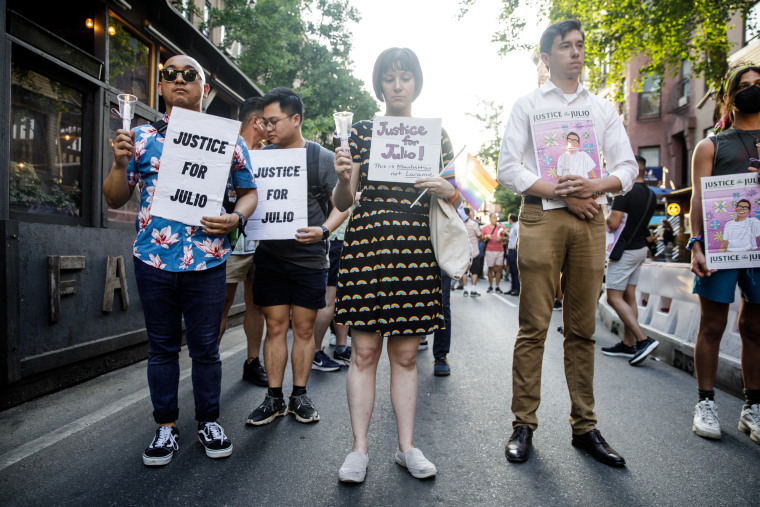
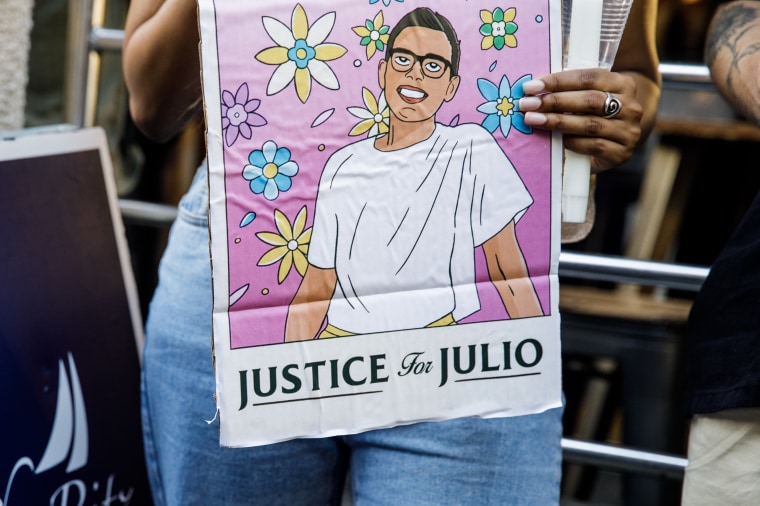
People hold signs for a vigil commemorating Julio Ramirez in New York in June 2022.Julius Constantine Motal / NBC News
Five of the suspects pleaded not guilty charges that included murder, conspiracy and grand larceny.
Eddie Ashley, though, admitted he was guilty.
One of the four crimes to which he pleaded guilty, the May 2022 robbery, was linked by prosecutors to the broader crime ring. Awaiting his sentencing three weeks ago, he asked if theexpected punishment fit the crime.
“I lost a lot being in here, financially, I lost my grandma — so I’m kind of messed up. This is basically a bad situation right now for something that was just one night,” Ashley told NBC News at Rikers Island jail complex in his first interview about the crimes.
Ashley’s sentencing is the most significant development in the year-old case, and it provides the best insights yet into how the investigation unfolded. But it also highlights how much is still not known.
A separate crime ring was committing similar crimes at bars in Manhattan’s Lower East Side within the same time period, according to prosecutors. Some victims still don’t know if their specific cases are linked to one or the other alleged crime ring — or neither. And there’s even bigger gaps: One man remembers being victimized in March of this year by a woman — yet all the people who have been charged are men.
And almost all of the victims who spoke with NBC News say they wonder whether the reign of terror afflicting New York City’s nightlife still continues, unnoticed once again.
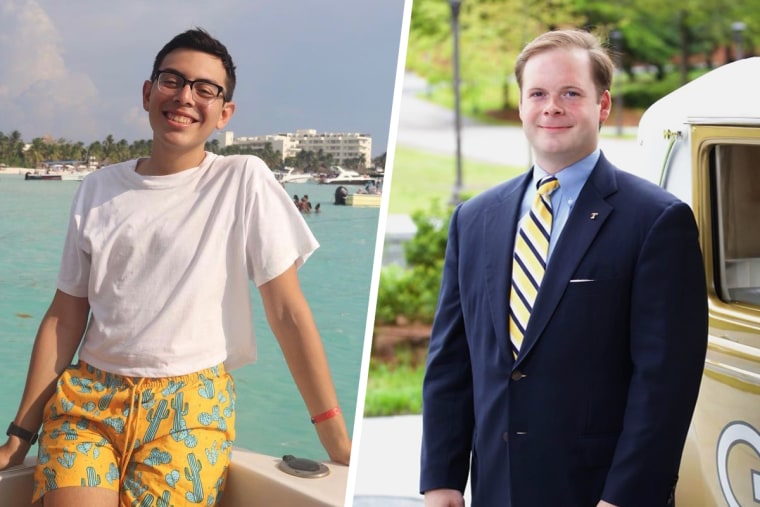
Julio Ramirez and John Umberger.Ramirez family photo; Linda Clary
Julio Ramirez was a 25-year-old social worker. John Umberger was a 33-year-old political consultant. Both went out to gay bars in Hell’s Kitchen 38 days apart last spring. Both ended up drugged, robbed and dead.
Police initially told relatives that their deaths appeared to be self-inflicted: accidental overdoses, the families said.
But that didn’t add up to the families. They suspected foul play.
Both Ramirez and Umberger each left a bar with at least one man. Both had their bank accounts drained. Both appeared to be reading text messages on their phoneafter their bodies were found.
“Right away I knew something was wrong,” Ramirez’s brother, Carlos, said. “He would never intentionally take any drugs or anything that could harm him.”
Umberger’s family was similarly not convinced by the police explanation.
To them, “it looked like John had gone out to a club, been robbed, emptied his credit cards out of his wallet — but he still had his wallet, no phone — and he came home and did a bunch of drugs because he was so depressed over what happened,” Umberger’s mother, Linda Clary, previously told NBC News. “That’s where it was like, ‘I’m sorry, that’s not my child.’ I can assure you if that were to happen, that’s not what John would have done.”
Both families were determined to take matters into their own hands.
In the days following her son’s death last spring, Clary flew to New York from her home in Georgia, seeking answers. With the help of six family members and her son’s friends, she retraced his last steps from what she gathered from his bank transactions, phone records and those who saw him last. Similarly, after several failed login attempts to Ramirez’s computer, Carlos Ramirez gained access and uncovered suspicious banking records from his brother’s accounts. Clary and Ramirez both said thousands of dollars had been drained from their loved one’s accounts following their deaths.
Both families took their findings to the NYPD.
“They looked at us like we were from outer space,” Clary previously said. “No one was interested in finding out the truth.”
Two days after speaking with authorities, Clary said a homicide detective was assigned to her son’s case.
But still frustrated with the pace of the investigations, both families brought their stories to the media, hoping it would put pressure on authorities.
Had she not gone to reporters, Clary speculated, “it would have continued to be pushed under the carpet, and things would still be going on.”
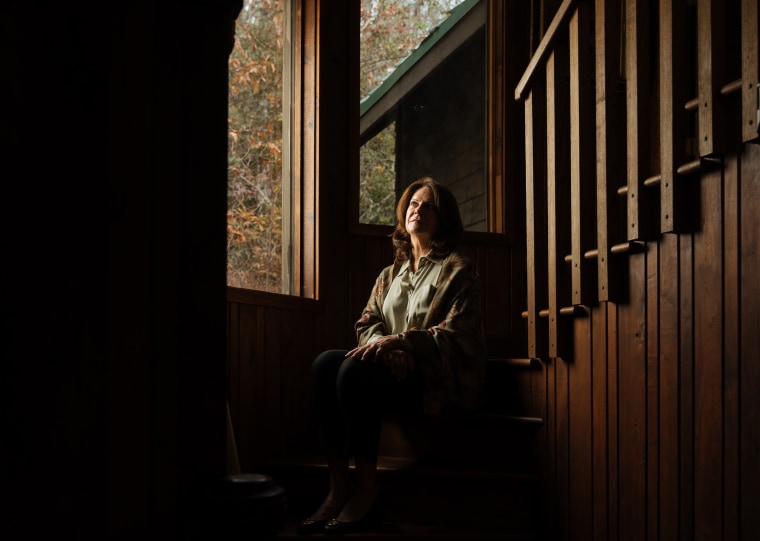
Linda Clary in her home in Highlands, N.C. Will Crooks for NBC News
Once the news of Umberger’s death became known, gay men who said they had survived similarly harrowing experiences stepped forward to share their stories publicly.
NBC News spoke with six people who say they or their family members had been the victims of crimes from December 2021 to this March that broadly fit the pattern of the Ramirez and Umberger cases. Many of the victims say the suspects used their faces while incapacitated to unlock their phones, via facial recognition technology, and access their bank accounts. Some of them asked that their names not be published out of fear of retaliation by the people who harmed them. All of the men say they filed police reports shortly after their encounters occurred and most said their cases are ongoing.
In December 2021, Tyler Burt, 28, was walking home after a night out with friends when he stopped in at the Boiler Room, a gay bar in Manhattan’s East Village for one last drink. Sitting alone at the bar was the last thing he remembered before waking up the next day in his apartment fully clothed, with his shoes still on and roughly $15,000 and personal belongings stolen, Burt said.
“I feel lucky in a way that I didn’t get murdered,” Burt said. “Something horrible happened to me, but I’m still alive to tell the tale. I’m very grateful for that.”
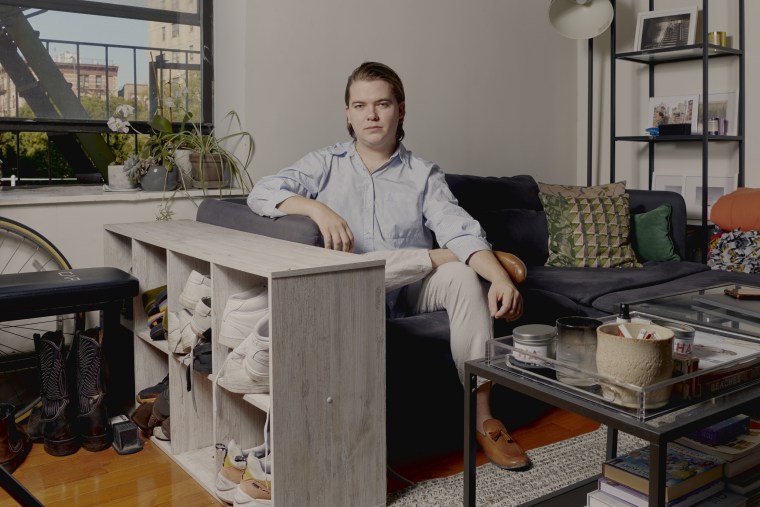
Tyler Burt in New York.Vincent Tullo for NBC News
In July 2022, a 51-year-old Manhattan resident said he woke up on his living room floor in a pile of his own vomit after having a single drink at the 9th Avenue Saloon, a gay bar in Hell’s Kitchen. The last thing he remembered was saying goodbye to his friends. He said that he had a single drink the entire evening and that roughly $8,000 had been taken from his account.
“The only reason I didn’t die was because they left me on my stomach,” he said. “And thank God I wasn’t raped.”
“Why can’t I go out and have fun and not worry that I’m not going to make it home?” the man added.
And this March, Michael, a 30-year-old gay man, said he was approached by an unknown woman after visiting The Eagle NYC, a gay bar in Manhattan’s Chelsea neighborhood. When he came to, he said, the same woman — who he said knew his name — was shaking him on an empty street in East Harlem, about 80 blocks north of the bar, “trying to get rid of me.” The next day, he realized that $5,000 was missing from his bank account.
“The way that they systematically went through all of my banking and credit card apps on my phone, it was like practice,” he said. “You could tell that they’d done this before.”
The medical examiner’s office ruled in March that Ramirez and Umberger’s deaths were homicides caused by a “drug-facilitated theft.” Multiple drugs were found in their systems, including fentanyl, lidocaine and cocaine.
In the following weeks, six men — Ashley, Jayqwan Hamilton, 36; Robert Demaio, 35; Jacob Barroso, 30; Andre Butts, 29; and Shane Hoskins, 32 — were chargedin connection with the crime scheme that led to the deaths of Ramirez and Umberger. Three — Hamilton, Demaio and Barroso — were charged with murder.
While many of the victims were gay men, all were targeted for financial gain and not because of their sexual orientation, prosecutors said.
The initial court appearance in April for three of the suspects — two of whom were charged with murder — was tense.
The small Manhattan courtroom was packed with family members and friends of the deceased sitting across a tight aisle from the family and friends of the men accused of killing their loved ones.
When the three defendants appeared, they were surrounded by a swarm of roughly a dozen court officers. Carlos Ramirez and his parents were visibly distressed, realizing they were seated directly behind where the defendants would be sitting, prompting others in the gallery to make room for them to move.
“It was such a bad, dark feeling just thinking that these were the last people my brother was with when he died,” Ramirez said. “That just really messed me up.”
As the judge spoke, a relative of one of the defendants got into a verbal altercation with a police officer after the officer asked them to quiet down. When the man asked why, the officer got in the man’s face and screamed: “Because I said so! You’re in our house.” When the man yelled expletives back, he was escorted out of the courtroom by several officers.
Once the courtroom became quiet again, all that could be heard through the whispers were the sniffles of tearful grieving family members.
Outside, supporters of one of the suspects, Barroso, went in front of the news cameras and yelled that he is “not a murderer. You guys got this backwards. We will prove his innocence.”
A few weeks later, Clary flew from Georgia to New York to attend the first court appearance for Hamilton, one of the two men charged in her son’s murder.
It was the first time she had been to New York since recovering her son’s body.
At the courthouse she was swarmed by a gaggle of reporters and news cameras, which she described as “overwhelming.” The attention on Clary was unsurprising.
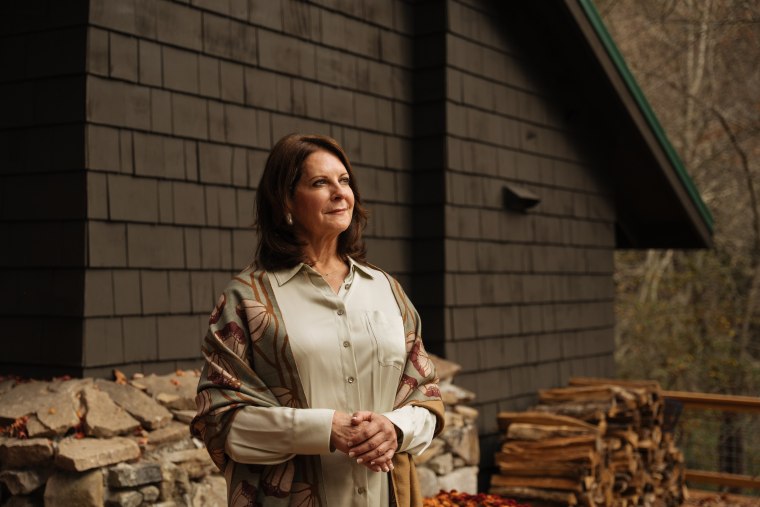
After months of raising awareness about the gay bar killings, Clary — a devout Christian from the South — had become somewhat of a leading voice for the safety and well-being of New York City’s gay men.
“It does strike me as being odd the more that I think about it though,” Clary said. “Here you are in New York, the bastion of progressivism, and yet I’m the one having to raise the flag.”
“Life is full of ironies,” she added.
Linda Clary in her home in Highlands, N.C. Will Crooks for NBC News
Ashley grew up downtown. As a high school dropout, he said he had been working toward earning some sort of employment certificate before he was sent to Rikers. He was living with his elderly grandmother in Manhattan’s Lower East Side and taking care of her.
“I had a lot of s— going on before,” Ashley said. “I was trying to get my life together.”
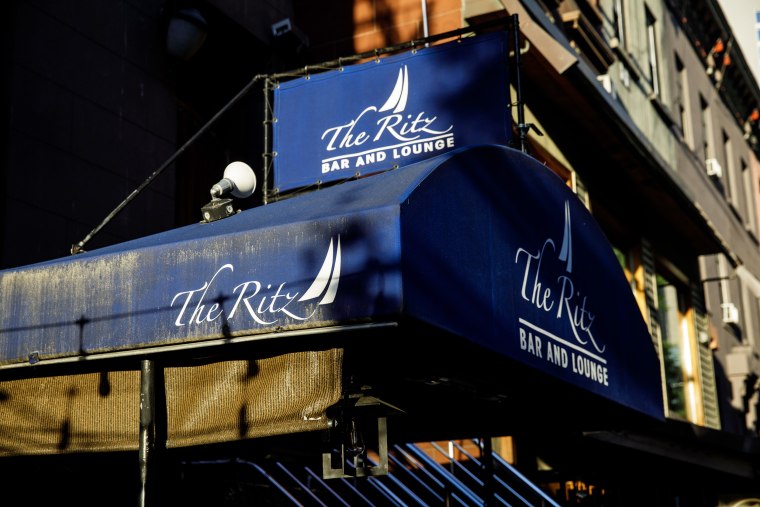
On May 14, 2022, Ashley went to The Ritz — the same bar where Ramirez was last seen a month before — looking for a hookup, he said. He said he had been to the bar two or three times before.
Prosecutors said Ashley left the bar and went to the apartment of the man whose phone and wallet Ashley would later steal. Ashley said he does not remember going back to the man’s apartment but does remember that he had not met the man before. He described the man as being in his 20s and Latino.
The Ritz Bar and Lounge in Hell’s Kitchen.Julius Constantine Motal / NBC News
Police obtained security footage of Ashley using the victim’s phone to pay for Taco Bell that same morning via Apple Pay, according to prosecutors. Ashley said he does remember getting Taco Bell but suggested the victim could have bought him food.
In April, Ashley was arrested and charged with robbery, grand larceny, petit larceny and identity theft for four incidents from October 2021 to August 2022, including the May 2022 encounter, which was linked to the broader crime scheme, according to prosecutors. Unable to make bail, he was sent to the notorious Rikers Island jail.
After nearly seven months there, Ashley said he changed his plea to guilty so he can serve time in prison elsewhere. For years, the massive jail complex has been under scrutiny by criminal justice activists and lawmakers from around the country for its allegedly “inhumane conditions.”
Ashley had one word to describe his time at Rikers: “rough.”
He said he’s been in fights with inmates, adding, “Maybe two or three altercations with officers’ use of force, but that’s about it.”
Being in custody has also taken an immense emotional toll, he said. His grandmother died while he was behind bars.
He explained that, regardless of the other crimes he committed, he believes the May 2022 encounter had an outsize impact on his sentencing because it was linked to the wider scheme.
Ashley was not charged with murder and was not present on the nights of either Ramirez’s or Umberger’s deaths, according to prosecutors. He said he only found out about the wider crime scheme when he obtained an attorney upon his arraignment.
“I knew it had nothing to do with me,” he said of victims who were drugged and died.
Prosecutors allege that another one of the six suspects, Hamilton, who was charged with murder in the deaths of both Ramirez and Umberger, was present on the night Ashley committed the robbery in May 2022. Hamilton was accused of giving Ashley’s victim an unknown illicit substance outside the bar and using the victim’s phone to steal $2,000 from his bank accounts. Hamilton’s lawyer declined to comment.
Ashley said he remembers Hamilton being at the bar that night, but he maintains that he never saw Hamilton drugging anyone. Ashley declined to say how he knew Hamilton, citing Hamilton’s ongoing case, but said they were not friends. He also denied knowing any of the other four defendants.
After sitting with NBC News in the Rikers visitors’ hall — a nearly empty room that could seat hundreds — for about 15 minutes, Ashley called a correction officer over to end the meeting.
“I don’t even care anymore,” Ashley said when asked about being connected by authorities to a broader scheme that led to the death of two men, walking off. “It’s behind me.”
People hold signs for a vigil commemorating Julio Ramirez in New York in June 2022.Julius Constantine Motal / NBC News
For the victims and families of the deceased, the yearslong crime scheme has been difficult to leave behind.
Many of the victims who spoke with NBC News described re-entering New York City’s nightlife scene with apprehension.
The 51-year-old man said he’s been out only once or twice since he was robbed. He said he’s afraid that his assailants — who he said do not appear to be any of the suspects arrested in recent months — might recognize him.
“I go straight to work and straight to home,” he said. “I’m always looking around; I’m always suspicious of everything.”
Michael said he is slowly trying to re-enter New York’s nightlife scene after being abandoned in East Harlem.
“My therapist has told me to be more discerning around people, and that’s a good defense mechanism, but I don’t really like that, you know?” Michael said. “I like the person I am. I like being friendly and trusting and open, and it would really suck if that’s something that was permanently changed by this experience.”
Michael went back to The Eagle NYC for the first time last month. Instead of opting for a late night out, he went for happy hour earlier in the evening.
All but one of the surviving victims who spoke with NBC News said they still have facial recognition software on their phones out of convenience. Some note that the larger issue is the danger of being drugged, regardless of whether a criminal can unlock a person’s phone and steal their money.
The Ramirez family did not celebrate Thanksgiving or Christmas last year, Carlos said, and does not plan on doing so this year either. For Carlos personally, he said he misses his best friend.
“When something happens and it’s good news and he’s not here, I can’t share it with him. It kind of takes away from it,” Carlos said. “That’s really hard.”
Clary said she hasn’t built up the courage to go through her son’s belongings in his apartment in Washington, D.C. More recently, she’s made a handful of trips to New York City for the pretrial court appearances of the suspects charged in connection with her son’s death.
Clary has been enjoying her new role as a grandmother in recent months. But even that, she said, has been challenging at times.
“That whole experience is diminished because John is not here,” she said. “At some point I have to let go of John not being here and trust God that He has a plan that this life, that we think is everything, is so small compared to eternity.”
When she’s in New York, she said she likes to frequent some of her son’s favorite restaurants in Manhattan: The Waverly Inn in the West Village, Minetta Tavern in Greenwich Village and La Goulue on the Upper East Side, across the street from the apartment where her son died.
“It is a kind of ridiculous, not logical thing,” Clary said. “But you like to go to the places he enjoyed being at because you’re thinking, ‘Yeah, this is the closest thing you have to him being here.’”
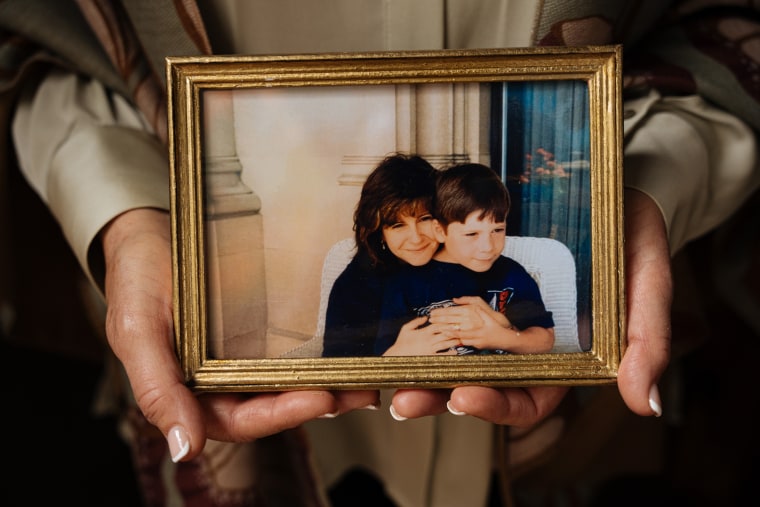
Linda Clary holds a family photo of her and her son John Umberger at her home in Highlands, N.C. Will Crooks for NBC News
It’s been more than two years since authorities say this crime ring, which largely targeted gay bars, began. Yet victims of similar crimes to the ones that killed Ramirez and Umberger say they are still nearly as perplexed about the encounters as they were when they first regained consciousness immediately afterward.
Michael said police and prosecutors told him his case was linked to the same group being charged in the two men’s deaths. Police sources also confirmed the connection with NBC News.
However, Michael said authorities were never able to identify the sole person he remembers from the encounter: an unknown woman.
“That tells me that there are still people on the streets who did this to me, to other people,” Michael said. “There’s no way they caught everyone who were doing these robberies.”
Some survivors have even less clarity. They say police told them their cases have not been connected to the ring related to Ramirez and Umberger or the second known ring.
A 48-year-old man, who asked not to be named out of fear of retaliation from people involved in his encounter, said he was drugged and robbed after visiting The Eagle NYC in October 2022. He said his case is still ongoing.
“I know what happened legally with the Hell’s Kitchen cases, but I feel like The Eagle cases just sort of fell off the radar,” the man said. “Were they connected to other cases? Have they all been caught? Are there suspects still at large? Is this still happening?”
The NYPD and mayor’s office launched a program in June to re-examine unsolved drugging, robbery and homicide cases involving LGBTQ victims, which was largely seen as a response to criticisms surviving victims made in the news media.
A spokesperson for the mayor’s office said that the NYPD has not received any requests to have cases re-examined as of last month and that the lack of applications could suggest that there is not a need to re-examine any cases.
However, Burt said he applied to have his case re-examined in June. He said he tried following up with the NYPD in July, but he did not receive a response to his last emails, which he shared with NBC News.
“I’m just disappointed in how this whole thing has been handled,” Burt said. “Every step of the way has made me feel like this is not a priority.”
Tyler Burt in New York.Vincent Tullo for NBC News
The NYPD defended how the cases were handled.
“The Detective Bureau is committed to conducting solid, high-quality investigations and ensuring that each investigation is handled efficiently with dedication and professionalism,” an NYPD spokesperson said in an email.
Michael suggested that while it is important to find and punish those who were responsible for the past crimes, it is equally paramount that people understand that the technological tactics used to access their financial accounts are likely being replicated by others.
“As long as there is a convenient way for you to unlock your phone without having to enter a pin, people are going to use it and people are going to find ways to exploit it,” he said. “Awareness is the most important thing.”
“Maybe they’re laying low, maybe it’s hard to find them,” he added, “but they’re definitely still out there.”
LGBTQ+ people in the military once faced dishonorable discharge if they came out (or were outed), and although they can serve openly now, some of their stories have been overlooked. But the Library of Congress’s collection “Serving in Silence: LGBTQ+ Veterans,” part of the library’s Veterans History Project, is shining a light on them.
“It’s been a long road to making sure that we are able to collect, to preserve for posterity, to make accessible and therefore discoverable, the fullness of the human story of America’s veterans, and that includes necessarily those of LGBTQ+ experience,” Monica Mohindra, director of the project, recently told New Jersey newspaper The Record.
Throughout LGBTQ+ history, the experience of bisexual people has often been ignored, even though they make up the largest portion of the LGBTQ+ population. Cliff Arnesen, one of the veterans featured in “Serving in Silence,” is seeking to address this.
“You don’t know how many bisexual people have made enormous contributions to the overall” LGBTQ+ movement, Arnesen told The Record. “People like Alexander the Great, Julius Caesar, Freddie Mercury, David Bowie — all bisexual. But none of that comes up in certain history books. That’s why the bisexual community is up in arms all the time and we’re trying to educate.”
Arnesen came out as bi when he was under arrest for being absent without leave from the U.S. Army base at Fort Dix in New Jersey in 1966 (he had been visiting his mother, who was suffering domestic abuse at the time). He was dishonorably discharged the following year. He eventually channeled the anger he felt at the military into activism, becoming the first bi veteran to testify before Congress and helping found American Veterans for Equal Rights.
He also worked for the Department of Veterans Affairs and became president of New England Gay, Lesbian and Bisexual Veterans Inc. His discharge was upgraded to “general under honorable conditions” under an amnesty program established by President Jimmy Carter in the late 1970s. During President Joe Biden’s time in office, Arnesen and other bi vets have been meeting with administration officials to talk about issues faced by bisexuals.
Arnesen is one of 22 LGBTQ+ veterans whose stories are posted on the “Serving in Silence” web page, but Mohindra noted that it’s “not fully encompassing of all of our collections of the LGBTQ+ experience.” The Veterans History Project has more than 118,000 individual narratives, and the public can add to this. Anyone can contribute, and there are online instructions for interviewing veterans for the project.
Anti-LGBTQ+ House Speaker Mike Johnson (R-LA) didn’t just agree with Justice Clarence Thomas’ suggestion that the Supreme Court should revisit its 2015 decision legalizing same-sex marriage — he applauded it.
The court’s 2022 decision in Dobbs v. Jackson Women’s Health Organizationstruck down Roe v. Wade, ending the constitutional right to abortion in the U.S. In his concurring opinion, Thomas included a footnote asserting thatby striking down the legal basis for Roe, the court had called into question every other decision using the same reasoning.
Thomas went so far as to specifically name the Supreme Court’s decisions in Obergefell v. Hodges and Lawrence v. Texas, the cases that established the legal right to same-sex marriage nationally and struck down anti-sodomy laws, respectively.
The same day that the court released its Dobbs decision in June 2022, Johnson cheered Thomas’s footnote on conservative pundit Todd Starnes’s radio show.
In an audio recordingresurfaced by CNN this week, Johnson touted his years of experience fighting against same-sex marriage, same-sex adoption, and same-sex marital benefits as a senior attorney for anti-LGBTQ+ hate group Alliance Defending Freedom (ADF) prior to being elected to public office.
“We’ve been sort of working against these activist courts for years,” Johnson said. “I was in those courts for 20 years, in federal court litigating these big cases, religious freedom, pro-life cases before I got elected to Congress in 2016.”
“There’s been some really bad law made,” Johnson continued. “They’ve made a mess of our jurisprudence in this country for the last, you know, several decades, and maybe some of that needs to be cleaned up.”
“What Justice Thomas is calling for is not radical,” he added. “In fact, it’s the opposite of that, you know? We finally have a majority of originalists on the court, and all that means is that they want to fairly interpret and apply the Constitution as it’s written, as the framers of the Constitution intended. That’s the basis of our whole system of government, and we have to get back to that. And that’s what he stands for, and we applaud that.”
Since taking the speakership late last month after weeks of Republican infighting, Johnson’s anti-LGBTQ+ beliefs and extensive history of opposing LGBTQ+ rights have come under scrutiny alongside his key role in efforts to overturn the results of the 2020 election.
In addition to his work for the ADF, which included work for a now-defunct anti-LGBTQ+ Christian group that promoted so-called “conversion therapy,” he wrote several editorials in the early 2000s criticizing the Supreme Court for striking down anti-sodomy laws. His editorials also opposed same-sex marriage and argued against non-discrimination protections for LGBTQ+ people.
Editor’s Note: It is difficult to fathom how any university or college can be deemed LGBT-Friendly when it’s campus is located in a state where LGBTQI+ rights and reproductive rights and health are threatened. Alas, this is a yearly index that some may find helpful. While we aplaud college’s that offerLGBTQI+ folks the right we deserve. we urge administrations to force state legislatures and governors to do the same.
The exclusive list is based on its Campus Pride Index which rates institutions based on self-reporting of various criteria important to LGBTQ+ students and their families.
“The Best of the Best list was first created in 2009 as a way to showcase colleges and universities that were committed to offering safe and inclusive environments for LGBTQ+ students so that students and families could make informed choices about where to pursue higher education,” says Shane Mendez Windmeyer, the founder, CEO, and executive director of Campus Pride. “In today’s climate, which finds LGBTQ+ identities being used as political talking points and laws being weaponized against LGBTQ+ people, the commitment to creating campuses that welcome and protect LGBTQ+ students cannot be taken for granted. The colleges and universities that made our list this year deserve this highest recognition for the efforts they have made and continue to make.”
You can read the complete list of the Best of the Best LGBTQ+ Friendly colleges and universities from Campus Pride, including individual pages for each institution, here.
But keep scrolling to see if your institution made the list.
Institution Type: Doctoral/Research University, Master’s College/University, Baccalaureate College/University, Private Institution, Liberal Arts College, Religious Affiliation
University of Wisconsin, Eau Claire – Midwest Region
Image Instagram: uweauclaire
Eau Claire, Wisconsin
Campus Pride Index: 5 out of 5
Institution Type: Doctoral/Research University, Master’s College/University, Baccalaureate College/University, Public/State University, Liberal Arts College
University of Wisconsin, Green Bay – Midwest Region
Image Instagram: uwgb
Green Bay, Wisconsin
Campus Pride Index: 5 out of 5
Institution Type: Doctoral/Research University, Master’s College/University, Baccalaureate College/University, Public/State University, Liberal Arts College
Former Chicago police sergeant James B. Sajdak pleaded guilty on Monday to a misdemeanor civil rights violation related to the 2019 sexual assault of a transgender woman, Tyshee Featherstone.
This latest development is a significant shift from the initial charges that could have led to a life sentence for Sajdak, as reported by theChicago Sun-Timesand theChicago Tribune.
The 65-year-old Sajdak, who served 29 years with the Chicago Police Department, faced the possibility of life in federal prison under a felony count. However, the plea agreement changed this to a misdemeanor count of deprivation of rights under color of law.
The charge carries a potential sentence of up to one year in federal prison, with sentencing scheduled for February 23 by U.S. District Judge John J. Tharp Jr.
The Chicago Sun-Times detailed the incident on March 5, 2019. Sajdak allegedly approached Featherstone near Kolmar and Fifth avenues in Austin, demanding she enter his squad car. After the initial refusal, he used his authority to force her into the vehicle, drove to a secluded lot, turned off his police radio and laptop, and coerced her to perform a sex act. He then attempted to give her cash.
The victim’s complaint led to a federal civil rights lawsuit, settled in April 2020, though the settlement terms have not been disclosed. Featherstone was awarded $100,000 by the city in a separate settlement, as reported by the Chicago Tribune.
Sajdak’s attorney, Tim Grace, said his client acknowledged his mistakes and was eager to move past this incident. The government’s decision to agree to a plea deal was commended by Grace, who looks forward to the sentencing.
The Chicago Sun-Times report also reveals a troubled history for Sajdak within the police department. He faced numerous citizen complaints throughout his career, with 44 complaints filed against him. Of these, one was sustained in 1997 involving the sale or possession of illegal drugs, resulting in a 30-day suspension. Furthermore, Sajdak settled a lawsuit in 2016 accusing him of harassment in a separate incident.