South Dakota Republican lawmakers on Tuesday revived a proposed law that would ban people from changing the sex designation on their birth certificates, even after a House committee rejected the bill that LGBTQ advocates decried as an attack on transgender people.
Republicans in the House forced the bill to be brought to a vote by the full House through a rarely used legislative procedure known as a “smoke out.” At least one-third of the House supported the procedure.
A committee of lawmakers had earlier Tuesday dismissed the bill on a seven-to-six vote after five Republicans joined two Democrats to oppose the bill, which would stop people from changing the sex listed on birth certificates after one year from birth. The proposal will be delivered to the full chamber for consideration by Wednesday.
Law changes that affect transgender people have become a perennial topic in the South Dakota legislature, although transgender advocates say they are making progress in getting their voices heard and issues understood. A handful of advocates gathered in the pre-dawn cold outside the statehouse on Tuesday, waving rainbow and transgender flags.
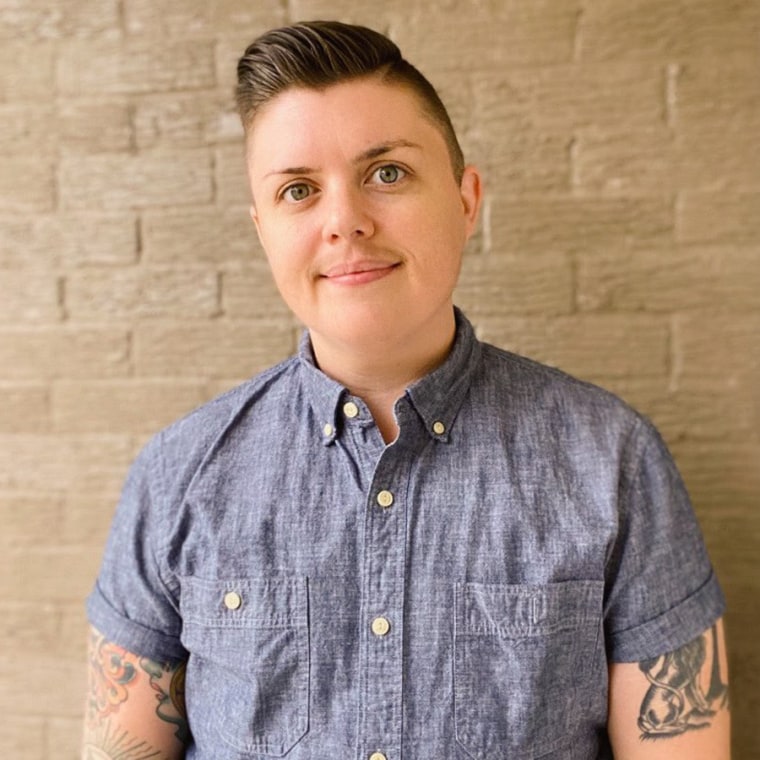
“I want transgender people to know they have a home here, a family here,” said Seymour Otterman, a nonbinary transgender person who testified to lawmakers on their experience living in the state.
The legislative efforts to address transgender issues were spearheaded by Rep. Fred Deutsch, a Watertown Republican who introduced this year’s proposal. After the bill was rejected in committee, he said he had heard from fellow Republicans that they would like to debate and vote on the bill in a meeting of the full House.
Deutsch pushed a bill last year that would have banned puberty blockers and gender confirmation surgery for transgender children under 16. And in 2016, he introduced a bill that would have limited the bathrooms and locker rooms that transgender students can use.
But Deutsch’s efforts have increasingly struggled to gain traction: His 2016 bill cleared the House and Senate before being vetoed by former Gov. Dennis Daugaard, a Republican; his bill last year passed the House before being halted by a Senate committee; this year’s bill failed to clear its first hurdle in the House and had to be revived by the “smoke out” procedure.
Deutsch defended his efforts, saying he was not motivated by hate but by social importance.
He argued that the state’s judges have struggled with how to handle requests from people who want to change the sex on their birth certificates and that keeping vital records on sex is an important aspect of government business.
South Dakota courts have received 11 requests for updates to the sex listed on birth certificates since 2017, according to the court system.
Rep. Kevin Jensen, a Canton Republican who supported the bill, said he doesn’t feel it discriminates against transgender people, and that a birth certificate serves as an objective record of someone’s sex at birth.
But LGBTQ people see Deutch’s efforts as an attack intended to send a message that they are not welcome in a state dominated by conservative politics. They warned that barring people from updating their birth certificates was dangerous, exposing them to violence, hate and discrimination. They could be unwillingly exposed as transgender when they apply for jobs, housing or health care.
“It’s incredibly disrespectful that we have to address this every year. It’s infuriating,” said Rep. Erin Healy, a Democrat from Sioux Falls. “We are disrupting the lives of a vulnerable population, and I think what we are missing today is empathy and compassion.”
Opponents to the bill pointed out that similar bans, such as a 2018 law passed in Idaho, have been struck down by federal courts as unconstitutional. LGBTQ advocates have also pointed to President Joe Biden’s order reversing a Trump-era Pentagon policy largely barring transgender people from military service as a sign that the federal government is taking a stronger approach to protections for transgender people.
Otterman said Deutsch’s proposed ban did not come as a surprise, even though they are struck by increasing waves of anger and sadness each January when the bills come.
“In most places in South Dakota, it is a very lonely, isolating experience because of this sentiment,” they said.
Healy said bills that delve into transgender issues can be harmful, even if they often fail.
“It’s an emotional roller coaster,” Healy said. “To be so happy and relieved that it died, only to see it resurrected and have that threat all over again.”
As the world marks Holocaust Memorial Day, PinkNews remembers all those in the LGBT+ community that were persecuted by the Nazis — and how the pink triangle, used to identify gay or bisexual men in concentration camps, became a symbol for gay rights.
When Adolf Hitler and his Nazi Party seized power in Germany in July 1933, the dictatorship moved to persecute and murder minority groups, including Jews, LGBT+ people, the Romani people, and political prisoners.
Beginning in 1933, the Nazis built a network of concentration camps throughout Germany, where “undesirable” groups were detained, including Jewish people and gay men.
This persecution continued following the outbreak of World War II in 1939 and, between 1941 and 1945, the Nazi Party systematically murdered six million European Jews — as part of a plan known as “The Final Solution to the Jewish Problem” — in extermination camps and mass shootings. This genocide is referred to as the Holocaust, or the Shoah in Hebrew.
In total, up to 17 million people, including thousands of gay and bisexual men, were systematically killed at the hands of the Nazis.
Holocaust Memorial Day is held on January 27 annually — marking the anniversary of the liberation of Auschwitz-Birkenau, the largest Nazi death camp — and remembers the millions of people killed by the Nazis and in subsequent genocides in Cambodia, Rwanda, Bosnia and Darfur.
Holocaust Memorial Day: Nazi persecution of gay men and the LGBT+ community
Under Nazi rule, the persecution of homosexual men intensified, although gay sex between men had already been illegal since 1871.
It’s estimated that the Nazis imprisoned more than 50,000 gay men, including an estimated 5,000 to 15,000 men who were sent to concentration camps, according to research by historian Rüdiger Lautmann.
The classification system used for the uniforms of inmates—including the pink triangle for homosexuals—in Dachau concentration camp in Upper Bavaria, southern Germany. (HMDT/USHMM)
Although sex between women was not officially illegal in Nazi Germany, lesbians were also persecuted. Benno Gammerl, a lecturer in Queer History at Goldsmiths, University of London, tells PinkNews that the persecution of lesbians is “much harder to trace” because they weren’t included in the penal code and there was no specific categorisation of gay women in concentration camps (although some were made to wear a black triangle badge used to denote “asocial” prisoners).
Trans people, too, are known to have been persecuted under the Nazis, including being sent to concentration camps. According to Transgender Day of Remembrance, in 1938 the Institute of Forensic Medicine recommended that the “phenomena of transvestism” be “exterminated from public life.”
Again, Gammerl acknowledges that there have been demands for further research on the plight of trans people under the Nazis, saying: “At the moment, we simply [do] not know enough yet.”
Holocaust Memorial Day: The pink triangle in Nazi concentration camps.
In Nazi concentration camps, a pink triangle was used to identify some gay men. Gammerl, who describes the pink triangle as a “Nazi invention,” says it is “not quite clear” why the Nazis used the colour pink for this purpose.
In concentration camps, LGBT+ inmates were subjected to starvation and forced labour, as well as facing discrimination from both SS guards and fellow inmates.
Pierre Seel, a gay survivor from the Schirmeck-Vorbrück concentration camp near Strasbourg, who passed away in 2005, recalled one traumatising incident in his memoir. Seel wrote that a group of SS guards stripped his 18-year-old lover naked before releasing a pack of German Shepherd dogs which mauled him to death.
“There was no solidarity for the homosexual prisoners; they belonged to the lowest caste,” Seel wrote in his 1995 book I, Pierre Seel, Deported Homosexual: A Memoir of Nazi Terror.
“Other prisoners, even when between themselves, used to target them.”
Gay men were also subjected to torture — including forced sodomy using wood — and human experimentation at the hands of the Nazis. There are records of gay men being forced to sleep with female sex slaves, and lesbians being made to perform sex acts on males, as a form of gay conversion therapy.
There was no solidarity for the homosexual prisoners; they belonged to the lowest caste.
Still, Gammerl argues that, although “there is evidence that homosexuals received worse treatment,” the available records make it hard to claim with certainty that gay people were consistently treated worse than other inmates.
“It is difficult to make definite claims about homosexuals being at the very ‘bottom’ of the camp hierarchy,” he says.
“All inmates were living under the permanent threat of being beaten or raped or killed by guards and there was also violence happening between inmates, some of that was certainly also homophobic.
“So, I would say, all inmates lived horrendous lives far beyond what I can imagine.”
He stresses that, given that Jewish people predominately populated the concentration camps, “one certainly cannot say that homosexuals were treated worse than they were.”
All inmates were living under the permanent threat of being beaten or raped or killed by guards and there was also violence happening between inmates, some of that was certainly also homophobic.
Thousands of LGBT+ people are believed to have been murdered by the Nazis. However, the Nazis’ poor documentation of LGBT+ people means that historians have been unable to calculate an exact estimate. Lautmann has argued that the death rate for gay men could be as high as 60 percent of those detained in concentration camps.
Gammerl also stresses that some Jewish and Romani people killed by the Nazis may also have identified as a sexual or gender minority.
“When talking about numbers, it is important to bear in mind that part of the people who were persecuted as Jews, Communists, Sinti and Romanies, or as members of other groups the Nazis sent to concentration camps, that a certain number of these people may also have been LGBT+,” he adds.
Gay men after WWII and how the pink triangle was reclaimed as a gay rights symbol.
After the end of World War II, the persecution of gay and bisexual men continued. Same-sex sexual activity between men remained illegal in East and West Germany until 1968 and 1969 respectively.
Gammerl notes that, while authorities in East Germany were “more lenient” towards gay men after Word War II, the persecution of gay men in West Germany was “rather intense” in the decades afterwards with “large waves” of arrests in cities like Frankfurt.
“Same-sex desiring men and women had to make sure that they lived their lives not too publicly and for men there was the permanent fear of being sent to prison,” he explains.
Pink Triangle Park in San Francisco, where the pink triangle has been used to remember LGBT+ victims of the Holocaust.
There are also accounts of gay men being re-imprisoned using evidence obtained by the Nazis. For decades after the Second World War, the Nazis’ treatment of LGBT+ people went unacknowledged in many countries.
It took until 2002 before the German government apologised to the gay community and annulled the convictions of gay and bisexual men under the Nazi regime. In 2005, the European Parliament passed a resolution including homosexuals as part of those persecuted during the Holocaust.
Poignantly, as the gay rights movement gained momentum in West Germany in the 1970s, the pink triangle started to be used as as a symbol for marking the history of anti-gay violence.
In an act of defiance, the pink triangle was reclaimed — and often inverted, with the tip pointing upwards — as a sign of gay activism. It became known on an international scale during the 1980s, when a six-person collective, called the Silence=Death Project, used an inverted version of the triangle on posters that the group plastered around New York to raise awareness of the AIDS crisis.
The upwards pointing pink triangle was later used by the AIDS Coalition to Unleash Power (ACT UP) in its campaigns during the AIDS epidemic. It was also used in memorials to remember LGBT+ victims of the Holocaust in San Francisco, Amsterdam and Sydney.
The Washington Blade has learned Judy Shepard will testify in support of a bill that would ban the so-called LGBTQ panic defense in Virginia.
The measure — House Bill 2132 that state Del. Danica Roem (D-Manassas) introduced — will go before a House of Delegates subcommittee on Wednesday.
Shepard’s son, Matthew, died on Oct. 12, 1998, after two men brutally beat him and left him tied to a fence outside of Laramie, Wyo. One of the men convicted of murdering Matthew Shepard claimed he became after he made a sexual advance towards him.
Eleven states and D.C. currently ban the so-called LGBTQ panic defense. Lawmakers in Maryland are considering a measure that would prohibit the use of the legal strategy in the state.
Legislators in Montana advanced two bills Monday focused on transgender youth: House Bill 112 would prohibit transgender student athletes from participating on teams that correspond to their gender identities, and House Bill 113 would prohibit health care professionals from providing gender-affirming care to trans minors.
“If passed into law, HB 112 and HB 113 will cause irrevocable harm to trans youth,” Caitlin Borgmann, executive director of the American Civil Liberties Union of Montana, said in a statement. “If these discriminatory bills pass — we will sue, and we will win. Trying to defend laws in court that stigmatize and target trans youth doesn’t seem like a good use of taxpayer dollars to us.”
University of Montana cross country runner Juniper Eastwood, center, warming up with her teammates at Campbell Park in Missoula, Mont., on Aug. 15, 2019. The proposed ban is personal for people like Eastwood, a transgender woman and former member of the University of Montana’s track and field and cross-country running teams. She said the legislation “would make it impossible for other young Montanans like me to participate in sports as who they are.”Rachel Leathe / Bozeman Daily Chronicle via AP file
The bills working through Montana’s Legislature are among an estimated 21 anti-LGBTQ measures that have been filed or pre-filed for 2021 state legislative sessions, according to Freedom for All Americans, an organization advocating for LGBTQ nondiscrimination protections. Many of the bills, like those in Montana, focus on transgender youths.
“I think the volume of bills is going to dramatically increase, particularly because of what is happening at the federal level,” said Kasey Suffredini, CEO of Freedom for All Americans. “For the opposition, this is the only avenue for their narrative that treating LGBT people with dignity and respect is a problem for the country.”
Chase Strangio, deputy director of transgender justice for the American Civil Liberties Union, agreed.
“We often see backlash” after advancements in LGBTQ rights, he said, citing the flurry of measures targeting LGBTQ people after the Supreme Court’s landmark decision in Bostock v. Clayton County, Georgia, which expanded the scope of federal nondiscrimination law to include sexual orientation and gender identity.
Strangio said that with fewer opportunities to roll back LGBTQ rights at the federal level under President Joe Biden — who has signed multiple pro-LGBTQ executive orders — he’s not surprised that opponents are zeroing in on the states.
Anti-LGBTQ bills
Republican legislators in over a dozen states have proposed legislation that targets LGBTQ people. The bills touch on athletics, health care and a grab bag of other issues related to queer rights and recognition.
Legislators have also introduced bills to restrict transgender participation in student athletics in Oklahoma, South Carolina, Tennessee, Kentucky, North Dakota, New Hampshire and Florida. The trend carried over from last year, when lawmakers took up the issue in several states. Idaho is the only state to have adopted such a law, and it did so just last year.
Proponents of such bills say it’s about fairness, while opponents say the measures are discriminatory.
Bills that would penalize or criminalize medical professionals for providing trans youths with gender-affirming care have been introduced in Utah, Missouri, Indiana, Alabama, Mississippi and Texas.
“Criminal health care bans are unlike anything we have ever seen before,” Strangio said. “To cut someone off from their health care and make it a crime is pretty much unparalleled.”
In Kentucky, SB 83 would prohibit “discrimination” against any health care provider who refuses to administer care because of a religious objection.
In New Hampshire, HB 68 would expand the definition of “child abuse” to encompass parents’ provision of gender-affirming care, while bills in Alabama, Missouri and Indiana would make it a crime for physicians to give any gender-affirming care to a minor.
Research released in September in the journal Pediatrics found that transgender children who receive gender-affirming medical care earlier in their lives are less likely to experience mental health issues like depression and anxiety.
Strangio said he is alarmed by “how far-reaching these bills are becoming.” For example, a bill introduced by Mississippi state Sen. Angela Burkes Hill would criminalize access to care for young adults up to age 21.
Hill defended the bill on social media as necessary in the face of Biden’s pro-LGBTQ policies: “It should have been passed last year. Who is going to fight for your daughters not to be cheated by biological males deciding to identify as a girl?? Women shouldn’t have to change clothes in front of men either. That federal money will be the carrot. Get ready.”
Other bills that have alarmed LGBTQ advocates include Indiana’s HB 1456, which aims to prohibit transgender people’s access to bathrooms that match their gender identities; South Dakota’s HB 1076, which would require birth certificates to reflect biological sex; North Dakota’s HB 1476, which would codify discrimination against LGBTQ people; and Iowa’s Senate File 80, which would require schools to alert parents if their children are asked by school employees about their “preferred” pronouns.
Pro-LGBTQ legislation
For LGBTQ advocates, the news from legislatures isn’t all bad.
Suffredini expects several states to advance nondiscrimination protections, including Ohio, Pennsylvania, Arizona and Michigan. In Michigan, advocates collected over 400,000 signatures to put a measure on the ballot to extend such protections, and the Legislature has 40 days to amend existing nondiscrimination legislation or the issue will appear on the November 2022 ballot for voters to decide.
Advocates in Arkansas — one of only three states that have no hate crimes law, along with South Carolina and Wyoming — hope an LGBTQ-inclusive hate crimes bill makes it to the governor’s desk this session. Conservatives tried to derail the bill this month because it includes protections based on sexual orientation and gender identity.
In Indiana, the state’s first openly gay legislator, Sen. J.D. Ford, has proposed legislation that would outlaw conversion therapy for minors by licensed counselors. If the bill becomes law, Indiana would join 20 other states and 80 cities in banning the widely discredited practice.
North Carolina cities and municipalities have begun to pass nondiscrimination measures after the end of a moratorium on such local ordinances as a result of a 2017 compromise bill that repealed HB 2, the controversial “bathroom bill.”
New York Senate Democrats are advancing a bill that would strike down an anti-loitering statute, also known as the “walking while trans” law, which allows police to arrest and detain sex workers merely for being on the street. LGBTQ advocates say that the statute is used to harass transgender women of color and that its repeal is necessary to end targeted discrimination. The legislation is on track to pass next week.
Maryland legislators introduced a measure that would make it easier for transgender people to legally change their names.
State Sen. Scott Wiener, an openly gay lawmaker from California, has introduced a bill that would prohibit medically unnecessary surgical procedures on intersex children before age 6. If it passes, the law would be the first of its kind in the U.S.
An ally in the White House
Since he took office last week, Biden has taken several actions applauded by LGBTQ advocates, including issuing an executive order that prohibits discrimination on the basis of sexual orientation and gender identity across federal agencies and another that rescinds former President Donald Trump’s ban on transgender people’s serving openly in the military.
“The Biden administration is by far the most supportive of LGBT people in U.S. history,” Suffredini said. “He took action on day one to extend protections on day one. No other president has done that. That is a first.”
With Biden in the White House and Democrats in control of Congress, Suffredini and other advocates are optimistic about passage of pro-LGBTQ federal legislation, including the Equality Act, which would grant LGBTQ people federal protections from discrimination in employment, housing, credit, education, use of public space, public funding and jury service.
“We are in the best position we have ever been to update federal civil rights law,” Suffredini said. “Our dedicated opposition knows this, and they know this moment could be coming. This is a last gasp.”
Covid-19 News for SeniorsSee the announcement in the next section about our Thursday senior zoom group on February 4th when a coronavirus and vaccine expert will join us to provide information and answer our questions. Sign up now to be informed of when you can be vaccinated. Marin County has a form online where you can sign up to be notified when vaccine is available for you. Since supplies of vaccine are limited, people 75 and over as well as healthcare workers and those in residential facilities are prioritized. As more becomes available, additional populations will become prioritized. Sign up for notification here. The best place to get Coronavirus updates and vaccine updates for Marinhere and here, respectively. California Covid Vaccine Update. The latest California-wide information on the vaccine rollout, safety and more:here. Free, pop-up Covid testing sites in seven cities around the county: Bolinas, Larkspur, Novato, San Anselmo, San Geronimo, San Rafael, and Sausalito. You can see a schedule for each site and read more here. California is now offering covid vaccines to anyone over 65-years old & older. You can read more about the new policy here. Contact your healthcare provider for more information. A new allotment of Rental Assistance comes to Marin for those economically impacted by the pandemic. Read about it here and the new Eviction Moratoriumhere.
To join the Spahr Senior GroupMonday, 7 to 8 pm,click the purple button below the Butterfly Heart. New participants are warmly welcomed!
Topical Thursdays12:30 to 2 pm January 28What the World Needs Now Is …What does the world need now? We’ve experienced our world turned practically upside down in these past years. What would begin to make it right? Yes, changes in D.C. will bring some change, but much of our problem is local, neighbor to neighbor, people to people. Washington alone cannot fix all our problems. What wisdom would we share with the world as the elders we are if we could talk to it directly? February 4Covid and Vaccine Expert Joins UsTyler B. Evans, MD, MS, MPH,Deputy Public Health Officer; Chief, COVID-19 Immunization Branch, Marin County Health and Human Services Agency, will join our group to speak about the pandemic & the vaccine rollout. There will be plenty of time for him to answer our questions. Coming soon: Beyond the Binary: Gender and Pronouns IINancy Flaxman facilitates soon
Check-in Mondays7 to 8 pm We catch up with each other on how we’re doing and have unstructured conversations focused on listening and deepening community.
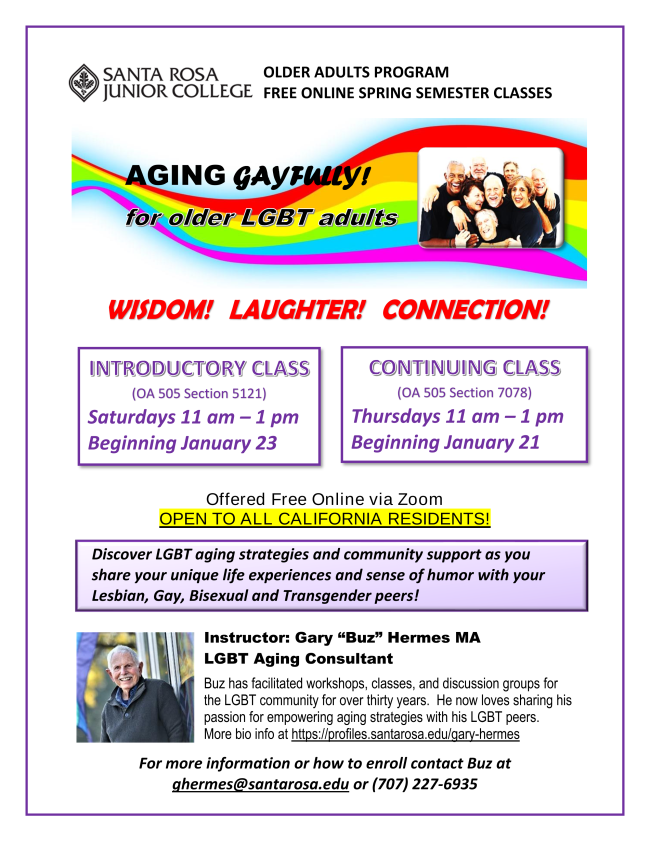
Buz Hermes is offering Aging Gayfully, his popular class, free through the Santa Rosa Junior College. And there’s a Continuing Class for those who have taken it in the past. It’s called a class but indeed, it’s as much a vehicle for community building and growth for LGBT seniors. You can sign up past the date of the first class. The Continuing class is evidence of the community-building and heartfulness of the experience seniors have in the class. You can reach Buz here: garydhermes@comcast.net
The Adventures ofPriscilla, Queen of the DesertSunday February 7 @ 7 pm A worldwide hit that’s become a cult classic, the 1994 Australian road comedy follows two drag queens played by Hugo Weaving and Guy Pearce and a transgender woman, played by Terence Stamp, as they journey across the Australian Outback in a tour bus that they have named “Priscilla”, along the way encountering humanity in that remote part of the world as well as in themselves. You can watch the trailer here. On the off chance that we need to laugh aloud, we can watch Priscilla and have our hearts warmed at the same time. Rated 96% on Rotten Tomatoes and worth watching again if you’ve already seen it. It feels like Schitt’s Creek in different drag. – Bill Blackburn
Not Another Second: LGBT+ Seniors Share Their Stories. A new photography exhibit features LGBT seniors who had to live much of their lives hiding in the closet. Now liberated, their stories may well reflect some of our own. You can read great articles about it – and us – by clicking the following: NYT and NBCNews.
We encourage you to consider offering a song or a poem, play a favorite piece of music or maybe a tap dance, comedy routine or drag number. Jerry, our impresario, is incredibly skilled and patient in recording our acts on zoom well ahead of the show, making sure we performers are satisfied with the result. He will then strings them together to be shown in late February. Jerry Schmitz can be reached at jschm117@aol.comDebbie Alcouloumre at socialcommittee@comcast.net He already has three performances recorded and is looking for more…
The Social Committee has been consistently offering fun events to offset the boredom of the pandemic. They want to celebrate your birthday if you’ll let them know when it is. They offer a women’s coffee plus a number of times to gather on zoom over games and conversation. To sign up for their emails, click here.
California Department of AgingThe CDA has a website that is packed with information and resources relevant to the lives of seniors in our state. From Covid-19 updates to more general care for age-related health issues, access to legal assistance to getting home-delivered meals to help with housing, you may well find answers to your questions by clicking: here.
The Spahr Center has a number of tablets, i.e., small mobile computers, available to give to seniors for free!We’re also seeking ways to help teach seniors how to use them. If you would like to receive a tablet, please let Bill know: 415/450-5339 orbblackburn@thespahrcenter.org. The tablet would enable you to join our senior groups on zoom with video as well as access other parts of the internet. Please Note: We’re hoping to have the tablets individuals have requested begin to be available soon.
Also in this email (below):Spahr has skilled therapists ready to work with seniors on a sliding-scale basis.Nutrition ResourcesBisexual Support zoom group forming through The Spahr Center.
Building Community in the Midst of Sheltering-in-PlaceSee old friends and make new ones! Join us!The Spahr Center’s LGBT Senior Discussion Groupscontinue everyMonday, 7 to 8 pm& Thursday, 12:30 to 2 pm on zoom
To Join Group by Video using Computer, Smart Phone or TabletJust click this button at the start time, 6:55 pm Mondays / 12:25 pm Thursdays:Join GroupAlways the same link! Try it, it’s easy!
To Join Group by Phone CallIf you don’t have internet connections or prefer joining by phone,call the following number at the start time,6:55 pm Mondays / 12:25 pm Thursdays:1-669-900-6833The Meeting id is 820 7368 6606#(no participant id required)The password, if requested, is 135296# If you want to be called into the group by phone, notify Bill Blackburn at 415/450-5339
Spahr’s skilled therapists are available to work with seniors on a sliding-scale basis. Write toinfo@thespahrcenter.org. A Bisexual Support Group is forming with The Spahr Center, facilitated by a therapist. Let Bill Blackburn know if you are interested. Whistlestop, renamed Vivalon, provides access to resources including rides for older adults. Please note: there is a 3-week registration process for the ride program so register now if you think you may need rides in the future. They also offer free classes on zoom including zumba, yoga, chair exercises, & ukulele! Click here. Adult and Aging Service’s Information and Assistance Line, providing information and referrals to the full range of services available to older adults, adults with disabilities and their family caregivers, has a new phone number and email address: 415/473-INFO (4636) 8:30 am to 4:30 pm weekdays473INFO@marincounty.org
The Spahr Center has opened its Food Pantryto seniors who need support in meeting their nutrition needs. We want to help! Items such as fresh meats, eggs and dairy, prepared meals, pasta, sauces, and canned goods are delivered weekly to people who sign up. Contact The Spahr Center for more information: info@thespahrcenter.org or 415/457.2487
A lesbian who was forced to flee Zimbabwe after facing death threats from her own family has been denied refugee status in Ireland.
In April 2019, an International Protection Officer (IPO) recommended that the woman – who has not been named – be denied asylum, arguing that her claim lacked credibility.×
The woman said she forced into two separate marriages as a child in Zimbabwe at the ages of nine and 13. She claimed she was forced to flee her home country after her family found out that she was a lesbian, leading to threats of violence.
The woman subsequently brought judicial review proceedings in an effort to have the 2019 IPO recommendation overturned – however, Justice Tara Burns denied her request on Friday (22 January), The Irish Timesreports.
In her appeal, the woman argued that her sexuality was a “core element” of her asylum claim and that the IPO had failed to determine her sexuality when it recommended that she be denied asylum.
Before making a recommendation on her asylum claim, the IPO asked her questions about her sexuality and found that she was not aware of any LGBT+ support groups in either Ireland or Zimbabwe.
The IPO used her responses to questions about her sexuality, and other information about the woman, in reaching a recommendation that she should be denied asylum in Ireland.
In her ruling, Justice Burns said the IPO had reached a determination on the question of her sexuality. Her appeal to have the IPO recommendation overturned was denied.
She can now appeal the matter at the International Protection Appeals Tribunal, the judge said.
The case comes just months after a bisexual healthcare worker who fled anti-LGBT+ discrimination in Zimbabwe had her application for asylum in Ireland rejected because she doesn’t “seem bisexual”.
That ruling sparked international backlash, with the healthcare worker and another queer Zimbabwean woman speaking on condition of anonymity to CNN about their experiences seeking asylum in Ireland.
The Movement of Asylum Seekers in Ireland (MASI) told PinkNews that it is “appalled” by recent decisions for LGBT+ refugees.
“The Irish state assumes to have the authority to validate or invalidate a person’s sexual orientation in order to deny them protection,” said spokesperson Bulelani Mfaco. “Nowhere in Irish law or practice would the Irish state treat its own citizens in such a manner.”
Mfaco said the Irish government “ignores the difficult and life-threatening conditions LGBTQ+ asylum seekers escape in their home country”. He said queer people in some countries could face prison or death if they were to join an LGBT+ organisation.
“The Irish government doesn’t have the authority to validate a person’s sexual orientation,” Mfaco added.
California lifted regional stay-at-home orders across the state Monday in response to improving coronavirus conditions, returning the state to a system of county-by-county restrictions, state health officials announced.
The order had been in place in the San Francisco Bay Area, San Joaquin Valley and Southern California, covering the majority of the state’s counties. The change will allow businesses such as restaurants to resume outdoor operations in many areas, though local officials could choose to continue stricter rules. The state is also lifting a 10 p.m. to 5 a.m. curfew.
“Together, we changed our activities knowing our short-term sacrifices would lead to longer-term gains. COVID-19 is still here and still deadly, so our work is not over, but it’s important to recognize our collective actions saved lives and we are turning a critical corner,” Dr. Tomas Aragon, the state’s public health director, said in a statement.
Gov. Gavin Newsom is expected to address the public later Monday.
The decision comes with improving trends in the rate of infections, hospitalizations and intensive care unit capacity as well as vaccinations.
Newsom imposed the stay-at-home order in December as coronavirus cases worsened. Under the system, a multi-county region had to shut down most businesses and order people to stay home if ICU capacity dropped below 15%. An 11-county Northern California region was never under the order. The Greater Sacramento Region exited the order last week. The state makes the decisions based on four-week projections showing ICU capacity improving, but officials have not disclosed the data behind the forecasts.
During the weekend, San Francisco Bay Area ICU capacity surged to 23% while the San Joaquin Valley increased to 1.3%, its first time above zero. The huge Southern California region, the most populous, remains at zero ICU capacity.
Early last year, the state developed a system of color-coded tiers that dictated the level of restrictions on businesses and individuals based on virus conditions in each of California’s 58 counties. Most counties will now go back to the most restrictive purple tier, which allows for outdoor dining, hair and nail salons to be open, and outdoor church services. Bars that only serve beverages cannot be open.
Devyn Box, 36, a social worker in Dallas, avoids going places in Texas where IDs have to be shown, because Box’s lists their sex assigned at birth rather than their nonbinary gender.
Nineteen states across the U.S. allow nonbinary residents to use an “X” mark for gender on state IDs, like driver’s licenses, though Texas is not one of them. Box, who uses gender-neutral pronouns, said a federal policy that would allow them and other individuals who identify as neither exclusively male nor female to receive an accurate ID would make a huge difference in their daily quality of life.
“On my mortgage, I had to put the wrong gender, because they wouldn’t let me select my actual gender,” Box told NBC News. “I’ve had situations where people are going on what’s on my ID, and so then I have to basically out myself to them if I want for them to speak to me respectfully, which can be unsafe, and it’s also just uncomfortable and exhausting having to continuously educate and advocate for myself.”
Devyn Box.Courtesy Devyn Box
In Joe Biden’s plan to “advance LGBTQ+ equality in America and around the world,” which is on his campaign website, the president-elect said he “believes every transgender or non-binary person should have the option of changing their gender marker to ‘M,’ ‘F,’ or ‘X’ on government identifications, passports, and other documentation.” As a result, he vowed to support state and federal efforts that permit trans people to have IDs that accurately reflect their gender identity.
Box said they hope the Biden administration will push for a federal rule in its first 100 days, because they don’t plan to move out of Texas anytime soon, and they don’t expect the state to pass its own legislation. Until then, Box said they will continue to feel unsafe and experience hostility from people while explaining their identity.
“I don’t want to make it a big deal, like I just want to exist and not have to give this any thought,” Box said. “I just feel like if I had an ID that matched who I am, that I could possibly cut down on the number of times that I have to experience that. But it’s just kind of unavoidable everywhere I go.”
Last March, during the Democratic presidential primary race, Biden released an ambitious plan to advance LGBTQ rights, but at the time it was unclear what he would realistically be able to accomplish if elected with a Republican-controlled Senate. But now that Democrats will narrowly control Congress and the White House for the first time since 2011, many of Biden’s LGBTQ proposals appear much more achievable.
LGBTQ people and advocates are gearing up to hold Biden to his promises in the first 100 days of his presidency. Some, like Box, want to see federal ID legislation, which the American Civil Liberties Union is pushing for Biden to institute via an executive order. Others want him to immediately undo the ban on transgender people serving in the military and a variety of other Trump administration policies that rolled back protections for LGBTQ people. Advocates would also like to see Biden pass federal discrimination protections, among other legislation.
The Equality Act
In May 2019, the Democrat-controlled House passed the Equality Act, a sweeping bill that would grant LGBTQ people federal protections from discrimination in employment, housing, credit, education, public space, public funding and jury service. The legislation, however, was never given a vote in the Republican-led Senate.
“With Mitch McConnell in charge of the Senate, there was no chance we would ever get a vote on any of our stuff,” Mara Keisling, executive director of the National Center for Trans Equality, said of pro-LGBTQ legislation.
With McConnell, R-Ky., in a minority leader role, the bill faces fewer barriers.
“The opportunity that we have to pass the Equality Act is better now than it’s ever been before,” said Alphonso David, president of the Human Rights Campaign, the country’s largest LGBTQ advocacy group. “This should be a part of our civil rights laws.”
Addressing a four-year ‘onslaught of attacks’
Advocates also expect Biden to deliver on his promises of immediately undoing Trump policies that targeted LGBTQ people with executive orders or new guidelines.
Neither of those policies are currently in effect. The Department of Housing and Urban Development is scheduled to issue the final version of the policy for homeless shelters in April. Last August, a federal judge blocked the Department of Health and Human Services from removing nondiscrimination protections for LGBTQ people in health care. The administration finalized another rule on Jan. 12 that would allow social service providers to discriminate against LGBTQ people, and it’s scheduled to take effect Feb. 11.
“I think we will see a reversal of the illegal and incompetent and dangerous trans military ban,” Keisling said. “I bet you that turns out to be one of the first things we see.”
Just a week before Biden’s inauguration, the Department of Health and Human Services issued a rule allowing taxpayer-funded social services organizations, like adoption agencies, to discriminate based on LGBTQ status.
Heather McNama-Nyman, left, and Nancy Nyman.Courtesy Nancy Nyman
Nancy Nyman, who is a foster parent with her wife in Los Angeles, said she hopes Biden will act immediately to “recognize the importance of same-sex couples and families in the foster care system.”
“There is definitely always a need for more families in foster care, and to enable organizations to discriminate against same sex couples or LGBTQ couples in the foster care system just seems outrageous to us,” she said. “This kind of discrimination, it cuts deep, because it cuts parents who are very well equipped to help, and to help solve a really big problem in our country.”
Some of the “attacks” on LGBTQ people over the last four years have been more subtle, according to David. For instance, the Trump administration removed references to LGBTQ people from federal agency websites.
“All of these steps that have been taken by the Trump administration were really focused on effectively erasing LGBTQ people, trying to suggest that LGBTQ people don’t exist,” David said.
The administration has also rolled out policies that disproportionately affect LGBTQ people of color, like the travel restriction focused on Muslim-majority countries, among other immigration policies, according to Kamal Fizazi, 47, a lawyer who lives in New York City. Fizazi said immigration and criminal justice are two issues that matter most to them as a queer Muslim.
Kamal Fizazi.Thomas Johnson
“There are some people who live in Muslim-majority countries that need to get out of those societies because they’re facing some persecution, and the U.S. used to be a safe harbor,” Fizazi said. “At the same time, the idea that the U.S. is a safe harbor is increasingly open to question. It feels increasingly unsafe here for some people.”
There are currently around 70 countries around the world that criminalize homosexuality and at least nine that have laws criminalizing certain types of gender expression, which are aimed at transgender and gender-nonconforming people, according to Human Rights Watch. Most of them are in Africa, the Middle East and Southeast Asia.
Fizazi also said they would like to see Biden enforce and expand Deferred Action for Childhood Arrivals, a program for undocumented young people who came to the United States as children, and expand access to affordable health care.
“Health care is an LGBTQ issue, given that we have higher rates of mental health illness and addiction,” Fizazi said.
Many of the Trump administration policies that LGBTQ advocates would like to see reversed by the incoming Biden administration could be undone without congressional action in the first 100 days, although rules issued by the Department of Health and Human Services will take longer to address as they have to follow a longer administrative process that includes a public comment period.
Sending a new message
While LGBTQ advocates want Biden to move swiftly to reverse a number of Trump-era policies, they would want his administration to implement proactive, pro-LGBTQ policy. In addition to federal ID legislation, a number of advocates would like to see the Biden team issue guidance to federal agencies regarding implementation of the Supreme Court’s 2020 decision in Bostock v. Clayton County, Georgia, which granted LGBTQ people protections from employment discrimination.
While the Bostock ruling specifically addressed Title VII of the Civil Rights Act of 1964, which deals with workplace discrimination, David advocated for the decision’s central finding — that sex discrimination includes discrimination on the basis of sexual orientation and gender identity — to be applied to other federal discrimination protections.
“We have many federal statutes not only in the area of employment, where LGBTQ people could be protected but have not been because the administration has not implemented the Bostock decision,” David said.
Much of what the administration can do immediately, Keisling said, is send LGBTQ people a different message than the one they’ve received over the last four years. She said that after the Trump administration rescinded Obama-era guidance meant to protect trans students in schools, calls to the Trans Lifeline, a crisis hotline run by and for trans people, increased.
“What it does to trans kids to know that the president of the United States is coming after them over and over again, what it does to our service members, who one month they’re told, ‘We welcome you if you’re qualified, you can serve,’ and in the next month, the commander in chief is just whimsically tweeting that they can’t serve anymore — there’s big psychic damage to that,” Keisling said. “People are going to feel better not being attacked.”
New York City now recognizes LGBTQ-owned companies as minority-owned businesses, making them eligible for billions in city contracts, as well as access to consulting, mentorship, educational programs and other resources.
The new designation, announced Tuesday by New York City’s Department of Small Business Services in partnership with the National LGBT Chamber of Commerce, will fast-track LGBTQ-owned businesses into city certification programs, including the Minority and Women-owned Business Enterprise, or MWBE, Program.
“New York City has a legacy of leadership in promoting inclusivity at every level of public life,” Justin Nelson, the chamber’s president, said in a statement. “LGBT entrepreneurs in New York City will now have the opportunity to create jobs and develop innovations that benefit all who live there.”
New York is the largest city to incorporate LGBTQ businesses in minority contracting and procurement opportunities, but it follows similar efforts by numerous other cities — including Chicago; Baltimore; Los Angeles; Nashville, Tennessee; and Philadelphia — and several states, including California, Massachusetts and Pennsylvania.
The estimated 1.4 million LGBTQ-run companies in the United States generate $1.7 trillion a year in revenue, according to the chamber, larger than the economy of many European countries. The National LGBT Chamber of Commerce, commonly referred to as NGLCC, said its members alone contributed more than $1.15 billion to the economy in 2015.
“These small-business owners drive economic development, create jobs, and build stronger communities, all despite the latent, and often outright hostile discrimination they continue to endure on account of their sexual orientation or gender identity,” according to a statement on the NGLCC website.
In 2015, New York City Mayor Bill de Blasio set a 10-year goal to award $25 billion in city contracts to minority-owned businesses by 2025. LGBTQ-run businesses now have access to those opportunities, but NGLCC Senior Vice President Jonathan Lovitz told NBC News, “This is as much about equality as it is about contracts.”
“Getting certified is about telling our story to America — we have everything from mom-and-mom and pop-and-pop businesses all the way up to multinational corporations,” he said.
In 2019, then-City Councilmember Ritchie Torres introduced a billrequiring the city’s Small Business Services agency to certify queer-owned businesses.
“The LGBT business community is a stimulus to the American economy,” Torres, now a U.S. senator, told reporters at the time. “But even though New York City is reputed to be a bastion of diversity and equality, LGBT businesses are invisible to our government.”
Opponents feared the bill would undermine existing programs aimed at minority- and women-owned business enterprises, available to female, Black, Hispanic, Indian, Asian Pacific and Native American entrepreneurs. Openly gay City Council Speaker Corey Johnson raised concerns that, under New York state law, the city didn’t have the authority to give preferential treatment to LGBTQ contractors.
Torres’ measure failed to advance, but the chamber moved forward in its discussions with the city’s Small Business Services agency leading to the policy change.
Openly gay Councilmember Daniel Dromm said the agreement will “impact the lives of thousands of New Yorkers in a meaningful and lasting way.”
“When it comes to establishing and growing businesses, LGBTQ entrepreneurs face many significant and manifold challenges,” Dromm said in a statement Tuesday. “I am pleased that these business owners who were once excluded from sorely needed contracting and procurement opportunities will be able to participate.”
Lovitz said New York City will have a snowball effect, with other cities and states following suit. The chamber worked with the Obama administration on achieving federal recognition for LGBTQ-owned businesses, he said, but “time ran out” before an executive order could be issued.
“We’re excited about working with the Biden administration to make it happen,” he added. “If we want a seat at the table, we have to have our names printed on the place cards.” The policy announcement comes as New York City is still reeling from the economic devastation wrought by the pandemic, including a $9 billion revenue shortfall and an unemployment rate that reached twice the national level in the summer.
LGBTQ Americans are more likely to face job loss as a result of the pandemic, according to a May 2020 poll by the national LGBTQ advocacy group Human Rights Campaign and PSB Research.
“We work in industries, like the service industry, that are more likely to be impacted,” HRC spokesperson Elizabeth Bibi said previously.
Within the queer community, people of color were disproportionately affected, with 22 percent of LGBTQ people of color losing their jobs because of the pandemic, compared to 14 percent of white LGBTQ workers and 13 percent of the general population.
LGBTQI History: A Sonoma County Timeline 1947-2000.Wednesdays 1:30-3pm. Online via Zoom. Wed. 1/27/21, we will be talking with members of Lesbian Voters Action Caucus (LVAC) about the community building they did in Sonoma County during the 1980s-90s. Please contact me to enroll in this FREE class and get a Zoom invite: cdungan@santarosa.edu
To register for the LGBTQI Timeline class please click on the appropriate link below. If you have not taken any classes through SRJC in the past year, you are considered a New Student.






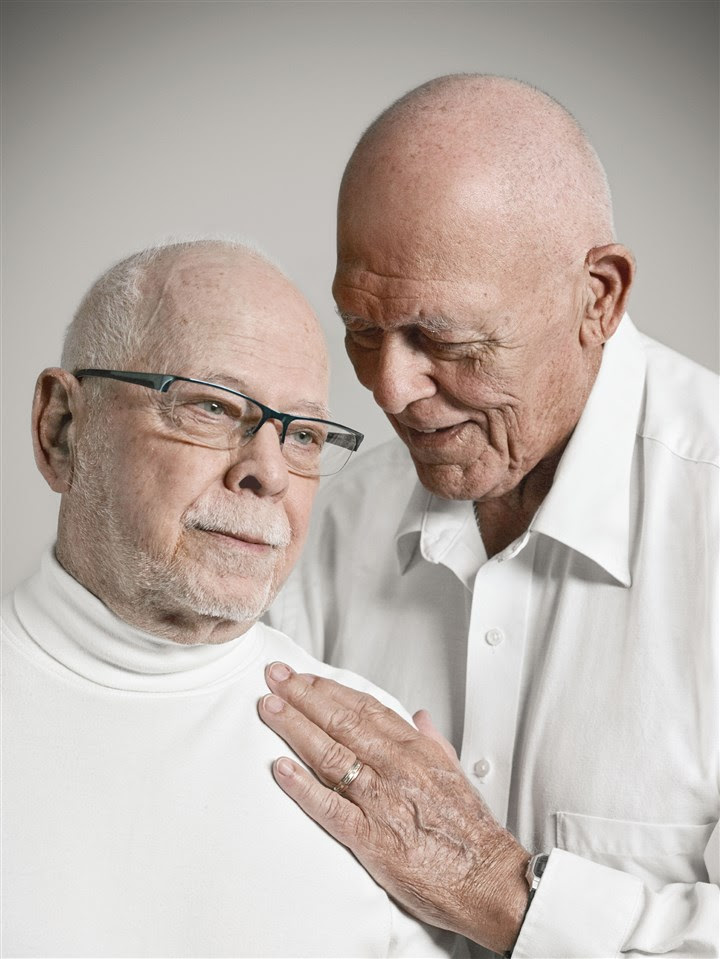 Not Another Second: LGBT+ Seniors Share Their Stories.