Join Sonoma Pride Bowling League at Double Decker Lanes in Rohnert Parl Tuesday Nights


President Donald Trump’s new acting chief of staff Mick Mulvaney has a history of anti-LGBT legislation and statements, including saying that encouraging countries to drop homophobic policies is “religious persecution.”
Mulvaney, who will become Trump’s third chief of staff in less than two years when he replaces General John Kelly in January, has also co-sponsored bills to ban same-sex marriage and allow anti-LGBT discrimination on the basis of religion.
In July, at the State Department’s Ministerial to Advance Religious Freedom, he lashed out at President Barack Obama’s government because “our US taxpayer dollars [were] used to discourage Christian values in other democratic countries.”
“That’s a different type of religious persecution.”
— Mick Mulvaney about opposing anti-LGBT policies
“It was stunning to me that my government under the previous administration would go to folks in sub-Saharan Africa and say… ‘We know you have a law against gay marriage, but if you enforce that law, we’re not going to give you any money,’” continued the 51-year-old.
“That’s a different type of religious persecution… That is a different type of religious persecution that I never expected to see.”
As director of the Office of Management and Budget, a role he’s held since February 2017, Mulvaney released a budget for the 2019 fiscal year which included cuts to domestic HIV/AIDS programmes and slashed $1 billion from global HIV programmes.
Human Rights Campaign (HRC)’s government affairs director David Stacy said at the time that the budget showed “a callous disregard for critical programmes that impact LGBTQ Americans” and created “a direct threat to the safety and well-being of LGBTQ people here and around the world.”
During his time in state government, he co-sponsored a law which banned same-sex marriage in South Carolina.
He also told lawmakers that the state government should stop “advertising South Carolina to gay tourists in Europe” before winning election to the House of Representatives in 2010.
The former South Carolina lawmaker scored zero on HRC’s Congressional Scorecardfor all three of his terms in the House, unwaveringly opposing LGBT+ rights.
It was while he was a congressman that he urged President Obama to enforce the Defence of Marriage Act, a federal law which defined marriage as being between a man and a woman, and which was eventually ruled unconstitutional.
Mulvaney also signed a letter questioning the Obama administration’s transgender guidance which allowed students to use their chosen facilities.
The letter criticised the guidance, which was revoked by the Trump administration just weeks into the president’s term, for forcing schools to “disregard the privacy, ‘discomfort,’ and emotional strain imposed on other students during use of bathroom, showering, and changing facilities.”
During a debate with Democrat Fran Person in 2016, Mulvaney said that he was supporting Trump in the upcoming presidential election despite thinking he was “a terrible human being,” The Daily Beast has reported.
On Tuesday (11 December), he signed the PEPFAR Extension Act of 2018. This program provides billions in funding and research for HIV prevention and treatment.
Created in 2003, the President’s Emergency Plan for AIDS Relief is the largest global health program targeted at one specific disease. Presidents George W. Bush and Barack Obama previously renewed it in 2008 and 2013, respectively.
This new bill extends the program and its funding until 2023.
Trump’s previous budget proposal for 2019 suggested cutting hundreds of millions from PEPFAR. According to reports, these cuts could have led to 300,000 AIDS-related deaths and 1.75 million new infections each year.
As a program, PEPFAR is the United States federal government’s answer to the global HIV/AIDS epidemic. President Bush and the Global AIDS Act of 2003 first established it.
According to their website, PEPFAR currently provides antiretroviral treatment for 14.6 million people.
Since its creation, it has received rare bipartisan support.
‘This is one of those rare examples in Washington. There’s been an incredible history of bipartisanship around PEPFAR that stands outside the rancor we hear about,’ Jennifer Kates, vice president and director for global health and HIV Policy at the Kaiser Family Foundation, told Vox.
It also works.
A 2009 study showed a significant reduction in the HIV death rate of African countries receiving PEPFAR support. The rate dropped by 10.5%.
Trump’s action signing this bill into laws comes of the heels of threats to slashing other HIV funding. These other research programs, however, are completely separate from PEPFAR.
They are much smaller in scale, with most of them taking place at university labs. The threats to their funding come from pro-life advocates and lobbyists angry about the labs using fetal tissue in their research.
The President and his administration have also failed to acknowledge the LGBTI communitywhen discussing the global HIV/AIDS epidemic.
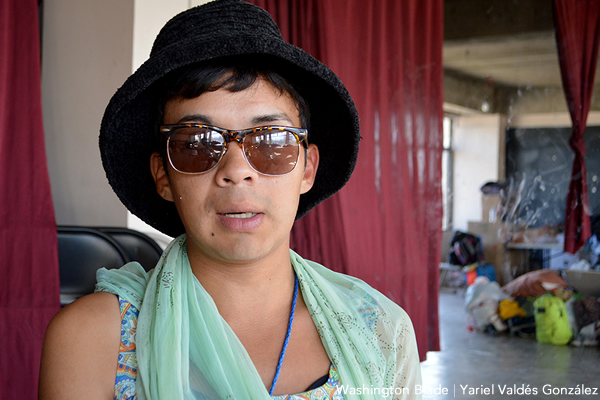
Melani Sofía Rosales Quiñones, a transgender woman from Guatemala City, was beaten, threatened and discriminated against in her country simply because of her gender identity (Washington Blade photo by Yariel Valdés González)
TIJUANA, Mexico — Melani Sofía Rosales Quiñones, a transgender woman from Guatemala City, was on her way home one night in July 2017 when she saw a group of homophobes waiting for her. She said good evening to them and that alone provoked an atrocious attack.“They hit me with bats and sticks,” Melani now recalls. “They broke my jaw and left jaw bone. I was in a coma in the hospital for three days and 15 days later I had surgery to reconstruct my face. They put in plates and screws. It took me four months to recover.”
A year later the gangs, who are full of hate and violence in Latin America, took over their house and turned it into a stash house. Melani’s mother never accepted this and filed a harassment complaint against the so-called “gangs.”
“They called my mom and threatened her as she was leaving the police station,” says Melani. “They said she can’t play with them and they will kill my younger brother who is 15.”
Melani shared part of her life with the Washington Blade from a guest house in downtown Tijuana where LGBTI members of the migrant caravan who arrived in this border city weeks earlier receive temporary refuge. Melani and other LGBTI migrants in Tijuana all hope to seek asylum in the U.S., a nation in which they think they can live without fear and with economic prosperity.
The LGBTI migrants, like other members of the caravan, are now scattered along Mexico’s northern border. They were a small group that faced abuse and mistreatment while traveling with the caravan itself before arriving in Mexico. Today the LGBTI migrants are nothing more than small and vulnerable groups scattered in Tijuana, Baja California state and Nogales, another border town in Sonora state.
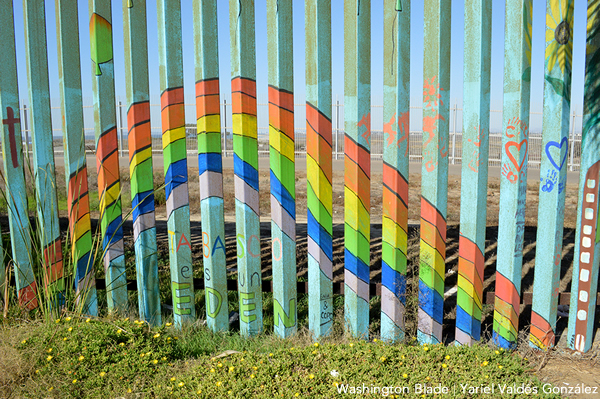
Crossing this wall and safely entering U.S. territory is the dream of the thousands of migrants who are stuck in Tijuana. They are only looking for an opportunity to live in the U.S. (Washington Blade photo by Yariel Valdés González)
It is not the first time that Melani has launched herself north in order to reach American soil. She “went up” to Tijuana in May of this year with another caravan, but another attack made her think twice. “I was very disappointed because Tijuana officials beat me when I went to the El Chaparral checkpoint,” she says. “I later went to the hospital and filed a complaint against the immigration officers.”
Melani returned to a small town between Guatemala and Mexico she says was “in no man’s land” with the hope that she could once again hit the road and seek the American dream at any moment. She was unable to return to Guatemala or Tijuana. She had almost become a hermit during that time. Melani, an extroverted and sociable girl, was living far away from people.
“I worked in a bakery and from there I went to my house without saying a word, without saying hello to anyone,” she adds.
Melani fled from a Guatemala, where violence is seen as a normal part of life and is worse for members of LGBTI communities. One report on the situation for LGBTI people in four Central American countries says they endure “insults, bribes, arbitrary detentions and physical attacks that often lead to murders, but they do not report them because of fear of reprisals.”
“LGBTI people live in fear and don’t depend on community support networks that help them deal with the violent scenarios in which they live,” reads the report.
The Observatory of Murdered Trans People notes 39 trans women were killed in Guatemala between January and July 2017. Guatemala has the sixth highest rate of trans murders out of any country in Latin America and the Caribbean.
Honduras’ National Commission for Human Rights says 40 LGBTI people have died between 2007 and May of this year. Cattrachas, a lesbian feminist network, indicates 288 LGBTI people have been killed in Honduras between 2009-2018.
Insecurity is not the only situation the Honduran LGBTI community faces. Infobae, an Argentina-based news website, once reported “there is no record of any trans person who has been hired by a private company or a government agency in Honduras.”
Amelia Frank-Vitale, an anthropologist at the University of Michigan who has spent more than a year living in Honduras studying issues related to deportation, migration and violence, confirmed to the Blade “people from the LGBTI community are exposed to all forms of violence that exists against any person in Honduras, which is mainly urban, young and poor.”
“But they are nevertheless discriminated against and stigmatized because of their sexual orientation and in many cases the government is absent on justice-related issues,” she added. “It is always more critical for the LGBTI community.”
It is this situation from which Alexis Rápalos and Solanyi, two identities that live inside the same robust 38-year-old body, fled.
Alexis was wearing a knit hat that covered a nearly shaved head when he spoke with the Blade.
He comes from a family with few resources and he revealed he has suffered the scourge of discrimination in the streets of his city, San Pedro Sula, which for four years was recognized as the world’s most dangerous city, since he was 10. He has lived alone since his mother died a year ago.
A tailor and a chef, he worked in a restaurant in his native country but he decided to join the caravan in search of a future with more security and a life without the harsh realities of rampant homophobia.
He left with nothing more than a pair of pants and a shirt in his backpack and joined the caravan at the Guatemala-Mexico border. “I was discovering friends in the caravan,” says Alexis. “And then the gay community. We came fighting, fighting many things because we are discriminated against, insulted constantly.”
“The road has been very hard,” he adds. “Sometimes we slept in very cold places, with storms. I had the flu with a horrible cough, people gave us medicine, clothes, thank God.”
They reached Tijuana by hitchhiking, and sometimes by bus while depending on charity groups to eat. “We arrived at the shelter that had been at the Benito Juárez Sports Complex, but we were in our own group. They treated us well with clothes, medicine and food,” he said, insisting he is thankful for the assistance he received while there.
Once at the shelter, where unsanitary conditions and overcrowding were a constant, they experienced homophobia that follows some of their fellow travelers and places them in an even worse situation than the rest of the migrants. Alexis says they were booed in food lines and there were times when they were not allowed to eat. The situation repeated itself in the cold outdoor showers where privacy was an unthinkable luxury.
He felt the harshness of the early morning cold while he and roughly 6,000 Central Americans were staying at the shelter that city officials set up. Alexis slept in the street because he didn’t have a tent to protect himself. The unusually heavy seasonal rains that soaked his meager belongings chilled him to the bone.
“In the (Benito Juárez) shelter we saw humiliations, criticisms and they even made us take down our gay flag,” says Bairon Paolo González Morena, a 27-year-old gay man from Guatemala. “We were discriminated against a lot. They told us we could not make the same line for food and they made us stand at the end of the line for the bathroom and here (at Enclave Caracol, a new shelter) they are treating us much better. They gave us our place. We have a separate bathroom and everything.”
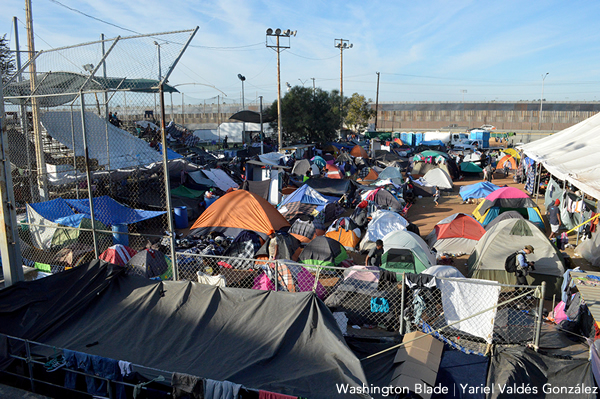
LGBTI members of the caravan that arrived in Tijuana were housed at the Benito Juárez Sports Complex that had been converted into a shelter. They were discriminated against by their fellow migrants. The LGBTI migrants were forced to take down their gay flag. They were also not allowed into food lines and were the last ones to use public showers. (Washington Blade photo by Yariel Valdés González)
Bairon was a cross-dresser known as Kaira Paola at night and was a sex worker, which left him with many scars on his body. “I worked to provide food for my twin brother and younger brother,” he says. “My family there found out that I was gay. My stepmother discriminated against me and my dad did not support me and until this day I am fighting for my well-being.”
He lived alone and decided to join the caravan because he was constantly extorted for money. He was already working in a restaurant in Tuxpan in Veracruz state when the migrants reached Mexico, and he didn’t think twice about joining the caravan that Frank-Vitale says is “a civil disobedience movement against a global regime.”
“The caravan is the form that has been recognized as the way one can cross Mexico without being as exposed to criminal groups, corrupt authorities and without paying a smuggler to seek an opportunity to live,” she says.
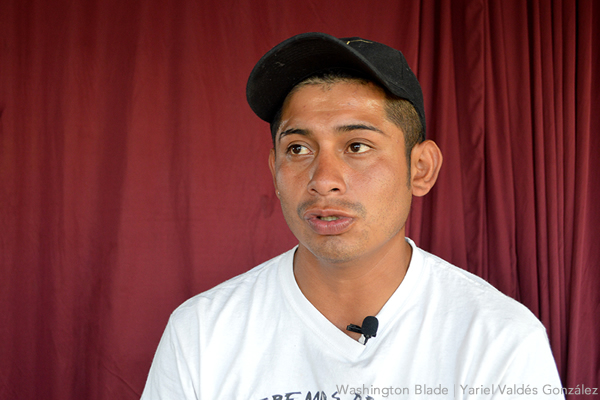
Paolo González Morena, a 27-year-old gay man from Guatemala, was a sex worker in his country and was constantly extorted and mistreated because of his sexual orientation. (Washington Blade photo by Yariel Valdés González)
A long line has formed outside Enclave Caracol, a community center located on First Street in downtown Tijuana that has welcomed this portion of the LGBTI caravan that arrived weeks after the first.
Under tents, the migrants organize themselves to distribute food they prepared themselves inside the building in which a wedding for several gay couples took place weeks earlier.
Nacho, who asked the Blade only to use his first name, works for Enclave Caracol. He said (he and his colleagues) are supporting “the community with food and water, (allowing them to) use the bathroom, Internet access, use of telephones that allows them to call practically any part of the world and at some moments it has functioned as a shelter.”
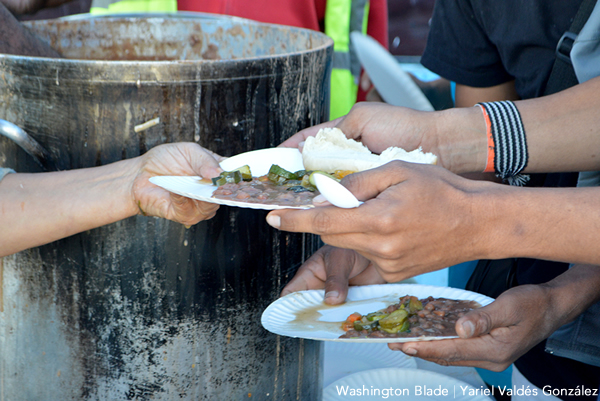
At same migrants who receive services at Enclave Caracol have cooked and organized their lives there. Donations from members of civil society in various cities have made it possible for Enclave Caracol to provide assistance to the dozens of migrants who are taking shelter there. (Washington Blade photo by Yariel Valdés González)
Enclave Caracol’s employees were the ones who cooked most of the food and did the cleaning when the center first provided aid to these displaced people. But Nacho says “people from the caravan have been getting involved bit by bit.”
“No one from Enclave has actually ever been in the kitchen,” he tells the Blade. “Over the last few weeks we have received donations and we have also been going to the markets for leftover fruits and vegetables and we clean them, process them and they’re cooked. They are organizing the cleaning and delivery of food themselves.”
Nacho said many civil society members in Los Angeles, San Diego and in Tijuana itself are donating money, food, cleaning products, disposable plates and cups to alleviate the tense situation that exists with the arrival of thousands of migrants, many of whom have not begun the political asylum process, to this urban border city. These civil society members are also volunteering their time.
“There is a very long list of people who are seeking asylum, who have been brought to the port of entry and are looking to following the correct process under international law,” says Frank-Vitale, noting the U.S. asylum process has been made intentionally difficult. “It has been said that they are going to have to wait up to two months to have the opportunity to make their case and this is truly a deadly humanitarian crisis for vulnerable people who have fled persecution, who live in the rain, the cold, outside all this time.”
“Sometimes one becomes hopeless because there is no stable place,” says Alexis, who remains hopeful. “We are going from here to there. They say that today they are going to bring us to another house to wait for lawyers who are going to help us with our papers.”
Melani is nevertheless more realistic when speaking about her asylum claim. “Our situation is a bit difficult because many people continue to arrive,” she says. “Donald Trump closed the border and the crossing is very complicated. This is why people who are going to the border are under stress.”
Frank-Vitale thinks the actual asylum system should be changed in order to recognize modern forms of violence and persecution to which people are exposed and especially LGBTI groups. “Taking all of this into account, yes, it is possible,” she says. “There are cases from Central America that perfectly enter the system, always and when they have a founded fear of their lives in their countries and many people have a very real fear.”
This fear, which has been with Melani for most of her life, will follow her to the U.S., because in “the previous caravan there was a girl named Roxana (Hernández) who died because she had HIV, but the autopsy revealed that she had been beaten by U.S. Immigration and Customs Enforcement (ICE) officials.”
The original autopsy performed on Hernández, a trans Honduran woman with HIV who died in ICE custody in New Mexico on May 25, lists the cause of death as cardiac arrest. The second autopsy to which Melani referred shows Hernández was beaten, but does not identify who attacked her while she was in custody.
Hernández’s case has reached the U.S. Senate with three senators recently asking U.S. Customs and Border Protection to provide them with documents relating to her death.
In spite of all of these situations, in spite of a xenophobic president who commands the other side of the border, in spite of a powerful army positioned on the border, in spite of the long lines to be heard, in spite of the constant uncertainty, Bairon remains firm in his decision: “We are here. With everything we have given up, I will not return.”
We already know why.
Occupy Sonoma County Presents
A community conversation with facilitators Bill Say and Debbie Notkin:
Trans Rights & Radical Feminism: An Opening Dialog
Monday, January 14, 5:00-9:00PM
Peace & Justice Center, 467 Sebastopol Ave., Santa Rosa, CA 95401
C0-Sponsored by National Organization for Women Sonoma County and Positive Images
Free (donations welcome!) with healthy snacks provided
This large circle, facilitated exploration event is for activists, LGBTQ+, feminists, radical feminists, trans activists, queers and allies. In an honest and open environment with respectful and supportive facilitation, we will address concerns that have emerged between trans rights activists and radical feminists. We especially invite and encourage members from these communities to attend.
This will be publicized only within the activist and LGBTQ+ community and not to the general public. Please share this invitation within your own circles, groups and newsletters
to invite people impacted by this issue.
Carpools from outside Sonoma County may be available to
encourage participation from the greater SF Bay area.
Bill Say and Debbie Notkin use Process Work, a multi-disciplinary approach to individual, group, and collective change. One of Process Work’s main philosophies is Deep Democracy, the idea
that all people, perspectives, and parts contribute to sustainable solutions.
Bill Say focuses on the intersection of diversity awareness, conflict resolution, leadership, team and
community development. For more information about Bill Say, visit his website at billsay.com
Debbie Notkin uses process work and other facilitation skills in her life and political work in her home city of Oakland, and the surrounding area. She has conducted several successful facilitations for Occupy Sonoma County.
Process Work focuses on the process-oriented facilitation and study of conflicts on all levels of human experience: from the inner dynamics of personality, personal history and psychological conflicts, to the interpersonal conflicts that arise in relationships, families, teams, organizations and the broader human society. Individual and group paradigms on their own can only explain part of human behavior. Process work develops the ability to follow a process between individual, relationship, and group levels of
experience.
For more information about Process Work go to processwork.org or processwork.edu/what-isprocesswork
Contact: OccupySonomaCounty.org or call 707-877-6650 (contact through our website is preferred.)
Occupy Sonoma County embraces the egalitarian, deep democracy principles of the Occupy Movement with a regional strategy for effectively organizing countywide social justice campaigns that are globally relevant.
A committee in the United States House of Representatives has delayed a hearing on the national minimum wage after discovering anti-gay and sexist remarks a witness wrote 16 years ago.
Joseph Sabia, San Diego State University economist, was supposed to testify today for the House Subcommittee on Workforce Protections.
When they unearthed comments from 2002 on his blog, No Shades of Gray, however, they decided to postpone.
Several posts with these comments are archived online.
In in August 2002 post, he compared taxing the fast food industry for its bad health outcomes to taxing homosexual activity.
‘When two random men get together and choose to have sex, there is not an insignificant risk of infection and death,’ he wrote. ‘In gay sex, we have an activity that is clearly leading to disastrous health consequences. What rational person would engage in this sort of activity?’

Sabia’s post about taxing homosexuality | Photo: No Shades of Gray/Web Archive
In another post, Sabia said universities with women’s studies departments encourage young women to be ‘whores’.
He also wrote: ‘Feminist thought has taught young women that equality is achieved by acting like promiscuous sluts.’
Sabia addressed these writings in an emailed statement to Politico.
‘I regret the hurtful and disrespectful language I used as a satirical college opinion writer,’ he said.
He added, however, that now as an ‘out gay man… accusations of homophobia stemming from college nonsense I wrote nearly 20 years ago are hurtful to my family today’.
At San Diego State, Sabia is director of the Center for Health Economics and Policy Studies. His research focuses on ‘the economics of risky health behaviors, minimum wage policy, labor market discrimination against sexual minorities’, which he also mentioned in his statement.
‘My academic research has studied a variety of subjects, including discrimination against the LGBTQ community. My peer-reviewed scholarship on this topic brings me great pride.’
According to Kelley McNabb, communications director for the committee’s majority, the decision to postpone stemmed from members being ‘uncomfortable moving forward’.
Democrats, though, are angry Republicans postponed the hearing entirely.
‘My Republican colleagues on the committee should have issued a strong rebuke disavowing this witness and let the hearing go on,’ said Rep. Mark Takano (D-CA).
‘It is unfortunate that this hearing will not be happening because of my Republican colleagues’ oversight of the repulsive views of one of their witnesses.’
The hearing was meant to discuss raising the hourly minimum wage to $15, something long advocated by Democrats.
San Diego State also released a statement in response:
‘The language and sentiments expressed in these posts are counter to the values of any institution which supports the principles of diversity and inclusion.
‘SDSU unequivocally rejects any sentiment which seeks to undermine or devalue the dignity of any person based on their gender, orientation, ability, or any other difference among people which has been an excuse for misunderstanding, dissension or hatred.’
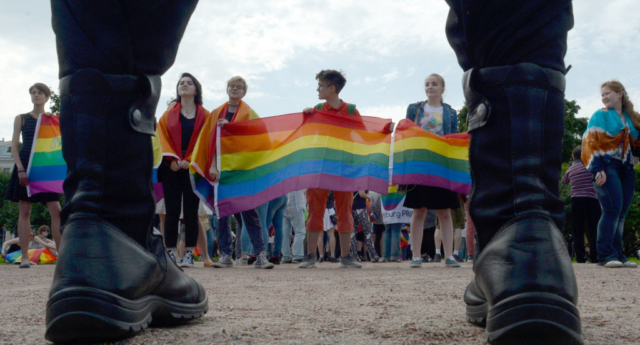
Russia’s “gay propaganda” law is directly harming and endangering LGBT+ children and young people, according to a new report.
The report – which is called “No Support: Russia’s ‘Gay Propaganda’ Law Imperils LGBT Youth” – was released today by Human Rights Watch, and runs to 92 pages.
The human rights group found that the law, which was implemented in 2013, exacerbated hostility towards LGBT+ people in Russia.
They also found that the law has prevented LGBT+ people from accessing inclusive education and support services, and that this has had a detrimental impact on children and young people.
Human Rights Watch interviewed LGBT+ young people in Russia to gain an understanding of the impact the law is having on Russian youth.
The interviews pointed to an intensification of stigma, harassment and violence against LGBT+ people since the law was passed in 2013.
Human Rights Watch also found that the law was preventing mental health professionals from offering the necessary support to LGBT+ youth.
One transgender person, who is 18 years old, told Human Rights Watch that LGBT+ people in Russia now fear getting beaten on the street.
“We know that most people believe the mass media, and the stories there teach them that we are horrible creatures, so we are in danger all the time.”
Another young person – an 18 year old university student – said the law was akin to “cutting off air” from the LGBT+ community.
Meanwhile, a 14 year old lesbian told Human Rights Watch that the law gives homophobes free rein, and said that LGBT+ people “are afraid to organise prides and demonstrations.”
She also said that LGBT+ people are afraid of being “beaten or humiliated” as the offenders would likely go unpunished.
Dr Ilan Meyer, an expert in social psychology and public health who submitted testimony about the law to the European Court of Human Rights, said that the law has a “serious negative impact” on LGBT+ young people.
“The law increases and enshrines stigma and prejudice, leading to discrimination and violence,” he added.
The report also issued a series of recommendations to Russia’s government concerning the law.
Human Rights Watch has asked the President of the Russian Federation to issue a public statement “condemning the use of hate speech towards LGBT+ people.”
They also asked the government to repeal the “gay propaganda” law, and to repeal or amend other laws that foster discrimination against LGBT+ people.
The group has also called on the Russian government to introduce legislation that would protect the rights “of all LGBT+ people, including children.” They recommend laws to combat discrimination in public services, among others.
The report also asks the European Union and other member states to heap pressure on the Russian government to repeal the law.
The Russian “gay propaganda” law has been a source of controversy ever since it was enacted in 2013.
Earlier this month, police confiscated 17 drawings from a school in Yekateringburg for “promoting homosexuality.”
Meanwhile, the European Court of Human Rights ruled in November that Russia’s ban of pride events was violating LGBT+ people’s human rights.
Ruling against Russia, the court found that “the ban on holding LGBT public assemblies… did not correspond to a pressing social need and was thus not necessary in a democratic society.”
Last August, there was international uproar when a 16 year old boy was found guilty under the gay propaganda law for posting pictures online.
In October, he had his sentence overturned after his case was reviewed and it was decided that there was not enough evidence.
152 elected officials in the US have signed an open letter urging the incoming Congress to prioritize a series of LGBTI rights initiatives.
The list of priorities include protections of trans constituents, amending the Civil Rights Act of 1964 to include sex, sexual orientation, and gender identity, focussing on HIV/AIDS treatments, and supporting asylum claims from LGBTI people who face persecution in their home nations.
The letter lists its signatories as including ‘Members of Congress, Governors, State Legislators, Mayors, City Councilmembers and School Board Members’.
The officials wrote the letter last week at a conference which was hosted by the Victory Institute, an organization which focusses on the training and support of LGBTI candidates.
The letter will be sent to the 116th Congress at a later date, The Hill reports.
In a statement, president and CEO of the Victory Institute, Annise Parker, said that the letter was a further indication of greater LGBTI representation and influence on US politics.
‘LGBTQ political power is growing thanks to the rainbow wave of LGBTQ people who won elected office in November — and this letter is the first sign of us wielding that new power,’ said Parker, who is also the mayor of Houston.
‘The current U.S. Congress failed to advance equality policies and legislation that most Americans support: non-discrimination protections, addressing the HIV/AIDS crisis, protecting trans people from abusive policies, and being a moral voice on the global stage.
‘The next Congress can remedy these wrongs and LGBTQ elected officials are determined to add their voice and energize their constituents around these important measures,’ she added.
The letter condemns the Trump administration for proposing ‘anti-trans’ policies, such as bans on trans people serving in the military, and the revocation of Obama-era federal guidelines which allow trans students to use public toilets aligning with their gender identity.
The calls for supporting asylum claims also come during a time the White House has faced severe criticism from LGBTI rights groups for its attempts to block asylum seekers from entering the US.
The midterm elections from November saw an unprecedented number of LGBTI candidates being elected to official positions throughout the US.
Though the elections failed to produce the ‘blue wave’ many Democrats had hoped for, many analysists said that America had experienced a ‘rainbow wave’ during the midterms.
Of the 432 openly LGBTI candidates to run, 240 (or 56.5%) won their elections.
This included Kyrsten Sinema, who will be the first openly bisexual senator in US history. Sinema was also the first Democrat to be elected to the Senate by voters Arizona since 1988.
Jared Polis also made history by becoming the first openly gay man elected as a state governor. Democratic candidate Polis won Colorado’s gubernatorial race by claiming 52% of the vote.

A Kansas lawmaker has defected from the Republican party to the Democrats over the GOP’s anti-trans efforts.
Senator Barbara Bollier, who represents Mission Hills in Kansas City, also stated Trump as a major factor in her decision to defect.
Talking about her defection, the lawmaker told the Shawnee Mission Post: ‘Morally, the party is not going where my compass resides.
‘I’m looking forward to being in a party that represents the ideals that I do, including Medicaid expansion and funding our K-12 schools.’
However, her decision came after the state party adopted a heavily-criticized resolution in February 2018 that would attempt to eliminate trans identities. It read: ‘We believe God created two genders, male and female.”
Bollier said this motivated her decision: ‘That was my final, last straw. I support the people of Kansas. I do not condemn whoever they are.’
The defection still keeps the Republicans in control of the state government. There are now 10 Democrat seats to 40 GOP. The state senate is the upper house in the USA’s individual states’ legislature.
Bollier has been at odds with Republican leadership for awhile now. In the 2018 Midterms, she backed Democrat Laura Kelly for Governor of Kansas. Kelly won the election, including a majority in the district Bollier represents.
That same district also overwhelming voted for Sharice Davids, who is a lesbian woman and native American, for Congress in the midterms.

$85 VIP Meet & Greet:
He is the creator and star of the long-running BroadwayWorld.com web series Chewing the Scenery with Randy Rainbow and Last Minute with Randy Rainbow.
Randy Rainbow (yes, real name) is a comedian, actor, writer, host and Internet sensation best known for his viral comedy videos. His popular series of political spoofs and song parodies have garnered international acclaim and over a hundred million views. He’s been called “the best thing about the 2016 GOP race” by Dan Savage and his musical tribute to the first presidential debate of 2016 “BRAGGADOCIOUS!” received 28 million views in its first two days. He was subsequently asked by the cast of TV’s Will & Grace to parodize a song, which they performed during a political fundraiser for the 2016 election. Randy has also written for comedian Kathy Griffin and hosted and performed in numerous theatrical events for the Broadway, cabaret and gay communities, as well as for the Tony Awards and some of New York City’s most popular night spots including 54 Below, Birdland Jazz Club, XL Nightclub and Therapy NYC where his own weekly show ran for two years. He’s been seen as a talking head on VH1 and has been heard regularly as both a guest and co-host on Sirius XM Radio. He is the creator and star of the long-running BroadwayWorld.com web series Chewing the Scenery with Randy Rainbow and Last Minute with Randy Rainbow.