A man who allegedly threatened to harm the LGBTQ community with explosives and twice stole a rainbow flag from the Guerneville Chamber of Commerce made an appearance in court Tuesday.
It began with a pride flag stolen, and then tossed into the Russian River. Today, the story entered a new phase in Sonoma County Superior Court. It has been symbolic from the start. “Every time he is in court, I will be here,” said Beth Sheets, who joined several other people in watching proceedings.
The flag, symbolizing LGBTQ pride, was stolen on April 26 from the building at 16201 First Street in the unincorporated area of Guerneville in Sonoma County.
The building arranged for a replacement, but the flag was again stolen on May 5. According to Sonoma County’s website, Guerneville became a “welcoming resort area for Bay Area gay men and lesbians” in the 1970’s.
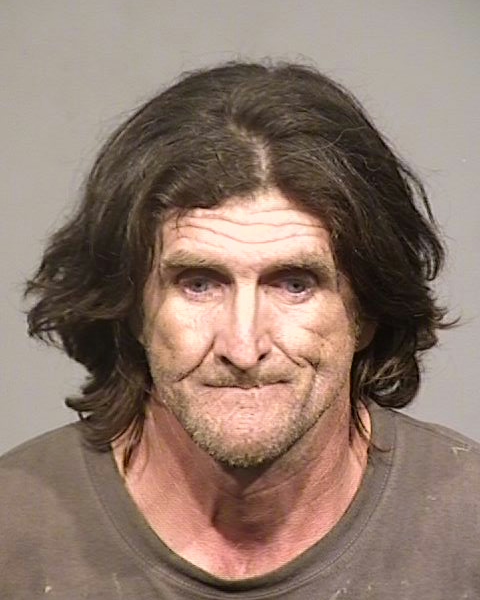
A man named Vincent O’Sullivan, 55, is seen in this undated image.
This marked the first appearance of Vincent Joseph O’Sullivan, Jr. following his arrest last weekend. He pleaded not guilty to misdemeanor charges Tuesday of stealing a pride flag from the county flagpole in Guerneville, and also to felony charges of a hate crime by threatening to blow up gay people, a grocery store, and sheriff’s substation with a pipe bomb.
“It is a terrorist threat. He did not take action to carry out that act,” said Sonoma County Sherriff’s Department spokesman, Sgt. Spencer Crum.
In open-minded and permissive Guerneville, both alleged crimes resonate disturbingly. Hence, a large group who came to court today. “We’re here to protect ourselves from people who want to blow us up,” said Guerneville resident Jennifer Wentz.
“It is about a community of people who have been discriminated against,” added Beth Streets.
Beth Streets had lobbied with the county to place that pride flag in the town square, beneath the American and California flags. A surveillance video from last week shows two men. One of them covers the camera’s lens, and then the flag disappears. The thieves reportedly left a warning signed in the name of veterans. David Juarez told us today that the notes certainly do not speak for him. “I was leery of coming here. My husband said as a veteran and openly gay person you have to do that.”
So he did, and they did.
They will continue to be on hand as the cases move forward.
You might call it a matter of pride and principle.
NLGJA – The Association of LGBTQ Journalists is excited to announce that Entertainment Weekly Editor-in-Chief Henry Goldblatt will receive the Lisa Ben Award for Achievement in Features Coverage at its annual L.A. Exclusive benefit event on Friday, June 1. INTO Editor-in-Chief Zach Stafford and CBS News correspondent Jamie Yuccas will serve as co-hosts of the event.
Each year L.A. Exclusive brings together some of the nation’s top journalists at the Los Angeles LGBT Center’s The Village at Ed Gould Plaza, 1125 N. McCadden Place, to show support for NLGJA’s mission to advance fair and accurate LGBTQ coverage. The event is chaired by NLGJA national board member Senta Scarborough.
“We are extremely proud to have Jamie and Zach serve as co-hosts this year,” said NLGJA Executive Director Adam K. Pawlus. “We are also beyond excited to present our Lisa Ben Award to Henry Goldblatt, whose work to cover the LGBTQ community at Entertainment Weekly has exemplified NLGJA’s values.”
Goldblatt was named editor-in-chief of Entertainment Weekly in 2015, where he previously served as the brand’s deputy managing editor and director of brand development. In 2014, Goldblatt was named deputy editor of PEOPLE where he provided editorial oversight to all brand extensions, ran the magazine’s front-of-book sections and managed staffing, budgets and publishing/editorial collaborations. A 20-year veteran of Time Inc., Henry Goldblatt began his career as a reporter at Fortune where he wrote about the media business and ran the magazine’s news coverage. In 2002, he moved to EW and was instrumental in integrating the brand’s print and digital editorial operations. Goldblatt was named one of Columbia Journalism Review’s “Ten Young Editors to Watch” and won a New England Press Association award for articles on AIDS awareness.
Stafford is the editor-in-chief of INTO, a new digital lifestyle magazine launched by Grindr in 2017. Prior to this role, Zach served editor-at-large of OUT Magazine and as an award-winning investigative reporter at The Guardian, where he covered justice, violence and social issues in both his column and long-form features. He regularly provides commentary on radio, podcasts and has appeared on the BBC, CNN and “The Daily Show with Trevor Noah”. And he also is the co-editor of the bestselling book “Boys, An Anthology,” as well as his latest photo-essay book, “When Dogs Heal,” which explores the lives of HIV+ people and the pets that saved their lives.
Yuccas is a CBS News correspondent based in Los Angeles. Yuccas joined CBS News as a New York-based correspondent for CBS Newspath in August 2015. Her reporting has been featured across all CBS News broadcasts and platforms. During her time at CBS News, Yuccas has covered high-profile stories including Orlando’s Pulse nightclub shooting, the 2016 Rio Summer Olympics and the 2016 presidential campaign. Yuccas joined CBS Newspath from WCCO-TV, the CBS owned and operated station in Minneapolis where she had been a morning anchor and general assignment reporter since 2011. While there, she won two Emmy Awards and contributed reporting to the “CBS Evening News” and “CBS This Morning” for breaking news stories in the Midwest, including flooding in Minot, N.D., the Minnesota state government shutdown and winter weather and flooding across the region. She also won an Emmy Award for coverage of Hurricane Sandy in 2012.
About NLGJA – The Association of LGBTQ Journalists:
NLGJA is an organization of journalists, news executives, media professionals, educators and students working from within the news industry to foster fair and accurate coverage of LGBTQ issues. NLGJA opposes all forms of workplace bias and provides professional development to its members. For more information, visit www.nlgja.org.
The Department of Justice wants to stop collecting data about the sexual orientation and gender identity of 16- and 17-year-olds, officials announced this week.
The National Crime Victimization Survey is a twice-annual report that collects the data of up to 135 thousand households to understand the “frequency, characteristics, and consequences” of crime in the United States, according to the Bureau of Justice Statistics. Since 2016, the NCVS has given participants 16 and older the option to confidentially list their sexual orientation and gender identity. The survey has been especially useful for acknowledging under-reported crimes.
In a statement released on Wednesday, the DOJ announced its intentions to raise the minimum age “due to concerns about the potential sensitivity of these questions for adolescents.”
The move drew a quick rebuke from advocacy groups, including the University of California-Los Angeles’ Williams Institute, a think tank dedicated to LGBTQ+ research and public policy. In a statement, the Williams Institute argued for the necessity of the data, saying it was essential for understanding violence against LGBTQ+ groups.
“The Bureau of Justice Statistics at the Department of Justice has been a leader in advancing knowledge about the LGBTQ+ population, but the Bureau’s new leadership seems to want to bury its head in the sand,” Director of Federal Policy Adam Romero says in the statement.
This point was echoed by another advocacy group, New York-based Gay, Lesbian & Straight Education Network. “What’s measured is what matters when it comes to public policy,” said executive director Eliza Byard to Mother Jones.
For instance, in August 2016, the Center for Disease Control and Prevention published data that detailed the health disparities and high rates of violence suffered by lesbian, gay, and bisexual high school students. The groundbreaking report has been “hugely important for designing public health programs run out of the CDC,” according to Byard.
On the CDC’s own website, the agency states, “Collecting information about students’ sexual identity and about the sex of their sexual contacts is necessary.”
While LGBTQ+ advocacy groups do not deny the sensitivity of the questions, they find the DOJ’s argument disingenuous. “Youth have been answering questions about their sexual orientation for years, in numerous studies, as well as on federal surveys,” said Kerith J. Conron, Blachford-Cooper Research Director and Distinguished Scholar at the Williams Institute.
Conron points out that two other national surveys have asked similar questions to even younger respondents. The 2015 Youth Behavior Risk Survey included respondents as young as 13, and the National Survey of Family Growth polls subjects as young as 15.
“We know that LGBTQ+ youth are more likely to be victimized, sometimes by their own families, and we need data from the NCVS to learn whether crimes are reported and how the criminal justice system is responding to young LGBTQ+ victims,” said Conron. “Instead of dropping these items from the NCVS, which were cognitively tested and performed well, the Department of Justice should focus on making it easier for youth to answer questions by investigating strategies to improve the data collection process.”
This latest move falls into a strategy of the Trump administration to ignore LGBTQ+ people into bureaucratic nonexistence, denying them use of government protection and services. For historically marginalized groups, the political nostalgia of “Make America Great Again” always represented a red flag of regressive policy. There is no “again” for racial, ethnic, sexual, or gender minorities; there is only the hard-won progress accrued over the last few decades and the current threat to that progress.
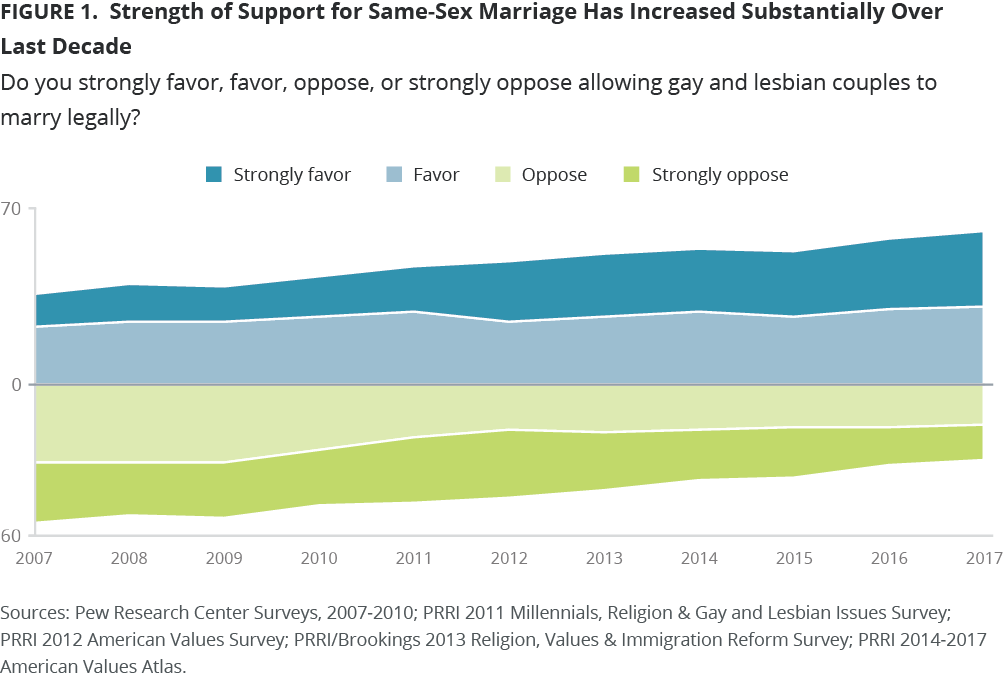
Since the U.S. Supreme Court ruled in 2015 that same sex couples have a constitutional right to marry, support for same-sex marriage has increased substantially. Currently, more than six in ten (61%) Americans say gay and lesbian couples should be able to marry legally, while only about half as many (30%) are opposed.
Strength of support for same-sex marriage has increased dramatically over the past decade, while strength of opposition has fallen in nearly equal measure. Today, Americans who strongly favor same-sex marriage outnumber those who strongly oppose it by more than a two-to-one margin (30% vs. 14%). In 2007, only 13% of the public strongly favored same-sex marriage, while nearly one-quarter (24%) strongly opposed it.1 Much of this shift has occurred within the last five years. As recently as 2013, more than four in ten (42%) Americans opposed same-sex marriage, including about one in four (23%) who strongly opposed it.2 Over the last five years, strong supporters of same-sex marriage increased only modestly, from 25% to 30%.
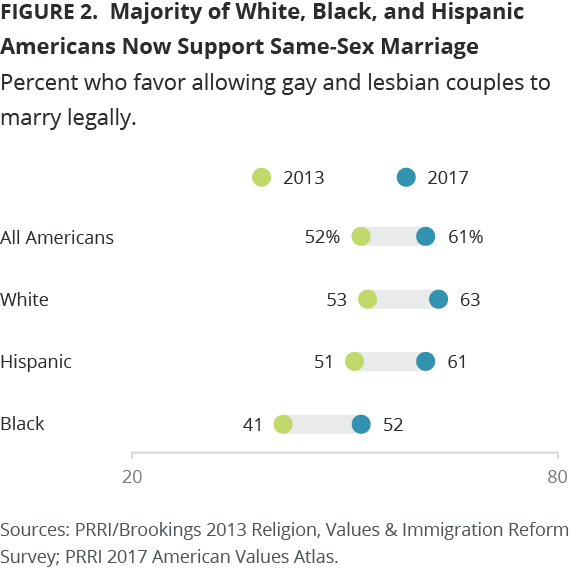
The rise in support for same-sex marriage, particularly over the last few years, has led to a milestone: Today a majority of all racial and ethnic groups favor allowing gay and lesbian couples to marry legally. Between 2013 and 2017, we have seen a double-digit increase in support for same-sex marriage among white (53% vs. 63%), black (41% vs. 52%), and Hispanic (51% vs. 61%) Americans.3 Currently, about four in ten (39%) black Americans, three in ten (30%) white Americans, and only about one-quarter (26%) of Hispanic Americans oppose same-sex marriage. Majorities of smaller racial and ethnic groups also support same-sex marriage today, including Asian-Pacific Islander Americans (72 percent), Native Americans (56 percent), and those identifying as multiracial or with another racial and ethnic group (66 percent).
Conservative Republican Holdouts
Partisan gaps in views of same-sex marriage persist, even as the public has become more supportive of the policy overall. Nearly three-quarters (73%) of Democrats and about two-thirds (66%) of independents favor same-sex marriage, compared to only 42% of Republicans. A slim majority (51%) of Republicans oppose same-sex marriage. However, opposition is mostly confined to conservative Republicans. Nearly six in ten liberal (58%) and moderate (59%) Republicans favor same-sex marriage, compared to only 36% of conservative Republicans. About six in ten (58%) conservative Republicans oppose it.
Among Democrats, as well, there is a considerable ideological divide. Nearly nine in ten (87%) liberal Democrats say same-sex marriage should be legal, compared to 67% of moderate and 52% of conservative Democrats. Four in ten (40%) conservative Democrats oppose same-sex marriage.
Liberal independents are roughly as supportive of same-sex marriage as liberal Democrats. More than eight in ten (82%) liberal independents favor same-sex marriage, compared to nearly three-quarters (73%) of moderate independents and fewer than half (49%) of conservative independents. More than four in ten (41%) conservative independents oppose allowing gay and lesbian couples to marry.
Declining Religious Resistance
Most religious groups in the U.S. now support same-sex marriage, including overwhelming majorities of Unitarians (97%), Buddhists (80%), the religiously unaffiliated (80%), Jewish Americans (77%), and Hindus (75%). Roughly two-thirds of white mainline Protestants (67%), white Catholics (66%), Orthodox Christians (66%), and Hispanic Catholics (65%) also favor same-sex marriage. A slim majority of Muslims (51%) favor same-sex marriage, but only 34% are opposed; 15% offer no opinion on this issue.
Over the last five years, opposition to same-sex marriage among nonwhite Protestants has dropped considerably. Most notably, black Protestants have moved from solid opposition to a plurality of support for same-sex marriage. In 2013, nearly six in ten (57%) black Protestants opposed same-sex marriage.4 Today just 43% oppose it, compared to nearly half (48%) who support it. Hispanic Protestants have moved from solid opposition to same-sex marriage to being divided over the policy. In 2013, nearly two-thirds (65%) of Hispanic Protestants opposed same-sex marriage. Today, 43% favor the policy, compared to 45% who oppose it and 13% who offer no opinion.
Opposition to same-sex marriage is now confined to a few of the most conservative Christian religious traditions. Only about one-third (34%) of white evangelical Protestants support same-sex marriage today, while nearly six in ten (58%) are opposed, including 30% who are strongly opposed. And just 40% of Mormons support same-sex marriage, compared to 53% who are opposed. Jehovah’s Witnesses, a racially mixed religious group, are the exception. Just 13% support the policy, compared to 63% who oppose it. However, nearly one-quarter (24%) of Jehovah’s Witnesses express no opinion on this issue.
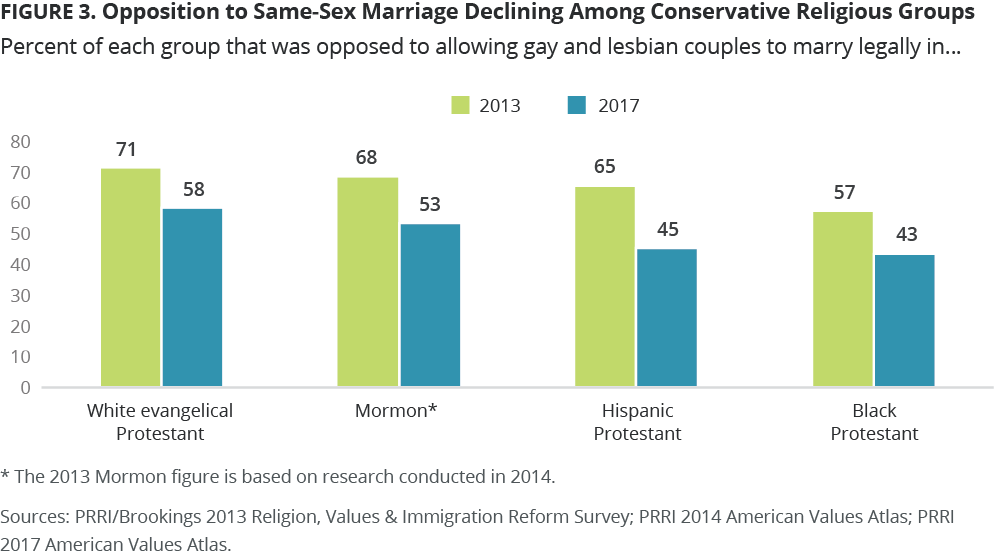
Nevertheless, even those religious groups most opposed to same-sex marriage have become more accepting of it over the last five years. Since 2013, opposition to same-sex marriage has dropped 13 percentage points among white evangelical Protestants (from 71% in 2013 to 58% today).5 Over a similar time period, opposition among Mormons has dropped 15 percentage points (from 68% in 2014 to 53% today).6
Opposition to Same-Sex Marriage Declining Among Conservative Religious Groups
The Coming Generational Realignment
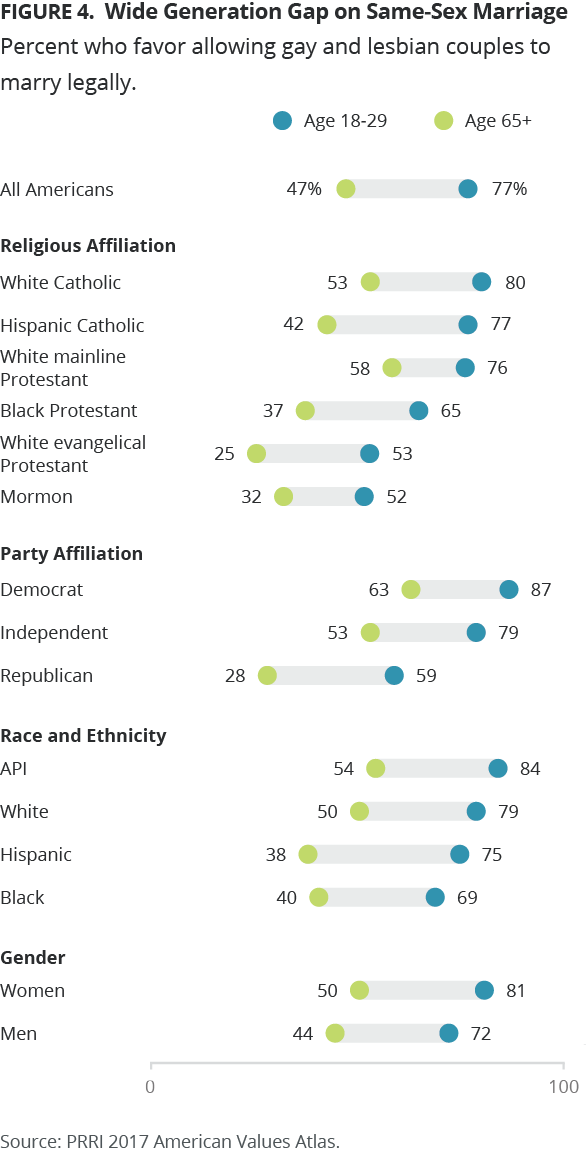
The issue of same-sex marriage is approaching consensus among young adults (age 18 to 29). More than three-quarters (77%) favor legalizing same-sex marriage, including nearly half (45%) who strongly favor it. Only 17% of young adults are opposed. In contrast, fewer than half (47%) of seniors (age 65 and up) say same-sex marriage should be legal, while about four in ten (42%) oppose it. Ten percent of seniors express no opinion on the issue. Notably, there is an increase in support at both ends of the generational spectrum, although more movement occurred among older Americans. Support for same-sex marriage among young adults is up five percentage points from 72% in 2013, and support among seniors is up 11 percentage points from just 36% in 2013.7
The generational divide cuts through every demographic group in the U.S. Even in groups most opposed to same-sex marriage, a majority of young adults favor this policy. A majority (53%) of young white evangelical Protestants favor legalizing same-sex marriage, compared to just one-quarter (25%) of white evangelical seniors. A majority (52%) of young Mormons also believe same-sex marriage should be legal, while only about one-third (32%) of Mormon seniors agree.8 While only 37% of black Protestant seniors favor same-sex marriage, nearly two-thirds (65%) of young black Protestants support it.
Wide Generation Gap on Same-Sex Marriage
The generation gap is larger among Republicans than Democrats. Young Republicans are more than twice as likely as senior Republicans to favor same-sex marriage (59% vs. 28%). In contrast, Democratic young adults and seniors largely agree on same-sex marriage (87% and 63% support it, respectively).
Among no racial or ethnic group is the generation gap wider than Hispanic Americans. Three-quarters (75%) of young Hispanics favor same-sex marriage, compared to only 38% of Hispanic seniors, a gap of 37 percentage points. Among white Americans, roughly eight in ten (79%) young adults favor same-sex marriage, compared to half (50%) of white seniors. And close to seven in ten (69%) young black Americans express support for same-sex marriage, compared to only 40% of black seniors. Finally, majorities of both young (84%) and senior (54%) Asian-Pacific Islander Americans favor same-sex marriage.
Enduring Gender Divides
More women than men in the U.S. support allowing same-sex couples to marry. Roughly two-thirds (65%) of women overall favor same-sex marriage, compared to fewer than six in ten (58%) men. The gender gap crosses lines of race and ethnicity, although its size varies substantially from group to group. Two-thirds (67%) of white women and fewer than six in ten (59%) white men favor same-sex marriage. Among Hispanic Americans, 64% of women favor it, compared to 57% of Hispanic men. And though support is much higher overall among API Americans than other ethnic groups, API women still express greater support than men (76% vs. 67%). Black Americans stand out here in not displaying a gender gap: Similar numbers of black women (53%) and men (50%) favor same-sex marriage.
Notably, the gender gap is slightly larger among young adults than older Americans. More than eight in ten (81%) young women favor same-sex marriage, compared to 72% of young men. The intensity gap is even larger among young people, with 52% of young women expressing strong support for same-sex marriage, compared to 38% of young men. Among seniors, the gender gap and intensity gap are somewhat more modest. Senior women are more likely to favor same-sex marriage than senior men (50% vs. 44%).
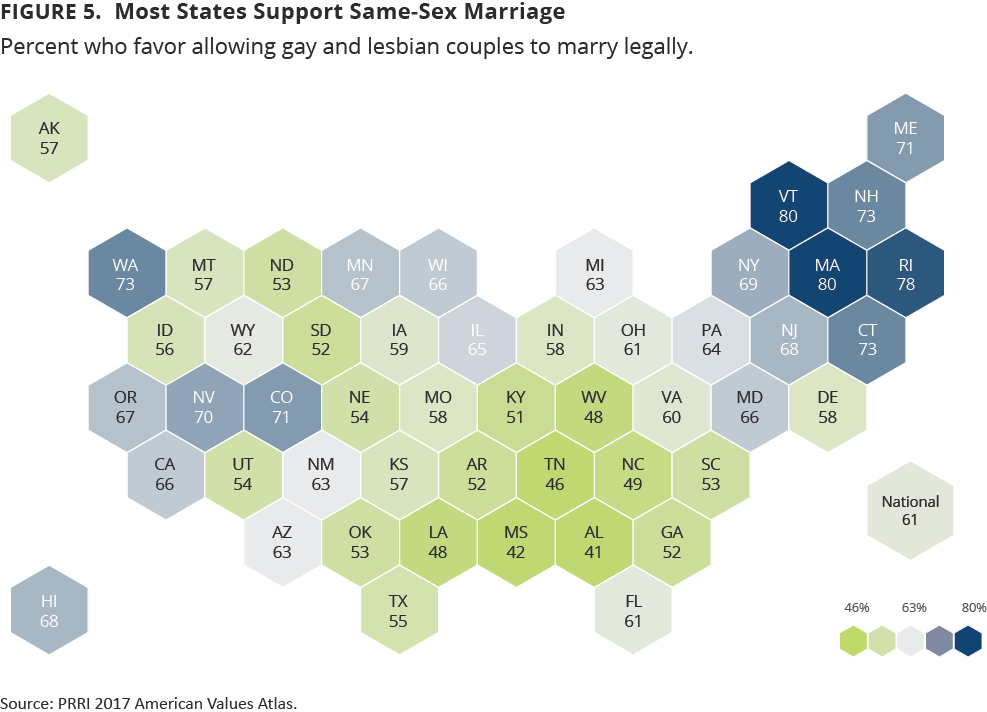
Most States Now Support Same-Sex Marriage
Recent dramatic shifts in support for same-sex marriage are also evident at the state level. Today, majorities in 44 states believe gay and lesbian couples should be allowed to legally marry, compared to only 30 states in 2014.9 In only six states does the issue of same-sex marriage garner less than majority support: Alabama (41%), Mississippi (42%), Tennessee (46%), West Virginia (48%), Louisiana (48%), and North Carolina (49%). But notably, only one state, Alabama, has a majority of residents who oppose same-sex marriage.
Substantial regional disparities in views of same-sex marriage are evident. New England is generally more supportive of same-sex marriage than any other region in the U.S. Roughly eight in ten residents of Vermont (80%), Massachusetts (80%), and Rhode Island (78%) support the policy. And nearly three-quarters of Americans living in Connecticut (73%), New Hampshire (73%), and Maine (71%) support it. A number of Southern states have only a slim majority expressing support for same-sex marriage, such as Kentucky (51%), Arkansas (52%), and Georgia (52%).
Religiously Based Service Refusals Remain Unpopular
Religiously based refusals of service to gay and lesbian people are relatively unpopular among the American public. Six in ten (60%) Americans oppose allowing a small business owner in their state to refuse products or services to gay or lesbian people if providing them would violate their religious beliefs. One in three (33%) Americans support such a policy. Eight percent offer no opinion. Attitudes have remained stable since 2015, when 59% of Americans opposed allowing business owners to refuse products or services to gay and lesbian people for religious reasons.10
Black Americans are more likely than any other racial or ethnic group to oppose religiously based service refusals. Nearly two-thirds (66%) of black Americans oppose them, compared to roughly six in ten Hispanic (61%), Asian-Pacific Islander (60%), and white (58%) Americans.
Women are more likely than men to oppose religiously based service refusals. Close to two-thirds (64%) of women oppose allowing small businesses to refuse to provide products or services to gay or lesbian people, compared to 55% of men. But the gender gap varies somewhat across racial and ethnic groups. It is most pronounced among white Americans: White women are far more likely to oppose them than white men (64% vs. 52%). Differences between black women and men (68% vs. 64% are opposed) and API women and men (58% vs. 61% are opposed) are much narrower. Hispanic women and men demonstrate a slightly wider gap than other nonwhite Americans, but still not as large a gap as that of white people: Sixty-four percent of Hispanic women oppose religiously based service refusals, compared to 58% of Hispanic men.
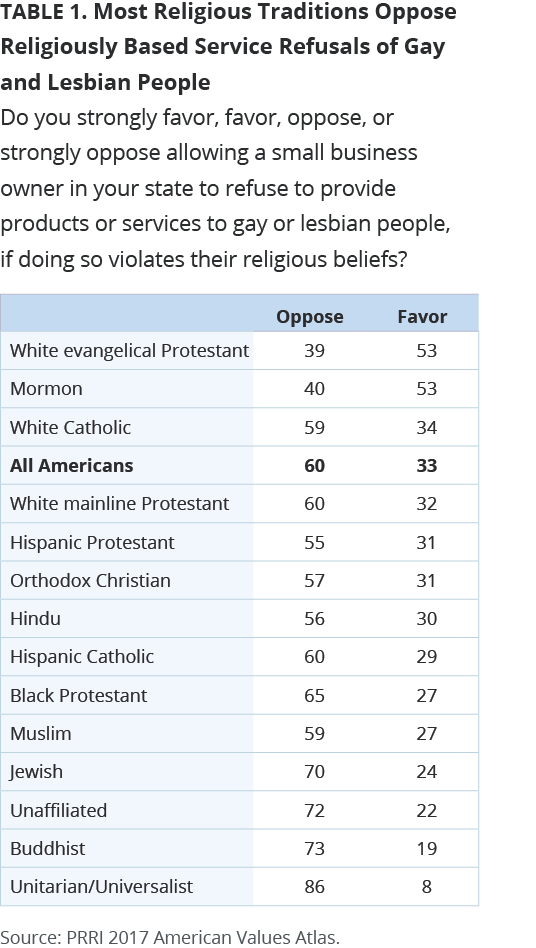
Only Mormons and White Evangelicals Support Religiously Based Service Refusals
Most religious groups do not believe small business owners should be allowed to refuse service to gay and lesbian people for religious reasons. Nearly nine in ten (86%) Unitarians and at least seven in ten Buddhists (73%), unaffiliated Americans (72%), and Jewish Americans (70%) oppose such a policy. And roughly two-thirds (65%) of black Protestants and about six in ten white mainline Protestants (60%), Hispanic Catholics (60%), white Catholics (59%), and Muslims (59%) also reject a policy allowing religiously based refusals to serve gay and lesbian people. Majorities of Orthodox Christians (57%), Hindus (56%), and Hispanic Protestants (55%) are also opposed to the policy.
Only two major religious groups believe small business owners in their state should be allowed to refuse service to gay or lesbian people on religious grounds—white evangelical Protestants and Mormons. Notably, they support this position at the same rate—53%.
Although there are profound generational differences among white evangelical Protestants regarding same-sex marriage, on the issue of service refusals the generation gap is minimal. Roughly half (49%) of white evangelical seniors and half (50%) of young adults would allow small business owners to refuse service based on their religious beliefs, while 40% of seniors and 45% of young adults would not.
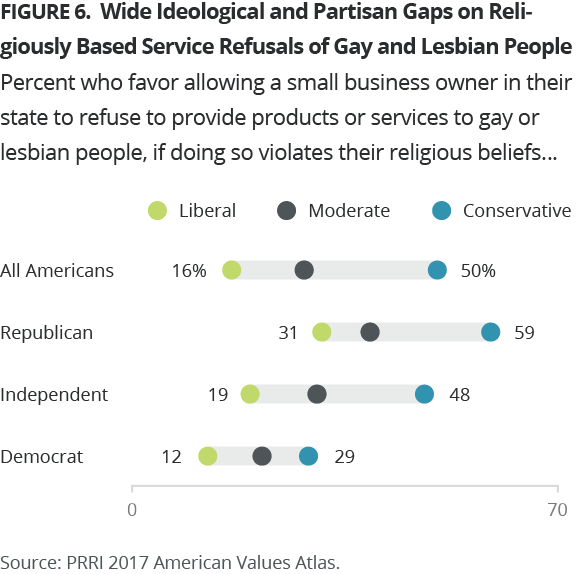
Sharp Political Divisions
As with same-sex marriage, views on religiously based service refusals vary dramatically by political affiliation. More than three-quarters (76%) of Democrats and six in ten (60%) independents are opposed, compared to only 40% of Republicans. A slim majority (52%) of Republicans favor giving business owners in their state the right to refuse products or services to gay or lesbian people if providing them would violate their religious beliefs.
Among Republicans there are stark divisions by ideology. Nearly six in ten (59%) conservative Republicans say religiously based service refusals should be legal, compared to roughly four in ten (39%) moderate and about three in ten (31%) liberal Republicans. But a majority of moderate (55%) and liberal (63%) Republicans oppose such a policy.
There are also sharp ideological differences among independents. Conservative independents are roughly divided, with about as many supporting the right to religiously based service refusals as opposing (48% vs. 44%) it. In contrast, 63% of moderate independents and more than three-quarters (77%) of liberal independents do not think small business owners have this right.
Democrats are far more unified than Republicans and independents in their position on the matter. Majorities of liberal (85%), moderate (72%), and conservative (63%) Democrats oppose religiously based refusals to serve gay and lesbian people.
More Modest Generational Divisions
Although views on same-sex marriage are highly stratified by age, on the issue of service refusals there is greater consensus across age cohorts. A majority of Americans across generations oppose them. Two-thirds of young adults (67%) and a majority of seniors (53%) say small businesses should not be allowed to refuse to serve gay or lesbian people, even if doing so violates their religious beliefs. Only 36% of seniors say this should be allowed, while 11% express no opinion.
The Relationship Between Support for Same-Sex Marriage and Service Refusals
Even among Americans who oppose same-sex marriage, close to half (45%) are against allowing small business owners to refuse service to gay and lesbian people. A similar number (48%) would allow them this option if providing service violates their religious beliefs.
Opposition Across the Country
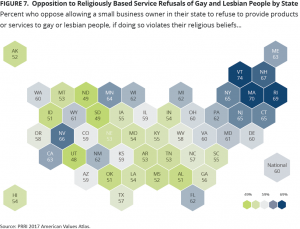
A majority of Americans in nearly every state believe small business owners in their state should not be allowed to refuse service to gay and lesbian people. Notably, state-level opposition to same-sex marriage or nondiscrimination protections for LGBT people does not reliably predict state-level support for religiously based service refusals. Whereas opposition to same-sex marriage and nondiscrimination protections is concentrated in the South, the states with the lowest levels of opposition to service refusals cluster in and near the Mountain West and Midwest. In three states—Utah (48%), North Dakota (49%), and South Dakota (49%)—fewer than half of residents oppose service refusals. A slim majority of residents of Idaho (51%), Oklahoma (51%), Nebraska (53%), and Montana (53%) object to them.
In contrast, New England states express the strongest objection to religiously based service refusals. At least two-thirds of residents of Vermont (74%), Massachusetts (70%), Rhode Island (69%), and New Hampshire (67%) oppose allowing small business owners to refuse gay and lesbian customers.
Americans Continue to Support Nondiscrimination Protections for LGBT People
Americans are broadly supportive of laws that would protect lesbian, gay, bisexual, and transgender (LGBT) people against discrimination in jobs, public accommodations, and housing. Seven in ten (70%) Americans favor such laws, including more than one-third (35%) who strongly favor them. Fewer than one-quarter (23%) of Americans oppose legal nondiscrimination protections for LGBT Americans.
Although there is broad agreement about nondiscrimination laws, there are still notable differences by age and gender. Younger Americans tend to be more supportive of legal protections than older Americans. Nearly eight in ten (78%) young adults (age 18-29) favor nondiscrimination protections, including 45% who strongly favor them. Even among seniors (age 65 and up), who tend to be less supportive of same-sex marriage, more than six in ten (61%) favor nondiscrimination protections for LGBT Americans, and only 29% oppose them.
Gender differences on this issue are much more modest than with respect to same-sex marriage. Nearly three-quarters (73%) of women favor the passage of laws that would protect LGBT Americans from discrimination in jobs, public accommodations, and housing, compared to about two-thirds (65%) of men. But there is a considerable intensity gap: Four in ten (40%) women, compared to only about three in ten (29%) men, strongly favor nondiscrimination protections for LGBT people.
Americans, Regardless of Race and Ethnicity, Support Nondiscrimination Protections
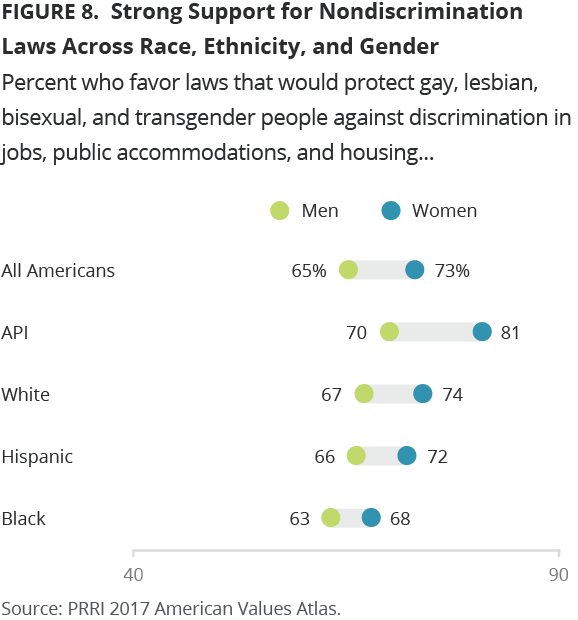
There is only modest variation across racial and ethnic lines in support for nondiscrimination laws to protect LGBT Americans. About two-thirds (66%) of black Americans favor these protections, as do about seven in ten Hispanic (69%) and white (71%) Americans. Asian-Pacific Islander Americans demonstrate the highest levels of support, with 75% favoring nondiscrimination laws to protect LGBT Americans.
The gender gap is fairly constant across racial and ethnic groups, but there is considerable variation in its size. Black men express the lowest level of support for nondiscrimination policies aimed at protecting LGBT people, while API women express the greatest. More than six in ten (63%) black men favor nondiscrimination laws, compared to 66% of Hispanic, 67% of white, and 70% of API men. More than two-thirds (68%) of black women favor these policies, while more than seven in ten Hispanic (72%), white (74%), and API (81%) women say the same.
Support for Nondiscrimination Protections Transcends Partisan Boundaries
Nondiscrimination protections for LGBT people are broadly supported across party lines, although Democrats and independents register greater support for them. More than seven in ten independents (72%) and Democrats (79%) favor providing legal protections from discrimination for LGBT people, while nearly six in ten (58%) Republicans say the same. Notably, half (50%) of Democrats strongly favor these protections.
While political ideology also influences views on nondiscrimination protections for LGBT people, it plays a larger role in structuring the attitudes of independents and Democrats than Republicans. Six in ten (60%) conservative independents favor laws to protect LGBT individuals against discrimination in jobs, public accommodations, and housing, compared to about eight in ten moderate (77%) and liberal (82%) independents. Democrats demonstrate a similar pattern. While less than two-thirds (63%) of conservative Democrats support nondiscrimination protections, more than three-quarters (76%) of moderate and nearly nine in ten (87%) liberal Democrats say the same.
There are more modest ideological differences among Republicans. Roughly two-thirds of moderate (68%) and liberal (65%) Republicans support nondiscrimination protections for LGBT people, compared to 56% of conservative Republicans.
Near Consensus Among Religious Groups on Nondiscrimination Policies
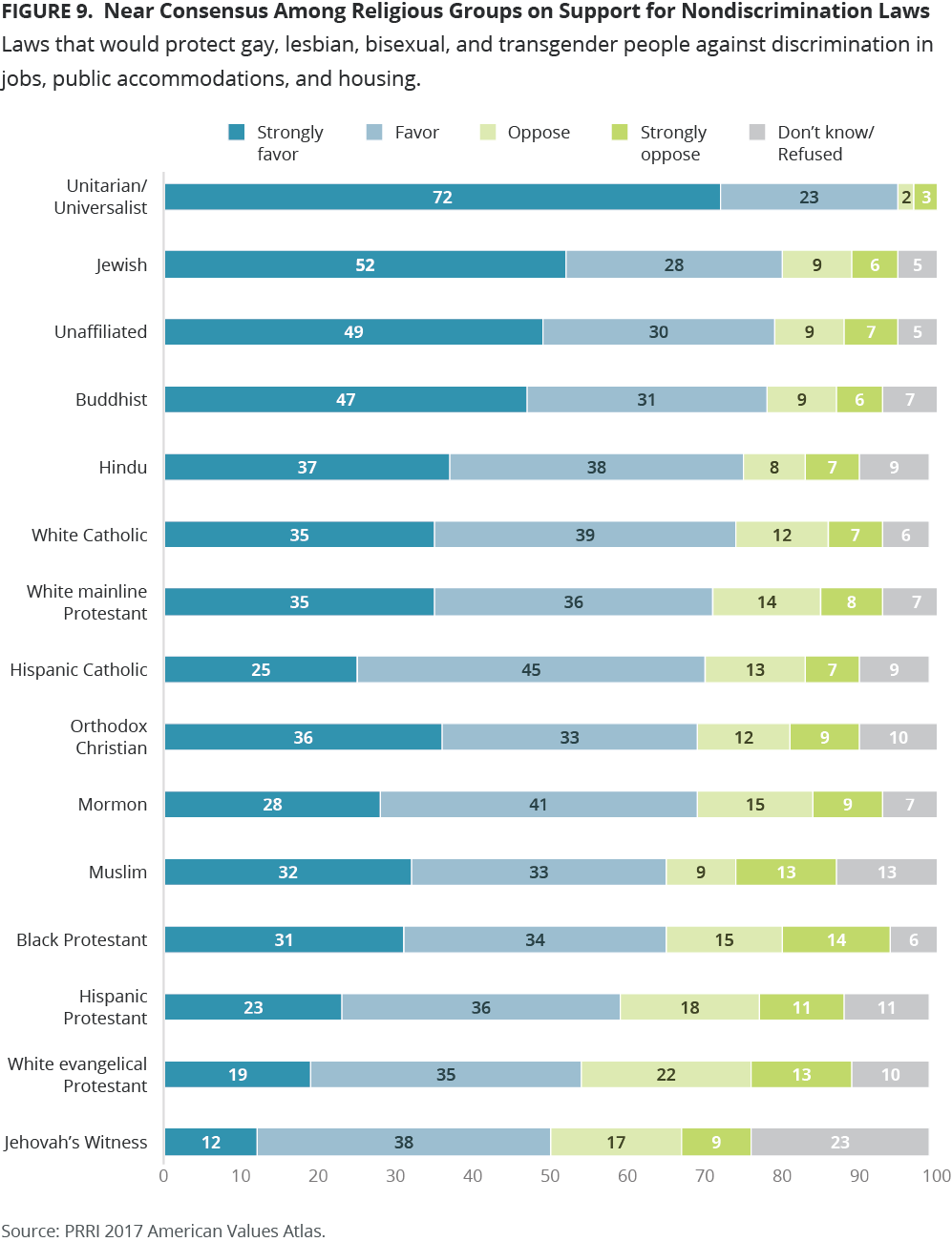
Majorities of nearly every major religious group support legal protections against discrimination for LGBT Americans, with non-Christian religious groups tending to be the most supportive. No religious group is more supportive than Unitarians, among whom 95% favor nondiscrimination policies. At least three-quarters of Jews (80%), religiously unaffiliated Americans (79%), Buddhists (78%), and Hindus (75%) favor laws that protect LGBT Americans against discrimination in employment, housing, and public accommodations.
Support is also robust among most Christian religious communities. At least seven in ten white Catholics (74%), white mainline Protestants (71%), and Hispanic Catholics (70%) support nondiscrimination protections for LGBT people. Approximately two-thirds of Orthodox Christians (69%), Mormons (69%), and black Protestants (65%) favor them, as well as a majority of Hispanic Protestants (59%) and white evangelical Protestants (54%). While only half (50%) of Jehovah’s Witnesses support nondiscrimination protections, just over one-quarter (26%) oppose these protections, and roughly as many (23%) express no opinion.
Mormon Exceptionalism
Mormons are unique among religious Americans in their outlook on same-sex marriage and nondiscrimination protections for lesbian, gay, bisexual, and transgender people. Only 40% of Mormons favor allowing same-sex couples to marry, yet nearly seven in ten (69%) support laws that would protect LGBT people from discrimination in housing, public accommodations, and employment—a 29-point gap. Among no other major religious group is the gap on these two issues larger.
Majorities of Residents of Every State Favor Nondiscrimination Protections for LGBT People
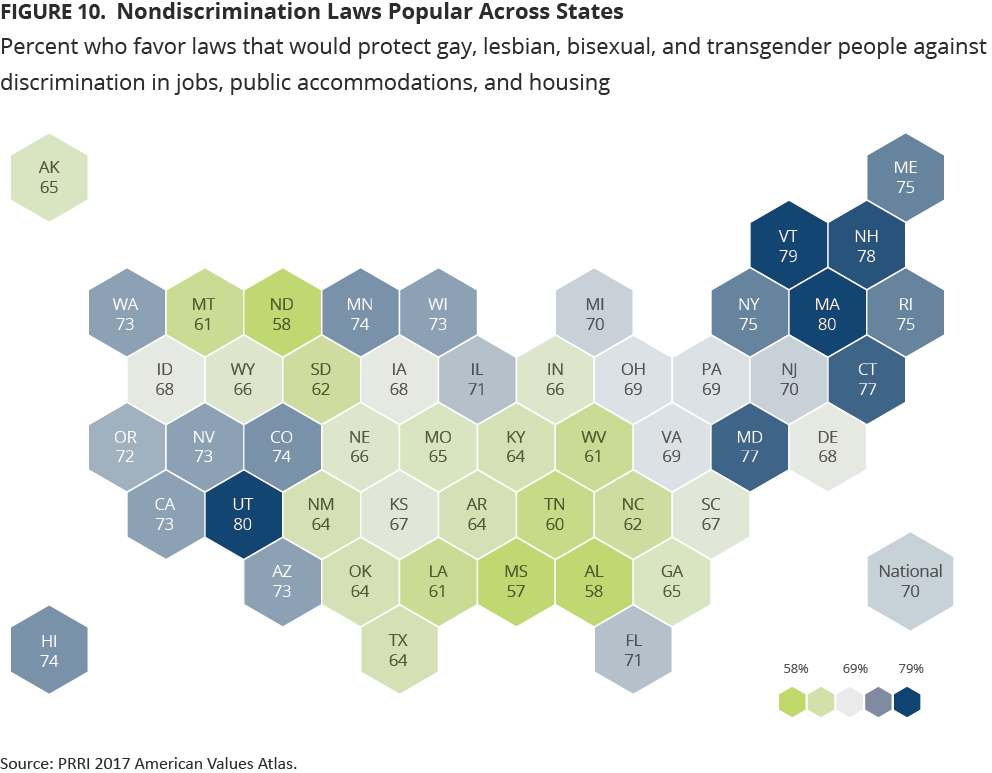
Majorities of residents of every state favor nondiscrimination protections for LGBT Americans. Predictably, New England states express the most robust support for laws designed to protect LGBT people from discrimination. At least three-quarters of the residents of Massachusetts (80%), Vermont (79%), New Hampshire (78%), Connecticut (77%), Maine (75%), and Rhode Island (75%) favor nondiscrimination protections for LGBT Americans.
Conversely, states with the lowest levels of support are primarily located in the South, as only about six in ten residents of Mississippi (57%), Alabama (58%), Tennessee (60%), Louisiana (61%), and West Virginia (61%) say LGBT people should be legally protected from discrimination.
States in the West tend to demonstrate high levels of support for nondiscrimination protections for LGBT individuals. More than seven in ten residents of the Western U.S.—including Washington (73%), California (73%), Nevada (73%), Arizona (73%), and Oregon (72%)—favor laws that would protect LGBT Americans from discrimination. Notably, despite the fact that only 54% of Utahans favor same-sex marriage, fully 80% say they would support laws to protect LGBT people from discrimination.
Survey Methodology
The 2017 American Values Atlas (AVA) is a project of PRRI. Results for questions on specific issues (e.g. LGBT issues) are based on a subset of 40,017 telephone interviews (including 23,903 cell phone interviews) conducted between April 5, 2017 and December 23, 2017 by professional interviewers under the direction of SSRS. The AVA was made possible by generous grants from the Evelyn and Walter Haas, Jr. Fund, the Gill Foundation, the Nathan Cummings Foundation, and the Unitarian Universalist Veatch Program at Shelter Rock.
Throughout 2017, at least 1,000 interviews were completed each week, with about 600 interviews conducted among respondents on their cell phones. Each week, interviewing occurred over a five-day period, from Wednesday through Sunday or from Thursday through Monday. The selection of respondents within households was accomplished by randomly requesting to speak with the youngest adult male or female currently living in the household.
Data collection was based on stratified, single-stage, random-digit dialing (RDD) of landline telephone households and randomly generated cell phone numbers. The sample was designed to represent the total U.S. adult population from all 50 states, including Hawaii and Alaska. The landline and cell phone samples were provided by Marketing Systems Group.
The weighting was accomplished in two separate stages. The first stage of weighting corrects for different probabilities of selection associated with the number of adults in each household and each respondent’s telephone usage patterns. In the second stage, sample demographics were balanced to match target population parameters for gender, age, education, race and Hispanic ethnicity, region (U.S. Census definitions), population density, and telephone usage. The population density parameter was derived from 2010 Census data. The telephone usage parameter came from an analysis of the January-June 2017 National Health Interview Survey. All other weighting parameters were derived from an analysis of the U.S. Census Bureau’s March 2017 Current Population Survey.
The sample weighting was accomplished using iterative proportional fitting (IFP), a process that simultaneously balances the distributions of all variables. Weights are trimmed so that they do not exceed 4.0 or fall below 0.25 to prevent individual interviews from having too much influence on the final results. The use of these weights in statistical analysis ensures that the demographic characteristics of the sample closely approximate the demographic characteristics of the target populations.
The margin of error for the sample is +/- 1.2 percentage points at the 95% level of confidence. The design effect is 1.4. Table 1 shows the margin of error and design effect for each weekly survey at the 95% level of confidence. Tables 2 and 3 show the sample sizes for each state and metro area. In addition to sampling error, surveys may also be subject to error or bias due to question wording, context, and order effects.
Bisexual people in the U.S. state of Utah report the most incidences of sexual violence, according to a new survey.
The shocking new survey analyzes responses from about 10,000 Utahan adults collected in 2016.
It reveals 45.5% of bisexual people in Utah have experienced sexual violence. It also said 33.6% of lesbian/gay respondents reported sexual violence.
This compares to just 8.7% for straight people.
According to the survey, sexual violence is ‘sexual activity (sexual touching, harassment or exposure to sexual content) that involves victims who do not consent, or who are unable to consent.’
Turner Bitton, executive director of the Utah Coalition Against Sexual Assault, said in a written statement: ‘Sexual violence is rooted in the inequities of our society and disproportionately hurts those who have been pushed to the margins.’
He also said: ‘Utah communities are counting on us to ensure that everyone is included in prevention efforts.’
Bitton calls for ‘culturally specific prevention programming’ in the state to combat the huge disparity.
Interestingly, other breakdowns of the statistics include disproportionate incidences among unemployed people, with 21.3%. ‘Student’ comes in second with 10.7% and ’employed’ with 10%.
Sexual violence in Utah breaks down to affecting 3.1% of the state’s male population and 16.4% of females.
Hank Wilson was a sort of Johnny Appleseed of queer San Francisco. Everywhere he went, new organizations sprouted. Many of these organizations form the institutional backbone of today’s LGBTQ community in the city and beyond.
Hank was an extremely modest man who avoided the spotlight, so his story is largely unknown. That’s why I’m working with cinematographer Leo Herrera and the GLBT Historical Society to make a documentary about him, “Thanks to Hank.” Fortunately, the Historical Society’s archives hold not only Hank’s personal papers, but also organizational records, photos, ephemera, and audio and video recordings reflecting his work and the times in which he lived.
To give you an idea of Hank’s impact, here are just a couple of the gay groups he helped found: the San Francisco Gay Democratic Club (1976), now the Harvey Milk LGBT Democratic Club, and the Gay Film Festival (1977), now the Frameline International LGBTQ Film Festival. Hank also helped organize some of the first community responses to the AIDS crisis, including the AIDS Memorial Candlelight March (1983), now the International AIDS Candlelight Memorial, sponsored by 1,200 organizations in 115 countries.
Incredibly, Hank did all this in his free time. His main work was managing the Ambassador Hotel, a 150-room residency hotel in the Tenderloin where he pioneered a harm-reduction approach to social services. During the worst years of the AIDS epidemic, thousands of people with HIV found housing and hospice care at the Ambassador.
The GLBT Historical Society archives are providing crucial materials for telling these stories — and what’s more, the society is serving as fiscal sponsor for the documentary. For information on how to support the project, visit the “Thanks to Hank” page on my website.
Bob Ostertag is a composer, writer and filmmaker who lives in San Francisco. He holds the post of professor of cinema and digital media at the University of California, Davis.
Equality California, the nation’s largest statewide LGBTQ civil rights organization, announced the endorsements of 10 openly LGBTQ candidates running for local office in 2018. The candidates are among a surge of out LGBTQ Californians seeking public office across the state — and a record number of LGBTQ candidates running throughout the country this year.
Equality California has endorsed the following candidates in their respective races:
San Francisco Board of Supervisors: District 8
Equality California has dual-endorsed Supervisor Jeff Sheehy and City College Trustee Rafael Mandelman for the Eighth District of the San Francisco Board of Supervisors.
Jeff Sheehy, who was appointed by the late Mayor Ed Lee in January 2017 to fill Senator Scott Wiener’s (D-San Francisco) vacant seat, is a longtime HIV/AIDS activist and LGBTQ civil rights advocate who previously served as president of the Harvey Milk LGBT Democratic Club and as then-Mayor Gavin Newsom’s HIV/AIDS advisor.
“Supervisor Sheehy is a pioneer in our community’s fight for full equality and social justice and has been an incredible advocate for people living with HIV over decades,” said Equality California Executive Director Rick Zbur. “A self-described ‘activist,’ Sheehy is committed to making San Francisco more affordable and safer for all.”
Rafael Mandelman is an urban development attorney and member of the San Francisco City College Board of Trustees, previously serving as the Board’s president. A San Francisco native, Rafael has dedicated his career to building affordable housing and revitalizing commercial districts in the Bay Area.
“Rafael Mandelman is a tireless advocate for San Francisco’s LGBTQ community and a champion for the city’s students and for San Franciscans experiencing homelessness,” said Equality California Executive Director Rick Zbur. “We’re proud to endorse Rafael and are confident he would bring bold ideas, energetic leadership and a fresh perspective to City Hall if elected.”
San Mateo County Superintendent of Schools
Equality California has dual-endorsed Gary Waddell and Nancy Magee for San Mateo County Superintendent of Schools.
Gary Waddell, who currently serves as Deputy Superintendent of the Instructional Services Division, was previously an award-winning principal and school counselor. He has also received endorsements from California State Superintendent of Public Instruction Tom Torlakson, Congresswoman Jackie Speier and the California Teachers Association of San Mateo County, among other elected leaders and organizations.
“Dr. Gary Waddell is a champion for LGBTQ equality who has devoted his life to ensuring access and opportunity for all students and communities,” said Equality California Executive Director Rick Zbur. “We are impressed by his vision of equity and inclusion and are excited to support his campaign for San Mateo County Superintendent of Schools.”
Nancy Magee, who currently serves as the County’s Associate Superintendent for the Student Services Division, was previously an award-winning high school English teacher for 20 years before becoming a high school librarian. She has also received endorsements from San Mateo County Board of Supervisors President Don Horsley, County Sheriff Carlos Bolanos and County Controller Juan Raigoza, along with a growing list of local elected leaders and educators.
“Nancy is a proven leader and LGBTQ civil rights advocate with a long track record of fighting to ensure all our children have a shot at success,” said Equality California Executive Director Rick Zbur. “We are thrilled to support her campaign for San Mateo County Superintendent of schools and are confident she will work tirelessly to ensure that our schools are safe and supportive learning environments for LGBTQ youth.”
Davis City Council
Equality California has endorsed Linda Deos and Eric Gudz in their campaigns for the Davis City Council. There are nine candidates running for two open seats on the Council.
The daughter of a school teacher, Linda Deos is a consumer protection attorney who has taken on big banks and worked to establish the first help desk for underrepresented clients at the Sacramento Federal Court. Deos is the current President of the Northern California Bankruptcy Forum, Treasurer of the Yolo County Progressives and a member of both the Davis Democratic Club and the Yolo County Democratic Central Committee.
“Linda Deos is a dedicated, passionate community advocate dedicated to standing up for those who need a helping hand,” said Equality California Executive Director Rick Zbur. “We’re excited to see Linda bring that passion with her to the City Council and continue fighting to ensure the voices of all Davis residents, including members of our LGBTQ community, are heard.”
Eric Gudz is an Eagle Scout and retired Army captain, who has led drug policy reform efforts in Davis in recent years. After returning from Afghanistan, Gudz worked with the Army’s Warrior Transition Unit, supporting the recovery process for other returning soldiers. Gudz currently serves on the City of Davis’s Bicycling, Transportation and Street Safety Commission.
“As an Eagle Scout, Army veteran and accomplished community leader, Eric Gudz has dedicated their life to serving others,” said Equality California Executive Director Rick Zbur. “We’re confident that Eric will continue fighting for Davis families, small businesses and our LGBTQ community on the City Council”
Rancho Mirage City Council
Equality California has endorsed Robert Mueller in his campaign for the Rancho Mirage City Council. Robert is one of three candidates challenging the three incumbents on the Council seeking reelection to their at-large seats. Mueller has spent five decades as a top executive with Sony, JVC Kenwood and Panasonic and has been a strong community advocate for LGBTQ civil rights and social justice.
“Robert Mueller will bring experience, drive and a fresh vision to Rancho Mirage’s City Hall,” said Equality California Executive Director Rick Zbur. “If elected, he’ll prioritize reducing crime, increasing government transparency and strengthening the city’s public schools — helping to ensure that every child in Rancho Mirage has access to a safe and supportive learning environment.”
Kern County Board of Supervisors, District 2
Equality California has endorsed Whitney Weddell for the Second District of the Kern County Board of Supervisors. Weddell has been a school teacher for nearly thirty years and a longtime community activist. She previously spent a decade building coalitions around the fight for marriage equality, traveling all over the Central Valley recruiting community organizers and volunteers.
“Whitney Weddell has a proven track record of thirty years of LGBTQ advocacy in Kern County, and we are convinced she will continue to lead as a Supervisor for the residents of the Second District,” said Equality California Executive Director Rick Zbur. “She cares deeply about improving the lives of Kern County families and will bring a fresh perspective to the Board of Supervisors.”
San Diego City Council, District 2
Equality California has endorsed Dr. Jen Campbell for the Second District of the San Diego City Council. Campbell is an active community leader, having served on the Clairemont Town Council Executive Board, in a number of capacities in the San Diego County Democratic Committee and California Democratic Party and as a Board Member and interim Executive Director of The San Diego Human Dignity Foundation, a local LGBTQ nonprofit. She is a physician and practiced family medicine for 37 years.
“We’re proud to support Dr. Jen’s campaign for San Diego City Council and know she will be an excellent advocate for our families and small businesses in the Second District,” said Equality California Executive Director Rick Zbur. “She will be a strong addition to LGBTQ San Diegans’ representation on the Council and will continue to fight for civil rights and social justice for our community.”
Santa Cruz County Board of Supervisors, District 4
Equality California has endorsed Jimmy Dutra for the Fourth District of the Santa Cruz County Board of Supervisors. Dutra currently serves on the City Council in Watsonville and as the Mayor Pro Tem. The first openly LGBTQ member of the City Council, he has worked to enhance city contracts and legal documentation to protect the LGBTQ community and has expanded support for the local shelter for LGBTQ youth experiencing homelessness. Dutra also serves on the Board of the LGBT Caucus at the League of California Cities.
“Jimmy Dutra is a committed leader with a proven track record of getting results for his community,” said Equality California Executive Director Rick Zbur. “As County Supervisor, Jimmy will continue to be a strong advocate for progress toward a Santa Cruz County that is healthy, just and fully equal for all LGBTQ residents.”
###
Equality California is the nation’s largest statewide LGBTQ civil rights organization. We bring the voices of LGBTQ people and allies to institutions of power in California and across the United States, striving to create a world that is healthy, just, and fully equal for all LGBTQ people. We advance civil rights and social justice by inspiring, advocating and mobilizing through an inclusive movement that works tirelessly on behalf of those we serve. www.eqca.org
“The lesbian world that I first came into, here in Los Angeles almost 40 years ago, seemed to me to exist only in darkness,” once wrote historian Lillian Faderman in an open letter to explorers of L.A.’s June Mazer archives. “Our world seemed to have been invented in that moment of time. We had no past – or, if we did, no one knew or could tell me about it. Because we had no knowledge of those who came before us, our isolation and loneliness felt tragic and inevitable.”
In Oakland, California in 1981, the first large-scale West Coast Lesbian archival project began, thanks to a collection of activists and an all-volunteer crew. By collecting photographs, audio materials, and other fragments from feminist and Lesbian history, from a collection of flyers documenting 60s protests and video archives to a few softball uniforms from a 1940s women’s league. A series of flyers show protesters in the 1970s and 80s, at the beginning of the rape crisis organization Women Against Violence Against Women, taking a stand against harmful media representation in popular films and albums. One 1976 protest took to task a billboard for the Rolling Stones’ album “Black and Blue,” which advertised a picture of a battered woman saying “I’m ‘Black and Blue’ from the Rolling Stones and I love it!”
By 1987, thanks to the Connexxus Women’s Center/Centro de Mujeres, the June L. Mazer Lesbian Archives were moved to the heart of West Hollywood. Since that time, the center has dedicated itself to collecting and preserving pieces of Lesbian history from across historical and global borders. Today, the archives are in the process of getting a “facelift.” Thanks to the UCLA archives housing and showcasing parts of the archive during the hiatus, the June L. Mazer Archives are preparing to come back stronger than ever with a grand re-opening on May 6. The reopening will features new “exhibits, tours and a celebration of Simone Wallace’s Sisterhood Bookstore collection” at 626 N. Robertson Blvd. in West Hollywood.
The New York Times has addressed its poor history of covering HIV/AIDS during the AIDS crisis.
The newspaper came under heavily criticism from AIDS activists and the LGBT community over its “shameful” coverage of the AIDS epidemic in the 1980s, when New York City’s gay community was ravaged by the spread of the disease.
President Reagan did not mention AIDS in public until 1985, when 5000 people – primarily gay and bisexual men – had already died.
AIDS activist Larry Kramer was vocally critical of the New York Times for its coverage, attributing deaths to the paper’s actions.
In a piece published today, New York Times writer Kurt Soller addressed the newspaper’s coverage – more than 30 years on.
Soller wrote: “Any newspaper must, by definition, aspire to be the “paper of record,” and yet when it came to this newspaper’s coverage of gay people and AIDS in the early ’80s — when the disease was morphing into a national crisis, and when rights that had been won a decade earlier, after the Stonewall Riots, were once again being jeopardized — The Times’s own record was checkered at best.
“Information about the spread of illness was often scant, judgmental or distressingly vague — even while reporters on the Science desk were trying their best with an ever-evolving story. The social and emotional toll of AIDS and the resulting queer movement were, when covered, often buried in the back of the newspaper (on a page called Styles of the Times), far from national news stories that were deemed important enough for the front page.
“Famously, it would take President Ronald Reagan more than four years to acknowledge the disease publicly. And it took until 1983 for The Times to run an article about the disease on Page A1, two years after the first reports of symptoms.”
Economy reporter Natalie Kitroeff notes that “many employees felt that A.M. ‘Abe’ Rosenthal, the paper’s editor, was homophobic”, reflecting on internal battles over the use of terms like “admitted homosexuals”.
Media reporter John Koblin noted that there were 558 dead in the United States before the Times put the issue on the front page.
He added: “Roughly 700 editions of the paper had come and gone before AIDS, quickly turning into a full-fledged crisis, had earned a spot on Page One. It was never lost on AIDS activists just how vital the paper was — and for how long it did not pay serious attention to the disease.”
How Can Lawyers Get More Comfortable With Artificial Intelligence?
It doesn’t matter how AI works as long as it solves problems. Discover the 7 steps to understanding AI and becoming more comfortable with it
Ad by Thomson Reuters
David W. Dunlap, a reporter in the Metro section at the time, told him: “There were strong messages that you got that were not written on any whiteboard. You knew to avoid it. It was a self-reinforcing edict: Don’t write about queers.”
Koblin added: “By the time The Times did give AIDS front-page attention, it did so with a bit of a stiff arm. Though public health officials were now going on the record to discuss the disease’s devastation, there was reluctance to discuss whom it affected most. In that first front-page story, it took seven paragraphs — which appeared after the jump, or inside the paper — to mention how hard it was hitting gay men.”
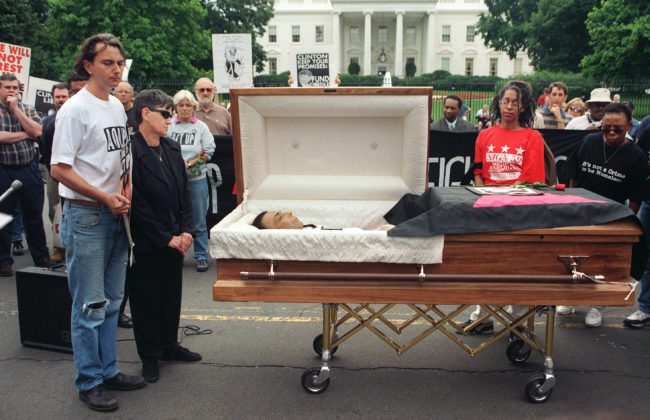
AIDS activists hold an open-casket funeral protest in front of the White House (JAMAL A. WILSON/AFP/Getty Images)
Washington correspondent Jeremy W. Peters wrote that even when it did cover the crisis, the newspaper often did unwitting harm.
He wrote: “They employed the same euphemisms, like ‘bodily fluids’, to substitute for words like semen, leaving the [false] impression that saliva from a kiss might infect you.”
And according to local publication The Nation, Thailand may beat Taiwan to that deadline.
The justice minister is set to present the final draft of the bill to the Cabinet for approval after a subcommittee is done with creating it, a source at the ministry’s Rights and Liberties Protection Department said.
It is expected to be passed before the next general election, which is set to be held in February 2019.
Ratthanan Prapairat, 38, said he had been with his partner for more than 20 years, and that together, the two men have bought a house and run a clothing business.
Prapairat said he would register under the proposed law, adding: “It is a must-have that should have been in place years ago as it would be very helpful in protecting the rights of same-sex couples.
“Same-sex couples are no different from straight couples. We have accumulated a lot of assets and heritage together. This law will be great for us.”
After 50-year-old Vitaya Saeng-aroon’s partner was taken into hospital earlier this year, he didn’t know of his death until a relative let him know.
(Taylor Weidman/Getty)
Saeng-aroon said the legislative shift would give same-sex couples the right to have a say over their partner’s medical care, and to be present with them in the hospital.
“I was not permitted to sign any document after he went into a coma,” he said. “I was not his relative, even though I had been taking care of him for over a year.
I had to wait for his brother from upcountry to show up. After a week in ICU, he passed away peacefully,” he added.
“I did not know about his death until his brother called me.”
He said that the law would legitimise same-sex relationships, and the LGBT people in general.
“It’s not only about equality, but also about humanity,” said Saeng-aroon.
“Gay people need to be recognised as common couples in every supporting aspect. That will bring wider understanding towards the true meaning of diversity.”
The unions carry some of the same benefits as marriage, especially relating to housing and hospital visits.
The city of 1.5 million people, located on the northern coast of the island of Kyushu, was the seventh city or ward in the country to legalise same-sex partnerships.