A large Pride flag has been removed from a flagpole at the Stonewall National Monument in Manhattan, weeks after the Department of the Interior issued federal guidance on displaying “non-agency” flags in the National Park System. Brad Hoylman-Sigal, the Manhattan borough president, said that the directive from the Trump administration, issued on Jan. 21, led to the removal of the flag from the Greenwich Village monument.
Mr. Hoylman-Sigal criticized the decision in an interview. “The mean-spiritedness of the Trump administration seems to know no bounds,” said Mr. Hoylman-Sigal, who is gay. “But we as a community are not going to take it standing by idly as our history, and by extension our human rights, are attempted to be erased.”
Mr. Hoylman-Sigal said he and other local representatives are planing to raise the flag at the monument again on Thursday. “We may be prevented from doing so,” he said. “But if we don’t seize this moment, and this outrage, I think we’ll let down generations of queer activists.”
Read the full article. Longtime JMG readers will recall Hoylman-Sigal’s tireless work for marriage equality in the New York Senate.
In a tribute and fundraising page Summer’s family created for The Trevor Project, they said: “The world was a scary place for her, as a transgender, autistic woman. It should not have been. It should have seen her for the wonderful, radiant, and deeply empathetic person she was.
“Nothing can make up for Summer’s death, but we hope that it at least can be used as a catalyst to make the world a kinder place, and to prevent anyone else from dying in this way.”
A GoFundMe for Ash He said: “Ash had a deep passion for art and theatre, using their immense talent to express themselves and bring people together.”
It went on: “Ash’s kindness, creativity, and spirit touched so many lives.”
If you’ve been affected by this story, you can contact The Trevor Project at 1-866-488-7386 or text START to 678678 in the U.S.Suicide is preventable. Readers who are affected by the issues raised in this story are encouraged to contact the Samaritans on 116 123 (www.samaritans.org), or Mind on 0300 123 3393 (www.mind.org.uk). Readers in the US are encouraged to contact the National Suicide Prevention Line on 1-800-273-8255.
Hate crimes targeting people on the grounds of their sexuality, gender identity or disability would be made an aggravated offence, under a proposed new law.
If passed, an amendment to the Crime and Policing Bill would see hate crimes targeting LGBTQ+ and disabled people brought in-line with racially and religiously aggravated hate crimes, meaning they too will carry a higher maximum sentencing penalty.
The bill is currently progressing through the House of Lords and is intended to tackle anti-social behaviour alongside crimes including offensive weapons, sexual offences and stalking and public order.
Stonewall CEO Simon Blake described the amendment a “major step in the journey of LGBTQ+ equality”.
“Putting hate crime against LGBTQ+ people on the same footing as religious and racial hate crime has always been the right thing to do. It sends a powerful message that LGBTQ+ people deserve equal access to justice,” Blake said.
“Stonewall, and others, have campaigned hard for this change for many years; and we welcome that the Government is delivering on a manifesto commitment for LGBTQ+ people at a time when many in the community are feeling increasingly under threat.”
He added: “Now that this amendment to the Crime and Policing Bill has been laid, Stonewall will continue to work hard with Government and Parliamentarians to make sure this vital change becomes law.”
LGBT+ anti-abuse charity Galop described it as a “landmark step” towards increasing access to criminal justice for LGBTQ+ and disabled people.
Jasmine O’Connor, co-chief executive of Galop, said: “At a time when our services are seeing consistent rises in LGBT+ hate crime victims seeking support, this long-overdue change sends a clear message that anti-LGBT+ hate crime is as deserving of justice as crimes motivated by religious or racial hate.”
Home Office data shows that in the year ending March 2025, there were a total of 137,550 hate crimes recorded by the police in England and Wales.
In the 2024/25 year, there were 18,702 hate crimes targeting people on the basis of their sexual orientation and 3,809 targeting trans people because of their gender identity, decreases on 2023/24 by two and 11 per cent respectively.
In terms of disability hate crime, there were 10,224 incidents recorded in 2024/25 compared with 11,131 recorded in 2023/24.
However, these figures are all higher than five years ago in 2020/21 when there were 15,668 sexual orientation hate crimes, 2,510 related to gender identity and 9,418 in relation to disability.
State legislative session has begun in many parts of the U.S. this month, offering opportunities for state- and local-based activations for LGBTQ people, their families, and their allies.
Early action at statehouses include passage of a disturbing bill in Kansas that ultimately seeks to strip personal liberties from transgender people, banning them from accessing restrooms that match who they are in government buildings and making it impossible for them to access accurate documents. Lawmakers forced the bill to passage by suspending legislative rules and prohibiting participation from the public.
“Bills like this are exactly why everyday Americans are fed up with lawmakers who prioritize targeting innocent people instead of solving actual problems, and then have the gall to try to hide their actions,” said Sarah Kate Ellis, GLAAD’s President and CEO, in response to the news. “Transgender people, like all of us, deserve the dignity to be themselves and to be safe to go about their daily lives without harassment. Every taxpayer and family should let their elected leaders know that their voices matter too and they must be allowed to review and comment on any government action that strips people’s rights and humanity. Everyday people are barely able to make ends meet, pay the rent, or afford groceries and health care. Elected officials should start listening to the people and stop playing dangerous games with people’s lives.”
Kansas Governor Laura Kelly, a Democrat, has consistently vetoed a number of anti-transgender bills previously passed in the legislature. Although anti-equality lawmakers hold a supermajority that can override an executive veto, ACLU of Kansas and local advocates urge constituents to continue contacting their lawmakers and speaking out about the bill’s harm. Kansans can easily do so by visiting ksleglookup.org.
Florida
Equality Florida hosted its Let Us Live March at the Florida statehouse in Tallahassee this past Weds., Jan. 28, as part of its Pride at the Capitol series in which lobbyists and volunteers show a strong presence at the Capitol every day throughout the 60-day legislative session currently taking place. Hundreds of Floridians have already participated and shown up to make their voices heard. Marchers chanted “This is what democracy looks like” as they showcased a strong presence in front of the statehouse just yesterday. In addition, Equality Florida recently announced its incoming executive director, Stratton Pollitzer, who is stepping into the role after co-founding the organization nearly 30 years ago and most recently serving as Deputy Director.
“Speaking out at the hearings in opposition or in support of bills really changes how people see things. But more importantly, I learned that my story is the most important aspect of that. And I can’t tell my story if I’m not here,” said Angelique Godwin, Director of Transgender Equality at Equality Florida, in a video highlighting the need to get involved.
In 2025, Floridians stopped every single anti-LGBTQ bill filed by bringing out hundreds of volunteers in-person at the statehouse and thousands more participating by phone and letter-writing to their legislators.
This year, Equality Florida has already mobilized volunteers and families to oppose HB 743/ SB 1010, extreme legislation that would permit the Attorney General sweeping authority to investigate and sue school staff and health care providers under vague and undefined standards, intensifying Florida’s attacks on transgender youth and LGBTQ communities and aiming to intimidate and punish public servants who support them. The bill faces ongoing consideration at the committee levels in the House and Senate. Equality Florida is also urging residents to speak out against HB 1471/ SB 1632, the “Outlawing Activism Bill,” an extreme escalation of state terror against those who disagree with the government. That bill is also currently up for consideration at the committee level.
With the same relentless advocacy as last year, Equality Florida and its supporters will again defeat the legislature’s proposed anti-LGBTQ bills in 2026. Click here to sign up for shifts!
Missouri
Missouri has kicked off their legislative session as well, with anti-LGBTQ lawmakers introducing a number of hostile bills — not unusual for the state, but again highlighting a need for early organizing and coalition-building.
So far, the House has already heard seven anti-trans bills. PROMO, the lead equality advocacy group in the state, is urging Missouri residents to submit online testimony opposing HB 1998. This bill forces state agencies to revoke funding for diversity, equity, and inclusion (DEI) initiatives, building off a dangerous executive order passed by the Governor last year.
Voters in the state will additionally face a ballot measure in November concerning both health care for transgender people, and reproductive freedom for women and girls. PROMO recently announced it will be celebrating its 40th anniversary later this year – an opportunity to celebrate the long term organizing that advocates have built from the ground up and to enjoy company among like-minded residents.
State-Level Anti-LGBTQ Bills Introduced Elsewhere in 2026
The overwhelming majority of anti-LGBTQ bills get defeated every year. That’s because of persistence and action. When people get to know the LGBTQ community and hear our stories, we are able to change hearts and minds and build understanding about our community that dispels the dangerous myths and misconceptions that drive anti-LGBTQ bills.
Make sure to follow GLAAD on all our social channels to stay informed about local action alerts and ways to get involved in your community!
The Indiana Bureau of Motor Vehicles will no longer accept court orders or medical documentations recognising transgender residents’ gender changes, effectively banning trans people from changing their gender markers on state ID.
The change was announced in a small post on the BMV’s website on 9 February and went into effect on 12 February, meaning people had just three days to act.
In a statement released on 9 February, LGBTQ+ advocacy group Indiana Youth Group said: “Denying people the ability to update the gender marker on their identification is not only discriminatory; it is dangerous. In an increasingly hostile climate, mismatched identification can expose individuals to harassment, threats, and violence. It can also create serious barriers to employment, housing, and access to essential services.”
It continued: “For many LGBTQ+ young people – like those served by IYG – affirming identification is more than paperwork. It is a matter of safety, dignity, and basic recognition by their state.”
The change had been proposed twice before in July and November 2025, but both times it was criticised by the people of Indiana.
“The people of Indiana spoke clearly and repeatedly against this policy, and the BMV chose to ignore them,” said IYG CEO Chris Paulsen.
“Quietly implementing a rule that puts transgender Hoosiers at risk – while offering no transparency or meaningful notice – is not governance. It’s cruelty,” they continued. “Our young people deserve a state that protects their safety and dignity, not one that deliberately puts them in harm’s way.”
In the late 1960s and early 1970s, second-wave feminism, a.k.a. women’s liberation, was gathering steam, but it still didn’t have widespread support. Many Americans wondered why feminists would protest the revered Miss America pageant, as they did in 1968. “Women’s lib” was a punch line for comedians, and TV shows often presented feminist characters in a negative light. Amid all this, some feminist leaders were worried that their movement would have an image problem because of the presence of … lesbians.
Betty Friedan was one of the feminists particularly worried about lesbians. Friedan authored The Feminine Mystique, a 1963 book that revealed the dissatisfaction many women felt with traditional roles. It helped inspire second-wave feminism, although it was criticized for its focus on affluent white straight women. In 1966, Friedan and others founded the National Organization for Women, which became the leading U.S. feminist group.
At a 1969 NOW meeting, Friedan declared that the movement was being threatened by a “lavender menace,” that is, lesbians. “Mainstream media had already dismissed the feminist movement as ‘a bunch of bra-burning lesbians,’ so Friedan and other straight feminist leaders were acutely sensitive to this labeling — and dismissal — of all feminists as lesbians,” Victoria A. Brownworth wrote in a column published by The Advocate in 2023. “Friedan wanted ‘feminine feminists’ in the movement.”
Friedan went on to purge lesbians from NOW, including Rita Mae Brown, then editor of NOW’s newsletter and soon to be an iconic author, and Ivy Bottini, who had designed the organization’s logo. Friedan feared that lesbians “would kill the women’s movement,” Bottini told The Advocate’s LGBTQ&Apodcast in 2020, adding, “That was Betty Friedan’s image in her head.”
However, they and other lesbians weren’t about to go quietly. They fought back in a big way the following year.
In 1970, NOW’s Second Congress to Unite Women was held in New York City. One night during the conference, women from Radicalesbians and other lesbian-inclusive feminist groups crashed the meeting. They turned the lights off, then turned them back on, and made their presence known, with some lining the aisles and others in the audience. Many of them wore T-shirts emblazoned with “Lavender Menace.”
“I was dressed in a nice blouse. I stood up and I said, ‘Sisters, I’m so tired of being in the closet in the women’s movement. This is too much already.’ And I ripped my blouse off, and I had a ‘Lavender Menace’ T-shirt underneath,” activist Karla Jay told NBC News in 2024.
The lesbian demonstrators and held signs with slogans such as “We are all lesbians,” “Lesbianism is a women’s liberation plot,” and “We are your worst nightmare, your best fantasy.” They took over the stage and demanded that the women’s movement address issues of concern to lesbians.
“NOW leaders attempted to restore their planned session and a few women left, but the majority of the audience was engaged by the action’s humor and theatricality,” notes an online article from the NYC LGBTQ Historical Sites Project. “The Menaces held the floor for over two hours, inviting all attendees to share their thoughts and questions on lesbianism. Many straight women thanked Menaces for making them confront their feelings about lesbianism, and Black and working-class women connected with the Menaces’ feelings of exclusion in the women’s liberation movement.” The following year, NOW adopted a resolution recognizing “oppression of lesbians as a legitimate concern of feminism.”
Lesbian inclusion progressed further at the National Women’s Conference, held in 1977 in Houston to mark International Women’s Year. The conference was something hard to imagine today — it was funded by Congress with bipartisan support, as politicians wanted “to find out what women wanted the government to do,” notes a blog post from the Organization of American Historians. (That didn’t keep far-right leaders, including Phyllis Schlafly, from organizing a competing event.)
Along with discussions of the Equal Rights Amendment, reproductive freedom, childcare, workplace equality, and more, delegates at the conference considered lesbian rights. They came together on a National Plan of Action, consisting of 26 planks that they said “ran the gamut of issues that touch women’s lives.”
“The most controversial plank” was “the one calling for equal protection under the law regardless of ‘sexual preference,’” according to the Organization of American Historians blog. (“Sexual preference,” a term considered offensive today, was accepted language at the time.) In adopting this plank, the conference attendees clapped back at Anita Bryant’s antigay crusade, which had resulted in the repeal of a gay rights ordinance in Miami that year. Such homophobia “led many straight feminists to conclude that their lesbian sisters needed their support,” the OAH article relates.
“When the plank was adopted, lesbians in the balconies erupted with cheers of “thank you, sisters!” the article continues. “One reporter described a great sense of satisfaction that she detected in the feminist delegates, proud of themselves for having adopted the lesbian rights plank in bold defiance of the right. This, she wrote, seemed to confirm that they were, in fact, better than men. It was ‘impossible to imagine a comparable group of men conquering their sexual fear of each other and rising to embrace male homosexuals, and these women knew that.’”
Also at the conference, Friedan apologized for her use of the term “lavender menace.”
The women’s movement hasn’t been without tensions and challenges since then, but the conference did make clear that lesbians were welcome in the movement and integral to it. Such inclusion likely wouldn’t have happened without the Lavender Menace action of 1970, and the women who participated in it have advice for present-day activists.
“Our movement is needed right here, right now,” one of them, Flavia Rando, told NBC in 2024. “It’s really because we’re an easy scapegoat, an easy target. There’s kind of a gender hysteria in the country right now.”
“It didn’t matter that there were only 30 or 40 of us, and I think that young people today can do what they want and not be afraid that there aren’t enough of them to make social change,” Jay told the network. “They have to have the courage of their convictions and go out and organize, and they have to decide what dream they want to follow. Don’t follow my dream. I’m still marching, but I want them to pick up their own torches and march up the street as well.”
A new human rights report has claimed the US is undermining LGBTQ+ and wider human rights across the world, with the second Trump administration marked by a “blatant disregard for human rights and egregious violations”.
The report from Human Rights Watch, entitled World Report 2026, examines the state of human rights in countries across the globe, with a focus on key events that happened throughout 2025.
“The global human rights system is in peril,” Philippe Bolopion, executive director at Human Rights Watch, said in the introduction to the report.
“Under relentless pressure from US President Donald Trump, and persistently undermined by China and Russia, the rules-based international order is being crushed, threatening to take with it the architecture human rights defenders have come to rely on to advance norms and protect freedoms. To defy this trend, governments that still value human rights, alongside social movements, civil society, and international institutions, need to form a strategic alliance to push back.”
Bolopion went on to say 2025 “may be seen as a tipping point” for human rights.
“In just 12 months, the Trump administration has carried out a broad assault on key pillars of US democracy and the global rules-based order, which the US, despite inconsistencies, was, with other states, instrumental in helping to establish,” he wrote.
“In short order, Trump’s second-term administration has undermined trust in the sanctity of elections, reduced government accountability, gutted food assistance and healthcare subsidies, attacked judicial independence, defied court orders, rolled back women’s rights, obstructed access to abortion care, undermined remedies for racial harm, terminated programs mandating accessibility for people with disabilities, punished free speech, stripped protections from trans and intersex people, eroded privacy, and used government power to intimidate political opponents, the media, law firms, universities, civil society, and even comedians.”
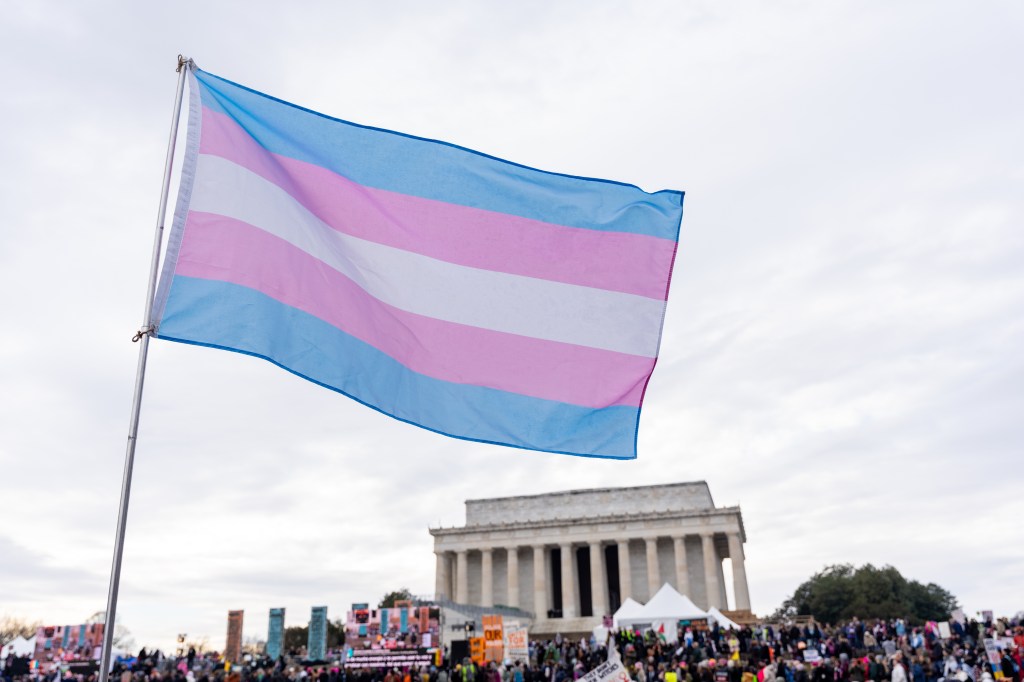
A person waves a transgender pride flag during the People’s March and rally to the Lincoln Memorial in Washington, D.C., United States, on January 18, 2025. (Photo by Nathan Morris/NurPhoto via Getty Images)
Bolopion outlined how the Trump administration has “embraced policies and rhetoric that align with white nationalist ideology”, whilst the US has left dozens of international organisations and has also culled US aid programmes, including those which support children, women and LGBTQ+ people.
In the specific US section of the report, Human Rights Watch states the Trump’s second administration has “been marked from the start by blatant disregard for human rights and egregious violations”, adding the nation took significant steps backward on various issues including immigration, health, environment, disability, gender and freedom of speech.
You may like to watch
It outlined how in many parts of the US, officials at all levels of government continue to target LGBTQ+ people, with the administration particularly having escalated attacks on transgender communities.
Following his return to the White House, Trump has signed several executive orders seeking to remove the rights of trans people.
Trump has also moved to eliminate diversity, equity and inclusion programmes across the government and in the military. This move, coupled by campaigning by anti-woke MAGA activist Robby Starbuck, has seen several big name US businesses – including Walmart, Target, Ford, Lowe’s, Harley-Davidson and Jack Daniel’s – drop their DEI policies, programmes and targets.
As the report outlines: “Twenty-seven states now ban medically indicated gender-affirming care for youth, and several impose criminal penalties on providers. In June, the Supreme Court upheld these bans, which have a devastating impact on young peoples’ health and well-being. Eight states require school staff to disclose students’ gender identity to parents and twenty states restrict bathroom access for transgender people in schools. Nineteen states restrict classroom discussion of sexual orientation and gender identity.
“Less than half of US states prohibit discrimination based on sexual orientation and gender identity. Congress has failed to enact comprehensive federal protections for LGBT people in education, housing, public accommodations, and federally funded programs.”
In his introduction, Bolopion mused who will defend human rights in the face of the US “undermining the global human rights system”.
“Despite rhetorical flourishes, many governments treat rights and the rule of law as a hindrance, rather than a benefit, to security and economic growth,” the executive said.
“The European Union, Canada, and Australia appear to hold back out of fear of antagonizing the US and China. Others are weakened by the way political parties displaying illiberal tendencies have skewed their domestic politics and discourse away from a rights-respecting approach. In many parts of Western Europe, including the United Kingdom, Germany, and France, many voters gladly accept limits on the rights of “others,” whether immigrants, women, racial and ethnic minorities, LGBT people, or other marginalized communities.
“But as history shows, would-be autocrats never stop at ‘others’.”
Tennessee lawmakers have advanced a host of anti-LGBTQ bills that would run counter to U.S. Supreme Court precedent. Two measures, both proposed by Rep. Gino Bulso, R-Franklin, would challenge landmark cases that legalized same-sex marriage and established protections for discrimination based on sexual orientation or gender identity.
Rep. Gloria Johnson, D-Knoxville, questioned the legality to going against Bostock v. Clayton County, which established that LGBTQ people are protected from discrimination under the Civil Rights Act of 1964. Tom Lee, member of the Board of Directors of the Tennessee Pride Chamber, spoke against the bill, arguing that it could allow discrimination against LGBTQ couples.
“Imagine if under this bill a private employer said, ‘Well, you can’t take family leave because I, as a private citizen, don’t recognize — using the language of the bill — your purported marriage,’” Lee said. “Or a bank says, ‘You’ll pay the higher rate (for unmarried couples). We’re not bound by the 14th Amendment. You’re not married in our eyes.’”
The Banning Bostock Act would codify that laws prohibiting sex discrimination would not prohibit discrimination against a person for being homosexual or transgender, nor would it prohibit discrimination because of sexual orientation, sexual behavior, gender identity, or gender non-conforming behavior.
Meanwhile, the next bill would allow private citizens, businesses, and organizations to refuse to recognize same-sex marriage, and protect attorneys from being punished for refusing to celebrate or perform a same sex marriage.
Bulso first appeared here in February 2024 for his ultimately failed bid to ban Pride flags, which he is now attempting again. In April 2024, we heard from Bulso when he objectedto a ban on marriages between first cousins because gays can’t make babies. Last year Bulso launched a failed bid to fill the US House seat left open by the abrupt resignation of Rep. Mark Green.
The New York City Council has advanced a resolution urging Congress to protect LGBTQ history at Stonewall National Monument after the Trump administration ordered Pride flags to be removed from the site.
Stay up to date with the latest in LGBTQ+ news with The Advocate’s email newsletter, in your inbox five days a week.
Resolution 269 passed the council’s cultural affairs committee 6-0 on Wednesday morning, and now awaits consideration from the full chamber. Lead sponsor Chi Ossé told The Advocate that the resolution marks a step toward combating President Donald Trump’s anti-LGBTQ agenda.
“These attacks that we’re seeing on LGBTQ history [are] … a distraction from the actual enemies we have at hand, which are Donald Trump [and] the fascist right-wing government,” said Councilmember Ossé, a Democrat who represents the Brooklyn neighborhoods of Bedford–Stuyvesant and Crown Heights.
The Trump administration issued a federal directive last month that prohibited national parks from flying banners other than the U.S. flag, with few exceptions. Similar orders have restricted what flags can be flown at U.S. embassies and military outposts.
The orders seem to be a crackdown on symbols like the Pride flag and Black Lives Matter slogan from appearing at government buildings, which Trump has previously criticized. But hundreds of protesters who have convened outside Stonewall argue the Pride flag is integral to commemorating LGBTQ history at the site.
“They’re trying to erase anything that accurately conveys the history of struggle of marginalized communities in this country,” Jay W. Walker, a New York City activist, told The Advocateat a protest Tuesday.
Patrons of the Stonewall Inn fought back during a June 1969 police raid and helped set in motion a national movement for LGBTQ+ rights. Stonewall is widely regarded as one of the most important sites of LGBTQ history in the United States, and was designated a national monument by President Barack Obama in 2016.
The resolution “goes beyond just a flag,” said Councilmember Justin Sanchez, a co-sponsor, during Wednesday’s committee meeting. “What removing a flag or desecrating any of our park space does is remove the places and the spaces where we get to see and be ourselves.”
Stonewall’s status as federal property means the federal government, and Trump, have jurisdiction over the site. But local officials, including Ossé, members of city council and Mayor Zohran Mamdani, have promised to push back against the Pride flag removal.
“I am outraged by the removal of the Rainbow Pride Flag from Stonewall National Monument,” Mamdani posted on the social media platform X Tuesday. “New York is the birthplace of the modern LGBTQ+ rights movement, and no act of erasure will ever change, or silence, that history.”
In an interview with Attitude, to celebrate his place on its Attitude 101 Trailblazer of the Year list, the leader revealed that as a teen he was the victim of a homophobic attack.
“I felt, like, a smack on the head and [someone] shouting ‘f*****!’ I fell to the ground and kept being kicked. I just remember crawling up into a ball and hoping it was going to stop.”
Polanski said he went to hospital but never told his parents about the incident.
He explained: “This was around [the] Section 28 [era]. You weren’t [finding community] in school; it didn’t feel like there were community support groups. The way I was finding out who I was was through bars and nightclubs, which is a pretty unacceptable place for a 14, 15, 16-year-old to be hanging out.”
Section 28 banned what the Tories called the promotion of homosexuality by schools and local authorities.
The law was repealed on 21 June, 2001, in Scotland, and on 18 November, 2003, it was taken off the statute books across the rest of the UK.
Elsewhere in the interview, Polanski described his approach as “bold politics”, meaning that he works directly with communities while aiming to focus policies away from “the rich who are hoarding that power and that wealth”.
In January, Polanski showed his support for London’s LGBTQ+ community by turning up at a bar to party with them.
Polanski joined clubbers for the launch of his party’s Green Space – a new nationwide community initiative from the Green Party. All money raised from the event will go towards getting Greens elected.