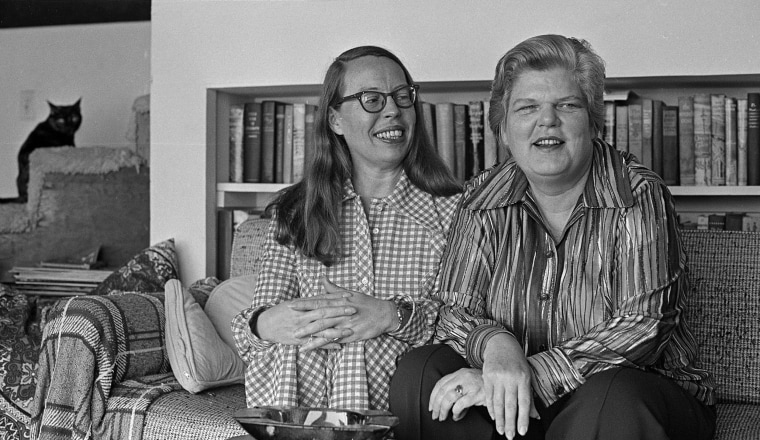
The hilltop cottage belonging to a lesbian couple who were the first same-sex partners to legally marry in San Francisco has become a city landmark.
The Board of Supervisors voted unanimously Tuesday to give the 651 Duncan St. home of the late lesbian activists Phyllis Lyon and Del Martin landmark status. The home in the Noe Valley neighborhood is expected to become the first lesbian landmark in the U.S. West, the San Francisco Chronicle reported.
“They provided a place for lesbians who were really, really, really in the closet to hang out and dance, have holiday potlucks so they wouldn’t have to go home and hang out with their homophobic relatives,” said Shayne Watson, an architectural historian who specializes in LGBTQ heritage conservation and was active in the movement to get the home landmarked.
Martin and Lyon bought the simple one-bedroom house, terraced up the hillside, as a couple in 1955, the same year they co-founded the Daughters of Bilitis, a political and social organization for lesbians.
The group started as a social support organization but quickly transformed into activism and politics.
“The Daughters of Bilitis didn’t have an office space, so 651 was really ground zero for the lesbian rights movement at the time. It was a place where people could be safe and reveal their sexuality,” said Terry Beswick, executive director of the GLBT Historical Society.
Phyllis Lyon and Del Martin at their San Francisco home on July 10, 1972. San Francisco Chronicle/Hearst Newspapers via Getty Images file
Lyon was a journalist who met her lifelong love, Martin, while working at a magazine in Seattle. The couple moved to San Francisco in 1953. Besides the political organization, they published a national monthly for lesbians and a book called Lesbian/Woman in 1972.
Gov. Gavin Newsom was a newly elected mayor of San Francisco in 2004 when he decided to challenge California’s marriage laws by issuing licenses to same-sex couples. His advisers and gay rights advocates had the perfect couple in mind to be the public face of the movement.
Lyon and Martin, who had been together more than 50 years by then, were secretly swept into the clerk’s office. They exchanged vows before a tiny group of city staffers and friends.
Martin died in 2008, and Lyon in 2020, and the house was left to Martin’s daughter, Kendra. The property was sold in September 2020.
After the sale, a loose organization called the Friends of Lyon-Martin House was formed to guard against demolition, with the GLBT Historical Society as a financial sponsor.
The new owner, Meredith Jones McKeown, supports landmarking and protecting the cottage, the Chronicle reported.
Within six months, the group will put forth a proposal, with a sidewalk plaque as “a bare minimum,” Beswick said. Beswick and Watson both want to preserve the interior as a student residency, public research facility and center for LGBTQ activism and history.
“No one wants to see a tour bus in front of the house,” said Watson, “but Phyllis and Del affected so many lives, including my own, and I feel strongly that the house where they did it should stay in the community.”
Caitlyn Jenner, the former Olympic champion and reality TV personality now running for governor in California, said she opposes transgender girls competing in girls’ sports at school.
Jenner, a 1976 decathlon gold medalist who came out as a transgender woman in 2015, told a TMZ reporter on Saturday that it’s “a question of fairness.”
“That’s why I oppose biological boys who are trans competing in girls’ sports in school. It just isn’t fair. And we have to protect girls’ sports in our schools,” Jenner said Saturday during a brief interview in a Malibu parking lot.
It was Jenner’s first comment on the issue since announcing her candidacy to replace Gov. Gavin Newsom, a Democrat, in a recall election. Five states have passed laws or implemented executive orders this year limiting the ability of transgender youths to play sports or receive certain medical treatment. There’s been a vehement outcry from supporters of transgender rights.
Jenner, a Republican, supported Donald Trump in the 2016 presidential election but later criticized his administration for some discriminatory actions against transgender people.
Many transgender rights advocates have criticized Jenner, saying she has failed to convince them that she is a major asset to their cause.
Kai Shappley, a trans 10-year-old who lives in Texas, asked Jenner to “stop hurting” trans kids.
Some trans people said Jenner doesn’t represent the community.
Equality California, an LGBTQ advocacy organization, wrote: “Here are the facts: Caitlyn Jenner is willing to sacrifice the health & well-being of trans kids to win votes. Gavin Newsom is not. It’s that simple.”
Others pointed out that, as recently as last year, Jenner supported trans athletes competing on the sports teams that align with their gender identity.
“I think every trans person, if they’re into athletics, should have an opportunity to compete and to improve themselves,” Jenner said in April 2020 on theOutsports podcast,The Trans Sporter Room, according to Forbes. “I think sports is such a great way to learn a lot about yourself. … Hopefully they’ll have the opportunity in the future to do whatever they can do. I’m all for it. I’m all for it.”
She echoed a similarly supportive sentiment in 2015, when she received the Arthur Ashe Courage Award at the ESPY Awards, and spoke about issues affecting trans people.
“I also want to acknowledge all the young trans athletes who are out there — given the chance to play sports as who they really are,” she said in her acceptance speech. “And now, as of this week, it appears that trans people will soon be serving in the military. That’s a great idea. We have come a long way. But we have a lot of work to do.”
Advocates say Jenner’s flip-flop is evidence that she’s changed her public view just to attract the attention of California’s Republican voters.
But trans people say that her comment won’t be without consequence, and that it could help people behind anti-trans legislation justify their views.
“Jenner is gonna be America’s ‘some of my friends are trans’ trans woman that allows countless conservatives a little cover to decimate our rights,” trans filmmaker and author Leigh Finke said. “Not that they’ll succeed, but it’s the elbow room they need to better make their case, and hurt our kids.”
Caitlyn Jenner, the former Olympian, reality TV star and transgender activist, said Friday she is running to be governor of California, as a recall of the sitting Democratic governor moves forward.
In a press release posted to Twitter, Jenner, a longtime Republican, said that she’d make a “formal announcement” in the “the coming weeks” and pitched herself as a “compassionate disruptor” who will campaign on “solutions” and “providing a roadmap back to prosperity” for the state.
“California has been my home for nearly 50 years. I came here because I knew that anyone, regardless of their background or station in life, could turn their dreams into reality. But for the past decade, we have seen the glimmer of the Golden State reduced by one-party rule that places politics over progress and special interests over people. Sacramento needs an honest leader with a clear vision,” Jenner said.
Jenner’s campaign website also went live Friday morning. Axios first reported the news.
POLITICO reported this week that Jenner did not cast ballots in nearly two-thirds of the elections in which she was eligible to vote since 2000. Though critical of Newsom, she did not vote in the 2018 gubernatorial election in which the Democratic governor had the biggest landslide victory for a non-incumbent since 1930.
All told, Jenner has voted just nine times in California’s 26 statewide elections since 2000, Los Angeles County records show.
Jenner announced she is a transgender woman in April 2015. She starred in her own reality TV show, called “I am Cait” in 2016.
“The reality is that the trans community is being relentlessly attacked by this president,” she wrote.
Despite her renouncement of Trump, pro-LGBTQ groups were quick to slam Jenner over her entrance into the race Friday, citing her prior support for him.
“Make no mistake: we can’t wait to elect a #trans governor of California. But @Caitlyn_Jenner spent years telling the #LGBTQ+ community to trust Donald Trump. We saw how that turned out,” tweeted Equality California.
Senator Scott Wiener (D-San Francisco)’s Senate Bill 357, the Safer Streets for All Act, passed the Senate Public Safety Committee by a vote of 4-1. SB 357 repeals provisions of California law that criminalize loitering for the intent to engage in sex work. These provisions — arrests for which are based on an officer’s subjective perception of whether a person is “acting like” they intend to engage in sex work — result in the disproportionate criminalization of trans, Black and Brown women, and perpetuates violence toward sex workers. SB 357 does not decriminalize soliciting or engaging in sex work. Rather, it simply eliminates an anti-loitering offense that leads to harmful treatment of people for simply “appearing” to be a sex worker.
Criminalizing sex work does not make sex workers or our communities safer. Most criminal penalties for sex workers, loitering laws included, do nothing to stop sex crimes against sex workers and human trafficking. People engaged in sex work deserve to be treated with dignity and respect.
In February, a similar piece of legislation to repeal this type of loitering ban became law in New York. SB 357 is part of the movement to end discrimination against and violence toward sex workers, especially the most targeted communities — trans, Black, and Brown people. SB 357 is cosponsored by Positive Women’s Network – USA, St. James Infirmary, SWOP LA, TransLatin@ Coalition, Asian Pacific Islander Legal Outreach, Equality California and the ACLU of California.
Under current law, it is a crime to loiter in a public place with the “intent” to commit a sex work-related offense. But this law can be broadly interpreted, and thus allows for discriminatory application against the LGBTQ community and people of color. Law enforcement can use a non-exhaustive list of circumstances to subjectively determine if someone “intends” to engage in sex work, including factors such as speaking with other pedestrians, being in an area where sex work has occurred before, wearing revealing clothing, or moving in a certain way. Because current law regarding loitering is highly subjective and vague, law enforcement officers disproportionately profile and target Black and Brown transgender women by stopping and arresting people for discriminatory and inappropriate reasons. This is how Black and Brown transgender women get arrested and cited for simply walking on the street. It also gives law enforcement the ability to more easily target and arrest sex workers.
People within the LGBTQ, Black, and Brown communities report high rates of police misconduct throughout the United States and are disproportionately affected by police violence. Transgender people who have done street-based sex work are more than twice as likely to report physical assault by police officers and four times as likely to report sexual assault by police. A Black person is 3.5 times more likely to be shot by police than a white person. These statistics are a daily reality that transgender, Black and Brown people face and lead to mistrust of law enforcement.
SB 357 will repeal a discriminatory law that makes it a crime to loiter with the intent to engage in sex work, given that it fails to prevent street-based sex work and disproportionally results in the criminalization of transgender people and communities of color.
“Sex workers are workers like anyone else, and they deserve to be treated with dignity and respect,” said Senator Wiener. “Our criminal justice system criminalizes people – particularly Black, Brown and LGTBQ people – for simply existing and going about their lives. Laws like this one do nothing to make people safer, or stop sex trafficking. Instead, they criminalize members of our community who are simply going about their lives. We need to support sex workers instead of criminalizing them.”
“This is just one step towards ending the criminalization of the color of a person’s skin, their gender or their livelihood,” said Celestina Pearl of St. James Infirmary. “We all deserve to exist in public peacefully without fear of arrest.”
Fatima Shabazz of Fatima Speaks, and co-lead the Policy Committee of the DecrimSexWorkCA Coalition added, “This is the first step in repealing a Jim Crow law that criminalizes Black and trans people in public spaces.”
“For far too long, California law has been used to arbitrarily target, harass and arrest transgender and gender-nonconforming people simply for existing in public spaces,” said Tami A. Martin, Equality California Legislative Director. “Let’s be clear: this law doesn’t make our communities safer — it contributes to distrust between LGBTQ+ people of color and law enforcement. By listening to and following the lead of transgender people of color — who are most often targets of archaic and discriminatory loitering laws — California has the opportunity to boldly stand on the side of justice and improve public safety. All LGBTQ+ people deserve to exist without fear of harassment and violence, which is why we are proud to cosponsor SB 357.”
###
Equality California is the nation’s largest statewide LGBTQ+ civil rights organization. We bring the voices of LGBTQ+ people and allies to institutions of power in California and across the United States, striving to create a world that is healthy, just, and fully equal for all LGBTQ+ people. We advance civil rights and social justice by inspiring, advocating and mobilizing through an inclusive movement that works tirelessly on behalf of those we serve. www.eqca.org
Though COVID-19 has had a profound impact on us all, Planned Parenthood Northern California has kept its doors open throughout the past year thanks to supporters like you!Join us at Stronger and Healthier Together a night of celebration!
Saturday, May 1, 2021
6:00 PM Main Program VIP Reception to FollowEntertainment Sponsor
A half century is a long time in the history of the modern LGBTQ rights movement, encompassing more change than could have been imagined in the early 1970s. Nowhere is this better reflected than in the archives of the Bay Area Reporter (BAR), “America’s longest continuously published and highest-circulation LGBTQ newspaper,” which is celebrating its 50th anniversary with special coverage, events and a new online exhibition with the GLBT Historical Society. The exhibition, “Stories of Our Movement: The BAR at 50” is made possible by generous support of the Bob Ross Foudation, and will debut on the society’s website on April 26; information is available here.
“Back in 1971, the mainstream media wasn’t really covering gay and lesbian people, much less bi and trans people,” said Cynthia Laird, the BAR’s news editor for the last 22 years, who joined the paper as assistant editor in 1996.
From its first issue, published April 1, 1971, the BAR laid out its independent but unifying mission: “This publication is in no way connected with any organization and will publish the views and thoughts of all groups. This paper will also try to help bridge the communication gap that seems to exist between groups in our own community.”
A RELIABLE WORKHORSE
Surely, this goal is still a work in progress, but over the intervening decades, the Bay Area Reporter became a reliable workhorse of original LGBTQ political and cultural reporting and, like many alternative weeklies around the country, an advocacy paper, influencing elections and helping to advance a civil rights movement that changed the world. Bob Ross, who founded and published the paper until his death in 2003, “had a real keen vision and foresight to see that a newspaper could bring the community together,” said Laird, one of a very few women news editors in LGBTQ media.
As the LGBTQ community and the broader culture have evolved, so has the BAR, said Michael Yamashita, who began working with the paper as an assistant editor in 1989. Now the publisher and perhaps the first LGBTQ Asian man to publish a legacy LGBTQ newspaper, he notes a more inclusive trend in the paper’s coverage and intended audience. “During Bob’s time … the focus really was on the, how would you say it? The power brokers in the gay community, which was really a lot of men,” Yamashita said in a recent interview. “White men who were heading up the agencies and running businesses and attempting to run for office. And increasingly women became part of that, (especially) in terms of the [San Francisco] board of supervisors. And so the focus really did have to enlarge, but I don’t think he would have ever imagined that it would enlarge and change as much as it has in the last, maybe 10 years.”
In 2018, with funding from the Bob Ross Foundation, the GLBT Historical Society completed a project to digitize the entire run of the BAR, from 1971 to 2005, when the paper went online. Since then, the key-word searchable version at the California Digital Newspaper Collection has proven a treasure trove for historians, and provides ample evidence of the breadth and depth of the BAR’s coverage. Laird notes in particular the paper’s reporting on HIV/AIDS, and now COVID, which continues to be critically important to the community’s survival. Nowadays, of course, LGBTQ issues are frequently covered in print and online outlets serving the general public, a fact Yamashita acknowledges, but he thinks there is still a clear need for the LGBTQ press. “I mean, [the mainstream press] just doesn’t have the bandwidth. They don’t have enough people to cover all the subjects that they should be covering and so one of the first things to go are minority and LGBTQ in any kind of reporting.”
EXPANDING THE FOCUS
“The BAR still plays an extremely critical role because we do publish stories that you won’t really find anywhere else. A lot of our content is original. Or if it’s something that everyone else is covering like a major event or major news or something, we will often speak to other voices that the mainstream media don’t speak to,” said Laird. “I think you see that especially in transgender coverage today, and trans women of color in particular. What I’ve tried to do in my story assignments in our coverage is really focus on other communities within the LGBT umbrella.”
Both Laird and Yamashita also spoke of their efforts to be more fully representative of all races and classes within the LGBTQ community. “After the George Floyd killing and all the Black Lives Matter actions and activity,” said Laird, “we’ve worked hard to feature people of color, queer people of color, in our stories, and photos of queer people of color with our stories even before that. But I have been really more aware of it in that context.”
Like many community newspapers and businesses, the BAR faces many challenges, particularly in the midst of the COVID pandemic. Last year, the paper was forced to lay off two long-time employees as print advertising revenue plummeted and online advertising has not made up the difference, despite an increase in online traffic. But Laird and Yamashita expressed confidence that, with the community’s support, the BAR will persevere. “Part of survival, I think, is paying attention to meeting your readers where they are and giving them what they want. So we’ve tried to stay away from sensational, quick clickbait things which work, but we’re hoping to cultivate a more consistent and loyal readership, “said Yamashita. “We hope to provide a steady diet of the kind of news coverage that local people here are looking for.”
Regardless of what comes next, 50 years — or some 2,600 weeks — of writing the first draft of LGBTQ history is an extraordinary contribution . “It’s really amazing,” commented Laird on the BAR’s quinquagenary. “It’s really a milestone and I’m really proud of the paper. I’m proud of everyone that’s contributed to it over the years to make it this great resource. I think the Bay Area is really lucky to have it.”
Terry Beswick is the executive director of the GLBT Historical Society. He spearheaded a successful campaign to preserve the Castro Country Club for the queer recovery community in San Francisco, co-founded the Castro LGBTQ Cultural District and co-chaired the LGBTQ Cultural Heritage Strategy.
Thursday, April 8 7:00–7:30 p.m. PDT Online program Free | $5 suggested donation
GLBT Historical Society Executive Director Terry Beswick will interview director, producer, screenwriter and playwright Joe Castel, whose body of work explores Latinx and LGBTQ history and identity. Castel will also discuss his newest documentary, Nelly Queen: The Life and Times of José Sarria (2020), which will be screened immediately following the interview (see the separate event listing). This is the April installment of “Queer Culture Club,” our monthly series each second Thursday that focuses on LGBTQ people who are defining the queer culture of yesterday, today and tomorrow. Each month, Beswick interviews queer culture-makers, including authors, playwrights, historians, activists, artists and archivists, to learn about their work, process, inspirations, hopes and dreams. Please note: the discussion and the film screening are ticketed as two separate events, so please register for each event if you wish to attend both. Register for the discussion online here.
Thursday, April 8 8:00–9:30 p.m., PDT Online program Free | $5 suggested donation
Join us for a special screening of director, producer, screenwriter and playwright Joe Castel’s new documentary film Nelly Queen: The Life and Times of José Sarria (2020). An intimate look at an extraordinary man, the film documents Sarria’s life, starting with his performances at the North Beach establishment the Black Cat Café in the 1950s, to his historic run for the San Francisco Board of Supervisors in 1961 (becoming the first openly gay person to run for political office anywhere), to his founding of the Imperial Court System in 1964. Alternating historical footage with bittersweet revelatory interviews, the film shows “how a marginalized outcast fought unjust laws and united an often fractured community by giving them a political and social identity,” as the Bay Area Reporter wrote in its review. The film is preceded at 7:00 by a discussion with Castel (see the separate event listing). Please note: the discussion and the film screening are ticketed as two separate events, so please register for each if you wish to attend both. Register for the film screening here.
Equality California, the nation’s largest statewide LGBTQ+ civil rights organization, announced early 2022 endorsements of four Congressional incumbents in key 2022 battleground districts on Wednesday: Rep. John Garamendi (CA-03), Rep. Josh Harder (CA-10), Rep. Katie Porter (CA-45) and Rep. Mike Levin (CA-49). Protecting the four incumbents and winning back Congressional seats lost to anti-LGBTQ+ candidates in 2020 will be a top priority for the organization ahead of the 2022 midterm elections.
“Protecting our champions in Congress and expanding our pro-equality House majority are critical priorities for the LGBTQ+ community,” said Equality California Executive Director Rick Chavez Zbur. “Voters gave the Biden-Harris Administration a mandate in 2020: pass the Equality Act, reform our broken immigration system, advance racial justice and equity and expand access to quality, affirming healthcare. The Biden-Harris agenda is achievable, but only if we ensure they have pro-equality partners in Congress — and all four of these leaders have demonstrated their unwavering commitment to creating a world that is healthy, just and fully equal for all LGBTQ+ people.”
Candidate Reactions:
“I’m honored to be endorsed by Equality California—an organization that understands that we must have equal opportunity for all, do what we can to end discrimination, and remove barriers to opportunity,” said Rep. John Garamendi. “Throughout our country’s proud history, every generation has faced a national debate on civil rights issues. While these struggles have often been slow and arduous, as we have witnessed for more than two centuries, the trajectory of our society is toward more equality under the law. That’s why I support legislation like the Equality Act, which would update the Civil Rights Act to include LGBT Americans, specifically making it illegal to discriminate against them in the workplace, housing, and public accommodations. Thank you to Equality California for their endorsement. Together, we will work to end discrimination in our nation and create a more just and fair society.”
“No matter who you are or who you love, you deserve equal treatment under the law,” said Rep. Josh Harder. “I’m proud to stand with our LGBTQ neighbors and loved ones, and will keep fighting to make sure they are finally treated with the respect and equality they deserve.”
“Equality California has been a leader and a key partner as I advocate for the LGBTQ+ community, and I am thrilled to receive their early endorsement,” said Rep. Katie Porter. “Until every American, regardless of who they are or who they love, can live free from hate, discrimination, and violence, I’ll keep up the fight. I look forward to continuing to work with Equality California to build an equal and just future for all.”
“Equality California is one of the nation’s most effective organizations advancing the rights of the LGBTQ+ community and social justice,” said Rep. Mike Levin. “In the past two decades they have led the fight to pass over 150 bills and resolutions advancing human rights in the California legislature. I am deeply honored that they have recognized me as an ally and that they have endorsed my campaign for re-election to Congress.”
For a complete list of Equality California’s current endorsements, visit eqca.org/elections.
###
Equality California is the nation’s largest statewide LGBTQ civil rights organization. We bring the voices of LGBTQ people and allies to institutions of power in California and across the United States, striving to create a world that is healthy, just, and fully equal for all LGBTQ people. We advance civil rights and social justice by inspiring, advocating and mobilizing through an inclusive movement that works tirelessly on behalf of those we serve. www.eqca.org
The California Legislative LGBTQ Caucus, the LGBTQ Caucus of the League of California Cities and Equality California, the nation’s largest statewide LGBTQ+ civil rights organization, announced their opposition to the misguided and dangerous effort to recall Governor Gavin Newsom during a virtual press conference on Friday (Facebook, Download). Equality California Executive Director Rick Chavez Zbur, Insurance Commissioner Ricardo Lara, Legislative LGBTQ Caucus Chair Assemblymember Evan Low (D-Campbell), former Chair Senator Scott Wiener (D-San Francisco), Senator John Laird (D-Santa Cruz), Assemblymember Chris Ward (D-San Diego), Long Beach Mayor Robert Garcia, League of California Cities LGBTQ Caucus Board Member Palm Springs Mayor Pro Tem Lisa Middleton and BART Board Director Janice Li praised Governor Newsom’s long record of support for LGBTQ+ civil rights and his leadership during the COVID-19 pandemic, national economic downturn and devastating wildfires. The leaders also spoke to the risk that the partisan recall effort, led and funded by anti-LGBTQ+ and pro-Trump extremists, poses to LGBTQ+ Californians and the diverse communities to which LGBTQ+ people belong.
After the press conference, 60* LGBTQ+ elected officials throughout California (listed below) released the following joint statement opposing the recall effort:
“As LGBTQ+ Californians and elected leaders in our communities, we strongly oppose the misguided effort to recall Governor Gavin Newsom. This attempt to remove the Governor — led and funded by anti-LGBTQ+ and pro-Trump extremists — is the product of a coordinated disinformation campaign that will cost the state of California $100 million. Instead, this money should be used to support Californians as our state recovers from the COVID-19 pandemic. The recall poses an especially grave threat to our LGBTQ+ community and the progress that California continues to make toward full, lived equality for all people.
“Throughout his career, Governor Newsom has been a dedicated ally of the LGBTQ+ community and an unyielding champion in our fight for civil rights and social justice. He stood with us at times when it was not politically popular, regardless of personal and professional risks, because he knew it was the right thing to do. He has taken bold, principled actions to advance marriage equality, expand access to life-saving HIV prevention medication, protect transgender Californians from discrimination, and ensure that California’s government reflects the diversity of our communities.
“Governor Newsom’s leadership has earned the trust of LGBTQ+ Californians, and our community stands ready to defeat a recall.”
The following officials signed the statement above:
California Insurance Commissioner Ricardo Lara
U.S. Representative Mark Takano
California Senator Susan Talamantes Eggman
California Senator John Laird
California Senator Scott Wiener
California Assemblymember Sabrina Cervantes
California Assemblymember Evan Low
California Assemblymember Chris Ward
San Leandro Unified School District Board Trustee James Aguilar
San Leandro Vice Mayor Victor Aguilar
Berkeley Unified School District Board President Judy Appel
Signal Hill City Treasurer Larry Blunden
Los Angeles City Councilmember Mike Bonin
Anaheim City Councilmember Jordan Brandman
Former San Mateo County Harbor District Commissioner Sabrina Rose Brennan
El Monte Union High School District Board President Florencio Briones
Belvedere Mayor James Campbell
Pleasant Hill City Councilmember Ken Carlson
Berkeley Rent Stabilization Board Commissioner James Chang
San Francisco Treasurer José Cisneros
Redlands City Councilmember Denise Davis
Hacienda La Puente Unified School District Board Member Anthony A. Duarte
Bay Area Rapid Transit (BART) Board Director Bevan Dufty
Oceanside Unified School District Trustee Eleanor Evans
Santa Clara Valley Open Space Authority Director Shay Franco-Clausen
Los Angeles City Controller Ron S. Galperin
Long Beach Mayor Robert Garcia
San Diego Mayor Todd Gloria
Former San Diego City Council President Georgette Gómez
Cathedral City Mayor Gregory Raymond
Sacramento Municipal Utility District Board Member Rosanna Herber
Pajaro Valley Unified School District Trustee Jennifer Holm
Palm Springs Mayor Christy Holstege
West Basin Municipal Water District Director Scott Houston
Palm Springs City Councilmember Geoff Kors
Los Angeles County Supervisor Sheila J. Kuehl
Dublin City Councilmember Shawn Kumagai
Bay Area Rapid Transit (BART) Board Director Janice Li
Monterey Park Mayor Pro Tem Henry Lo
Former Stockton Unified School District Board President Lange Luntao
San Francisco Supervisor Rafael Mandelman
Palm Springs Mayor Pro Tem Lisa Middleton
Encinitas City Councilmember Joe Mosca
College of Marin Board Trustee Stephanie O’Brien
San Leandro Unified School District Board Member Peter Oshinski
Oak Grove School District Board of Trustees Vice President Jorge Pacheco, Jr.
Chula Vista City Councilmember and California Coastal Commission Chair Steve C. Padilla
San Carlos Mayor Laura Parmer-Lohan
Los Angeles County Assessor Jeff Prang
San Gabriel Valley Municipal Water District Director Miles Prince
El Cerrito Mayor Pro Tem Gabriel Quinto
Bay Area Rapid Transit (BART) Board Vice President Rebecca Saltzman
San Francisco Unified School District Commissioner Mark Sanchez
Cabrillo Community College District Trustee Adam Spickler
City College of San Francisco Trustee Tom Temprano
Marin Community College District Board of Trustees President Wanden Treanor
Los Angeles Community College District Trustee David Vela**
Palm Springs City Councilmember Dennis Woods
San Gabriel Valley Municipal Water District Board President Thomas Wong
Fullerton City Councilmember Ahmad Zahra
Desert Healthcare District Director Dr. Les Zendle
*Number updated to reflect new total **Added March 18, 2021
###
Equality California is the nation’s largest statewide LGBTQ civil rights organization. We bring the voices of LGBTQ people and allies to institutions of power in California and across the United States, striving to create a world that is healthy, just, and fully equal for all LGBTQ people. We advance civil rights and social justice by inspiring, advocating and mobilizing through an inclusive movement that works tirelessly on behalf of those we serve. www.eqca.org
Ivy Bottini an artist, mother and a legendary activist, devoting over 50 years to the feminist & LGBTQ struggle for civil & human rights died on February 25th, 2021 surrounded by close friends and family. She was 94 years old.
Originally from Malverne, New York Bottini was a resident of West Hollywood for over 22 years and a Los Angeles Local for over 40 years.
In 1952, after marrying Eddie Bottini and having two daughters, Bottini began questioning her sexuality.
It wasn’t until 1968 that Bottini experienced a major life change when she accepted the fact that she was a lesbian. She inadvertently came out on TV shortly after that. During a New York City NOW press conference, she was answering a question.
“I said, ‘As a lesbian, I think . . .,’” she recalled. “I didn’t even realize I’d said it at first. But the rest of the room did.”
Once out of the closet she made lesbianism a feminist issue and dedicated her life to woman and LGBTQ rights.
In 1983 Bottini founded AIDS Network LA, the first AIDS organization, which focused on collecting and sharing information about the epidemic. In 1984 she was one of the founders of AIDS Project LA (now APLA Health).
Because of her work throughout her career Bottini trail blazed paths for women and LGBTQ people for generations.
An exact cause of death is not known at this time. She had been receiving hospice care at her daughters home in Florida for the past several weeks. Bottini is survived by her daughters Lisa and Laura, and a grandson.