This summer, a Texas judge declared the Deferred Action for Childhood Arrivals (DACA) program unlawful. But President Biden’s administration is moving swiftly to respond and protect undocumented young people. He must, for so much more is at stake for LGBTQ+ Asian Dreamers.
President Obama created DACA in 2012, which has helped thousands of undocumented young people to work, study, and improve their lives in this country, without the fear of deportation. Many of them are LGBTQ+. And many come from Asian counties.
To address this disastrous court decision from this summer, Biden is looking to shore up the program with new rules. Still, only Congress can permanently safeguard DACA recipients and grant them, along with the rest of the estimated 11 million undocumented immigrants in the U.S., a pathway to citizenship.
Estimates say that 267,000 undocumented immigrants are LGBTQ+, of which a disproportionate share is Asian and Pacific Islander. More than 169,000 people who are API are eligible for DACA. According to the U.S. Citizenship and Immigration Service, over 16,000 people from South Korea, the Philippines, India, Pakistan, and China have already benefitted from DACA. The court’s ruling will subject 800,000 potential DACA beneficiaries to again live in fear of deportation.
On Biden’s first day in office, he announced the Citizenship Act of 2021 (HR 1177/S.348), which will give undocumented immigrants a path to citizenship (including 1.5 million Asians and a quarter million LGBTQ+ immigrants), keep LGBTQ+ Asian immigrant families together, reduce visa backlogs, and expand visas and green cards for workers.
Absent congressional action, thousands of talented LGBTQ+ and Asian young people could be deported, many of them to countries where they cannot live their authentic lives and reach their fullest potential.
For LGBTQ+ people, the stakes are even higher than those who are not LGBTQ+. Many countries in Asia and the Pacific prohibit same-sex relations, such as Bangladesh, Bhutan, India, Pakistan, Malaysia, Myanmar, Indonesia, Papua New Guinea, and Tonga. In Indonesia, police shaved the heads of trans women and publicly caned a gay couple for having consensual sex. In most Asian and Oceania countries, transgender people cannot legally change their gender on their IDs, and LGBTQ+ people are not protected by anti-discrimination laws.
The programs supporting undocumented youth have real-world consequences for real people. Tony Choi is a 32-year-old gay Korean DACA beneficiary from New Jersey. In 2010, his options were taking care of his mother with cancer in the U.S. or returning to Korea where his LGBTQ+ identity would subject him to harsh hazing for two years in the mandatory military service. The Korean military penal law also criminalizes homosexuality. Because of DACA, he’s been able to serve his community. Bupendra Ram is a South Asian Dreamer from Fiji who came to the U.S. when he was only 2 years old. He is the first person in his family to earn a college degree, but he had to save every extra dollar from his minimum wage job in order to afford tuition. His undocumented status at the time meant he couldn’t receive financial aid.
DACA has provided LGBTQ+ undocumented young people employment opportunities and educational opportunities. Asian Americans, South Asians, Southeast Asians, and Pacific Islanders are the fastest-growing racial group in the U.S. today and the largest segment of new immigrants. Undocumented immigrants, LGBTQ+ Dreamers, and DACA recipients are the ones who are making our country great and they deserve an opportunity for a pathway to citizenship.
Glenn D. Magpantay has been an advocate for the LGBTQ+, AAPI, and immigrant communities for over 30 years. He is a longtime civil rights attorney, professor of law and Asian-American Studies, and LGBTQ+ rights activist.
A-League midfielder Josh Cavallo says he knows there are other players “living in silence” after becoming the only known current male top-flight professional footballer in the world to come out as gay.
Cavallo on Wednesday became a rarity in men’s professional sport, announcing on social media he was “ready to speak about something personal that I’m finally comfortable to talk about in my life”.
The Twitter post and emotive personal video, shared by his club Adelaide United, has since made international headlines and elicited support from all corners of the game.
The 21-year-old said growing up he “always felt the need to hide myself because I was ashamed.” “Ashamed I would never be able to do what I loved and be gay,” he wrote.
“Being a closeted gay footballer, I’ve had to learn to mask my feelings in order to fit the mould of a professional footballer. “Growing up being gay and playing football were just two worlds that hadn’t crossed paths before. “I’ve lived my life assuming that this was a topic never to be spoken about.”
Adelaide United coach Carl Veart said Cavallo, who has played 19 games for the Reds after playing nine matches for Western United, has “shown incredible courage to be one of very few professional sportsmen to be this brave.”
An Adelaide United statement said: “Today, Josh Cavallo speaks his truth to the world and demonstrates profound courage. Adelaide United, not only as a football club, but as the embodiment of an inclusive community, supports a remarkable and brave person.
“We stand alongside Josh for proudly being true to himself and will continue to love and support him as a member of our beautifully diverse family.”
Football Australia chief executive James Johnson said: “Football Australia wishes to commend Josh’s bravery to come out as the only openly gay player in the A-League Men competition. His courage to be open with himself and share that part with others is inspiring and will hopefully inspire more footballers to do the same in the future.”
When Jaime was 44, we fell hard for each other. We had been working on queer youth projects together over 10 years and in the middle of our second date, we decided to have a child. We know the cliché — lesbians usually bring a U-Haul to the second date. Amazingly, masculine-identified, gender non-binary M’Bwende brought a bassinet.
So, in a few short months, we took a massive leap of faith that many people in love take: we got pregnant with the help of some great fertility choreography. M’Bwende’s 35-year-old eggs, Jaime’s 45-year-old womb, and sperm from a 49-year-old gay male beloved who had sired Jaime’s then 6-year-old son.
In 2006, we felt nothing but grateful for this option. When Jaime came out in 1984, lesbians could not even access sperm at a sperm bank — only heterosexual, married women “qualified.” Our family’s reproductive journey to our daughter ultimately took nearly a year of overstimulating egg production, retrieval, implantation, one failed attempt, and $40,000, which we financed by taking out a loan on M’Bwende’s house.
A recent lawsuit against Aetna insurance company for discriminating against LGBTQ women in fertility coverage has brought this all back to us in technicolor. In our family, it’s gone like this: the miracle baby is in her first year of high school; our romantic partnership long ago ended; our parenting partnership is solid; and M’Bwende lost their house to the predatory loan undertaken to bring our daughter into being.
There’s been so much more hemorrhaging of cash and dignity along the way — the work and cost of “adding” one of us to our daughter’s birth certificate, inability to access health insurance during the many years when only one of us was on the birth certificate, one of us has been fired twice for being “too activist” (actual quote), one has navigated unemployment and underemployed due to racism and their gender presentation, one of us has suffered outrageous police harassment, one has endured humiliation at various agencies for not being our daughter’s “legal” parent… the list goes on and on.
Today, Jaime is part of a team of veteran LGBTQ+ activists that has created a new National LGBTQ+ Women’s Community Survey to capture all of the blood, sweat, tears and lost assets that come when LGBTQ+ women form and grow our families. How do sexism, racism, and anti-LGBTQ animus impact families headed by lesbian, bisexual, pansexual, intersex, and/or transgender women? What do masculine spectrum people who identified as or were perceived to be women have to tell us about their experiences in relationships with women who partner with women? How do LGBTQ+ women and their families thrive, regardless? What are our brilliant adaptations and forms of resistance? We want to know!
It is thrilling to finally have this place to tell our stories. The larger world needs to see us, and all we have been forced to endure to make our amazing lives work. Policy makers, corporations, and movement organizations need to wake up to our realities and change laws and priorities. We want equity and justice for all of us. The LGBTQ+ National Women’s Community Survey is over 100 questions long and yet it will ultimately only scratch the surface of the complexity of our struggles. Six thousand people who formerly or currently identify as an LGBTQ+ women have already taken the survey. We plan to be the largest repository on data by, for and about LGBTQ+ women in the world. Come join us.
M’Bwende Anderson is an organizer/activist with various nonprofit, NGO, and government agencies. Dr. Jaime M. Grant, author of Injustice at Every Turn: A Report of the National Transgender Discrimination Survey, and Great Sex: Mapping Your Desire, is an equity expert, researcher and trainer.
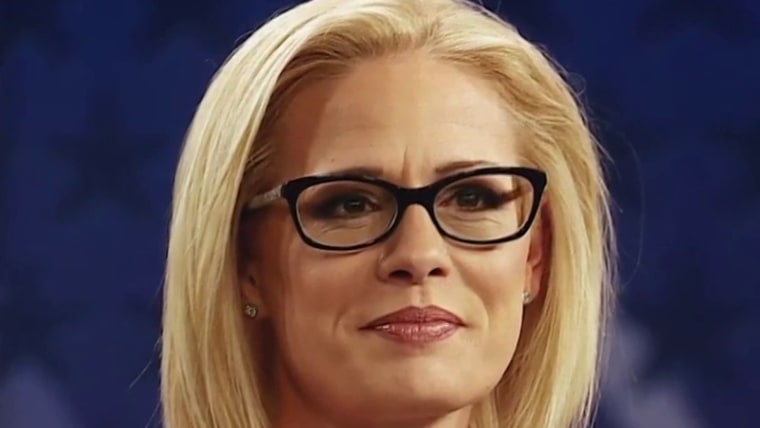
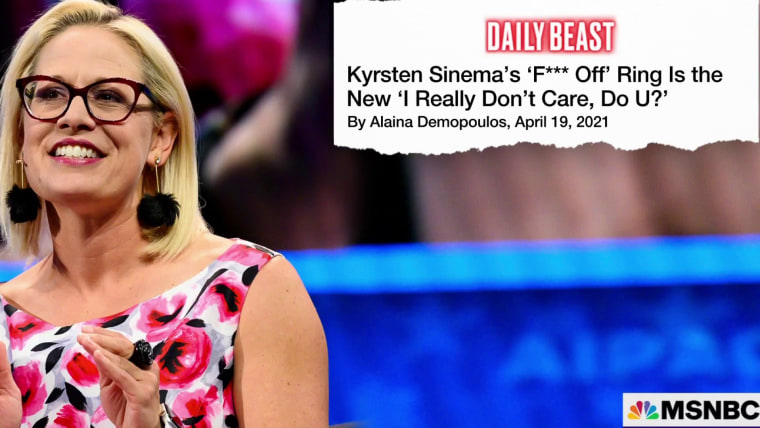
As a bisexual woman — and one who, like Sinema, is white and cisgender — I now cringe every time the senator makes the headlines. Whether it’s fashion columnists dissecting her showy personal style, cartoonists mocking her as a “manic pixie dream senator” or the seemingly endless analyses of her inscrutability, Sinema seems to embody many of the nasty assumptions about bi women I’ve worked my whole life to avoid.
Bi women are constantly told we’re untrustworthy, that our attraction to multiple genders means we’re more likely to cheat. We’re called greedy for finding more than one gender attractive, “confusing” for liking more than one gender and self-absorbed because apparently our brains are unable to think about much beyond our own sexual gratification. Within the LGBTQ community, bisexuals can be viewed as fair-weather members at best — likely to bail the second we stop having fun. Media outlets might not be talking about Sinema’s sex life, but her political reputation as greedy, unreliable and attention-seeking echoes many of the stereotypes my community has been dealing with for years.
“Is she bad for the bisexuals?” I find myself wondering on a nearly daily basis. It feels uncharitable to put so much responsibility on one woman’s shoulders. Yet given that she’s arguably the most prominent bisexual woman in the nation, it feels fair to wish she’d put a little more effort into being a bit less of a stereotype.
At the same time, I find myself wondering why Sinema’s sexuality matters so much to me in the first place. What does “bisexual representation” actually mean in this instance?
Bisexuals have a unique perspective that should ideally be helpful when crafting legislation.
One obvious answer is that bisexuals have a unique perspective that should ideally be helpful when crafting legislation. There’s no question that bisexuals face our own particular challenges when it comes to topics like sexual health, mental health and abuse and assault.
At the height of the HIV epidemic, bi people, and especially bi men, were frequently treated as vectors of disease; yet bi-specific outreach and education was thin. Research has shown that bi people, particularly bi women, are at an elevated risk for depression, anxiety, substance use and suicide; yet mental health resources are rarely targeted specifically to the bi community. Bi women are also at an elevated risk of abuse and assault: 2010 data from the Centers for Disease Control and Prevention found that over 60 percent of bisexual women reported experience with rape, intimate partner violence or stalking, compared to over 43 percent of lesbians and 35 percent of straight women. Bisexual women are also extremely vulnerable to poverty: A 2019 report showed nearly 30 percent of the community living below the poverty line — a rate matched only by the percentage of transgender people of all sexual orientations living in poverty.
In theory, electing more bisexuals will lead to better legislation that more thoughtfully addresses bisexual-specific concerns, making sure bisexuals don’t fall through the cracks of public health, anti-violence and anti-poverty initiatives. But in practice, it’s clear that politicians from marginalized backgrounds don’t always act in the best interests of their community. Sinema herself is proof of that. Despite her own history with poverty, she’s worked to gut the social safety net provisions included in the Build Back Better Act.
According to Gallup poll results published in February, about 3 percent of Americans identify as bisexual — and yet in over 200 years, there have only been two openly bisexual members of Congress: Sinema and Katie Hill, who stepped down less than a year into her first term after her ex-husband allegedly leaked private photos revealing that the couple had been sexually involved with a female campaign staffer. With Hill out of office, Sinema is the only bisexual member of Congress out of the 535 possible voting members. (For comparison, there are currently seven gay men and three lesbians in Congress.)
This brings me back to my frustration with Sinema. Watching news outlets eat her alive, it’s hard not to feel like America’s getting a rather poor first impression of what bisexuals bring to the table as legislators. Will voters shy away from other bisexual candidates out of a fear that we’ll turn out to be just as fickle as Sinema? Probably not, but it wouldn’t surprise me if some potential legislators found themselves less eager to publicly identify as bisexual in the wake of Sinema’s first Senate term.
On the other hand, perhaps the opposite will be true. Maybe Sinema will inspire a new wave of openly bisexual politicians, simply out of a desperation to prove that Kyrsten Sinema is not an accurate representation of all bisexuals. If that were to happen, it’d offer an ironic twist on Sinema’s story. She could very well be the best thing to ever happen to bisexuals in politics — if only because she inspires so many of us to stand up and reject the example she’s set for the country.
Two boys were arrested on suspicion of making homophobic comments during the Manchester City v Burnley football game on Saturday (16 October).
As well as the two teenagers, a third man in his 20s was apprehended by police at Etihad Stadium during the Premier League match. Greater Manchester Police said this arrest was a ‘separate incident’, on suspicion of a breach of the peace and police assault.
No further details were given about the precise ages of each boy or which team they support.
All three were held in custody for questioning over Saturday night and could now face possible football banning orders as well as criminal charges.
Match commander for the event, chief inspector Jamie Collins, emphasised that “the majority of fans attending [last Saturday’s] match behaved in an exemplary manner,” adding that he “thanked” those people.
He continued: “We work closely with Manchester City Football Club to promote good behaviour at matches and to identify anyone who commits a criminal offence.
“GMP officers will take positive action against those using homophobic or racist language and that is what my officers have done at today’s fixture.”
He emphasised that the “strongest action” will be taken towards anyone who engages in this kind of abusive or discriminatory behaviour at games, “including banning those fans from attending future football matches”.
“Our top priority is the safety and well-being of the fans, staff and players,” Collins continued. “We want fans to be able to enjoy matches without the experience being ruined by a small number of people.”
City won the game 2-0, with goals from Bernado Silva and Kevin De Bruyne.
Homophobic and racist abuse is a recurring issue within football, with London’s Met Police forced to increase their numbers at Wembley City last Tuesday (12 October) due to concerns over possible racist abuse during the England v Hungary game.
More recently a gay Premier League footballer revealed he is in therapy over crippling fears that football fans on opposing teams will “crucify” him for being gay should he come out.
Two weeks ago, The Athletic published an incredibly harrowing story that rocked the world of women’s soccer. Multiple National Women’s Soccer League players accused a prominent coach, Paul Riley of the North Carolina Courage, of sexual coercion. (Riley has denied the allegations.) In the wake of the story, league Commissioner Lisa Baird resigned, Riley was fired and Steve Baldwin, the controlling owner and CEO of the Washington Spirit women’s soccer team, stepped down (more on that later).
The players banded together and forced the cancellation of a weekend’s worth of games, and, when they returned to the pitch, brought with them public protest and a list of demands.
The players banded together and forced the cancellation of a weekend’s worth of games, and, when they returned to the pitch, brought with them publicprotest and a list of demands. Their bravery inspired other players from the women’s soccer world to speak out, and Alético Madrid player Deyna Castellanos released a statement accusing the coach of the Venezuelan national team of sexual abuse, as well. (That coach has also denied all allegations against him.) These events are part of a larger reckoning across the world of sports, as we saw in fencing over the last few months and in gymnastics when athletes came forward about Larry Nassar.
But there is one element to the abuse described by the women’s soccer players that has been under-discussed: the homophobic elements of it. This is an important point, because the world of women’s sports is thought to be generally queer-friendly, with many openly gay players and a large queer fan base. While it’s true that it’s much more acceptable to be openly queer in women’s sports, there are plenty of examples that show it’s still not entirely safe.
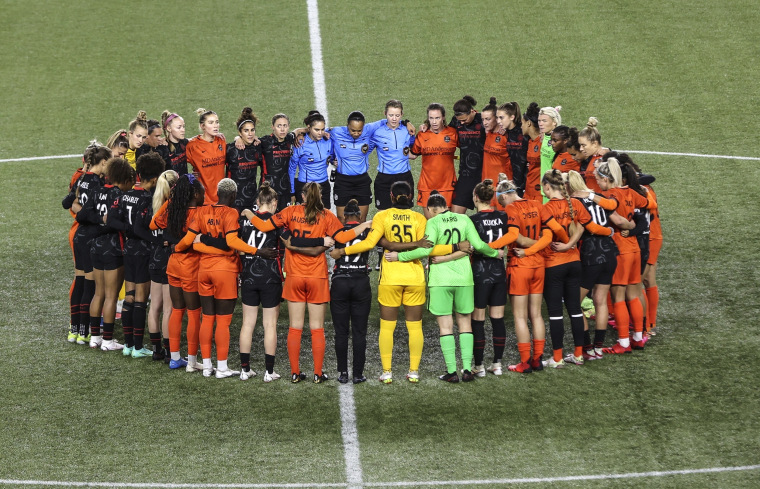
Portland Thorns and Houston Dash players, along with referees, gather at midfield, in demonstration of solidarity with two former NWSL players who came forward with allegations of sexual harassment and misconduct against a prominent coach, during the first half of an NWSL soccer match in Portland, Ore., on Oct. 6, 2021.Steve Dipaola / AP
In The Athletic’s report, players alleged that Riley, while he was coaching the Portland Thorns, was hyperfocused on their sexual orientation. Former Thorns players Sinead Farrelly and Mana Shim said Riley brought them back to his apartment one night and pressured them to kiss each other while he watched, incentivizing them with decreased team conditioning if they complied. Farrelly claimed that when she began dating one of her teammates, Riley became focused on their relationship, saying Farrelly couldn’t be gay because she was “too hot to be a lesbian” and that she wasn’t a “real lesbian” because she had previously been involved with men.
Shim said when she arrived in Portland in 2014, she was instructed not to talk publicly about being gay. In 2018, Riley defended Courage player Jaelene Daniels after she blamed her homophobia on her Christian faith, saying she had “a good heart.” (Riley was fired from the Thorns in 2015 after Shim reported his behavior and an investigation found he had violated team policy; he was hired by the Courage just months later.)
But it goes beyond Riley and the Portland organization’s behavior nearly a decade ago. The Washington Post in August reported that Washington Spirit coach Richie Burke was verbally abusive toward his players, including using homophobic slurs, something also alleged by youth players he had coached previously. (Burke was fired in September after an investigation into his conduct.) On Sept. 1, it was also announced that Andy Carroll, the chief business officer for the Real Salt Lake organization, which oversees the NWSL’s Utah Royals FC, was taking a leave of absence. Among other things, The Salt Lake Tribune reported Carroll would comment often on players’ sexual orientation, saying things like, “They’re all just a bunch of lesbians.”
But going back further to 2016, leaders in the Spirit organization have been accused of homophobia. That year, OL Reign (which was then called Seattle Reign) player Megan Rapinoe accused Bill Lynch, the Spirit’s owner, of anti-gay behavior. “I have had conversations with Spirit players current and past, the fact that [the organization doesn’t] have a Pride Night,” Rapinoe said at the time. “They’ve made it pretty clear, at least internally, that that’s not a game they are interested in, which is homophobic to me. … Yeah I do think that Bill Lynch is homophobic.”
Married NWSL players Ali Krieger and Ashlyn Harris, who currently play for the Orlando Pride, corroborated Rapinoe’s accusations in 2019. The pair reported that they clashed frequently with Lynch during their time in Washington. (In 2018, Lynch sold his majority ownership stake to Steve Baldwin, who stepped down in the wake of the recent allegations against coach Richie Burke.)
To be clear, this is not just a problem in women’s soccer. NCAA women’s basketball has long grappled with a homophobic culturethat has encouraged players to stay closeted or pressured them to make their appearance more feminine. The WNBA also has a number of openly gay players, and a strong LGBTQ fan base. But it has really only openly embraced its inherent queerness in recent years.
The reality is that even leagues known to be queer-friendly are often run by white, cishet men. As a result, they replicate — and enforce — existing systems of power and oppression. “Women’s sports, traditionally, have been built by men and are also trying to use the structures of men’s sports,” Meg Linehan, one of The Athletic reporters who broke the NWSL story, said on MSNBC. “That leads to problems in a major way.”
The reality is that even leagues known to be queer-friendly are often run by white, cishet men.
It’s always been this way. Throughout the history of professionalized women’s sports, players have been forced to wear feminized clothing (like the skirts and makeup worn by the All-American Girls Professional Baseball League during World War II) or told to keep quiet about their personal life if they didn’t have a male partner. They have been sexualized in ways that would make them appeal to the straight male gaze. And while the world has changed over the last century, female athletes still deal with stereotypes about being gay or masculine and, therefore, unappealing.
There are signs of hope. New data from Outsports, the University of Winchester and the Sports Equality Foundation shows that LGBTQ athletes who are out to their teams receive widespread, deep support from their teammates. The bravery of players like Farrelly, Shim and others who have come forward will also, hopefully, highlight how and why cultures of sexism, abuse and homophobia must be eradicated.
But in order to root these problems out completely, sports must recognize the ways that homophobia is deeply related to sexism and be committed to dismantling all of it. The recent spate of revelations out of the world of women’s soccer shows how far we still have to go.
At the end of August, the last U.S. passenger plane disappeared from Afghanistan’s horizons. The Taliban had finally taken control of the entire country after several days of battles and fire within the capital city. The leaders of the Taliban declared a new state of rule from the presidential palace formerly occupied by President Ashraf Ghani.
Soon after the Taliban’s taking of Kabul, Afghan men and women panicked in troves to the airport to flee oppressive rule. Getting a ticket onto an American bound plane was like winning the lottery for many Afghans.
Canada declared it would help resettle 20,000 Afghans, purposefully including LGBT Afghans among that mix. Canada made its intention to resettle those who would suffer tremendously under Taliban rule: Gay and trans folk, and any other kind of queer person, among a few other marginalized groups.
In early August of 2021, when the Afghan crisis was unfolding, a group of Democratic senators urged Biden to prioritize LGBT refugees. This group of senators, including Amy Klobuchar, wrote a letter to the State Department asking them to explain in greater detail a statement that Secretary of State Anthony Blinken made regarding LGBT asylum seekers.
In February of 2021, President Biden signed a memorandum that instructed U.S. agencies to ensure the rights of LGBT persons around the world. After that memorandum was signed, the State Department under Sec. Blinken said that it would make an enhanced effort to protect LGBT asylum seekers.
But the group of senators, in their letter, are still asking what has specifically been done to protect LGBT asylum seekers. What new steps has the Biden administration taken? And specifically, what steps has it taken to protect these LGBT refugees in Afghanistan?
It’s time that the United States not only resettle Afghan refugees, but purposefully make it part of its mission statement to resettle LGBT people. Although, since 1994, the U.S. has acknowledged asylum claims based on homosexuality, during the latest Afghan crisis, the Biden administration never made any intentional effort to prioritize LGBT folk as refugees. Biden never came out and aggressively prioritized LGBT Afghans.
Under Taliban rule, gay people are killed and thrown off buildings. Under the former Afghan administration, being gay was a punishable crime and LGBT folk who were outed were sent to jail.
Taliban rule also spells disaster for trans people: Being trans is not even an option in Afghanistan, where the Taliban would surely kill trans people as well as those who are gay.
Article 130 of the Afghan constitution implements Sharia law, which bans homosexuality. In these cases, men who have sex with men or women who have sex with women can be put to death. Moreover, Sections 645 and 646 of the constitution punish intimacy between two women with jail time.
Some recent victims of Taliban rule describe how the Taliban is asking LGBT folk to identify others in the LGBT community within the country. They are promising a safe rite of passage to those who identify members of the queer community. Such targeting is inordinately cruel—asking members of the LGBT community to turn on each other.
The Biden administration, armed with a liberal agenda, should create an LGBT refugee resettlement initiative. Some details about this kind of initiative have to be ironed out—take, for instance, the issue of metrics. How would the U.S. accurately assess someone’s LGBT status? If you were to argue that this initiative already exists, then I must ask—where is it? Where are these concrete steps that Biden has taken to make the lives of LGBT Afghans safer? Has he given a speech on this topic?
Perhaps the administration can start by reaching out to LGBT nonprofits in these uncertain regions—Rainbow Railroad, is, for instance, an organization that helps LGBT people in the Middle East find better lives in safe countries. Other groups in countries such as Jordan help smuggle trans people to safer countries, such as Turkey. Preexisting LGBT citizens who seek help from these nonprofits can be identified by the Biden administration to come to the United States, seeking a safe rite of passage.
Afghanistan serves as an example to help LGBT people who suffer in crisis. It’s high time that the U.S. government not only acknowledge LGBT asylum seekers, but place them on a pedestal, along with other groups who are immune to abuse.
Isaac Amend (he/him/his) is a transgender man and young professional in the D.C. area. He was featured on National Geographic’s ‘Gender Revolution’ in 2017 as a student at Yale University. Isaac is also on the board of the LGBT Democrats of Virginia. Find him on Instagram @isaacamend.
“Tell me about your coming out,” my 30-something friend Seth recently said to me.
“It was more than a day!” I joked.
National Coming Out Day (NCOD) is on Oct. 11. The holiday, celebrated yearly on Oct. 11, was first observed on Oct. 11, 1988.
That date was the one-year anniversary of the 1987 queer rights march in Washington, D.C. More than half a million people were at the march, which was a turning point in the LGBTQ+ rights movement.
Robert H. Eichberg, a psychologist who died in 1995, and gay rights activist Jean O’Leary, who died in 2005, co-founded NCOD.
Things have progressed so far for us queers since then. We can marry and serve in the military. We’re parents, cops, athletes, teachers and preachers.
In this era of marriage equality, it’s tempting to wonder: What is all the fuss about coming out?
But, a reality check shows that coming out still matters.
A quick look through the news headlines reveals why staying in the closet is so hurtful and how unsafe it can still be to come out as LGBTQ+.
If you’re of a certain age, you likely cried your eyes out when you watched the Disney movie “Old Yeller.” Who could forget the scene when the young boy Travis (played by Tommy Kirk shoots “Old Yeller” because his dog has rabies? In 2019, the Library of Congress added
”Old Yeller” to the National Film Registry.
Kirk died on Sept. 28 at 79 at his Las Vegas home. Despite Kirk’s popularity with fans, Disney didn’t renew his contract because he was gay.
“I was caught having sex with a boy at a public pool in Burbank,” Kirk told the gossip columnist Liz Smith. “We were both young, and the boy’s mother went to Walt.”
In the 1960s, there was no way that an out actor would have had a chance in Hollywood.
I wish I could say that everything’s changed since Disney fired Kirk. But, this isn’t the case.
In August, Jamel Myles, a fourth grader in Denver killed himself, the Denver Post reported. His mother told the Post that her son, who’d come out to her as gay, took his own life because he’d been bullied for a year.
“We are deeply committed to our students’ well-being,” a Denver Public Schools spokesman said in a statement.
Unfortunately, Jamal’s story is far from unique. Nationwide, many LGBTQ+ students in the U.S. have been bullied. Nearly half (43 percent) of transgender youth have been bullied, according to the 2019 Youth Risk Behavior Surveillance survey. Nearly a third (29 percent) of trans youth, 21 percent of gay and lesbian youth and 22 percent of bisexual youth have attempted suicide, the survey reports.
Life is far more dangerous for queer folk in many places worldwide from Hungary to Ghana.
You could respond to this grim news by going to bed, staying under the covers—tucked in the closet.
But that would let homophobia and transphobia have the right of way. It would deny us the chance to joyfully, proudly, defiantly celebrate who we are.
Studies have shown that knowing us can help alleviate prejudice.
Family members, friends and colleagues may still feel uncomfortable around us because of our sexual orientation or gender identity.
But, it’s hard to hate your non-binary 10-year-old granddaughter on Christmas morning. Or your gay buddy at the gym.
One of my fondest memories is when I came out to my Aunt Manci. I worried that she wouldn’t accept my girlfriend. I needed have been anxious. “You’re lucky,” she said, “she loves you.”
Coming out is a process that lasts a lifetime—from deciding if you want to be out in the third grade to ensuring that your loved ones won’t erase your queerness from your obituary.
Coming out can be arduous. But, it’s liberating! Let the revels begin! Happy National Coming Out Day!
Last summer, at the height of the Black Lives Matter protests sweeping the nation, the players of the Atlanta Dream stood united against an off-the-court opponent: Kelly Loeffler, then a U.S. senator from Georgia and a co-owner of the team.
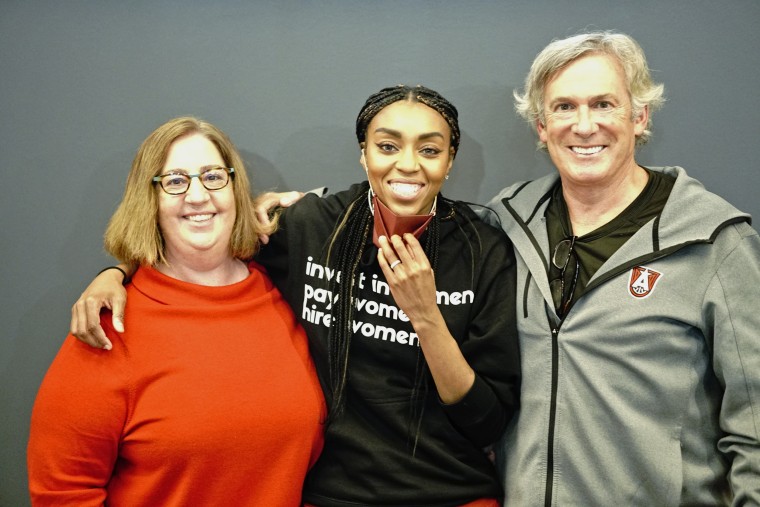
Renee Montgomery with Suzanne Abair and Larry Gottesdiener. Courtesy of Atlanta Dream
After opting out of the 2020 season to focus on social justice issues, Montgomery, who said she was inspired by LeBron James’ role in the “More Than a Vote” campaign, recognized the rare and unique opportunity to have a stake in an ownership group that aligned with her own values, which prompted her to announce her retirement after 11 seasons.
“You can’t be a player and an owner at the same time, and for me it was a pretty quick decision, because I understood that this was a big moment that I basically wanted to capitalize on,” Montgomery told NBC News. “I felt like women’s basketball was changing.”
While there was no official announcement that the Atlanta Dream was looking for new ownership, Montgomery had “heard the rumblings” from different sources and reached out to WNBA Commissioner Cathy Engelbert, who introduced her to Abair and Gottesdiener, who had been in talks with the league about acquiring a team.
“At Northland, we basically focus our philanthropic initiatives around three items: eliminating racism, empowering women and ending homelessness,” Abair said. “If you look at those three issues, I think it’s very easy to see that there’s a clear alignment in both the progressive nature of the Northland organization and the core values of the WNBA.”
With a set of similar core values, the trio bonded over a shared desire to invest in women’s professional and collegiate sports — which, they say, continues to be undervalued and underappreciated — and in the minority communities across the Greater Atlanta area.
“We really believe that there’s a need for investors like us to do a number of things: to elevate the league, to essentially bring deep-pocketed investors to the league, to build model franchises, to respect our players as athletes and people,” Abair said, adding that there’s a “need to change that narrative” that women’s sports aren’t worth investing in.
“I would say that having Renee as the third member of the ownership team has just been really incredibly valuable to both Larry and I — just to have that former player’s perspective,” Abair continued. “Renee knows the market from a different perspective than we do, and I think having the three of us each focused on different aspects, as we start to build the organization, has been a really nice blend.”
Montgomery echoed those sentiments, adding that she understands the “inner workings of the league” and can, therefore, “do things that are more player-friendly” during periods of travel and free agency. She also credited Abair and Gottesdiener for bringing the best practices from their work at Northland to their business dealings with the team.
“And then, to take it a step further, I don’t have to hold them kicking and screaming to talk about social justice or to lean into the community of Atlanta, because they’re so in on minority-owned business, small-owned businesses,” Montgomery said. “‘How can we be a part of the community? How can we be a part of the culture?’ They’re locked in, so any ideas that we all come up with together are always going to be for community first. Obviously, we want to be great on the court — and that will come, but we want to make sure we’re doing our part from the front office.”
By virtue of their acquisition of the Atlanta Dream, Abair and Montgomery also became among the first openly LGBTQ people to own and operate a major professional sports franchise in the U.S., helping to pave the way in an industry that has historically lacked queer representation on and off the court (though the WNBA boasts a long list of out players). It’s a responsibility that both women, who know what it feels like to not be seen or represented, don’t take lightly.
“I think it’s important that members of the community, particularly younger members, see that and know that if you are a member of the LGBTQ community, you can do great things,” Abair said. “There is a tremendous opportunity for you everywhere, and I think if you see it, you can be it, or you can believe it. I think just being visible to members of the community is really important, whether it’d be as a female business leader in the real estate sector or as an owner of a professional women’s sports team.”
For Montgomery, “representation is the foundation I stand on in everything that I do,” she said with a natural fervor. “So when I’m in a room and it’s a project that I’m creating, I want to make sure that there’s representation all around — Black women, Latin women, LGBTQ [people]. I want to make sure that, all the things that I do, there are voices there that can add to it. Because, for me, when you have different people from different walks of life, you have diverse input, and that’s how you build a great brand, a great company.”
When they officially acquired the team in early March, Gottesdiener, Abair and Montgomery were less than six weeks away from the start of training camp. Describing the next month-and-a-half of preparation as “an all-out sprint,” Abair said that the group faced a steep learning curve as they worked diligently to get up to speed about the inner workings of the team and the strict, league-mandated Covid-19 protocols.
But while the leadership of the front office has changed, the new co-owners wanted to reiterate that they are committed to honoring the same spirit that brought women’s basketball into sharp focus last year — and recently earned the Atlanta Dream ESPN’s “Sports Humanitarian Team of the Year Award.”
“It’s not like this was a one-and-done sort of goal for the players, and we will continue to honor that spirit and that commitment around causes that the players and other individuals in the organization care deeply about,” Abair said. “We need to live up to our name. We are the Atlanta Dream, named after Martin Luther King’s famous ‘I Have a Dream’ speech. Our goal is to build an organization that honors the legacy of our name by rising to meet the urgency of now, whatever that may be in the political landscape.”
“With the civil unrest that happened in 2020, I think a lot of people’s eyes were opened to not even just social justice but women’s sports,” Montgomery added. “A lot of people were introduced to the WNBA in 2020 in the sense of they didn’t know about the culture of the league, the players in the league, what we stood for. I was really happy to see that people started to dive deeper into the players and the storylines of the WNBA, and now we have new fans.”
Despite the change in leadership in the United States Senate, Montgomery said the current sociopolitical situation in the country continues to be top of mind for the entire organization, particularly as state and federal governments pass legislation on increasingly fraught issues like voting rights and abortion.
With no intention of rehashing the past, the co-owners have signaled that, with their acquisition of the Dream, they are committed to creating a “flagship franchise in the WNBA,” partnering with other organizations in the community, and winning both on and off the court.
“That means building an organization both on the business side and the basketball side with a winning culture,” Abair explained. “When we talk about winning off the court, we mean [something] that honors our name … that our players are visible in the community and that we’re essentially a valued member of the Atlanta and Greater Atlanta marketplace like the other professional sports teams in the market. [We mean] occupying our own space and having our own brand and really elevating women’s professional sports in a relatively crowded sports market.”
At the end of the day, it comes down to “not being afraid to take a stand on issues, even when it might not be the most popular thing, but you’re doing it because you think it’s right,” Abair said.
“I’d be lying if I said I didn’t want to create a dynasty here, where every year we’re in the running, and it’s a surprise if we aren’t … And then, in the same breath, our goal is to be that North Star in the WNBA,” Montgomery added. “Suzanne sent an email out to all of the players at the beginning of the season, asking them, ‘What issues are you passionate about? What do you want us to be leaning into?’ We want to be able to adapt to which players we have. … But we just really want to be that organization that leans into social justice, that leans into women empowerment. Those are the pillars that we stand on.”
Amanda Kammes was offered a position earlier this month as the head girls lacrosse coach at Benet Academy, a private Catholic high school in suburban Chicago.
A day later, after Kammes submitted paperwork listing her wife as her emergency contact, the offer of employment was rescinded, according to Kammes’ supporters.
“Benet Academy respects the dignity of all human beings to follow their conscience and to live lives of their choosing,” spokeswoman Jamie Moss said. “Likewise, as a Catholic school, we employ individuals whose lives manifest the essential teachings of the church in order to provide the education and faith formation of the young people entrusted to our care.”https://iframe.nbcnews.com/lJOVdr1?app=1
However, after a groundswell of support for Kammes, including a rally outside the school and a letter signed by more than 3,000 alumni and members of the community, Benet reversed its decision Monday.
“The Board of Directors of Benet Academy today announced that the Academy has extended an offer to Amanda Kammes to be the school’s next girls lacrosse head coach and she has accepted the offer,” Benet Academy’s board said in a statement emailed to NBC News. “The Board has heard from members of the Benet community on all sides of this issue over the past several days. We had an honest and heartfelt discussion on this very complex issue at our meeting. Going forward we will look for opportunities for dialogue in our community about how we remain true to our Catholic mission while meeting people where they are in their personal journey through life. For now, we hope that this is the first step in healing the Benet community.”
Amanda Kammes.via LinkedIn
Kammes, who is also an alumna of the school, did not immediately respond to requests for comment.
Colleen Savell, the assistant varsity lacrosse coach at Benet Academy, said she’s “overjoyed” by the school’s decision to reverse course.
“I am so proud of the girls on the team and of their parents,” Savell said, referring to the girls lacrosse team. “They have really rallied around Amanda, and it’s been unbelievable. They have blown my mind.”
Savell added that she hopes school officials take steps to support LGBTQ students at Benet whose mental health and sense of well-being were affected by the school’s treatment of Kammes.
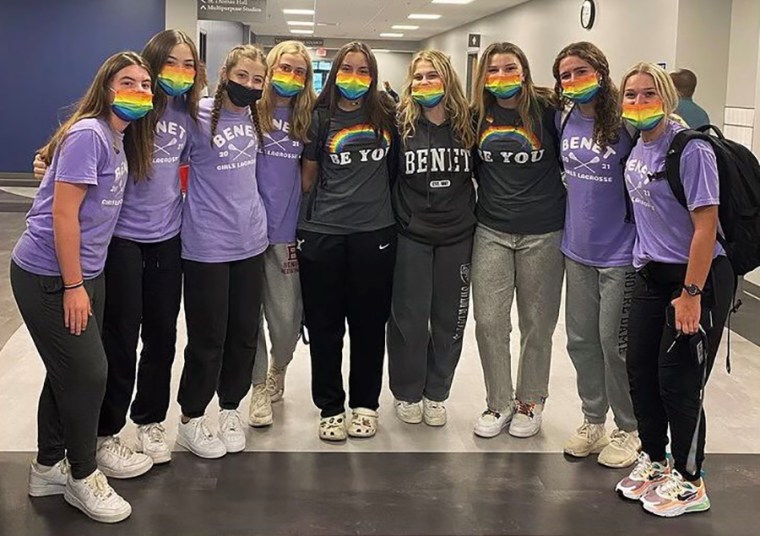
Members of the Benet Academy lacrosse team wear rainbow Pride masks in support of new coach Amanda Kammes.Courtesy Colleen Savell
While this particular story has a happy ending for Kammes and her supporters, legal uncertainties continue to surround how much leeway religious institutions have when it comes to hiring and terminating LGBTQ employees — and experts say these disputes are unlikely to disappear soon.
“I think it’s going to percolate for a while,” Jenny Pizer, law and policy director for Lambda Legal, an LGBTQ civil rights organization, said.
In a landmark decision last year, the Supreme Court ruled thatLGBTQ employees are protected from discrimination under Title VII of the Civil Rights Act of 1964. However, there are important carve-outs for religious organizations like Catholic schools.
Lynn Starkey, a guidance counselor of nearly 40 years at Roncalli High School in Indianapolis, was fired after school officials discovered she is married to a woman. She sued the city’s archdiocese, but last month a federal judge sided with the Catholic school, saying Starkey could be considered a “minister of faith” and is therefore subject to the “ministerial exception” in employment law that allows religious institutions tremendous discretion when it comes to hiring and firing.
Not all the news is bad for LGBTQ employees, as some courts have found the ministerial exception is limited in scope.
Earlier this month, a federal judge ruled in favor of gay substitute teacher Lonnie Billard, who announced on social media that he was marrying his partner. The judge found the school was not protected under Title VII exemptions because Billard did not give religious instruction.
The Supreme Court, which has the legal final word on questions regarding the ministerial exception, has demonstrated what Pizer called an “enthusiastic embrace” of religious liberty. The court has issued decisions about the ministerial exception in recent years, finding in favor of the religious schools.
Changing social attitudes, however, may send a clearer message than case law, according to Pizer.
“I think that there is a growing recognition among some of the faith-based institutions that they are increasingly out of step with the young people that they are inviting to be students and to get their education,” Pizer said. “Parents have a greater sense of confidence and urgency to push the institution to be consistent.”
“It’s lovely that in this situation the school decided to value the needs of the students,” she added.