A court in western Japan on Wednesday approved a transgender man’s request to have his gender changed in official records without undergoing sterilization surgery, the first known ruling of its kind since the country’s top court struck down a surgery requirement for such record changes.
The Okayama Family Court’s Tsuyama Branch said Tacaquito Usui, 50, could get the gender listed for him in his family registry updated to male. Usui original application for the revision was rejected five years ago.
“It’s like I’m standing at the start line of my new life,” he said during a televised news conference after Wednesday’s ruling came out. “I’m so excited.”
Japan’s Supreme Court ruled in October that a provision of a 20-year-old law that made the removal of reproductive organs a precondition for the legal recognition of gender changes was unconstitutional. The ruling, however, only applied to the sterilization provision and did not address the constitutionality of requiring other procedures.
The Okayama court found that the hormone therapy Usui received made him eligible for gender affirmation. Usui welcomed the recognition, saying he thinks the law in Japan might be evolving faster than the public awareness.
Many LGBTQ people in Japan still hide their sexual orientations and gender identities due to fear of discrimination at work and schools. The country remains the only Group of Seven member that does not allow same-sex marriages.
Activists have pressed for greater rights and protections. But change has come slowly in a country of conformity with a conservative government that sticks to traditional paternalistic values and is reluctant to accept gender, sexual and family diversity,
The law that the Supreme Court addressed in its ruling took effect in 2004. It stated that individuals who wanted to register a gender change needed to have reproductive organs, including testes or ovaries, removed. They also were required to have a body that “appears to have parts that resemble the genital organs” of their expressed gender.
More than 10,000 Japanese have since had their genders officially changed, according to court documents from another court case. A court in central Japan noted in last year’s case that sterilization surgery was not required in most of the approximately 50 European and central Asian countries that have laws that allow gender changes on official documents.
A civil rights group alleged Tuesday that North Carolina’s public schools are “systematically marginalizing” LGBTQ youth while new state laws in part are barring certain sex-related instruction in early grades and limiting athletic participation by transgender students.
The Campaign for Southern Equality filed a complaint with the U.S. Department of Education and U.S. Department of Justice against the State Board of Education and the Department of Public Instruction, alleging violations of federal law. The complaint also alleges that the board and the department have failed to provide guidance to districts on how to enforce the laws without violating Title IX, which forbids discrimination based on sex in education.
“This discrimination has created a hostile educational environment that harms LGBTQ students on a daily basis,” the complaint from the group’s lawyers said while seeking a federal investigation and remedial action. “And it has placed educators in the impossible position of choosing between following the dictates of their state leaders or following federal and state law, as well as best practices for safeguarding all of their students.”
The Asheville-based group is fighting laws it opposes that were approved by the Republican-controlled General Assembly in 2023 over Democratic Gov. Roy Cooper’s vetoes.
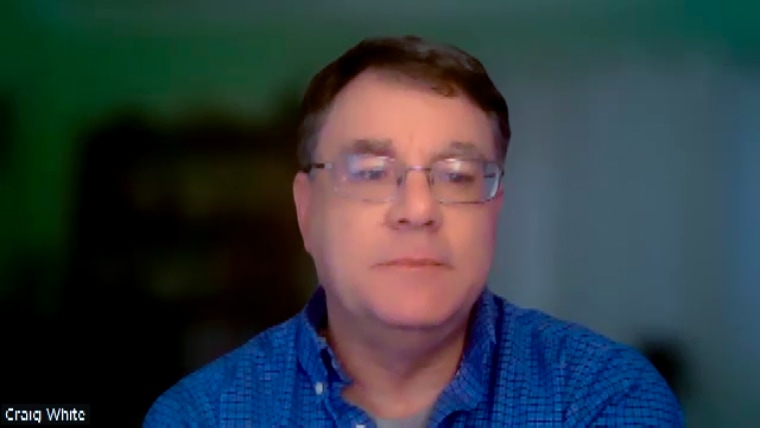
Craig White with the Campaign for Southern Equality argues the Parents Bill of Rights forces North Carolina schools to discriminate against LGBTQ students. WCNC
One law, called the “Parents’ Bill of Rights,” prohibits instruction about gender identity and sexuality in the curriculum for K-4 classrooms and directs that procedures be created whereby schools alert parents before a student goes by a different name or pronoun. The athletics measure bans transgender girls from playing on girls’ sports teams from middle and high school through college.
The group said it quoted two dozen students, parents, administrators and other individuals — their names redacted in the complaint — to build evidence of harm. These people and others said the laws are contributing to school policies and practices in which LGBTQ students are being outed to classmates and parents and in which books with LGBTQ characters are being removed from schools. There are also now new barriers for these students to seek health support and find sympathetic educators, the complaint says.
The group’s lawyers want the federal government to declare the two laws in violation of Title IX, direct the education board and DPI to train school districts and charter schools on the legal protections for LGBTQ students and ensure compliance.
Superintendent Catherine Truitt, the elected head of the Department of Public Instruction, said Tuesday after the complaint was made public that the Parents’ Bill of Rights “provides transparency for parents — plain and simple” and “ensures that parents remain aware of major health-related matters impacting their child’s growth and development.”
Local school boards have approved policies in recent weeks and months to comply with the law. It includes other directives designed to give parents a greater role in their child’s K-12 education, such as a process to review and object to textbooks and to get grievances addressed. But earlier this month the Chapel Hill-Carrboro City Schools voted for policies that left out the LGBTQ-related provisions related to classroom instruction and pronouns.
Supporters of the transgender athlete restrictions argue they are needed to protect the safety and well-being of young female athletes and to preserve scholarship opportunities for them. But Tuesday’s complaint contends the law is barring transgender women and girls from participating in athletics. The group wants a return to the previous process in which it says the North Carolina High School Athletic Association laid out a path for students to participate in sports in line with their gender identities.
Legislation in West Virginia to narrow the definitions of gender would give women no further rights and is a way for Republicans to suppress transgender people, speakers at a public hearing said Thursday.
Dozens of speakers condemned the “Women’s Bill of Rights” while a handful spoke in favor of it during the 45-minute hearing in the House chambers at the state Capitol.
The legislation says that “equal” does not mean “same” or “identical” with respect to equality of the sexes. It would define in state statues and official public policies that a person’s sex is determined at birth and that gender equity terms may not be substituted. It also would establish that certain single-sex environments, such as athletics, locker rooms and bathrooms, are not discriminatory.
Marshall University student Max Varney said the bill uses women’s rights as a cover for transphobia.
“I stand before you as a transgender person in West Virginia. I am not a threat to the public, nor is my existence offensive,” Varney said. “This bill is dehumanizing. It is unjust. And it is disgusting.
“Why am I not supposed to be considered a person too?” Varney continued. “I am here today to show you that trans people in West Virginia are real. I am real. I exist. And I deserve to be treated with humanity.”
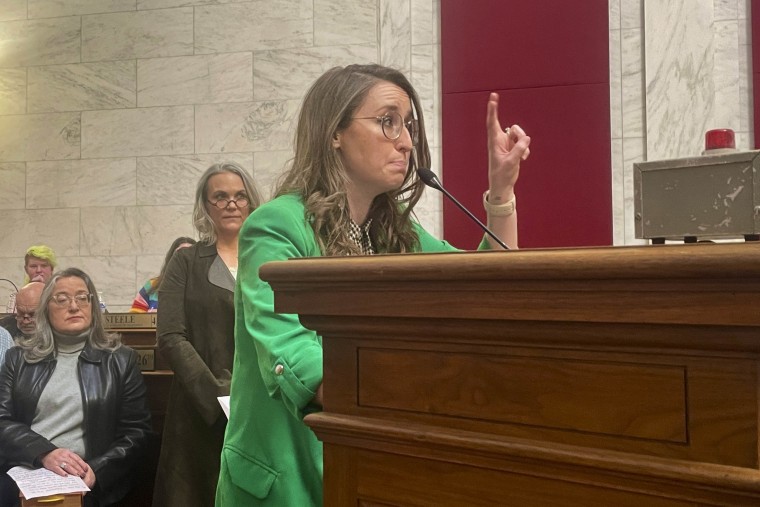
Mollie Kennedy, community outreach director for the American Civil Liberties Union’s West Virginia chapter, speaks out against a proposed “Women’s Bill of Rights” during a public hearing today.John Raby / AP Photo
Fairness West Virginia, the state’s only LGBTQ advocacy organization, said the bill does nothing to support women and among other things would ban transgender people from using government building restrooms that align with their gender identity.
The legislation is pending in the GOP-supermajority House of Delegates. West Virginia Gov. Jim Justice strongly backed the bill at a gathering shortly before its introduction last month. Other states have seen similar moves: Oklahoma Gov. Kevin Stitt signed an executive order on the narrow definitions of sex in August.
Attending both events was former Kentucky swimmer Riley Gaines, who criticized an NCAA decision allowing transgender swimmer Lia Thomas to compete against her in a women’s championship race in 2022. Gaines is part of the anti-trans group Independent Women’s Voice.
The bill’s language lacks details such as enforcement mechanisms and penalties, leaving its potential impact unclear. In other states with laws restricting how transgender people can use bathrooms, officials have struggled to understand how they will be implemented.
Despite its broad “Bill of Rights” premise, the measure doesn’t address issues such as reproductive care, abortion, or affordable childcare. One lawmaker’s attempt to insert an equal pay clause was rejected when a House committee chairman ruled that it wasn’t pertinent to the bill, which is alternatively titled: “The West Virginia Act to Define Sex-Based Terms Used in State Law, Help Protect Single Sex Spaces, and Ensure the Accuracy of Public Data Collection.”
Supporter Nila Thomson said at the House Judiciary Committee’s public hearing that the bill “guarantees my rights to safety, privacy and protection. I’m so grateful you took the initiative to put forth this bill.”
But Mollie Kennedy, the community outreach director for the American Civil Liberties Union’s West Virginia chapter, called it a “bigoted bill.”
“We don’t need a women’s bill of rights to know how this legislature feels about women,” she said. “It is appalling and offensive.”
Another bill that would prohibit transgender students from using the school restroom that aligns with their gender identity advanced through the House Education Committee last month. That bill has not been taken up by the judiciary committee.
In 2020, the Richmond-based 4th U.S. Circuit Court of Appeals ruled that a Virginia school board’s transgender bathroom ban was unconstitutional. West Virginia is in the 4th Circuit’s jurisdiction.
Last year the U.S. Supreme Court allowed a 12-year-old transgender girl in West Virginia to continue competing on her middle school’s girls sports teams while a lawsuit over a state ban continues. The ban prohibits transgender athletes from participating in sports consistent with their gender identity.
Kansas’ attorney general is telling public schools they’re required to tell parents their children are transgender or non-binary even if they’re not out at home, though Kansas is not among the states with a law that explicitly says to do that.
Republican Kris Kobach’s action was his latest move to restrict transgender rights, following his successful efforts last year to temporarily block Democratic Gov. Laura Kelly’s administration from changing the listings for sex on transgender people’s birth certificates and driver’s licenses to reflect their gender identities. It’s also part of a trend of GOP attorneys general asserting their authority in culture war issues without a specific state law.
Kobach maintains that failing to disclose when a child is socially transitioning or identifying as non-binary at school violates a parents’ rights. He sent letters in December to six school districts and the state association for local school board members, then followed up with a public statement Thursday after four districts, all in northeast Kansas, didn’t rewrite their policies.
The Kansas attorney general’s letters to superintendents of three Kansas City-area districts, Topeka’s superintendent and the Kansas Association of School Boards accused them of having “surrendered to woke gender ideology.” His letters didn’t say what he would do if they didn’t specifically require teachers and administrators to out transgender and non-binary students.
LGBTQ+ rights advocates saw the letters as seeking policies that put transgender and non-binary youth in physical danger but also as an attempt to tell transgender people that they’re not welcome. Jordan Smith, leader of the Kansas chapter of the LGBTQ+ rights group Parasol Patrol, said forced outing will create more anxiety for students and even push some back into the closet.
“It’s like they don’t want us to exist in public places,” said Smith, who is non-binary.
Five states have laws requiring schools to inform parents if their children use different pronouns, socially transition to a gender different than the one assigned at birth or present as non-binary, according to the Movement Advancement Project, which supports transgender rights. Another six have laws that encourage it, the project says.
Kansas is on neither list. A bill introduced last year would bar schools from using the preferred pronouns for a student under 18 without a parent or guardian’s written permission, but it did not clear a Senate committee.
GOP lawmakers did enact a law over Kelly’s veto that ended the state’s legal recognition of transgender and non-binary identities by defining male and female for legal purposes based on a person’s “reproductive anatomy” identified at birth. But Republican state Sen. Renee Erickson of Wichita, a vocal supporter and a former middle school principal, said it does not cover issues about whether schools must inform parents about a child’s gender identity at school.
Erickson said she now favors taking a look at the bill before a Senate committee, saying it addresses a “policy gap.”
“The parents have a right to know what is affecting their child. They’re an integral part, if not the most important part, in helping their child grow and develop with the values that the parent wants,” she said.
But Kobach didn’t cite Kansas law in his letters to the state school boards association, the Topeka school district and the Kansas City, Shawnee Mission and Olathe school districts in the Kansas City area. Instead, he cited U.S. Supreme Court decisions going back as far as 1923 that he said affirmed parents’ rights to control how their children are raised. His office released copies Thursday.
He told each of the four district that its policies on transgender students violated parents’ rights and said two other districts in the Wichita area quickly rewrote their policies after his letter arrived. In his letter to the school boards group, he noted it provides legal help to local districts.
“It would be arrogant beyond belief to hide something with such weighty consequences from the very people (parents) that both law and nature vest with providing for a child’s long-term well-being,” Kobach wrote in each of the letters.
State attorneys general serve as the lead lawyers for state governments, and most also oversee at least some criminal prosecutions. But they also look outward, and Kobach’s letters weren’t the first to issue warnings not grounded in a specific state law.
Last year, Texas Attorney General Ken Paxton sent requests to at least two medical providers that don’t operate in his state for information about providing gender-affirming care as part of an investigation, though it’s not clear what Texas law would cover them. Washington state’s attorney general invoked a law there to block Seattle Children’s Hospital from complying, and QueerMed, a Georgia-based telehealth provider, said on its website that it will not comply.
As for Kobach, Tom Alonzo, a Kansas City, Kansas, LGBTQ+ rights advocate, argued that the Kansas attorney general is bent on “intentional marginalization” of transgender people.
“There’s no excuse for it,” he said as he staffed a table Thursday in the Statehouse. “I was a gay kid hiding in high school. I remember how ugly high school can be if you’re out.”
While the Kansas City, Kansas, district declined comment, the other three districts said they deal with transgender and non-binary students case by case and seek to work with parents. The Topeka district expressed confidence that its practices are legal. The four districts are among the largest in Kansas and together have more than 88,000 students or 18% of the total for the state’s public schools.
The strongest response came from Michelle Hubbard, the Shawnee Mission superintendent, in her district’s response in December. She said “it is rarely the case” that students seek something “entirely opposed” by their parents.
She also chided Kobach for not citing actual cases in the district of parents’ rights being violated and suggested that he was relying on “misinformation” from “partisan sources.” She called his use of woke “as an insult” disappointing in an attorney general.
“We are not caricatures from the polarized media, but rather real people who work very hard in the face of intense pressure on public schools,” Hubbard wrote.
A transgender “bathroom ban” in North Carolina caused a national uproar in 2016. Bruce Springsteen, Cyndi Lauper, Nick Jonas and a long list of other A-list performers canceled shows in the state. Global corporations Deutsche Bank and PayPal torpedoed plans to expand in Cary and Charlotte. The NCAA moved its scheduled championship games elsewhere.
Now, eight years later, after Utah passed a similar bill on Monday, the reaction beyond the state’s borders appears to be more of a shrug.
Neither of Utah’s largest businesses released statements in response to the legislation. Tens of thousands of out-of-towners, and an ensuing economic boost, were just heading home from the Sundance Film Festival, held annually in Park City. Global sensation — and queer icon — Bad Bunny is slated to headline a concert in Salt Lake City in upcoming weeks. Next month, Salt Lake City will be hosting first- and second-round games in the NCAA men’s basketball tournament.
Representatives for the NCAA, Bad Bunny and Sundance did not immediately return requests for comment.
In fact, nine other states passed so-called transgender bathroom bills in the years between those passed by North Carolina and Utah, with little fanfare as well.
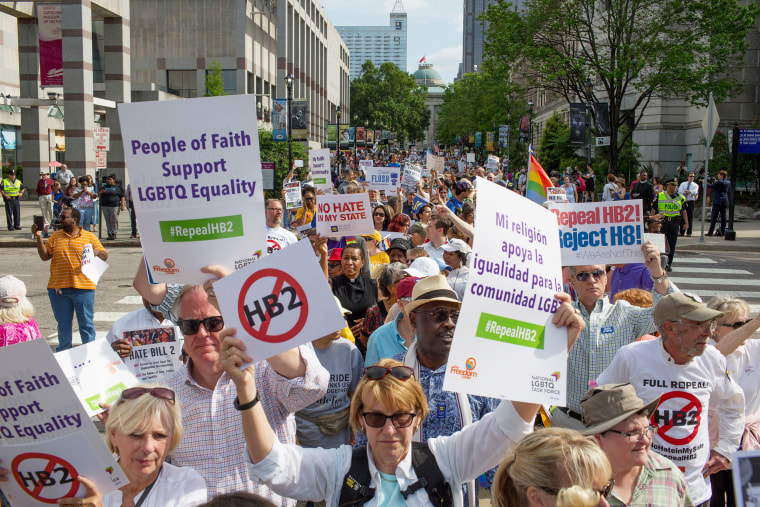
Moral Monday demonstrators head toward the General Assembly from the Bicentennial Mall after gathering and calling for the repeal of HB2 in Raleigh, N.C., in 2016.Jill Knight / Raleigh News & Observer via Getty Images file
Allison Scott, who volunteered as an on-the-ground activist in North Carolina to fight HB 2, described this week’s lackluster reaction to Utah’s “bathroom bill” and the several others that have been passed in recent years as “very telling.”
“We were all saying that with HB 2: ‘It’s not over,’” said Scott, who is also the director of impact and innovation for the Campaign for Southern Equality, an LGBTQ advocacy group. “Now, here we are several years later and we’ve seen these bills grow and increase and grow and increase year over year over year, and we’re right back not only where we started but worse.”
While the enactment of the Utah law has immediate implications for the state’s trans community, the tepid response to its passage also reflects a broader retreat on transgender rights that less than a decade ago galvanized corporate America, elite sports and Hollywood.
Utah House Bill 257, which is titled “Sex-based Designations for Privacy, Anti-bullying and Women’s Opportunities,” limits transgender people’s access to bathrooms in public schools and government-operated buildings. These include restrooms at Salt Lake City International Airport, which is managed by local government, and in Utah’s public hospitals and universities. It also specifies the state’s legal definition of “male” and “female” is based on a person’s genitalia at birth rather than their gender identity.
The bill makes exceptions for trans people who have received genital surgery and changed their gender marker to match their gender identity on their birth certificates.
Critics of the legislation have said the law will create a “dangerous situation for trans youth.”
Supporters of the legislation have argued that without a measure in place, men posing as trans women will go into women’s public restrooms and commit sexual misconduct.
Rep. Kera Birkeland, who sponsored the Utah law, said that the bill was necessary to close a “giant loophole for predators” and will only criminally charge offenders who commit “an offense of lewdness,” as the bill states.
“If the people just go in and use the bathroom the way they’re supposed to be used, they will be fine. That has remained consistent throughout the bill, throughout any change,” Birkeland said in a phone call. “We’re not targeting just people who are transgender or people who are like, ‘I’m going to miss my flight, I’m going to duck into the men’s bathroom because the line is shorter.’”
She also pushed back on criticism that the bill would create an environment where Utahns are policing trans people in public restrooms, pointing to a provision in the bill that would criminally charge people for falsely reporting trans people in public restrooms.
“We do not want to incentivize any vigilante people out there trying to be jerks,” she said. “The whole goal is just to ensure that everyone feels like they have a safe place to do private things.”
Erin Reed, a transgender journalist and advocate, pushed back on this, arguing that the legislation will create disruption for trans people regardless of the bill’s specifics.
“People are not going to go through the fine points of a 12-page law,” Reed said. “More likely than not, you’re just going to see trans people and cis people challenged in bathrooms.”
Aside from Utah and North Carolina, lawmakers in nine other states have enacted similar legislation in recent years, including in Florida, Tennessee and Kentucky, according to a tally by The Associated Press. The measures largely restrict trans people’s access to restrooms solely in schools or in schools and government-operated buildings.
But North Carolina’s law, HB 2, went further, barring trans people from using restrooms and changing facilities that matched their gender identities in most public spaces.
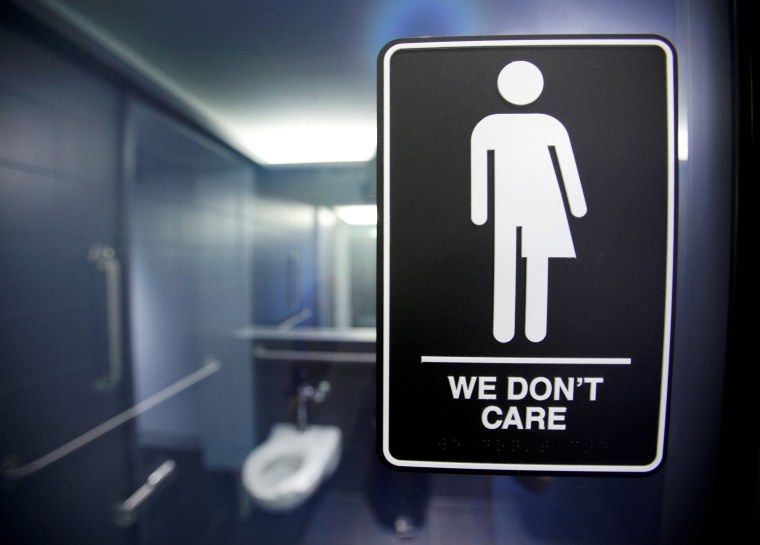
A sign protesting a North Carolina law restricting transgender bathroom access in the bathroom stalls at the 21C Museum Hotel in Durham, N.C., in 2016. Jonathan Drake / Reuters file
HB 2 — which was later partially repealed in 2017 — also prevented local governments from passing LGBTQ nondiscrimination measures and rendered then-existing protections, including one in Charlotte, moot. For this reason, the law affected a much broader segment of the population compared to today’s bills and therefore drew national ire, said Shannon Gilreath, a professor at Wake Forest University’s School of Law and a faculty member of the university’s gender and sexuality program.
“When one’s own interests are not directly compromised by some form of discrimination, one is less likely to respond or to care,” Gilreath said. “I might not believe that’s necessarily the right attitude to have — to do what’s expedient versus to do what’s right in a situation — but that’s human nature.”
Some studies back Gilreath’s line of reasoning.
A survey from the nonpartisan research group Public Religion Research Institute conducted last year found an estimated 79% of Americans support anti-discrimination protections for LGBTQ people. Policies that largely favor trans Americans solely received significantly less support, the poll found. However, Americans who say they know at least one trans person are much more likely to support pro-trans policies, a 2022 survey from the Pew Research Center found.
Reed said that what’s changed from 2016 to now is that people — and even billion-dollar corporations — have become afraid of provoking the far-right.
She pointed to a group of conservative provocateurs who collectively have amassed tens of millions of social media followers in part by stoking outrage over LGBTQ issues. In several instances, threats of violence have followed the subjects of posts made or amplified by the group of right-wing influencers.
“These people are scary,” Reed said. “If the NBA All-Star Game threatened to pull a game right now? In this atmosphere? Today? They’d get bomb threats from conservatives.”
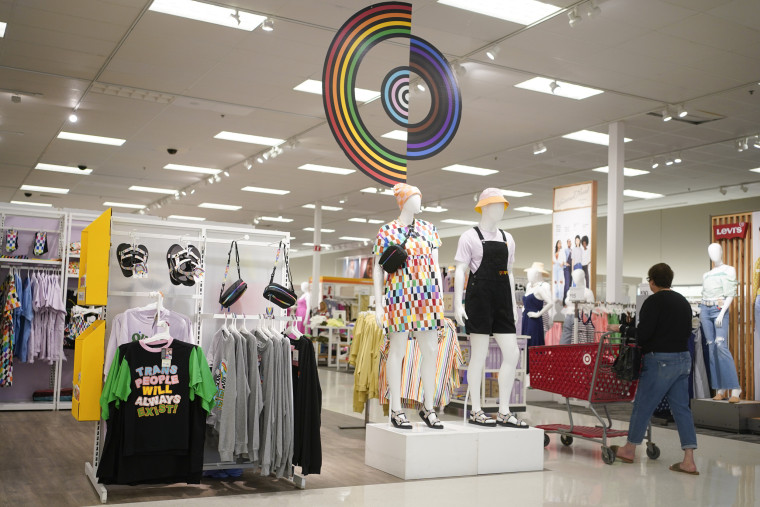
Last year, bomb threats were made to Budweiser factories across the country after trans influencer Dylan Mulvaney’s brand partnership with Bud Light created an online firestorm in pockets of right-wing social media. Target also pulled some of its LGBTQ-themed merchandise for Pride Month from its shelves last year after it said it received “threats impacting our team members’ sense of safety and wellbeing while at work.”
Pride month merchandise at the front of a Target store in Hackensack, N.J., last year.Seth Wenig / AP file
Reed also suggested that it might not be politically advantageous for Republicans to go against the grain when it comes to issues that affect trans people.
Republican Ohio Gov. Mike DeWine faced political blowback after vetoing a bill that would ban gender-affirming care for minors in the state in December. Former President Donald Trump urged Ohio state lawmakers to override the veto, writing on his social media platform, Truth Social, that he was “finished” with the Republican governor. Ohio senators overrode the governor’s veto last week.
In recent weeks, local activists had been unsure whether Utah Gov. Spencer Cox would sign HB 257. Cox in 2022 vetoed legislation that aimed to limit transgender students’ ability to compete on girls sports teams in school, citing the disproportionate rate of suicidal ideation among trans kids.
Conservative lawmakers introduced more than 500 anti-LGBTQ bills in state legislatures across the country, according to a tally by the ACLU, with the majority of them targeting trans people. Seventy-five of those bills became law, including a ban on gender-affirming care for minors in Utah, which Cox signedinto law.
Cox signed Utah’s “bathroom bill” on Monday evening with little fanfare and issued a short statement after weeks of speculation on his position.
“We want public facilities that are safe and accommodating for everyone and this bill increases privacy protections for all,” the statement read.
The law is effective immediately.
In addition to Utah, legislators in five states — South Carolina, Virginia, West Virginia, Kansas and Iowa — have introduced their own “bathroom bills” or legislation that further expands “bathroom bills” already on the books, according to the American Civil Liberties Union.
For U.S. House Speaker Mike Johnson, the homophobic hits just keep on coming.
Last week, Johnson was one of the speakers at the National Gathering for Prayer and Repentance, an event cofounded by Tony Perkins, president of the Family Research Council, dubbed an anti-LGBTQ+ hate group by the watchdogs at the Southern Poverty Law Center. And a new report from another watchdog organization, Accountable.us, details the extent of Johnson’s relationship with Perkins, which goes back more than a quarter of a century.
“From his decades-long relationship with extreme anti-LGBTQ activist Tony Perkins to his legal career dedicated to rolling back LGBTQ rights, it’s clear where his allegiances lie,” Accountable.us president Caroline Ciccone says of Johnson. “Speaker Johnson is a champion for the dangerous extremist faction of the House MAGA majority — and his leadership has only meant more desperate political stunts to force a far-right agenda instead of actually solving the issues facing our nation.”
The National Gathering for Prayer and Repentance was held Wednesday at the Museum of the Bible in Washington, D.C., and featured many Christian right activists and Republican politicians, including 16 members of Congress. Perkins founded the event with Jim Garlow, founder and CEO of Well Versed. Garlow hosted Johnson on a “prayer call” shortly before the latter was elected speaker, and during the call, Johnson said American culture was “dark and depraved,”partly because so many young people identify as “something other than straight.”
During Johnson’s segment of the prayer and repentance event, he shared the stage with the other members of Congress, and each of them offered a prayer. Most, including Johnson, avoided overtly anti-LGBTQ+ rhetoric in their prayers, instead saying in general terms that the U.S. has turned away from God and asking for God’s guidance. But there were some exceptions.
For instance, U.S. Rep. Randy Weber of Texas said, “We’ve trampled on holy marriage and called it an alternate lifestyle.” Bob Good of Virginia said the nation has “failed to honor [God’s] designs for marriage and the family.” Mary Miller of Illinois appealed for God’s forgiveness by saying, “We have disparaged your beautiful institution of marriage.” And Wisconsin’s Glenn Grothman listed homosexuality and feminism as evils that must be fought.
They were preceded on the program by Rabbi Jonathan Cahn, a Messianic Jew, that is, a person who identifies as Jewish but accepts Jesus Christ as savior — that church is a evangelical Christian sect. Cahn’s virulently anti-LGBTQ+ views were evident in his presentation. He said America is under the influence of pagan gods and goddesses, one of whom, Ishtar, “the enchantress,” is “the spirit of sexual immorality.”
The enchantress, he said, “turns men into women and women into men” and “seeks to possess an entire generation of children.” She is identified with the rainbow and the month of June, he continued.
Johnson’s entrenchment in the Christian right goes far beyond this event. His work as a lawyer with the Alliance Defense Fund (now Alliance Defending Freedom), which represents many anti-LGBTQ+ and anti-choice clients, is well documented, as are his writings denouncing marriage equality and LGBTQ+ rights in general. His coziness with Perkins is also well known, but the Accountable.us report provides a particularly expansive look at their work together.
They met in the 1990s in Louisiana, when Perkins was a Republican state representative and Johnson a law student at Louisiana State University. They met through Woody Jenkins, then also a Republican state representative who in 1996 ran for an open U.S. Senate seat against Democrat Mary Landrieu. Landrieu won by a narrow margin, leading Jenkins’s supporters to cry fraud. Johnson has said that election formed his views on fraud, and he went on to be closely involved in efforts to overturn the 2020 presidential election. Johnson and Perkins have both worked with the Council for National Policy, which Accountable.us describes as a secretive conservative organization.
When Perkins was a Louisiana state representative, Johnson sometimes helped him write legislation, such as a first-in-the-nation law establishing covenant marriage; it’s harder to end a covenant marriage than a conventional one. “Johnson and his wife, Kelly, were married under this law in 1999,” the report notes.
In 1997, Johnson helped Perkins found the Louisiana Family Forum, a right-wing political group. “Working pro bono, Johnson helped pen the group’s incorporation filing and later represented the organization in lawsuits targeting abortion access and same-sex marriage,” Accountable.us points out. “When Johnson first ran for Congress in 2016, he identified himself as a Louisiana Family Forum board member.”
Johnson and Perkins also worked together on Gov. Bobby Jindal’s Louisiana Commission on Marriage and Family, to which both were appointed in 2008. Perkins was a board member for a nonprofit law firm, Freedom Guard, that Johnson founded in 2014. It is no longer in operation, but it represented the same type of clients as ADF, and its other projects included drafting model bylaws for churches that characterized homosexuality and transgender identity as “sinful and offensive to God.”
When Perkins ran — unsuccessfully — for U.S. Senate in 2002, Kelly Johnson was one of his first campaign contributors, donating $1,000. Perkins returned the favor and then some in her husband’s first run for Congress, with a contribution of $2,700, the maximum personal donation allowed by law at the time.
In every run since then, Johnson has received the endorsement of the Family Research Council’s political action committee. He’s a three-time recipient of the FRC’s True Blue award, which goes to members of Congress who vote according to the group’s positions 100 percent of the time. That contrasts with Johnson’s zeroes from the Human Rights Campaign. And Johnson has described Perkins as one of his biggest heroes.
“Once a fringe organization on the right, the Family Research Council has been elevated to newfound prominence with the Speaker’s gavel in Mike Johnson’s hand,” the Accountable.us report states. That newfound prominence has chilling implications for LGBTQ+ rights, reproductive freedom, and more.
The Washington State Liquor and Cannabis Board (LCB) has paused enforcement of lewd conduct regulations following outcry over raids conducted late last month at multiple Seattle LGBTQ+ bars.
The Stranger reports that the LCB sent a letter last Thursday to state officials informing them of the pause. The board also announced that it would not issue citations for any violations reported by officers during the raids and that it has paused its participation in the city’s Joint Enforcement Team (JET), the coalition of police, fire, and other departments that conducted the January raids.
“Since LCB’s participation last week with the City of Seattle Joint Enforcement Team (JET) on Capitol Hill and additional enforcement work Saturday at some historically gay venues in the greater Seattle area, the agency has become acutely aware of the fear and alarm it raised within the LGBTQ+ community,” the February 1 letter read. “At Wednesday’s Board meeting and in many private conversations, we heard strong objections to our actions. The community expressed concerns that LGBTQ+ venues are being targeted and that the LCB did not understand the troubling history of such enforcement or the value of these clubs as a safe place for people who often face discrimination, threats, and violence.”
The LCB said that it would present a proposal to change the lewd conduct rules at its February 6 caucus and vote on the proposal next week.
The raids, conducted over the January 26 weekend, sparked outrage in Seattle’s LGBTQ+ community and drew national attention. Shortly after midnight on January 27, ten JET task force members enter LGBTQ+ bar The Cuff wielding flashlights, according to owner Joey Burgess, causing patrons to leave the venue in fright. All they discovered was a bartender with his nipple visible. According to The Stranger, JET also raided two other LGBTQ+ venues, Neighbours Nightclub and The Lumberyard, on the same night.
The following evening, two JET members entered the Eagle at around 11:30 p.m., where they found patrons wearing jockstraps. They also reportedly photographed patrons.
Both the Cuff bartender’s exposed nipple and the Eagle patrons’ jockstraps were cited as violations of LCB’s rules prohibiting “lewd conduct” in venues that serve liquor. Meanwhile, Washington state has no other laws restricting public nudity. As Eater Seattle notes, you can wear a G-string outside in a public park but not in a bar.
According to The Stranger, during a recent meeting with the LCB, the state Senate LGBTQ caucus made it clear they wanted changes to the regulation.
“As the only openly LGBTQ member of the board, I take that role and responsibility seriously,” said LCB Board member Jim Vollendroff. “I made a commitment to the Legislature to see this through and to hold the Board accountable. To make long-lasting change to make sure this doesn’t occur in the future, long after the leadership that’s in place now changes.”
State Sen. Jamie Pedersen (D), the out gay majority floor leader, saidlawmakers are working to repeal the “lewd conduct” regulation.
Meanwhile, Seattle’s LGBTQ+ community cheered the LCB’s announcement.
“This is a huge victory for queer people, queer spaces, and queer self-expression,” a group of club owners said in a statement.
“The relief that I have–that I no longer have to strip away queer culture and honestly people’s right to be themselves on behalf of an agency that’s threatening our liquor license–is probably one of the most gratifying things in my career, period,” Cuff and Queer/Bar owner Joey Burgess told The Stranger. “I feel like a ton of bricks are off me, and that heading into this weekend people can feel safe and good about themselves.”
A Tennessee city must pay $500,000 as part of a settlement with the American Civil Liberties Union and other groups over an ordinance designed to ban drag performances from taking place on public property, attorneys announced Wednesday.
Last year, the Tennessee Equality Project — a nonprofit that advocates for LGBTQ rights — filed a federal lawsuit after Murfreesboro leaders announced they would no longer be approving any event permit requests submitted by the organization. At the time, the city alleged that the drag performances that took place during TEP’s 2022 Pride event resulted in the “illegal sexualization of kids.”
TEP denied the shows were inappropriate, countering that the performers were fully clothed. However, the city not only vowed to deny TEP permits but also decided later to update its “community decency standards” intended to “assist in the determination of conduct, materials, and events that may be judged as obscene or harmful to minors.”
Murfreesboro is located about 34 miles (55 kilometers) south of Nashville.
Eventually, a federal judge temporarily blocked Murfreesboro from enforcing the ordinance while the lawsuit proceeded.
On Wednesday, the ACLU announced the case had reached a settlement. Under the agreement, the city not only agreed to pay $500,000 but also to repeal the ordinance and process any upcoming event permit applications submitted by TEP.
“The government has no right to censor LGBTQ+ people and expression,” said attorneys for the ACLU, ACLU of Tennessee, Ballard Spahr, and Burr & Forman in a joint statement. “More important than the monetary recovery, this settlement sends a clear message that the city’s discrimination against the LGBTQ+ community was blatantly unconstitutional and that this type of behavior will no longer be tolerated here — or anywhere across the country.”
A spokesperson for the city of Murfreesboro didn’t immediately respond to an email for comment.
The legal challenge is the latest development in the ongoing political battle over LGBTQ rights inside Tennessee, where the state’s conservative leaders have sought to limit events where drag performers may appear, restrict classroom conversations about gender and sexuality, and ban gender-affirming care.
The year: 1969. Man landed on the moon, the Beatles gave their last concert on top of the Apple building in London, and we mourned Judy Garland’s death. But most notable for me was the Stonewall Uprising on June 28.
As a gay African-American man, I am an activist and a pioneer. I have experienced some of the brightest and darkest highlights of LGBTQ history. So much has changed and I know my generation has made a significant contribution to the growth and positive changes. My mantra: “I’m living my best life!”
The year of the Stonewall Uprising, I was beginning my studies at Parsons School of Design. It was a turning point in my life. I felt equipped to leave my family nest and ready to be independent, a trait that was instilled in me at an early age.
As soon as I arrived in New York, the city was swarming with so much energy that it was hard to contain myself. New York City has always been a significant influence on gay life, art, music, fashion, commerce, and innovations on all fronts. I took some time to discover myself during those years, learning to navigate the city and indulge in self-expression.
The diversity of New York is something I have always loved. In fact, it was the openness and freedom of expression that led me to accept my sexuality. I gradually acclimated to my new life and adventures, only later realizing what an accomplishment it was to move to New York City and succeed at the tender age of 18.
As a textile designer and artist in the Garment District, I continued to take drawing classes at the Leslie-Lohman Museum of Art to keep my skills sharp. While in the workforce, I complied to corporate standards in the workplace to be taken seriously and avoid discrimination. But even so, I accepted my truth and began to live unapologetically as a gay African-American man.
One of the hard truths I had to learn – and something many people still refuse to acknowledge – is that the LGBTQ community has always been splintered and separated. I made it a point to nurture friendships with young gay people, mostly people of color. Most of my gay and bi friends attended venues that attracted people like me, where nightlife was flourishing and the creative community thrived. We saw diverse venues like David’s Loft in Manhattan, the first private dance club, as well as Andre’s, Jays, and the Big Apple in Harlem, all catering to people of color. I saw the 70’s as a “Golden Age” of gay life and freedom of self-expression.
Overwhelmed with a thirst for knowledge and enthusiasm to discover more about the LGBTQ experience, I moved to Berlin, Germany, in 1979. I was influenced by many Black figures who paved the way, including Josephine Baker, Richard Wright, and James Baldwin. Moving to another country allowed me to escape racial disparities back home.
I was emboldened to continue advocating for LGBTQ people of color, which became crucial as we were hit with the HIV/AIDS epidemic. As a result of attending so many funerals weekly, I became exhausted and fearful for my own health. I moved back to the U.S., making the best of my time in the Midwest professionally, but also prioritized being an advocate for HIV/AIDS and the LGBTQ community as a whole.
Together, gays and lesbians organized community events, prepared meals, and initiated housing projects for suffering people who had been on the street. Fundraisers were held to raise money for those in need. Organizations like AmfAR (the Foundation for Aids Research) made their debut, as well as the drag ball Night of a Thousand Gowns and the Design Industry Foundation for AIDS. The late great Larry Kramer founded Gay Men’s Health Crisis and ACT UP, two organizations that changed the narrative in New York City and the world, invoking lifesaving solutions and resources for the LGBTQ community.
In 1995, the introduction of protease inhibitors – drugs that impede the spread of the virus – added longevity to a generation that did not expect to survive.
Returning to New York in the early 2000s and having reached my 50th birthday, I began to think about how I was beginning this stage in my life. My generation of LGBTQ folks have now become elders, with organizations like SAGE helping us age with dignity.
As we age, there are challenges in housing, healthcare, and other life support systems for our cohort. Many of us do not have families and face discrimination and isolation because of our sexual orientation, making LGBTQ elder support groups critical. I remain an advocate for older adults so we can keep our independence as we age.
As I continue to share my experiences before and after 50 years of Stonewall activism, I age with pride and dignity.
Alston Green is a longtime activist and fighter in social justice and LGBTQ movements. A creative thinker and a passionate spokesperson, Alston has worked with the Intergenerational Media Literacy program with Senior Planet (OATS) and SAGE – two organizations that offer aging adults an opportunity to explore, learn, mingle and renew their passions, to keep abreast of the ever changing world of digital technology and how it impacts everyone’s lives daily.
Stephanie Vigil, a queer Colorado state legislator, flipped her district from Republican to Democrat. Now, she’s ready to make some other changes.
While the GOP has launched repeated attacks on transgender students nationwide, a local effort to prevent teachers from asking a teenager about their preferred pronouns has spawned a response from Vigil.
She’s introduced a bill requiring teachers to use a student’s preferred name in the classroom. Deadnaming a trans student would be considered discrimination.
“Making sure that we can create space for them to be seen and heard as their true self is very important,” said Nadine Bridges, the executive director of One Colorado, told the local news after the bill was introduced. “It’s a great opportunity to kind of create equity and inclusion in schools.”
A controversial effort by a school board that would have prevented school staff from accommodating trans students was ultimately defeated after students, parents, and activists objected.
“I’m kind of old-fashioned,” one school board member said at the time. “I know a boy when I see one, and I know a girl when I see one.”
The board has reservations about the proposed law too, insisting that “parents are responsible for determining the upbringing, education, care, and moral development of their child.”
“Parents do have the right, for their specific child, to make whatever decisions they deem best for that young person,” Bridges said. “They do not have the right to make decisions for every student that attends a charter school or a public school.”
“We’re talking about pronouns and names and making sure that a young person can be seen as their authentic selves. Why wouldn’t anybody want to create space for that?”
The bill would also create a task force to “examine existing school policies and provide recommendations to schools on how to best implement student non-legal name change policies.”