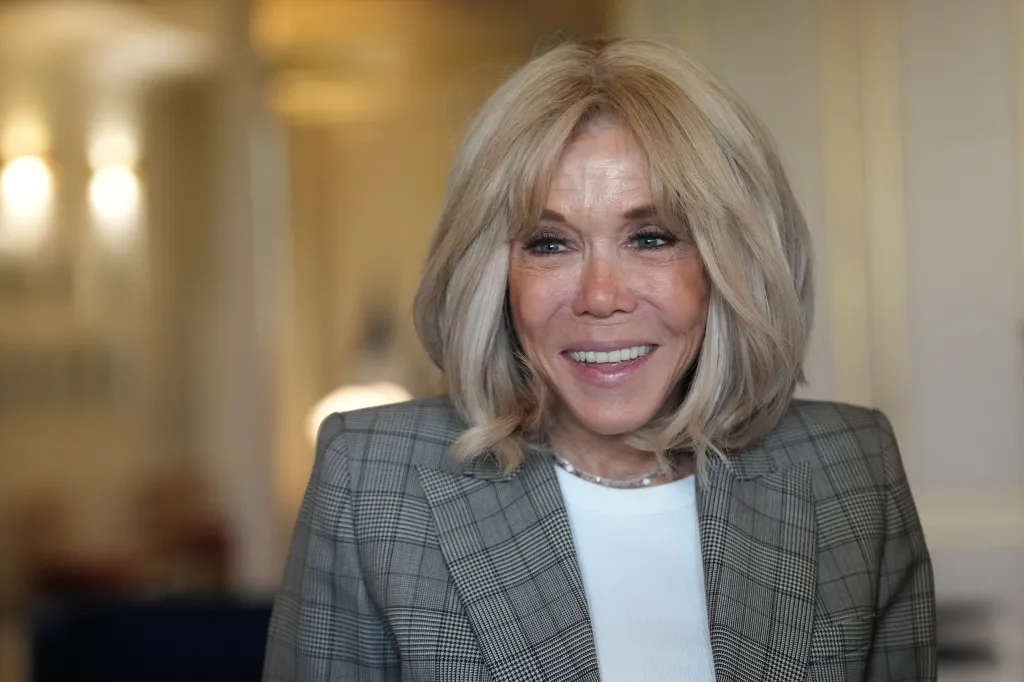
Ten people in France have been found guilty of cyberbullying first lady Brigitte Macron, wife of French President Emmanuel Macron, by claiming she is secretly a transgender woman.
A court in Paris on Monday (5 January) ruled the defendants, which includes eight men and two women aged between 41 and 65, had spread false claims about her gender and sexuality alongside making “malicious remarks” about the 24-year age gap between the couple.
The court noted “particularly degrading, insulting, and malicious” comments made by the defendants about Macron’s gender, amid a wide-ranging conspiracy theory that she is secretly a trans woman who was born under the name Jean-Michel Trogneux – which is, in fact, the name of her brother.
The court decision comes as the Macron’s pursue a separate defamation case in the United States against far-right influencer Candace Owens, who has repeatedly pushed the conspiracy theory about Brigitte’s gender including releasing an eight-part audio and video series on the topic. The defamation complaint, which is 219 pages long, was filed in Delaware state court in July 2025 and names both Owens and her business entities, which are incorporated in the Democratic state.
The defendants were also accused of linking the age gap between the French president, 48, and first lady, 72, to a peadophillic relationship. The couple met when he was a 15-year-old student at Le Providence, a Catholic school in northern France, and she was his drama teacher, then aged 39. They married in 2007 after Brigitte divorced her first husband, when Macron was 29 and she was 54. Their relationship has been the subject of much press and public scrutiny.
Brigitte Macron is the wife of Emmanuel Macron, the current President of France (Edward Berthelot/Getty Images)
Some of the posts made by the defendants were said to have been viewed tens of thousands of times.
The first lady did not attend the trial hearings in October but reportedly told investigators after filing the legal complaint that the false claims she is trans have “strongly affected” herself and loved ones.
Her daughter, 41-year-old Tiphaine Auziere, also testified that the faux claims had impacted her mother and their whole family, saying there had been a “deterioration of her health” and a “deterioration of her quality of life”.
“She’s constantly having to pay attention to what she wears, how she holds herself because she knows that her image can be distorted,” she said, as per French outlet Le Monde.
You may like to watch
Auziere also said: “Not a day or week goes by when someone does not talk about this to her … What is very hard for her are the repercussions on her family … Her grandchildren hear what is being said: ‘Your grandmother is lying’ or ‘Your grandmother is your grandfather.’
“This affects her a lot. She does not know how to stop it … She’s not elected, she has not sought anything, and she is permanently subjected to these attacks.
“I – as a daughter, a woman and a mother – would not wish her life on anyone.”
The defendants were given sentences that ranged from cyberbullying awareness training to suspended prison sentences of up to eight months.
At the time of writing, Brigitte Macron has not yet commented on the outcome of the case but speaking with TF1 on Sunday evening (4 January) defended her action against cyberbullying, saying such people are “playing with my family tree”.
“A birth certificate is not nothing. It is a father or a mother who goes to declare their child, who says who he is or who she is,” she said of the conspiracy theory about her gender.
“I want to help adolescents to fight against harassment, and if I do not set an example, it will be difficult.”
Sex scares me. As a teenager, at a time when most young men were starting to physically connect with their new, exciting, primal sexual desires, the blood in my body was flowing through my veins just as fast. There was nothing unusual about puberty.
Except that my desires were for other men.
I had no references, images, or examples. No place to go, and no one to talk to about these feelings. My resources included a pamphlet from my godmother on men’s bodies. I clung to a passage in it on how common it was for teenage males to have sexual desires for other males, but it was usually a phase, and you grow out of it. Then there was my mother’s copy of The Joy of Sex, hidden in the right bottom drawer under negligees and lingerie, and a funny plastic disc which I later discovered was a diaphragm.
Then there were the homoerotic shoots of beautiful, hypersexual models in the pages of GQ. And Greg Louganis at the 1984 Los Angeles Olympics. His Adonis-like body, wearing a tight red bikini brief, is standing on the diving board, preparing to dive in. And there was Gene Anthony Ray on Fame, whose incredible dancing prowess was only matched by his swagger bursting out of hismuscular body.
And then there were headlines in the newspapers and on broadcast news, about “the plague” or “the gay cancer.” AIDS.
My earliest thoughts about sex were nestled between puberty, promiscuity, and “the plague.” All fueled by respectability politics and the silence, stigma, and shame fostered in the Black church. The U.S. government had also been largely silent about HIV and AIDS. It wasn’t until 1987, near the end of his second term, that Ronald Reagan finally addressed AIDS as “public health enemy number one.”
In 1985, I was a freshman at Hampton University when Rock Hudson died of AIDS complications. He was 59. This was the first time AIDS was referenced in a big media story. It was sobering, resounding, and terrifying. The disease that was claiming the lives of so many gay men — The Lost Generation — had a profound impact on my life and psyche. If I were to live my truth as a Black gay man, it could be a possible death sentence.
Would I live in the closet and remain alive, or come out and risk everything to be comfortable in my own skin and live my truth if only for a few years? Heavy stuff for an 18-year-old. Sex became a game of roulette. And anal penetration was not an option.
Today, I am 58 years old. A year younger than Rock Hudson when he died. I didn’t survive unscathed. I am what is called a long-term survivor. I was diagnosed with HIV in 1997 — 28 years ago. I am living with the virus, but thanks to modern medicine, I am what is called undetectable. According to the CDC, a person living with HIV who is on treatment and maintains an undetectable viral load has zero risk of transmitting HIV to their sexual partners. Still, many people don’t fully understand this fact or believe that it is untrue.
I’ve been on dates and often bring up my HIV status early in the conversation so that I am being honest, transparent, and vulnerable. On more than one occasion, I have had the date tell me they aren’t interested in someone who is HIV+ or they indiscreetly ghost me. There have also been situations where the person wants to make a go of it, but finds it challenging because they can’t unhear my status or they don’t want to risk the “nonexistent” possibility that they may contract HIV.
Living in this reality in 2025 is frustrating and demoralizing.
I founded Native Son as a community and platform created to inspire and empower Black gay, queer, and gender-nonconforming men to amplify the voice and visibility of our community. I considered the gap in our history because of the massive loss of life due to the AIDS crisis. We lost a generation of Black artists, actors, dancers, innovators, builders, and many more whose lives are unknown and whose existence was extinguished, eliminated, and evaporated. We lost our griots (African storytellers), mentors, and teachers, along with our uncles, brothers, fathers, and history. Native Son created a community where Black queer men could mentor, learn from, support, and nurture one another. We could stand in the gap. We could also be a sacred space where our lives, legacies, and existence are honored, celebrated, and remembered.
At the first Native Son Awards in 2016, I shared my HIV status publicly for the first time. It was imperative that if I were leading and serving a community of Black queer men, I be transparent about my status. It was one of the hardest things I’ve ever done and one of the most rewarding. The challenge was that I hadn’t told my mother that I was HIV+. That weekend, I flew home to tell my mother the secret I had hidden for 19 years. But a mother’s love is like a lifeline, and I was grateful that my mother loved me beyond the limits of her own prejudice.
World AIDS Day is a time for us to remember the 44.1 million souls who have died from AIDS related causes since the start of the epidemic. It is also a moment to have open, honest, loving, and healing conversations about HIV within and beyond the Black community. Particularly, when:
Black people are 12% of the U.S. population, but account for 39% of HIV diagnoses.
1 in 2 Black gay or same-gender-loving men may face an HIV diagnosis.
Black women make up 50% of HIV diagnoses among cisgender women
Black Transgender women face HIV rates more than 3x higher than other groups.
We don’t have to be pathological; we can actually be a community of care. HIV is preventable and treatable. We have the power to break the cycle and heal our community daily.
Emil Wilbekin is the Founder of Native Son, an Assistant Professor at the Fashion Institute of Technology, a journalist, and a content creator.
There’s a good chance you may have heard the term homonationalism used in political or public debate recently.
In fact, just a couple of days ago, Spiked published an article claiming that homonationalism is “on the rise” and suggesting that it is linked to the fact that “across Europe, gay voters are moving rightwards.” But what exactly does the term mean?
First coined by Rutgers University professor and Gender Studies scholar Jasbir Puar in her 2007 book Terrorist Assemblages: Homonationalism in Queer Times, the phrase has skyrocketed in usage over the past two decades and has yet to reach its peak, according to Google.
While the term’s specific meaning is incredibly nuanced, especially in the historical context that Puar first used it, the term broadly refers to the selective acceptance of LGBTQ+ people as a way to promote nationalist ideologies or actions.
The Oxford Encyclopedia of Communication summarises the phrase as the “growing embrace of LGBT rights by (mostly Western) nations, as well as the parallel complicity of lesbian, gay, bisexual, and transgender (LGBT) individuals and associations with nationalist politics.”
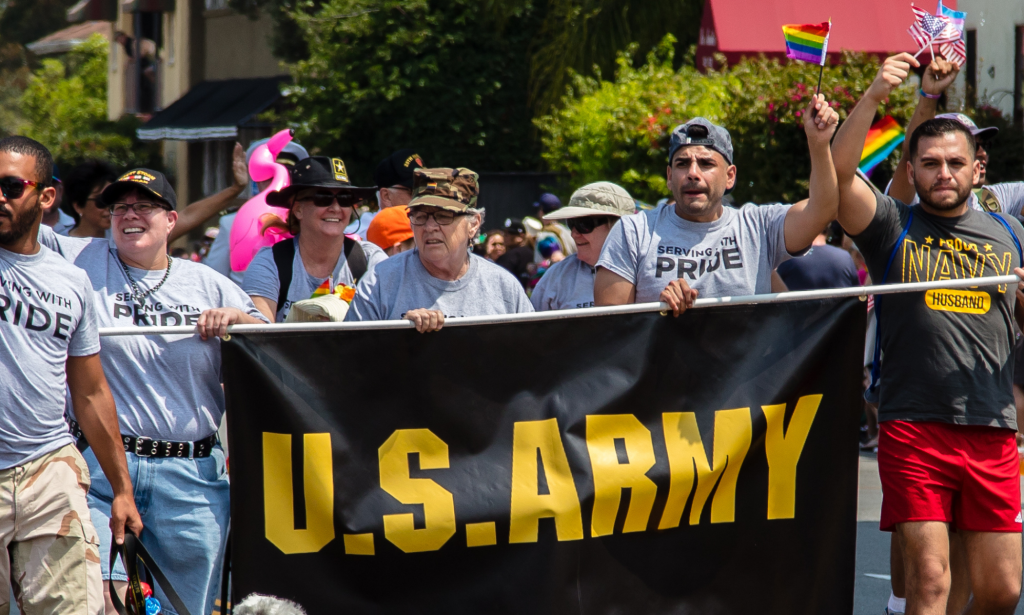
A stretched of US Armed Forces members at a Pride march. (Getty)
Puar coined the term while analysing how the United States attempted to justify its invasion of Iraq, Afghanistan, Syria, and other second- and third-world nations during its “war on terror” in the early 2000s following the September 11 terrorist attacks on the World Trade Center.
During its campaign, the US government attempted to deter widespread criticism by appropriating pro-LGBTQ+ rhetoric and constructing a narrative that the largely Muslim nations were inherently homophobic.
The majority of historical examples, Puar notes, are of Western nations using homonationalist rhetoric to justify Islamophobia by positioning Western “modernity” and liberal democracy as inherently superior compared to non-Western nations.
How do governments use homonationalism?
It’s important to emphasise that progress on LGBTQ+ rights is not a prerequisite of homonationalism. In fact, nations that use the tactic often have a poor track record on LGBTQ+ rights, despite claims to the contrary, and will rarely actually take meaningful actions to improve things – for example, same-sex marriage remained illegal in the US for nearly 15 years after the “war on terror” began.
You may like to watch
Homonationalism also typically only extends support to white, cisgender, gay or bisexual men, and tends to ignore more marginalised groups such as non-white queer women or trans and non-binary people.
While the tactic is most prominently used against Muslims, Western nations have also used it to justify actions against actions in Africa, Eastern Europe, and Asia.
Following Russia’s invasion of Ukraine in 2022, political scientist Emil Edenborg warned against Ukrainians using homonationalist rhetoric to dehumanise Russians, arguing that it mirrors the problematic nature of Russian nationalism by positioning LGBTQ+ rights as “evidence of ‘our’ national superiority.”
More recently, the term has seen particular usage while discussing Israel’s justification of the war in Gaza following the 7 October attacks in 2023.
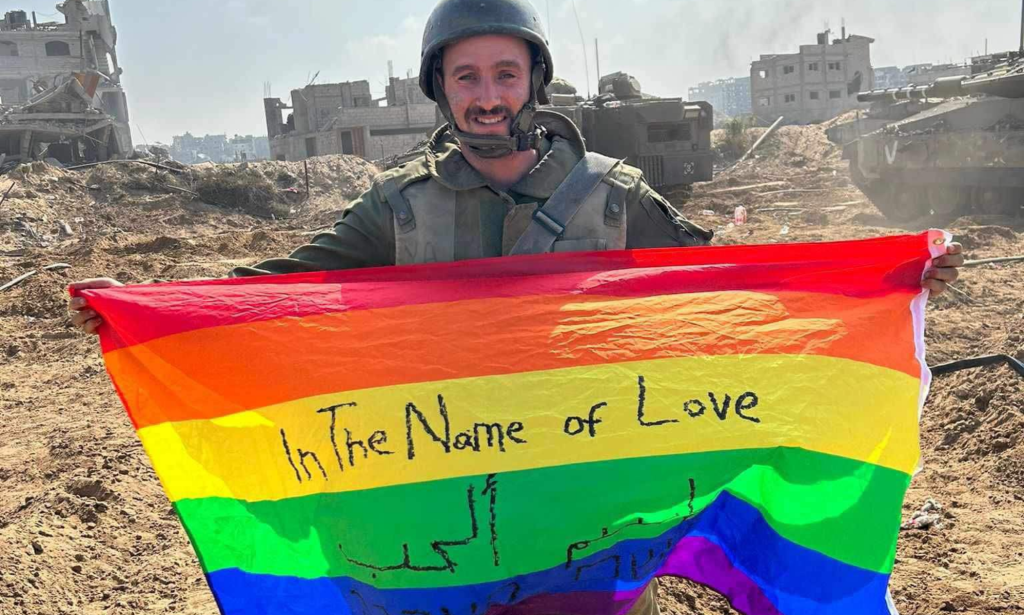
Israel has routinely used homonationalism to justify the Gaza genocide. (X/Twitter/Israel)
The Israeli government ramped up its homonationalistic rhetoric following the attack as a tactic to justify its continued campaign in Gaza, which has killed at least 71,200 Palestinians, including 20,000 children.
In November 2023, the official Israeli state X/Twitter account posted images of an IDF soldier holding a Pride flag in what appears to be war-torn ruins, with the caption: “The first ever Pride flag raised in Gaza.”
Same-sex marriage is currently illegal in Israel, where 56 per cent of citizens believe it is morally unjustifiable.
Homonationalism has also been linked to pinkwashing – defined as the act of a nation state or private institution promoting LGBTQ+ rights to divert attention from human rights abuses – and femonationalism, an unrelated term which describes how nationalist ideologies side with feminist discourse to justify racism or Islamophobia.
Critics of homonationalism have argued that its usage can often obfuscate the complex experiences of LGBTQ+ groups living in countries that use the tactic by inadvertently lumping them in with the nation state.
Others argue that criticism of homonationalistic rhetoric must consider the ways that colonialism, racism, and class influence islamophobic or nationalistic ideologies rather than assuming the tactic relates only to gender or sexuality.
Donnie McClurkin, a Grammy-winning gospel singer and pastor, sexually abused a young man over several years and wrote an apology email declaring himself a “dirty ‘old man,’” according to a new lawsuit.
Giuseppe Corletto says in the lawsuit that he was struggling to reconcile his sexuality with his faith when he sought out McClurkin in 2003. The lawsuit says Corletto, then 21, went to McClurkin’s church in Long Island, New York, after reading his autobiographical book, which described how God helped him overcome the “curse” of homosexuality.
McClurkin began to molest Corletto during “pray the gay away” spiritual sessions, the lawsuit says, and the abuse escalated over the next several years. During this period, Corletto worked as McClurkin’s assistant and regularly traveled with him, according to the lawsuit.
Corletto claims McClurkin coerced him into “further unwanted sexual acts,” from 2007 to as recently as 2015. Despite Corletto confiding in the church’s staff members about the alleged abuse, “no action was taken,” the lawsuit states.
According to Corletto, McClurkin would “coerce” him “into sexual activity” in hotel rooms, and years after Corletto resigned from the church in 2008, McClurkin allegedly tracked down his location and assaulted him twice.
Corletto “attempted to quit on multiple occasions” but was denied, according to the suit, with McClurkin allegedly “coercing him to stay” by telling Corletto “his ‘deliverance’ and ‘purpose’ were tied to” the pastor.
McClurkin has appeared here many times for his anti-LGBTQ tirades going back to 2007.
Donnie McClurkin, the supposedly “ex-gay” preacher that has been spotted having intimate dinners with “flamboyant” young men in quiet Manhattan restaurants, appeared at the Church of God In Christ’s youth conference in Memphis to babble in tongues and call gays “vampires” (among other lovely things). Take it away Rod McCullom:
In the first of three disgusting YouTube videos, McClurkin begins his rant against Tonex, the gospel star and minister who recently confirmed his long-rumored sexuality. McClurkin says Tonex is a “perversion” and must pray away the gay: “God did not call young people to such peversion. Society has failed him, his church has failed him … I would be homosexual to this day if Jesus hadn’t delivered.”
McClurkin also rails against against openly gay youth as “broken and feminine”: “I see feminine men, feminine boys, everywhere I go … No, don’t applaud ‘cuz it ain’t funny. It’s because we failed. I see them everywhere.”
In December 2009, the Black Gay Men’s Network published a full-page ad in the NYC daily newspaper Metro in reaction to attacks on the LGBTQ community by black clergy and in response to McClurkin’s hateful rantings.
Actor and rapper Will Smith is reportedly being sued by a male tour violinist over accusations of sexual harassment, wrongful termination and retaliation.
Musician Brian King Joseph, part of Smith’s Based on a True Story: 2025 Tour, claims Smith exhibited “predatory behaviour.” He also alleges Smith was “deliberately grooming and priming” him for “further sexual exploitation”.
Smith, 57, is best known as part of a hip hop duo with DJ Jazzy Jeff, as well as starring in The Fresh Prince of Bel-Air and Men in Black.
Joseph names Smith and Treyball Studios Management as defendants in the suit, as reported by Variety. He is pursuing them for wrongful termination and retaliation in a suit filed in California’s Superior Court on Tuesday (30 December). Joseph is demanding a jury trial.
Smith allegedly told Joseph: “You and I have such a special connection that I don’t have with anyone else.”
Joseph also alleges that during a Las Vegas tour date, his bag and hotel room key went missing. He further states that his hotel room has been “unlawfully” accessed.
‘Joseph is demanding a jury trial.’
According to the lawsuit: “Among the remaining belongings were wipes, a beer bottle, a red backpack, a bottle of HIV medication with another individual’s name, an earring, and hospital discharge paperwork belonging to a person unbeknownst to Plaintiff.”
Also, he states a note read: “Brian, I’ll be back no later 5.30, just us <3 [heart symbol], Stone F.”
Joseph said he concluded that “an unknown individual would soon return to his room to engage in sexual acts.”
Joseph’s suit outlines that tour management members were “the only individuals with access” to his room. Furthermore, Joseph notified hotel security and Smith’s representatives. Also, he reported the incident to a non-emergency police line.
Joseph claims that the incident led to being“shamed” by a member of Smith’s management team. Furthermore, his contract was terminated, implying that he had fabricated the event.
Joseph’s suit claims that the termination led him to suffer from PTSD and economic loss.
‘False, baseless and reckless’
Smith’s attorney, Allen B Grodsky, denied Joseph’s allegations. Grodsky released a statement to the Daily Mail: “Mr Joseph’s allegations concerning my client are false, baseless and reckless.
“They are categorically denied, and we will use all legal means available to address these claims and to ensure that the truth is brought to light.”
Only four people in the UK have formally complained about a trans woman entering a “single-sex” facility, an eye-opening report has revealed.
A report published by advocacy group TransLucent found that only four official complaints were documented across 382 public bodies since 2022.
Between 2022 and 2024, the group’s members submitted hundreds of Freedom of Information (FOI) requests across multiple investigations to local councils, NHS hospitals, domestic abuse refuges, and other major public authorities in England.
Just four people have complained about trans people using toilets. (Getty)
Its first investigation examining council-owned buildings such as swimming pools and leisure centres found that 35 of the 40 responses reported zero complaints about trans people using toilets, changing rooms, and other facilities, while the remaining five held no relevant records.
One council did cite a single complaint, but it was about a cisgender person in the “wrong” facility, not a trans person.
Its follow-up investigation, which examined public bodies in an area covering over 16.5 million people, found just two complaints – one about policy and another which Translucent said was about “perception rather than confirmed identity”.
Anti-trans outlets to blame for trans toilet myths, group argues
The findings contradict spurious claims that trans people must be excluded from so-called “single-sex” spaces for the safety of cisgender women and girls.
While there is no evidence backing up the claim, ‘gender-critical’ groups and governmental institutions routinely cite the “safety” of women and girls in justifying anti-trans rhetoric and policy.
Research, including the 2023 Femicide Census, regularly proves that the biggest threat to women’s safety is cisgender men. On average, one woman is killed by a man in the UK every three days.
‘Gender-critical’ groups typically try to use these statistics to proliferate transphobia by falsely claiming trans women are men, and thus are culpable in that violence.
Trans people have been targeted for violence because of bathroom bans and hateful policies. (Getty)
TransLucent wrote in its report that media coverage is often responsible for much of the disconnect between rhetoric and reality.
It argued that anti-trans outlets often create a “perception of widespread problems where none exist” by conflating hypothetical concerns with actual incidents.
As a result, it continued, organisations have felt compelled to implement restrictive bathroom policies based on fear of complaints rather than actual data.
“The term ‘single-sex spaces’ (for which there is no legal definition) has become politically charged, with its meaning shifting from practical safety considerations to ideological positioning,” they wrote.
“Our FOI data addresses this by focusing on recorded complaints – formal objections that organisations must document and investigate – rather than informal expressions of discomfort or political opposition to trans inclusion.”
TransLucent urged organisations to use the research as a foundation for policies “grounded in empirical risk data rather than hypothetical scenarios”.
“Behind the statistics are real people navigating daily life. Trans women using public toilets, accessing healthcare, or seeking refuge from domestic abuse are not engaged in political protest; they are simply trying to live safely and with dignity.”
A Minnesota woman sitting in the snow with her dog told a person filming her that Immigration and Customs Enforcement agents had just shot and killed her wife — now identified as Renee Nicole Good, 37 — according to newly circulating video that has intensified scrutiny of a fatal federal shooting during a sweeping immigration enforcement operation in south Minneapolis on Wednesday.
“They killed my wife. I don’t know what to do,” the woman says through sobs in the footage, with a damaged SUV visible in the distance behind her. “We stopped to videotape, and they shot her in the head,” the woman cries.
“We have a 6-year-old at school,” she says, almost unable to breathe, as a chaotic scene in which federal officers prevented at least one doctor who was on the scene from assisting the shot victim unfolds. “We’re new here,” the distraught woman says in despair.
The video emerged hours after Good was fatally shot Wednesday morning near East 34th Street and Portland Avenue during what the Department of Homeland Security has described as its largest immigration enforcement surge ever in Minnesota. Roughly 2,000 federal agents have been deployed across the state as part of the Trump administration’s aggressive immigration crackdown.
Good was identified late Wednesday by her mother, Donna Ganger, who toldTheMinnesota Star Tribune that her daughter lived in the Twin Cities with her partner and was not involved in protests or any activity confronting ICE agents. Ganger said her family was notified of the death late Wednesday morning.
“She was probably terrified,” Ganger told the paper. “Renee was one of the kindest people I’ve ever known. She was extremely compassionate. She’s taken care of people all her life. She was loving, forgiving and affectionate. She was an amazing human being.”
Good was previously married a man named Timmy Ray Mackin, who died in 2023 at age 36, and had her son with him, according to the Star Tribune.
DHS has said that “rioters began blocking ICE officers” during what it called “targeted operations,” alleging that one person “weaponized” a vehicle, prompting an agent to fire what the agency described as “defensive shots.” The department characterized the killing as an act of self-defense and labeled the incident “domestic terrorism.”
But multiple videos circulating online appear to tell a different story. Separate footage shows a dark SUV attempting to drive away from the scene when three shots ring out, sending bystanders into panic. Moments later, the vehicle crashes into a light pole and parked cars as people scream and rush toward the wreckage. Authorities have not publicly reconciled those images with DHS’s account.
In another video, a person wearing the same outfit as the distraught woman can be seen leaning over a bloodied body in the driver’s seat of the SUV.
Late Wednesday afternoon, President Donald Trump weighed in on his social media site, Truth Social, claiming he had “just viewed the clip” and asserting that the woman filming was “obviously, a professional agitator” and that the driver had “violently, willfully, and viciously ran over the ICE Officer,” calling the shooting an act of self-defense and blaming what he described as a “Radical Left Movement of Violence and Hate.”
Condemnation has grown from civil rights and advocacy groups nationwide.
“Today, a woman was senselessly killed in Minneapolis during an ICE action — a brutal reminder that this agency and the Trump regime put every community at risk, spreading fear instead of safety,” Robinson said. “Reports that she may have been part of the LGBTQ+ community underscore how often the most vulnerable pay the highest price. Her family and the people of Minneapolis deserve a full investigation, real accountability, and decisive action. And we must remove ICE and their terror from all our communities before even more preventable violence occurs. As Governor Walz requested, we join the nation in standing with Minneapolis.”
Los Angeles LGBT Center CEO Joe Hollendoner also released the a statement, saying, “The fatal shooting of Renee Good — an LGBTQ+ United States citizen exercising her right to protest ICE activity in Minneapolis—is a horrifying and senseless loss of life. Renee’s death lays bare the dangerous reality of an agency that continues to operate with impunity, fueled by a Trump administration that has normalized violence, cruelty, and the erosion of basic human rights. This is now the fifth known killing linked to ICE agents amid an aggressive escalation of raids and abuses. These are not isolated incidents — they are the predictable and devastating consequences of a federal agenda that treats immigrant communities, and those who stand in solidarity with them, as expendable.”
Amnesty International accused the Trump administration of “unnecessary lethal force,” of misrepresenting the circumstances, and of using militarized immigration crackdowns that have made communities unsafe.
Common Defense Executive Director Jose Vasquez said ICE’s “uninvited presence in Minneapolis is not only destabilizing, it is dangerous and deeply unjust,” calling the killing “heartbreaking and unforgivable.” He said the shooting reflects an “unnecessary escalation” and demanded ICE leave Minneapolis immediately.
Local leaders also pushed back forcefully. Minneapolis Mayor Jacob Frey told reporters, “To ICE, get the fuck out of Minneapolis. We do not want you here,” while Gov. Tim Walz said the state would ensure a “full, fair, and expeditious investigation.”
Minnesota State Rep. Leigh Finke, the state’s first out transgender legislator, said the killing left her “heartbroken” and warned that the federal immigration surge had created the conditions for violence long before Wednesday’s shooting.
“My reaction is one of great sadness,” Finke told The Advocate. “For those of us here in Minnesota who’ve been seeing what these federal agents — ICE, CBP, others — have been doing and how they’ve been treating our communities and our neighbors, something like this felt very possible. But we’ve just had so many tragedies here. Waking up to this news was heartbreaking. It’s terrible. It’s one too many of these things.”
Finke said the sudden influx of roughly 2,000 federal agents announced earlier this week created an inherently volatile situation.
“That kind of influx of law enforcement, often untrained young people coming in with a mandate to kidnap neighbors and abduct people and deport them, violence is the only way that something like that can go at some point or another,” she said, adding that what happened to Good was “devastating” and “the kind of violence being bred by our federal government.”
Finke also called for accountability, saying state law enforcement must “arrest the killer and prosecute that person to the fullest extent of the law,” even as legislative options are constrained by Minnesota’s divided legislature.
And in a message to Minnesotans shaken by the shooting, Finke urged solidarity, noting that immigrant, transgender, and LGBTQ+ communities are bearing the brunt of the federal crackdown.
“We all need to remember that we are in this together,” she said. “We are going to continue to fight for it. We are going to stand up nonviolently with peace and love and fight for our communities no matter what.”
The Advocate has contacted Walz and Minneapolis city officials, including Frey and the police department, for comment.
Wednesday evening, hundreds of protesters gathered in Good’s neighborhood for a vigil and march. “She was peaceful, she did the right thing,” Jaylani Hussein, the executive director of CAIR-MN, said at the event, the Star Tribunereports. “She died because she loved her neighbors.”
Another speaker at the event, identified only as Noah, denounced those who called Good a domestic terrorist. Instead, he said, Good was watching the terrorists.
They say with age comes wisdom. When I was much younger, I laughed at that idea. I was convinced I already possessed all the wisdom I’d ever need. Now, with time behind me, lots of it, I laugh for a very different reason, and at how little I truly understood back then.
One of the gifts of getting older is perspective. You begin to recognize that while the trials you’re facing may feel overwhelming in the moment, chances are you’ve survived something harder before. Not always, but often enough to matter.
I was reminded of that recently while talking with a young gay friend who described 2025 as a devastating year for our community. He used an expletive too. And he wasn’t wrong.
It was an abominable year.
In 2025, LGBTQ+ people watched hard-won progress unravel in real time. Diversity, equity, and inclusion programs were dismantled with startling speed, often under the false banner of “fairness.” Queer people, particularly trans Americans, were targeted in the military and elsewhere, once again treated as liabilities rather than patriots.
LGBTQ+ history was scrubbed from government websites, our contributions quietly erased from history as if they were inconveniences rather than facts.
Trans people and trans youth bore the brunt of it. Health care bans expanded. School policies treated their existence as controversial. Legislators spoke about them not as children, neighbors, family members, or human beings, but as an issue, a problem to be solved, fears to be exploited, and unfamiliarity as danger.
Pride itself was under extreme duress. Funding for Pride marches and LGBTQ+ initiatives disappeared. Rainbow crosswalks, the very symbols of visibility and belonging, were painted over, wiped off streets as though our presence had been a temporary mistake. Meanwhile, hate crimes continued to rise, fueled by rhetoric that painted queer people as threats simply for existing.
For many of us, it felt like we had come so far, only to be yanked backward.
I reached a point later in life where I finally felt fully comfortable being an out and proud gay man. And I still am. I remain grateful for who I am. But I would be lying if I said there isn’t now an added layer of trepidation. It’s especially prevalent when meeting someone new, someone you don’t yet know. There’s a quiet calculation that happens. A guard that goes up. A question you haven’t asked yourself in years: Are they safe? I haven’t asked myself that in a long time.
That question didn’t come out of nowhere. It came from watching a more vocal crowd grow bolder, convinced that because Donald Trump and his allies attack us openly, they are somehow licensed to do the same.
Writing for The Advocate has exposed me to that reality in ways I didn’t anticipate. My columns are picked up by aggregators and spread far beyond our community, and with that exposure has come some truly hateful language. Accusations, slurs, and venom masquerading as someone’s useless opinion. It’s unnerving and demeaning. And yet, in this era, some people treat it as acceptable, even justified, because queer people are still viewed as different, and therefore disposable.
I’ve felt it not just online but in my personal life too. But you know what? They can go eff themselves. I’m not going to stay quiet. None of us should. In fact, vitriol only encourages digging in deeper.
That’s where wisdom asserts itself. I know we have endured worse. Maybe you have too.
And for some of us, it was much worse.
It’s been said repeatedly, but it bears reiteration. Always. During the AIDS crisis, it was so much worse that words still struggle to do it justice. It felt insurmountable. Life itself seemed fleeting, hope dimmed to a dangerous shadow, and your sense of self could collapse into something devastatingly close to worthlessness.
Fear feels too tame a word for that time. Because just being “fearful” seemed too simplistic.
There were no out celebrities filling magazine covers, no likable LGBTQ+ characters populating television and film, no openly queer coworkers chatting freely at the office. Or Pride flags on desks, on the doors of businesses, or outside dimly lit gay bars.
They were horribly lonely years when it felt like you were utterly alone in a world that condemned you for being out of the ordinary. And worse, assume you carried a lethal disease simply by existing. And you were going to infect them. Some people didn’t hug you. Many more wouldn’t kiss you. Being loved felt like a luxury.
What saved us then wasn’t comfort or acceptance. It was each other.
We banded together. We fought. We demanded to be seen, to be treated, to be valued. Our resolve hardened into resilience, and that is exactly what is happening again.
The pendulum of hate and exclusion is swinging sharply to the right, almost violently. But 2026 is our opportunity to slow it down.
We have battles ahead. We have doubts. And we will once again be weaponized as cultural wedge issues in the upcoming midterms. Our lives, our families, our health care will be debated by people who know little about us and care even less.
Yet every political leader I spoke with over the past year, including U.S. Sens. Elizabeth Warren and Chris Murphy, U.S. Reps. Ro Khanna, Jamie Raskin, and Maxwell Frost, and more, expressed the same belief: that the American people do not ultimately tolerate hate and cruelty. I want to believe they are right. More than that, we need to believe they are right.
When queer people are used as political bait, voters must recognize the cruelty for what it is and turn away from it.
At the same time, 2026 gives us something too. We have the opportunity to be louder, prouder, and more visible than ever before. Visibility has always been our biggest advantage. Our best attribute. And I have no doubt we will pull through, just as we always have, and in doing so, stop that pendulum from swinging any further.
Our only real recourse is resilience. Supporting one another. Refusing to shrink. Being ferociously, unapologetically proud.
We have more allies, more recognition, and more love than at any other point in our history. That matters. We must remember it, especially when fear tries to convince us otherwise.
We are not alone. Not even close.
It won’t be easy. There’s no use sugarcoating that. The far right and Christian extremists will do what they have always done, and that is attack us vehemently. But I would argue we are more prepared than we’ve ever been. We’ve gained a hell of a lot of wisdom over the years, particularly last year.
And wisdom, when paired with community, is so, so powerful.
Someday, those much younger than me will look back on this moment with wisdom of their own. They’ll tell the generations behind them that yes, there was a time when things weren’t good. When fear was loud and hate felt ascendant.
A former New York Times editor has claimed the newspaper’s management is “militant” about their anti-trans views.
Trans journalist and campaigner Billie Jean Sweeney claimed senior staff members at the 175-year-old news publication’s shut down “all avenues” of internal criticism over its reporting of trans issues in the lead-up to the 2024 US election.
Speaking to Trans News Network, she said the organisation allowed staff to raise questions and criticisms over senior staff decisions through “Employee Resource Groups” but subsequently shut the groups down.
“One the things that happened was that [NYT chairman A.G. Sulzberger] kind of came around and gave a stump speech to every part of the paper, including the international desk,” Sweeney claimed. “He talked for 40 minutes about how we were going to cover the election ‘fairly’ and that sort of thing. The international desk wasn’t really that involved in the coverage of the election, so it was a little off-key for us. We were all like, ‘why are we talking about this?’”
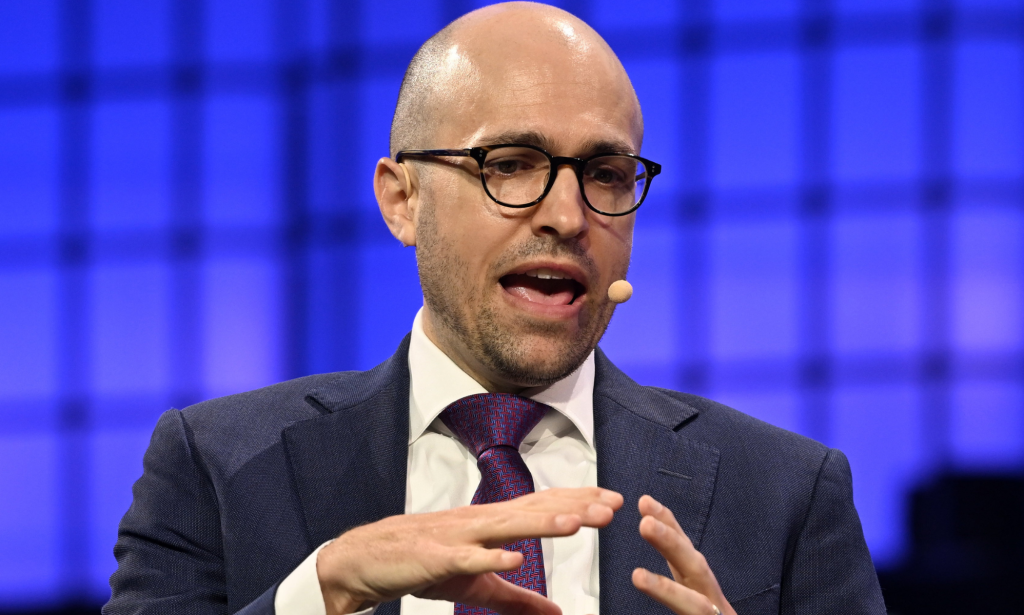
New York Times chairman A G Sulzberger. (Getty)
Around the same time, Sulzberger reportedly gave a speech at the Reuters Foundation in March 2024 claiming the New York Times had “protected” young people through its coverage of trans youth.
Sweeney said things only escalated from there, claiming that pockets of dissent from NYT’s views on trans rights were silenced through “militant” actions such as the cancellation of internal forums for voicing opinions.
The American publication’s infamous trans reporting has routinely faced criticism from a variety of human rights groups, campaigners, and media watchdogs.
In 2023, a coalition of more than 100 LGBTQ+ organisations signed an open-letter accusing the New York Times of frequently publishing inaccurate and biased articles about trans people which, they wrote, endanger the rights and safety of the community.
Journalist Ari Drennen noted in 2023 that one of the outlet’s articles, which contained misinformation about trans youth care, had been used to justify a Missouri executive order heavily restricting gender-affirming care for trans under-18s.
Joseph McConville’s first memory of being online was at 13 years old when he started playing Neopets, a virtual pet game, at his home in Boynton Beach, Fla. At the time, he had no clue that just months later, the internet would suck him into the alt-right.
As a young, white man, McConville says he was taught to believe that he’d have everything he wanted.
He started to realize this dream wouldn’t come to fruition when he was pulled out of private school as his parents struggled during the 2008 recession.
McConville quickly graduated from kids games to popular social media sites like Myspace and Facebook. But it was when he found FunnyJunk.com in ninth grade that he started being exposed to alt-right content.
The website gave users the ability to upload memes and upvote popular content. When McConville began using it, he was initially exposed to dark humor and edgy right-wing memes.
He then migrated to 4chan, a website known for hosting anonymous, fringe, right-wing communities, where he started engaging with content used to stoke extremist meaning —pushing us vs. them narratives that alienated McConville from his multicultural South Florida community.
“Everyone else is wrong. … These guys are right. These guys get it,” says McConville. The deeper he got, the more anger he felt—especially towards transgender people.
“It’s all a psyop … there’s a big trans psyop to destroy manhood,” McConville remembers believing for nearly a decade. “It’s all about making men hate themselves, to become women, to weaken the American hegemony.”
McConville, now 30, eventually found his way out of the alt-right world around 2018 when he was deradicalized by a friend who had previously been a part of the community.
But since then, the pervasiveness of this thinking has grown. What was once conspiratorial thinking on fringe websites has now become commonplace. “The [2016] Trump election changed a lot of things, it all became serious,” McConville told Uncloseted Media and GAY TIMES. “You feel like, ‘Wow, we’re actually being listened to—we’re changing the mainstream talking points.’”
Transgender Americans have been one of the biggest targets of this alt-right rhetoric, and it’s effective. Since 2022, Americans have increased their favorability towards laws limiting protections for trans people and have become less favorable towards policies safeguarding them.
This change in public perception may be because of the growing claims that falsely link transgender people as perpetrators of mass violence and domestic terrorism. After Charlie Kirk’s death in September, these narratives reached a boiling point.
But how did Americans get taken to believe this anti-LGBTQ lie? And what does it say about how people can be brainwashed to hate?
Who’s Pushing the False Link Between Trans People and Domestic Terrorism?
One reason many Americans began to believe that trans people are more likely to be linked to terrorism is because trusted sources in mainstream conservative spaces are telling them it’s true. Even though the overwhelming majority of mass shooters are cisgender men, the Heritage Foundation, notably behind Project 2025, recommended the FBI create a category of domestic terrorism called Transgender Ideology-Inspired Violent Extremism, which suggests transgender people pose an imminent threat.
“I think some people know that this is false, but push it,” Thekla Morgenroth, a professor of psychology at Purdue University, told Uncloseted Media and GAY TIMES. “It’s worth giving false information if you get people on your side and support your opinion, and I think that is malicious.”
Unlike when McConville was in the alt-right, many of the people behind the rhetoric today hold powerful positions in the government. After a shooting in August at a Minnesota Catholic school perpetrated by a transgender person, Rep. Lauren Boebert falsely said there was a “pattern of transgender violence in our country.” Trump officials and other members of Congress used this as an excuse to attack gender-affirming care. And Harmeet Dhillon, an assistant attorney general at the Department of Justice, has insisted that hormone replacement therapy played a role in the shooting, although officials do not believe the perpetrator was using hormones.
This narrative has bled into the mainstream media who are used to trusting government sources. Just a few hours after Kirk was pronounced dead, The Wall Street Journal and other media outlets picked up claims from the Bureau of Alcohol, Tobacco, Firearms and Explosives that the bullet case engravings pointed to a motive related to “transgender ideology,” a term coined by transphobic commentators. The bullet casings ultimately did not have any reference to transgender people.
Nevertheless, suspicions around this shooter being connected to the transgender community spread like wildfire.
Former Fox News personality Megyn Kelly posted a video titled “Megyn Kelly Reveals the Truth About the ‘Trans’ Phrases Found on Ammo of Gun Which Shot Charlie Kirk,” to YouTube on Sept. 11, 2025, where she falsely told over 4 million subscribers, “There’s a particularly high percentage [of transgender people] committing crimes these days and it is responsible and important to say so.” The video now has 2.1 million views and Kelly has not retracted these comments.
Her followers—who believed her false claims—began calling for extreme action in the video’s comment section. @WonkoTheDork wrote, “Trans insanity needs to end. I don’t care how, this has to stop.” And @kathleenbarton-m6c wrote, “As an American, I completely agree that this [Trans] movement needs to be completely eradicated.”
Referencing Kirk as a martyr, Texas Attorney General Ken Paxton took it a step further, writing in a press release that “corrupted ideologies like transgenderism and Antifa are a cancer on our culture and have unleashed their deranged and drugged-up foot soldiers on the American people.”
The Social Psychology of Transphobia
Morgenroth thinks many people who endorse rhetoric around transgender domestic terrorism are threatened or afraid of otherness and of the breaking of traditional gender norms.
“People are very attached to the way that they think about gender because it gives them a sense of certainty—it gives them a sense of who they are and who they’re not,” they say.
Morgenroth says people come up with justifications for their discomfort, even if they don’t make sense.
“‘Here’s an explanation for why I should be scared. I’m gonna endorse that and I’m gonna believe that regardless of whether that makes logical sense or not,’” they told Uncloseted Media and GAY TIMES. “I think that’s what’s happening and why people are so willing to endorse these conspiracy beliefs or theories about trans people.”
Joseph Vandello, a psychology professor at the University of South Florida, says that when influential figures ramp up a threat, it triggers an emotional response of fear or anger, which leads to a desire to punish or exclude people.
“This is the same playbook that people were using against gay people going back to the 1970s or against other kinds of marginalized or minority groups like Jews,” Vandello told Uncloseted Media and GAY TIMES, referencing the gay panic of that era. “I think there’s this idea that if you frame the issue in terms of a threat, then it becomes an issue of moral protection of the community.”
Another One Down the Rabbit Hole
Vandello says many young men fall for anti-trans narratives because they confirm their place of privilege in the world and validate their insecurities. He coined the term “precarious manhood,” which is the idea that manhood is a social status that has to be won and can be lost. His research indicates that threats to one’s sense of manhood—like trans and queer identities—provoke not only insecurity, but aggression.
Ten years ago, Justin Brown-Ramsey became a case study of precarious manhood, lashing out when he began thinking that trans people were a threat. At 18 years old, and in search of an escape from his parents’ divorce, he started binge-watching YouTube lectures from Jordan Peterson, a clinical psychologist who’s best known as an outspoken anti-trans thought leader and has said that using someone’s preferred pronouns is the road to authoritarianism.
“He has a degree, he’s working at an institution, it seems like if that’s the kind of guy that has this opinion, I should probably also have that opinion,” Brown-Ramsey told Uncloseted Media and GAY TIMES.
This intellectualized version of transphobia appealed to the sense of insecurity Brown-Ramsey faced growing up in a household with strictly enforced gender roles.
Eventually, Brown-Ramsey became an active participant in anti-trans rhetoric. As an anonymous keyboard warrior, he’d fight in the YouTube comments against the #MeToo, feminist and trans rights movements.
Near the end of his senior year of high school, Brown-Ramsey brought this hatred into the real world against another classmate.
“They mentioned they were trans, and I recall always taking issue with that for seemingly no reason, and being just generally antagonistic about that,” says Brown-Ramsey, now 28.
He purposefully misgendered the student in class and started lashing out against friends, family and romantic partners until he was almost totally isolated.
“I think over time, the less acceptable my behavior was for people in person, the more it became acceptable to lean into the online version of that,” he says. “It went from those lecture videos to watching long rant videos about trans people and gay people, or seeking out stuff that was more 4chan-adjacent.”
Brown-Ramsey, who eventually left the alt-right after deeply engaging with U.S. history in college, believes he was manipulated to hate trans people because it helped him displace his anger about other elements of his life. “I think it was the fact that I was lower working class or lower middle class, and didn’t have an economic future ahead of me,” he says. “I was like, ‘Well if the world is that way then I just might as well be hateful and try to be more powerful than somebody.’”
Undercover in the Alt-Right
Anthony Siteman (Photo courtesy of Siteman, design by Sam Donndelinger)
This phenomenon of young men getting drawn in by alt-right algorithms fascinated 21-year-old Anthony Siteman, who started investigating online extremism ahead of the 2024 presidential election.
“My main goal was to understand how and why people became radicalized,” Siteman, a senior at Quinnipiac University, told Uncloseted Media.
Siteman immersed himself on right-wing sites like Rumble and Gab as well as encrypted messaging apps like Telegram where he joined channels that included Proud Boys. He noticed trends that draw people in: all caps text, red alarm emojis and inflammatory language, which all trigger a sense of urgency and concern.
He saw constant racist, sexist and transphobic language, but also violent videos and memes created from the livestreamed footage of the 2019 mosque shootings in New Zealand that left 51 people dead.
Even though he entered this project to learn about indoctrination, sometimes he felt his own views slipping. “ I was really questioning myself and what I believed,” he says, adding that he had to turn to his professor to keep him grounded. “They make you really question all of reality.”
“Social media companies are feeding people more extreme content, more emotional content,” Vandello says. He explained that emotionality is what has made the online alt-right successful at manipulating users against transgender people.
Siteman agrees: “ It’s always framed about fear, anger, and just some sense of belonging.”
The Way Out
Siteman believes that to exit these spaces, people outside the alt-right should use empathetic communication to help those in their network who have been radicalized.
For Brown-Ramsey, it was a professor that pulled him out.
“Unlike online spaces, where I curated the information that I wanted to see, and the algorithm fed me more of the same bigoted, hateful content, college was perhaps the first time I was required to engage with media outside of my usual diet,” Brown-Ramsey published in an essay about his experience.
Brown-Ramsey had to read books aloud in class like “Narrative of the Life of Frederick Douglass,” which detailed the abolitionist’s experience being born into slavery. “The narrative turned a mirror onto me and, in upsetting detail, showed me that my inclinations toward antagonizing those who looked, acted, or believed differently than myself [were the same beliefs that] led to Douglass’ dehumanization,” he wrote.
“That trajectory is really just me learning, ‘Why should I be at odds with a trans person if both of us work crappy jobs and can’t pay our bills?’ Obviously, that’s not who I should be angry at, but it took a while to get around to that,” Brown-Ramsey says.