Petaluma Pride Happens October 13-15


The United States has scored a middling “C-level” rating in lesbian, gay, and bisexual human rights in a study of queer rights across the globe from 2011 to 2020. The 2020 “C” score for the U.S. represents a decline from its higher “B” score in 2016, ranking the U.S. 31 out of 204 world countries overall. The U.S. has also scored a consistent “F” on trans rights throughout the study’s span.
These scores come from the Franklin & Marshall Global Barometers Report, an annual study that measures LGBTQ+ rights in 204 world territories and countries on five different dimensions: anti-LGBTQ+ laws, political and cultural practices, LGBTQ+ rights advocacy, anti-discrimination protections, and violent persecution. The final scores rely on reporting from governmental and non-governmental organizations, media coverage as well as surveys from over 167,000 LGBTQ+ people worldwide.
After Russia invaded Ukraine, the United States suspended operations in Kyiv. But they didn’t stop helping Americans who needed them – especially the queer community.
The report scored each country’s LGB and T rights, separately, with one of five scores: A for “protecting” queer rights, B for “tolerant” of them, C for “resistant” to queer rights, D for “intolerant,” and “F” for “persecuting.”
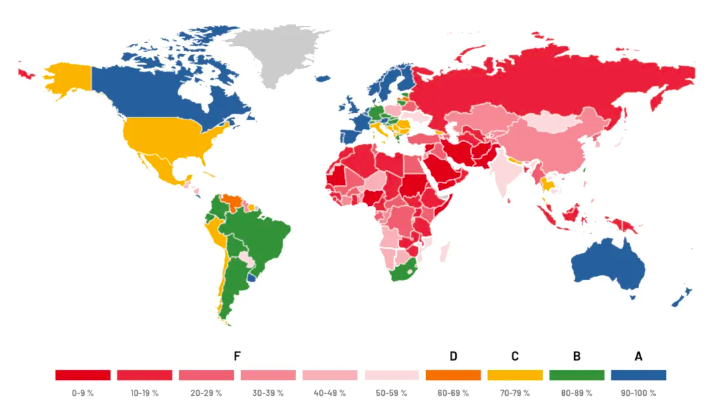
While the U.S. currently has a “C” for its LGB rights record, Susan Dicklitch-Nelson, a professor of government at Franklin & Marshall College who founded the study, told The 19ththat the U.S. will likely score an “F” in the years to come because of the recent wave of anti-LGBTQ+ legislation targeting queer people in public life.
“With the anti-drag laws that they have in Tennessee and in Florida, a lot of LGBT rights organizations are not able to peacefully or safely assemble, or pride events are not allowed by the state,” she said. “And do security forces provide protection [for] LGBT Pride participants? Again, that varies . . . depending on state.”
The study gave 62% of world countries an F on LGB rights. Only 35% of countries got a C-level grade or higher on LGB rights. All countries and territories that allowed for same-sex marriage scored either an A or a B on LGB rights by 2020, except for the United States.
The study found that countries and territories with higher levels of democratic rights tend to have more rights for LGBTQ+ individuals. It also found that most persecuting world regions continue to be in the Middle East and North Africa.
Only 10 countries have consistently scored an A on LGB rights from 2011-2020: Belgium, Canada, Denmark, England, Luxembourg, Norway, Scotland, Spain, Sweden, and Uruguay.
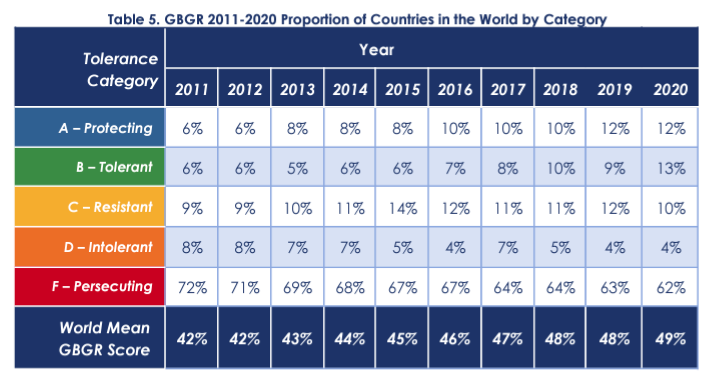
However, the study also had some good news from the global perspective: More countries are moving from lower LGB scores to higher scores. From 2011 to 2020, 24 countries — including the U.S. legalized — same-sex marriage equality. Eight other countries decriminalized homosexuality, bringing the total number of countries that criminalize homosexuality to 71.
As for trans rights, 70% of all countries got an F, and only 24% scored a C or higher. The U.S. has consistently scored an F on trans rights because of laws against the trans community in different states and continued violence and political rhetoric against trans people.
While trans rights improved somewhat globally over the 10-year span of the study, international scores overall have stayed low largely due to violence against trans people and arbitrary arrests for gender non-conformity.
We have come a long way from the days when HIV was an almost certain death sentence. But our work is far from over. The COVID-19 pandemic led to an uptick in rates of sexually transmitted infections (STIs), including HIV, and low-income communities, LGBTQ+ communities, and communities of color continue to be impacted at alarming and disproportionately high rates.
These communities are also more likely to be served by Medicaid. Medicaid is the largest source of insurance coverage for people living with HIV in the United States, covering an estimated 40 percent of nonelderly adults with HIV, and Medicaid accounted for 45 percent of all federal HIV spending in 2022. During September, Sexual Health Awareness Month, it is worth examining the crucial ways Medicaid works to keep people healthy—and what threatens our progress today.
In recent weeks, we have seen a troubling trend develop. Five million Americans have been removed from Medicaid rolls, and many millions more are on the verge of losing coverage as a result of the Medicaid enrollment cuts. This represents the single greatest threat to our progress toward ending the HIV epidemic in years.
During the pandemic, Medicaid enrollment grew by an estimated 20 million people, contributing to the uninsured rate dropping to the lowest level on record in early 2022. But, after a three-year period during which states provided continuous enrollment in exchange for enhanced federal funding, some states resumed disenrolling people from Medicaid on April 1. A recent KFF survey found that 17 million people could lose Medicaid coverage as a result of this process, referred to as the Medicaid “unwinding.”
Many states are not doing enough to ensure that Medicaid-eligible residents don’t lose their coverage. While some have been removed from the rolls because they are newly ineligible, procedural issues account for 74 percent of people losing coverage. An unacceptably high number of Florida, Texas, and Virginia residents who are still eligible for Medicaid are losing coverage because of procedural reasons, such as failing to confirm proof of income or household size.
Our goal should be to ensure that no one who qualifies for Medicaid loses their coverage. The U.S. Centers for Medicare and Medicaid Services (CMS) gave states the option to use a 12-month grace period, along with other flexibilities, to prepare for the unwinding and make sure residents had what they needed to recertify. So why are some states so eager to remove their residents from Medicaid rolls?
New York, on the other hand, has made equity a cornerstone of recertification work and provides a template for what states can do to help their residents remain covered. The state maximizes the flexibilities offered by CMS and works directly with providers, health plans, and recipients to minimize procedural disenrollments and ensure that people retain health care coverage, either through Medicaid, the state’s health exchange, or private insurance. New York is among the nation’s top-performing states in terms of call center wait times, call drop rates, and average time it takes to make an eligibility determination, according to the Center on Budget and Policy Priorities. New York’s call center is also able to produce materials in 26 languages. In June 2023 alone, New York State certified renewals for more than 400,000 residents.
At Amida Care in New York, we know firsthand that gaps in care for people living with or placed at elevated risk of contracting HIV can be especially devastating. When people lose access to PrEP medication to prevent HIV, they are left vulnerable to contracting HIV, and when people living with HIV lose access to antiretroviral therapy, they risk becoming seriously ill and transmitting HIV to others. We support and guide our members through the recertification process with dedicated outreach efforts that include phone calls, mailings, text messages, and home visits to limit loss of coverage and interruptions in life-saving treatments.
We cannot begin to address health inequity or end the HIV epidemic without strengthening Medicaid. The recent moves by some states to strip their residents of Medicaid coverage will undermine the progress we’ve made.
Doug Wirth is the President and CEO of Amida Care, a Medicaid Special Needs Health Plan for people affected by HIV.
Meta, the parent company of Facebook, Instagram, and Threads, has allowed an anti-LGBTQ+ group to spread hate speech and misinformation about LGBTQ+ people on its platforms in violation of the company’s policies for over a year, according to a new report from Media Matters for America.
The report, published by the media watchdog organization on Tuesday, details dozens of instances in which Gays Against Groomers used its Facebook, Instagram, and Threads accounts to post anti-LGBTQ+ content, including false claims that trans people are mentally ill and that LGBTQ+ people embrace pedophilia, as well as misinformation about gender-affirming care and the false “groomer” narrative propagated by the anti-LGBTQ+ right.
All of this content appears to clearly violate Meta’s policies prohibiting hate speech, harassment and misinformation, and yet it has remained on the company’s platforms. As the report notes, Meta has also vowed to label false and misleading information as such and deprioritize it in feeds. But the company has failed to do so on Gays Against Groomers’s posts.
The report notes that Instagram in particular has a well-documented history of failing to moderate harmful content, especially when it comes to attacks on the LGBTQ+ community.
“It’s an age-old problem that we’ve seen with Meta,” Media Matters research director Kayla Gogarty told The Advocate. Gogarty noted changes Elon Musk has made to Twitter, rebranded as X, since taking over the company last year. Last December, the company disbanded its Trust & Safety Council, which advised on the removal of hateful content.
“One of my biggest concerns is that they’re seeing Elon Musk’s kind of backsliding on enforcement and things like that [and] they’re seeing that almost as a permission structure for them to also backslide,” Gogarty said.
Gays Against Groomers’s very name and raison d’etre appear to be in violation of Meta’s hate speech policies. In July 2022, the company confirmed to The Daily Dot that baseless accusations of “grooming” aimed at LGBTQ+ people are governed under its policies prohibiting hate speech.
Launched in June 2022, Gays Against Groomers purports to be a “grassroots” coalition dedicated to “protecting children.” But as Media Matters reported in February, the group’s founder Jaimee Michell and its former chair and co-founder David Leatherwood “were pro-Trump operatives employed by right-wing communications firms representing other conservative figures who have attempted to capitalize off of the anti-LGBTQ fervor of the last two years.” In January, the Anti-Defamation League described the group as “an anti-LGBTQ+ extremist coalition” based on its peddling of “dangerous and misleading narratives about the LGBTQ+ community.” The Southern Poverty Law Center has also has also labeled Gays Against Groomers as “an extremist group.”
Since its June 6, 2022, launch, the group’s Instagram account has amassed over 357,000 followers. It has around 39,000 followers on Facebook and over 24,000 followers on Threads. While the group has been kicked off of platforms like Venmo, Paypal, and Google and has been suspended on Twitter multiple time prior to Musk’s takeover, Meta’s platforms have taken no action against its accounts. The group’s Facebook account was briefly suspended last week, but a source told The Daily Dot that the suspension was an error.
“Facebook, Instagram, and Threads are some of the few mainstream platforms that have not banned Gays Against Groomers, even though the group seems to have repeatedly violated the platforms’ policies,” the Media Matters report states.
In fact, Meta has profited off of ads promoting the false “groomer” narrative, despite publicly stating that use of the term to attack LGBTQ+ people violates its policies. An August 2022 report from the Center for Countering Digital Hate and the Human Rights Campaign found that the company accepted up to $24,987 for 59 ads promoting the narrative on Facebook and Instagram. The following October, Media Matters identified over 150 ads featuring the slur that ran on Meta’s platforms.
According to The Advocate, a spokesperson for Meta said that examples of Gays Against Groomers posts documented in the Media Matters report were “non-violating.”
“If someone were to use the term ‘groomer’ as an attack against someone based on being part of the LGBTQ+ community, it violates our hate speech policies,” the Meta spokesperson clarified.
The U.S. Department of Health and Human Services’ Administration for Children and Families is proposing a rule aimed at assuring that LGBTQ+ and intersex youth in foster care are placed in supportive homes, the federal government announced Wednesday.
“The proposed rule would require that every state’s child welfare agency ensure that LGBTQI+ children in their care are placed in foster homes where they will be protected from mistreatment related to their sexual orientation or gender identity, where their caregivers have received special training on how to meet their needs, and where they can access the services they need to thrive,” says a White House fact sheet.
The rule also “would require that caregivers for LGBTQI+ children are properly and fully trained to provide for the needs of the child related to the child’s self-identified sexual orientation, gender identity, and gender expression,” adds an HHS press release.
The proposed rule will be published online and will be subject to 60 days of public comment before becoming final. It is in keeping with an executive order President Joe Biden issued directing HHS to protect LGBTQ+ and intersex youth in the foster care, where they are overrepresented because of family rejection and abuse. But they often face mistreatment in foster care as well, and the new rule is aimed at preventing that.
The Administration for Children and Families is issuing another proposed rule, this one designed to expand access to legal representation for children in foster care, parents, and kinship caregivers by allowing state and tribal child welfare agencies to use federal funds to provide legal services. It will also let these agencies provide legal representation to parents seeking restraining orders and young people exiting the foster care system.
It has put out a final regulation that allows a child welfare agency to adopt simpler licensing or approval standards for foster homes that include one of the child’s extended family members, such as grandparents, aunts, and uncles. It also requires that states provide these caregivers with the same level of financial assistance that any other foster care provider receives.
“This is a historic package that underlines the Biden-Harris Administration’s steadfast commitment to putting children’s well-being first,” HHS Secretary Xavier Becerra said in the release. “This package allows kin to step into a critical caretaker role, proposes necessary legal representation to keep families together, and a safe and accepting environment in which children can thrive. The Administration is providing vital resources to remove barriers for child welfare agencies to provide supports necessary to accomplish that mission.”
The proposal was welcomed by LGBTQ+ advocacy groups.
“LGBTQ+ youth face higher risks of rejection and abuse than their peers – a reality being made worse by the wave of right-wing hate that has plunged our community into a state of emergency,” said a statement from David Stacy, the Human Rights Campaign’s vice president of government affairs. “This proposed rulemaking is an important step toward ensuring LGBTQ+ youth in foster care, who make up nearly one in three of the children in the foster care system, have the safe, healthy, and affirming environments they need in order to thrive. We applaud the Biden-Harris Administration for proposing such a critical new rule and look forward to working together to protect these young people.”
“All young people in foster care, including those who happen to be LGBTQ, deserve affirming, supportive environments to call home,” Kasey Suffredini, interim senior vice president of prevention at the Trevor Project, noted in a press release.
Suffredini referenced research conducted by the Trevor Project that showed queer young people in foster care report higher odds of attempting suicide than youth outside the foster care system. The group also found that LGBTQ+ youth in foster care are more likely to be subjected to the harmful and discredited practice of conversion therapy.
“The proposed rule specifically carves out protections against this abusive practice and, instead, calls on foster families to provide support and respect to LGBTQ young people, through access to mental health and medical care, honoring who young people know they are, and using names and pronouns that match who they are. Especially at a time when we continue to see so many lawmakers pushing politicized policies that harm these youth, it gives us hope to see an informed, data-driven effort to protect and support the health and well-being of LGBTQ young people,” Suffredini said.
A Philadelphia journalist and community advocate was fatally shot inside his home overnight, according to police.
Police were notified of a shooting at Josh Kruger’s home in the 2300 block of Watkins Street at 1:28 a.m. Monday.
Kruger, 39, sustained seven gunshot wounds to the chest and abdomen. He was taken to a local hospital where he was pronounced dead at 2:13 a.m.
No arrests have been made, and a motive is still under investigation, police said.
Kruger was known in the Philadelphia community as a social justice advocate and a longtime journalist, writing for news outlets such as The Philadelphia Inquirer and The Philadelphia Citizen. He also worked for Mayor Jim Kenney’s administration as a spokesperson for the Office of Homeless Services.
In a statement, Kenney said he was “shocked and saddened” by Kruger’s death.
“Josh cared deeply about our city and its residents, which was evident both in his public service and in his writing,” Kenney said in a statement shared with NBC News on Monday. “His intelligence, creativity, passion, and wit shone bright in everything that he did — and his light was dimmed much too soon.”
As a community advocate, Kruger focused on uplifting the community’s most vulnerable, including those experiencing homelessness, addiction and members of the LGBTQ+ community, according to District Attorney Larry Krasner’s office.
“As an openly queer writer who wrote about his own journey surviving substance use disorder and homelessness, it was encouraging to see Josh join the Kenney administration as a spokesperson for the Office of Homeless Services,” Krasner said in a statement. “Josh deserved to write the ending of his personal story.”
“As with all homicides, we will be in close contact with the Philadelphia Police as they work to identify the person or persons responsible so that they can be held to account in a court of law,” he said.
The investigation into Kruger’s death is ongoing.

A report released by Media Matters for America, the media watchdog group, on Tuesday, criticizes Instagram, for its alleged failure to effectively moderate content posted by the controversial anti-trans organization Gays Against Groomers.
The report, which The Advocate is reporting exclusively, highlights a series of instances where Gays Against Groomers is accused of spreading harmful rhetoric about LGBTQ+ people on the platform, clearly violating Instagram’s community guidelines against hate speech, harassment, and misinformation.
One of the primary concerns raised by the report is the apparent inconsistency in Instagram’s enforcement of these content policies. While other prominent platforms, including PayPal and Google, have taken decisive action to ban Gays Against Groomers for alleged violations of their content guidelines, Instagram, which is owned by Meta, has allowed the group’s content to remain accessible for over a year, according to Media Matters.
This discrepancy has led to widespread questioning of Instagram’s commitment to effectively moderating harmful content, particularly content that targets marginalized communities. Gays Against Groomers has been labeled an extremist hate group by the Anti-Defamation League.
The report points out that Gays Against Groomers has faced multiple suspensions from the platform formerly known as Twitter, X, including at least one suspension for using the derogatory anti-LGBTQ+ “groomer” slur. The contrast between platforms raises questions about Instagram’s relative leniency in dealing with content violations, especially compared to sites that have taken more aggressive measures.
Gays Against Groomers has leveraged Instagram as one of its primary platforms, amassing over 357,000 followers since its creation in June 2022. The group has also joined Threads, Meta’s Twitter-like platform, where it has continued to post content criticized as hateful and false about LGBTQ+ people, according to the report.
The Instagram community guidelines emphasize the platform’s commitment to fostering a diverse and positive community. Expressly, these guidelines prohibit content that contains credible threats or hate speech, especially attacks on sex, gender, gender identity, or sexual orientation.
Instagram’s rules also direct users to Facebook’s hate speech policy, which prohibits content targeting people or groups based on their sexual orientation, gender, or sex.
The Media Matters report documents Gays Against Groomers’ alleged repeated use of derogatory terms like “groomers” and their dissemination of false narratives about the LGBTQ+ community. The accusations range from claims that LGBTQ+ people are actively “grooming” children to promoting harmful stereotypes. Some of the group’s posts also target companies and individuals publicly supporting LGBTQ+ rights.
Gays Against Groomers has repeatedly employed derogatory rhetoric, referring to the LGBTQ+ community as “groomers” and alleging that they are actively involved in nefarious activity with kids. These claims have raised concerns and sparked widespread outrage within the LGBTQ+ community and their allies.
Meta, however, seemingly has done little to curb this.
“It’s an age-old problem that we’ve seen with Meta,” Media Matters research director Kayla Gogarty told The Advocate. “One of my biggest concerns is that they’re seeing Elon Musk’s kind of backsliding on enforcement and things like that [and] they’re seeing that almost as a permission structure for them to also backslide.”
After Musk acquired Twitter in October last year, he promptly fired much of the platform’s trust and safety team, responsible for content moderation. Since then, Musk has removed safeguards that protect transgender people and even wrote that he considered the word “cisgender” as a slur on his social media site.
Meanwhile, on April 28, Gays Against Groomers posted on Instagram, asserting that LGBTQ+ people “are actively grooming kids into the Rainbow Cult,” seemingly citing a report that indicated “1 in 4 high school students identifies as LGBTQ.”
The group implied that this statistic resulted from LGBTQ+ individuals “grooming” children.
Further, the organization shared a TikTok video depicting children celebrating LGBTQ+ Pride, labeling it an “indoctrination ceremony.”
The caption on the post claimed that “Indoctrinated kids are groomed kids.”
The group’s rhetoric didn’t stop there. They also criticized a clip from Sesame Street celebrating Pride, accusing it of “grooming children for sexual orientation and sexual preference.” The caption characterized the video as “teaching toddlers about sex” and “grooming, point blank.”
Gays Against Groomers attacked Target for promoting LGBTQ+ clothing and products aimed at children, even calling for a boycott of the retail giant. The group replaced the Target sign with the word “groomers” in an image, claiming they would “no longer allow these companies to pervert our youth and groom them into the Gender Cult.”
These allegations have been met with strong opposition from LGBTQ+ advocates and organizations. Many have criticized Gays Against Groomers for spreading baseless claims and harmful stereotypes about LGBTQ+ people and their supportive initiatives. Medical organizations have also debunked their assertion that gender dysphoria is a “social contagion.”
https://www.instagram.com/reel/CtH2ZmML5UZ/embed/captioned/?cr=1&v=4&wp=1070&rd=https%3A%2F%2Fwww.advocate.com&rp=%2Fexclusives%2Fmeta-gays-against-groomers-mmfa#%7B%22ci%22%3A3%2C%22os%22%3A64319%7D
Despite Gays Against Groomers’ self-presentation as a grassroots coalition dedicated to protecting children, Media Matters revealed that this group is composed of right-wing individuals with established ties to such organizations, linking the group’s founder, Jaimee Michell, and its former chair and co-founder, David Leatherwood, to right-wing firms and figures.
After Florida Gov. Ron DeSantis pushed a widely criticized homophobic video attacking former President Donald Trump, a conflict within GAG resulted in Leatherwood leaving the organization over Michell’s continued support for DeSantis.
Nonetheless, in a recent Instagram post on June 10, the group claimed to be a volunteer-driven, grassroots effort, stating, “No one has pocketed a dime, and we have had zero big donors.”
U.S. health officials plan to endorse a common antibiotic as a morning-after pill that gay and bisexual men can use to try to avoid some increasingly common sexually transmitted diseases.
The proposed CDC guideline was released Monday, and officials will move to finalize it after a 45-day public comment period. With STD rates rising to record levels, “more tools are desperately needed,” said Dr. Jonathan Mermin of the Centers for Disease Control and Prevention.
The proposal comes after studies found some people who took the antibiotic doxycycline within three days of unprotected sex were far less likely to get chlamydia, syphilis or gonorrhea compared with people who did not take the pills after sex.
The guideline is specific to the group that has been most studied — gay and bisexual men and transgender women who had a STD in the previous 12 months and were at high risk of contracting one again.
There’s less evidence that the approach works for other people, including heterosexual men and women. That could change as more research is done, said Mermin, who oversees the CDC’s STD efforts.
Even so, the idea ranks as one of only a few major prevention measures in recent decades in “a field that’s lacked innovation for so long,” said Mermin. The others include a vaccine against the HPV virus and pills to ward off HIV, he said.
Doxycycline, a cheap antibiotic that has been available for more than 40 years, is a treatment for health problems including acne, chlamydia and Rocky Mountain spotted fever.
The CDC guidelines were based on four studies of using doxycycline against bacterial STDs.
One of the most influential was a New England Journal of Medicine study earlier this year. It found that gay men, bisexual men and transgender women who previously contracted STDs and who took the pills were about 90% less likely to get chlamydia, about 80% less likely to get syphilis and more than 50% less likely to get gonorrhea compared with people who didn’t take the pills after sex.
A year ago, San Francisco’s health department began promoting doxycycline as a morning-after prevention measure.
With infection rates rising, “we didn’t feel like we could wait,” said Dr. Stephanie Cohen, who oversees the department’s STD prevention work.
Some other city, county and state health departments — mostly on the West Coast — followed suit.
At Fenway Health, a Boston-based health center that serves many gay, lesbian and transexual clients, about 1,000 patients are using doxycycline that way now, said Dr. Taimur Khan, the organization’s associate medical research director.
The guideline should have a big impact, because many doctors have been reluctant to talk to patients about it until they heard from the CDC, Khan said.
The drug’s side effects include stomach problems and rashes after sun exposure. Some research has found it ineffective in heterosexual women. And widespread use of doxycycline as a preventive measure could — theoretically — contribute to mutations that make bacteria impervious to the drug.
A popular Iraqi TikTok personality was shot dead on Monday in Baghdad, an Iraqi security source told CNN.
Known on social media as “Noor BM,” 23-year-old Noor Alsaffar had over 370,000 followers collectively on Instagram and TikTok. Alsaffar mostly posted short videos showing dresses, hair and makeup styles, often dancing to music. Following news of the shooting, many posted commentslamenting Alsaffar’s death. Some others cheered it, celebrating the man who fired the shot.
The Iraqi security source told CNN that “an investigation has been opened,” speaking on condition of anonymity as they were not authorized to speak to the media. “The deceased has been taken to the forensic department.”
Khaled Almehna, spokesperson for the Iraqi police, described the attack as a “criminal incident” on Tuesday, adding that he will provide “important updates” at a later time.
The killing comes as Iraq cracks down on LGBTQ expression and moves to criminalize it in law. While being queer is not explicitly banned under current Iraqi legislation, LGBTQ people are often targeted under vague morality clauses in its penal code.
Before the shooting, Alsaffar faced online abuse, as well as questions about sexuality and gender. In a 2020 interview on Iraq’s Al Walaa channel, Alsaffar said: “I’m not transgender and I’m not gay. I don’t have other tendencies, I’m only a cross-dresser and a model.” Alsaffar identified as male who worked as a model and makeup artist.
Alsaffar spoke in videos about facing threats on social media over choices of dressing.
In a 2021 YouTube interview with Iraqi blogger Samir Jermani, Alsaffar said: “I’m cautious but not afraid” in response to a question about the TikToker’s appearance.
The Iraqi LGBTQ rights group, IraQueer, posted about Alsaffar’s death, adding the hashtags #Transphobia and #MuderOfTransPeople on X, formerly known as Twitter.
Iraq’s media regulator in August banned the term “homosexuality” across all traditional and social media platforms, demanding that the term “sexual deviance” be used instead.
Rights groups have decried growing crackdowns on LGBTQ communities in the Middle East, including what Human Rights Watch found to be digital targeting based on online activity.
Online targeting is often followed by extreme punitive measures, including arbitrary detention and torture, the rights watchdog said in February after examining LGBTQ rights violations in Egypt, Iraq, Jordan, Lebanon, and Tunisia.
Amsterdam, the capital city of the Netherlands seems well on its way to accomplishing its goal of zero HIV transmissions by 2026. Only nine cases of HIV were reported in Amsterdam last year, thanks to heavy investment in pre-exposure prophylactics (PrEP), a drug protocol that prevents HIV transmission, and other HIV-prevention efforts.
While scientists have announced that a half dozen people may have been cured of HIV worldwide, the process is painful and expensive. It generally requires a bone marrow transplant after a cancer diagnosis. Dutch health authorities have found a way to circumvent the curing process that prioritizes prevention rather than treatment.
The Dutch AIDS Fund’s report of only nine new cases proves that the city’s investment in PrEP and other prevention strategies, which started in 2019, has had an impact. 128 people in Amsterdam were infected in 2019. PrEP can be used by people who don’t have HIV to prevent the virus from gaining hold of their immune system. When taken by people with the virus, it lowers the viral load to undetectable levels and makes it transmissible.
Health authorities worldwide have particularly recommended the drug for gay men, sex workers, and other people who are at risk for transmission.
In addition to PrEP, health officials have collaborated with politicians and HIV-care workers to create and promote easily accessible services and programs for key at-risk populations, including men who have sex with men (MSM), people with a migration background, and people who inject drugs. Many clinics and hospitals in the city offer HIV testing and immediately provide anyone who tests positive with medication to lower viral loads to undetectable (and thus, untransmittable) levels.
According to Aidsfonds-Soa Aids Nederland, the number of new HIV infections in the city had decreased by 95% since 2010. Approximately 98% of city residents living with HIV have been diagnosed, 95% of those have received medication treatment, and 96% of those on treatment have suppressed the virus to untransmittable levels.
“After more than 40 years of working together to stop the spread of HIV, this is great news,” said Mark Vermeulen, the executive director of Aidsfonds-Soa Aids Nederland. “It really is possible to end HIV and AIDS. Amsterdam is proving to everyone that it can be done.”
So far, only three people have been cured of HIV. Three others have been in remission and potentially cured.