Four people have reportedly been arrested in Uganda in the Buikwe district, located in central Uganda along Lake Victoria.
Police told the AFP that that four people – two of whom were women – were arrested after receiving a tip that “homosexuality” was happening at a massage parlor in the area.
“The police operation was carried out following a tip-off by a female informant to the area security that acts of homosexuality were being carried out at the massage parlor,” said police spokesperson Hellen Butoto.
The arrests come just months after Ugandan President Yoweri Museveni signed the country’s new Anti-Homosexuality Act, which contains provisions allowing for the death penalty in cases of “aggravated homosexuality.” Even though the World Bank and the U.S. have condemned the law as a violation of human rights, the Christian-marjority nation has stood its ground, accusing the West of “blackmail.”
“We do not consider homosexuality as a constitutional right,” Chris Baryomunsi, Uganda’s Information Minister, said of the international backlash. “It is just a sexual deviation which we do not promote as Ugandans and Africans.”
A federal appeals court ruled Monday that Alabama can enforce a ban outlawing the use of puberty blockers and hormones to treat transgender children, the second such appellate victory for gender-affirming care restrictions that have been adopted by a growing number of Republican-led states.
A three-judge panel of the 11th U.S. Circuit Court of Appeals vacated a judge’s temporary injunction against enforcing the law. The judge has scheduled trial for April 2 on whether to permanently block the law.
Alabama Attorney General Steve Marshall called the ruling a “significant victory for our country, for children, and for common sense.”
“The Eleventh Circuit reinforced that the State has the authority to safeguard the physical and psychological wellbeing of minors,” Marshall said.
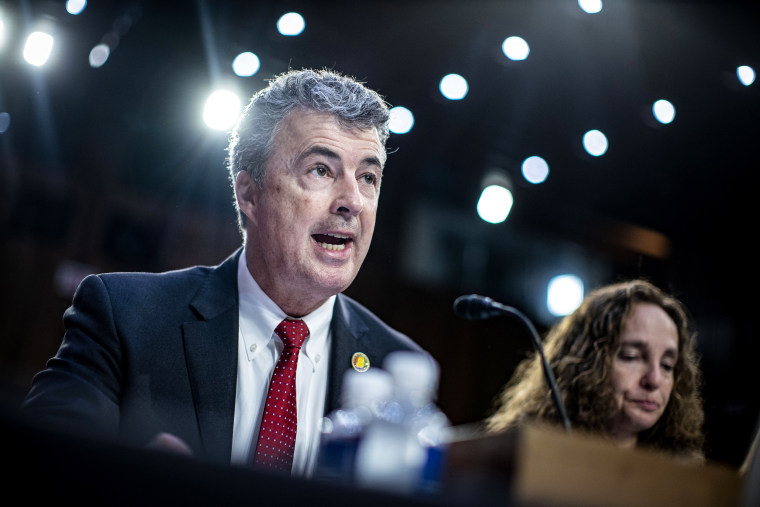
Steve Marshall, Alabama’s attorney general, speaks during a Senate Judiciary Committee confirmation hearing for Ketanji Brown Jackson on March 24, 2022.Al Drago / Bloomberg via Getty Images
In lifting the injunction, the judges wrote that states have “a compelling interest in protecting children from drugs, particularly those for which there is uncertainty regarding benefits, recent surges in use, and irreversible effects.”
The decision leaves families of transgender children, who had been receiving treatment, scrambling for care. The injunction will remain in place until the court issues the mandate, which could take several days. But once it is officially lifted, the attorney general’s office will be able to enforce the ban, which threatens doctors with prison time.
Advocacy groups representing families who challenged the Alabama law vowed to continue the fight, saying “parents, not the government, are best situated to make these medical decisions for their children.”
“Our clients are devastated by this decision, which leaves them vulnerable to what the district court—after hearing several days of testimony from parents, doctors, and experts—found to be irreparable harm as a result of losing the medical care they have been receiving and that has enabled them to thrive,” said a joint statement from the Southern Poverty Law Center, the National Center for Lesbian Rights, GLBTQ Legal Advocates & Defenders, and the Human Rights Campaign.
Major medical groups, including the American Medical Association and the American Academy of Pediatrics, oppose the bans and experts say treatments are safe if properly administered.
Puberty blockers are fully reversible prescription medication that pause sexual maturation, typically given in injections or skin implants. Hormone treatments can prompt sexual development, including changes in appearance.
Dr. Morissa Ladinsky, a Birmingham pediatrician, said in a statement Monday that she is hopeful “today’s decision is just a temporary setback.”
“As a doctor who has treated hundreds of transgender adolescents, I know firsthand the challenges these young people and their families face and the benefits these treatments provide to youth who need them. This is safe, effective, and established medical care. There is no valid reason to ban this care,” Ladinsky said.
The ruling follows a string of decisions in recent weeks against similar bans. A federal judge in June struck down a similar law in Arkansas, the first state to enact such a ban. At least 20 states enacted laws restricting or banning gender-affirming care for minors.
Opponents of youth transgender medical treatment say there’s no solid proof of purported benefits, cite widely discredited research and say children shouldn’t make life-altering decisions they might regret.
Bans have also been temporarily blocked by federal judges in Florida, Indiana, and Kentucky. A federal appeals court has allowed Tennessee’s ban, which had been blocked by a federal judge, to take effect.
The ruling applies to only the Alabama ban, but comes as most of the state bans are being challenged in court.
Alabama Gov. Kay Ivey signed the Vulnerable Child Compassion and Protection Act into law in 2022, making it a felony punishable by up to 10 years in prison for doctors to treat people under 19 with puberty blockers or hormones to help affirm their gender identity.
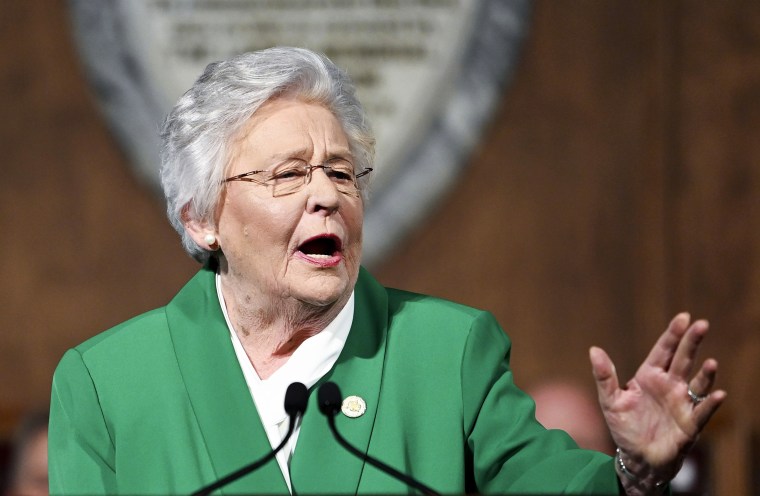
Alabama Gov. Kay Ivey delivers her State of the State address in Montgomery on March 7, 2023.Julie Bennett / AP file
Four families with transgender children ranging in ages 12 to 17 challenged the Alabama law as an unconstitutional violation of equal protection and free speech rights, as well as an intrusion into family medical decisions. The U.S. Department of Justice joined their lawsuit, seeking to overturn the law.
U.S. District Judge Liles Burke, who was nominated to the court by President Donald Trump in 2017, ruled when issuing the preliminary injunction that Alabama had produced no credible evidence to show that transitioning medications are “experimental.”
Alabama then appealed to the 11th Circuit.
Burke allowed two other parts of the law to take effect. One bans gender-affirming surgeries for transgender minors, which doctors had testified are not done on minors in Alabama. The other requires counselors and other school officials to tell parents if a minor discloses that they think they are transgender.
More GOP states are poised to enact similar bans on gender-affirming care for minors. Democratic governors in Louisiana and North Carolina vetoed bans last month, but both were overridden by Republican-led legislatures.
Artist Carmen Rose used to perform regularly in Malaysia, until a police raid last year put an end to the veteran drag queen’s act and fueled the fears of the LGBTQ community at a time when Islamists are rapidly gaining political clout.
Since the raid, during which several party-goers were arrested, Rose has stopped doing shows, and rarely ventures out in public in costume.
“It’s always a risk going out in drag. If there was a raid, who do we call? Do we bring our boy clothes just in case?” said Rose, who declined to disclose her non-drag identity due to fears of reprisal. “They see us as sexual deviants or sinners.”
Queer Malaysians and rights groups told Reuters that LGBTQ communities face increasing scrutiny and discrimination under Prime Minister Anwar Ibrahim’s government, despite the longtime opposition leader’s reputation as a progressive reformer.
Analysts say Anwar, who took office after a November general election, is under pressure to bolster his Islamic credentials among the Muslim majority in the face of an increasingly popular ultra-conservative opposition that has steadily gained more political ground since the vote.
Malaysia’s opposition bloc includes Islamist party PAS, which promotes a strict interpretation of sharia law and opposes LGBTQ rights. The party holds the most number of seats in parliament for the first time ever, and its gains in state elections this month reinforced its political influence.
A PAS lawmaker recently said LGBTQ people should be classified as “mentally ill.” Another PAS leader urged the government to cancel a concert by Coldplay because the band supports queer rights.
“Anwar doesn’t feel politically stable, so he has to be more Islamic than the other side,” said James Chin, a political analyst at the University of Tasmania in Australia.
Sodomy is a crime in Malaysia, which also has Islamic sharia laws banning same-sex acts and cross-dressing. The multi-ethnic, multi-faith country has a dual-track legal system with Islamic laws for Muslims running alongside civil laws.
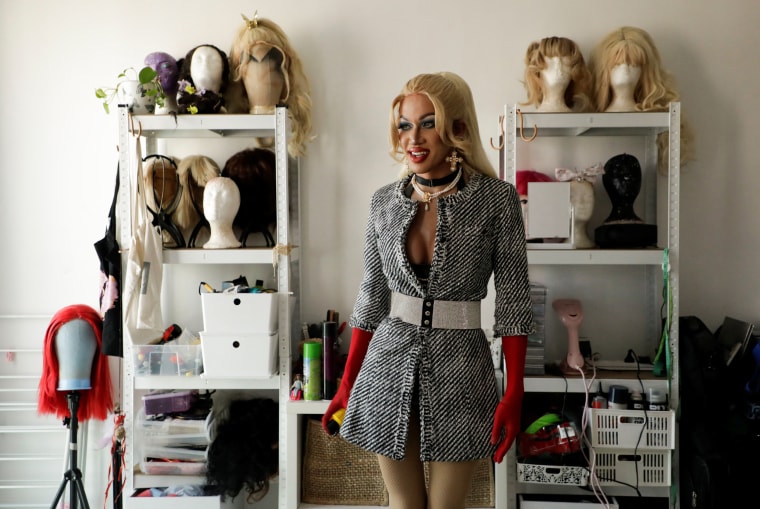
Carmen Rose in Petaling Jaya, Malaysia, on July 25, 2023.Hasnoor Hussain / Reuters
While Anwar has never expressed support for the LGBTQ community, activists say they expected him to show more tolerance as he advocated for an inclusive society during his 25 years in the opposition.
“There was some hope when Anwar came to power that the reform agenda would seep in to some extent,” said Dhia Rezki Rohaizad, deputy president of JEJAKA, an organization that supports gay, bisexual and queer men.
“It’s disappointing that it has not happened. At the very least, we had hoped that they would just leave us alone, not be actively persecuting us.”
Discrimination and threats
Anwar vowed this year that Malaysia would never recognize LGBTQ rights.
His government has banned books for “promoting the LGBT lifestyle”, detained demonstrators expressing support for queer rights and confiscated Pride-themed watches made by Swiss watchmaker Swatch.
Last month, authorities halted a music festival, after the frontman of British pop band The 1975 kissed a male bandmate onstage and criticized Malaysia’s anti-LGBTQ laws.
Asked about the government’s position on LGBTQ rights, government spokesperson and communications minister Fahmi Fadzil told Reuters: “Whatever the prime minister has said is the position.”
Some analysts say Anwar’s uncompromising stance on LGBTQ rights stems from a desire to wipe out doubts about his own sexuality which surfaced after he was jailed for nearly a decade for sodomy. Anwar has repeatedly said the charges were fabricated and politically motivated, but some political opponents still question his Islamic values.
Activists say online harassment and death threats against queer Malaysians are rampant on social media, while undercover police often attend LGBTQ-friendly events. Many groups now ensure there are lawyers at these events in case of a raid.
Thilaga Sulathireh, founder of LGBTQ advocacy group Justice for Sisters, said the government’s rejection of queer Malaysians was tantamount to a human rights violation.
“This has emboldened the conservatives and the right wing, it allows discrimination and violence to take place against LGBT people with impunity,” said Sulathireh, who uses they/them pronouns.
Justice for Sisters is receiving more queries from LGBTQ Malaysians seeking asylum in other countries, they said, adding that the community is also increasingly adopting self-censorship to stay under the radar.
Drag queen Carmen Rose said she canceled a show this year, fearing another crackdown. She occasionally performs in neighboring Singapore, and is now considering leaving Malaysia.
“This is not me running away. I’m just tired and I have to also think about myself and my own happiness,” she said.
A federal judge has blocked the state of Georgia from enforcing part of a new law that bans doctors from starting hormone therapy for transgender people under the age of 18.
In a ruling issued Sunday, U.S. District Judge Sarah Geraghty granted a preliminary injunction sought by several transgender children, parents and a community organization in a lawsuit challenging the ban.
“The imminent risks of irreparable harm to Plaintiffs flowing from the ban — including risks of depression, anxiety, disordered eating, self-harm, and suicidal ideation — outweigh any harm the State will experience from the injunction,” the judge wrote.
An email to a spokeswoman for the state attorney general’s office was not immediately returned. Geraghty said her ruling will block enforcement of the ban on hormone replacement therapy until a further court order or a trial.
But the ruling allows part of the law, which took effect on July 1, to remain in place. It bars any new patients under 18 from starting hormone therapy and bans most gender-affirming surgeries for transgender people under 18.
Geraghty’s ruling was an “incredible victory for Georgia families,” attorneys for the plaintiffs said in a statement. The American Civil Liberties Union of Georgia, the Southern Poverty Law Center, the Human Rights Campaign Foundation and the law firm O’Melveny & Myers are representing the plaintiffs.
“This law unapologetically targets transgender minors and denies them essential health care,” they said. “The ruling restores parents’ rights to make medical decisions that are in their child’s best interest, including hormone therapy for their transgender children when needed for them to thrive and be healthy.”
At least 22 states have now enacted laws restricting or banning gender-affirming medical care for transgender minors, and most of those states face lawsuits. A federal judge struck down Arkansas’ ban as unconstitutional, and federal judges have temporarily blocked bans in Alabama and Indiana as well.
The plaintiffs in the Georgia lawsuit did not ask to immediately block the surgery ban, which remains in effect.
Doctors typically guide kids toward therapy or voice coaching long before medical intervention.
At that point, puberty blockers and other hormone treatments are far more common than surgery. They have been available in the U.S. for more than a decade and are standard treatments backed by major doctors’ organizations including the American Medical Association.
During two days of hearings earlier this month, Geraghty heard conflicting testimony about the safety and benefits of hormone therapy to treat adolescents with gender dysphoria — the distress felt when people’s assigned sex at birth does not match their gender identity.
Experts for the families said the benefits of gender-affirming care for adolescents are well-established and profound. State government experts raised concerns about the risks of hormone treatment and the quality of studies establishing its effectiveness.
In her ruling, Geraghty said witnesses for state health officials set a very high bar for evidence of hormone therapy’s benefit and a low bar for evidence of its risks. She noted that experts agreed that prolonged use of puberty blockers was harmful to a person’s health and inadvisable.
For the transgender children in the suit, “time is of the essence,” she wrote, and SB 140 could cause them to suffer heightened gender dysphoria and unwanted and irreversible puberty.
A national health task force’s sterling new endorsement of a long-acting injectable medication for use as HIV prevention will require health insurers to begin covering the pricey drug by 2025. Such expanded access to the preventive therapy could lend a much-needed boost to the country’s relatively anemic efforts to thwart the HIV epidemic.
However, the hotly anticipated development in the four-decade fight against HIV is on a legal collision course. A conservative lawsuitadvancing through the courts could void the requirement that insurers cover the HIV-prevention drug, along with dozens of other coverage mandates stemming from the task force’s recommendations. That could have a sweeping impact on people’s ability to afford preventive interventions and screenings for a host of health conditions.
The U.S. Preventive Services Task Force, which is an independent, volunteer assembly of medical experts, issued a new recommendation Tuesday for using antiretroviral medications to prevent HIV, a protocol known as pre-exposure prophylaxis, or PrEP. After it commissioned a systematic review of the relevant scientific literature, the task force published the findings in JAMA. The paper states “with high certainty” that all three currently approved forms of PrEP provide a “substantial net benefit” to adults and adolescents at elevated risk of HIV.
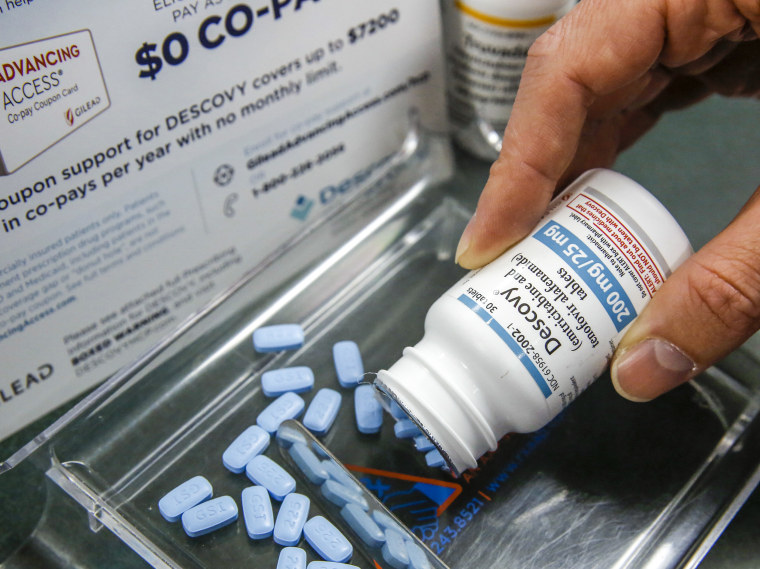
The HIV prevention drug Descovy at a pharmacy in Sacramento, Calif., on Oct. 7, 2019.Rich Pedroncelli / AP file
The endorsement concerns two daily oral medications, Gilead Sciences’ Truvada and Descovy, and ViiV Healthcare’s long-acting injectable medication, Apretude. Research has shown that Apretude, which is provided every eight weeks by a health care worker, is superior to Truvada at preventing HIV across a population of at-risk people. But nearly two years after Apretude hit the market, its potential to combat HIV in the U.S. remains woefully unrealized; because of its high cost, insurers rarely cover it.
Dr. Kenneth Mayer, the medical research director at the Fenway Institute, an LGBTQ-focused clinic in Boston, characterized the task force’s Apretude recommendation as “gratifying.” However, he expressed frustration over the roadblocks prescribers such as him have faced when they seek to put patients on Apretude.
“Insurance hassles have definitely been part of the problem, including high copays and requirements that providers demonstrate that patients failed oral regimens,” said Mayer, who was the lead author of a 2020 paper that found Descovy was just as effective as Truvada at preventing HIV.
The task force granted Truvada, Descovy and Apretude “A” ratings for their use as HIV PrEP, as it previously had for Truvada alone in 2019. Under a provision of the Affordable Care Act, A or B ratingsprompt a legal mandate that the vast majority of insurers, including state Medicaid programs expanded under the ACA, cover the preventive intervention in question and at no out-of-pocket cost to patients. Medicare administrators are considering new coverage rules about PrEP under which the public insurance plan would fall in lockstep with the policies about HIV prevention medication.
Dr. Jonathan Mermin, director of the Centers for Disease Control and Prevention’s National Center for HIV, Viral Hepatitis, STD and TB Prevention, said the task force’s Apretude recommendation represented “a major step” toward expanding PrEP access.
“More ways to take PrEP means more people can benefit,” he said.
A legal showdown
By law, insurers now have until January 2025 to begin widely covering Apretude. But the requirement could be nullified by a lawsuit pending in the 5th U.S. Circuit Court of Appeals.
The suit is being waged by a group in Texas, many members of which are self-described Christian business owners, who oppose covering PrEP on religious grounds. In September, a U.S. district judge in Texas agreed that the plaintiffs’ religious freedom had been violated and ruled that the health task force had no constitutional authority to dictate insurance policy, because its members were not appointed by the president or confirmed by the Senate. The ruling has been stayed pending appeal.
Elizabeth Kaplan, an expert in health care law at Harvard Law School, said she “can’t venture a guess as to how the 5th Circuit will rule in this case,” but she noted that it “is one of the most conservative federal appellate courts in the country.” Ultimately, she said, she expects the case to land on the Supreme Court’s docket.
The case’s impact could stretch well beyond the HIV battleground. Ultimate victory for the plaintiffs could vacate the federal government’s authority to follow the task force’s recommendations and mandate free access to, for example, screening for colorectal and lung cancer, statin treatment and smoking cessation therapy.
The PrEP landscape
In July 2021, federal health authorities announced that insurers could not charge patients for Truvada as PrEP or for the quarterly clinic visits and lab tests required to maintain prescriptions. Should the task force lose its authority, insurers could return to imposing such fees. Truvada’s use as HIV prevention was, however, already widely covered by insurance before the task force ever weighed in. And Gilead has long covered up to $7,200 in annual out-of-pocket expenses for PrEP.
The PrEP landscape has evolved dramatically since the task force first lent its vote of confidence to Truvada four years ago. The Food and Drug Administration approved Descovy for use as PrEP in October 2019, followed by Apretude in December 2021. Truvada became available as a cheap generic in the spring of 2021 and is often available for as little as $30 per month. Consequently, insurers have largely refused to cover Apretude, which has a list price of $1,900 per month. Medicaid is already required to cover the injectable drug, although physicians may have to submit prior authorization requests to some state programs.
Descovy is considered gentler on the kidneys than Truvada. But many experts believe it offers no clinically significant benefit to most PrEP users. And so, given Descovy’s $2,160 monthly list price, insurers began restricting coverage for its use for HIV prevention after inexpensive generic Truvada came online. Kaplan said it remains unclear whether the health task force’s inclusion of Descovy in its new recommendation might compel insurers to cover it more liberally.
Jeremiah Johnson, the executive director of the public health advocacy nonprofit group PrEP4all, said the impact of the task force’s support for Apretude “will depend largely on how seriously the federal government takes enforcement of coverage with insurers.”
“And, of course,” Johnson added, “this will mean nothing” for the uninsured.
A nation in need of a game changer
Compared with other wealthy nations, many of which have experienced plummeting HIV transmission rates in recent years, the U.S. is a notable laggard. International health authorities estimatethat from 2015 to 2021, the annual new infection rate dropped by more than 70% in the Netherlands and 44% in Australia, whereas the CDC estimates that the U.S. rate declined by only 12% from 2017 to 2021, from 36,500 to 32,100 cases.
The CDC points to insufficient PrEP use among those most at risk of HIV as a major drag on the nation’s efforts to combat the virus.The agency estimates that gay and bisexual men account for 71% of new cases of the virus and that about 814,000 members of the demographic are good PrEP candidates. A recent CDC study found that only about 190,000 people — a group that other research suggests is overwhelmingly made up of gay and bisexual men — were taking PrEP last September. And crucially, PrEP has never become sufficiently popular among Black and Latino men who have sex with men, who contract HIV at much higher rates than their white counterparts.
If the results of a major clinical trial are any guide, Apretude could pack a substantial public health punch. In a double-blind, placebo-controlled study of gay and bisexual men and transgender women,published in 2021, the participants randomized to receive the injectable drug contracted HIV at a rate two-thirds lower than those who got Truvada as PrEP.
When they are taken as prescribed, Truvada and Descovy lower HIV risk by at least 99%. But many people do not take the pills daily, leaving them vulnerable to the virus. Apretude apparently bridged that gap in the clinical trial.
Dr. Hyman Scott, an HIV prevention expert at the San Francisco Department of Public Health, characterized the need to take a daily pill as the “Achilles’ heel of oral PrEP.” He expressed hope that widely accessible Apretude could mitigate the stark racial disparities in HIV transmissions.
However, Scott noted, “users will still need to adhere to the clinic visits.” That raises the question of whether the imperative that Apretude recipients attend medical appointments every two months, rather than every three months for Truvada or Descovy, will substantially alienate at-risk people.
There are, meanwhile, longer-acting forms of PrEP in the research pipeline, including implants and Gilead’s lenacapavir, which requires injecting only every six months. But even if the health task force keeps its authority in the wake of the legal challenge, insurers would most likely not wind up having to begin covering lenacapavir until 2030.
Planned Parenthood of the Heartland and its medical director, Dr. Sarah Traxler, are appealing the dismissal of their lawsuit challenging a Nebraska law that bans most abortions after 12 weeks of pregnancy and restricts gender-affirming care for transgender people under age 19.
They argue that the law violates the Nebraska constitution, which stipulates that any piece of legislation should deal with one subject only. Attorney General Mike Hilgers had countered that the legislation complied with the constitution because the restrictions on abortion and transition procedures both deal with health care. Lancaster County District Court Judge Lori Maret agreed with Hilgers and dismissed the suit August 11. Lancaster County includes Lincoln, the state capital.
The Planned Parenthood group and Traxler filed a notice of appeal Friday with the Nebraska Supreme Court. They are represented by the American Civil Liberties Union, its Nebraska affiliate, and Powers Law.
The trans care restrictions had been subject to a filibuster led by Sen. Machaela Cavanaugh, who vowed to block every bill pending in Nebraska’s one-chamber, officially nonpartisan legislature in order to keep the anti-trans measure from passing. However, her fellow lawmakers eventually overcame that filibuster. The legislature folded the 12-week abortion ban into the anti-trans bill, Legislative Bill 574, and passed the combined measure in May. Republican Gov. Jim Pillen signed it into law within days. The abortion ban took effect immediately, and the trans care regulations go into effect October 1.
The ban on gender-affirming care has taken a different form from the one originally introduced, but opponents say it could still do great harm. The original bill would have banned puberty blockers, hormone treatment, and gender-confirmation surgery for anyone under 19 for the purpose of transition, although genital surgery is almost never performed on minors. The new legislation bans only surgery, both genital and otherwise, but allows Nebraska’s chief medical officer to regulate the use of puberty blockers and hormones.
That officer, Timothy Tesmer, was appointed by Pillen and has said he opposes all gender-affirming procedures for minors, so putting the power in his hands would likely result in a policy as restrictive as the one proposed in the first version of LB 574, possibly more so, according to opponents. Those already receiving nonsurgical care are exempt from new regulations.
“We will never stop fighting for the reproductive freedom, bodily autonomy, and health of our Nebraska communities. We are doubling down on that commitment with this appeal,” Ruth Richardson, president and CEO of Planned Parenthood North Central States, which includes Planned Parenthood of the Heartland, said in a press release. “Planned Parenthood is dedicated to continuing to provide abortion care to the patients we can legally see within the 12-week limit and will continue to connect other patients in Nebraska with the resources they need to get to the essential care they so desperately need, wherever they may be. Every person deserves the freedom to control their body, health, and future — and that right shouldn’t be determined by your zip code.”
“We are hopeful that the Nebraska Supreme Court honors the language in our state’s constitution that ‘no bill shall contain more than one subject,’” added Mindy Rush Chipman, ACLU of Nebraska executive director. “We will continue to advocate for Nebraskans’ rights and do all we can to block both the abortion ban and the restriction on gender-affirming care for trans youth.”
The victim killed in a Friday shooting at a punk show in Minnesota has been identified. A gunman opened fire into a backyard venue, killing August Golden and striking six others.
Minneapolis police are looking for two people who fled the area.
It all happened at an outdoor music show in the backyard and garage of Nudieland, a residential performance space south of Minneapolis shortly after 10 p.m.
“We believe one of the persons was being targeted by a shooter,” Minneapolis Police Chief Brian O’Hara said at a press conference on Saturday. “We know two suspects ran from the scene. I can’t confirm there were two shooters, though.”
The backyard punk show was underway on Friday as Quinn McClurg snapped pictures of her joyful friends when a gunman targeted the LGBTQ+ attendees in a deadly mass shooting.
As a poet and journalist attending the University of Minnesota who moved to Minneapolis in 2021, McClurg was quickly welcomed into DIY shows like Nudieland, Reckon reports.
“DIY shows are one of the only regularly safe places for trans folks, queer folks, punks, and everybody to get together and socialize,” the 21-year-old transgender woman said. “Because everybody you know and love is there. People you’ve worked in the encampments with, people you’ve done protests with—everybody’s there.”
Nudieland was formed two years ago as an extension of its sister venue, Disgraceland. In addition to being a venue, Nudieland is also home to many of its punk patrons who reside in the house.
One of the residents, who is trans, told Reckon, “This is not a unique space. So many of the bunkhouses I started going to, as young as 16, in and around Southside [Minneapolis], were the same way: there was no striving; we were just in it together, whoever walked in. We’ve always been freaks.”
On the night of the shooting, there was a celebration of the new album release of one of the local bands, Texture Freq.
McClurg and Aaron Diveley, who is also transgender, are among the survivors of that night who have been supporting one another to figure out what happened. It appears that two men followed two queer women at the show.
MPR News posted an Instagram photo with a comment from a user who said they were at the event, “They were trying to flirt with me and my friend—who both identify as lesbians—and we told them we weren’t interested and not to touch us. They got upset and eventually walked off, and less than a minute after [they] started firing.”
“This was a hate crime,” Diveley said.
Several GoFundMe sites have been set up to support the victims of the attack.
“Our hearts are saddened this week as we absorb the impact of yet another hateful, violent attack on our queer/trans community with the shooting at Nudieland,” said Jeremy Hanson Willis, CEO of Minnesota LGBTQ+ health group Rainbow Health, in a statement. “We share the feelings of loss and fear, and we send our love to those affected by this senseless act.”
Ted Brown said his now-deceased civil partner of 50 years, Noel Glynn, received bruises and cigarette burns from homophobic workers while living in a London nursing home for nine months. Brown sued the local council that oversees the home, and the council offered a £30,000 ($38,266 U.S.) settlement to Brown two years ago, but he said he hasn’t received any of the promised money yet.
Glynn lived in the Albany Lodge Nursing Home in Croydon in South London from December 2018 to October 2019 while receiving care for dementia. Brown paid £1,400 ($1,787) a month for Glynn’s care. Brown said two LGBTQ+ residents advised them to stay closeted otherwise “that won’t be good for either of you.” Brown became alarmed several months later when he discovered that Glynn had tried to independently leave the nursing home four times.
“I don’t like it here, they beat me up,” Glynn told a social worker in January 2019, The Guardian reported. Glynn told Brown that he had been held down and punched, leaving him with bruises on his chest and wrists, My London News reported.
When Brown and a friend examined Glynn’s body, they found “a bruise on his body that went from his navel, around his back, together with a yellowing bruise on his chest where you could still see the knuckle prints where he had been punched,” the aforementioned publication noted.
A whistleblower at the home told Brown that he witnessed a staff member approach Glynn in the hallway and ask, “Are you a gay man? Do you like gay men?“ The worker then dragged Glynn into his room and “everyone heard the sounds of him calling out for help for two or three minutes.”
A doctor who examined Glynn said in court documents, “He could not give me any details of who beat him up, how many times and when and where this happened, but he clearly appeared frightened and distressed.”
Brown also said that the staff refused to acknowledge their relationship. He two met at the first-ever London Pride event in 1972, which Glynn helped organize. But even though the two were legally civil partners, the staff referred to Glynn as Brown’s “father,” something that made no sense to Brown.
“There is no way these people could have mistaken Noel for being my father,” he told My London News. “At the time he was 76. I was 69…. I’m Black. He was white. No way was he my father. I think this was just the written way of letting me know [that] we don’t recognize your civil partnership.”
“Several of us fought to get the rights that we’ve got now,” Brown told The Guardian, “and, as we get older, we have the frightening reality that we have to go back into the closet if we go into a care home.”
A spokesperson from Future Care Group, which owns Albany Lodge, said that they worked closely with authorities in investigating the claims and implementing changes since then.
“The health and wellbeing of our residents has always been our greatest priority and, in line with our values, we have mandatory diversity and equality training for all staff,” the spokesperson said.
Glynn moved out of the nursing home and into a new facility in October 2019. Glynn died in December 2021 after falling and fracturing his ribs.
A 2021 survey found that LGBTQ+ elders are suffering alarming rates of poverty, discrimination, health care risk, and abuse, but most don’t report it over fear of retaliation or hopelessness of anything being done to help them.
Nearly half of all LGBTQ+ youth feel unsafe in school settings, and over half said they had been bullied due to their queer identities, a new report from the Human Rights Campaign(HRC) found.
But even though over half of queer respondents also showed signs of anxiety and depression, majorities of LGBTQ+ youth have also come out to their families and feel hopeful for the future nonetheless.
The HRC’s 2023 LGBTQ+ Youth Report surveyed over 13,000 LGBTQ+ youth between the ages of 13 and 17, from all 50 states and Washington, D.C.
Approximately 54% of transgender and gender-expansive youth and 46% of LGBQ+ youth surveyed said that they felt unsafe in at least one school setting. Nearly 60% of all LGBTQ+ youth said that they had been “teased, bullied, or treated badly” at school over their LGBTQ+ identities.
Only one in five LGBTQ+ youth reported school bullying to a school staff member. While 23.3% of these kids said the adult “didn’t help me at all,” 20.0% said the adult “helped me a lot.”
Additionally, 55.1% of survey respondents screened positive for depression, 63.5% screened positive for depression, and 64.7% rated their ability to manage stress as “fair” or “poor.” These rates were on average five points higher for transgender and gender-expansive youth. 48.9% of LGBTQ+ youth had received therapy in the prior year.
The HRC noted that these findings have likely been affected by the spike in anti-LGBTQ+ legislation nationwide. During the most recent legislative session, 10 have passed transphobic “bathroom bills,” 23 states have passed transphobic “sports bans,” six have passed “forced outing” bills requiring schools to out trans and gender-expansive youth to their parents, and six have passed “Don’t Say LGBTQ+” bills banning queer content from classrooms.
Despite this, 90.3% of LGBTQ+ youth said they were proud to be part of the LGBTQ+ community, and nearly 83% of queer youth said that they had come out to at least one member of their immediate family.
Trans and gender-expansive youth who feel free to express their gender identity around their families and those whose family members use their correct pronouns and names also reported the lowest levels of depression and anxiety among trans and gender-expansive youth.
Additionally, 56.8% of LGBTQ+ youth said they somewhat or strongly agree that “the LGBTQ+ community is accepted more and more every day.”
If you or someone you know is struggling or in crisis, help is available. Call or text 988 or chat at 988lifeline.org. The Trans Lifeline (1-877-565-8860) is staffed by trans people and will not contact law enforcement. The Trevor Project provides a safe, judgement-free place to talk for youth via chat, text (678-678), or phone (1-866-488-7386). Help is available at all three resources in English and Spanish.
An attacker has been sentenced to over a year in jail after he punched and threatened a man who he thought was gay with a deactivated AK-47 rifle and bayonet in a homophobic incident.
Marcin Skalimowski, 41, assaulted an unidentified man in an unprovoked attack after the man tried to talk to him at the St James Wine Bar in St Helier, Jersey on the evening of 20 March.
Skalimowski was removed from the bar after the assault, but he returned 10 minutes later to threaten the victim, who he assumed was gay, with the two weapons.
Crown advocate Luke Sette, prosecuting, told the court that Skalimowski asked door staff if the victim was “still inside” before he unzipped the bag containing the deactivated AK-47 rifle, the Jersey Evening Post reported.
Fearing for their safety and the lives of customers, the door staff wrestled the man to the ground and alerted police.
While under interview, Skalimowski, who admitted to assault and possessing an offensive weapon, said he had “nothing against” LGBTQ+ people but wanted them to keep “themselves to themselves rather than bothering straight people”.
During sentencing on Friday (18 August), bailiff Sir Timothy Le Cocq said the incident was “incredibly stupid and reckless” and included a “significant element of homophobia”.
The bailiff sentenced Skalimowski to 12 months for possession of a weapon and three months for the assault, with both sentences to run concurrently. Skalimowski also received a consecutive three-month sentence for breach of a previous community service order.
On 13 August, at 10.15pm, two men, one in his 20s and the other in his 30s, were attacked by a man with a knife outside the Two Brewers bar. The attacker then fled the scene on foot, which resulted in an urgent investigation by authorities.
Both victims were taken to hospital and later discharged.
Members of the LGBTQ+ community have been in shock since the horrific incident, saying they feel like their “second home was attacked”.