Iowa Gov. Kim Reynolds (R) has signed an education bill that includes several anti-LGBTQ+ policies.
S.F. 496 bans instruction on LGBTQ+ identities through sixth grade and requires schools to out trans youth to their parents. It also bans all books containing sex acts from school classrooms and libraries, which will undoubtedly lead to the banning of several LGBTQ+ books.
And despite the fact that Iowa has already banned gender-affirming care for trans youth, the bill explicitly establishes that parents and guardians have “the fundamental, constitutionally protected right, to make decisions affecting [their] child, including decisions related to the minor child’s medical care….”
The section clarifies that it does not authorize parents and guardians to “engage in conduct that is unlawful,” and as such, parents of trans youth still do not have the right to seek gender-affirming care for their kids.
Democrats and LGBTQ+ rights groups have blasted the bill.
“We need all Iowa trans kids to know, LGBTQ kids to know, that you belong here,” House Minority Leader Jennifer Konfrst (D), reportedly said as the legislative session came to a close.
After Reynold’s signed the bill, the Iowa Senate Democrats tweeted that the law seeks to “ban books and marginalize kids just because they’re different.”
“Censorship and singling out LGBTQ Iowans is wrong for kids, and wrong for our state,” the tweet concluded.
Courtney Reyes, the executive director of One Iowa, said in a statement that the law “will harm an already vulnerable group of children and will benefit no one.”
The bill was part of a slate of education bills signed by Reynolds last week. In a statement, she said the state has “secured transformational education reform that puts parents in the driver’s seat, eliminates burdensome regulations on public schools, provides flexibility to raise teacher salaries, and empowers teachers to prepare our kids for their future.”
“Education is the great equalizer and everyone involved – parents, educators, our children – deserves an environment where they can thrive,” she said.
Reynolds has made her anti-trans views a cornerstone of her tenure. She has also made “parental control” a centerpiece of her public messaging, claiming a far-left “woke” agenda is threatening the health and well-being of the state’s children.
While campaigning for reelection in 2022, she aired a TV spot highlighting what she called her values of faith, freedom, and hard work.
“Here in Iowa,” she declared, “we know right from wrong, boys from girls.”
At the end of March this year, Reynolds signed two bills targeting trans youth. One forbids minors from accessing puberty blockers and hormone replacement therapy and forces trans teens currently receiving gender-affirming care to de-transition. It also threatens the professional licenses of any medical practitioners who provide such care. Studies show that gender-affirming care is safe, reversible, and essential to trans people’s overall well-being.
The other prohibits people from using school restrooms that don’t correspond with the gender a person was assigned at birth.
Last year, Reynolds also signed an anti-trans sports ban.
Montana Gov. Greg Gianforte has signed three more anti-LGBTQ+ bills into law, including one that activists are calling the “LGBTQ erasure act,” defining sex as binary and determined by reproductive capacity.
Gianforte, a Republican, announced Saturday that he had signed the bill. Also, he signed one allowing public schools to out transgender students to their parents and one that will let parents withdraw their children from school if they object to the day’s lesson plan.
The “erasure” legislation, Senate Bill 458, defines sex based on their chromosomes and their reproductive characteristics — females by their ability to produce an egg and males by their ability to produce sperm, “under normal development.” Those who can’t do so because of a condition present at birth will be defined according to their “nonambiguous” genitalia, the bill reads. Intersex people will be assigned a gender based on the characteristic deemed predominant. The bill’s provisions affect more than 40 sections of state law.
“In human beings, there are exactly two sexes, male and female, with two corresponding types of gametes,” the legislation reads. “The sexes are determined by the biological and genetic indication of male or female, including sex chromosomes, naturally occurring sex chromosomes, gonads, and nonambiguous internal and external genitalia present at birth, without regard to an individual’s psychological, behavioral, social, chosen, or subjective experience of gender.”
It was drafted with advice from the Montana Family Foundation, an anti-LGBTQ+ organization, and its sponsor, Republican Sen. Carl Glimm, “framed the policy as a response to a rise in people identifying as transgender,” the Montana Free Press reports.
Language added to the bill toward the end of the legislative session says it includes people “who would otherwise fall within this definition” of male or female “but for a biological or genetic condition.” But medical professionals say that’s not inclusive of all intersex people, and trans and nonbinary people say the measure excludes them from state law.
“If you start with the assertion that there are exactly two sexes, which is the literature of the bill, that’s an inaccurate statement,” Dr. Erin Grantham, a pediatric urologist, told the Free Press. She also said it’s unscientific to ignore the role of psychology. “You can legislate whatever you want,” she said. “You can say that gravity only applies when you’re at sea level, but that doesn’t change the fact that there’s gravity when we walk up a hill.”
State Rep. SJ Howell, a Democrat who is nonbinary, objected to the bill during debate in April. “The reality is that there are people who are out living their lives, Montanans, our friends and community members, who do not fit into these definitions just because of their medical and biological reality,” Howell said at the time, according to the Free Press. The lawmaker added, “Imagine my dismay at discovering that a state like Montana, my state, my home, says the government knows better. There’s two boxes, you got to choose, end of story.”
The legislation could harm Montana financially, civil rights activists say. Federal agencies that fund state universities and other institutions have the right to deny money to those that discriminate, and if these agencies do so, it could cost the state up to $7.5 billion, half its annual budget.
The outing bill, Senate Bill 518, requires school districts to establish “procedures by which a parent shall provide written consent before the parent’s child uses a pronoun that does not align with the child’s sex,” as the legislation reads. “If a parent provides written consent under this subsection … a person may not be compelled to use pronouns that do not align with the child’s sex.” It also calls for written parental permission for students to participate in school-sponsored clubs and other extracurricular activities.
House Bill 676, which provides for the school withdrawals, additionally says public employees, except for law enforcement, can’t “encourage or coerce” a child to withhold health information from parents — something that could result in outing too — and requires parental consent if a child rooms with “an individual of the opposite sex” on a school-sponsored trip, something that could affect trans youth.
The Human Rights Campaign denounced Gianforte’s signing of the bills, which comes after he OK’d legislation banning gender-affirming health care for trans minors last month despite his nonbinary son’s opposition. “Governor Gianforte had an opportunity to do the right thing. He chose not to,” said a statement from HRC State Legislative Director and Senior Counsel Cathryn Oakley. “These bills will not only make life harder on LGBTQ+ folks across the state of Montana, but they will also put half of Montana’s annual budget at risk as well. That’s a high price to pay to please the fringe elements of your political base. The people of Montana deserve better.”
The new batch of bills was signed after the legislative process for SB 99, which banned certain gender-affirming care, was particularly contentious. Democratic Rep. Zooey Zephyr, one of the first trans lawmakers in Montana, told her colleagues they’d have “blood on your hands” if they approved the bill. Republicans, who hold a majority in the legislature, then barred Zephyr from speaking on the House floor for the rest of the session. Some citizens who came to the capitol to demonstrate their support for her were arrested. Gianforte signed that bill into law in late April.
Months after the war to end all wars came to a close in 1918, a German researcher named Magnus Hirschfeld opened his Institut für Sexualwissenschaft (Institute of Sexology) in Berlin, the world’s first academic institution devoted to the study of sexuality.
He bought the building from the defeated government of the Free State of Prussia in the leafy Tiergarten district. It would house a research library and a large archive with tens of thousands of volumes; a marriage and sex counseling office; a museum of sexual artifacts; medical exam rooms; and a lecture hall.
Hirschfeld, who was openly gay and Jewish, would occupy a building next door that he later acquired. The institute became a gathering place for colleagues, patients, and friends who were both. Christopher Isherwood, Margaret Sanger, André Gide and Nehru were honored guests. The Soviets were repeat visitors.
Fourteen years later — and 90 years ago this month — it was sacked by Nazi youth, a milestone in the construction of the Nazi state, and a harbinger of an even more devastating conflict to come.
On May 6, 1933, just weeks after Adolf Hitler came to power, the Nazi-dominated German Student League marched to the Institute and sacked it while a brass band played. Hirschfeld was in Switzerland at the time and later watched newsreel footage in Paris of his beloved Institut destroyed.
What volumes the Nazi youth — and later that afternoon, the SA, the Nazi paramilitary wing — didn’t destroy were hauled out of the building four nights later and thrown atop the enormous bonfire of books at Opernplatz, the most iconic of the Nazi book burnings of the 1930s. A bronze bust of Hirschfeld from his Institut was set atop the pyre.
The tens of thousands of books, papers, research documents, films and photographs represented decades of work by Hirschfeld and his colleagues, reaching back to Hirschfeld’s visit to the World’s Columbian Exhibition in Chicago in 1893, where he first encountered a gay subculture similar to what he’d experienced in Berlin. So began a career dedicated to the study of, and advocacy for, sexual minorities of all kinds.
While Hirschfeld is best known to history for his Institut and the enormity of its loss, he first gained international fame in turn of the century Germany testifying as an expert witness in a libel case involving Kaiser Wilhelm II’s close friend, the politically powerful Prince Philipp von Eulenburg, who was accused of having a sexual relationship with a German general, Kuno von Moltke.
Hirschfeld famously testified he could confirm Moltke was gay, there was nothing wrong with it, and that “homosexuality was part of the plan of nature and creation just like normal love.”
He represented everything the Nazis would come to loathe.
Ninety years after Hitler began building his National Socialist state by tearing down the work of enlightened scholars like Hirschfeld, LGBTQ Nation spoke with Jonathan Friedman, Director of Free Expression and Education Programs for PEN America, to find out what lessons an authoritarian leader and his devoted followers from the past can teach us about the power of censorship today.
LGBTQ NATION: What does it say about Nazi tactics that they started their intellectual purge at a gay academic institution?
Jonathan Friedman: When we think about the Second World War, we sometimes forget what a multifaceted assault the Nazi regime was propagating. It was really never about only one group of people that was being targeted. It was many. It was people being targeted for religion, for ethnicity, for race, for their professions, for their political beliefs and their organizing for their sexual orientation. And, to some extent, for their gender, even at a time when maybe those weren’t the words that people used.
And so it’s astounding, I think, to reflect on what was lost, but then also, in an interesting way, in which historical chapters are now being highlighted in ways that we may have not been aware of before this one book burning, and the destruction of the Institute. It reminds us of the violence with which it began.
LGBTQ NATION: What parallels do you see in the tactics of that authoritarian regime with groups like Moms for Liberty?
JF: For many people, the drastic spread of this movement to totally erase certain identities from books in schools seems certainly of a similar vein, in the sense that both are tactics of erasure. I think a lot of the time right now, people want to downplay what’s happening. They say, “Well, if you can buy it on Amazon, it’s not a book ban,” or, “If you can get permission from a parent to go into a backroom in a library, then it’s not really banned.”
But the truth is, on the road to total censorship, there are many steps. It can be a ladder, a sliding scale. It does not happen that we go to sleep one night and wake up the next morning, and now we’re in an authoritarian country. It can be a slide, a kind of daily normalization, or routinization, of state censorship. It’s something people come to expect and come to live with. And when I speak to teachers and librarians around the country in places where these issues are intense right now, they do feel like they’re already living under McCarthyism.
LGBTQ NATION:What does the sacking of the Institute in Berlin have in common with the Don’t Say Gay law in Florida?
JF: I would say that both are cut from the same cloth, in the sense that they start from a place of intolerance, and they’re trying to weaponize that intolerance to spread misunderstanding, disinformation, marginalization, and to empower one group of people over others.
And you know, the reality is that in the United States right now, in Florida — anywhere — we’re actually living at a time of a kind of blossoming of freedom of expression, gender expression and sexuality. In fact, there has been so much circulation of ideas and information and identity that more people feel more affirmed in who they are today. And these tactics are undeniably an effort to push those identities back in the closet, to make people more uncomfortable in their bodies once again.
That might not start with book burnings. It might not start with closing of institutes. But where does it start? I think it starts with laws like Don’t Say Gay in Florida.
LGBTQ NATION:It’s like the definition of reactionary.
JF: It’s the very definition of a reactionary.
LGBTQ NATION:What characteristics do you think National Socialism and Christian Nationalism have in common?
JF: The common ideology I see would be a kind of supremacist notion that one group of people ought to be able to control society for everybody else, ought to be in positions of power, and ought to be able to keep anyone — any group of people that didn’t have historic power — at the margins. That’s a degree of commonality.
LGBTQ NATION: What do you think the ultimate aim of groups like Moms for Liberty is? What’s driving them?
JF: I think you can’t deny that there is a degree of political opportunism at work in all of this, where a particular movement is trying to galvanize people to the polls. You know, a lot of this intensified after the election of Governor Youngkin in Virginia in 2021. It has continued to have very clear political elements in both the involvement of some politicians in local school board affairs and in the passage of more and more laws.
So you can’t really distinguish anymore in a lot of states between the book bans that might be pushed by a group of local parents who are associated with Moms for Liberty and the laws that they’re taking advantage of, which are being promoted and passed in state houses in order to make that local activism easier. There’s a fundamental connection.
It’s not clear, I would say, what their ultimate aims are, beyond perhaps an effort to destroy public education.
LGBTQ NATION: How should writers today respond to censorship, and what lessons can they learn from what happened in Nazi Germany?
JF: I think we are seeing more and more solidarity. I think we’re seeing more people come together to speak out. But it’s already clear, in the second year of this, that it’s attacking more and more writers. So if censorship hasn’t come for your books yet, it doesn’t mean it’s not going to.
In a lot of places, censorship works in a chilling manner. And so people get more and more cautious. They want to restrict more and more content. They see concerning content in more and more places. And so there’s this whole effort to move the Overton windowaround how people think that libraries and schools should operate, from places that champion open inquiry and opportunities to learn about the world, to places where there are questions that one cannot ask, identities that one cannot learn about, histories that cannot be discussed.
That’s what’s so troubling, and so alarming, about the spread of this movement in our country.
Pride-themed Swatch watches have been seized by authorities in Malaysia in raids of 11 of its stores, reportedly due to ‘LGBT symbols’ on the timepieces.
The raids happened between 13 to 15 May and around $14,000 (£11,347) worth of stock was seized, according to various media reports.
The watches were part of the brand’s 2023 Pride collection, launched on 4 May, which features six different watch faces in Pride colours. Each watch strap is made up of two bands containing colours that make up the full Pride flag.
As reported by local newspaper MalayMail, Malaysian prime minister Anwar Ibrahim was questioned about the seizures while making his way to parliament on Thursday (25 May).
Ibrahim told reporters: “The only fact I know is that the confiscation was because the watches had LGBT symbols, not because of the colours.”
In a statement to the AFP news agency, Swatch Malaysia’s marketing manager Sarah Kok said the stock would be replenished and displayed on shelves.
Swatch Group chief executive Nick Hayek said the company “strongly contests” that the watches “could be harmful”, saying that the collection is meant to spread a message of peace and love.
“We wonder how the Home Ministry’s enforcement unit will confiscate the many beautiful natural rainbows that are showing up thousand times a year in the sky of Malaysia,” he said.
AFP quoted an anonymous ministry official who said the watches had “LGBT” on them and had six colours (as in the Pride flag) instead of seven in a rainbow.
The band’s November performance was announced in same the week that the watch raids took place, and welcomed on social media by Ibrahim.
However, an opposition MP called for it to be cancelled because frontman Chris Martin has been pictured holding Pride flags in the past.
Ibrahim’s local government development minister, Nga Kor Ming, hit back, describing such a call an “old-fashioned way of thinking” that was “not suitable for our multicultural society”.
Recent pushback against businesses such as Anheuser-Busch and Target, blatantly organized by extremist groups, serves as a wake up call for all businesses that support the LGBTQ+ community.
We’ve seen this extremist playbook of attacks before. Their goal is clear: to prevent LGBTQ+ inclusion and representation, silence our allies and make our community invisible.
These attacks fuel hate against LGBTQ+ people, just as we’ve seen this year with more than 500 anti-LGBTQ+ bills that restrict basic freedoms and aim to erase LGBTQ+ people.
Extremist attacks and harassment of businesses for standing in solidarity with the LGBTQ+ community and values of diversity, equity and inclusion have challenged Target, and businesses more broadly, to lead – to demonstrate they mean what they say when investing in and standing with LGBTQ+ people, creatives, and organizations.
Businesses must continue to lead and respond with unwavering support for LGBTQ+ employees, shareholders, customers, allies – and the broader community. When values of diversity, equity and inclusion are tested, business must defend them unequivocally.
Doubling down on your values is not only the right thing to do, it’s good for business. Research shows that if a brand publicly supports and demonstrates a commitment to expanding and protecting LGBTQ+ rights, Americans are 2x more likely to buy or use the brand.
Americans ages 18-34 are 5.5x more likely to want to work at a company if it publicly supports and demonstrates a commitment to expanding and protecting LGBTQ+ rights.
It isn’t just LGBTQ+ consumers and communities: 70% of non-LGBTQ+ people believe companies should publicly support and include the LGBTQ+ community through practices like hiring, advertising and sponsorships (Accelerating Acceptance, 2023).
At this moment, it’s critical that Target champions equity and inclusion as it has for over a decade. Target consistently tops the list for brands that show genuine, authentic support of the LGBTQ+ community through outreach and policies.
Target received recognition for outstanding commitment to DEI from the Executive Leadership Council in 2022. It’s time to prove the recognition was earned.
When it comes to advancing diversity, equity and inclusion, there is no such thing as neutrality.
We’re calling on Target to release a public statement in the next 24 hours reaffirming their commitment to the LGBTQ+ community, put Pride merchandise back on the sales floor and online in full, ensure safety of team members who are on the front lines.
Target, and all businesses, can leverage the support of LGBTQ+ organizations to navigate this hate, so that together, we can let extremists know unequivocally that, just as with every other failed anti-LGBTQ+ campaign of the past, fear will not win.
The above is cosigned by GLAAD, the Human Rights Campaign, the National Center for Lesbian Rights, the National LGBTQ Task Force, the National Black Justice Coalition, and other groups mentioned below.
Over the last year, Texas, Oklahoma, Arizona, and Utah — four states bordering New Mexico — have all banned gender-affirming care for transgender youth. Meanwhile, New Mexico passed two laws ensuring that such care will remain legal statewide and that no government entities will ever help another state prosecute someone who obtains or provides that care.
As a result, New Mexico is quickly becoming a refugee state for those escaping their state’s anti-trans policies. That creates a unique challenge for the Transgender Resource Center of New Mexico (TGRCNM). The Albuquerque-based center is the state’s only brick-and-mortar center run by trans people, for trans people.
“We’re geographically situated in between states that are struggling with treating people like human beings and allowing folks to have the bodily autonomy to take care of themselves in whatever way suits them best,” TGRCNM’s executive director T. Michael Trimm tells LGBTQ Nation. “So folks are fleeing here in droves.”
It’s difficult to quantify how many trans people have migrated to avoid trans healthcare bans. At least 17 states nationwide have passed laws restricting or banning such care for minors. Other states have also recently passed laws denying trans people restroom access, sports teams, and pronouns matching their gender identities.
While Republican legislators claim such laws are necessary to protect children from “indoctrination” and harm, opponents accuse the GOP of inserting itself between families and doctors as part of its larger culture war on queer people, leaving some no choice but to flee their home states.
New Mexico’s laws mimic those of California, Minnesota, and other “sanctuary states” which promise to protect the right to gender-affirming healthcare for youth and their families. As a result, out-of-state immigrants have increasingly sought help at TGRCNM, turning the Center into a sort of “trans Ellis Island,” Trimm says, referring to the New York center in the early 1900s that processed European immigrants and refugees.
The influx is challenging the TGRCNM to meet additional people’s needs in an already under-resourced state, Trimm adds.
Statistics suggest that trans newcomers may suffer from higher rates of poverty, familial rejection, workplace discrimination, and other oppressions that result in increased houselessness, food insecurity, and poor healthcare. As such, some newcomers may need a lot of assistance to establish new lives.
While many larger cities in surrounding states have LGBTQ+ centers with programs to help trans folks, the nearest centers focusing solely on trans people are located in Missouri and California, both over 800 miles away, leaving TGRCNM as the only nearby option for untold numbers of trans people seeking support.
“We do not feel equipped to handle the needs of these folks,” Adrien Lawyer, TGRCNM’s co-founder tells LGBTQ Nation. Trimm adds, “This is incredibly overwhelming and has continued to stretch the limits of our capacity.”
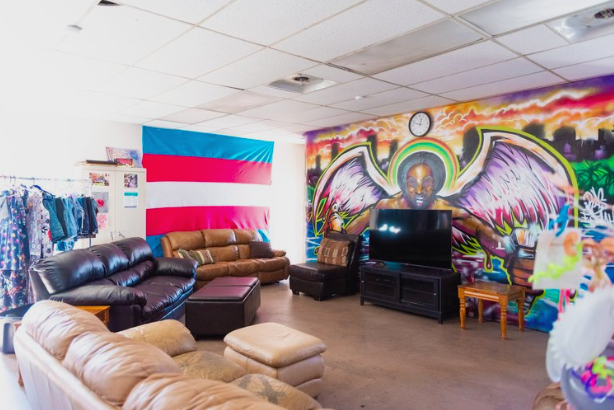
A room inside the Transgender Resource Center of New Mexico. Credit: TRCNM
The TGRCNM already offers “direct services” for trans people in need, including a drop-in center three days a week that provides showers, washers and dryers, prepared meals, an open donation clothes closet, a computer lab, a lending library, and workers who can help people access food benefits, healthcare (including STI testing, needle-exchange, and mental health counselors), legal services, as well as housing and employment assistance.
The center also offers statewide services, including assisting with name changes on government ID documents, providing trans body shaping items (like binders and gaffes), an online directory and referral for trans-friendly healthcare providers, a support program for incarcerated trans people, and also nine weekly in-person and online support groups for trans people of color, children, parents, partners, and others who live inside and outside of the state.
“We have grown so much since we started in 2007, but one of our challenges remains finding and sustaining the funding to do the statewide work that we set out to do here,” Lawyer says.
Trimm agrees.
“New Mexico isn’t the most resourced state, yet we are offering the most protections for folks,” he says. “Funding would allow us to further serve the people already in our state, who may be unintentionally harmed by the influx of [transgender and non-conforming] refugees who come to the state, occupying housing, which raises market rent for everyone.”
Lawyer says TGRCNM’s immediate mission is “to not let people die here in our local community,” but he adds that the Center doesn’t just “want to just be trying to patch up people’s bullet holes with band-aids all the time” either. The Center wants to keep shifting the state’s culture towards valuing trans lives.
Doing this requires progressive legislation to ensure that trans people will be able to thrive in peace throughout the state. Recently passed legislation has made New Mexico “the safest state in the country for LGBTQ people,” according to Marshall Martinez, executive director of Equality New Mexico.
This year alone, New Mexico passed House Bill 207, which added gender identity to anti-discrimination and hate crime laws; House Bill 31, which made it easier for trans people to legally change their names; House Bill 7, which forbids anyone from restricting access to reproductive and gender-affirming health care; and Senate Bill 13 is a “shield law” that forbids the government from assisting with any out-of-state investigations into people who provide or receive such care.
The latter two laws are especially important since Texas and other states have threatened to prosecute doctors and parents for “child abuse” if they help kids access such care. Similar laws also threaten anyone who assists in obtaining an abortion.
Martinez says New Mexico’s trans-inclusive laws passed thanks to a strong, cooperative coalition consisting of Equality New Mexico, the TRCNM, local Planned Parenthood affiliates, the American Civil Liberties Union (ACLU), the reproductive justice organization Bold Futures New Mexico, the healthcare access advocacy group Strong Families New Mexico, and a “ton of other groups.”
The coalition’s organizations regularly communicate with each other every day, he says. Throughout the year, they make sure one another’s issues are represented at meetings with community and political leaders across the vast state. Each organization also uses its pre-existing relationships with legislators to educate lawmakers about one another’s key issues, gradually introducing leaders to lawmakers over time.
These groups all share a common enemy, Martinez notes: conservatives who hate LGBTQ+ people — they’re the same ones who want to dictate people’s medical decisions, he says. As such, it made sense for the coalition members to support healthcare legislation that bundled abortion access with access for gender-affirming care.
“These are the only two health care procedures being criminalized,” Martinez says. “At the end of the day in New Mexico, either you believe that a patient can make decisions about their health care and their body or you don’t. And if you believe that, then you must believe it about everything.”
“Liberation is bodily autonomy, and bodily autonomy is the same regardless of whose body it is and what decisions you’re trying to make,” he continues. “The ability to decide whether or not I take hormones to transition my gender is equally as important as the decision I or my partner or sibling may make about having or not having children…. [It’s] the same level of bodily autonomy as being able to sue the cops when they harm you [or] violate your civil rights… which is the same as being able to make an adult decision about using cannabis.”
Under this reasoning, the coalition has helped pass other progressive laws, including ones that will enable residents to purchase a state health insurance option, enable cannabis entrepreneurs of color to benefit first from legalized sales, remove “qualified immunity” protections from abusive cops, and repeal older anti-abortion and anti-sodomy laws. Martinez doesn’t see these all as individual policy changes so much as the victories of a movement that has been successful on multiple fronts.
Granted, New Mexico’s Democratic-leaning electorate differentiates it from other states in ways that could make this strategy difficult to replicate elsewhere. New Mexico has a pro-LGBTQ+ governor, Michelle Lynn Lujan Grisham (D), and its legislature has been controlled by Democrats for almost all of the last 30 years. Its population of just over two million — 30% of which is non-white, including 21 indigenous sovereign nations — has helped Democratic presidential candidates win seven of the last eight elections.
I am deeply honored and humbled to continue serving our beautiful state as governor of New Mexico.
As I begin my second term, I will continue doing the work to ensure that the next fifty years are the greatest and most prosperous in New Mexico history – progress is our destiny. pic.twitter.com/0PPKDpHLAS— Governor Michelle Lujan Grisham (@GovMLG) January 3, 2023
But Martinez says the state’s progressive victories at least disprove the idea that religious people of color are among the most conservative. “It has proven to be incredibly untrue amongst Hispanic, Latino, and indigenous Catholics across the country,” he says.
“People in New Mexico have been learning how to live with people of different cultural and religious values and backgrounds for 200 years,” he adds. “And at the end of the day, our values have always been that we love accept and affirm our neighbors, even when we don’t understand or agree with.”
He encourages advocacy organizations in larger states not to operate from a territorial and scarcity model, one that sees other progressive causes as a potential drain on an organization’s resources or influence. In New Mexico, he says, progressive groups inquire about one another’s legislation, asking how each can help apply equal pressure on legislators over a wide range of issues. Over the years, such coalition building has made it so that New Mexican lawmakers don’t pursue bad laws, he says.
It’s likely that the state’s trans protections will eventually be legally challenged by conservatives either inside or outside of its borders. But Martinez remains confident that the laws will withstand legal challenges, especially with a broad coalition supporting them.
“We’re not doing something radically new by protecting trans people,” he says. “We’re doing what we’ve always done, which is protect people from hatred and discrimination because that’s a New Mexican value.”
Shortly after announcing his 2024 presidential campaign, Florida Gov. Ron DeSantis (R) went on Fox News and showed everyone how obsessed he is with transgender people.
“How would you address the ongoing war in Eastern Europe between Russia and Ukraine on day 1 of a Ron DeSantis presidency?” host Trey Gowdy asked.
He also said LGBTQ stands for “Let God burn them quickly.”
“First, I think what we need to do as a veteran is recognize that our military has become politicized. You talk about gender ideology, you talk about things like global warming that they’re somehow concerned, and that’s not the military that I served in,” DeSantis responded, saying absolutely nothing about Ukraine, where almost no American troops are serving. Even if the issue were primarily about U.S. military involvement, “gender ideology” would have nothing to do with anything.
But responding to the question is never the point in these campaign interviews; getting out one’s campaign soundbites is. And the military being too pro-trans (and also pro-gay and anti-racism, according to Florida Republicans) is the talking point he wanted to get out there to show that he, too, would be willing to ban trans people from serving openly in the military, just like his top rival Donald Trump did in 2017.
DeSantis isn’t the only one who is trying to work transphobia into places where it makes no sense. Yesterday, former Trump administration official and 2024 candidate Nikki Haleymade nasty comments about transgender influencer Dylan Mulvaney, blaming her for teen girls considering suicide. There is nothing to tie Mulvaney to teen suicide rates, but no one cares about facts when they’re trying to stoke a moral panic.
“Everybody knows about Dylan Mulvaney? Bud Light, right?” Haley told an audience of New Hampshire business leaders who were probably there to hear what she had to say about business and not Instagram videos. She was met with silence. “Make no mistake. That is a guy, dressed up like a girl, making fun of women. Women don’t act like that. Yet everybody’s wondering why a third of our teenage girls seriously contemplated suicide last year?”
Both Haley and DeSantis are facing an uphill battle against Trump, who is currently the top choice of over half of Republican primary voters. They have to stand out somehow instead of being one of a dozen not-Trumps – how most GOP primary candidates failed in 2016 – and they’re betting that outrage against the very existence of transgender people is how to do it.
After two years of hundreds of anti-trans bills being considered in state legislatures across the country – including bans on trans people participating in school sports, trans people being called by the correct names and pronouns, and trans youth getting gender-affirming health care – and two years where anyone flying a rainbow or a trans Pride flag risked getting labeled a “groomer” or a “pedophile,” people can be forgiven for forgetting that, as recently as 2020, anti-trans activists were trying to get the attention of the Republican Party to make transphobia a campaign issue.
That was where the country was in the middle of the pandemic. In August 2020, Terry Schilling’s small and relatively unknown anti-LGBTQ+ organization American Principles Project was forced to run its own anti-trans ads in several campaigns in an attempt to get the Trump-Pence campaign and the national Republican Party to even think this was an issue worth mentioning.
That’s not to say that Trump was pro-trans equality; his administration repeatedly attacked transgender rights as well as LGBTQ+ rights more broadly every chance they got. But they didn’t think that it was the top vote-getting issue last time around, the one issue to bring up at every campaign stop to rile up the base and get swing voters into the GOP camp.
Trump himself has been talking more about trans people at his campaign stops this past year, calling out “the perverted sexualization of minor children,” a Republican expression that covers any form of support for LGBTQ+ people.
Mike Pence, another likely 2024 candidate, has also been making transphobia a bigger part of his not-yet-a-campaign, telling people at events in Iowa that he’ll stop the “radical gender ideology” that has “invaded our schools, our colleges, and our workplaces.” Just two days ago, in an interview with Scripps News, Pence brought up his opposition to trans rights and promised to implement a ban on trans people in the military and a national ban on gender-affirming care for trans youth, saying that he would campaign on the military ban if he runs in 2024.
Even South Dakota Gov. Kristi Noem (R), who hasn’t announced her 2024 campaign yet and is speculated to be trying to get the VP slot on Trump’s ticket, ran a national ad in early 2022 touting her opposition to trans rights. “In South Dakota, only girls play girls’ sports. Why? Because of Governor Kristi Noem’s leadership,” the ad told the nation, even though she was officially just running for reelection as governor then.
The 2004 presidential election was historic in its homophobia. George W. Bush and other Republicans saw marriage equality as the top issue that could drive Evangelicals to the polls. Harold Meyerson of the American Prospect said that the GOP saw”the specter of gay marriage as a political gift from the gods.”
Twenty years later, it looks like they’re making the same bet with the basic humanity of transgender people. The Republican primary – when it’s not just Trump dunking on the other candidates who will be too afraid of his supporters to respond in kind – will be full of outlandish stories about schoolteachers secretly performing gender-affirming surgery on kids in restroom stalls, student-athletes with arms “30 feet long” setting world records in middle school, and hypnotic children’s cartoons making little boys wear dresses.
And when the primary is over, the winner will go on to attack President Joe Biden’s record of supporting trans equality through executive orders, rules, and guidelines as well as lawsuits in his first four years in office.
A new study from a market research firm in Austin, Texas reveals where in the U.S. the most people are questioning their sexuality.
The unlikely answer is ruby red, religiously conservative Utah, a finding that earns the Mormon enclave the title “most closeted” among the 50 states and the District of Columbia.
This year, the state has become an epicenter of Republican-fueled anti-LGBTQ+ vitriol.
“The evolution of social attitudes around sexual orientation and gender identity over the last two decades has been profound,” Cultural Currents Institute writes in a memo accompanying the study, which examined Google Trends data from 2004 to 2023.
The deep dive uncovered “a staggering 1300% increase in specific searches that may indicate that a user is questioning their sexual identity.”
CCI mined data for five search terms: “am I gay,” “am I lesbian,” “am I trans,” “how to come out,” and “nonbinary,” finding a significant upward trend among all the terms, with the results in some states more pronounced than others.
The top five states for “am I gay” were Utah, Iowa, Indiana, West Virginia, and New Hampshire.
Utah, a red state with the country’s largest Mormon population, topped the search list for three of the terms: “am I gay,” “am I lesbian,” and “am I trans.”
The state’s top spots “might indicate a significant underlying questioning of identity among its internet users,” writes CCI, “possibly driven by the conflict between personal feelings and societal expectations.”
The firm describes this tension as “common” in Utah, where recent data revealed a surge in searches for “VPN,” an internet workaround employed after the website PornHub was blocked in the state.
Total search volume for the five terms combined shows a remarkable jump in the last two years, coinciding with the far-right’s campaign targeting the LGBTQ+ community with legislative bans on gender-affirming care, drag performance and other discriminatory measures, and efforts of groups like Moms for Liberty, LibsofTikTok and Gays Against Groomers directed at school boards, libraries and local governments.
Utah was the first state to ban gender-affirming care for trans youth in 2023. The law is on hold pending a court challenge.
The top five states for the search term “am I lesbian” were Utah, Connecticut, Kentucky, Washington, and Colorado.
“Am I trans,” was most popular in Utah, Kentucky, Colorado, Michigan, and Washington.
A collection of five deep red states topped the list for the search term “how to come out,” including Oklahoma, West Virginia, Mississippi, Louisiana, and Kentucky, a result that “could indicate a more challenging environment for self-disclosure of identity,” according to the study authors.
The search for “nonbinary” yielded a broader ideological mix of states, including Vermont, Oregon, Maine, Montana, and Washington.
Florida Governor Ron DeSantis has earned his state a rare reprimand from the leading civil rights organization, NAACP. It took the unusual step of issuing a warning to Black people thinking of visiting the sunshine state.
The move comes after DeSantis signed a law last week that prohibits colleges from using public funding for anything relating to diversity, equity and inclusion. This follows the Florida Department of Education earlier this year rejecting an Advanced Placement (AP) African-American studies course. It’s understood the board objected to a ‘queer studies’ component to the course.
DeSantis also signed off the Stop WOKE Act. It limits how race can be discussed in workplaces and schools during required training or instruction.
Of course, this follows DeSantis promoting and signing off the notorious ‘Don’t Say Gay’ legislation for schools last year.
The NAACP advisory is a “direct response to Governor Ron DeSantis’ aggressive attempts to erase Black history and to restrict diversity, equity, and inclusion programs in Florida schools.”
“Under the leadership of Governor Desantis, the state of Florida has become hostile to Black Americans and in direct conflict with the democratic ideals that our union was founded upon,” NAACP states.
It continues, “Florida is openly hostile toward African Americans, people of color and LGBTQ+ individuals. Before traveling to Florida, please understand that the state of Florida devalues and marginalizes the contributions of, and the challenges faced by African Americans and other communities of color.”
The Florida chapter of the NAACP had previously issued its own advisory and requested the national group to do the same.
Equality Florida also issues warning to travelers to Florida
The NAACP’s travel warning follows a similar one issued last month by Equality Florida.
“As an organization that has spent decades working to improve Florida’s reputation as a welcoming and inclusive place to live work and visit, it is with great sadness that we must respond to those asking if it is safe to travel to Florida or remain in the state as the laws strip away basic rights and freedoms,” said Nadine Smith, Equality Florida Executive Director.
Last week, Disney pulled a rumored $1billion investment from Florida. It was set to build a new office complex in Orlando that would have brought 2,000 jobs to the district. In an email to employees, Josh D’Amaro, Disney’s theme park and consumer products chairman, blamed, “changing business conditions”.
Many interpreted this as a reference to Disney’s ongoing feud with DeSantis. He has criticized the organization for coming out against his ‘Don’t Say Gay’ law.
Pundits say DeSantis will announce his long-expected bid to become the GOP Presidential nominee this week.
The LGBTQ+ organization Human Rights Campaign (HRC) kicked Bud Light parent company Anheuser-Busch off the top of its corporate equality index (CEI), citing the company’s tepid response to the Dylan Mulvaney backlash.
“When we saw the company working with Dylan, that was a good sign. It was a sign of inclusion,” HRC senior vice president of programs, research, and training Jay Brown told CNN. “What we were really disturbed by was the company’s reaction once the backlash started happening.”
There are approximately 3 million Dashers who are the public face and main workforce of DoorDash who are not considered in the CEI because DoorDash doesn’t consider them employees.
On April 1, Mulvaney posted a 50-second video to Instagram showing off some custom Bud Light cans with her face on them, a part of a brand partnership with the beer company.
But Anheuser-Busch’s weak response to the backlash led to anger among LGBTQ+ people as well. The company released a statement in April saying that it “never intended to be part of a discussion that divides people… We are in the business of bringing people together over a beer.” And Anheuser-Busch CEO Michel Doukeris downplayed the partnership on a call with investors this month, saying: “We will continue to learn, meet the moment in time, all be stronger and we work tirelessly to do what we do best: Bring people together over a beer and creating a future of more cheers.”
Meanwhile, Mulvaney said she was “having trouble sleeping” after becoming the target of so much hatred for the past month and a half, leading to criticism that Anheuser-Busch left her out to dry. Some LGBTQ+ people – including Colorado Gov. Jared Polis (D) and several bars in Chicago – have been boycotting Anheuser-Busch as a result of their response to the controversy.
And now HRC is jumping into the fray.
HRC’s Brown said that the beer company’s lackluster response couldn’t have come at a worse time, as transgender equality is being targeted in state legislatures across the country. He said that he asked Anheuser-Busch to at least release a statement in support of Mulvaney and transgender people, offer inclusion training to executives, and listen to LGBTQ+ employees, but the company hasn’t done any of those things. In fact, two of the marketing executives who worked on the Mulvaney partnership have been put on leave, which many on the right are claiming as a victory of their Bud Light boycott.
After asking to at least talk to someone at the company, Brown sent a letter informing Anheuser-Busch that they were losing their 100% rating on CEI, which rates the “Best Places to Work for LGBTQ+ Equality.”
HRC has been maintaining the CEI since 2002, when it rated policies for gay, lesbian, and bisexual employees, and has expanded it in the last two decades to include evaluations of transgender employee policies, partner benefits, and how a corporation supports an inclusive culture outside of its own workplace.
HRC gave a 100% rating to the Fox Corporation until last year when it got demoted due to Fox News’s coverage of LGBTQ+ issues.