Marsha P. Johnson — a towering figure in the Stonewall Rebellion — would have celebrated her 77th birthday this week. Johnson was an outspoken advocate for gay and trans rights, and the “P” in her name stood for “Pay it no mind” — her response when asked about her gender.
In honor of the late activist’s birthday, the Blade sat down with Elle Moxley, founder of the Marsha P. Johnson Institute, to discuss how Johnson’s legacy lives on.
BLADE: When and why did you found the Marsha P. Johnson Institute?
ELLE MOXLEY: The Marsha P. Johnson Institute launched in 2019, and my founding of the organization was in response to the consistent murders that were being reported of Black trans women across the country. I have spent many years working as an organizer and activist, and I saw that there was a gap in social justice spaces — in terms of the solutions that were being generated in response to those murders, but also to the systemic and structural violence that existed around Black trans people and Black people period.
The organization was named in honor of Marsha P. Johnson to affirm the movement that Marsha spearheaded and to create a space where the movement of today had a place to live, without disregarding the history of so many that came before.
BLADE: Can you tell me about the spirit of Marsha P. Johnson that you see in the Institute?
MOXLEY: The fight for equity is something that we see as an evolvement of Marsha’s belief in equality, and we recognize that Marsha was very visible in a movement that did not always reflect faces that looked like hers, in terms of what we understood about LGBTQ rights or LGBTQ people. Knowing that Black trans people exist outside of our deaths and outside of our murders is really where we see the evolvement of our work at the Institute, but that evolvement would not even be possible if Marsha had not made herself visible on the front lines of her activism. It is in that regard where we see ourselves very much mirroring a model that she created for the movement, and we have certainly held up the torch and are carrying it forward.
BLADE: The Institute’s Starship Artists Fellowships are set to begin soon — what are your hopes for the new program?
MOXLEY: With all of our new programming, it really is our hope that we are changing the culture of global societies — that we are not only making Black trans people visible, but we’re making the full humanity of our existence visible. The artists’ fellowship was created to pay homage to the visionaries that exist in the Black trans community. There’s a Black trans renaissance that certainly is underway, and we want to continue to support that function of movement. A lot of people assume that movement is literally about protesting — and that certainly is a big part of it — but there are other ways that you can resist but also practice your joy. We really want it to mirror that Black trans people are joyful — we have joy, and murder is not the only thing we expect to happen to us. Our artists’ fellowship creates space for artists to imagine a bigger picture, a bigger world, for Black trans futures.
I am an artist myself, so that was also a big part of it. Activism is something that Black trans people often have to choose to survive, and we are mad and angry about our circumstances, but we actually are people who have other dreams and desires outside of just fighting for our lives. Marsha P. Johnson again served as an amazing model for movement — her participation in street art and in theater troupes is a reflection of the joy that so many people find outside of their activism.
BLADE: In honor of Black Philanthropy Month and Black August, are there any understudied or underreported causes and freedom fighters that people should be more aware of?
MOXLEY: Just several weeks ago, we lost one of the most important freedom fighters and political prisoners of our time — Albert Woodfox, who was held in solitary confinement for 44 years, the longest solitary confinement in U.S. history. I would say that Black August is always an opportunity for people to understand the structural inadequacies that exist not only in prisons, but in the world. It’s real people who are being housed in prisons, and I say real people because the atrocities of life are often happening to the people who are in cages. I think Black Philanthropy Month creates a space for more investments to happen to organizations who are leading the fight against the apartheid and the segregation that certainly exist in America.
To celebrate the freedom fighters of our time, we are uplifting Black trans freedom fighters who have given their lives to movement, who have given their lives for others. And that’s happening in and outside of prisons — those who are on the inside of prisons are always still advocating for the people in the communities that they believe in, and we are so grateful and thankful to those folks.
BLADE: It seems like most of the recent news about reproductive rights and trans rights has been dismal. Are there any bright spots on your radar, in terms of legislative progress on these issues?
MOXLEY: Anytime a human right is interrupted or taken away, it is such a negative for so many people who are looking for legislation that gives them hope. I will say that I’ve just been hopeful about the future of democracy and of our humanity. I think there are so many activists who have been activated to lead to more generative resolutions around legislation, especially when we think about piecemeal legislation actually being the thing that’s being abolished. That’s the beautiful juxtaposition of what happens when we lose a law — the thing about laws is that they can go away, and they can always return.
If we lean into the positive, we have an opportunity to create more than we originally started with. And that’s the thing that gives me so much hope — we can create more foundational legislation that accounts for the human rights of all people and not just a specific kind. With reproductive justice being at the center of so many of our political conversations, what we are seeing is an expansion of what reproductive justice means and who reproductive justice applies to. And that is what gives me great hope, that we will now be able to account for more than just the abortions of trans men, that we’ll be able to think about the reproductive rights of Black trans women and nonbinary people in ways that we’ve never been able to consider before.
Saint Kitts and Nevis’ colonial-era law banning same-sex relations has been struck down in a “historic moment” for the Caribbean country.
On Monday (29 August), the Eastern Caribbean Supreme Court struck down sections 56 and 57 of the Offences Against The Person Act which banned the “abominable crime” of “buggery”.
The law carried a maximum penalty of 10 years with hard labour.
While no evidence showed the longstanding provisions had been enforced in recent years, it seemingly justified the discrimination and violence LGBTQ+ Kittitians and Nevisians face due to societal stigma and shame.
Judge Trevor Ward overturned the parts of the act that criminalised “unnatural offences” and compared them to “bestiality”, which he said was unconstitutional.
He wrote in his judgment: “The absolute nature of the prohibition created by sections 56 and 57 are not reasonably justified in a democratic society in circumstances where they proscribe sexual acts between consenting adults in private, which involve no element of public conduct or harm to, or sexual acts, with minors.”
“To the extent that it criminalises the private lives of gay persons in this year, the law is excessive and arbitrary,” he continued, adding that the sections “fail to meet the constitutional qualification of being … in the interest of public morality.”
Ward added: “Section 56 of the act shall be read as if the words ‘This section shall not apply to consensual sexual acts between adults in private’ were added at the end of the section.”
The court’s verdict immediately went into effect.
“This is a transformative journey and a step to full recognition of LGBTQ persons across the Organisation of Eastern Caribbean States,” Kenita Placide, executive director of the Eastern Caribbean Alliance for Diversity and Equality (ECADE), said.
“An affirmative decision means a yes to privacy and a yes to freedom of expression.”
Jamal Jeffers, a gay man, brought the constitutional challenge in January 2021 arguing that sections 56 and 57 breached constitutional rights to freedom of expression and privacy, and should be made null and void.
Joined by advocacy group St Kitts and Nevis Alliance for Equality, the claimants sought orders for same-sex acts to not be an offence if committed privately between “persons 16 years of age or more”, their motion read.
Saint Kitts and Nevis were among the first islands in the Caribbean to be colonised by the British, bringing with them centuries-old laws that outlawed homosexuality.
Section 56 read: “Any person who is convicted of the abominable crime of buggery, committed either with mankind or with any animal, shall be liable to be imprisoned for a term not exceeding ten years, with or without hard labour.”
Former British colonies Barbados, Dominica, Guyana, Grenada, Jamaica, St. Lucia, and St. Vincent and the Grenadines all have similar buggery laws in the books.
“We are witnessing a historic moment in the Caribbean in which antiquated, colonial-era laws are being challenged and struck down,” said Maria Sjödin, executive director of global LGBTQ+ rights group OutRight Action International.
“We are awed by the strategic persistence of activists in the region who are leading the charge to ensure that human rights are advanced and that discriminatory, outdated law like this is overturned. Hopefully, the remaining countries in the region and beyond will follow.”
The cost of living crisis is forcing queer young people out of safe homes and into potentially dangerous situations.
The economic crisis is hitting young people in the UK especially hard as landlords demand higher rents and inflation hits more aspects of everyday life.
Melissa Gilpin, marketing and communications manager at LGBTQ+ youth homelessness charity akt, told PinkNews the looming crisis is “undoing years of work” in helping young people at risk of homelessness – especially trans youth.
The cost of living crisis is “pushing” many queer youth “out of safe spaces” because they “can’t afford rent in private housing”.
“If you’re under 35, the government can give you £300 a month in Manchester towards rent, and you’re supposed to be in shared housing,” Gilpin said. “But at the moment, rent can be up to £600 to £1,000. Where are you getting the rest of the money – especially if you factor in that unemployment is a massive issue?”
Gilpin said akt has seen young people being “pushed further away from their support networks and communities” as a result of the cost of living crisis and lack of trans-friendly housing. While many couch surf, there is a concern that some queer youth could be forced to return to unwelcoming family homes.
“A lot of parents [of these young people] say: ‘You can move back home, but you’re not allowed to out as trans or as queer,’” Gilpin said.
“Trans youth get rejected from a lot of housing, like for instance single-sex or women’s-only hostels,” Gilpin added. “They then don’t accept trans women, which is an issue anyway.”
LGBTQ+ groups have condemned EHRC guidance excluding trans people from separate or single-sex spaces. (Getty)
It went on to say that such spaces – which include single-sex or separate toilets, refuges, changing rooms or hospital wards – can “prevent, limit or modify trans people’s access to the service” if it achieves a “legitimate aim”.
Gilpin said trans youth are being rejected a “lot more often” since the guidance was issued and that there is a lack of hostels that are trans-friendly to begin with.
Many young trans people are forced to “choose between eating and getting gender-affirming care” due to lack of funding.
LGBTQ+ advocates have protested against the Tory government’s rollback on promises to the queer community and long waitlists for gender-affirming healthcare via the NHS. (Getty)
Increasingly, trans people are accessing such healthcare privately and crowdfunding for affirming treatments due to the years-long waitlists through the NHS.
“For trans youth, getting gender-affirming services and care is a huge priority for how they spend their money,” Gilpin said. “At the moment, they’re not able to afford hormones so a lot of people are choosing between eating and getting hormones.”
She added: “We’re seeing this at the moment where people are having to come off their hormones because they need to pay their bills, and this triggers huge gender dysphoria and mental health issues.
“They have no way to budget for the future. This is undoing a lot of their gender-affirming care they’ve been putting their money into which became a cycle of maybe substance abuse, having breakdowns, getting back onto the street and getting into sex work to be able to afford hormones again.”
Gilpin said the charity is only able to do “contingency planning” at the moment. As such, akt is seeking help from the public to support LGBTQ+ youth impacted by the lack of government support and the cost of living crisis.
“The barriers to accessing safe, affordable housing for queer trans youth are exasperated a lot more by the cost of living crisis, but the barriers existed before that and affect trans people a lot more because it’s harder for them to find jobs, get into any space or housing,” Gilpin said.
Gilpin added it was “nearly impossible” at the moment for trans youth who are “rejected by their family to get into long-term safe, private housing” given these barriers.
She said it was essential for the Tory government to commit to a strategy to end homelessness and include a “specific call out to queer youth” within it.
“They can’t just be lumped in with the homelessness population because they have specific needs to access housing and employment services,” she said.
Anti-LGBTQ users on 4chan targeted the Trevor Projects suicide prevention services on Tuesday in an effort to prevent LGBTQ youth from getting help.
In a post on the notorious platform’s “Politically Incorrect” imageboard, an anonymous user posted a plan to bog down the nonprofit organization’s crisis hotline and online chatswith fake requests for help. The goal was to “f**k up the queue so sodomites and f*gs commit suicide,” to “demoralize the therapists,” and “waste as much of their resources as possible.”
According to The Daily Dot, the original thread appears to have been deleted, but it’s unclear whether it was removed by 4chan or the original poster. A second thread has been archived and was still visible on the site as of Tuesday evening.
Alex Kaplan, a senior researcher at progressive media watchdog org Media Matters for America, posted screenshots of the original post and responses from trolls sharing screenshots of their chats with Trevor Project councilors.
One 4chan user posted a screenshot from the Trevor Project’s online crisis chat saying that “wait times to reach a counselor are higher than usual.”
“The act of attacking a crisis services line intended to prevent suicide among young people is egregious,” the Trevor Project said in a statement. “Our crisis counselors work around the clock to be there for LGBTQ youth who feel like they have nowhere to turn, and it’s harrowing that anybody would attempt to compromise our lifeline or encourage suicide.”
“LGBTQ youth are at significantly increased risk for suicide—not because of anything inherent about their identities, but because of the stigma, bullying, violence, and discrimination that they face,” the Trevor Project said. “The incident of users on 4chan who maliciously planned to overtake our crisis lines today is exactly the kind of mistreatment and abuse that contributes to heightened suicide risk. Alarmingly, our research has found that every 45 seconds, an LGBTQ young person attempts suicide. Every second counts when you work in suicide prevention, and we strongly condemn this intent to obstruct our lines and create even more barriers for LGBTQ people who rely on our help. We are working diligently in the face of this disruption to protect our counselors and those youth who need us.”
The Trevor Project became a target of far-right trolls earlier this year when Chaya Raichik, who runs the influential anti-LGBTQ Twitter account “Libs of TikTok,” called the non-profit “a grooming organization” in a tweet that was later deleted. Other anti-LGBTQ organizations and pundits like Moms for Liberty and Lauren Chen followed suit, equating the Trevor Project’s outreach to LGBTQ teens in crisis with giving abusers access to children.
Texas has reported its first death of a person diagnosed with monkeypox.
The unnamed man lived in Harris County, the state’s largest county, containing Houston and several nearby suburbs. He was also “severely immunocompromised,” the Texas Department of State Health Services said in a statement issued on Tuesday. The statement provided no other identifying information about the man.
“The case is under investigation to determine what role monkeypox played in the death,” the department wrote.
In a Tuesday White House press briefing, Dr. Jennifer McQuiston with the Centers for Disease Control and Prevention (CDC) expressed sympathy for the man’s passing, and said that the CDC will also conduct an inquiry into the conditions that contributed to the man’s death. She also warned against panicking about other possible monkeypox-related deaths.
“I think it’s important to emphasize that deaths due to monkeypox, while possible, remain very rare,” McQuiston said. “In most cases, people are experiencing infection that resolves over time. And there have been very few deaths even recorded globally. Out of over 40,000 cases around the world, only a handful of fatalities have been reported.”
In mid-August, the World Health Organization (WHO) reported that there had been 12 deaths of people infected with monkeypox worldwide. Health authorities have urged men who have sex with men (MSM) to get vaccinated against the illness, to reduce sexual partners, and to get tested and quarantine if they experience any symptoms.
The briefing also confirmed that the White House is continuing its strategy of making vaccines and mobile testing facilities available to communities ahead of scheduled public events that are popular with MSM, such as Atlanta Black Pride and Southern Decadence in New Orleans, Louisiana.
“[It’s] a great opportunity to get folks ready for the event in terms of getting some vaccines on the ground early, but also, a great opportunity to reach people who won’t go to a clinic or a vaccine effort, but will feel comfortable in, frankly, less stigmatizing spaces that can occur in the events,” Dr. Demetre Daskalakis, the White House National Monkeypox Response Deputy Coordinator, said.
On Monday, the Department of Health and Human Services (HHS) announced $11 million in funding to domestically produce the Jynneos smallpox vaccine in Grand Rapids, Michigan. The vaccine is being used to limit monkeypox’s spread.
Previously, the global supply of the vaccine came entirely from a tiny company in Denmark called Bavarian Nordic whose distribution had been hampered by a company’s lab renovation and supply chain disruptions.
President Joe Biden declared a national state of emergency for monkeypox in early August. The WHO also declared monkeypox a Public Health Emergency of International Concern in late July.
In late August, the U.S. Food and Drug Administration approved the vaccine to be administered intradermally in order to stretch out the supply of available vaccines. The intradermal method could stretch the nation’s vaccine supply fivefold and has been found to be effective when vaccinating against rabies and polio.
The Biden administration on Tuesday announced plans to expand the response to the monkeypox outbreak by providing vaccinations and education at large LGBTQ-centered events around the country following a recent pilot program carried out in Charlotte, N.C.
Demetre Daskalakis [photo], deputy director for the White House’s national monkeypox response, stated during a briefing that the administration was aiming to make its response more “intentional and targeted.”
“Given the progress we’ve made toward making the tools available to end this outbreak, our vaccine strategy is to meet people where they seek services, care or community — especially in communities of color. We know that Prides and other large LGBTQI+ focused events can do just that,” Daskalakis said.
Read the full article. Last year Daskalakis was a grand marshal for New York City Pride.
In March of 1947, a Florida court ordered the Ha Ha Club — a nightclub famous for its “female impersonators,” as they were called at the time — to close after declaring it a public nuisance.
The order came just a month after Frank Tuppen, a juvenile probation officer with political ambitions, filed a complaint against the venue. He argued that the club’s performers were “sexual perverts” who had embedded “in the minds of the youngsters” who lived in the area “things immoral” and were “breaking down their character.”
The owner of the club, Charles “Babe” Baker, appealed to the Florida Supreme Court, but in October 1947, it affirmed the lower court’s decision that the club was a public nuisance. “Men impersonating women” in performances that are “nasty, suggestive and indecent” injure the “manners and morals of the people,” the court ruled.
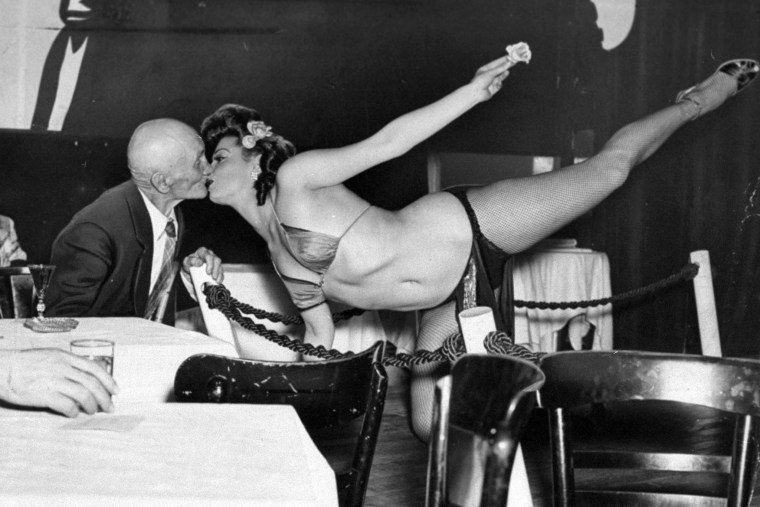
Andrea Kinig at the Ha Ha Club in New York City. Herb Breuer / NY Daily News via Getty Images
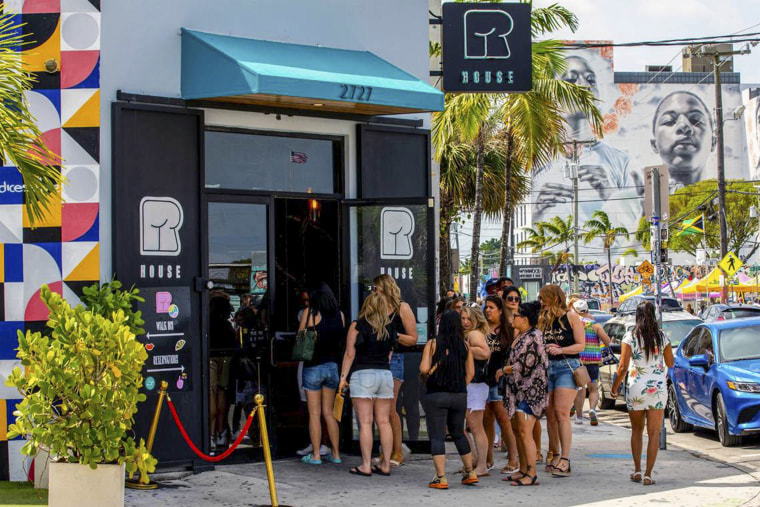
Last month, nearly 75 later, Florida Gov. Ron DeSantis, a Republican who is widely thought to be eyeing a 2024 presidential run, cited the case that shut down Ha Ha Club in a complaint against Miami restaurant R House over its drag performances.
The 2022 complaint, filed by the Florida Department of Business and Professional Regulation, threatened to revoke R House’s liquor license, arguing that the establishment violated a state public nuisance law by becoming “manifestly injurious to the morals or manners of the people.”
Historians say the parallels between the R House and the Ha Ha Club complaints, and the fact that DeSantis’ administration cited a 75-year-old court decision, reveal how conservatives are resurfacing a decades-old moral panic about LGBTQ people to target queer spaces.
‘Seeding America with queer consciousness’
Baker first opened the Ha Ha Club in April 1933 in New York City’s Midtown Manhattan neighborhood, where it became “Broadway’s favorite hangout spot,” said Michail Takach, who researched the Ha Ha Club for a book he co-authored, “A History of Milwaukee Drag: Seven Generations of Glamour.”
Later that year, Baker traveled south and opened the club in Hallandale, Florida, about 13 miles north of R House, which is in Miami’s Wynwood neighborhood. He opened the club toward the end of the so-called Pansy Craze, which was a time period when drag surged in popularity, particularly in cities, Takach said.
Same-sex sexual relations were illegal at the time in most states, and cross-dressing was criminalized in many cities, though Miami never officially had an anti-cross-dressing law on the books. As a result, Takach said clubs like the Ha Ha Club catered primarily to seemingly straight, cisgender audiences, because drag drew attention and could be a liability to club owners.
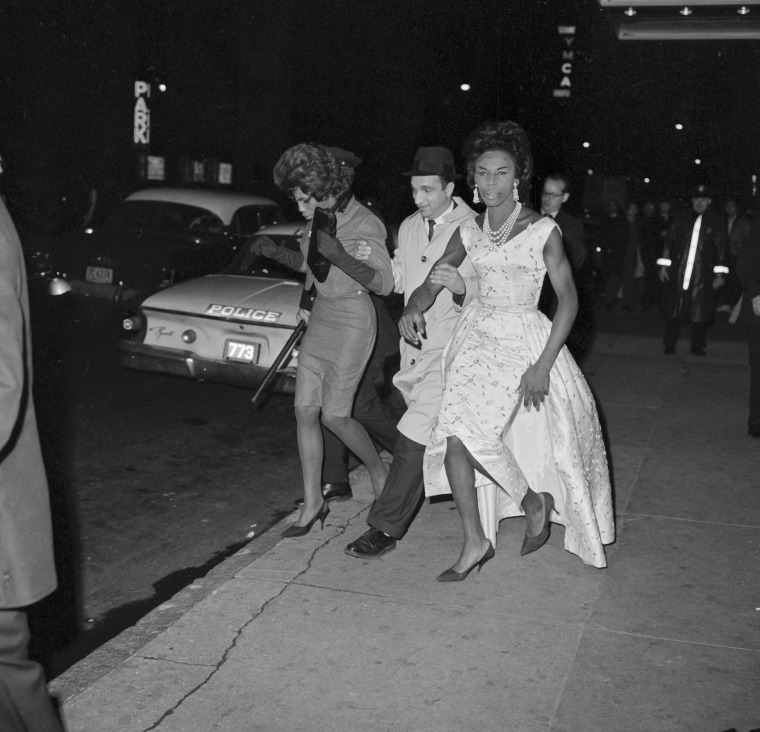
Dozens of men dressed as women were locked up on charges of masquerading and indecent exposure at the National Variety Artists’ Exotic Carnival and Ball held at the Manhattan Center in 1962. Bettmann Archive / Getty Images
However, Takach wrote in his book that female impersonator clubs offered gay and gender-nonconforming men that performed at these venues “a safe sanctuary where they could not only embrace their identities but make a name for themselves.”
In Baker’s court testimony, he described how he stood at the club’s door every night and greeted all of the guests. The club held three shows from 9 p.m. to 4 a.m., with more than 40 performers who sang, danced and told jokes, according to court documents.
Baker featured some of the most famous female impersonators, including Jackie Maye, whose wardrobe was estimated at the time to have been worth $50,000, Takach said, which would be worth over $1 million in today’s dollars.
His production was also a traveling show, called the Ha Ha Revue, which was inspired by the Jewel Box Revue, a famous touring company of female impersonators — and the first racially integrated drag revue in the country — that operated from 1937 to about 1960, according to Takach’s drag history book.
The traveling version of the Ha Ha Club’s show and the Jewel Box Revue “really did a solid job of seeding America with queer consciousness,” Takach said. “And you have to wonder how much of that played into the gay liberation era — how many children that went to these shows, how many adults that watched these shows, were later part of the gay liberation scene.”
The shows brought queer representation to many cities across the U.S. at a time when gay people were being criminalized and also at a time when drag had fallen “violently out of favor,” Takach said.
“They brought it back in a big way and created a mid-century drag craze in the 1950s that, in some ways, is a parallel and a rival to the RuPaul drag craze of this decade,” he said.
‘A home of perverts, queers, phonies’
On Feb. 2, 1947, after operating his club in Hallandale for 14 years, Baker tried to stop a fight between two customers at the club and called the police. Both he and a customer were arrested for assault and battery, though Baker was never charged, according to court documents.
Just three days later, on Feb. 5, Tuppen — who was running for sheriff of Broward County in an upcoming election — filed his complaint against the club. He claimed multiple men he had arrested for having same-sex sexual relations said they frequented the Ha Ha Club.
James Lathero, the lawyer for the state, asked Tuppen what the general reputation of the Ha Ha Club is, and Tuppen said, “General knowledge, it is nothing but a home of perverts, queers, phonies.” Tuppen’s complaint also alleged that the venue had contributed to “juvenile delinquency” in the county that was “injurious to the manners and morals of the people” residing there.
Baker’s lawyers called more than half a dozen locals who testified that they enjoyed the club’s shows. Baker also testified that his cast had performed for a church and the Kiwanis Club and that it had raised money for the March of Dimes, a nonprofit organization that supports mothers and babies. He also denied that his club was associated with homosexuals and said there was no evidence of “crimes of perversion” at the club.
But the Broward County Circuit Court ultimately declared the Ha Ha Club a public nuisance and ordered it to close in the spring of 1947.
Baker appealed to the Florida Supreme Court, and one of his lawyer’s, Robert Lane, wrote in the appeal that there were no complaints against Baker’s club during its 14 years in business “until an aspirant for a political office decided to complain,” referring to Tuppen and his run for sheriff.
Lane also argued that “there are different views as to what may injure the manners and morals of the public.”
Get the Morning Rundown
Get a head start on the morning’s top stories.SIGN UPTHIS SITE IS PROTECTED BY RECAPTCHA PRIVACY POLICY | TERMS OF SERVICE
Despite Baker’s efforts, the Florida Supreme Court affirmed the lower court’s decision in October 1947.
“The lawful evidence presents a dirty picture; the Ha Ha Club looks as if it were a cross between a ‘honky tonk’ and a ‘speak easy,’” wrote Justice William Terrell, who later went on to defend segregation after the Supreme Court struck it down in Brown v. Board of Education. He added that the lower court determined that the Ha Ha Club’s “major connotations were evil, that it was exerting a corrupting influence and that the time had arrived to abate it.”
The case against the Ha Ha Club happened at a time when public support for drag had waned, because law enforcement and media nationwide claimed that gay people were a danger to women and children, Takach said.
“There was a very strong reaction to the liberation that people had felt, and the visibility that gay and lesbian people and gender-nonconforming people had earned during the Pansy Craze,” he said. “It led to many cities creating drag bans, shutting down drag clubs, banning female impersonation completely — silencing the queer nightlife and the queer representation that had really flourished during the Pansy Craze in the early parts of the 1930s.”
‘A cultural panic moment’
Last month, the Florida Department of Business and Professional Regulation alleged in its complaint against R House that a “nearly nude dancer was filmed parading a young girl through the audience” on or about July 3 and that the video ignited public outrage.
Inquired about it during a news conference, DeSantis said the video prompted the department to investigate further, “and what they found was not only were there minors there — and these are sexually explicit drag shows — the bar had a children’s menu. And you think to yourself: ‘Give me a break, what’s going on?’”
People wait in line for a Drag Brunch at R House Wynwood on April 9, 2022 in Miami, Fla. Daniel A. Varela / Tribune News Service via Getty Images
The complaint threatened to revoke R House’s liquor license and cited the Ha Ha Club case, noting that the Florida Supreme Court recognized that “men impersonating women” in the context of “suggestive and indecent” performances can constitute a public nuisance.
R House’s ownership said in an emailed statement last month that it is aware of the complaint and that it is working with the department through its attorney to “rectify the situation.”
“We are an inclusive establishment and welcome all people to visit our restaurant,” the email said. “We are hopeful that Governor DeSantis, a vociferous supporter and champion of Florida’s hospitality industry and small businesses, will see this as what it is, a misunderstanding, and that the matter will be resolved positively and promptly.” Ownership has not returned an additional request for comment.
There are multiple parallels between the Ha Ha Club case and DeSantis’ complaint against R House, historians said, revealing a cultural cycle.
Just as there was a public backlash to increasing queer visibility after the Pansy Craze, historians said conservatives are now pushing back against LGBTQ people winning major rights such as same-sex marriage.
But unlike in decades past, those who oppose LGBTQ equality cannot “attack gay people per se, so the people they attack are actually trans people or trans youth or drag queens, and then only in connection with children,” said Michael Bronski, a professor of women and gender studies at Harvard University and author of “A Queer History of the United States for Young People.”
Bronski called the backlash against drag today part of a “cultural panic moment,” and Takach said it’s happened throughout history in the U.S.
“People get drawn in by the glamor, and it’s a novelty,” he said of drag, “and then something happens, and the entire community turns on it.”
Maxx Fenning, the president and founder of Prism, a nonprofit that works to expand access to LGBTQ-inclusive education in South Florida, said the complaint against R House, like the one filed against the Ha Ha Club 75 years ago, shows how laws related to “public morals” can be used to disproportionately censor LGBTQ people and topics.
“This Florida Supreme Court case noted that men impersonating women is not in and of itself a verifiable offense, but it’s doing it in an indecent fashion,” he said. “You see very often this use of vague and subjective language to be able to create laws and rulings that seem common sense, but have just enough vagueness to be applied in ways that unnecessarily silence the queer community.”
As for the Ha Ha Club, Babe Baker didn’t shut down his performance after the club was forced to close. In fact, he moved it to about a mile away, to a club called Leon & Eddie’s, a nightclub first opened in New York City by Leon Enker and Eddie Davis and later moved to Miami.
He also started advertising in a “curious” fashion, Takach said. He placed ads in the Miami Herald that prominently featured the word “gay” in phrases like “gay laughs,” “gay surprises,” “gay faces,” “gay music” and “gay dancing.” Even though gay wasn’t widely used at the time to refer to queer people, Takach said Baker chose the word intentionally.
Prior to opening the Ha Ha Club in New York, Baker worked at the Howdy Club, which Takach described as “an unapologetic lesbian bar” and one of the first places in Manhattan to hire lesbians as entertainers and allow women to gather and drink without male company. Takach said it was raided by police regularly, and that the word “howdy” became synonymous code for queer.
The word “gay” similarly became a code in Baker’s newspaper ads, and the Miami Daily News caught on in 1952, Takach said. The paper criticized the Miami Herald, its competitor, for running ads for clubs like Baker’s on one page and then condemning the clubs in the Herald’s editorials. “The words ‘gay,’ ‘ha ha’ and ‘howdy’ have become beacons pointing to the hands of the perverts,” the Miami Daily News wrote, according to Takach.
Baker’s cast performed four times a night at Leon & Eddie’s, and they also went on tour across the country, selling out weeks of shows in cities including Milwaukee; Detroit; Dayton, Ohio; Minneapolis; and Spokane, Washington, Takach said.
“You could say that Broward County won the battle, but Babe Baker won the war.”
Did you read about the group of staid U.S. historians who just met privately with President Biden to warn him that U.S. democracy is teetering? They told him we’re closer to civil war and authoritarian rule than at any point in history since the 1860s.
Guess who knew that already? Queer people. Black people. Immigrants. Women. Politicians on the right are using us as punching bags, and violence is breaking out everywhere.
It’s not in our imaginations, and I’ll show you the data in just a minute to back that up. Then I’ll explain what that has to do with the breakdown of democracy.
But first, let’s meet some canaries.
Chuck Johnson and J.P. Singh recently told the Washington Blade a group of young men spotted them holding hands steps away from their D.C. home. As the couple was returning from an evening out, the group shouted that they were “faggots” and punched them both. The couple ran, but the men chased them down. They knocked Chuck to the ground, punching and kicking him.
Responding to J.P.’s 911 call, EMS rushed Chuck to the hospital where he was treated for a broken thumb and underwent surgery for a jaw broken in two places.
According to the Blade, another gay couple was attacked in D.C. under similar unprovoked circumstances on Aug. 7, chased down by random strangers who objected to them holding hands, then called them “monkeypox faggots,” knocking them to the ground, brutally punching and kicking them.
Jacob and Christian are also canaries.
They’re a gay couple who were attacked while standing at the end of Christian’s driveway in a suburb of Salt Lake City, Utah in July. A group of young men in a car spotted them hugging. They jumped out, yelling, “We don’t like gay people in our street.”
Christian tried to defend Jacob from violence by stepping in front of him. He ended up on the ground, beaten so badly he landed in the hospital diagnosed with brain swelling.
I interviewed Christian and his family earlier this month and learned that he often puts up with anti-gay slurs shouted at him in the street by random strangers.
Over the past week, nurses and doctors in Boston have received a barrage of hateful phone calls and text messages, including at least one bomb threat, inspired by anti-LGBTQ extremist Chaya Raichik of Brooklyn who tweets as Libs of Tiktok. Raichik objects to parents choosing gender-affirming care for transgender teens, and she objects to medical providers delivering that care. She used Twitter to unleash an army of Proud Boys and other haters.
Slate reporter and Harvard Law instructor Alejandra Caraballo tweeted this: “In the last 5 days, Libs of Tiktok has tweeted and retweeted 14 posts about Boston Children’s Hospital. As a result, BCH providers are being inundated in death threats and harassing calls and emails. It’s now affecting their services. This is stochastic terrorism, full stop.”
When I saw the tweet, I called a friend of mine who practices internal medicine at a different Boston hospital. As I asked him for a comment, he reminded me that we watched the 2016 election returns together at a bar in Detroit.
“I won’t say I told you so,” he said. “But I told you so.”
I remembered how fearful he became the night Donald Trump was elected. “I’m from Lebanon,” he reminded me, “and my last name broadcasts ‘Arab’ loud and clear. Trump is going to make my life hell, and since you’re a gay man, you’d better be as worried as I am.”
Libs of Tiktok is the tip of the iceberg on Twitter, where attacks against LGBTQ people are constant background noise, and where community standards meant to prohibit slurs and attacks are rarely enforced. Caraballo asks in her tweet thread, “When will Twitter do something about [Libs of TikTok] and their ability to rile up massive harassment campaigns against their targets? Last time it was Nazis at pride and drag events. This time it’s threatening pediatricians.”
According to a new study released on Aug. 10 by the Human Rights Campaign and the Center for Countering Digital Hate, “discriminatory and inflammatory “grooming” content surge by over 400% across social media platforms” in response to Florida’s Don’t Say Gay law.
According to Christopher Kane writing in the Los Angeles Blade, major social media platforms including Facebook and Twitter are doing almost nothing to counter growing waves of anti-LGBTQ hate speech on their platforms. Both platforms claim their rules prohibit users from calling LGBTQ people pedophiles or groomers, but neither platform routinely removes such slurs, not even when users report the slurs.
According to Alexandra Martinez writing in Prism, anti-LGBTQ arson and frequent street attacks in New York City have left queer people this summer living with a gnawing feeling of unease.
It’s not just New York City. She notes that 2021 was the deadliest year on record for LGBTQ people in the U.S., and that violence rates are surging higher in 2022.
Remember Ricky Shiffer who was shot and killed after he tried to shoot up an Ohio FBI office? He was outraged that the FBI searched Donald Trump’s Mar-a-Lago resort. He urged people to arm themselves and join him.
Did you know hatred of LGBTQ people is one of the reasons he supported Trump? Read this tweet, in an account deleted after his attack:
“We need to be ready for war against the communists who chemically nueter [sic] prebuscent [sic] children and call it gender transitioning, not bellyache about the arguments of 30 years ago. Save ammunition.”
Large majorities of Americans say they support LGBTQ equality. Large majorities of Americans say they believe our nation should stand for freedom and liberty for all, including for marginalized people. Large majorities of Americans support women’s reproductive freedom, support taking steps to lift up Black people, and support immigrant rights.
Large majorities of Americans want to live in a diverse, pluralistic society where everyone is free to pursue happiness and live in peace.
I wrote this column from the perspective of a queer person, but my Lebanese-American doctor friend could have written something similar from his immigrant perspective. My writer friend Allison Gaines could have written from the perspective of a Black woman.
We share a common fear: that politically and religiously conservative white men are working as hard as they can to sow fear of the Other for personal power and privilege. Men like Donald Trump, Florida Gov. Ron DeSantis, Texas Gov. Greg Abbott, and many more are plying the demagogue’s trade.
Leaders are spouting hate, seeking to establish or maintain minority rule, and historians are warning President Biden that they may very well succeed.
Chuck Johnson, J.P. Singh, Chad Sanford, Jacob Metcalf, Christian Peacock, and a score of nurses and doctors at Boston Children’s Hospital already know. They’ve been the targets of extreme violence in the past few weeks, directed by people using hatred of the Other to prop up their own privilege and power.
I opened this article by writing about the historians who told President Biden that we’re at a place we haven’t been since the 1860s. In the same meeting, they made a more frightening comparison.
They warned the president we’re at a very similar place to where Germany found itself in the 1930s when a demagogue took power by demonizing the Jews. They say a war like the one that destroyed Europe could repeat itself soon, only with the U.S. in the driver’s seat.
We worry the rest of you don’t see and hear the hatred directed against us. We worry that you’re too complacent. We don’t think you appreciate the gravity of the crisis facing our nation. We fear apathy will let the the Republican Party seize Congress and state governments this November, unleashing a process that could cement minority rule for generations.
Extremists in the Republican Party are already quietly taking over state election offices, something the Washington Post warned about last November.
Will Democratic voter turnout this November be overwhelming? Will it be enough to stop the assault on our teetering Democracy?
Only you can help make that happen. Will you?
(The preceding article was previously published by Prism & Pen– Amplifying LGBTQ voices through the art of storytelling and is republished by permission.)
James Finn is a columnist for the Los Angeles Blade, a former Air Force intelligence analyst, and alumnus of Queer Nation and ACT UP. Reach him at jamesfinnwrites@gmail.com.
Gov. Greg Abbott’s (R) order to investigate the parents of transgender youth for child abuse caused behind-the-scenes tumult at the Texas Department of Family and Protective Services caused by, according to internal emails.
In February, Texas attorney general Ken Paxton (R) issued a non-binding opinion stating that gender affirming health care for transgender youth is a form of child abuse. A week later, the governor directed DFPS to investigate parents who support their transgender children and allow them access to gender affirming medical care prescribed by their doctors in a letter sent to the agency.
“I will resign,” one staffer wrote in February in response to DFPS associate commissioner for statewide intake Stephen Black’s emailed guidance on Abbott’s directive. The same employee wrote in a separate email to a colleague, “I have told my boss I will resign before I (report) on a family whose child is transitioning.”
Another employee wrote in an email to her supervisor that the directive was “Effing bull poop.”
Last week, the Houston Chronicle published a report in which several former DFPS employees said they had left the agency because of Abbott’s order regarding the families of transgender children. In April, The Texas Tribunereported that more than a dozen child abuse investigators said they had either resigned or were actively looking for new jobs for the same reason.
According to WFAA, 11 DFPS investigations have been opened related to Abbott’s directive, eight of which have been closed.
“None of the investigations have resulted in a removal of a child,” said DFPS media relations director Marissa Gonzales.
In June, a Texas judge issued a temporary injunction halting the investigations into the three remaining families.
EuroPride has defiantly vowed to host the event in Belgrade even after Serbia’s president claimed it has been cancelled.
For Serbia’s LGBTQ+ community, hosting EuroPride in the capital city in September was intended as a way to celebrate diversity and push for more rights in the deeply conservative country.
But Serbia’s strongman president, Aleksandar Vučić, claimed EuroPride won’t be happening amid growing tension with Kosovo, he said at a press conference in Belgrade on Saturday (27 August).
The leader of the nationalist Serbian Progressive Party told reporters: “The Pride parade that was scheduled for the month of September will be postponed or cancelled, or whatever that miracle is called, it doesn’t matter.
“We can’t at this moment when we have both the open Balkans and the crisis in Kosovo and Metohija that will not end at least until 31 October, we have no progress, we have nowhere to move. We have to deal with energy, and drought, we have many crises.”
He said prime minister Ana Brnabić on behalf of the government “will explain everything in accordance with the law”, according to television network Nova S.
But EuroPride won’t be shut down anytime soon, European Pride Organisers Association (EPOA) president Kristine Garina said.
“President Vučić cannot cancel someone else’s event. EuroPride is not cancelled, and will not be cancelled,” the Latvian activist said.
“EuroPride in Belgrade will not be cancelled and will bring together thousands of LGBTI+ people from across Europe with LGBTI+ people from Serbia and the wider western Balkans.”
Garina pointed to a letter to the EPOA in 2019 from Brnabić in which she backed Belgrade Pride’s bid to host EuroPride.
Serbian president Aleksandar Aleksandar Vučić said EuroPride was ‘cancelled’. (Milos Miskov/Anadolu Agency via Getty Images)
“The government I lead is committed to ensuring the full respect of human rights and of all citizens and we hereby promise to help the Belgrade Pride organising team in ensuring a safe and successful organisation of EuropPride in Belgrade in 2022,” she wrote at the time.
To ban a Pride event, Garina said, would violate Serbia’s commitment to the European Convention of Human Rights.
“Aside from the illegality of such a ban, it must be noted that those opposing EuroPride in Belgrade are using tired old tropes, inaccuracies and downright lies to discredit what is, in fact, a celebration of human rights and equality,” she continued.
“They say that we are against family values when all of us comes from a family and many of us have families of our own. They say that we are child abusers when we all stand firm against all child abuse.”
EuroPride, a nearly month-long festival, has been held almost every year since 1992 when London, England, first hosted the event.
Belgrade Pride won the right to host EuroPride in a landslide vote by the EPOA, the European counterpart of the InterPride association, in 2019.
British-Serbian activist Nik Jovčić-Sas sees tensions are higher than ever before as Vučić drags the country further and further right.
“Vučić is simply pandering to the far-right, who are violently opposed to EuroPride. It’s hard to know if this is serious or just political manoeuvring – the president cannot ban a public gathering, only the police have that power and they have yet to do so,” Jovčić-Sas told PinkNews.
Since Vučić won the presidency in 2017, the quality of Serbian democracy has fallen from “free” to only “partly free”, according to Freedom House, an independent rights research group.
If the president does find a way to make LGBTQ+ Serb’s dreams of hosting the event come crashing down, Jovčić-Sas expects the backlash to be swift.
“We will not allow compromise on our fundamental human rights,” he said.