Two polar research ship crew members are set to become the first ever same-sex couple to get married in British Antarctic Territory.
Eric Bourne and Stephen Carpenter have been together for 20 years, having first met on the RFA Sir Percivale before being deployed in the Gulf war.
Since then, they have travelled the world’s oceans, and currently work together on the polar research ship RRS Sir David Attenborough, which is on its maiden voyage in Antarctica.
The couple plan to tie the knot either on Sunday (24 April) or Monday (25 April) depending on the weather, with temperatures predicted to be between -3 and 0 degrees Celsius.
They will be joined by 30 of the ship’s crew members, with the ceremony performed by ship captain Will Whatley at the British Antarctic Survey’s (BAS) Rothera Research Station.
Carpenter said: “Antarctica is such an incredible place. We have been together for 20 years but now we’ve both been to Antarctica together, it felt like the perfect place for us to finally tie the knot!”
He said that they had both had the coordinates of the research station where they will be married engraved on their wedding rings before setting off to Antarctica.
Bourne added: “We’re both very proud to be the first same-sex marriage to happen in British Antarctic Territory. BAS is such a welcoming and accepting employer, and we feel very lucky to be able to live and work in such an incredible community and place together.”
Whatley, the ship’s captain who will perform the wedding, said: “It is such honour to be officiating Eric and Steve’s wedding. The RRS Sir David Attenborough is not only our place of work but also our home, and it is a privilege to help two integral members of our crew celebrate their special day.
“I’m very proud of the inclusive culture within the British Antarctic Survey and across the Polar Regions. I am thrilled for them both and wish them all the very best.”
The couple plan to have a celebration with family and friends in Spain when they return from their voyage.
The International LGBTQ+ Travel Association and the IGLTA Foundation celebrate transgender and gender-expansive people, in all their diversity, for their empowering contributions to societies across the planet. We strive to eradicate the discrimination that still prevents many gender-diverse individuals from living openly and fully as their authentic selves.
“We are very aware of underrepresentation in travel, whether it’s overall marketing that fails to include transgender and gender-diverse travelers or lack of visibility in our business network,” said IGLTA President/CEO John Tanzella. “We need to develop more inclusive resources to help tourism professionals better understand the needs of transgender and gender-expansive clients.”
“There are so many safety issues and concerns specific to transgender and gender-diverse travelers that need to receive more attention globally, and we want to ensure that the tool kit we develop is informed by those we wish to serve,” said IGLTA Foundation Board Chair Theresa Belpulsi.
Please join us in elevating trans and gender-expansive people today, Transgender Day of Visibility, and every day. If you’re interested in joining this group or would like to refer a new member, please email info@igltafoundation.org.
The International LGBTQ+ Travel Association is the global leader in advancing LGBTQ+ travel and a proud Affiliate Member of the United Nations World Tourism Organization. IGLTA’s mission is to provide information and resources for LGBTQ+ travelers and expand LGBTQ+ tourism globally by demonstrating its significant social and economic impact. The association’s professional network includes 10,000+ LGBTQ+ welcoming accommodations, destinations, service providers, travel agents, tour operators, events and travel media, and its members can be found in nearly 80 countries. The philanthropic IGLTA Foundation empowers LGBTQ+ welcoming travel businesses globally through leadership, research, and education. For more information: iglta.org, igltaconvention.org or iglta.org/foundation and follow us on Facebook @IGLTA, @IGLTABusiness or @IGLTAFoundation, Twitter, LinkedIn, and Instagram @iglta
An increasing number of child welfare workers in Texas are quitting because of a directive from Gov. Greg Abbott that requires them to investigate child abuse claims against parents suspected of providing gender-affirming care to their transgender children.
Morgan Davis, a transgender man, put in his two-week notice with the Child Protective Services office in Travis County this month because he “couldn’t morally continue” his job after investigating the family of a trans teen, he told KXAN-TV, an NBC affiliate in Austin.
Davis is reportedly not alone. More than a half dozen Child Protective Services employees in the state told The Texas Tribunethis month that they have either resigned or were looking for new jobs as a result of Abbott’s directive.
Last year, the Texas Legislature failed to pass a bill that would’ve changed the state’s definition of child abuse to include providing gender-affirming medical care, such as puberty blockers and hormones, to minors.
As a result, Attorney General Ken Paxton issued a legal opinion in February that said providing gender-affirming medical care to minors, including puberty blockers and hormones, constitutes child abuse under state law. Abbott issued his directive to the Texas Department of Family and Protective Services, the state agency that investigates child abuse reports, shortly after.
One of the first cases under Abbott’s order landed on Davis’ desk. He said he could have recused himself, but he wanted the family being investigated to see a friendly face.
“In my case, it was an exemplary family. Exemplary. The kind of family you wish and pray that every case we had would have,” Davis said.
He didn’t find any abuse or neglect, but said the agency didn’t drop the case.
“All we do is protect children. That’s all we’re supposed to do,” he told KXAN. “And then we’re genuinely in a path to hurt and, or terrify families. To tell them anything else other than to walk into that home and applaud them is unthinkable.”
Davis told The Texas Tribune that he decided to resign after speaking with the lawyer of the family he had investigated.
“She said, ‘I know your intentions are good. But by walking in that door, as a representative for the state, you are saying in a sense that you condone this, that you agree with it,’” Davis told the paper.
The lawyer’s comment “hit me like a thunderbolt,” he said. “It’s true. By me being there, for even a split second, a child could think they’ve done something wrong.”
The Department of Family and Protective Services declined to comment on the resignations. In regards to the investigations, Marissa Gonzales, the agency’s director of media relations, said “DFPS has and continues to comply with Texas law.”
Davis told KXAN that turnover at the agency is already high, adding that caseworkers, who usually manage about 15 cases at one time, have recently been overseeing about 35 to 45.
“You have caseworkers calling in sick just because they need a break,” he explained.
In May 2021, the Human Rights Campaign (HRC) officially announced the worst year for anti-LGBTQ+ legislation in recent history. At the time, state lawmakers introduced over 250 bills – from anti-Trans sports legislation to religious refusal measures – in statehouses across the country, 17 of which were enacted into law.
Now, LGBTQ+ rights in states seem to be taking even more of a hit. According to HRC, over 300 anti-LGBTQ+ bills have surfaced in 36 Legislatures. As the legislation increases – 41 such measures were introduced in 2018 – so does the number of bills passed and enshrined into state law, though LGBTQ+ advocates often challenge the laws in court.
The legislation overwhelmingly targets Trans youth, according to the organization, from blocking participation in sports to baring access to gender-affirming care. Lawmakers have also attempted, and in some cases passed, legislation limiting how LGBTQ+ issues can be taught in schools and keeping Trans kids from using restrooms that correspond with their gender identity.
“2022 is on track to surpass last year’s record number of anti-transgender bills,” Cathryn Oakley, state legislative director and senior counsel at the HRC, told the Blade, calling the “legislative attacks” on Trans youth “craven, baseless, and an effort to create more division, fearmonger, and rile up radical right-wing voters at the expense of innocent kids.”
Proponents of the bills say they are to “protect” parental rights, children and religious freedom. However, LGBTQ+ advocates and people continue to denounce the legislation as discriminatory and harmful.
This year, one of the most talked-about anti-LGBTQ+ measures was Florida’s so-called “Don’t Say Gay” bill, which Republican Gov. Ron DeSantis signed into law last month. The legislation will ban classroom instruction about sexual orientation and gender identity in grades K-3 if it survives legal challenges.
Days after DeSantis signed the bill, the first lawsuit against the measure emerged, arguing the statute “would deny to an entire generation that LGBTQ people exist and have equal dignity.”
“This effort to control young minds through state censorship —and to demean LGBTQ lives by denying their reality — is a grave abuse of power,” the lawsuit says.
Since Republican sponsors successfully pushed the bill through, other states have followed in Florida’s footsteps. Ohio, for example, introduced its version of the legislation roughly a week after DeSantis’ signature.
Like Florida, LGBTQ+ advocates were quick to announce legal challenges to the legislation. Some of the most prominent LGBTQ+ and civil rights organizations – including the HRC, GLAD and Southern Poverty Law Center (SPLC) – announced a legal challenge in federal court against Alabama’s gender-affirming care ban.
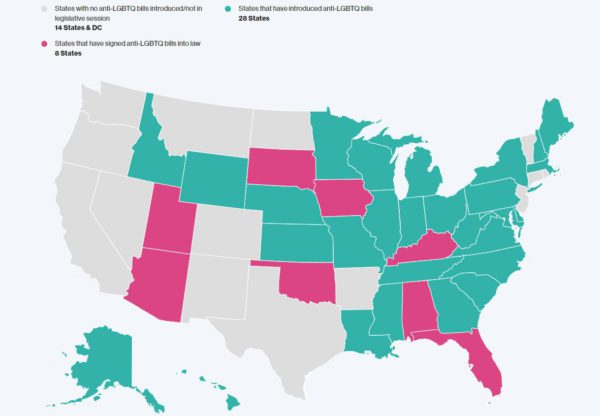
In terms of legislation introduced, Tennessee has far outpaced other states, according to LGBTQ+ rights organization Freedom for All Americans. The group’s legislative tracker found over 30 bills limiting LGBTQ+ rights in the state – including a “Don’t Say Gay” bill and a ban on LGBTQ-themed literature in schools. But, unlike other Republican-controlled states, none have made it out of the statehouse.
Arizona has also been a hotspot for anti-LGBTQ+ legislation, with at least 17 bills, according to Freedom for All Americans. In March, Republican Gov. Doug Ducey signed two billslimiting the rights of Trans people in the state – one banning some types of medical care for Trans youth, and the other preventing Trans students from participating in school sports consistent with their gender identity.
“Across the country, moderate Republicans are struggling—and too often failing—to stop the takeover of their party by dangerous extremists,” Shannon Minter, legal director for the National Center for Lesbian Rights (NCLR), told the Blade at the time, adding: “We are in danger of watching large segments of our nation give way to authoritarian extremism.”
In other states, anti-LGBTQ+ legislation became law without support from its governor – Democratic or Republican. In fact, two Republican governors vetoed anti-Trans sports bills in late March.
Utah Gov. Spencer Cox and Indiana Gov. Eric Holcomb, both Republicans, vetoed legislation that barred Trans youth from participating in sports. Cox said the bill had “several fundamental flaws and should be reconsidered,” while Holcomb said the measure was in search of a problem.
“This [Utah] bill focuses on a problem of ‘fairness’ in school sports that simply does not exist — but its negative impacts on the mental health and well-being of trans and nonbinary youth are very real,” said Sam Ames, director of advocacy and government affairs at The Trevor Project. “These youth already face disproportionate rates of bullying, depression, and suicide risk, and bills like this one will only make matters worse.”
In recent weeks, two Democratic governors vetoed anti-LGBTQ+ legislation from their Republican-controlled legislatures.
“Shame on the Kentucky General Assembly for attacking trans kids today,” said Chris Hartman, executive director for the Fairness Campaign. Shame on our commonwealth’s lawmakers for passing the first explicitly anti-LGBTQ law in Kentucky in almost a decade.”
Kansas Democratic Gov. Laura Kelly vetoed last weekend two anti-LGBTQ+ measures, the “Parents’ Bill of Rights” and the “Fairness in Women’s Sports” Acts.
GOP lawmakers in Idaho decided last month to effectively kill a bill criminalizing gender-affirming care, one of the most extreme proposals in the country. It would have made it a felony — punishable by up to life in prison — to provide minors with hormones, puberty blockers or gender-affirming surgery.
In a statement, Idaho Senate Republicans said they “stongly” oppose “any and all gender reassignment and surgical manipulation of the natural sex” on minors. But they also wrote that the controversial legislation “undermines” a parent’s right to make medical decisions for their children.
“We believe in parents’ rights and that the best decisions regarding medical treatment options for children are made by parents, with the benefit of their physician’s advice and expertise,” the senators wrote.
Texas is one of the 14 states with no anti-LGBTQ+ legislation, as the state only holds legislative sessions in odd years. However, the Lone Star State has made headlines for anti-Trans orders from Republican Gov. Greg Abbott.
But even as Republican politicians continue to push for limits to LGBTQ+ rights, many LGBTQ+ advocates, people and allies promise to continue fighting against the discriminatory efforts – whether in court or on the streets.
“The Human Rights Campaign strongly condemns these harmful, potentially life-threatening bills and will continue to use every tool at our disposal to fight for the rights of transgender youth and all LGBTQ+ people,” Oakley said.
In a January 2022 poll by The Trevor Project, an organization that provides crisis intervention and suicide prevention services to LGBTQ youth under 25, and Morning Consult, over two-thirds of LGBTQ youth said recent debates over state laws that target transgender people have negatively impacted their mental health.
“These results underscore how recent politics and ongoing crises facing the globe can have a real, negative impact on LGBTQ young people, a group consistently found to be at significantly increased risk for depression, anxiety and attempting suicide because of how they are mistreated and stigmatized in society,” Amit Paley, CEO of The Trevor Project, said in a statement.
An LGBT+ charity in Russia that has provided support to the community for more than a decade has been formally dissolved by the courts.
Charitable Foundation Sphere was formally dissolved by Kuibyshev District Court judge Tatiana Kuzovkina on Thursday (21 April) after the Russian ministry for justice argued that they were carrying out “political activities”.
The ministry claimed one of CF Sphere’s goals is to change Russian legislation, which is not a permissible charitable goal under federal law.
A representative for the ministry claimed that Sphere “carried out political activities using foreign property, which does not correspond to the statutory goals”.
The ministry argued in court that liquidating Sphere was the only way to successfully curb the organisation’s “illegal activities”.
Vitaly Isakov, the lawyer representing Sphere, argued against the move, telling the court that liquidating the charity would have a severe impact on LGBT+ people in Russia, who would find themselves left without any protection.
Judge Kuzovkina granted the ministry of justice’s request to liquidate Sphere, according to a press release from the charity.
Decision to liquidate LGBT+ charity in Russia is ‘politically and ideologically motivated’
“The decision to liquidate the foundation, especially on these grounds, is absolutely unreasonable and inconsistent with the norms of the law,” a Sphere spokesperson said.
“We consider it politically and ideologically motivated, separately noting the state’s desire to destroy the majority of civil and human rights organisations in the country.
“At the moment, our services continue to provide legal, psychological and emergency assistance to the LGBT+ community, and we will do everything possible to ensure this work continues without interruption, regardless of the legal status of our team.”
They continued: “We cannot leave the community without protection and support at such a difficult time. Our team has always seen it as a duty to help the community and unite it based on the principles of human rights and humanitarianism.”
Sphere has been providing legal and psychological assistance to LGBT+ people in Russia since it was founded in 2011.
In late 2021, Russia’s ministry of justice launched an “unscheduled audit” of the charity. As part of that audit, Sphere handed over more than 5,000 pages of documentation.
The ministry found that “all the actual activities of the organisation are aimed at supporting the LGBT+ movement in Russia”.
The state agency said that the country’s constitution upholds “traditional family values”. It said Sphere was trying to change the “legislation and moral foundations in the Russian Federation” through its work.
The ministry formally asked the courts to dissolve Sphere in February.
Russia wants to ‘negate the entire human rights movement’
In a press release, Sphere said this is not the first time human rights groups have been forced to stop operating because of state interference. The International Memorial and the Memorial Human Rights Center were shut at the end of 2021.
“In many ways, a similar attempt to liquidate Sphere is the contribution of the ruling structures to negating the entire human rights movement, including the LGBT movement,” a Sphere spokesperson said.
Since it was set up 11 years ago, Sphere has opposed Russia’s much-criticised ban on “LGBT propaganda”. It has also supported LGBT+ people who have survived abduction and torture.
Russia has become an increasingly hostile place for LGBT+ people over the last decade.
In 2013, the country faced international backlash when it enacted its infamous “gay propaganda” law, which prohibits the promotion of homosexuality.
In a grisly attack that has appalled Kenya, a non-binary lesbian reportedly was raped and murdered by six men in their home.
Sheila Lumumba, a 25-year-old hospitality worker, was found dead in their home in Karatina, a town in Nyeri County, earlier this week, LGBT+ groups and activists and BBC Africa reported.
K24TV said that it is understood that the gang also broke Lumumba’s leg during the incident, according to an autopsy report.
They were discovered four days after the attack by colleagues from FK Resort and Spa. Karatina police have not yet determined a motive behind the killing.
Their alleged killing has touched off intense outrage and despair online among national rights groups.x
Under the hashtag #JusticeForSheila, activists expressed a disturbing sense of familiarity over Lumumba’s death. To campaigners, Lumumba has become the latest example in a long legacy of violence against LGBT+ people in Kenya, where same-sex activity is illegal.
LGBT+ people in Kenya face fierce and relentless discrimination, the Kenya National Commission on Human Rights reported, from arbitrary arrests to mob justice.
“It bears mentioning that unfortunately these are not isolated incidences [sic] and are part of a pattern of attacks and violence against LGBTIQ+ persons in the country,” Kenya’s National Gay and Lesbian Human Rights Commission tweeted.
“No one deserves such cruel treatment. Sheila didn’t have to experience all this pain,” Amnesty Kenya tweeted.
More than 86,520 Kenyan shillings (£580) have been raised to cover Lumumba’s funeral costs on M-Changa, Africa’s largest online fundraising platform.
“Sheila and I are both 25 and lesbians. I can’t rest because I am one statistic away from being this,” tweeted Afrika, director of the queer-led women’s group the Kisumu Feminists’ Society.
“I can’t rest because I know my silence will mean Sheila’s death goes unpunished. I can’t rest because Sheila and I experience violence both as ‘female-presenting bodies’ and lesbians.
GLAAD, the world’s largest LGBTQ media advocacy organization, and Sony Music announced a partnership in March to amplify LGBTQ voices and representation in the music industry.
According to Variety, the partnership includes several initiatives to advance advocacy and inclusion at Sony and within the broader industry. The initiatives include the following:
GLAAD Media Institute will implement consultation and education for Sony Music Group, including LGBTQ-focused education sessions for Sony employees and leadership in an effort to help build greater awareness and competency around LGBTQ issues and people.
GLAAD will consult Sony on its campaigns and programs that seek to highlight contemporary LGBTQ people and/or issues.
Sony will be an official sponsor for the 33rd Annual GLAAD Media Awards in Los Angeles on April 2, and New York City on May 6.
Sony’s artists and songwriters nominated for the Outstand Music Artist award include: Brockhampton, Roadrunner: New Light, New Machine (RCA Records/Question Everything), Kaytranada, Intimated (RCA Records), Lil Nas X, Montero (Columbia Records, Sony Music Publishing) and Arlo Parks, Collapsed in Sunbeams (Sony Music Publishing).
GLAAD and Sony will launch “Icons,” a three-part interview series that will bring together LGBTQ musicians, songwriters and producers across generations for discussion about LGBTQ inclusion in music, history of and the future of the industry.
“Over the past several years, many LGBTQ artists have made major strides within the music industry, but there is still significant room to improve LGBTQ inclusion, representation, and awareness at all levels,” said Sarah Kate Ellis, GLAAD president and CEO. “Sony Music Group continues to be an incredible leader for diversity, equity, and inclusion in music, and we’re grateful to partner with them to both amplify diverse LGBTQ voices and establish greater pathways to grow LGBTQ inclusion within the industry at large.”
Charlie Sprinkman traveled to 42 of the 50 states for work as a representative of an organic beverage company in 2019 and kept Googling “queer hangouts here” when he would arrive in a new town. But he would often come up empty.
“I couldn’t find a resource for it,” Sprinkman, 25, said of a centralized directory of LGBTQ-owned businesses.
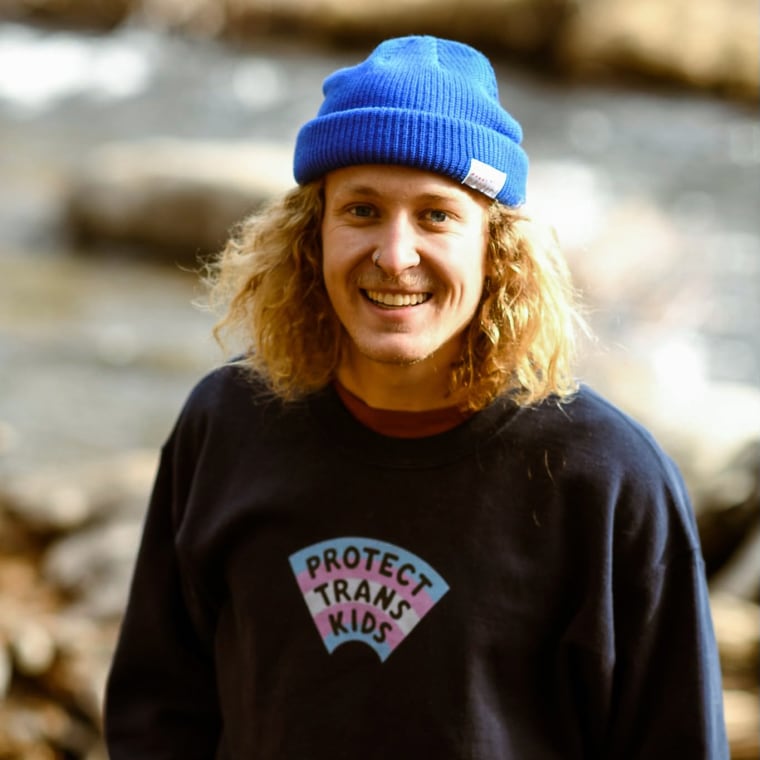
Charlie Sprinkman, creator of Everywhere Is Queer.Katie Hope / The Wild Within Us
Then, in the summer of 2021, he was a counselor at a queer leadership camp for 12- to 18-year-olds outside Los Angeles, and he said being surrounded by 100 LGBTQ people for 11 days was “euphoric.”
“I was like, ‘How do I create this space?’ Maybe not as grand as a camp, but like a space where people can feel this energy and not be judged for who they are,” said Sprinkman, who currently lives in Bend, Oregon, and works in customer service.
On the long drive back from the camp to his then-home in Colorado, Sprinkman said the phrase “Everywhere is queer” came to his mind. A few months later, in January of this year, it became the name of his LLC.
Everywhere Is Queer consists of both a website that houses a worldwide map of LGBTQ-owned businesses and an Instagram page that shines a spotlight on some of these companies. Three months after the launch, the map has more than 500 businesses listed, and the Instagram page has nearly 5,000 followers.
The Everywhere Is Queer map.Everywhere Is Queer / Google maps
Sprinkman said the project is personal for him, not just as a queer traveler but as someone who didn’t know of any LGBTQ-friendly spaces in his small suburban hometown about 30 miles west of Milwaukee.
“I didn’t have any out cousins, aunts, uncles, anyone as like an influence, so I didn’t really have a space as a child to find queer spaces around my hometown,” he said. “As I was building Everywhere Is Queer, I was thinking about youth, my hometown, trying to find and build spaces for them to just, even if they’re not out, just sit in a queer-owned coffee shop and just see queer people. You know, that subconscious layer of just like seeing queer people is what I hope Everywhere Is Queer will provide for so many.”
Charlotte Tegen
So far, Sprinkman said most of the LGBTQ-owned businesses on the map are concentrated in the U.S., and that there are only four states that don’t have an LGBTQ-owned business listed yet. He said there are also businesses listed in Germany, Spain, South Africa, the United Kingdom, Costa Rica and Mexico.
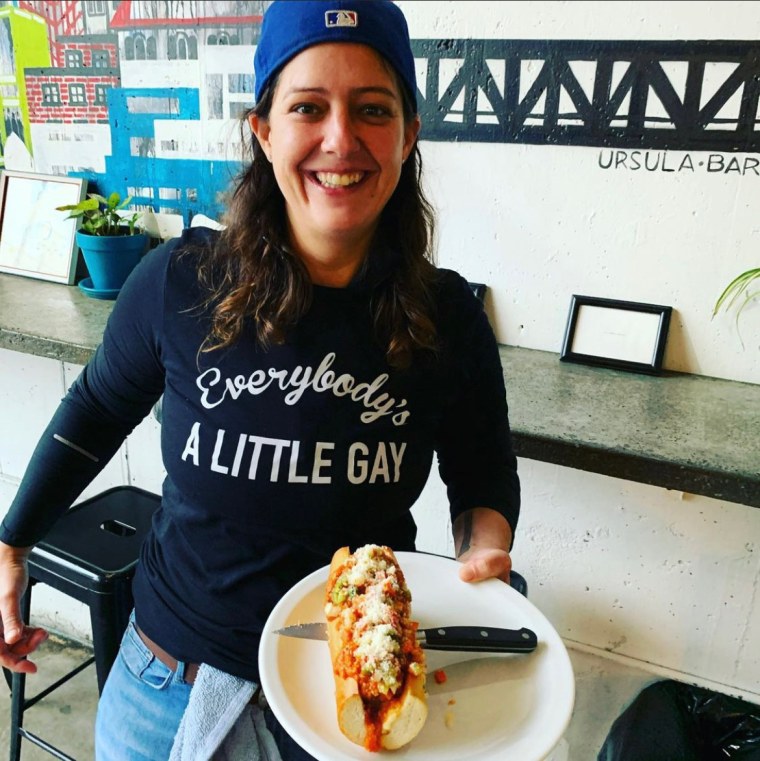
One business owner listed on the map said she has seen more queer people come into her restaurants. Mel McMillan is the owner of Sammich in Oregon, which sells sandwiches made with house-smoked meats. Both of her Sammich locations, in Portland and Ashland, are listed on the map, as is her food truck, also in Portland.
“If you Google ‘lesbian meat maker,’ you’ll get a real touch of what’s going on with me,” McMillan said. (It’s true: An article about her is the first thing that comes up in the search results for that phrase.)
Get the Morning Rundown
Get a head start on the morning’s top stories.SIGN UPTHIS SITE IS PROTECTED BY RECAPTCHA PRIVACY POLICY | TERMS OF SERVICE
McMillan, 39, said that one of the things she loves about Everywhere Is Queer is that it’s bringing together queer people from different generations.
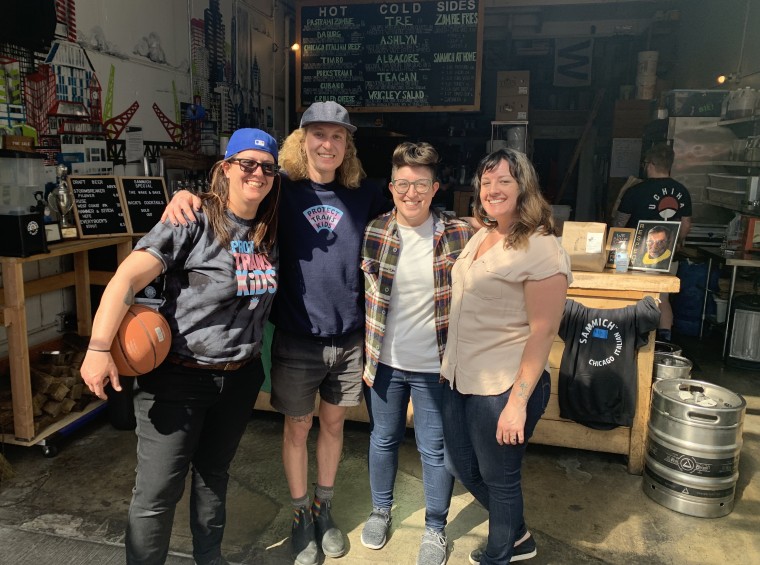
Last month, Sprinkman and McMillan invited about 20 people to Sammich’s Portland location.
“The first thing that I thought was so cool about this was it’s bridging the gap between older queers and younger queers,” McMillan said. “That was really cool, because there were 20-somethings and 40-somethings, and there’s not even a place really for that either.”
Sprinkman said he’s also building a job board that allows businesses that are on the map to share job opportunities.
“I also have been searching for a queer-owned business job board, and I cannot find one, so we’re building one,” he said.
In the future, he said, he hopes to build an app to house the map and travel around to visit many of the LGBTQ-owned places listed.
“I would love to hit the road and visit and really hear the authentic stories of these queer-owned businesses,” he said, adding that “uplifting” the voices of queer business owners is a dream of his.
He said he also hopes that it helps LGBTQ travelers feel safer — and some have told him that it already has. He’s received hundreds of messages from people who have thanked him for filling a void.
States across the U.S. have a variety of laws regarding whether businesses can refuse service to LGBTQ people. Twenty-one states and Washington, D.C., have laws that explicitly prohibit discrimination based on sexual orientation and gender identity in public accommodations, such as businesses, according to the Movement Advancement Project, a nonprofit think tank. Eight states interpret their laws to protect LGBTQ people or provide partial protection. The remaining 21 states and five territories don’t provide any protection based on LGBTQ status.
From left, Mel McMillan, Charlie Sprinkman and the owners of catering company Two Spoons PDX, Laura Taki and Rachel Arenas.Charlie Sprinkman
As of this month, the map has been viewed more than 100,000 times, and Sprinkman doesn’t make any money off it.
“I’m building this just out of my own little queer heart,” he said.
He hopes that the map can ultimately just help people find the spaces that allow them to be themselves.
“I hope that a queer-owned business that was maybe unknown before can provide a space and a little bit more confidence, less judgment for anyone that’s struggling with figuring out their most authentic self,” Sprinkman said. “We’re always constantly on a journey, all of us.”
The majority of US voters oppose using the slur “groomer” to describe LGBT-inclusive teachers and parents, a new poll has revealed.
The Data for Progress poll surveyed 1,155 likely voters and asked them about the spread of anti-LGBT+ legislation across the US.
While the dangerous and ignorant conflation of homosexuality and LGBT+ identities with paedophilia goes back decades, there has been a recent surge in Republicans and religious conservatives using “grooming” language to describe LGBT-inclusive education, or just queer folk in general.
The Data for Progress poll noted: “Some groups have been describing teachers and parents who oppose banning discussion about sexual orientation or gender identity in schools as ‘groomers’ – a term used to describe someone who gets close to and builds trust with a child or young person with the intent of sexually abusing them.”
Respondents were asked whether they agreed that “teachers and parents that support discussions about sexual orientation and gender identity in school” were “groomers”, and a majority of 55 per cent said they did not.
However, there was a stark political divide.
While just 15 per cent of likely Democrat voters supported anti-LGBT+ “groomer” language, this figure jumped to 45 per cent for likely Republican voters.
The poll also revealed some serious cognitive dissonance among likely Republican voters.
Asked whether the US government should “have a say in personal matters like a person’s sexual preference or gender identity”, the overwhelming opinion across the political spectrum was that it should not (88 per cent of Democrats and 86 per cent of Republicans).
However, when asked about the hundreds of bills across the country which aim to limit the discussion of LGBT+ topics in classrooms, as well as “limit transgender people’s ability to play sports, use bathrooms that correspond with their gender identity, and receive gender-affirming health care”, 63 per cent of Republicans said they supported such legislation, compared with just 15 per cent of Democrats.
The same trend appeared in a question about gender-affirming healthcare for transgender children, with 59 per cent of Republicans saying the government should deny them this care, compared to 15 per cent of Democrats.
Transgender medical treatment for children and teens is increasingly under attack in many states, labeled child abuse and subject to criminalizing bans. But it has been available in the United States for more than a decade and is endorsed by major medical associations.
Many clinics use treatment plans pioneered in Amsterdam 30 years ago, according to a recent review in the British Psych Bulletin. Since 2005, the number of youth referred to gender clinics has increased as much as tenfold in the U.S., U.K, Canada and Finland, the review said.
The World Professional Association for Transgender Health, a professional and educational organization, and the Endocrine Society, which represents specialists who treat hormone conditions, both have guidelines for such treatment. Here’s a look at what’s typically involved.
Puberty Blockers
Children who persistently question the sex they were designated at birth are often referred to specialty clinics providing gender-confirming care. Such care typically begins with a psychological evaluation to determine whether the children have “gender dysphoria,″ or distress caused when gender identity doesn’t match a person’s assigned sex.
Children who meet clinical guidelines are first offered medication that temporarily blocks puberty. This treatment is designed for youngsters diagnosed with gender dysphoria who have been counseled with their families and are mature enough to understand what the regimen entails.
The medication isn’t started until youngsters show early signs of puberty — enlargement of breasts or testicles. This typically occurs around age 8 to 13 for girls and a year or two later for boys.
The drugs, known as GnRH agonists, block the brain from releasing key hormones involved in sexual maturation. They have been used for decades to treat precocious puberty, an uncommon medical condition that causes puberty to begin abnormally early.
The drugs can be given as injections every few months or as arm implants lasting up to year or two. Their effects are reversible — puberty and sexual development resume as soon as the drugs are stopped.
Some kids stay on them for several years. One possible side effect: They may cause a decrease in bone density that reverses when the drugs are stopped.
Hormones
After puberty blockers, kids can either go through puberty while still identifying as the opposite sex or begin treatment to make their bodies more closely match their gender identity.
For those choosing the second option, guidelines say the next step is taking manufactured versions of estrogen or testosterone — hormones that prompt sexual development in puberty. Estrogen comes in skin patches and pills. Testosterone treatment usually involves weekly injections.
Get the Morning Rundown
Get a head start on the morning’s top stories.SIGN UPTHIS SITE IS PROTECTED BY RECAPTCHA PRIVACY POLICY | TERMS OF SERVICE
Guidelines recommend starting these when kids are mature enough to make informed medical decisions. That is typically around age 16, and parents’ consent is typically required, said Dr. Gina Sequiera, co-director of Seattle Children’s Hospital’s Gender Clinic.
Many transgender patients take the hormones for life, though some changes persist if medication is stopped.
In girls transitioning to boys, testosterone generally leads to permanent voice-lowering, facial hair and protrusion of the Adam’s apple, said Dr. Stephanie Roberts, a specialist at Boston Children’s Hospital’s Gender Management Service. For boys transitioning to girls, estrogen-induced breast development is typically permanent, Roberts said.
Research on long-term hormone use in transgender adults has found potential health risks including blood clots and cholesterol changes.
Surgery
Gender-altering surgery in teens is less common than hormone treatment, but many centers hesitate to give exact numbers.
Guidelines say such surgery generally should be reserved for those aged 18 and older. The World Professional Association for Transgender Health says breast removal surgery is OK for those under 18 who have been on testosterone for at least a year. The Endocrine Society says there isn’t enough evidence to recommend a specific age limit for that operation.
Outcomes
Studies have found some children and teens resort to self-mutilation to try to change their anatomy. And research has shown that transgender youth and adults are prone to stress, depression and suicidal behavior when forced to live as the sex they were assigned at birth.
Opponents of youth transgender medical treatment say there’s no solid proof of purported benefits and cite widely discredited research claiming that most untreated kids outgrow their transgender identities by their teen years or later. One study often mentioned by opponents included many kids who were mistakenly identified as having gender dysphoria and lacked outcome data for many others.
Doctors say accurately diagnosed kids whose transgender identity persists into puberty typically don’t outgrow it. And guidelines say treatment shouldn’t start before puberty begins.
Many studies show the treatment can improve kids’ well-being, including reducing depression and suicidal behavior. The most robust kind of study — a trial in which some distressed kids would be given treatment and others not — cannot be done ethically. Longer term studies on treatment outcomes are underway.