A man serving 30 years for not disclosing his HIV status to sexual partners has been released 25 years earlier.
Former college wrestler Michael ‘Tiger Mandingo’ Johnson left Boonville’s prison, Missouri, yesterday (9 July).
In 2013, Johnson was the protagonist of what many defined a racially charged trial. His case was also one of the most relevant in the ongoing discussion about the criminalization of HIV transmission.
Criminalizing transmission
‘I feel great,’ Johnson told BuzzFeed as he left Boonville Correctional Center.
‘Leaving prison is such a great feeling.’
Police arrested Johnson, a black man, for ‘recklessly’ transmitting HIV to two men and exposing four others to it. Four out of these six sexual partners are white men.
The jury found him guilty of one of the two transmission cases and of all four exposure cases.
Johnson was serving 30 years
What struck many was the way Johnson’s trial was handled, particularly the fact that jurors were reportedly shown images of the man’s penis.
Johnson ended up receiving a lengthier sentence than Missouri’s average for second-degree murder, 30.5 years.
In December 2016, the Missouri Court of Appeals for the Eastern District overturned his conviction because prosecutors had waited until the last moment to disclose evidence.
To avoid another trial, Johnson took a no-contest Alford plea deal. He was later granted suspended parole.
Black men and HIV
Some argue that Johnson’s case proved that race plays a part in HIV transmission trials in the US.
The Centers for Disease Control and Prevention published research projecting that if current trends continue, one in every two black men who have sex with men in the US would become HIV positive in their lifetimes. This would happen despite them having ‘fewer partners and lower rates of recreational drug use than other gay men’.
On a global level, a disproportionate number of the roughly 1 million people a year who die of AIDS are black.
HIV transmission law in Missouri
Current state law in Missouri punishes HIV-exposure by up to 15 years in prison, or as many as 30 years if HIV is transmitted.
A Republican bill tried to change the law by reducing punishment for knowingly transmitting HIV from a felony to a misdemeanor. If passed, the new law would have taken into account several factors. Among these, whether the accused used a condom or was taking medication.
The bill’s sponsors say they will try again to get it passed in the next legislative session.
Multiple people attacked ex-gay bar owner, Jorge Sarmiento, 42, and his 80-year-old partner, Gerard Argiud, in their Atlántida home, according to reports.
In April 2017, unknown assailants strangled a trans woman, who also performed in drag,to death.
Sherlyn Montoya’s body was wrapped in sacks in a small alley in the northern part of the capital Tegucigalpa.
U.S. Secretary of State Mike Pompeo on Monday announced the formation of a new commission that will take a “fresh look” at human rights through the lens of “natural law,” and civil and human rights advocates are outraged. In preliminary filings the State Dept. noted the Commission will explore “our nation’s founding principles of natural law and natural rights.”
“Natural law,” is religious right wing extremist code for anti-abortion and anti-LGBTQ rights, especially marriage for same-sex couples.
Secretary Pompeo, a known right wing Christian extremist in his own right, has named Mary Ann Glendon, a professor who is also his former mentor, to lead the “Commission on Unalienable Rights.”
“I hope that the commission will revisit the most basic of questions: What does it mean to claim something is, in fact, a human right?” Pompeo told reporters Monday, adding, as Yahoo News notes, that “words like rights can be used for good or evil.”
Glendon should understand Pompeo’s remarks. She penned a 2004 op-ed supporting a constitutional amendment to ban same-sex marriage. In a unique twist of language she claimed the amendment “should be welcomed by all Americans who are concerned about equality and preserving democratic decision-making.”
And in a shocking move Glendon chastised the awarding of a Pulitzer Prize to the Boston Globe for its work exposing pedophile priests. She reportedly said; “If fairness & accuracy have anything to do with it, awarding the Pulitzer to the Boston Globe would be like giving the Nobel Peace Prize to Osama bin Laden.”
Anti-gay hate group leader Tony Perkins was briefed on the Commission before it was officially announced, CBS News reports.
A State Dept. official says the Commission is a “personal project” of Secretary Pompeo’s, and Politico reports the Commission “was conceived with almost no input from the State Department’s human rights bureau, people familiar with the matter say, effectively sidelining career government experts who have focused on human rights policy and history across numerous administrations.”
“This administration has actively worked to deny and take away long-standing human rights protections since Trump’s inauguration. If this administration truly wanted to support people’s rights, it would use the global framework that’s already in place. Instead, it wants to undermine rights for individuals, as well as the responsibilities of governments.”
“This approach only encourages other countries to adopt a disregard for basic human rights standards and risks weakening international, as well as regional frameworks, placing the rights of millions of people around the world in jeopardy.”
“International agreements, like the Universal Declaration for Human Rights, have been upheld by prior administrations over the last 71 years, regardless of their party. This politicization of human rights in order to, what appears to be an attempt to further hateful policies aimed at women and LGBTQ people, is shameful.”
Human Rights Watch has updated our marriage equality map, which provides an overview of countries with marriage equality, civil unions or registered partnership; links to the relevant legislation; and, where possible, a brief explanation of the path – legislative, judicial, or other – that these countries took to achieve marriage equality or to provide for same-sex civil unions or registered partnership.
As legal situations change in countries, this map will be further updated.
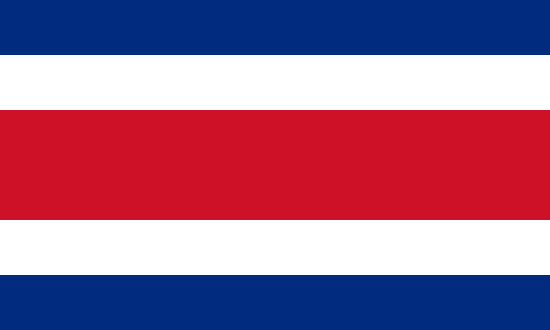
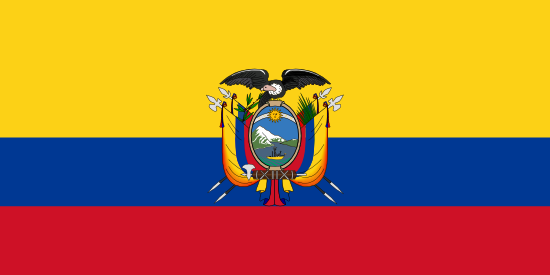
In 2001, the Netherlands became the first country to open civil marriage to same-sex couples. Other countries followed. Today there are 28 countries with marriage equality—most recently, Austria, Ecuador and Taiwan– with Costa Rica expected to join the list soon.
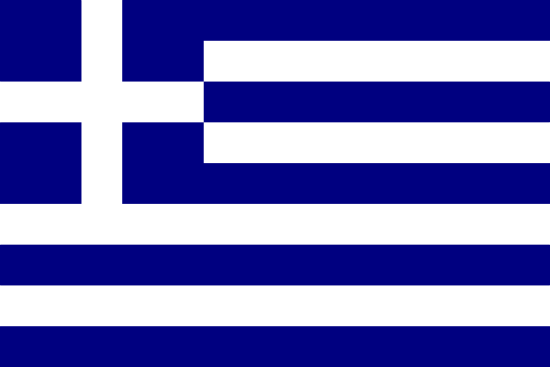
An additional fourteen countries have made civil unions or registered partnerships available for same-sex couples. In some cases, civil unions or registered partnership provide all the same rights and responsibilities of civil marriage and differ in name only; countries with such laws include Croatia, Greece, Slovenia and Switzerland. In other cases, civil unions provide some, but not all, of these rights.
In 2018, the Inter-American Court of Human Rights issued an advisory opinion on the interpretation of the Inter-American Convention on Human Rights in respect of marriage equality. The Court encouraged member states to take actions towards eliminating discrimination and achieving marriage equality.
There are causes to celebrate during Pride Month, as laws and policies continue to improve LGBT rights around the world.
We hope this map will assist those who are looking for this type of information. We decided to only mark independent countries on our map and not overseas territories, regions, departments or possessions. That’s why we did not include Bermuda, Greenland or Aruba for instance. If you have additional information, you can contact Human Rights Watch via lgbt@hrw.org
Recognition of same-sex relationships
Click on each country for a snapshot of current legislation. For more information and Human Rights Watch reporting on LGBT rights, click on the country name in the black pop-up box.
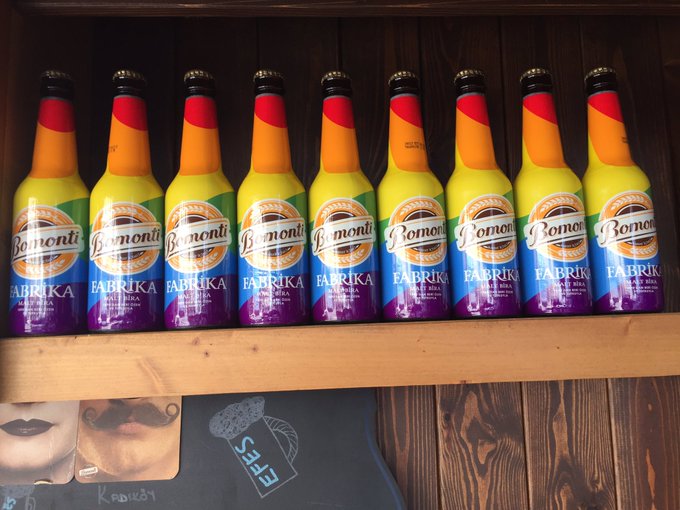
Established in Istanbul in 1890, Bomonti is Turkey’s oldest modern brewery and produces one of the country’s most popular lagers. The rainbow-coloured bottle was unveiled in an Instagram post by the head of Bomonti’s branding agency, alongside the caption: “We did it!”
It’s a bold move in a country which has been named the second-most restrictive on gay rights in Europe. Amnesty International previously told PinkNews in 2018 that Turkish LGBT+ people are “living in more fear than ever.”
Although courts ruled in April that the two-year ban on Pride parades could technically be lifted, Amnesty reported in May that “appalling” violence had been used against students holding a Pride march in the capital city of Ankara. Authorities also stripped the scholarships of students detained in the march.
And on Sunday (June 30) another Pride rally in Istanbul ended with tear gas and rubber bullets.
This current political climate makes Bomonti’s decision to embrace LGBT+ rights particularly significant — and while the commercialisation of Pride may be common in other countries, the Turkish LGBT+ community couldn’t be happier to see the beer brand following suit.
@zekibaskaya said, “I’m shocked! but really excellent idea,” @logolepsi said, “You’ve made us even more happy with rainbow marketing,” and @benimadimsencer said: “We’re so happy, so excited. For the first time in Turkey, a brand is investing in Pride and standing behind us like a door.”
Though old enough to have had firsthand knowledge of Stonewall (I was 22 when the riots occurred) my understanding of Stonewall came from hearing about it from friends and reading about it many years later. Though I grew up in upper Manhattan, anything having to do with gay life was something out of my experience.
When the Stonewall Riots began on June 28, 1969, I had just graduated from college and was on my way across the country. I was living a deeply closeted life. Even after going to work for gay rights advocate Bella S. Abzug (D-N.Y.) in 1972 it would be nearly 12 more years until I came out. So it was much later that I learned how much I owed those who took part in the riots and how the repercussions were to impact my life.
When I did come out in the early 1980s, I met and got to know Frank Kameny learning he demonstrated for gay rights before Stonewall. A little research confirmed that with a few others Kameny led a picket line protesting government treatment of gays and lesbians in front of the White House on April 17, 1965 — four years before Stonewall.
After coming out, I joined the fight for equality for the LGBTQ+ movement meeting many who were there before me to whom I owed much. Our community must recognize the very fast pace of change that has occurred for us compared to other minority groups and women. Until the Trump administration things were going at lightning speed for our equality movement compared to the hundreds of years it took for African Americans and knowing women still can’t get the Equal Rights Amendment passed by states that was first introduced in Congress in 1923. So while some think things have moved slowly, I hope when Democrats once again take the Senate and the presidency we will be able to pass the Equality Act first introduced in Congress by Bella in 1974.
We have gained recognition by society in some ways just as important if not more so than legislation. We have gained the right to marry even though in 37 states we can marry on Sunday and be fired from our jobs or thrown out of our homes on Monday.
I think the debate in our community as represented by the two competing parades being held in New York to celebrate 50 years since Stonewall are in some ways emblematic of our success. This year there is a counter march to the New York Pride parade called the “Reclaim Pride” march honoring Stonewall. It is a back-to-basics march without any outside participation from the corporate or government communities. While I can respect the views of the leaders of this march and wish them success, I think our success has been that government and the corporate communities want to march with us.
To me a celebration of those who took part in Stonewall and others like Kameny would include corporate floats, the police and military in uniform. We fought for broad-based acceptance and recognition for members of our community. Why is it a bad thing if a corporation is proud to have its gay employees march openly under their banner in a pride parade? Why should we not celebrate police departments proud to have their LGBTQ members and other officers who support them march openly? Then there is the military who some object to having participate. We fought long and hard to have members of the LGBTQ community be able to serve openly in the military. Why would we now not want them to march proudly in the uniforms they worked so long and hard to wear?
I am not blind to how far we have to go. There is discrimination in our society, even in our own community, especially toward people of color and women. We must demand our police be appropriately trained and diversify. We must rid police departments of those who allow their racial biases to influence their actions.
We honor those who were at Stonewall when we let corporations celebrate with us after 50 years of our activists fighting for this to happen.
When we needed help fighting anti-gay laws in North Carolina and Indiana among other places the business community stood with us. Those of us who are out need to live our pride every day of the year. We need to urge more and more people to come out and it’s so much easier if they know their neighbors and their employers say “you are welcome here and we support you.” We honor Stonewall when we are inclusive.
Peter Rosenstein is a longtime LGBT rights and Democratic Party activist. He writes regularly for the Blade.
According to The Guardian, the group are the first of 15 LGBT+ refugees finally coming to London after they were accepted onto a resettlement scheme, which is supposed to be faster than the lengthy asylum process, more than two years ago.
During that time, they have been waiting in Turkey where, although being gay is legal, homophobic and transphobic abuse are common and the government ruled that the group were in danger in the country.
Members of the group received death threats and were having to hide in safe houses to avoid violence, the newspaper reported.
The four refugees are in a “state of joy,” and the 11 others are expected to follow soon.
They will be able to openly express being LGBT+ for the first time. (Wiktor Szymanowicz / Barcroft Media via Getty)
The refugees “will proudly march with Pride for the first time in their lives”
Toufique Hossain and Sheroy Zaq, solicitors who launched the legal action, told The Guardian: “These men have been forced to conceal an enormous part of their identity, not just in their country of origin but also in Turkey.
“The detriment they suffered as a result of their sexuality in Turkey simply could not go on any longer; we had to ensure that their resettlement was expedited through legal channels.
“We are elated that they will at last be able to be open about their sexuality in all walks of life, just in time for Pride.”
The refugees were offered housing by the borough of Hammersmith and Fulham, and the leader of the council also told the publication: “No one anywhere should ever face death threats because of their sexuality.
“I’m so happy that we have been able to provide safe refuge for these young people and that tomorrow they will proudly march with Pride for the first time in their lives.”
The Gay Liberation Front, the U.K.’s long running activist collective, has released new demands for their continued fight.
The collective was founded in London nearly 50 years ago, following the 1969 Stonewall riots in New York, and staged the first Pride in London. Now, in honor of the 50th anniversary of the iconic throwing of the first brick by Marsha P. Johnson, the collective wants to reignite the spirit of rebellion in Pride.
On June 17, a cross-generational group made up of original members of the Gay Liberation Front and younger activists took to Trafalgar Square to recreate the first Pride in London and “to remember and reinvigorate the fires that fought back against centuries of oppression and seemingly overwhelming odds” as Ted Brown (original and presently active Gay Libertion Front member) stated. Brandishing banners replicating those from the 1970 protest and chanting the collective launched is aptly titled: “A NEW AGREEMENT ABOUT PRIDE EVENTS FOR A NEW WORLD AGE” – a 7-point intervention aimed at making Pride safe, accessible and inclusive.
The intervention demands are based in a historical valuing of the movement as well as an understanding of the intersection of numerous struggles which come to the attention of LGBTQ+ activists in modern day U.K. and the world.
1. Pride is FREE: Pride organizers who want ticketed events must arrange free Pride marches as well. No one should be denied entry to Pride because they don’t have enough money.
2. Pride is always a protest as well as a celebration. We’ve a whole world yet to change and we’ve hardly begun.
3. LGBT+ community groups actively engaged in grassroots LGBTQIA+ empowerment programs, or key allies such as the miners in the 1980s, always to head Pride marches.
4. Arms dealers and other corporations who trade with nations in violation of the U.N. International Charter on Human Rights are never again to be allowed to sponsor or have floats at Pride marches. Individual LGBT employees of such corporations are welcome as always, but not marching in groups sporting corporate logos.
5. The target is to be vehicle-free: No diesel-powered vehicles unless for mobility or safety reasons.
6. Full accessibility and reminders to LGBT-friendly venues near the March that full accessibility is the target.
7. Gay Liberation Front to lead Pride in London in 2020.
The U.K., even with the Equality Act of 2010 which protects all people against discrimination, has seen a rise in hate crimes over the past five years. On June 7, a lesbian couple was beaten on a bus by a group of young men for refusing to kiss in front of them. Stuart Feather, author of “Blowing the Lid: Gay Liberation, Sexual Revolution and Radical Queens” and original Gay Liberation Front activist, and firebrand of the struggle stated, “Gay Liberation will always be a socialist movement by virtue of its demand for social change.”
Noting the value in cross-generational collaboration in activism and paying it forward, Nettie Pollard said, “We did what we did to rescue ourselves, but we always thought of you as well — you who would come out after us, and will come out until the world ends.”
The initiative was supported by Queer Tours of London, a collective of LGBTQ+ activists based in London and around the world whose work merges research, education, entertainment and radical activism in order to advocate for social justice and preservation of queer histories as inscribed in the streets of London. With the fight for global decriminalization of queer livelihoods in Commonwealth states progressing — Botswana being the most recent state to abolish colonial laws — the 2022 celebrations of the 50th anniversary of Pride in London are set to be another monumental landmark in the expansive history of the Gay Liberation Front. On the build up calendar is a series of tours curated and guided in collaboration with the Gay Liberation Front featuring original members who show that they’re still packing in some fighting spirit.
“We believe that communities are empowered when they are represented,” said the contest’s organisers, Stardom Space and Project PoSSUM (Polar Suboribital Science in the Upper Mesosphere).SPONSORED CONTENTM
“Our goal is to train and fly a member of the LGBT+ community as a scientist-astronaut.”
The chosen astronaut would serve as “an ambassador” to the science, technology, engineering and math (STEM) industries, according to the contest website.
It states that currently, more than 40 percent of LGBT+ people in STEM are not out, with queer students less likely to follow academic careers than their straight peers.
“Astronauts inspire our youth, represent limitless possibilities, and serve as ambassadors to STEM,” Out Astronaut said.
“Astronauts inspire our youth and represent limitless possibilities.”
—Out Astronaut
The contest is in its first phase, with applications open to scientists or students aged 18- to 39-years-old who are residents of the US, Canada, Mexco, the Caribbean or Central America.
After applications close on July 15, 12 finalists will be chosen and put forward for a social media vote.
The final winner will be chosen by Out Astronaut and announced on September 8. They will receive a full scholarship to attend the Advanced PoSSUM Academy, with lodging and a round-flight trip included.
Out Astronaut is currently seeking funding for the second page of the project–which would see the top four contestants attend a year-long applied astronautics programme, and a third and final phase which would send one LGBT+ scientist into space.
Who was the first gay astronaut?
While there have been no openly LGBT+ astronauts up until now, one notable space explorer was revealed to have been queer following her death.
Sally Ride became the United States’ first woman in space on June 18, 1983, but kept her sexuality private until her death in 2012.
The Israeli-Palestinian conflict — ostensibly not about LGBTQ issues and thousands of miles from the U.S. — has become a potent flashpoint within the queer community.
For years, the debate over Israel’s treatment of the Palestinians has roiled LGBTQ gatherings and parades where Jewish groups wanted to display symbols of the religion. In 2017, organizers of the Chicago Dyke March kicked women out for carrying the Pride flag with a Star of David, citing its resemblance to the Israeli flag.
This month, a soon-to-open gay bar in Minneapolis became embroiled in the dispute when a journalist unearthed tweets by the bar’s owner calling for the death of all Israelis. The owner also accused Zionist Jews, broadly defined as those who support a Jewish state in Israel in some form, as running America. The tweets were both anti-Semitic and anti-Zionist, but in many other recent controversies, parsing those two ideologies can be divisive.
As it is, many Americans living at the intersection of Jewish and queer identities have been alarmed by news reports that affect the two groups: synagogue shootings, rollbacks in federal rights for LGBTQ people, swastikas painted on Jewish institutions, Israeli and Pride flags being burned and urinated on and rising hate crimes against Jews and queer people. Activists say that shared sense of alarm should prevent political disagreements over Israel from boiling over into anti-Semitism.
A.J. CAMPBELL
“It’s important that we all call out anti-Semitism in our own spaces,” said Amanda Berman, founder of the “unabashedly progressive” and “unquestionably Zionist” group Zioness. “It’s hard work to call it out in your own movement.”
CONFRONTATION OVER SYMBOLS
At this year’s Creating Change conference in Detroit, a national event that focuses on LGBTQ issues, pro-Palestinian protestors disruptedthe opening ceremony to condemn the lack of Palestinian programming. At the 2016 conference, in Chicago, the pro-Israel LGBTQ organization A Wider Bridge shut down its event and evacuated guests because of intense protests.
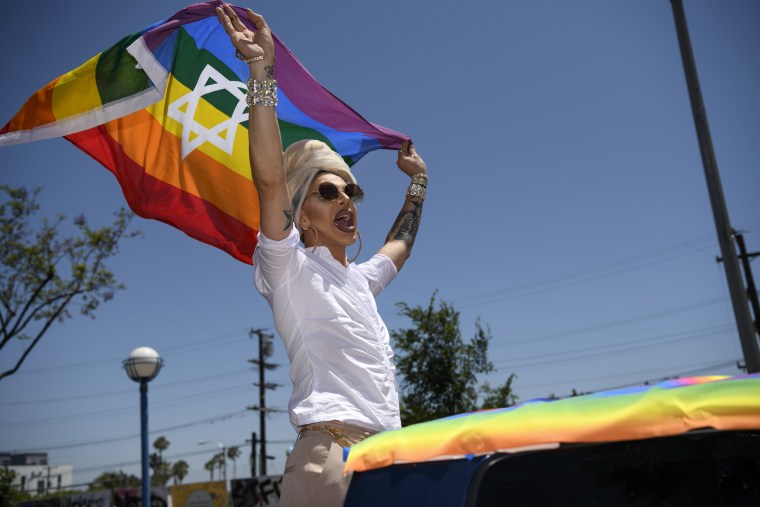
A participant holds a rainbow flag with a Star of David symbol during the LA Pride Parade in West Hollywood on June 10, 2018.Roven Tivony / NurPhoto via Getty Images file
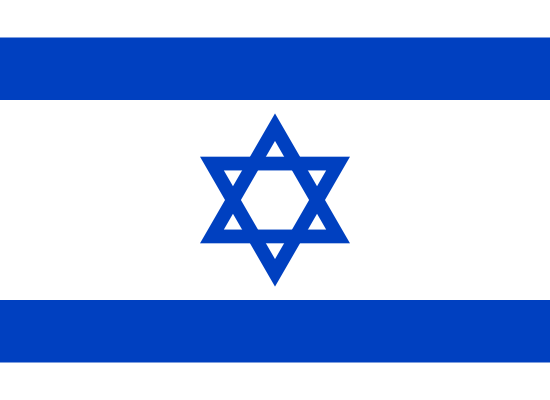
Whether that flag that has produced so many protests is Jewish, Israeli or both is complicated. The Star of David has been a Jewish symbol for hundreds and possibly thousands of years, long before the founding of the state of Israel in 1948. The Pride flag with the Jewish star in the middle of a rainbow background is the most common symbol of Jewish LGBTQ Pride, but it is not the official Israeli Pride flag, which replaces the two blue banners at the top and bottom of the Israeli flag with rainbow colors.
Rae Gaines, 30, is an organizer of the Dyke March in Washington that took place June 7. Gaines, who is Jewish but anti-Zionist, said it was unfortunate that Jewish women were kicked out of the Chicago march and wanted the situation handled better in Washington. Organizers there decided to ask attendees not to bring “nationalist symbols” of any country, but allowed Palestinian flags because they “don’t yet have a nation.”
“It can be scary to be a Jew. I can relate to the fear of existing,” Gaines said. “I wanted to relate to that, but without being nationalist.”
Gaines said march organizers had alternate Jewish Pride flags on hand and intended to ask anyone with a Star of David on their flag to swap them out in order to avoid making Palestinians feel unwelcome or unsafe. However, the nuanced approach Gaines hoped for turned into a bitter public confrontation.
A.J. Campbell, 50, an activist, contacted the march to ask about bringing the rainbow flag with the Jewish star, with the events in Chicago in mind. She was angered when she was told it “would not be welcome.” She took the issue to the media, and it was widely reported and condemned as a ban. The National LGBT Taskforce and the Human Rights Campaign disaffiliated from the march, condemning the policy as anti-Semitic and not inclusive.
“There’s Pride flags with crosses and crescent moons in the center. The Jewish star is our symbol,” Campbell said. “I would never ask Palestinians to censor their symbols,” she continued, noting that some Jews might feel unsafe around a Palestinian flag because of terror attacks against Israelis.
A group of 30 people, including Campbell, showed up to the Dyke March in Washington with their flags and argued with organizers about whether the placement of the star at the flag’s center was equated with Zionism and if the star should be placed elsewhere on the flag.
The group ultimately joined the march, flag in tow. Gaines said there was never an intention to block the flag but rather a hope people would understand why it wasn’t welcome.
“The narrative became that we were a space that was anti-Semitic, which was painful,” Gaines said. “I’m a Jew who loves being Jewish, so it hurts.”
EXCLUDED OVER MIDEAST POLITICS
Some LGBTQ Jews embrace the Jewish Pride flag’s similarity to the Israeli flag, saying they want to celebrate their connection to Israel as part of their intersectional identity. However, some say if they openly identify as anything other than anti-Zionist, they are unwelcome in certain queer spaces.
Emily Cohen, 36, a queer woman who runs an advocacy group for transgender people and other underserved groups in South Florida, said she is constantly defending her beliefs in LGBTQ spaces.
“It’s tiring to have to explain my position over and over,” she said. “There’s a line in the sand, you’re on one side or the other, and it shouldn’t be that way.”
Emily Cohen on a trip to Tel Aviv with A Wider Bridge.Courtesy Emily Cohen
In 2012, Cohen ran an LGBTQ student center at a South Florida university. She said she kept her Judaism quiet, because the students were “vehemently anti-Israel.”
That experience inspired her to explore her connection to Israel, so she went on a mission there with A Wider Bridge.
She said she came back emboldened to defend her support for Israel existing as a Jewish state, clarifying that she would like to see an end to the conflict and a Palestinian state. But she said the situation is complicated and cannot be blamed on or fixed solely by Israel.
She explains to friends that the Israeli government does not represent all Israelis, just as President Donald Trump does not speak for all Americans. Still, she said some of her queer friends dismissed her trip as a brainwashing effort by Israel supporters.
She said that sometimes the comments are blatantly anti-Semitic.
“People talk as if Jews are racist and elitist for wanting their own country, that Jews like to steal land,” she said. “It’s super uncomfortable for me.”
Cohen points out that in Israel, most LGBTQ people live safely with many rights, even if far from full equality, while many queer people in Palestine cannot live openly. She asks why pro-Palestinian queer people don’t specifically condemn queer oppression in Palestine, noting a report of Hamas executing a gay man in Gaza by throwing him off a building.
Gaines, the Washington march organizer, said that discussion of condemning the reported Palestinian brutality against queer people did not come up in planning meetings for the march, which considered itself “fiercely” pro-Palestinian. “Perhaps that’s something we can talk about for next year,” Gaines said.
Alyssa Rubin, 24, a queer activist with IfNotNow, a group that advocates ending the occupation of Palestinians, also declined to specifically condemn Palestinian oppression of queer people.
“Palestinians deal with multiple systems of oppression — from the occupation to the patriarchy and homophobia,” she said.
But, unlike many progressive activists, she also declined to dismiss Pride events in Israel, such as last week’s parade in Tel Aviv with over 250,000 participants, as “pinkwashing,” or an attempt to distract from the occupation of Palestinians.
“Queer Israelis have a right to celebrate being queer,” Rubin said. “Terrible things are happening in the U.S. right now, but we still celebrate Pride. The Dyke March has anti-colonialist politics, yet they’re in the U.S., colonial sins and all.”
Rubin said that while support for Israel can be a litmus test for Jews in queer spaces, it can also be a test for queers in Jewish spaces. She cited events in which Hillel, a Jewish organization across college campuses that supports Israel, banned queer Jewish groups that partner with anti-Zionist groups.
“Unquestionably supporting Israel should not be a requirement for Jews to support Jewish queers,” she said. “Hillel should support all queer Jews, regardless of Israel politics.”
All of the activists interviewed said their Jewish and queer identities are tightly bound and most said they have struggled to gain acceptance within the queer community, the Jewish community or both.
“We’ve made so much progress as queer Jews,” Campbell said. “I did not expect the next fight to be within the queer community.”