Days before leaving office, Michigan’s governor has signed a directive to protect against LGBTI discrimination.
The directive signed by Republican governor Rick Snyder states that companies seeking loans, grants or other contracts must agree not to discriminate against LGBTI employees.
Snyder announced the directive on Friday (28 December) after signing it the day before.
‘Michigan’s continued reinvention and economic growth depend on talented individuals choosing to live and work here,’ Snyder wrote.
‘It is essential for state government to be a leader in welcoming all people to our state and ensuring that everyone is treated fairly and with respect.’
Snyder has less than four days left in his tenure. He will be succeeded by Democrat Gretchen Whitmer on 1 January.
Although the directive is not binding on the state’s Attorney General or Secretary of State’s offices, Snyder encouraged both departments to comply with its conditions.
Dana Nessel, incoming Democrat Attorney General, will be the first openly gay statewide official in Michigan history, The Detroit News reports.
The progress of LGBTI rights in Michigan has been mixed during Snyder’s eight-year tenure as governor.
Synder pushed for the expansion of the Elliott-Larsen Civil Rights Act of 1976 to include anti-discrimination protection for LGBTI residents.
Prior to the Supreme Court ruling which legalized same-sex marriage, Synder was also involved in defending Michigan’s ban on marriage equality during several legal battles.
The governor will be remembered for being at the state’s helm during the water crisis in the town of Flint from 2014-2017, where thousands of people were forced to drink and bathe in bottled water due to contamination of the tap water supply.
Some Flint residents still do not have access to clean water.
A humble cinderblock home with a tin roof in a poor neighborhood in the Costa Rican capital of San José has become a refuge for nearly 40 gay Nicaraguan youth who played a leading role in the popular uprising against Nicaraguan President Daniel Ortega’s regime this past April. The destitute youth fled Nicaragua as refugees to nearby Costa Rica after Ortega launched a brutal and bloody crackdown on those who led months of mostly peaceful protests against changes in the country’s social security system and government corruption. The 8-month long government repression, condemned by the U.N. and the Organization of American States, has left at least 500 dead including two dozen minors as well as many more injuries. Among the victims are scores of LGBTI Nicaraguans. The violence has touched off a worldwide diaspora surpassing one million Nicaraguans, including hundreds if not thousands of gays. They are fleeing a country where neighbors inform on each other, the police and paramilitary supporters harass, illegally detain, beat, torture or kill anyone they suspect and do so with immunity.
‘They were shooting to kill’
“I never imagined that they would be so ruthless,” says Randal, a university senior studying psychology. “They were shooting to kill.” The bespectacled goateed youth’s voice quakes as he recounts the emotion filled months before he, along with many other gays were forced to flee Nicaragua. “As the number of innocent dead increased so did our rage,” he says. “The people were so enraged that we filled the streets of many cities in protests, we took over university campuses and flooded social media.” The country’s few LGBTI organizations were among the first to publicly denounce the violence. They were among the first to man the barricades, especially young gay influencers on social media. Randal says he was proud to see so many members of the LGBTI community participate in the protests.
“We were right there, upfront, in the struggle to defend our country,” he recalls. “Manning the barricades, delivering water and food. Helping the wounded. Providing encouragement,” he adds with a beaming, yet sad smile. “It was natural you see, we as a community are used to fighting for our rights. From an early age, I had to struggle for my right to be included and accepted in a homophobic culture.”
‘Payment for these protests has been death, prison and exile’
Once it became clear the Ortega regime was determined to kill or jail the dissenters even as it pretended to negotiate a settlement, many members of the LGBTI community involved in the protests realized they had little option but to flee to nearby Costa Rica. “The payment for these protests has been death, jail and exile,” says Ulises Rivas. The slight young man with copper brown skin and deep black hair and eyes was a long-time environmental and gay rights activist before the April crisis. He says when he fled for his life to Costa Rica he encountered scores of gay Nicaraguan youth who had been involved in the protests wandering the streets and parks of San José, homeless and hungry.
“About 10 of us got together and created Asociación Hijos del Arco Iris LGBTI (Children of the LGBTI Rainbow Association),” says Ulises.
Ulises approached several influential Nicaraguans who had been forced into exile in Costa Rica, including Alvaro Leiva, Nicaragua’s former human rights ombudsman. They contributed the seed money for the youth to rent the group home and launch Hijos del Arco Iris LGBTI. “We are so very grateful to them for their support. They have been among the few people willing to help us,” says Ulises.
“It broke my heart to see so many young educated Nicaraguan members of our community lost and confused in San José,” says Randal. “Hijos del Arco Iris LGBTI was our response. We not only gave them a roof and a plate of food but also a sense of purpose and a family.”
‘We share what little we have, even our body heat’
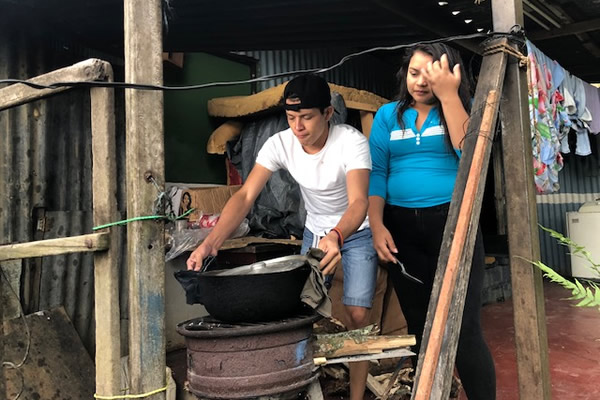
You have to drive through muddy rut filled roads on the outer fringes of San José to get to the Hijos del Arco Iris LGBTI home. It’s in a poor neighborhood where cinderblock tin-roofed houses are perched precariously on lush verdant hills. Skinny mongrels roam the neighborhood. Loud bachata music permeates the cool moist mountain air. As you enter the house, painted in faded mango, green and turquoise the first thing that you notice is the energy. Nearly 40 youth from late teens to late 20s share the space. Some are busy sweeping the cracked tile floor, others are huddled around a small battered laptop while others strategize beneath a Nicaraguan flag next to a wall calendar of upcoming events in which they will participate. I watch as a slight young man named Alberto carries an old aluminum pot to an outdoor wood fired stove and begins to make rice and beans.
“Sometimes it’s all we can eat,” he says. “Provided there are donations.”
What happens if there aren’t donations. I ask. “We go hungry,” he says almost apologetically.
Helping him cook is Arlen. The frizzy haired 20-something young lesbian was among the first people to move into the home “I was wandering through the parks, homeless,” she says. “I don’t know what would have become of me, if it weren’t for the boys,” she notes.
Two Nicaraguan refugees prepare rice and beans at the home outside San José, Costa Rica, where they are living. Hunger is among the many challenges for LGBTI Nicaraguans in Costa Rica who have fled violence associated with President Daniel Ortega’s regime’s efforts to quash anti-government protesters. (Photo by Armando Trull)
Arlen fled Nicaragua after she was flagged by security forces as one of the main providers of food, supplies and medicine to youth holed up in multiple barricades throughout Managua.
“Paramilitary crashed the door of the house where I was living,” she says. “Fortunately, I wasn’t there. That same day I headed to Costa Rica with just the clothes on my back and the little money I had.” It’s pretty much the same story for most of the youth here, fleeing one step ahead of paramilitary thugs under government orders. This humble home has indeed been a refuge. The youth share wafer thin mattresses on the floor. They huddle together like lost children, under multiple worn blankets that barely protect them from the cold sweeping up from the floor and hovering overhead. They hug battered teddy bears. On the walls, rainbow flags and even a unicorn.
“We have become like a family,” says Magdiel, one of the group’s leader, as he shivers beneath a blanket. “The older take care of the younger. We share what little we have even our body heat at night.”
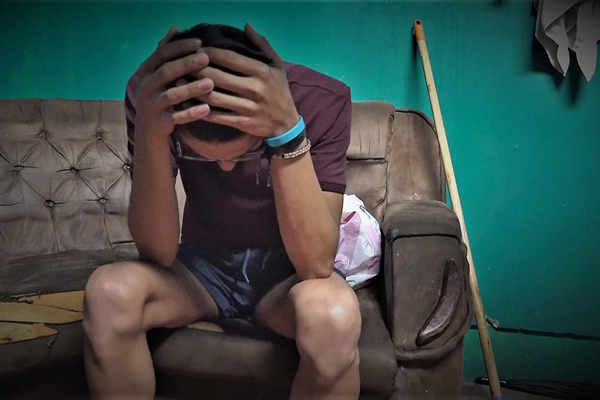
A gay man from Nicaragua sits in a house in San José, Costa Rica, after he fled violence in his homeland. (Photo by Armando Trull)
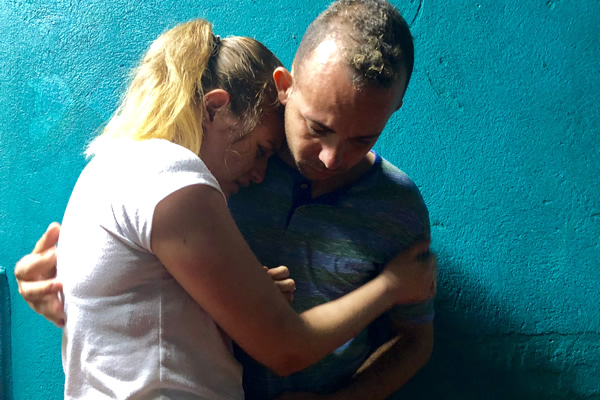
In one corner of the house towards the rear a slight young man and a blonde girl sit on a battered donated sofa talking about how much they miss their families. “I had always lived within the warm and loving embrace of my papa,” she says and then bursts into tears, the sobs coming like a tidal wave. Soon the young man is also crying and so are the other youth nearby. “We are so young, so inexperienced and innocent,” says Ulises in a cracked voice as he watches the youth embrace one another. “We long for our families so very much. It’s very painful. We did what we believed was right. We stood up against oppression.” But returning home is not an option, it could place not only them but their families in danger. So Hijos del Arco Iris LGBTI is giving these youth purpose. They participate in weekly activities such as cleaning up public parks, dance lessons and free haircuts.
“We want to show people in costa Rica that we can be a positive force in the country that has welcomed us,” says Ulises. The youth also participate in workshops to learn survival skills in a new society including how to apply for asylum.
‘A humanitarian crisis’
As undocumented refugees seeking asylum in Costa Rica, these gay youth face an uncertain existence. Unable to work legally, unused to paying for healthcare and with little support they are surviving in crisis mode. More than a million Nicaraguans have fled the political violence and the economic collapse of the country since April says Marcela Farrach, a caseworker for RET International, an international relief NGO. It’s likely that thousands of LGBTI Nicaraguans are part of that diaspora says the young woman. Farrach has been working on a pilot program sponsored by the U.N. High Commissioner for Refugees to help Nicaraguan refugees and asylum seekers in Costa Rica. “They are extremely vulnerable and the funds to help them are insufficient especially as the number of refugees continues to multiply. It is a humanitarian crisis,” Farrach says.
‘I was terrified I would be tortured and raped’
Some Nicaraguan gays have managed to escape to other parts of the world where they have a better second chance at life, including Spain. That is the case for David.
The 23-year-old gay rights activist and vlogger came under government scrutiny for posting videos of his participation in the peaceful marches and subsequent postings calling out the Ortega regime’s violent crackdown. In one tearful clip, a clearly distressed David with mascara running from his eyes says, “They are sending their thugs and mobs armed with guns, knives, rifles and shotguns. I don’t want my country to become another Venezuela. I don’t know where this will end.” For David it ended in October after a gay friend Denis Madriz was found shot to death a few days after disappearing. Madriz had been active in the protests and an iconic photo of him holding a large Nicaraguan flag had made the rounds of social media. “I feared I was next,” he says. “Human rights organizations had fled the country after death threats. There was no one left to protect us.”
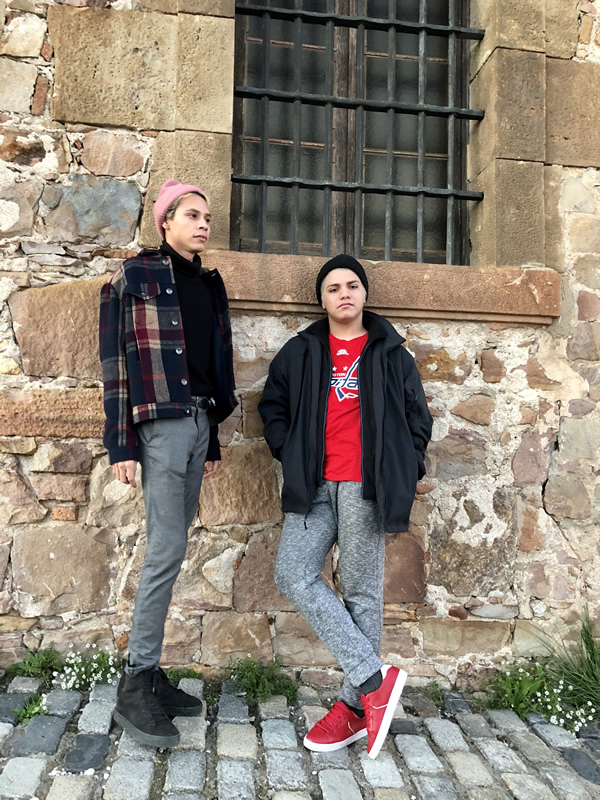
David crossed the border by bus to Costa Rica and after a few months of despair fled to Spain where he met two gay childhood friends, Victor and Justin. They also participated in the protests, providing food and drink to protesters. The slim young men are university students, one an industrial engineering major the other a psychology major. They both have white blond hair and that made them easy for government informants to finger them. A phone video recorded by Justin’s mother and aunt captured the night two armed paramilitary thugs came to arrest them.
“We are here for the two blondes, the terrorists participating in the protests,” says one of the thugs. The women denied the boys were there. “We don’t know what you are talking about,” they said defiantly. The thugs insisted and tried to break in the home and the women became shrill. Ultimately the thugs relented leaving with a final warning, “We were told they were here, we have their photos. We are coming back and we are going to fuck them up!” The youth had left the day before. Justin who is 5’5″ and weighs 120 lbs. and besides going to college was a professional makeup artist and manager at a family meat market. He says calling him a terrorist was an absurd but convenient label cooked up by the Ortega regime to arrest and disappear peaceful protesters.
“I was terrified that If I were to be arrested I would be tortured, raped, because that’s what they do to gay people and then disappeared,” says Justin, noting LGBTI protesters have been singled out for crueler treatment because of the homophobic nature of Nicaraguan society.
Victor and David say they feel safe in Barcelona because their rights as gay refugees are respected, but they admit that finding a place to sleep and even food is a daily struggle because they lack legal status. (Photo by Armando Trull)
Discrimination based on sexual orientation and gender identity was commonplace in Nicaragua before the protests broke out, but the Ortega’s government and specifically Vice President Rosario Murillo, who is Ortega’s wife, made some overtures to the LGBTI community.
The government in 2009 created the Special Ombudsman for Sexual Diversity position within its Office of the Human Rights Ombudsman. The country’s Health Ministry in 2014 issued a resolution that bans discrimination based on gender identity and sexual orientation in health care.
Murillo has appeared on Nicaraguan television with a trans woman who graduated from a prominent university with a communications degree, but the LGBTI community continues to face harassment and abuse from police officers and soldiers. Efforts to enact an LGBTI-inclusive nondiscrimination ordinance in Managua and in other cities have stalled because of the unrest. Most LGBTI groups not supportive of the government have closed their doors as their leaders and members have fled the country.
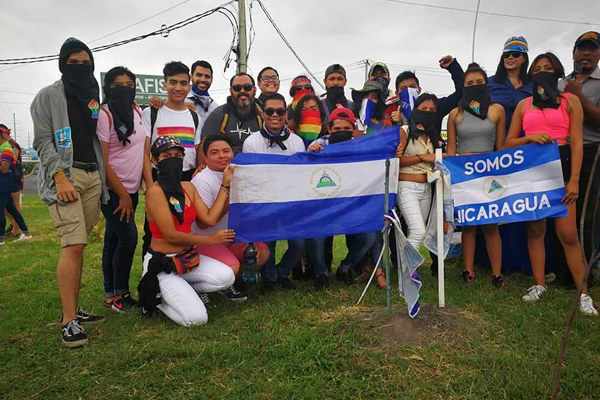
LGBTI activists participate in a Pride march in Managua, Nicaragua, on June 28, 2018. (Photo courtesy of William Ramírez Cerda)
‘Here I feel safe and welcome’
In Barcelona; Justin, Victor and now David have found a welcoming gay community that has helped them through the process of integrating into Catalonian and Spanish society. Their first stop was the community organization STOP SIDA, which means STOP AIDS. “We have lawyers who provide legal advice on how gays who are victims of violence because of their sexual orientation or gender identity can apply for asylum,” says Luis Villegas, co-manager of STOP SIDA. Villegas says the organization provides information on how to integrate into Spanish society.
“We also have social workers who provide them with resources on how to survive and thrive and ways for them to participate in workshops and outreach efforts,” he says. The youth applied for empadronamiento, a status that allows undocumented refugees to access a wealth of social and health services in Spain. They were helped to process asylum applications that would ultimately result in a NIE, an alien identification number that allows them to work as their asylum case is decided. “We are proud that as a community we are able to help fellow members of our community who are vulnerable and at risk,” says Villegas.
Victor is very grateful for that help. He tells me so as we walk through Plaça d’Espanya on a beautiful crisp fall afternoon. A pair of police officers smile and nod prompting a comment from Victor. “I was very afraid of cops when I first arrived here,” he says. “I know that in most places police are here to protect you but in my country they kill us. In Barcelona, I feel protected, I feel my rights are valued, you know?”
But life in Spain isn’t easy for these gay Nicaraguan exiles. They work in the underground economy, walking dogs, doing hair and makeup or as waiters. Sometimes they stand in soup lines to save the little they make in order to pay rent. The young men rent a small bedroom in a fifth-floor walk-up apartment in a rundown building. It’s in a working-class Barcelona neighborhood known as Venezuela because so many Latino immigrants live there. It’s a step up from when they first arrived says one of the young men. “We had to spend the night with our dates because we had nowhere to sleep, it was either that or the parks,” says Victor.
Shortly after that conversation, Justin and Victor were given NIE cards and David received empadronamiento The youth are very fortunate and on their way to a new life in Spain although the process is still many months from ending. For Hijos del Arco Iris LGBTI back in Costa Rica, it’s a much more difficult process in a poorer country straining under a refugee and humanitarian crisis of staggering proportions with fewer resources.
Yet all of these gay Nicaraguan youth face every day with optimism, dignity and hope. Living proof of the truth of their motto Juntos somos un volcán or “United we are a Volcano.” This volcano roared on April 19 and has continued to roar in Nicaragua and now roars in exile- Randal says his community fought for the rights of all Nicaragua and for a country where in the future the rights of all will be respected “for justice, for equality for what all of us as human beings deserve.”
Two LGBTI Nicaraguans who fled violence in their homelands embrace in the house in San José, Costa Rica, where they are currently living. (Photo by Armando Trull)
Paul Makonda ordered people to report others they suspected of being gay, and within days police received hundreds of reports.
‘If you know of a homosexual, you must report them to a police officer. No one can escape,’ Makonda told media.
Even though African LGBTI advocates protested the move, the World Bank and Denmark cut aid to Tanzania because of its homophobic policies. Advocacy group Pan Africa ILGA (International Lesbian, Gay, Bi and Intersex association) argued the LGBTI community would be blamed and made scapegoats for the cuts.
But in new research, Neela Ghosha of Human Rights Watch found the aid cuts had influence Tanzanian policy. The World Bank decided not to put forward a $300 million education grant because of the crackdown.
The action seemed to work. In a statement the World Bank said: ‘(government officials) assured the Bank that Tanzania will not pursue any discriminatory actions related to harassment and/or arrest of individuals, based on their sexual orientation’.
Even though the government promised to end the crackdown it has not eliminated all its discriminatory policies.
‘The extreme nature of Mr Makonda’s threats – to round up all gay men, subject them to forced anal examinations, and jail them for life – are what attracted international attention, including from the World Bank,’ Ghosha wrote.
‘But other forms of discrimination against lesbian, gay, bisexual and transgender people are persistent and pervasive.’
Ghosha pointed out the government banned HIV prevention programs for men who have sex with and the distribution of water-based lubricant for HIV prevention. Authorities also raided meetings of health and human rights group, where they accused activists of ‘promoting homosexuality’.
Two separate petitions launched earlier this year in Canada asking the government to ban conversion therapy have amassed a combined 70,000 signatures.
One petition has received 11,200 signatures, and the other – which was started by It Gets Better Canada – has 58,400, according to BBC News.
The first petition calls on Canada’s government to ban conversion therapy for minors, and also asks them to prohibit taking young people out of the country to take part in the practice.
Meanwhile, It Gets Better Canada is asking the government to clearly state that Canada “opposes the use of conversion therapy and other related treatments,” according to the BBC.
Devon Hargreaves, who helped launch one of the petitions, told the BBC that there was no reason for Canada to allow the practice as a country that considers itself a forerunner in human rights.
Just three countries in the world ban conversion therapy – Ecuador, Brazil and Malta.
UK LGBT+ charity Stonewall defines conversion therapy as “any form of treatment or psychotherapy which aims to change a person’s sexual orientation or to suppress a person’s gender identity.
“It is based on an assumption that being lesbian, gay, bi or trans is a mental illness that can be ‘cured’.”
The charity also brands the practice as “unethical and harmful.”
All major counselling and psychotherapy bodies in the UK – as well as the NHS – have condemned conversion therapy.
A 2009 survey of more than 1,300 mental health professionals in the UK found that over 200 had offered some form of conversion therapy.
Conversion therapy has been making headlines recently as two high-profile films have recently been made about the practice.
Boy Erased and The Miseducation of Cameron Post have both made waves for their powerful depictions of the harmful practice.
In May 2014, Time magazine featured trans actress Laverne Cox on their front cover and declared the arrival of a “trans tipping point.” American Vogue described 2015 as “the year of trans visibility.”
For someone like myself, intimately aware of the place of trans people in culture since my teens in the 1960s, and having been a leading campaigner for almost 30 years, these were monumental events and you might forgive me for thinking by September 2016, when pitching an anthology-based history of trans emergence in Britain, that I was going to be putting together a retrospective on a community whose story of emergence and freedom was almost over. We felt like the worst was behind us.
How could I have been so wrong, so prematurely relaxed?
2016 was a year historians will be writing about in a hundred years, of course, just as we look now on the origins of the First World War. Who could have predicted the emergence of a very ugly kind of populism, fuelled by economic grievance but weaponised by the production of easy scapegoats? Foreigners. Nationalism. The EU. Experts. Brexit was already a reality by the time I sat down to pitch my story about a community whose history goes back far longer than most people imagine. And Trump was just about to unexpectedly win the presidency, helped in large part by his policies designed to placate angry evangelicals, right wing neoliberals and actual Nazis and white nationalists. Still, you’d have thought that was far away and unlikely to touch us, eh?
Two significant events then happened: One public and one that we are only now figuring out.
In April 2017, Theresa May called a snap General Election. All three parties made manifesto commitments to reform the Gender Recognition Act (GRA). Indeed it was the Tories’ only LGBT manifesto commitment. In October that same year May made the elimination of medical evidence in GRA applications part of a speech at the Conservative Annual Conference. The idea of ‘Self-ID’ (a really bad choice of words) was on the table as potential government policy.
Less obvious to us in Britain, that same month, the US right wing’s Values Voter Summit — an annual strategic planning jamboree for anti-LGBT interests — was discussing the need to switch focus onto splitting the LGBT alliance, by targeting all their guns on trans people. Attacking trans people was to be the way of regrouping and rallying the troops after losing their war on equal marriage
Correlation isn’t causation — a smoking gun (if it exists) is yet to be uncovered — but it was shortly after these two seemingly disconnected events that the current controversy about trans people and our rights became really unpleasant in Britain. And that became the backdrop for the whole of 2018.
“2018 has been defined by a campaign against trans people and anyone identified as a possible ally.”
— Christine Burns
Groups that nobody had ever heard of before suddenly emerged, with glossy websites registered in the US, claiming to represent mainstream women’s interests. Questions have been raised about some of their funding. The ‘Feminist’ section of Mumsnet became the unofficial base for radicalising ordinary women who knew no more than what the leading figures were telling them.
And those leaders found a ready ear in some of Britain’s right-leaning press — so much so that there was barely a Sunday in 2018 when the Sunday Times (and sometimes the Mail) was not running story after story hostile to trans people, with no effective right of reply. “We’re being silenced,” cried the people silencing trans people. This peaked as first Scotland and then Westminster conducted public consultations on how to improve the GRA
Everything else is just detail. 2018 has been defined by a campaign against trans people and anyone identified as a possible ally. Everyone agrees it is unprecedentedly toxic but, just as Donald Trump pretended after Charlottesville, this is not an issue where ‘both sides’ can be considered equivalent.
How will it end? At the moment I don’t know. I pray that some of the blatant stirring by anti-trans campaigners doesn’t lead to physical violence. 2019 will be horrible, set against a political and economic landscape that may be nothing short of apocalyptic. At such times it is easy to make scapegoats. My prayer for the year ahead is that we — trans people — are not ‘it.’
Husband and wife Jake and Hannah Graf are both trans | Photo: Paul Grace
18 December 2018 19:07 GMT
Six leading publications aimed at lesbian and bisexual women have issued a joint statement in support of trans people.
Representatives of DIVA, Curve, Autostraddle, LOTL, Tagg and Lez Spread The Word signed the statement.
They state, unequivocally, ‘That trans women are women and that trans people belong in our community.
‘We do not think supporting trans women erases our lesbian identities; rather we are enriched by trans friends and lovers, parents, children, colleagues and siblings.’
It said it was issuing the statement in the wake of anti-trans reporting across much of the media. There have also been a number of lesbians who have spoken out against trans rights.
Pride protest over trans rights
Last summer, lesbian protestors briefly halted the Pride in London march. Among their objections, the protestors claimed that some younger, butch lesbians were rushing to identify as trans men instead of embracing their lesbian identities.
They also objected to trans women with penises gaining access to female-only spaces such as changing rooms.
In the press, many media commented on the UK’s recent consultation on changing gender recognition laws. Even the left-wing Guardian was criticized for an editorial cautioning against changing the law.
‘We strongly condemn writers and editors who seek to foster division and hate within the LGBTQI community with trans misogynistic content, and who believe “lesbian” is an identity for them alone to define,’ says the statement.
‘We condemn male-owned media companies who profit from the traffic generated by these controversies.’
Trans rights advocates march at Glasgow Pride, 14 July 2018 | Photo: David Hudson
‘Concerned about the message these so-called lesbian publications are sending to trans women’
The statement continues:
‘We also strongly condemn the current narrative peddled by some feminists, painting trans people as bullies and aggressors – one which reinforces transphobia and which must be challenged so that feminism can move forward.
‘We are really concerned about the message these so-called lesbian publications are sending to trans women and to young lesbians – including trans lesbians – and we want to make in clear this is not in our name.
‘As the leading publications for queer women, we believe it is our responsibility to call out scaremongering conspiracy theories levelled at the trans community, and make it clear that DIVA, Curve, Autostraddle, LOTL, Tagg and Lez Spread The Word will always be safe spaces for the trans community.
‘Forty years ago, to be a lesbian was to be questioned and persecuted. Today things are better for cis lesbians but there are still places where to be a lesbian is impossible.
‘So it is for trans men and women, as well as non-binary people, many of whom identify as lesbian, bisexual, gay or queer. We know something of these struggles. And just as they and other allies have supported us, so we must support those among us who are trans, or risk ending up on the wrong side of history.
‘The sooner we stop focussing on what divides us and instead focus on our commonalities, the stronger we will be to confront the other injustices imposed on us.
‘We won’t be divided.’
Toxic ‘debates’ and tackling hurtful systems
Signing the statement are: Carrie Lyell (Editor, DIVA magazine); Linda Riley (Publisher, DIVA magazine); Riese Bernard (Co-founder and editor-in-chief, Autostraddle); Merryn Johns (Editor, Curve); Silke Bader (Publisher, Curve and LOTL); Eboné F. Bell (Editor-in-chief, Tagg Magazine); and Florence Gagnon (Founder and president, Lez Spread The Word).
Lyell told Gay Star News why she hoped to happen going forward.
‘I hope the LGBTQI community can move past these toxic “debates” about what it means to be a woman or to be a lesbian and to actually get down to tackling the structures and systems that really hurt us. We can’t do that if we aren’t united.’
She also spoke of the importance of speaking out.
‘We can’t achieve equality without visibility, and therefore it’s so important that trans people and their allies are louder than our detractors.’
With Christmas less than a week away, it might be the perfect time to help others in need.
Micro Rainbow International Foundation is opening a new safe home for LGBTI asylum seekers in London and is calling for donations.
The charity is urging everyone to donate whatever they can on social media. They have set up an Amazon wishlist where whoever wishes to help can buy anything from bedsheets to microwaves.
MRI is crucial in helping asylum seekers
MRI was born in 2012. It provides shelter to lesbian, bisexual, gay, trans and intersex people who are homeless because they have been shunned by their families or persecuted by their government.
After programmes in Cambodia and Brazil, they opened the first safe house for LGBTI asylum seekers in the UK in 2017.
They have inaugurated other two safe houses in London ever since.
For one of their new houses in the UK capital, MRI is asking people to help via Amazon.
‘Many LGBTI people around the world are victims of persecution and violence because of their sexual or gender identity or intersex status. They face imprisonment or the death penalty just because of who they are and who they love. Those who can, leave their countries behind and come to the UK to seek safety,’ they wrote on their website.
‘However, when they come to the UK they are not safe and they face several challenges. One of these challenges is homelessness.’
They furthermore added: ‘In our experience the abuse that LGBTI asylum seekers face in accommodation pushes many to become homeless at a critical point in life: when they try to save their lives and to secure their right to stay in the UK. This is why Micro Rainbow’s safe housing project is so vital. Micro Rainbow decided to create safe homes where LGBTI asylum seekers can be safe whilst they go through the grueling asylum process.’
This is what you can do to help
‘Running the safe houses and providing the extra support that LGBTI asylum seekers need is expensive,’ they also explained.
‘However, together we can make sure that each person receives adequate bedding, food and clothing.’
There are different ways to help this Christmas. You can either make a monthly donation, donate an Amazon gift card or buy an actual item off the wishlist for as little as £5.
Apple has removed a religious app from its online store which portrayed being gay as an ‘addiction’, ‘sickness’ and ‘sin’.
Religious group, Living Hope Ministries created and owns the LHM Men’s Network app . It was pulled after a gay-rights organization petitioned against it.
Truth Wins Out, which says it fights ‘anti-gay religious extremism,’ launched the petition last Thursday, US news site NBC reported.
The Living Hope Ministries is a nonprofit that says it serves ‘those who are seeking sexual and relational wholeness through a more intimate relationship with Jesus Christ.’
Living Hope Ministries’ executive director Ricky Chelette. Photo YouTube
Executive director Ricky Chelette told NBC that the group developed its app three years ago. He said the group is a ‘discipleship ministry’ and ‘very much like a church.’
We help people understand who they are in Christ,’ Chelette told NBC News on Sunday. ‘We only help those individuals who are seeking us.’
Truth Wins Out alleged that the app sought for LGBTI youth ‘to change from gay-to-straight through prayer and therapy
In 2014, Tim Cook became the first ceo of a Fortune 500 company to come out publicly
The petition had 356 supporters and Truth Wins Out thanked Apple and its ceo Tim Cook for removing the offending app.
‘We thank Apple for exemplifying corporate responsibility and taking swift action to remove a dangerous app that stigmatizes and demeans LGBT people,’ said Truth Wins Out executive director Wayne Besen.
‘Ex-gay programs are consumer fraud and cause significant harm to the people they purport to help.’
Truth Wins Out said it will seek to have the Living Hope Ministries app removed from other platforms, such as amazon.com, that still host it.
Germany’s parliament has passed a law which will add a third gender to birth certificates for people born intersex.
The blank option on forms, instituted in Germany in 2013 as a Europe-wide first, will be replaced by a “diverse” option for newborns whose sexual anatomy does not fit the binary male or female, according to The Local Germany and Deutsche Welle.
Intersex people will also be able to change their gender and first name on birth certificates if they feel they were assigned the wrong gender at birth, though this will usually require a medical certificate.
The Federal Constitutional Court ordered that by the end of 2018, the parliament must legally recognise another gender option from birth or remove gender from documents entirely.
This overruled several lower courts who had rejected the intersex person’s case.
In August, Germany’s cabinet, led by Chancellor Angela Merkel, voted to approve plans to add the extra gender option.
Some pro-LGBT campaigners including Greens parliamentary group leader Anton Hofreiter have said that the law doesn’t go far enough.
Hofreiter opposed the need for people to provide a doctor’s certificate before any change could be made to their documents, telling Funke Media Group newspapers that it was “preposterous and a sign of distrust of those who don’t fit into an old-fashioned view of society, especially that of the CDU (Christian Democratic Union of Germany) and CSU (Christian Social Union in Bavaria),” according to Deutsche Welle.
Lesbian and Gay Federation in Germany board member Henny Engels also criticised the new law, as he said it was too focused on physical characteristics.
Engels insisted that “gender is not only defined physical signs, but also by social and psychological factors.”
More conservative lawmakers supported the requirement for a medical document, with CDU politician Marc Henrichmann, who sits in the Bundestag, saying it meant people would not be able to self-identify their gender.
The acting parliamentary group leader of far-right party AfD (Alternative for Germany), Beatrix von Storch, also made her opposition to self-identification clear.
She said: “Which gender you belong to has been an objective fact since the beginning of time — just like age and body measurements.”
Some people think you can’t be gay and Christian. What better way to prove them wrong than with a list of LGBTI saints?
The Catholic Church doesn’t want you to read this. They’ve deliberately erased many gay saints from official lists.
And we have to admit it is difficult to find hard historical evidence about most saints. Many of the stories about them are little more than legends.
But if you start looking, there are lots of LGBTI saints and martyrs. Here are just a few of the most famous:
St Joan of Arc
The 1999 movie The Messenger: The Story of Joan of Arc.
Jeanne d’Arc is not just the most famous LGBTI saint but the most famous saint full-stop.
Joan was just a French peasant. But an angel appeared to her in a vision and told her God wanted her to lead the French fight against the English in the Hundred Years War.
She persuaded the French Prince Charles to let her lead his army, even though she had no military training. And, dressed as a male soldier, she achieved a momentous victory over the English at the city of Orléans in 1429.
Thanks to her, the prince was crowned King Charles VII. But Joan was then captured by the English.
They decided she was a heretic and a witch and burnt her at the stake. She was just 19.
Some refuse to accept Joan was LGBTI.
Was she a trans warrior or did she only cross-dress in male armor through necessity? Either way, she would be part of our gay, trans and gender-fluid family today.
Likewise, the same people who claim she was a virgin admit she liked to share her bed with other young women. And that sounds pretty lesbian to us.
St Sebastian
Gerrit van Honthorst’s depiction of Saint Sebastian.
St Sebastian is the original gay icon. This near-naked, young, muscled man – tied to a post and pierced with arrows – is one of the most famous images in fine art.
He was the commander of a company of archers in the imperial Roman bodyguard. And he was known to be ‘close’ to his male superiors. But he had a secret.
To rescue two other Christian soldiers, he ‘outed’ himself as Christian too. The Emperor Diocletian ordered that he should be shot to death by his fellow archers.
Strangely, that didn’t kill him. The pious St Irene saved him and treated his wounds. But Diocletian caught up with him. He ordered a second execution and Sebastian’s fellow soldiers beat him to death.
There’s no single reason why he became the unofficial gay patron saint. It’s a mix of his rumored sexuality, his ‘coming out’ story and his iconic homoerotic image penetrated with arrows. And homosexuality was once considered an illness while St Sebastian was known to save plague victims.
St Wilgefortis
Conchita (right) brought fresh attention to St Wilgefortis.
Legend says Wilgefortis was the daughter of a king in Portugal who took a vow of chastity.
When her father tried to force her into marriage with the king of Sicily she prayed for help. God saved her by giving her a beard and the Sicilian king refused to marry a bearded wife.
So she is a trans male saint.
Sadly, there is no happy ending. Her father got so angry he crucified her.
Her only reward is to become the patron saint of difficult marriages. After all, it’s a particularly difficult marriage that ends in crucifixion. In Spain she is called Librada because she helps women who want to be ‘liberated’ from difficult husbands.
The Catholic Church plays down St Wilgefortis. But after Conchita – another bearded lady – won the Eurovision Song Contest in 2014 for Austria, depictions of the saint gained short-lived cult status.
St Perpetua and St Felicity
George Hare’s 1890 painting Victory of Faith depicted Perpetua and Felicity in prison.
This North African lesbian couple are the patron saints of same-sex relationships.
Perpetua was 22-year-old noblewoman with a newborn baby. Felicity, who was pregnant, was her slave.
Roman soldiers arrested them in around 203AD because they were Christians. They comforted each other in prison and Perpetua wrote a jail diary, describing the visions she had while inside.
Felicity worried that she wouldn’t be martyred because Roman law forbade the execution of pregnant women. But she gave birth to her daughter in time.
The day came for games to celebrate the birthday of the Emperor Septimus Severus. As part of the entertainment, the pair were taken into the amphitheater in Carthage, North Africa, along with a group of male Christians.
Gladiators whipped them. Then boar, a bear, and a leopard were set on the men, and a wild cow on the women. That still wasn’t enough to kill them and they gave each other the kiss of peace before a swordsman finished them off.
Perpetua’s diary became the ‘Passion of St Perpetua, St Felicitas, and their Companions’. The story was so popular in North Africa that St Augustine ordered people not to treat it like it was part of the Bible.
St Paulinus
St Paulinus processed through the streets of Nola, near Naples, Italy.
If you’ve ever heard a bell ringing to call you to church, you’ve got the bisexual St Paulinus to thank. He invented that tradition.
He had previously been a married Roman senator. But after his wife died, he became bishop of Nola in Italy from 395AD to 431AD.
When the Vandals raided the region, a poor widow came to Paulinus asking him to help her son who the Vandals had carried off.
He had spent all his money paying ransoms for other captives. So he went to Africa to offer himself to the Vandals in return for the widow’s son. They agreed and made Paulinus a gardener. But when the Vandal king realized his son-in-law’s slave was the Bishop of Nola, he set him free.
What’s not well known is Paulinus also wrote love poems to his boyfriend, Ausonius. In one, he promised there love would last even after his death. And he added:
Thee shall I hold, in every fiber woven, Not with dumb lips, nor with averted face Shall I behold thee, in my mind embrace thee, Instant and present, thou, in every place.
He is still honored every year in Nola when his statue is paraded through the streets. American descendants of Italians from Nola also honor him in the same way in Brooklyn.
St Francis of Assisi
Mickey Rourke as St Francis of Assisi in the movie Francesco.
St Francis is one of the best-loved religious figures in history, famous for hugging lepers and showing compassion to animals.
What you probably don’t know is he encouraged the other Franciscan friars in his 13th century cloister to call him ‘mother’.
Even more surprisingly, he allowed a widow to enter the all-male friary, renaming her ‘Brother Jacoba’.
And it is likely he had at least one same-sex relationship while in his 20s. His partner’s identity is hidden by history but is thought to be Brother Elias of Cortona.
Thomas of Celano, who knew Francis personally and wrote a biography of him in 1230 just four years after his death, wrote:
‘Now there was a man in the city of Assisi whom Francis loved more than any other…
‘He would often take this friend off to secluded spots where they could discuss private matters and tell him that he had chanced upon a great and precious treasure. There was a cave near Assisi where the two friends often went to talk about this treasure.’
St Sergius and St Bacchus
The Passion of Saints Sergius and Bacchus by Elastic Theatre.
Homophobic Christians tell us that same-sex marriage is against their faith. Trouble is they don’t know their own history. Step forward Saints Sergius and Bacchus.
Sergius was a commander in the Roman army in the third century and Bacchus was his second in command.
They were referred to in the earliest records of their story as ‘erastai’, the Greek word for ‘lovers’. And it’s believed they committed themselves to each other in a Christian ceremony called ‘adelphopoiesis’ or ‘brother-making’ which was a kind of same-sex marriage.
But their faith got them in trouble while they were stationed in Syria in 303AD. As Christians, they refused to sacrifice to Jupiter, the Roman’s chief god.
Officials arrested them, dressed them in women’s clothing and paraded them through the street to humiliate them into submission. But they resisted, chanting they were dressed as brides of Christ.
So the Romans turned to torture. They separated them and beat them so severely that Bacchus died.
That wasn’t the end of the story. That night Sergius had a vision.
Bacchus appeared to him in his soldier’s armor and with the face of an angel. He urged Sergius not to give in, saying they would live together as lovers forever in heaven. It’s a unique martyrdom story, because martyrs are always promised they will be with God in heaven, not with their lover.
Over the coming days, Sergius was tortured and finally beheaded.
Christians honored them as saints right up until 1969, the same year as the Stonewall Riots. The Catholic Church stripped them from the official list of saints, perhaps to starve the emerging gay rights movement of their power.
St Aelred
The Name of The Rose movie depicted medieval monastic life.
The patron saint of friendship was erotically attracted to men, and celebrated male relationships, throughout his life.
Aelred was the abbot of a Cistercian abbey in North Yorkshire, England for 20 years until his death in 1167. He wrote about the link between friendship and spirituality, saying ‘God is friendship’.
Aelred advocated chastity. But his passion for male relationships is clear when he wrote: ‘It is no small consolation in this life to have someone who can unite with you in an intimate affection and the embrace of a holy love…’
In the same passage he describes this relationship with another man as one where ‘the sweetness of the Spirit flows between you, where you so join yourself and cleave to him that soul mingles with soul and two become one.’
St Galla and St Benedicta
Women in the Dark Ages faced few choices, as depicted in The Last Kingdom.
Galla had been married but was widowed after just one year. Not wanting another relationship with a man, she grew a beard to ward them off.
And she went even further. St Galla founded a convent in Rome in the sixth century and fellow nun Benedicta moved in with her there.
Then Galla fell seriously ill and St Peter appeared to her in a vision, telling her to prepare for death. She was devoted to God so liked the idea of going to heaven. But she was also devoted to Benedicta and didn’t want to leave her behind.
So she prayed to Peter that Benedicta would swiftly follow her to the afterlife.
Admittedly, by modern standards, praying for your partner’s death seems a bit wrong. But Peter agreed.
Galla died in 550AD of breast cancer and Benedicta’s death came 30 days later, just as St Peter had promised.
Historical note on gay saints
To historians, we would point out there are around 10,000 Catholic saints (though there is no definitive figure). By any impartial standard, some of them are bound to have been LGBTI.
To Catholics, we would say that you accept a saint’s sanctity on the basis of faith, not scientific proof. So why would you not accept their sexuality on the same basis?