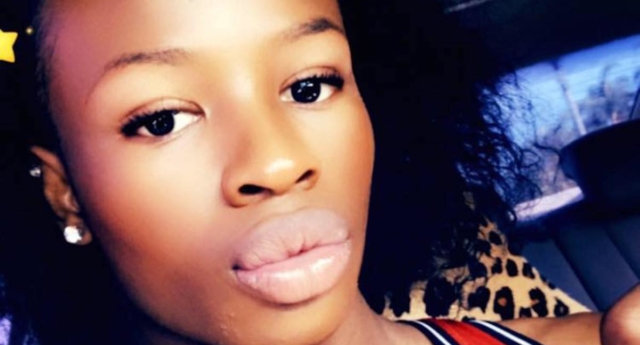
Local media have reported on Moore’s death, with some outlets referring to the woman by the name she was given at birth (commonly known as ‘deadnaming’).
Police are reportedly treating Moore’s death as murder. However, it is not yet clear if they are investigating it as a hate crime.
The overwhelming majority of known trans murder victims in the US this year have been trans women of colour.
Police are reportedly treating Moore’s death as murder. (Londonn Moore/Facebook)
“When it comes to murder, murder is murder,” North Port Police Department officer Joshua Taylor told NBC. “Whether it’s a hate crime or not, you’re going to pay that price.”
Just a week before her death, Moore had posted on Facebook: “Ima give this whole love thing one more chance. Wish me luck.”
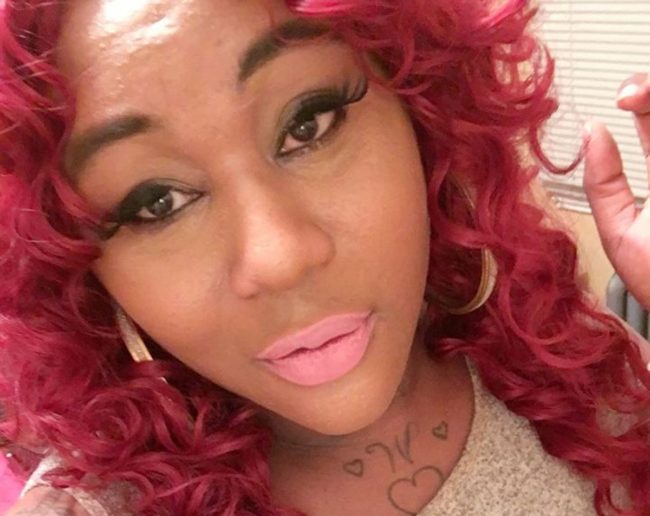
Tucker, who had celebrated her 30th birthday on September 2, was found with a gunshot wound by police at about 1am on a highway in the Hunting Park area of the city, according to local media reports.
She was taken to Temple University Hospital, where she was pronounced dead. Police are reportedly looking for a suspect in connection with the murder.
At the time of Tucker’s death, the Human Rights Campaign reported that 16 of the 19 known killings of trans people in the US in 2018 have been women of colour.
Shantee Tucker was found dead on September 5. (Shantee Tucker/Facebook)
These Women Of Various Skin Tones Are Raving About Savage X Fenty.
See What They Have To Say About The Hottest Styles!
Ad by Savage X Fenty
Dejanay L. Stanton, a 24-year-old woman, was found on a street in Chicago on Thursday morning with a gunshot wound to the head, the Chicago Sun-Times reported.
The other woman, 18-year-old Vontashia Bell, was found in a street in Shreveport, Louisiana, with gunshot wounds to the chest and wrist.
Sarah McBride, national press secretary for the Human Rights Campaign, recently told PinkNews: “There is a growing epidemic of violence targeting transgender people, particularly Black transgender women.
“This is an urgent crisis that is a by-product of the toxic and violent combination of transphobia, misogyny, and racism. As a society, our policymakers and lawmakers must do more to combat this violence.”
More than half (51 percent) of trans male teenagers have attempted suicide in the past year, according to new research.
The new study by researchers at the University of Arizona also found that more than four in 10 (42 percent) of non-binary adolescents and 30 percent of trans female teens had attempted suicide.
The new research has found trans and non-binary teenagers are significantly more likely to attempt suicide. (Getty)
Suicide is the second leading cause of death among teenagers and young adults aged between 10 and 34 in the US.
The latest data revealed that transgender and non-binary teens—aged between 11 and 19—are at a significantly greater risk of attempting suicide than their peers who are cisgender, meaning
Nearly two in 10 (18 percent) of cis female teens, and 10 percent of cis male adolescents, had tried to end their lives, according to the study.
Russ Toomey, an associate professor at the University of Arizona, who led the research, based his findings on an analysis of data from the Profiles of Student Life: Attitudes and Behaviors survey—a national survey of 120,617 adolescents in the US.
The survey, carried out between 2012 and 2015, included data from 202 transgender teenagers, 70 per cent of which were trans male adolescents.
Previous research has show that an alarming percentage of transgender people have attempted suicide. (Scott Olson/Getty Images)
Commenting on his research, Toomey said: “Transmasculine youth and non-binary youth are the two populations that often are the least focused on in the transgender community.
“So really reorganising our efforts to focus in and try to really understand and learn about the experiences of these youth is critical.”
Past research has shown that a shocking proportion of transgender people have attempted suicide.
In 2016, a study by the NationalCentre for Transgender Equality found that 40 percent of transgender people had tried to end their lives.
Other studies have also revealed that lesbian, gay and bisexual (LGB) young people are more likely to attempt suicide than their straight counterparts.
A 2016 study by the Centers for Disease Control and Prevention found that lesbian, gay and bisexual (LGB) young people are almost three times as likely to seriously contemplate suicide than heterosexual youths.
It also found that LGB youth were five times more likely to have attempted suicide than heterosexual young people.
If you are in the US and are having suicidal thoughts, suffering from anxiety or depression, or just want to talk, call the National Suicide Prevention Line on 1-800-273-8255. If you are in the UK, you can contact the Samaritans on 116 123.
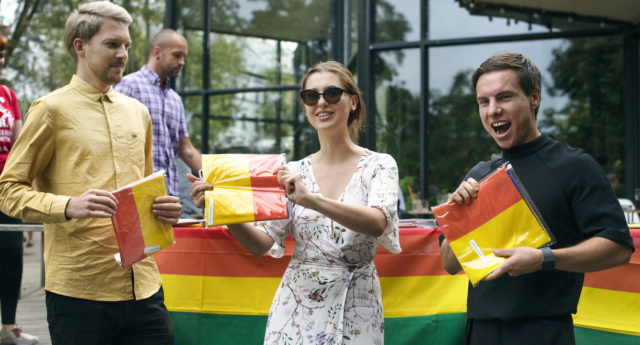
Fillmaker Romas Zabarauskas (left) and LGBT+ activists handing out free Pride flags in Vilnius on Friday. (Arcana Femina)
PinkNews Daily LGBT+ Newsletter
Two Lithuanians have responded defiantly to a series of arson attacks against the LGBT+ community in Vilnius—by buying 500 rainbow flags to wave around the city.
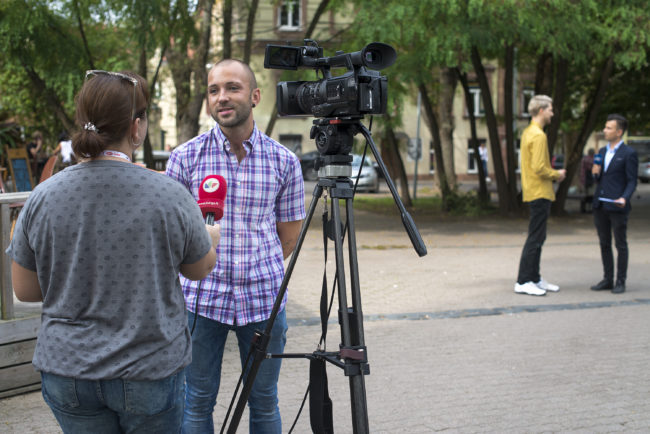
Filmmaker Romas Zabarauskas and LGBT+ rights activist Tomaš Ilja decided to fundraise thousands of euros to buy the flags after arsonists targeted the office of the Lithuanian Gay League (LGL)—the country’s only non-governmental organisation representing LGBT+ people—on August 10.
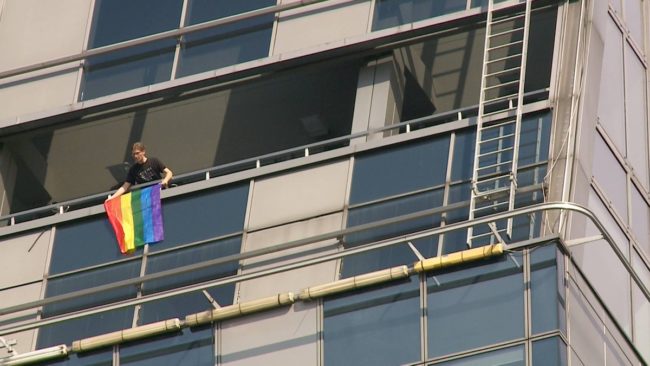
And, on September 2, arsonists set fire to the corridor outside Zabarauskas’ flat on fire in a possible homophobic incident, after the director hung a Pride flag on his balcony.
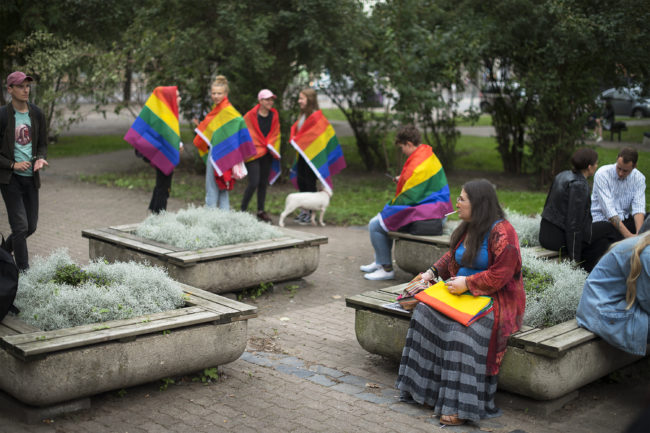
LGBT+ activists with Pride flags in Vilnius. (Arcana Femina)
Speaking to PinkNews, Zabarauskas said that, following the arson attack outside his flat, a police offer had told him to take down his Pride flag.
“The next morning, after the initial shock, I realised that not only I won’t take the flag down, I need to do something more to send a strong message and not to give in into fear,” he explained.
“So I made this story public, emailed some people and we quickly raised enough funds to buy 500 flags.”
Zabarauskas said that supporters of his and Ilja’s initiative are posting their own Pride flags on social media using the hashtag #LGBTdraugiškaLietuva, which means “LGBT+ friendly Lithuania.”
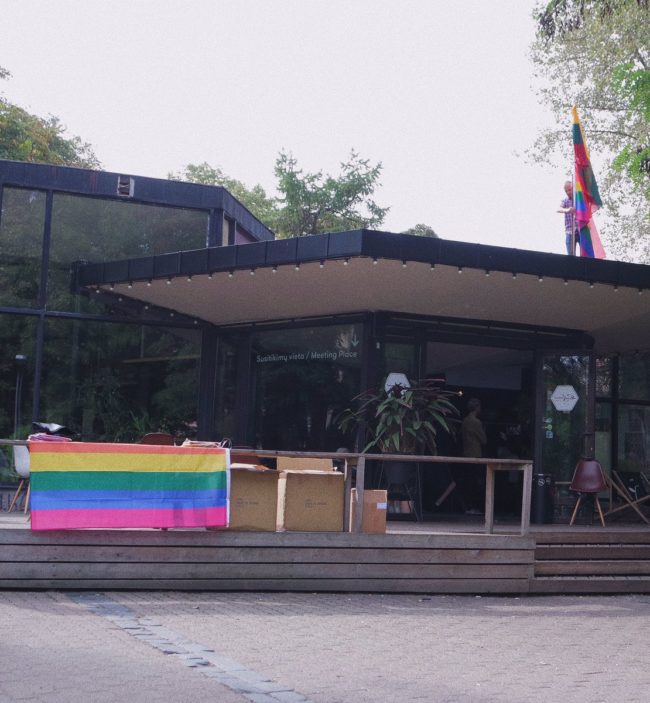
The first 400 Pride flags were handed out for free to LGBT+ supporters at the gay-friendly Paviljonas jazz club on Friday in the city.
A further 100 flags will be distributed for free during the queer festival Kreivės in Vilnius.
The initiative has been supported by politicians across the city, including Vilnius city councillor Mark Adam Harold, who attended the event on Friday and hung the Pride flag on the Vilnius City Municipality building. He has also supported the campaign on social media.
Zabarauskas also said that Vilnius city mayor Remigijus Šimašius has expressed support for the campaign. PinkNews has contacted Šimašius for comment.
Pride flags hanging from a building in Vilnius. (rzabarauskas/Twitter)
Zabarauskas continued: “Taking down a flag and hiding your true identity never makes you feel safer. Freedom of expression and acceptance do. I’m currently surrounded by rainbow flags—I can see one in each of the three buildings around mine. That makes me feel great.”
“Lithuania is a free country and we’ll defend our freedom with Pride,” he added.
LGBT+ rights activist Tomaš Ilja. (Arcana Femina)
“I care about LGBT+ visibility. I truly think it’s the main way to go if we want to achieve equality in our region. And it feels better to live your true life.”
Zabarauskas explained that he could not be certain that the arson attack outside his flat was a homophobic incident, but added that it “deserves to be investigated.”
Mark Adam Harold hanging a Pride flag on the side of the Vilnius City Municipality building. (rzabarauskas/Twitter)
He said, however, that the attack on LGL was “clearly a hate crime.”
PinkNews has contacted the police in Vilnius over the arson attack on LGL, and was directed to the Prosecutor General’s Office of the Republic of Lithuania, which has also been contacted for comment.
The Trump administration defended a new military policy that will allegedly result in HIV-positive service members being fired in violation of their constitutional rights when it takes effect Oct. 1.
The “Deploy or Get Out!” directive is intended to improve military readiness by weeding out soldiers who can’t deploy overseas for more than 12 consecutive months “for any reason.” An earlier directive from the height of the AIDS crisis prevents soldiers with HIV from deploying overseas, meaning the new policy may make it impossible for them to serve.
But the military has wide latitude in deciding who can serve, the U.S. said in filing Sept. 7 in federal court in Alexandria, Virginia, in seeking to dismiss a lawsuit over the policy.
The lawsuit was filed by OutServe-SDLN on behalf of a National Guard member who was deployed to Kuwait and Afghanistan before being diagnosed in 2012. He was later denied a promotion, apparently because he could not be redeployed.
The emcee at an LGBT journalists’ organization annual conference Saturday night called attendees “things and its.” Marshall McPeek, a meteorologist at a Sinclair-owned ABC affiliate station in Ohio later apologized and resigned his membership to The Association of LGBTQ Journalists (NLGJA).
“Ladies and gentlemen, things and its,” were the words McPeek chose to begin the evening’s event in Palm Springs, California, which was hosted by Fox News.
But it was a tweet from Mary Emily O’Hara, who covers LGBTQ news for Condé Nast’s them, that drew attention to McPeek’s offensive remarks. Those remarks were seen as especially bigoted toward the transgender and non-binary journalism professionals in attendance.In a statement to NCRM, the NLGJA called McPeek “a volunteer emcee,” who “made an inappropriate, unscripted remark that does not reflect our values.”
“We’ve worked hard for many years to make NLGJA an inclusive organization for transgender and nonbinary journalists,” the organization, in the unsigned statement, wrote. “People were understandably hurt and offended by last night’s remarks. As journalists, we understand uniquely that words matter. We apologize and are committed to working to make NLGJA more inclusive and diverse.”
McPeek has not publicly commented since his apology at the event.
Monica Roberts, the award-winning journalist and founder of TransGrio, reportedly shouted, “Oh no he did not,” and, “there are no things or its here,” when McPeek made his bigoted comment.
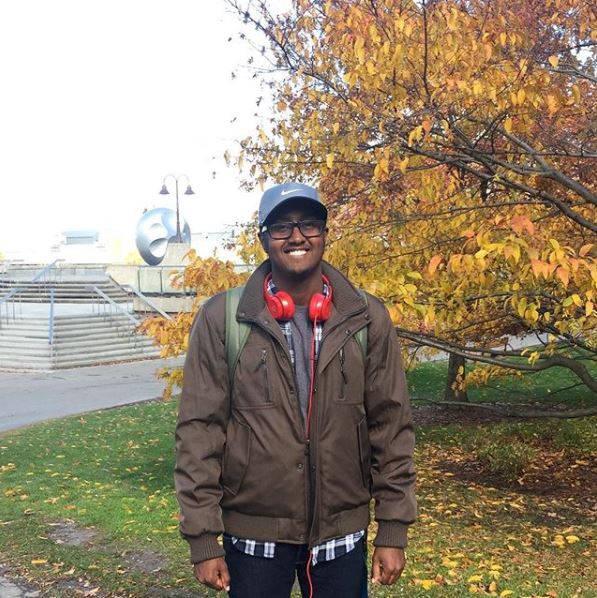
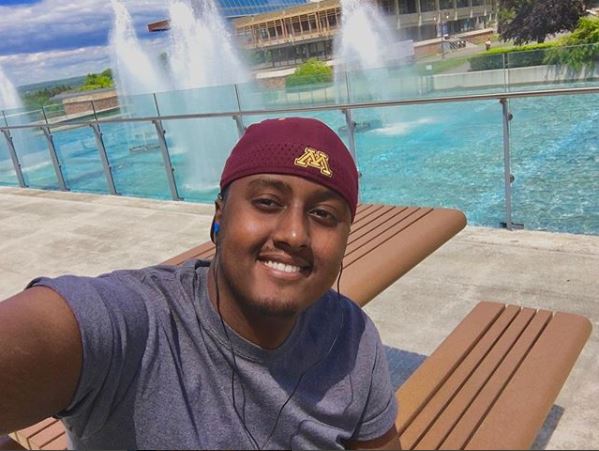
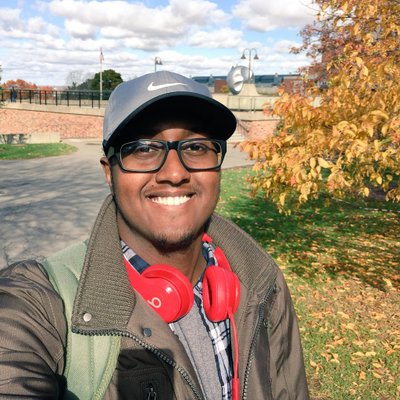
A gay student who was forced to flee Kenya after his family tried to send him to a gay conversion camp has been awarded the Colin Higgins Foundation’s annual Youth Courage Award.
Mahad Olad’s terrifying ordeal in the summer of 2017 left him with no contact with his family, who brought him to Kenya under the pretence that it was a “vacation.”
Mahad Olad (Instagram)
Receiving the Youth Courage Award also means that he will receive a $10,000 grant. The award is given to an inspiring person within the LGBT+ community who has overcome adversity brought on by their identity.
Olad, who lives and studies in New York, opened up about his ordeal of almost being sent to a gay conversion camp in his student newspaper, The Ithacan.
He went on a holiday in the summer of 2017 to Kenya with his mother, who Olad says comes from an “extremely conservative Muslim background.”
Watch PinkNews
video playing
PinkNews Awards 2015: Ed Milliband wins…
27/10/15
Ask the Aunties: Should I end my secret gay…
07/09/18
Chloë Grace Moretz on ‘praying the gay away’
05/09/18
‘The only gay in Nigeria’: How I became a refugee
07/08/18
Gay poet uses blood as ink to protest…
30/07/18
However, upon arriving in Kenya, his mother told him that it was not a vacation, as he had been told, and that she had brought him there to send him to a gay conversion camp.
He was horrified to discover that his family had discovered the truth about his sexuality, which he had chosen to keep from them.
His mother asked him to withdraw from college in New York so he could be placed under the control of a group of sheiks who would reform his religious beliefs and “reorient” his sexuality.
“A few sheiks were at our hotel that night,” Olad wrote in his student newspaper earlier this year. “They briefly spoke to me about how being gay and atheist is unequivocally against my Islamic upbringing and African heritage.
“I knew that when they came back to get me the following morning, I would be forced to go with them.”
Mahad Olad (Twitter)
Olad said that the camps that operate in Kenya and Somalia are terrifying places where captives are subject to “severe beatings, shackling, food deprivation and other cruel practices.”
“Those who fail to cooperate, make adequate progress or try to escape could possibly be killed.”
Olad told his mother he was going for a walk that night and immediately called a group called the Ex-Muslims of North America, who helped him get out of Kenya and back to the United States. He is no longer in touch with his family.
Stonewall say that LGBT+ people continue to be exposed to harmful conversion therapy. A 2009 survey of over 1,300 accredited mental health professionals found that more than 200 had offered some form of conversion therapy.
A group of House lawmakers is calling on the Department of Veterans to incorporate gender reassignment surgery as part of its coverage for U.S. veterans, calling denial of the procedure for transgender people “unconscionable.”In the Sept. 7 letter, the lawmakers respond to a request for comment on coverage for gender reassignment surgery.
“Simply put, the VA has an obligation to provide the necessary care that is prescribed to enrolled veterans by their health care practitioners,” the letter says. “It is unconscionable to deny veterans the same access to health care services that civilians receive in the private sector, and that is available to Medicare beneficiaries and federal workers, simply because of outdated and unscientific prejudice against their gender identity.”
The VA has request comment on gender reassignment surgery as a consequence of ongoing litigation against the department seeking coverage for the procedure. The case is currently pending before the U.S. Circuit Court of Appeals for the Federal Circuit.
Given the anti-LGBT policies of the Trump administration, including the attempt to ban transgender people from the U.S. military, it’s hard to see how the solicitation for comment could result in a proposed rule change. In fact, the administration could use comments against coverage as justification for current policy.
Brownley, top Democrat on the House Veterans’ Affairs Health Subcommittee, said in a statement the estimated 160,000 transgender veterans in the United States are deserving of coverage and “have put their lives on the line in order to protect our constitutionally protected freedoms.”
“It is simply unacceptable that we would ask our veterans to risk their lives to protect our rights but we would refuse to defend theirs in return,” Brownley said. “The VA must put an end to this discriminatory and outdated ban on treatments for gender dysphoria and ensure that all our nation’s veterans have access to the healthcare they have earned.”
The lawmakers’ letter to the VA has a blemish of bipartisanship. Among the 83 House members who signed the missive was Rep. Ileana Ros-Lehtinen (R-Fla.), who has a transgender son and is slated to retire from Congress at the end of this year.
Charlotte Clymer, a transgender veteran and spokesperson for the Human Rights Campaign, said in a statement the exclusion of gender reassignment surgery from VA coverage is harmful.
“The Department of Veterans Affairs’ exclusion of many forms of transition-related health care flies in the face of every major medical authority and undermines the health and wellbeing of transgender patriots who have laid their lives on the line for this country and their families,” Clymer said.
Indeed, the letter says studies have shown transition-related care, including gender reassignment surgery, can reduce the rate of suicide among transgender people as well as mental health problems, such as anxiety and depression.
“This broad medical consensus on the treatment of gender dysphoria is based on decades of peer-reviewed studies and clinical observation — including studies of veterans — that demonstrate its efficacy and substantial health benefits,” the letter says.
The Department of Veterans Affairs during the Obama administration had floated the idea of covering gender reassignment surgery, but the planned was scrapped after the election of President Trump — but before his inauguration — under the pretext of concerns about cost.
A VA spokesperson said in response to the letter the department “appreciates the lawmakers’ views and will respond to them directly.”
“VA will consider the comments received and determine the appropriate response,” the spokesperson added. “Although there is no specific timeframe required for this type of consideration, VA will announce any action it takes in the Federal Register.”
The National LGBT Cancer Network is the newest recipient of a $2.5 million five year award from Centers for Disease Control and Prevention to expand resources for their grantees serving LGBTQ people at risk for tobacco-related cancers.
“The LGBTQ communities smoke at rates significantly higher than other populations. That alone increases our cancer risks dramatically,” said Liz Margolies, the Executive Director of the National LGBT Cancer Network.
The Cancer Network’s new award will expand their NYC presence to Providence, RI, the base for their Principal Investigator, Dr. Scout. For more than a decade, Dr. Scout has led this CDC health priority at other agencies. He emphasizes that the next five years will bring a new vision for this work: “We are really looking to expand the online knowledgebase and toolbox for LGBTQ community members at risk for cancer, living with cancer, and policymakers serving us. Watch our website at www.cancer-network.org; each month we will be adding new resources, building a robust library of information and tools everyone can access.”
The CDC award leverages a trusted network of organizational members who specialize in tobacco-related cancers and/or serving LGBTQ people. The Cancer Network reports early membership commitments from a wide range of LGBTQ serving national organizations, including the Human Rights Campaign, the National LGBTQ Task Force, the Gay & Lesbian Medical Association, the Equality Federation, and more. Likewise, many states health departments and national health organizations have already signed on as members: American Cancer Society, The Truth Initiative, Association of State and Territorial Health Officers, and more. “The American Cancer Society has a longstanding commitment to addressing cancer in the LGBTQ communities. We are very excited about this new award and look forward to helping further reduce the cancer impact for this population,” said Tawana Thomas-Johnson, Vice President, Diversity and Inclusion at ACS.
Ms. Margolies added, “We are particularly excited to have members work with the state health departments, who collectively are the second largest health funder in the United States.”
The National LGBT Cancer Network works to improve the lives of LGBT cancer survivors and those at risk, through education, training, and advocacy. They recently created the most comprehensive LGBTQ cultural competency training program available, which has been used to train thousands people across the country to date. Learn more at www.cancer-network.org.
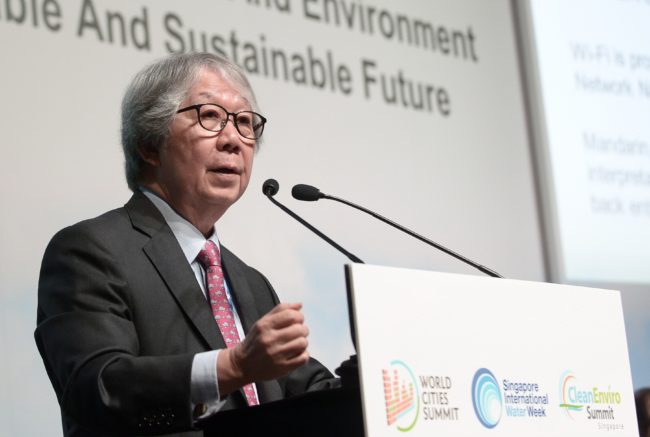
Tommy Koh, the country’s former UN ambassador, called for a class action suit to change Singapore’s Section 377A law, which, like India’s now-defunct legislation, was put in place under British colonial rule.
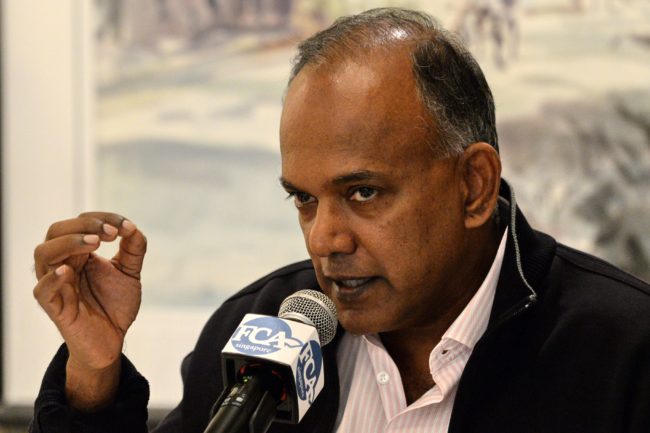
Singapore’s Law and Home Affairs Minister Kasiviswanathan Shanmugam has also raised the possibility of repealing the law, which carries a sentence of up to two years in prison and predates Singapore’s independence in 1965 by a decade.
Tommy Koh is currently serving as Singapore’s Ambassador-at-large (ROSLAN RAHMAN/AFP/Getty)
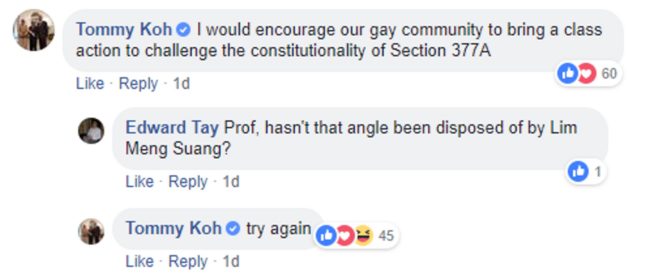
In response to a Facebook post by the dean of National University of Singapore’s Faculty of Law, Simon Chesterman, about the Indian court’s decision—which sparked joyous celebrations across the country—Koh wrote: “I would encourage our gay community to bring a class action to challenge the constitutionality of Section 377A.”
Koh responded with a simple solution, writing: “try again.”
“Try again” (Simon Chesterman/facebook)
Shanmugam, a cabinet minister, sounded sympathetic when asked about the issue on Friday.
He said, “Singapore… on this issue, it is a deeply split society. The majority oppose to any change to section 377A—they are opposed to removing it,” according to Channel NewsAsia.
“A minority—I have to say, a growing minority—want it to be repealed. The government is in the middle,” continued Shanmugam.
Singapore’s Home Affairs and Law Minister Shanmugam (ROSLAN RAHMAN/AFP/Getty)
“This issue relates to social mores, values—so can you impose viewpoints on a majority when it so closely relates to a social value system?”
But Shanmugam emphasised that the country’s founding Prime Minister Lee Kuan Yew had been “sympathetic” towards LGBT+ people and had “expressed his understanding for those who are gay.”
“The law is there but generally there have been no prosecutions for private conduct,” said Shanmugam.
“People openly express themselves as gay, you [have] got the gay parade. Police even approved a licensing for it, no-one gets prosecuted for declaring themselves as gay.
“So, really, when was the last time someone was prosecuted?”
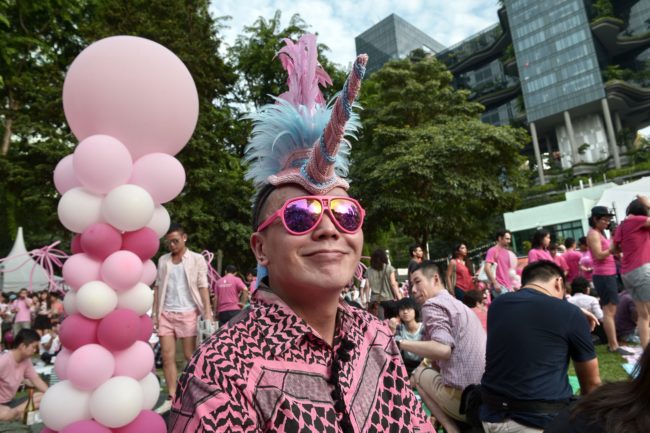
The Pink Dot Pride event attracts thousands every year (ROSLAN RAHMAN/AFP/Getty)
Shanmugam hinted at his personal acceptance of gay people, saying: “Speaking for myself, if you ask me, in a personal capacity, personal view—people’s lifestyles, sexual attitudes—(we) really should be careful about treating them as criminals or criminalising that.”
He refused to explicitly voice his support for LGBT+ equality, though, saying: “But again, it will be wrong for me to impose my personal views on society or as a policymaker.
“We live our lives, live and let live. If one side pushes, you will expect a substantial pushback.”
The prime minister’s nephew, Li Huanwu, came out publicly last month (Li Huanwu/facebook)
PinkNews spoke to activist Rachel Yeo last month about how life for LGBT+ people in Singapore can be difficult, with mental health issues prominent and a ban in place on positive representations of queer people in mainstream media.
Li Huanwu, the grandson of Singapore’s first prime minister and nephew of its current prime minister, came out as gay in July, but his public statement was seen as brave and unusual, rather than commonplace.
India’s highest court has just struck down a more than century-old prohibition on gay sex, calling the Victorian-era law “irrational, indefensible, and manifestly arbitrary.”
The ruling represents a hard-fought victory for gay-rights activists in India, who have been battling the law for more than a decade. But it’s also a symbolic break with India’s colonial past. The law, known as Section 377, dates to when the British Empire ruled India.
The court’s ruling on Thursday effectively makes it illegal to discriminate against people based on sexuality, though it doesn’t permit same-sex marriage. Section 377 was inconsistently enforced, but police and others sometimes weaponized the law to harass, blackmail, or extort transgender or gay people — especially men. Gay rights advocates said it also deterred victims of sexual assault from reporting crimes over fears of prosecution.
And that contributed to a culture of fear across India, according to activists who celebrated the ruling. A man named Krishna, one of the petitioners in the case, told the BBC: “I don’t know how it will change our lives yet but it helps us lead them without fear or depression.”
The fight to decriminalize gay sex in India
A five-judge panel, in a unanimous decision, overturned Section 377 on Thursday, though the same law had been upheld by the same court just five years earlier.
“We have to bid adieu to prejudices and empower all citizens,” India’s Chief Justice Dipak Misra said as he read the decision striking down the nearly 160-year-old law.
Section 377 criminalized “whoever voluntarily has carnal intercourse against the order of nature,” and sentences ranged from 10 years to life in prison.
Indian supporters of the LGBT community take part in a pride parade in Chennai on June 24, 2018.Arun Sankar/AFP/Getty Images
Activists have been trying to change the legislation for more than a decade.
In 2001, the Naz Foundation, an Indian organization that works on HIV/AIDS advocacy, disputed the constitutionality of the law. The legal challenge wove its way through the courts for years. Finally, in 2009, the Delhi High Court overturned the ban on gay sex, but the ruling only applied in that specific jurisdiction, not across the country.
That early gay rights victory almost immediately faced a setback. Proponents of Section 377 took the challenge to India’s Supreme Court, which fully reinstated the ban on gay sex in 2013.
In that 2013 decision, the court said that gay people made up a “minuscule fraction” of India’s population, and left it up to India’s Parliament to change the laws.
But it was another landmark decision by India’s Supreme Court in 2017 — this one about privacy — that provided opponents of Section 377 a new avenue with which to challenge the law.
In August 2017, India’s highest court ruled that Indians have a fundamental right to privacy, and it included sexual orientation among those protected rights. “Discrimination against an individual on the basis of sexual orientation is deeply offensive to the dignity and self-worth of the individual,” the Court said in its decision.
And a year later, India’s highest court strengthened that principle when it struck down the law criminalizing gay sex. “What makes life meaningful is love,” Justice Dhananjaya Y. Chandrachud wrote in the decision. “The right that makes us human is the right to love. To criminalize the expression of that right is profoundly cruel and inhumane.”
What these decision might mean for India — and the region
India’s gay rights advocates won a major victory on Thursday — but there’s still more to do.
Issues like same-sex marriage, adoption, and inheritance rules have yet to be decided, and could lead to court battles in the future.
Members and supporters of the LGBT community celebrate the Supreme Court decision in New Delhi on September 6, 2018.Chandan Khanna/AFP/Getty Images
The end of Section 377 won’t necessarily be embraced across India, and there’s still a lot of skepticism about gay rights outside major urban centers and among conservative religious Hindu, Muslim, and Christian groups. Those who wanted the law to remain in place argued that sexual orientation wasn’t innate, and that decriminalizing gay sex would lead to the spread of HIV, according to the New York Times.
But Prime Minister Narendra Modi and his conservative ruling party, Bharatiya Janata, largely stayed on the sidelines during this latest debate. The government, which had previously supported the law, said during the latest fight that they would leave the decision up to the courts.
This silence was likely driven by a mix of domestic and global political concerns — the desire to balance India’s ambitions as a modern economic power, while trying to placate some of its more conservative supporters.
Still, many advocates interpreted this ruling as laying the groundwork for a greater acceptance of gay, lesbian, and transgender people in India.
“This is not a narrow, do-what-you-want-in-your-bedroom type of decision,” Menaka Guruswamy, a lawyer for the plaintiffs in the case, told the Los Angeles Times. “This is so much wider than that, and the fact that many of the justices linked this to the idea of freedom and consent, that it was unanimous, that all of them looked to India as a constitutional democracy … it’s huge.”
The question now is how intensely this ruling might reverberate across the region, or in other countries (including former colonies) that have similar laws decriminalizing gay sex. According to the Washington Post, India was the largest country to have such a law — until Thursday.
“I was turning into a cynical human being with very little belief in the system,” Ritu Dalmia, one of the plaintiffs in the case, told the Guardian, “but honestly, this has really shown once again that we are a functional democracy where freedom of choice, speech and rights still exist.”









:format(webp)/cdn.vox-cdn.com/uploads/chorus_asset/file/12859907/GettyImages_982830230.jpg)
:format(webp)/cdn.vox-cdn.com/uploads/chorus_asset/file/12859913/GettyImages_1027680436.jpg)