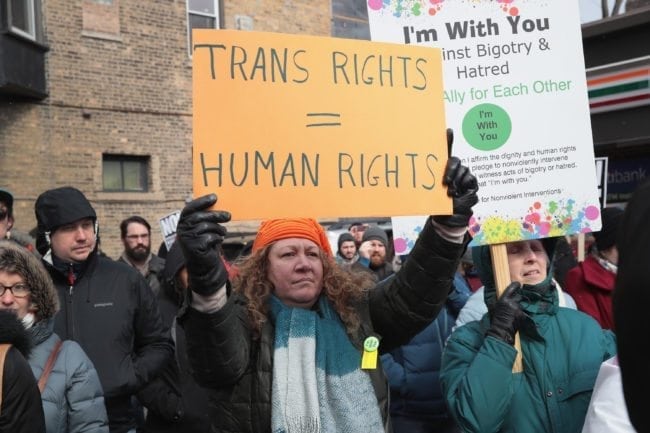
A group of 22 GOP senators is reintroducing a controversial measure that would protect opponents of same-sex marriage from federal actions intended to curb discrimination.
The First Amendment Defense Act (FADA) would bar the federal government from taking any action against individuals who discriminate against same-sex couples or others based on “a sincerely held religious belief.”
The bill would also protect those who discriminate against marriages not recognized under federal law or individuals who engage in sex outside of marriage.
The measure was introduced by Sen. Mike Lee (R-Utah) and 21 Republican co-sponsors, including Sens. Marco Rubio (Fla.), Ted Cruz (Texas) and Orrin Hatch (Utah).
FADA was introduced in both the House and the Senate in 2015, but only received a hearing in the House.
The bill never advanced to a full vote, however, amid protests from Democrats and concerns among Republicans that then-President Obama would veto the measure if it reached his desk.
Supporters of the bill say that it is necessary to protect First Amendment guarantees, while opponents argue that it ultimately amounts to an attempt to legalize anti-LGBT discrimination.
As a presidential candidate, Trump indicated that he would sign the measure if it were sent to his desk, saying that it would “protect the deeply held religious beliefs of Catholics and the beliefs of Americans of all faiths.”
Former LSU running back Derrius Guice said in an interview Wednesday that one NFL team asked about his sexuality and another inquired if his mother was a prostitute at the NFL Scouting Combine that concluded earlier this week.
‘’It was pretty crazy,” Guice said in an interview on the SiriusXM NFL show Late Hits. “Some people are really trying to get in your head and test your reaction. I go in one room, and a team will ask me do I like men, just to see my reaction. I go in another room, they’ll try to bring up one of my family members or something and tell me, ‘Hey, I heard your mom sells herself. How do you feel about that?’”
NFL spokesperson Brian McCarthy said in an email to USA TODAY Sports Thursday that the league is “looking into the matter.” “A question such as that is completely inappropriate and wholly contrary to league workplace policies,” McCarthy said. “The NFL and its clubs are committed to providing equal employment opportunities to all employees in a manner that is consistent with our commitment to diversity and inclusion, state and federal laws and the CBA.
The Human Rights Campaign reacts:
“The fact that Derrius Guice was asked by an NFL team — and a prospective employer — about his sexual orientation is absurd and inappropriate,” said HRC Director of Public Education and Research, Ashland Johnson. “With similar incidents already reported, it’s clear that the NFL did not do enough to prevent it from happening again. Guice’s experience illustrates the risks faced by millions of LGBTQ people today in employment, athletics, housing and other areas of their lives. It’s why we need swift action to condemn these kinds of practices and to fight for passage of the Equality Act to ensure comprehensive nondiscrimination protections for LGBTQ people. The NFL should take serious actions that address these unacceptable incidents and the perpetuation of an unwelcoming anti-LGBTQ environment, including publicly supporting the Equality Act.”
Pride marchers in Honolulu, Hawaii. (Creative Commons photo/Daniel Ramirez)
Hawaii has advanced a ban on gay ‘cure’ therapy for minors.
The US state could become the latest to outlaw the use of so-called ‘conversion therapy’ to attempt to change the sexuality of minors.
Performing gay cure therapy on minors is already is illegal in nine US states and counting, as well as Switzerland, Malta, Taiwan, two Canadian provinces, and the Australian state of Victoria.
State senators in Hawaii today passed SB 270, which bans efforts to “engage in or attempt to engage in sexual orientation change efforts on a person under eighteen years of age”.
The bill – tabled by Stanley Chang, Rosalyn Baker and Karl Rhoads – passed the state Senate, which is entirely controlled by the Democrats, by a vote of 24-1.
The lone vote against was Democratic Senator Mike Gabbard, the head of the so-called “Alliance for Traditional Marriage and Values” who previously waged a campaign to ban same-sex marriage in the state.
The bill notes: “the American Psychological Association convened a task force on appropriate therapeutic responses to sexual orientation.
“The task force conducted a systematic review of peer-reviewed journal literature on sexual orientation change efforts. The task force concluded that sexual orientation change efforts are unlikely to be successful and involve risk of harm to lesbian, gay, and bisexual individuals, including depression, suicidality, loss of sexual feeling, anxiety, shame, negative self-image, and other negative feelings and behaviors.
“The legislature further finds that children and adolescents who participate in these types of sexual orientation change efforts, which often use fear-based techniques, are given inaccurate scientific information regarding sexual orientation and gender identity and are also at risk of increased self-stigma and psychological distress.”
It adds: “The legislature additionally finds that sexual orientation change efforts are opposed by the country’s leading medical and mental health professional organizations, including the American Psychological Association, American Medical Association, American Academy of Pediatrics, American Psychiatric Association, National Association of Social Workers, American College of Obstetricians and Gynecologists, and American Academy of Child and Adolescent Psychiatry.
“The purpose of this Act is to protect the physical and psychological well-being of minors, including lesbian, gay, bisexual, and transgender youth, against exposure to serious harms caused by sexual orientation change efforts by regulating the conduct of specific state-licensed persons who provide professional counseling to minors under the age of eighteen and prohibiting these professionals from engaging in, attempting to engage in, or advertising the offering of sexual orientation change efforts on persons under eighteen years of age.”
HRC Legislative Counsel Xavier Persad said: “We thank the state senators who voted to protect LGBTQ youth from the dangerous and inhumane practice of conversion therapy.
“Children across the Aloha State deserve to live their lives authentically, and they deserve to know that they are not broken or ill because of who they are. We are calling on the House of Representatives to swiftly pass this bill and send it to Governor David Ige’s desk for his signature.”
A string of states have proposed laws on the issue, which have overwhelming backing from Democrats but are still largely opposed by GOP politicians.
The EU body voted by 435 to 109 to adopt text calling on member states to outlaw the discredited practice.
It says: “[The European Parliament] welcomes initiatives prohibiting LGBTI conversion therapies and banning the pathologisation of trans identities and urges all Member States to adopt similar measures that respect and uphold the right to gender identity and gender expression”.
It is the first time the Parliament has made the specific disavowal of conversion therapies.
The vote came on an amendment to the Parliament’s annual report on the situation of fundamental rights in the EU, which was later adopted.
The Intergroup’s Sirpa Pietikäinen MEP noted that only a small number of EU member countries “have explicitly banned LGBTI conversion therapies” to date.
The MEP continued: “The UN Committee Against Torture, the Committee on the Elimination of Discrimination against Women and the Human Rights Committee have already condemned the practice of conversion therapy in several countries.”
A man who said he was trying to start a “jihad” has pleaded guilty to murder and terrorism – before surprising the court by suddenly confessing to killing three other people.
Ali Muhammad Brown, 34, admitted to murdering 19-year-old Brendan Tevlin of New Jersey during jury selection.
Then, without encouragement, he confessed to killing three men on the other side of the country, in Washington – two of them because he believed they were gay.
One man was shot dead in April 2014, while two others were gunned down outside a nightclub two months later.
Prosecutors have said that Brown confessed to killing the two men in June 2014 “because he believed they were homosexual.”
The killings, prosecutors said, showed “an extreme level of violence.”
If Brown were to be convicted of these killings, he could be given the death penalty.
The prosecutor’s office said: “In his statement to the court today Brown admitted that the killings were a part of what he described as a ‘jihad.’”
Brown, who is already serving 35 years in prison for armed robbery, will be sentenced on May 1.He faces a mandatory sentence of life in prison.
Jamel Semper, who led the prosecution in New Jersey, said Brown “grievously harmed families and terrorised entire communities across the country.
“This defendant is no martyr.
“He’s just an admitted terrorist who will now spend the rest of his life in prison.”
Prosecutors said Brown made the confession in full knowledge that it would not get him a reduced sentence.
Acting County Prosecutor Robert D. Laurino said: “We did not negotiate with this defendant.
“From the beginning, our position has been that he had to plead to all the charges or we would go to trial and let the jury decide.”
As well as admitting to the four killings, Brown pleaded guilty to first-degree terrorism, first-degree carjacking, first-degree robbery, unlawful possession of a handgun and possession of a weapon for an unlawful purpose.
In 2005, Brown was convicted in federal court in Washington of conspiracy to commit bank fraud in connection with a plot which targeted several banks from 2002 to 2004.
The year before that, Brown was one of at least 13 people living in Washington who were accused of pursuing the fraud scheme as part of a plot to illegally move people into the US from Gambia.
“You don’t imagine things – seeing things like that, ever, especially not your friends.”
Bronson turned around, and watched helplessly as her friend, who was also known as Rio, died.
Through tears, she said: “I saw my boy, I saw Ta’Ron, I saw Rio, I saw my boo.
“I saw him on the ground. I saw him. I saw him go.”
Bronson said her friend was special.
“He loved himself, and in loving yourself you are able to love so many more people,” she said.
Another of Carson’s friends, D. Rashaan Gilmore, said: “In gay vernacular, particularly in black gay vernacular, there is a term called ‘beating your face,’ and so Rio would always be beat for the gods.
D. Rashaan Gilmore (Fox 4 news)
“That is just powder, pad, getting your face together, because he was beautiful.”
He added: “The beauty of Rio is that because of how he lived his life, it helped to free others to live their lives in that way.
Gary Junior also paid tribute to his friend, telling The Kansas City Star: “Ta’Ron was always himself.
(Facebook/Ta’Ron Carson)
“He was not ashamed of his sexuality. He did not hide himself from anybody. He was really about standing up for the LGBT community.”
Junior said Carson had not argued with anyone at Aura, and had left on good terms.
“There was nothing to say he was leery about anything,” he said. “He gave everybody hugs and said goodbye.”
Aura’s owner Stuart Salomon agreed, saying: “It was peaceful and docile,” he said. “Kids with glow sticks and hula hoops. Not a single person thrown out. Not a cross word.”
Breyana White said she had known him for nearly a decade, having met at Northeast High School, where Carson was made senior class president in 2011.
“He was really just like the life of the party,” said White.
“He was really outgoing, always welcoming to people, always, like, open to meeting new people. He just made sure everyone was happy and kept smiles on their faces.”
She added: “I’m still in disbelief.
(Facebook/Ta’Ron Carson)
“Kansas City lost a great person. They lost someone who was just full of life. He was just all about positivity.
“He was a good dancer. We always would just have fun.”
Simon Lokodo, the Minister of State for ‘Ethics & Integrity’, likened LGBTQ+ people to paedophiles in the statement in which he warned people would be apprehended.
He said: “We are aware that there are inducements, including money, being offered to young people to promote the practice.
“We wish to emphasise that whereas the promotion of homosexuality is criminalised under the Penal Code, there is no violence against the LGBT community in Uganda – contrary to some claims made loosely by proponents of this movement.”
Despite emphasising the lack of violence, organisers of the Pride officially cancelled it out of fear of physical harm.
“It is with very heavy hearts and deep-felt sadness that we announce the cancellation of Pride Uganda 2017.
“Following the Police raid and interruption of the Pride parade last year, extra precaution was taken in organising this year’s festival,” the statement read.
Despite the last Pride being “officially” cancelled, many Pride-goers still went to the event but they were broken up by police and some were arrested, including organiser and executive director of Sexual Minorities Uganda (SMUG), Frank Mugisha.
Any hope for a Pride event in 2017 was completely dashed after Lokodo promised “arrest, even violence”.
Living conditions for LGBTQ+ people are reportedly getting slightly better in the country, with activists reporting fewer people being “arrested, put in police cells and tortured”.
Activist Isaac Mugisha, from Uganda, told The Daily Beast that he and other LGBTQ+ activists were now trying to work with straight allies to ensure Pride events could go ahead without being raided.
“The momentum is now so different to 2015. Then just a handful of LGBTS gathered. Now we are looking at hundreds of people wanting to gather for a Pride event,” Isaac Mugisha said.
Ugandan men hold a rainbow flag reading “Join hands to end LGBTI genocide” at Ugandan Pride 2014 (ISAAC KASAMANI/AFP/Getty Images)
Frank Mugisha (who is not related to Isaac) added that “things are not looking so bad so far.
“Learning from last year our idea is to start planning early for Pride 2018.
“Our visibility is still very important to us, and we are hoping to have Pride this year, and a much bigger event,” he said.
However, he explained that it is still a very real fear that a Pride event could be raided by police.
“Even with the efforts to sensitize states’ institutions and lawmakers there is still so much discrimination and violations of LGBT persons going on here,” he said.
Some LGBTQ+ activists argue that the country is no safer than two years ago.
Adrian Jjuuko, executive director of Human Rights and Awareness and Promotion Forum (HRAPF), said: “From my perspective, I do not think any progress has been made, particularly in LGBT organizing. To the contrary, the situation seems to be worsening since 2016.”
Ugandan President Museveni signed the draconian Anti-Homosexuality Bill in February 2014. The law called for repeat offenders to be sentenced to 14 years in prison and to make it a criminal offence not to report someone for being gay.
Toronto police have found a seventh set of remains related to the investigation into alleged serial killer Bruce McArthur and have released a picture of a bearded, darker skinned dead man.
Detective Sgt. Hank Idsinga said Monday they could not identify the man in the picture and are now seeking the public’s help.
“I do not want to release this picture and I’m doing so as a last resort,” he said.
Idsinga declined to say how police obtained the picture of the dead man.
He said they showed the picture to members of the gay community but could not identify him. Many of the other alleged victims have been darker skinned and of South Asian or Middle Eastern descent who frequented the “Gay Village” area of Toronto.
Det. Hank Idsinga stands with a photo of an unidentified man who may be seventh victim of Toronto serial killer, at a news conference at Toronto Police headquarters on March 5, 2018. Chris Young / Canadian Press via AP
Idsinga said they’ve now found the dismembered remains of at least seven individuals this year in large planters at a home where McArthur did landscaping work and stored objects. It’s not clear if the remains of the seventh man are of the same man seen in the picture released by police.
He said they realize how difficult it might be for a relative or friend to see the picture and realize the man is deceased.
“I’ve never done this before,” he said about releasing the photo. “I do it with great hesitation. It is obviously a key piece of evidence that we have that we are releasing, but we feel by releasing it, hopefully we can identify him and close off that area of the investigation.”
Investigators have identified three sets of remains so far — 49-year-old Andrew Kinsman, 50-year-old Soroush Mahmudi and 40-year-old Skandaraj Navaratnam.
Bruce McArthur appears in a photo posted to his Facbeook account. Facebook via Reuters
McArthur, 66, is charged with first-degree murder in their deaths, as well as the presumed deaths of 44-year-old Selim Esen; Majeed Kayhan, 58; and Dean Lisowick, either 43 or 44. Police have said they believe there are more victims.
Dr. Michael Pollanen, Chief Forensic Pathologist for the Province of Ontario, said the causes of death are pending further studies.
Investigators have not yet released complete details, but McArthur is believed to have met his alleged victims in the Gay Village and on gay dating apps for older and large men with names such as “SilverDaddies” and “Bear411.”
Police are looking at unsolved missing person cases to determine if there are connections to McArthur and are running down tips that have come in from around the world.
McArthur, a grandfather and former mall Santa Claus, has not entered a plea. His case is due back in court March 14. Edward Royle, a lawyer for McArthur, has previously declined to comment on the case and didn’t respond to a message seeking comment on Monday.
More transgender people in the US are opting for bottom surgery, a report from one of the country’s leading medical schools has revealed.
According to statistics compiled by the John Hopkins University School of Medicine, from 2006 to 2011 83.9 percent of patients asked for the surgery, in comparison to 72 percent in 2000-2006, reported The Independent.
Collated through data of National Inpatient Sample (NIS) from 2000 to 2014, the data covers 95% of hospitals in the States.
The study has emphasised the importance of health insurers not discriminating against trans people who want the surgery – top, bottom, or both.
This is due to the fact that out of 4,118 people who underwent genital surgery, 56.3 per cent did not have any health insurance cover.
Furthermore, for trans people who had Medicare or Medicaid insurance policies, 70 chose to have genital surgery in 2014.
The patients were aged from 26-49, reported the study’s authors, Joseph Canner and Omar Harfouch.
Although the demand for gender reassignment surgery has quadrupled in the UK from 2008-2016, gender reassignment is still a lengthy process under the NHS.
Basic surgeries may be covered by the national health service, but users may wish to embark upon additional surgery in order to alter their appearance.
Yet spite of the rise in people needing access to surgery and a surge in transgender rights activism in the mainstream, it appears that President Donald Trump is still hellbent on making life for trans people as difficult as possible.
As well as scrapping Title IX protections which ensure that trans people’s rights are protected in educational institutions, the US administration was the only country where homosexuality is legal that also voted in favour of the death penalty for gay people at a UN summit.
The cruise ship industry is facing pressure to relocate ships registered in Bermuda, after the territory abolished same-sex marriage.
Bermuda this year passed a law that replaces a ban on gay couples getting married, less than a year after they were allowed to marry for the first time.
The new law has caused chaos in the cruise ship industry, as a large number of ships are domiciled in the British overseas territory for financial reasons and are thus subject to its laws – meaning they can no longer carry out onboard same-sex weddings.
Carnival, a cruise ship conglomerate which operates 24 Bermuda-registered ships under subsidiaries Cunard, Princess and P&O Cruises, is now facing pressure to end the arrangement and move its registrations elsewhere.
Human rights lawyer Jamison Firestone, who is married to his same-sex partner, wrote in an open letter to Cunard: “Moving the ships is the only way possible to dissociate your company from a jurisdiction that has so dramatically flouted the values you profess to uphold, and to show support for your LGBTQ customers and those who support equal treatment for all.
“I therefore urge you to re-register your vessels in one of the many jurisdictions that do support the freedom to marry without discrimination.”
He added: “Bermuda’s new law applies to 24 ships that Cunard, Princess and P&O have registered in Bermuda. Same-sex couples may no longer marry on those ships and can only be offered the lesser status of domestic partnership.
“Carnival Corporation’s ships now contribute to and expand the reach of a regime that has chosen to discriminate against LGBTQ people.”
He added: “No legal or tax bonus gained in Bermuda can possibly be worth colluding with discrimination.
“Make no mistake, a cruise ship line that chooses to be flagged or remain flagged under a nation that has chosen to discriminate becomes complicit in discrimination. Can the ships of Cunard, Princess and P&O proudly fly the flag of Bermuda after this act?
“The right answer is for Carnival Corporation to stand by its values and protect the dignity and rights of all its customers by moving its ships from Bermuda to a jurisdiction that embraces marriage equality.”
Rights campaigner Peter Tatchell added: “Carnival is at risk of provoking a backlash by LGBT+ communities worldwide.
“Not only is Carnival colluding with a homophobic government by continuing to register its 24 ships in Bermuda, it means that same-sex couples can no longer marry on board, even in international waters. This is tantamount to direct anti-LGBT+ discrimination.”
In a response, a spokesperson for Cunard said: “Having been delighted and wholly supportive of the Bermuda Government’s change in law last May, which allowed us to conduct same sex marriages on board our ships we are disappointed with this more recent outcome.
“We will now be working closely with the Bermudan authorities to understand the legalities of ‘Domestic Partnership Act’ and whether we can offer our guests same sex marriages in the future.”
Cunard said it would not be providing refunds to guests who did not want to travel on a Bermuda-registered ship after the decision.
It told Mr Firestone: “We are unable to offer anyone a free of charge cancellation due solely to any personal opinion of the independent laws of Bermuda and must make you aware that a cancellation for this particular reason would not constitute a significant alteration to the package as booked.”
The company did say it would specifically provide refunds to couples who had booked wedding packages if they were unable to go ahead.
However, Bermuda last week confirmed the ban on same-sex weddings would only come into effect from May, allowing existing wedding bookings to go ahead.
Peter* had set up a Skype account just to speak to PinkNews.
Even though it has been six months since he left Russia to embark upon a new life in Belarus, he has to be cautious, and won’t tell me his real name.
Since Russia’s gay propaganda law came into action in 2013, a spate of attacks against the country’s LGBT+ community have a affected the gay, bi and lesbian community’s right to an education, a job, and even the right to their life.
An according to Peter, even sharing a post advocating for gay rights can result in your arrest.
“Everyone knows everything about you. You can go to jail just for reposting stuff on social media,” he said.
The story of exile began for Peter* when the Russian’s neighbours began to gossip about Peter and his boyfriend.
Living in a small Russian town near Moscow, the 32-year-old found that news quickly spread about his sexuality.
St. Petersburg LGBT demonstration, 2013 (OLGA MALTSEVA/AFP/Getty Images)
“People in the city saw us and the gossips told everyone around the city. After that everyone in the community knew,” he said.
Although he had lived in his hometown for as long as anyone could remember, his life as a gay man started to become difficult as pressures from religious groups and the government mounted.
“Everyone knows me everywhere. In the city when I worked, everyone knew, no matter where I went or no matter what I did,” he said.
Since the introduction of the gay propaganda law, the little protections LGBT+ Russians had have now dissipated.
In order to survive, Peter started to take lower paid work as a programmer, as his sexuality was used as a bargaining chip for him to take lesser paid work.
“I couldn’t find work or live my life normally. There’s a forum where gay freelancers and programmers are listed. Everyone in the community online and offline knew me,” he said.
“I wasn’t beaten, but I was discriminated against. I identify as gay, and I’ve never hidden it. That’s why there were problems. There’s a website that writes about every programmer and freelancer there, and they outed me. After that, it was even hard to get work through unofficial channels.
“I would get lower paid work, when I could,” he added.
The stress of not being able to find paid work was compounded by the hostile reactions Peter faced from his family, which left him with no other options: he would have to move.
“My family knew about my sexuality, and were incredibly negative about me. One of the main reasons I left Russia was because I had so little support from my family there,” he said.
The pressure started to take its toll on Peter and his boyfriend.
After moving to a different city in the hope that life would improve, the relationship started to fall apart.
First, we lived together in a different city first, and moved together. But it may have been a different city, but the same attitudes remained. We couldn’t get work, and we were scared of being attacked. That’s when my boyfriend left me, and said “I don’t need this.” It’s really hard, and not everyone can manage to keep a relationship going under that pressure,” he said.
Now alone, Peter decided to ask a friend for advice on how to escape Russia, and decided to enter Belarus.
The post-Eastern Bloc nation of Belarus lies to the left of Moscow.
The landlocked country, which shares borders with Ukraine, Poland, Lithuania, and Latvia, is home to 9.5 million people – 800,000 more people than in London.
Around 8.3% of the country is made up of Russian migrants, and Russian is spoken as the country’s official language.
With its close ties to Russia, it was a feasible place for Peter to flee.
“You can access Belarus without a VISA or passport,” he said.
“It takes about two days to get to Belarus on the train. It took another three days on the car so we could get away from the border. You can go to Belarus without even a passport – it’s easier to enter even than Ukraine, which made the decision for me,” he said.
But unfortunately for Peter and other Russian LGBT+ asylum seekers, it shares a lot of the same hostilities.
“When I got there, friends took me in and helped me out. They even helped me with money and work when I first arrived. In Belarus, it’s more tolerant than in Russia,” he explained.
“I still can’t work properly, but at least I know I won’t be killed here. It’s not so tolerant, it’s old-fashioned, but they won’t kill you, like what happened in Russia,” he added.
Apart from with a small group of friends, Peter now lives his life in the closet, disclosing his sexuality only when he feels it is safe.
“If anyone found out about my sexuality, they might get aggressive, or even start a fight. There is not one way people react. There are only two ways, but in Russia, there’s just one: aggression all of the time. Some people are really easy about it here, some people are ridiculously aggressive. But in comparison to Russia, it’s a lighter load to bear,” he added.
But, similar to other post-Eastern Bloc LGBT+ asylum seekers from Russia, Peter is concerned that time is not on his side, and a move out of the country is essential to his survival.
“I try to hide my sexuality now, but as I am facing a small community just like before, it’s only a matter of time before people find out,” he said.
“I am working to save money to get out of Belarus. I want to go to the EU, an English-speaking country, where people are more tolerant,” he said.