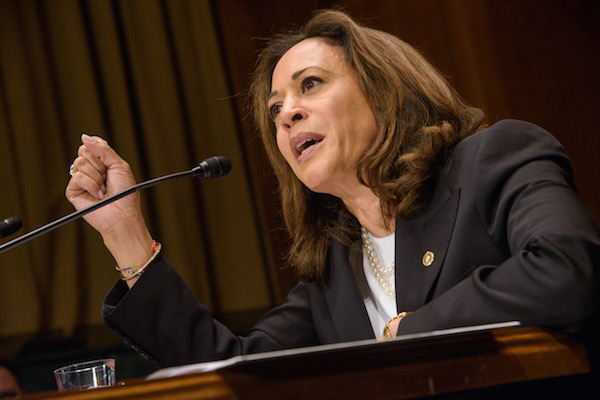
At her first hearing as a member of the Senate Judiciary Committee, U.S. Senator Kamala D. Harris pressed a judicial nominee for the District of Utah, Howard Nielson Jr., on his history of advocating against the rights of LGBTQ Americans. Previously, Nielson represented the proponents of California Proposition 8, a 2008 ballot measure that outlawed same sex marriages. After he lost the case, Nielson then tried to reverse the outcome by arguing that the judge should have recused himself due to the judge’s sexual orientation.
“I was Attorney General of California during this time and I opposed the motion to remove Judge Vaughn Walker,” Harris said. “I wrote in my brief, ‘As many judges have recognized however, this is a distinction without a difference. Faced with similarly nuanced challenges, courts have seen such recusal requests for what they really are: a thinly veiled attempt to disqualify judges based on their race, gender, religious affiliation, or in this case sexual orientation.’ I stand by those words.”
Harris continued, “As Judge Higginbotham noted over 30 years ago, who is an African-American judge, ‘It would be a tragic day for the nation and the judiciary if a myopic vision of the judge’s role should prevail. A vision that requires judges to refrain from participating in their churches, in their non-political community affairs, in their universities. So long as Jewish judges preside over matters where Jewish and gentile litigants disagree, so long as Protestant judges preside over matters where Protestants and Catholics disagree, so long as white judges preside over matters where white and black litigants disagree, I will preside over matters where black and white litigants disagree.”
Harris also questioned the judicial nominee for the United States Fifth Circuit, Kurt Engelhardt, on a case in which he ruled against a woman who was fired for taking medically mandated leave from work due to complications that arose from her pregnancy.
A European Court of Justice advocate general has advised that European Union member states must recognize the rights of same-sex spouses, even if a country has not extended marriage rights to gay and lesbian couples.According to The Guardian, Melchior Wathelet, a Belgian advocate general in the Luxembourg court, said that all EU members must recognize the rights of gay spouses.
Such opinions are non-binding but are normally followed by the court, the paper wrote.
The Luxembourg court is currently deliberating in the case of a Romanian national, Adrian Coman, whose American husband, Claibourn Robert Hamilton, was refused residence in Romania based on the couple’s 2010 marriage in Brussels. A decision is expected in the coming months.
Romania is one of the six EU member states that do not recognize the unions of gay couples. The other nations include Poland, Slovakia, Bulgaria, Lithuania and Latvia.
A the slate of anti-LGBTQ candidates have entered the race against Representative Kyrsten Sinema for Arizona’s open Senate seat. Tuesday, Joe Arpaio — whose infamous torture and racial profiling of immigrants and people of color has earned him both widespread derision and Trump’s presidential pardon — entered the race alongside noted conspiracy theorist Kelli Ward and Rep. Martha McSally, who is set to announce her candidacy this week. All three support giving businesses a license to discriminate, and oppose marriage equality and nondiscrimination protections for LGBTQ people.
As polling of GOP primary voters indicates a statistical dead heat between these three candidates, polling of likely voters in November’s general election indicates their shared anti-LGBTQ views will be a liability. The majority of likely voters in Arizona support protections for the LGBTQ community, with 63 percent in favor of the Equality Act. Further, when asked if knowing a candidate is anti-LGBTQ makes them more or less likely to vote for a candidate, a majority of Arizona voters, by a margin of 51-to-10, say they would be less likely to support that candidate.
“There’s absolutely no question about who Arizonans should be supporting,” said HRC Senior Vice President for Policy and Political Affairs JoDee Winterhof. “They can either support Kyrsten Sinema, a proven champion of equality who has worked her entire career to ensure that every person can achieve the American dream, or Arpaio, Ward and McSally, who, time and time again, have supported discrimination against LGBTQ people. These three share a dangerous agenda that is bad for Arizona and has no place in the U.S. Senate. It would do them well to remember that Arizona voters overwhelming support equality and reject politicians who don’t.”
Joe Arpaio built his career on attacking nearly every marginalized community, including using anti-LGBTQ schemes to humiliate inmates at his ‘Tent City’ prison, like forcing them to wear pink underwear. Following a long record of flouting the law, violating the civil rights of Maricopa County’s Latinx population, and carrying out a hate-filled agenda through extreme racial profiling, he was found guilty of criminal contempt, but pardoned by Donald Trump last August. He also continues to campaign against the Deferred Action for Childhood Arrivals (DACA) program, which provides much needed relief for undocumented immigrants who were brought to the United States as children — including 75,000 LGBTQ Dreamers.
Kelli Ward has consistently supported and voted in favor of legislation that would give businesses a license to discriminate against LGBTQ people. She even called for the impeachment of U.S. Attorney General Loretta Lynch after Lynch filed a complaint alleging North Carolina was discriminating against transgender people, following that state legislature’s passage of the notorious HB2 in 2016. Ward also praised the president for pardoning Sheriff Arpaio, agreeing with Trump’s claim that Arpaio was a “patriot.”
Rep. Martha McSally, who has long opposed marriage equality, is expected to announce her Senate run on Friday. She has pushed for discriminatory, anti-LGBTQ policies including an amendment that would allow discrimination against LGBTQ people by taxpayer-funded organizations.
HRC has endorsed Congresswoman Kyrsten Sinema (AZ-9) for U.S. Senate. She is a staunch advocate for the LGBTQ community, earning a perfect 100 on HRC’s Congressional Scorecards each Congress since she was elected in 2012. Sinema is also a cosponsor of the Equality Act, crucial federal legislation that would extend comprehensive federal protections to LGBTQ Americans.
HRC has prioritized Arizona for early and expanded investment in the 2018 elections. HRC has identified more than 800,000 “Equality Voters” who support pro-LGBTQ policies and will be targeted for outreach and mobilization in the run up to Election Day. In July, HRC launched HRC Rising, the earliest deployment of resources and largest grassroots expansion in its 37-year history ahead of the 2018 midterms. National and in-state staff across the country will be leading this historic campaign to win equality in states from coast-to-coast, resist the politics of hate, fight anti-LGBTQ legislation, and fuel pro-equality candidates and initiatives.
The Human Rights Campaign (HRC) Foundation in partnership with the Equality Federation, today released its fourth annual national report assessing the status of state legislation affecting LGBTQ equality across America and placing states in one of four categories based on their pro- and anti-LGBTQ state laws. California falls into the category, “Working Toward Innovative Equality.”
This year’s SEI details the onslaught of more than 125 anti-LGBTQ laws introduced across 30 states during the 2017 state legislative season, including legislative proposals to grant sweeping licenses to discriminate; undercut marriage equality; and target the transgender community — including transgender children. The report comes as more than 40 state legislatures will reconvene by the end of January. A new 2018 legislative preview report from HRC also found that state legislators, under relentless pressure from opponents of equality, are expected to wage attacks on transgender people — particularly in the critical areas of health care and access to appropriate restrooms.
The 2017 SEI report points to a few encouraging signs for LGBTQ youth, as well as transgender and gender non-conforming people seeking to update their identity documents. Four states — Connecticut, New Mexico, Rhode Island and Nevada — passed new bans on the practice of so-called “conversion therapy,” bringing the total number of states with such bans to 10, plus the District of Columbia. And the number of states in the SEI’s highest-rated category, Working Toward Innovative Equality, increased this year from nine to 13. These states and the nation’s capital have robust LGBTQ non-discrimination laws covering employment, housing and public accommodations, as well as protections in the areas of credit and insurance. Despite these wins, laws protecting LGBTQ people from discrimination vary widely across the nation — or simply do not exist in many states.
“If an LGBTQ couple drove from Maine to California today, their legal rights and civil rights protections could change more than 20 times at state borders and city lines. The vast majority of Americans today understand that this crazy quilt of protections — and lack thereof — is wrong, impractical, and unacceptable,” said HRC President Chad Griffin. “The time has come for us to do away with this ragged patchwork of state laws that fail to protect LGBTQ people equally by passing the Equality Act once and for all.”
Said Rebecca Isaacs, executive director of Equality Federation Institute: “Every year, the State Equality Index gives us an opportunity to share some of the victories and heartbreak from the state-based movement for equality. This year it’s more important than ever because our progress is under assault from the Trump administration, Congress, and the courts. Despite our emboldened opposition, we still have great opportunity for legislative advocacy and policy making on the ground in states where this work has a critical impact for millions of Americans.”
Even at a time of historically broad and deep support for full LGBTQ equality, an estimated 12 million-plus LGBTQ Americans and their families remain at risk, particularly if they live in one of the 31 states where laws do not adequately protect them against being fired, evicted or denied services because of their sexual orientation or gender identity. A map of this patchwork of protections can be found here.
According to new HRC polling data, collected by Hart Research Associates, a strong majority of likely voters nationwide support laws that would prevent discrimination against LGBTQ people in the workplace (59 percent) and in housing (58 percent) — such as the federal Equality Act, which was reintroduced in Congress earlier this year. In fact, many voters believe these protections already exist: fully thirty-eight percent of voters interviewed in a new HRC poll incorrectly believed that current federal law fully protects the right of LGBTQ people on matters such as employment, housing and access to government benefits.
HRC’s full State Equality Index report, including detailed scorecards for every state; a comprehensive review of 2017 state legislation; and a preview of the 2018 state legislative session is available online at www.hrc.org/sei.
Lambda Legal and 15 national, state, and local LGBT organizations sent a letter to the U.S. Senate Judiciary Committee ahead of today’s hearing urging them to oppose the nomination of Howard Nielson to the United States District Court for the District of Utah. The letter stressed Nielson’s long and active history opposing LGBT civil rights, and his unfounded and degrading attack on the impartiality of a gay judge. While Mr. Nielson’s attack on the integrity of a federal judge is shocking, this nomination fits the pattern identified by Lambda Legal of President Trump’s push to fill the courts with extremist anti-LGBT judges.
“Howard Nielson has spent the better half of this decade actively working to discredit and undermine legal protections for LGBT people,” said Sharon McGowan, Director of Strategy at Lambda Legal. “When he couldn’t find a legal ground to stand on, he tried to win by degrading and insulting a federal judge, a strategy from the Trump playbook with which we are now so familiar. While President Trump may think it is perfectly fine to attack federal judges because of their ethnicity or other aspect of their identify, the American people know — and expect the Senate to send a clear message — that such behavior is disqualifying in a nominee for a lifetime appointment as a federal judge.
“These kind of legal tactics move beyond zealous advocacy and call into question Mr. Nielson’s ability to administer impartial justice for the people of Utah. His underlying animosity towards the LGBT community must not be given the weight and authority of a lifetime appointment to the federal bench where he would surely continue find new ways to usurp protections and civil rights.”
The letter detailed Nielson’s long history of working to undermine LGBT protections, focusing specifically on his offensive attack on U.S. District Court Judge Vaughn Walker after Judge Walker struck down Proposition 8, a ballot measure passed in California in 2008 that denied same-sex couples in the state the right to marry. The letter cited Nielson’s failed effort to discredit Judge Walker by arguing “the public could not be confident that Judge Walker did not have a direct personal interest in the outcome unless he unequivocally disavowed any interest in marrying his partner,” who was a gay man.
The letter also cited an amicus brief authored by Mr. Nielson that laid out his discriminatory view of LGBT people and specifically, same-sex families. In his brief for Obergefell v. Hodges, the historic U.S. Supreme Court ruling that struck down state laws denying same-sex couples the freedom to marry, Nielson speciously argued that gays and lesbians should be denied the right to marry because same-sex families are “inferior to heterosexual families.”
The Neilson nomination follows last week’s announcement by the Trump Administration that it plans to resubmit the nominations of 21 Federal judges from last year, many of whom, like Nielson, have proven anti-LGBT records. Senate Republicans are doubling down on this effort by working behind the scenes to change the rules for confirming Trump’s most discriminatory nominees so that the American people have less time to weigh in on these crucial decisions.
Underscoring the significant stakes in place if Mr. Nielson is confirmed to the federal bench, the letter, sent to the Senate Judiciary Committee this morning, highlighted Utah’s significant LGBT community with Salt Lake City alone being home to “the seventh highest percentage of adult LGBT people in the country – even larger than New York City.”
Donald Trump rushed to a snap decision to ban transgender people from the military.
Donald Trump announced on Twitter last year that all transgender servicepeople would be purged from the US armed forces, claiming they were a burden on the military.
President Trump tweeted: “After consultation with my Generals and military experts, please be advised that the United States Government will not accept or allow transgender individuals to serve in any capacity in the U.S. Military.
“Our military must be focused on decisive and overwhelming victory and cannot be burdened with the tremendous medical costs and disruption that transgender in the military would entail. Thank you.”
Though Trump claimed the decision was taken “after consultation with Generals”, insiders claimed that he rushed to the conclusion by himself, after facing pressure from anti-LGBT Republicans in Congress.
And new Trump book ‘Fire and Fury’ by Michael Wolff, an inside story of much of the goings-on inside the Trump White House, presents a grim picture of how the decision was actually made.
The book paints a picture of the White House at the time in July when the ban was issued.
Wolff wrote: “That evening, the President travelled to West Virginia, to deliver a speech to the Boy Scouts of America. His speech was tonally at odds with time, place and good sense.
“It prompted an immediate apology from the Boy Scouts to its members, their parents and the country at large. The quick trip did not seem to improve Trump’s mood.
There are 5 critical strategies for how a data visionary can align resources and unleash data’s full potential. Discover them here.
“The next morning, seething, the President publicly attacked his Attorney General, and for good measure and no evident reason tweeted his ban of transgender people in the military.
“The President had been presented with four different options related to the military’s transgender policy. The presentation was meant to frame an ongoing discussion, but ten minutes after receiving the discussion points, and without further consultation, Trump tweeted his transgender ban.”
The account neglects to mention the pressure from Republicans in Congress, who days prior had attempted to attach a measure banning military funding for transgender medical treatment to a spending bill.
As The Advocate notes, the impasse on the spending bill was cited at the time as one of the key factors in the ban – though Trump’s snap decision to entirely ban transgender people from serving was far in excess of what the lawmakers in Congress had been seeking.
However, the lack of clarity in Wolff’s report potentially suggests an ignorance of advisors around Trump, who were the main sources for the book.
It’s possible that Trump’s advisors were simply not aware of the motive behind Trump’s action.
One thing is clear, however: if the account is to be believed, Trump was not telling the truth when he claimed the decision was taken “after consultation with Generals”.
Congress recently demanded that Donald Trump provide proof for his claims that generals supported the decision.
114 Members of Congress signed a letter requesting the White House release any correspondence with the Pentagon and military officials that took place prior to the announcement.
It says: “We request information about what discussions or correspondence between the White House and the Pentagon, if any, led President Trump to make his assertion.
“If senior military or Department of Defense personnel asked that the president ban transgender individuals from military service, we request access to any letters, e-mails, telephone transcripts, meeting logs and minutes. or other materials that document such requests.
“If the Department has records of any other discussions that might have justified the president’s claim, we request to see those materials, as well.
“We seek access to these materials in order to determine whether the president, his national security team, and military leaders are actively coordinating policy with one another, or whether the president’s transgender ban announcement reflected a breakdown in communication.
“As you know, clear communication between the White House and the Pentagon is essential to our nation’s security.
“We thank you for your consideration, and we look forward to receiving your reply. “
Tellingly, all 114 of the signatories are Democrats. Not a single Republican lawmaker has signed the letter asking to see evidence.
Former Vice President Joe Biden said: “Every patriotic American who is qualified to serve in our military should be able to serve. Full stop.”
Rep. Joe Kennedy, who chairs the Transgender Equality Task Force in Congress, said: “When our bravest men and women raise their hand and volunteer to defend our nation, they defend all of her people. Rich and poor, young and old, democrat and republican, gay and straight. Americans of all races, religions, ethnicities, gender identities.
“Our soldiers do not discriminate. They don’t offer to pay the ultimate sacrifice for some Americans and not for others. Their government owes them that same courtesy.”
“To the thousands of brave transgender men and women serving today in uniform, please know that a grateful nation does not take your service, your patriotism for granted. you deserve better from your president, you deserve better from your government, you deserve better from your country.”
Senator Tammy Duckworth said: “When my Black Hawk helicopter was shot down in Iraq, I didn’t care if the American troops risking their lives to help save me were gay, straight, transgender or anything else. All that mattered was they didn’t leave me behind.
“If you are willing to risk your life for our country and you can do the job, you should be able to serve—no matter your gender identity, sexual orientation or race. Anything else is discriminatory and counterproductive to our national security.”
The first out transgender people were able to join the military this month, after legal action over the ban.
The White House plans to renominate Kansas Gov. Sam Brownback to become ambassador-at-large for international religious freedom after he failed to be confirmed by the Senate last year.
Brownback has a long record of anti-LGBTQ rhetoric including calling marriage equality a “radical social experimentation” and “a grave threat to our central social institution.”
Brownback rescinded an executive order stating Kansas state workers could not face discrimination, harassment, or job termination based on sexual orientation or gender identity and voted against LGBTQ hate crimes legislation, stating: “This is something we have got to fight against, that somehow that the thought is what the crime is, and that being moved into an agenda not allowing people to speak their beliefs about homosexuality.”
“The idea that the same administration pushing the Muslim Ban is seeking to equitably promote religious freedom abroad is absurd. The renomination of Sam Brownback, is yet another example of President Trump using the Oval Office to target vulnerable communities,” said Sarah Kate Ellis, President and CEO of GLAAD. “Throughout his career, Sam Brownback has felt entitled to impose his anti-LGBTQ ideology on others, citing his faith while rescinding discrimination protections and voting against hate crime legislation. This deeply troubling record must be taken into full account as Brownback is, once again, sent through the nomination process.”
Adam Rippon, the first openly gay man to qualify for the U.S. Winter Olympics team, competes during the 2018 Prudential U.S. Figure Skating Championships in San Jose, Calif.
Matthew Stockman/Getty Images
Adam Rippon, a 28-year-old figure skater, will be the first openly gay man to compete for the United States in the Winter Olympics.
Despite a disappointing fourth-place performance at the U.S. figure skating championships Saturday night, Rippon was selected to join Nathan Chen and Vincent Zhou in Pyeongchang next month.
“I’m really grateful that the selection committee looked at my body of work over the last two seasons,” Rippon told reporters on Sunday.
The committee’s decision wasn’t without controversy. Rippon’s selection edged out Ross Miner, who placed second in the national championship. U.S. Figure Skating President Sam Auxier said the athletes’ track records in international competitions were a deciding factor.
But for Rippon, who was the U.S. national champion in 2016, the road to Pyeongchang has been a long one. This year will be the 28-year-old’s Olympic debut — more than 80 years since an American man his age competed as a rookie, according to The Washington Post.
“I don’t really care what other people think of me. I’m able to go out there and I’m really able to be unabashedly myself,” he said. “I want somebody who’s young, who’s struggling, who’s not sure if it’s OK if they are themselves to know that it’s OK.”
And depending on how the roster for the U.S. ski team shapes up, Rippon may end up sharing his historic moment.
U.S. freestyle skier Gus Kenworthy came out publicly in 2015, a year after he took silver in the 2014 Sochi Olympics. Kenworthy will find out later this month whether he heads to Pyeongchang.
A third gay athlete, luger John Fennell, had also been vying for a spot on Team USA, but a sled malfunction slashed his chance at qualifying in December.
Figure skater Johnny Weir faced speculation about his sexuality while competing in 2006 and 2010, but he avoided questions on the matter. In 2011, he publicly confirmed that he was gay in his memoir, Welcome to My World.
Despite the gain in LGBTQ representation this winter, the Olympics contend with a dearth of openly queer athletes. The U.S. hasn’t sent an openly gay man to the Summer Olympics in 14 years — since equestrians Robert Dover and Guenter Seidel competed in 2004.
But come February, a global audience will get the chance to know Rippon, who’s built a reputation as an unapologetic, highly entertaining skater.
“A few weeks ago, I was asked in an interview … what was it like being a gay athlete in sports. And I said it’s exactly like being a straight athlete. Only with better eyebrows,” Rippon said.
The U.S. Supreme Court left intact a Mississippi law that lets businesses and government workers refuse on religious grounds to provide services to gay and transgender people.
The justices turned away two appeals by state residents and organizations that contended the measure violates the Constitution. A federal appeals court said the opponents hadn’t suffered any injury that would let them press their claims in court.
The Mississippi fight in some ways represented the flip side of a Colorado case the high court is currently considering; the question in that instance is whether the state can require a baker who sells wedding cakes to make one for a same-sex couple’s wedding.
The cases are testing states’ ability to regulate what happens when LGBT rights come into conflict with religious freedoms. Colorado is aiming to bolster gay rights by enforcing an anti-discrimination law, even though the Denver-area baker says he has a religious objection to same-sex marriage.
The Mississippi law, by contrast, gives priority to religious rights. The state enacted its law less than a year after the 2015 Supreme Court ruling that legalized same-sex marriage nationwide.
The measure says religious people can’t be sued or penalized by the government for declining to provide services for same-sex marriage ceremonies. The law also protects people who believe gender is an immutable characteristic or who object to sex out of wedlock.
Critics say the law lets government clerks refuse to issue same-sex marriage licenses and lets adoption and foster-care organizations decline to place children with LGBT families. The measure also wiped out protections that cities including Jackson, the state’s most populous, had previously afforded to gay and transgender residents.
The suing residents and groups contended the statute unlawfully endorses a religious viewpoint and infringes the constitutional right to equal protection.
The cases are Barber v. Bryant, 17-547, and Campaign for Southern Equality v. Bryant, 17-642.
If you’re living with HIV, you’ve likely heard about HIV drug resistance. Maybe your HIV provider has even talked to you about HIV drug resistance testing. But what is drug resistance? How common is it, should you be worried about it, and more importantly—what can you do to prevent it?
HIV drug resistance is a problem because it means that the type of HIV you have is “resistant” to, or isn’t affected by, a particular type of HIV medication. Drug resistance can limit the treatment options that will work for a person.
In this article, we provide a low-down on HIV drug resistance, including what it is and how you get tested for it. We also have advice from HIV clinicians on prevention and what to do if you do develop HIV drug resistance.
What is HIV drug resistance?
HIV medications work by preventing the virus from replicating (making copies of itself). When a particular strain of HIV is able to make copies of itself, even in the presence of a particular antiretroviral, we say that it is “drug resistant.”
HIV drug resistance isn’t a blanket condition. People living with HIV may have one or more drug-resistant mutations that make them less sensitive to one or more antiretrovirals. For example, if people have protease mutations, their HIV is resistant to protease inhibitors, meaning that a drug like darunavir (Prezista), a protease inhibitor, may not work for them. People with reverse transcriptase mutations may be resistant to a drug like emtricitabine/TDF (Truvada), a nucleoside reverse transcriptase inhibitor.
Because antiretrovirals in the same “class” (for instance two different types of NNRTIs) prevent HIV from replicating in the same way, if the virus becomes resistant to one drug within that class, it can become partially- or fully-resistant to all drugs within that class. For example, a person that develops HIV drug resistance to Prezista may also be resistant to atazanavir (Reyataz), because they are both protease inhibitors.
How bad is drug resistance? Is it something I should worry about?
“Mostly no major harm is done if someone develops or even acquires drug resistant HIV. Usually there are other meds that will work,” said David Alain Wohl, MD, a professor in the Division of Infectious Diseases at the University of North Carolina at Chapel Hill. “But with more resistance comes fewer second chances and less flexibility. That means we may have to use drugs that are harder to take or have more side effects. In rare but not unheard-of cases, people run out of options.”
Fortunately, newer HIV medications are less likely to produce drug resistance mutations than older HIV medications.
“Today’s HIV treatments work, really well. Once common, HIV drug resistance has become a quite uncommon thing for patients taking modern medications, even among those with less than perfect adherence,” Benjamin Young, MD, PhD, senior vice president and chief medical officer of the International Association of Providers in AIDS Care (IAPAC), told BETA.
In addition, some of the newer drugs today are particularly resistant to resistance.
“Drug resistance is particularly uncommon among people taking first-line HIV integrase inhibitors. This appears to be especially true for dolutegravir (Tivicay), where only a single case of treatment-emergent resistance has been reported during initial treatment. With today’s treatment options, dealing with drug resistant virus is easier, with potent and well-tolerated second-line options,” said Young.
How do people develop drug resistance?
Acquired HIV drug resistance can happen when a person has HIV that is replicating (making copies of itself), but is also taking a particular antiretroviral medication. HIV can mutate “around” that medication. This will result in HIV being resistant to the medications and those medications now being ineffective. In most studies, more than 70 – 80% of people with virological failure develop acquired HIV drug resistance. (Keep in mind that once a person becomes virally suppressed, these drug resistant mutations are no longer an issue.)
Although acquired drug resistance can occur if a person does not maintain good adherence to their HIV medications, sometimes the drugs themselves or a combination of how a person’s body reacts to the drug can also cause drug resistance. Even if you maintain perfect adherence, you may experience poor absorption. This means that the drugs don’t get absorbed by your body easily and aren’t preventing HIV from replicating, which can cause drug resistance.
Sometimes, drugs with less than optimal pharmacokinetics can cause drug resistance. This means that the drugs aren’t effective because they aren’t moving efficiently and sufficiently within your body.
Transmitted HIV drug resistance occurs when a person with HIV who has never been on treatment before acquires a strain of HIV that is already resistant to one or more HIV drugs. Transmitted drug resistance, as the name implies, occurs when a strain of HIV with drug-resistant mutations gets transmitted from a person living with HIV to an HIV-negative person. The prevalence of transmitted drug resistance is estimated to be between 12% and 24% among people living with HIV in the U.S.
Pretreatment HIV drug resistance can occur before treatment is even started. This may occur if a person is exposed to HIV medications when they become infected with HIV. For instance, if a women is taking drugs for prevention of mother-to-child HIV transmission or if a person is taking pre-exposure prophylaxis (PrEP), and then that person becomes infected with HIV, it is theoretically possible for that person to develop drug-resistance.
It is rare for drug resistant mutations to develop from a person taking PrEP (remember, there is no risk of drug resistance if HIV infection is prevented). One review of PrEP trials using the medication tenofovir disoproxil fumarate (TDF) found that 0.1% of approximately 9,000 people taking PrEP developed TDF or FTC drug resistant mutations. (Most of the people in these studies who acquired HIV and had drug resistant mutations already were HIV-positive when beginning PrEP, and therefore should not have been started on PrEP.)
How do you prevent HIV drug resistance?
People living with HIV can prevent drug resistance by remaining on treatment and adhering to their medications. With current HIV regimens, “adherence” commonly means taking medications once a day. Proper adherence can also include taking medications at a particular time of day, as well as with or without food, or on an empty stomach.
“We need to ensure that people who start treatment can stay on effective treatment, to prevent the emergence of HIV drug resistance,” said Gottfried Hirnschall, MD, MPH, director of the WHO’s HIV Department and Global Hepatitis Program.
“The best thing a person living with HIV can do to prevent drug resistance is to take their meds every day,” Wohl reiterated to BETA.
“The medications we have now to control HIV work incredibly well and are usually [taken] once a day. Plus, almost everyone tolerates them,” Wohl said.
Will I get drug resistance if I miss a dose?
In general, if you forget to take a dose, take your medications as soon as you realize you’ve missed the dose. However, if it’s almost time for your next dose, just wait until your next dose and continue your regular routine. Most important, do not take a double dose; you cannot make up for a missed dose that way. Although it’s important to take your HIV medications every day, you likely will not develop drug resistance from missing just one medication dose.
What if I keep missing doses?
Wohl explained that people most commonly miss antiretroviral medication doses because of events in their life that cause chaos or get in the way of pill-taking. It’s not because HIV antiretroviral pills are harder to take than other pills or because they cause more side effects.
“Be honest with [your] provider and tell them how often doses of meds are being missed and why. Asking for help with adherence earns you cred and lets [your] provider find ways to help. Pill boxes, setting a cell phone reminder, getting a family member or friend to help are all examples of interventions that could support medication taking,” Wohl said.
Your provider is there to help, and wants to see you do well. If you have any issues with your medications, it’s best to talk to your provider about it right away. If you’re uncomfortable with your current medication regimen, your provider might be able to work with you to find one that’s a better fit.
Wohl said that providers can also provide medications that are less likely to lead to drug-resistant HIV. “For some regimens, the virus has to do many more tricks to become mutated and therefore less susceptible to the drug. These can be used in those who may be [less adherent] with their meds,” said Wohl.
What is drug resistance testing?
There are two types of resistance tests: genotype testing and phenotype testing.
Genotype tests look for drug resistance mutations in relevant genes of the virus. Most genotype tests involve looking at the reverse transcriptase (RT), protease (PR), and integrase (IN) genes to see whether there are mutations that are known to be associated with drug resistance.
Because these genes are essential for HIV to take over cells and replicate, these are the same genes that the different classes of drugs take action against to stop HIV from replicating. That’s why, for instance, two of the drug classes are known as protease inhibitors and integrase inhibitors, because they inhibit the protease and integrase genes.
Phenotype tests measure the ability of a person’s virus to replicate in different concentrations of antiretroviral drugs. This test is typically done in individuals who have been on treatment and who have more complicated drug resistance patterns.
Genotype testing should be done for all people living with HIV before they start treatment. However, in some special cases, such as for pregnant women or people with very recent HIV infection, treatment should not be delayed while waiting for resistance testing results; treatment regimens can be changed once results come back.
How do you know if you’ve developed resistance?
The U.S. Department of Health and Human Services (DHHS) HIV treatment guidelines recommend HIV drug resistance testing when you first get into care, which is why HIV providers test people living with HIV for drug resistance before they start them on treatment. Your doctor should already know to give you a test before choosing a regimen, but if not, you should ask for it.
“It’s also important that baseline drug resistance testing is performed, especially for anyone starting on non-nucleoside containing regimens,” said Young. “That information can help guide decisions about what treatments to start,” he said.
It’s important for your HIV provider to know if you have or develop any drug resistance mutations, which is why it’s important for you to complete and follow-up with clinical and lab monitoring plans.
If you’re already on treatment, and you suddenly experience a detectable viral load, that doesn’t automatically mean your treatment regimen is failing or that you have drug resistance. This may be just a viral load blip, and continuing to take your HIV medications will bring your viral load back to undetectable. You and your HIV provider will make a decision based on your viral load and specific case.
Generally:
If your viral load goes above 1,000 copies/mL, drug resistance testing is recommended.
If your viral load goes above 500 copies/mL, but remains below 1,000 copies/mL, drug resistance testing may not be successful, but is still worth considering.
If your treatment regimen is not lowering your viral load as quickly as it should be, then the guidelines also recommend drug resistance testing.
What should people living with HIV do if they develop drug resistance for the first time?
If you develop drug resistance, Wohl advised taking the time to figure out if something went wrong, and to try to keep it from happening again.
“Was adherence difficult? Did drug supplies run out? Addressing the underlying cause while moving on to second-line treatment is important to minimize the risk of failure of the new regimen,” said Young.
“Get help from your clinic and your support network, if possible. If missing doses was the issue, it can be difficult to change the things that made it hard to take meds every day. But you have to try,” said Wohl.
“The good news is that today’s second-line antiretroviral treatments can be both very effective in suppressing resistant virus, and still be very well tolerated. Irrespective of what type of first-line treatment was used, second-line use of integrase inhibitors or boosted protease inhibitors can be successful,” Young added.
What about for people who have multi-drug resistance?
Fortunately, multi-drug resistance is uncommon, said Wohl. “And even in these folks, some meds may work,” he said. “Resistance is not always all or nothing. That means the resistant virus may still be affected by a med, just not as much. Combining meds with partial activity can work. Also, new drugs are still coming out that can work against drug-resistant strains.”
“The situation for patients with multi-drug resistance depends a lot on just how many drugs (or families of drugs) that the virus is resistant to,” explained Young. “For most people, the careful use of drug resistance tests can help sort out what medications the virus retains sensitivity to. If a regimen can be constructed with two or more active drugs, then viral suppression is likely—though adherence to the next round of treatment is perhaps even more critical than before.”
But what about some of the worst-case scenarios? Is there still hope if you exhaust most or all of the treatment options?
“For patients with only one, or no active drugs on the resistance tests, the situation is more serious. For these individuals, we’ll consider how drugs still in clinical trials may work. Indeed, several new classes of medications (maturation inhibitors, or monoclonal antibodies) may still suppress the virus,” said Young.
Takeaways for avoiding drug resistance
Before starting treatment, learn everything you can about your available treatment options. Knowing when and how often you need to take a regimen will help you make a better-informed decision about which regimen will work best for you.
Work with your provider to choose a strong treatment regimen. This goes along with learning everything you can about your treatment options. But sometimes choosing a potent regimen does a great deal to prevent drug resistance. Some of the newer drugs, particularly the integrase inhibitors, have a higher barrier to resistance and are more forgiving if you miss a dose.
Good treatment adherence is key in preventing drug resistance. Follow the dosing instructions carefully and take your medications as prescribed. That includes taking the right amount of pills, at the right time and with the right frequency. Don’t miss doses. Set a reminder or system that works best for you, so you will remember every day to take your pills. If you do miss a dose, take it as soon as you remember; but if it’s almost time for your next dose, simply wait for your next dose. Do not double dose.
Talk to your doctor and communicate honestly. Let them know if you’re having trouble taking your medications and work on ways to improve.
Monitor your health. How is the treatment working for you? How does it make you feel? Keep track of your lab numbers, including your viral load and CD4 count, and stay in constant communication with your HIV provider about your health.
—
Warren Tong is a freelance health and science journalist, with an extensive background writing about HIV and hepatitis C. Follow Warren on Twitter: @warrentong https://twitter.com/warrentong.