A black transgender woman has described a confrontation in the ladies bathroom of an In-N-Out restaurant that left her feeling “demoralised, devalued and powerless”.
The encounter happened at an In-N-Out restaurant in the Bay Area, San Francisco. Mitchell was alone in the ladies loos when a manager approached her stall.
The woman reportedly misgendered Mitchell, telling her: “Sir, sir – you’re not supposed to be in here.” Mitchell responded: “Ma’am, it’s just me in here.”
Unfortunately, Mitchell says that wasn’t enough for the manager. “I thought she would leave and that would be it. But I’m a black transgender woman, and people don’t just let us live our lives,” she said.
The manager allegedly came up to the stall door and started looking through the cracks, and appeared to be scanning Mitchell’s body up and down.
(Tim Mossholder/Pexels)
“I got very scared. I clenched my purse to cover myself. I felt she was trying to look at my genitals, attempting to determine my gender. I asked her to leave while she continued to ask whether I was a man,” she said.
Eventually, the manager gave up and left Mitchell in peace. When Mitchell left the toilets she approached the woman and reminded her that she is “a human that deserves privacy in the bathroom”.
But the In-N-Out manager refused to explain her behaviour and just dismissed Mitchell: “I don’t have time for this.”
It was a crushing blow to her confidence. “I drove home to Oakland in a fog. I told my partner what happened and broke down crying angrily,” she recalled.
The “demoralising” encounter exacerbated her anxiety, stress and paranoia, and she grew increasingly depressed at a time when she was trying to focus on her career.
Afterwards she didn’t leave the house as she feared being harassed. When she felt able to go out again, she waited until she got home to use the bathroom as felt like “the safest thing to do”.
“I had regressed and had to rebuild my strength just to walk in and use a bathroom,” she said. “The smell of In-N-Out still bothers me.”
Mitchell filed a discrimination complaint against In-N-Out, as California’s laws clearly state that people can use bathrooms that match their gender identity.
But In-N-Out’s lawyers “made it clear that they do not feel the company did anything wrong”. A spokesperson told The Guardian that In-N-Out did not harass or discriminate against Mitchell and that the manager was not aware she was transgender.
A company report stated that a customer repeatedly raised the concern of a man in the women’s restroom. The manager claims she went to investigate, called out “Sir?” and when Mitchell answered “Excuse me?” she exited the bathroom after saying: “I’m sorry – we had a customer let us know there was a gentleman in here so I was just checking.”
Mitchell rejects this explanation, saying: “It felt as if they told me I was worth nothing. They offered me a settlement that I found offensive. I said no.”
She was encouraged to speak out ahead of an upcoming Supreme Court case that will decide if anti-LGBT+ employment discrimination qualifies as discrimination.
“I won’t be silent,” she insisted. “When it comes to black and brown trans folks, it feels like we don’t matter.
“Why can’t we exist in peace and have the same rights other people have? Why should somebody else’s opinion of what I should be get to dictate what my existence is?
“I’m asking that we are able to go about our lives and use the bathroom, without you kicking open the door and dragging us out.”
Samantha Boucher is on her way — both to Iowa for the 2020 U.S. Senate race there and to becoming the first openly transgender person to manage a U.S. senatorial campaign. Boucher, 24, will head Democratic candidate Kimberly Graham’s Senate campaign in the state against the Republican incumbent, Joni Ernst.
“Just the opportunity to do something so huge, to have a national impact, potentially, that really excites me, and I’m really looking forward to sinking my teeth in,” Boucher told NBC News.
Trans people are entering the political arena during an era when their rights are increasingly under attack — from a recent military ban on trans service members to myriad Republican-backed “bathroom bills.” At least 20 trans candidates have been elected to city and state offices across the country in recent elections. Prominent trans activist Sarah McBride recently launched her 2020 campaign to run for the Delaware senate.
Graham, a lawyer who represents abused and neglected children, said she wants to ban conversion therapy and has vowed to push the Equality Act, a bill that would add sexual orientation and gender identity to federal civil rights law to prevent discrimination against lesbian, gay, bisexual, transgender and queer people. She said she hired Boucher after realizing “how dedicated she is to changing things for the better through political action, through her own activism and through her own history.”
“I don’t think it’s OK for me to go around talking about social justice, LGBTQ+ rights, criminal justice reform and economic justice without hiring people for this campaign who reflect as much as possible all of that,” Graham told NBC News.
Graham will vie with four other Democrats — Michael Franken, Theresa Greenfield, Eddie Mauro and Cal Woods — for the right to take on Ernst.
As an out trans person, Boucher said the opportunity to manage a U.S. Senate campaign is “equal parts exciting and terrifying.”
Last year, Boucher served as a campaign manager to Danielle Mitchell, a doctor who won the Democratic primary but lost the general election in Tennessee’s 3rd Congressional District. During that campaign, Boucher was not vocal about her identity. But the 2020 campaign in Iowa, she said, will be different, and she expects there to be controversy.
“To me, it’s not something to be ashamed of. It’s not something to hide or try to avoid,” Boucher said. “It is a part of who I am, and it means I am well positioned to help represent a part of our country that just hasn’t been represented well before in government.”
Boucher has been a longtime activist for the LGBTQ community in eastern Tennessee where she lives and where she has spent most of her life. She organized Chattanooga’s Queer Community Forum, a local collective that fought for an LGBTQ equality ordinance in the city, and helped launch a “Queer the Vote” app that made it easy for voters in Chattanooga to identify which candidates on the 2018 ballot supported LGBTQ rights.
When Boucher isn’t advocating for the LGBTQ community, she’s using her tech skills as a volunteer intelligence analyst to save lives. She served on the U.S. Air Force Auxiliary Civil Air Patrol and Team Rubicon, a nonprofit, all-volunteer force of ex-service members who conduct search and rescue missions domestically and internationally.
Boucher, who will be based in Des Moines, Iowa, during the campaign, said she hopes her position as Graham’s campaign manager will give a voice to trans people during a time when it’s needed most.
“There are a lot of people whose voices go unheard, a lot of people who are pushed out and disenfranchised from the system,” Boucher said. “But hopefully it will inspire others to know it’s not a door that’s closed to them, and it’s something they can accomplish, too.”
Democratic presidential candidate Julián Castro went to Mexico to meet with migrants seeking U.S. asylum who are now required to stay south of the border under the Trump administration’s Migration Protection Protocols, also known as the Remain in Mexico policy.
As President Donald Trump pushed forward new restrictions on immigrants seeking visas to the United States, Castro visited a refugee encampment in Matamoros, Mexico, just across the border from Brownsville in deep South Texas. He planned specifically to meet with people with disabilities or who are LGBTQ, and also planned to cross the bridge with migrants to help them petition for asylum.
“There are thousands of migrants who are suffering because of Trump’s Remain in Mexico policy. They are being kidnapped, extorted and subjected to violence. I want to speak out particularly for the most vulnerable, migrants with disability and migrants who are LGBTQ. They’ve been particularly hurt by this policy,” he told NBC News in a phone interview before crossing the border.
“If I’m elected, I’ll end this policy immediately,” Castro said. He has said he’d do so through an executive order.
In a tweet, the campaign said several cases of migrants who are supposed to be exempt from the Remain in Mexico policy were being reviewed after Castro went with them to the international bridge and demanded to speak to Customs and Border Protection supervisors.
Under Trump’s policy, migrants must wait in Mexico in towns along the U.S. southern border while their asylum claims are considered. The policy almost completely cuts them off from legal assistance to navigate the asylum process. In addition, NBC News reported, the policy has led to more separations of families and subjected migrants to kidnapping, extortions and violence while they wait in Mexico.
Castro said migrants are supposed to be given opportunities to appeal being forced to remain in Mexico, but that exemption means “zero right now because the administration is not honoring it.”
His visit follows Trump’s announcement late Friday that legal immigrants would be denied visas if they could not prove they have health insurance or means to cover medical costs in the U.S. Castro had announced his trek to the border before the latest news emerged.
“This president uses migrants as a punching bag whenever he wants to rile up his base … Cruelty is his political lever and Americans of good conscience cannot allow him to make life worse for migrants simply so he can get more points,” he said.
Previously migrants considered to have a credible fear of persecution if they returned to their countries were allowed to remain in the U.S. while their case moved through the court process.
But as the number of people from Northern Triangle countries of Honduras, Guatemala and El Salvador seeking asylum at the border increased and court docket backlogs expanded, Trump ordered they be made to remain in Mexico.
In a June letter to acting DHS Secretary Kevin McAleenan, Rep. Raul Grijalva, D-Ariz., raised concerns about the danger that migrants face under the new policy and the higher standard it set for asylum seekers to be exempted from it.
Grijalva said that the policy creates health and safety concerns for vulnerable populations, especially the LGBTQ community.
According to Grijalva’s letter, 83 percent of LGBTQ asylum-seekers and refugees from North Triangle countries who were interviewed by the U.N. High Commissioner for Refugees were victims of sexual and gender-based violence in their countries. Two-thirds reported sexual and gender-based violence in Mexico.
“Many of these individuals have been persecuted already where they are coming from,” Castro said in the telephone interview. “They’ve struggled tremendously in their home countries and journeyed to the U.S., and now they are being victimized disproportionately in Mexico.”
Castro was the first 2020 presidential candidate to roll out an immigration reform platform, which was the first policy proposal of his campaign. His proposal to make crossing the border without legal permission a civil violation rather than a criminal misdemeanor has drawn the most attention. Other candidates have since endorsed the idea and some have their own immigration proposals.
It is not illegal to seek asylum in the U.S. and many people had previously done so by crossing an international bridge connecting the U.S. and Mexico and requesting it at a port of entry. But the administration began limiting how many people could do that daily and in some places stopped it.
Along with ending the Remain in Mexico policy, Castro’s plan calls for increasing access to legal assistance for asylum-seekers and reversing guidance issued by former Attorney General Jeff Sessions that prevented victims of domestic or gang violence from seeking asylum. A federal district judge in the District of Columbia has struck down that prohibition, but the ruling is being appealed in the D.C. Circuit Court.
The Spahr Center and Mill Valley Film Festival are screening And Then We Danced, a beautiful film about coming out, on National Coming Out Day, Friday, October 11. This special event begins at 2:45 pm at the Sequoia Theater in downtown Mill Valley and will be followed by a reception across the street at the gorgeous Outdoor Art Club.
Please join us for this important celebration of Coming Out, and encouragement to others to do the same! Bring a family member, friend or colleague to whom you’ve come out, and rejoice in the freedom and support you have received for Coming Out. Bring your story in writing to add to The Spahr Center’s archive, or plan to make a short video at the capturing your story at the reception!
AND THEN WE DANCED Friday, October 11 at 2:45 pm – Sequoia TheaterView TrailerIn Tbilisi, Georgia, teenage Merab lives in a crowded apartment where the electricity gets turned off as regularly as his phone runs out of data, forcing him to panhandle. After a lifetime of rigorous training alongside his dance/romantic partner Mary, Merab has hitched his hopes for an escape from his circumstances to a coveted slot in the Georgian National Dance Ensemble. But the tradition-bound regional ensemble leader thinks Merab is too “soft” to master the challenging, athletic choreography. The arrival of another male dancer, Irakli, upends Merab’s dedication to the company and his relationship with Mary, with galvanizing results. Levan Akin’s gorgeous film is a feast for the senses and an emotional tug on the heart. With his exuberant physicality, star Levan Gelbakhiani, who won the Best Actor award at the Sarajevo Film Festival, shapes Akin’s story into a joyous journey of liberation, a coming-out and-of-age tale. A vibrant, musical celebration of the dance of life.
Tickets are: $16.50 for Adults$15.00 for Seniors$8.00 for students and educatorsBuy Tickets
Saturday October 12 @ 8 pm. Occidental Center for the Arts presents Danny & Essence: Dynamic Americana Duo. Don’t miss theSonoma County debut of well known song stylist/music producer from West Marin, Danny Uzilevsky, in duo with award-winning singer/songwriter Essence Goldman, whose artistic support of ASL victims has earned her national recognition (Bernie & The Believers). www.essence music.com.Evoking Johnny and June, this pair brings a heartfelt, soulful and crowd-pleasing evening of Americana, blues, country and toe-tapping originals to West County’s acoustic sweet spot! $18 Adv/$23 at door. Fine refreshments; wheelchair accessible; Art Gallery. www.occidentalcenterforthearts.org. 707-874-9392. 3850 Doria Murphy Ct. Occidental, CA. 95465.
Locals in the city of Ames, Iowa, are delighted with their new Pride crossings – but the federal government isn’t.
The Trump administration told the town that they must remove the rainbow crosswalks, which are painted in different colours to represent different members of the LGBT+ community.
The Iowa city’s response? They’ve decided to say no.
Pride crosswalks don’t comply with federal rules.
The city was told in a letter last month from the Federal Highway Administration (FHWA) that their Pride-themed crosswalks were in violation of federal rules, CNN reports.
The letter further said that they must remove the crosswalks as they fail to comply with traffic control standards. Federal rules dictate that crosswalks must only use white paint.
“Crosswalk art has a potential to compromise pedestrian and motorist safety by interfering with, detracting from, or obscuring official traffic control devices,” the letter said.
“The art can also encourage road users, especially bicycles and pedestrians, to directly participate in the design, loiter in the street, or give reason to not vacate the street in an expedient or predictable manner.
Crosswalk art has a potential to compromise pedestrian and motorist safety by interfering with, detracting from, or obscuring official traffic control devices.
“It also creates confusion for motorists, pedestrians, and other jurisdictions who may see these markings and install similar crosswalk treatments in their cities.
“Allowing a non-compliant pavement marking to remain in place presents a liability concern for the City of Ames in the event of a pedestrian/vehicle or vehicle/vehicle collision.”
Ames city attorney says the federal government does not have jurisdiction over the road.
However, the FHWA’s claims may not be entirely correct. Ames city attorney Mark O Lambert sent a memo to the mayor saying that he believes the federal body does not have control over the roads where their Pride crosswalks are based.
He also said that they were unlikely to face monetary penalties for keeping the Pride crossings in place.
The Ames City Council discussed the issue at a meeting last week and decided on their plan of action: they would do nothing.
Council member Chris nelson asked at the meeting if they need to do anything, the Ames Tribune reported.
“Can we just accept the letter and say thank you?”
It appears that that is exactly what they are going to do.
History was made 30 years ago on October 1, 1989, when Denmark became the first country in the world to allow same-sex couples to tie the knot.
The trailblazing move was the culmination of a 40 year campaign by Danishcivil rights activists, and it would spearhead the equal marriage movement for decades to come.
‘Registered partnerships’, as they were then known, gave same-sex couples almost all the same rights as heterosexual ones, with the exception of adopting or sharing joint custody of a child.
The Danish bill was passed by an overwhelming majority of 71-47. The opposition came mainly from the small Christian People’s Party which calledthe legislation unnatural, unethical and dramatically at odds with the laws of other countries.
But this, too, would change: just three years later, Norway would follow Denmark’s lead with a similar registered partnership bill, as would Sweden in 1994 and Iceland and Greenland in 1996.
Taiwan recently became the first country in Asia to legalise same-sex marriages (Sam Yeh/AFP/Getty)
The move towards full same-sex marriages began with the Netherlands in 2000. But the LGBT+ community will never forget that day in 1989 when 11 Danish same-sex couples were legally wed with the eyes of the world on them.
The very first were were Axel and Eigil Axgil, who were 74 and 67 years old at the time and have now sadly passed away. The second were Ivan and Ove Carlsen, who recalled the unforgettable day in an interview with AFP.
It was a pioneering act to get married that day,” said Ivan. “It was a ceremony that takes place every day at city hall. But for us, for the first time in history two men could experience this ceremony.”
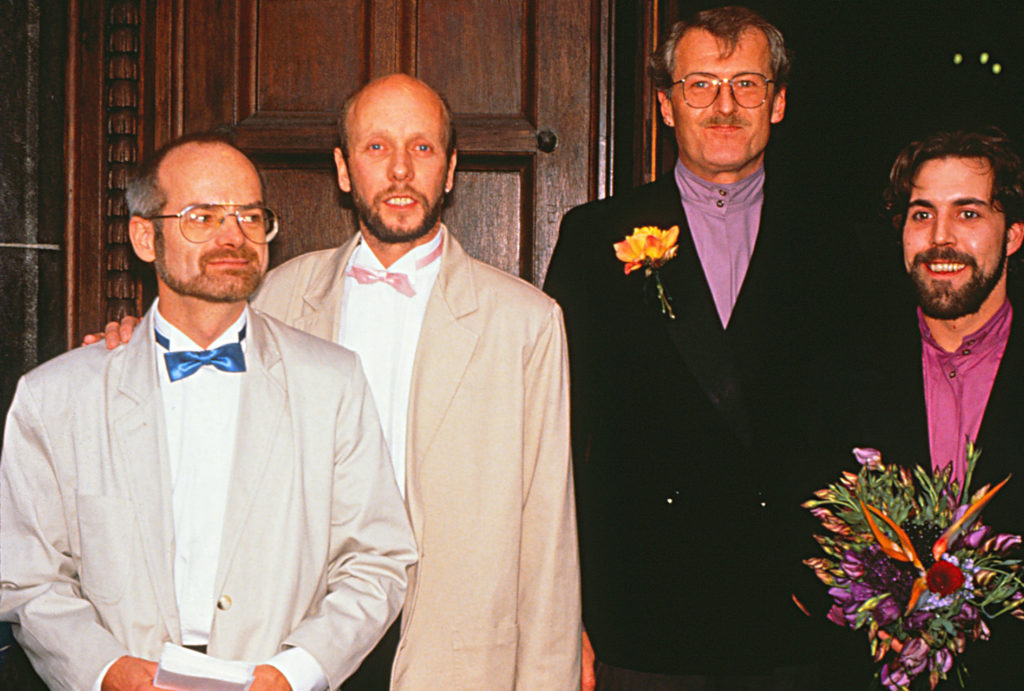
Ove and Ivan Carlsen (left) were the second same-sex couple to marry in Denmark (Francis Dean/Corbis/Getty)
“We thought it was necessary to talk about what was happening in Denmark, to spread the message: it’s OK and it was possible,” Ove said.
Ivan, a Lutheran pastor, had met Ove, a psychologist, three and a half years earlier. Both dressed in cream-coloured suits, with Ove wearing a pink bow tie and Ivan wearing a blue one.
“We had been told that you can have 25 guests with you at city hall,” said Ivan. “We had three.”
“Because of the journalists,” his husband added.
Ivan and Ove married again in 2012 when full marriages were offered to same-sex couples. The pair are now enjoying their retirement in a cosy Copenhagen apartment they share together.
They may have been the first gay couple to marry but they are far from the last – today same-sex marriages are legal in 28 countries, with a further 16 recognising civil partnerships.
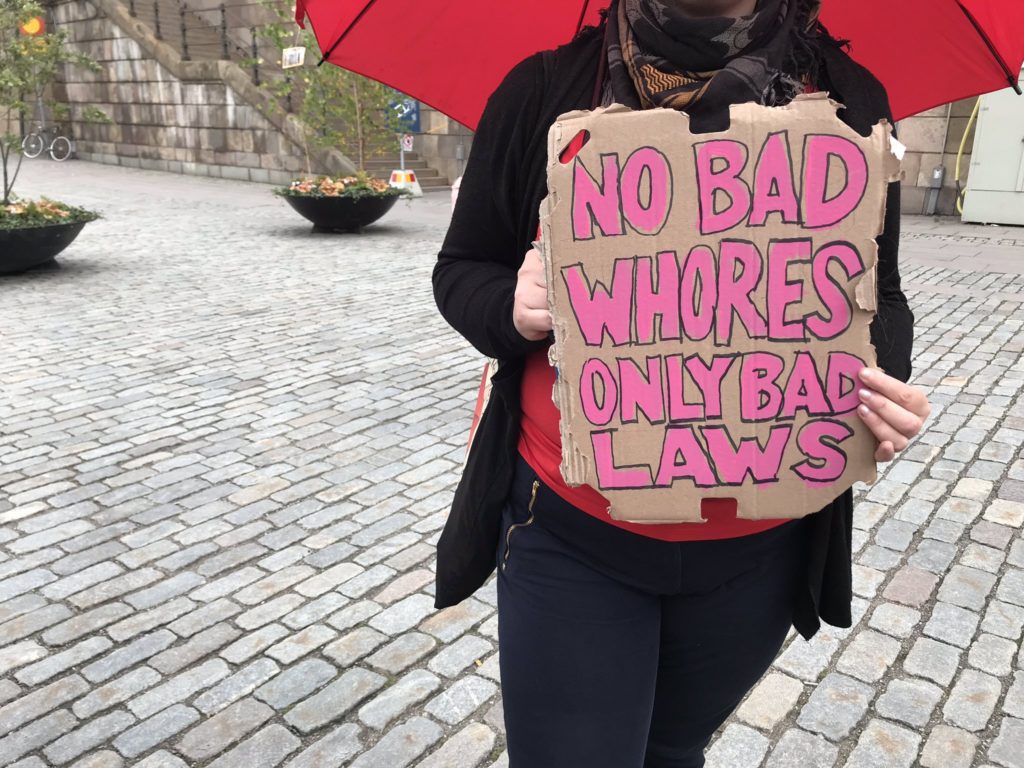
For the first time, hundreds of sex workers marched through the streets of Stockholm calling for sex workers’ rights and the decriminalisation of the sex industry.
The sex workers’ rights protestors demanded that the government end the “harmful”, “unjust” and “stigmatising” criminalisation of sex work.
At the September 29 protest, activists urged the government to listen to their condemnation of the Swedish model – the sex-work law that criminalises sex workers’ clients and is broadly opposed by sex-worker organisations globally.
rans sex workers told PinkNews how the lethal combination of transphobic discrimination and the criminalisation of sex work puts their safety and survival on the line.
“Transgender people and queer people in general in Norway are still stigmatised and discriminated against to begin with,” says Lilith, from Norwegian sex workers organisation PION. “So we are as a community are often overrepresented in the sex industry.”
We are seen as the parasites, the monsters that the world needs to abolish.
“When the Swedish law criminalises our clients, it also creates this notion that we are a criminal enterprise. Yes, it only criminalises clients, but it creates this illusion that the whole sex industry is criminal. As such, we are seen as the parasites, the monsters that the world needs to abolish,” she says.
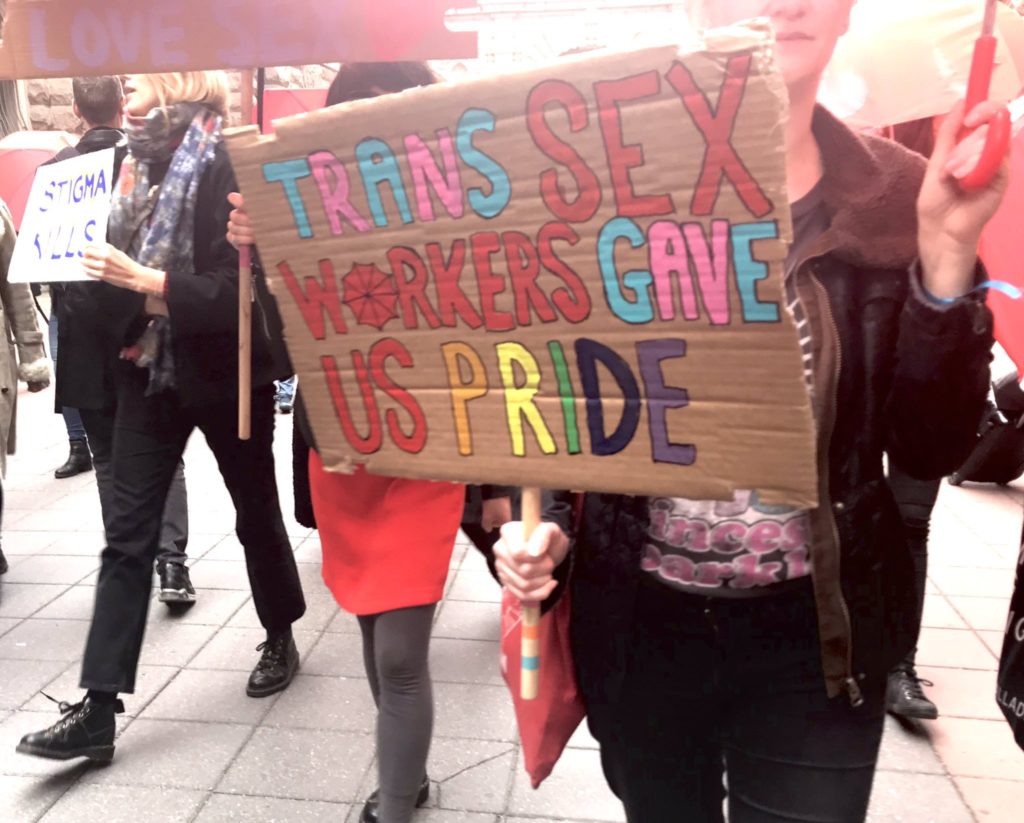
Placard at the march in Stockholm. (Twitter/SWARM)
Sex worker rights are human rights.
The Swedish – also called Nordic – model, which makes it illegal to buy sex, was hailed as progressive by feminist organisations when it was introduced in 1999. Versions of the law have since been introduced in other countries including Norway, Iceland, Ireland and Canada.
In 2016, Amnesty International said sex work has to be decriminalised worldwide, because the current models of partial criminalisation prevent the “realisation of the human rights of sex workers“.
Criminalisation impacts trans sex workers twofold, Dinah, from Trans United Netherlands, told PinkNews.
“Decriminalisation for trans sex workers is very important because we are already discriminated [against] and actually criminalised as trans people, we are very much on the forefront of being visible in society and then the only way that we can do work, many times, is sex work,” she says.
There is a double criminalisation – one on being LGBTIQ and one on being a sex worker.
“Criminalisation of sex work means that there is a double criminalisation, in fact. One on being LGBTIQ and one on being a sex worker.”
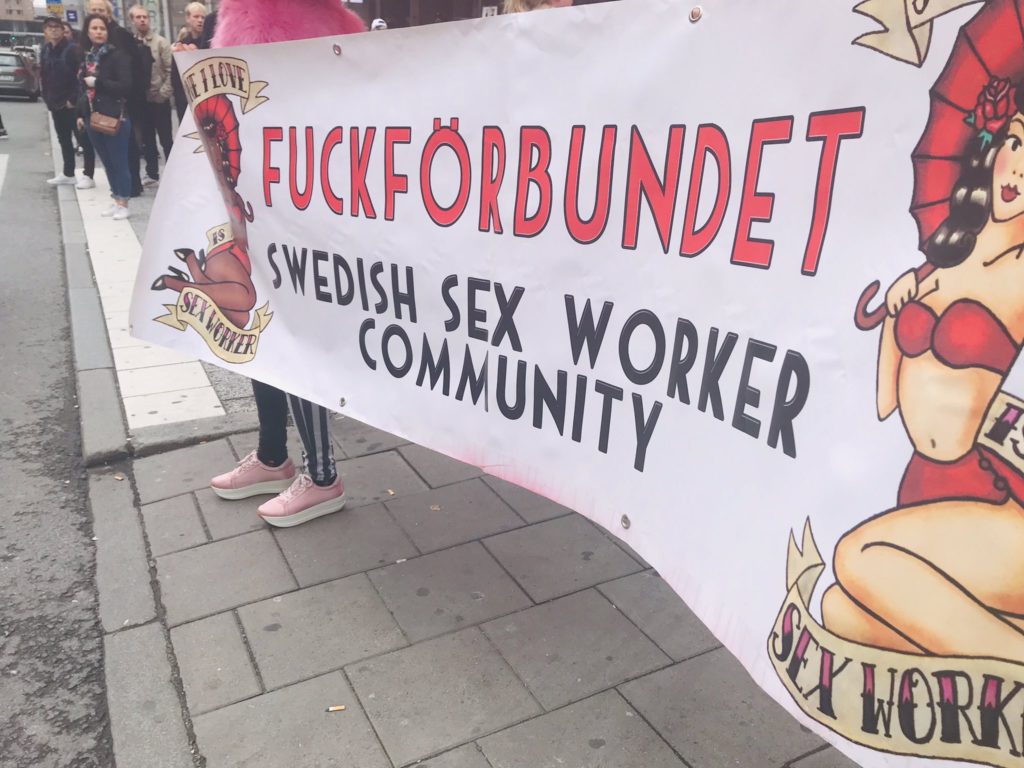
The protest in Stockholm was organised by sex-worker organisation Fuckförbundet. (Twitter/SWARM)
Trans sex workers vital to gay rights movement.
Red Canary Song is a New York-based, migrant sex-worker grassroots organisation that fights for justice and police accountability, after the death of Chinese massage worker, Yang Song, during a police raid in Flushing in November 2017.
The organisation’s director, Kate Zen, says that US anti-trafficking laws similar to the Swedish model increase policing of sex workers and “primarily harm migrants, trans, and street-based sex workers, while doing little to actually reduce the factors driving trafficking: poverty, migration laws, lack of adequate and accessible housing and healthcare”.
“Migrant, black, brown, and trans sex workers are overrepresented in police arrests, and report rampant police violence, including sexual violence,” she says. “Ironically, these are also the groups of people that pro-police/anti-prostitution organisations say they want to help. Their help is clearly misdirected, and actually harming the very people who are most vulnerable in society.”
The leaders of LGBTQ movements in NYC during the Stonewall Rebellion were trans sex workers of colour.
“More than 50% of sex workers in the US say that they have turned to sex work in order to survive, pay for medical procedures, due to employment discrimination in other jobs. LGBTQ people are overrepresented in the sex industry, and the leaders of LGBTQ movements in NYC during the Stonewall Rebellion were trans sex workers of colour – Sylvia Rivera and Marsha P Johnson,” Kate says.
Dozens of sex worker organisations went to the protest in Stockholm on Sunday.
Henna, from sex-worker led activist organisation FTS Finland, says that Finnish sex workers went to the protest in solidarity with their Swedish colleagues “as well as any other colleague who is affected by the Swedish model”.
Listen to us, please!
“Be that trans sex workers or cis, both are affected by this model which doesn’t hear what the sex workers are saying. Listen to us, please!” she says.
Only one country in the world has listened to sex workers and decriminalised sex work – New Zealand.
The New Zealand model aims to uphold the human rights of sex workers and to decriminalise sex work. It was introduced in 2003.
While New Zealand’s approach appears to be moving towards ensuring safety for sex workers, other countries appear to be moving backwards.
Mimi, a trans migrant sex worker from French sex-work union STRASS, told PinkNews that laws criminalising clients – introduced in France in 2016 – are negatively affecting many trans sex workers.
“Especially those who are trans migrant sex workers, who face a lot of discrimination, especially when they are undocumented and working on the streets. Many of them face more insecurity, especially more aggression and more violence.
“More physical violence and any kind of attack, because right now, trans migrant sex workers need to isolate themselves in order to hide their clients from the police, and this is the reason, this is why they are more exposed to violence than before, because they are afraid that their clients will be arrested.
“This, and the fact that there are fewer clients, is a direct result of the criminalisation of the clients.”
Red umbrellas – the worldwide symbol of the sex workers’ rights movement – at the Stockholm march. (Twitter/SWARM)
Criminalisation increases police violence against sex workers.
Police violence as a result of the criminalisation of clients is also being experienced by sex workers in Ireland, according to Adi, from the Sex Workers Alliance Ireland.
Ireland brought in laws making it illegal to buy sex in 2017, but has only seen two clients prosecuted since then – while in that time “we’ve seen a 92 percent increase in violent crime against sex workers”, she says.
“In Ireland, and elsewhere, it’s impossible to find employment in any other field other than sex work – I’ve tried, over and over again, to find other types of work, but nobody’s willing to hire you,” Adi says. “And then in sex work, you’re constantly facing Gardaí harassment, which in my case resulted in my eviction from the premises in which I was working.”
LGBT+ people are overrepresented in the sex-work industry.
The widespread impacts of the criminalisation of sex work have catalysed the sex workers’ rights movement around the world. Luca Stevenson, coordinator at the International Committee on the Rights of Sex Workers in Europe (ICRSE), says ICSRE also joined the Stockholm protest “in support of decriminalisation of sex work”.
Many LGBTI people sell sexual services to survive.
“Most LGBTI organisations around the world – Transgender Europe, ILGA Europe, ILGA World – are supporting the decriminalisation of sex work. We know that many LGBTI people sell sexual services to live, to survive,” he says.
Greater Fort Lauderdale is proud to be the host destination for the first-ever Pride of the Americas on April 21-26, 2020. This historic and transformational event brings two continents and 35 countries together, welcoming everyone under the sun. Pride of the Americas will be hosted by Pride Fort Lauderdale with the Greater Fort Lauderdale Convention & Visitors Bureau serving as the presenting sponsor.
“Greater Fort Lauderdale/Broward County is the perfect launch destination for Pride of the Americas 2020 because we are world renowned for our open embrace to the LGBT+ community and to all visitors from across the globe,” said Stacy Ritter, CEO and president of the Greater Fort Lauderdale Convention and Visitors Bureau. “We are excited for Pride of the Americas attendees to experience our cosmopolitan destination, as well as our beautiful melting pot of cultures.”
Six days of events will begin with opening ceremonies on Tuesday, April 21 in downtown Fort Lauderdale, and culminate on Sunday, April 26, with an epic beach festival and fireworks display. Pride of the Americas will include social events throughout the destination, a parade, beach party, arts festival, A-list entertainment, sunset concerts, top DJs and drag brunches. A glamorous fashion show will feature designs by Bravo’s “Project Runway” alumni and local designers – modeled by male, female, transgender and drag models – at the Seminole Hard Rock Hotel & Casino in nearby Hollywood.
“Greater Fort Lauderdale is home to a thriving LGBT+ community, and we are very much looking forward to welcoming hundreds of thousands of LGBT+ visitors and allies to our destination where diversity shines brightly,” said Richard Gray, senior vice president of Diversity & Inclusion at the Greater Fort Lauderdale Convention and Visitors Bureau.
Pride of the Americas will draw attention to the shared issues LGBT+ individuals, families, youth and seniors face in Latin America and the Caribbean. Key thought leaders from different countries will share their expertise at life-changing conferences and symposiums on human rights, business, travel, health and wellness, education and more.
Although Greater Fort Lauderdale is close in proximity to Latin America and the Caribbean, they are miles apart regarding the treatment and acceptance of the LGBT+ individuals in their communities. The event hopes to bring international attention to these inequalities while improving education and understanding of the LGBT+ community on a global scale.
“Greater Fort Lauderdale is a community that celebrates diversity and inclusion in every way, each and every day, where Pride is our daily way of life,” said Miik Martorell, president of Pride Fort Lauderdale. “Pride Fort Lauderdale and the Greater Fort Lauderdale Convention & Visitors Bureau are committed to leveraging Pride of the Americas to strengthen the LGBT+ communities and the Pride movement in the Caribbean and Latin America.”
Welcoming 1.5 million LGBT+ visitors annually spending $1.5 billion, Greater Fort Lauderdale is well-suited to host Pride of the Americas. With hundreds of gay-owned and operated businesses and the highest concentration of same-sex couple households in the country, the destination is one of the most diverse and welcoming in the world.
Greater Fort Lauderdale is also the LGBT+ capital of Florida and is home to one of the largest Pride Centers in the country, the world’s first AIDS museum, the global headquarters of the International Gay & Lesbian Travel Association, and the Stonewall Museum, one of the only permanent spaces in the U.S. devoted to exhibitions relating to LGBT+ history and culture. The LGBT+ Visitor Center is co-located with the Greater Fort Lauderdale LGBT Chamber of Commerce in the heart of Wilton Manors.
The Greater Fort Lauderdale Convention & Visitors Bureau has been reaching LGBT+ travelers since 1996, when it became the first Convention & Visitors Bureau with a dedicated LGBT+ marketing department. Since then, Greater Fort Lauderdale has continued to break down barriers and facilitate visibility for the LGBT+ community at large, acting as a pioneer in the hospitality industry and ensuring that the destination is inclusive and welcoming with a diverse, safe and open community for all travelers.
Four years ago, it became the first destination in the world to create a transgender marketing campaign. Now the Greater Fort Lauderdale Convention & Visitors Bureau includes trans, lesbian, gay and straight people in all its mainstream marketing initiatives.
About Greater Fort Lauderdale Greater Fort Lauderdale, also known as the “Venice of America,” boasts an average year-round temperature of 77˚F and has 3,000 hours of annual sunshine. Explore 4,000+ eateries, 300+ miles of navigable waterways, eight distinct beaches, a thriving arts and culture scene, craft breweries, rooftop bars, outdoor adventure, and world-class shopping – all conveniently located in the center of South Florida. Made of up 31 municipalities, the destination boasts more than 35,000 lodging accommodations at a variety of hotels, luxury spa reports and Superior Small Lodgings reflecting a cosmopolitan vibe. Upon arrival at FLL Airport (Fort Lauderdale-Hollywood International Airport), it is just 5 minutes to the beach, Port Everglades, the Broward County Convention Center and downtown. For trip planning inspiration, visit the Greater Fort Lauderdale Convention & Visitors Bureau at www.sunny.org and follow @visitlauderdale.
About Pride Fort Lauderdale Pride Fort Lauderdale (originally Pride South Florida) was founded 41 years ago amid protests after entertainer and evangelical activist Anita Bryant successfully waged a hateful public campaign to overturn a landmark gay civil rights ordinance in Miami-Dade County. The organization’s name and location have changed over the years, but its mission has remained the same—to instill pride in our community and support those organizations that serve the local LGBTQ community. In 2017, Pride Fort Lauderdale celebrated its 40th anniversary on Fort Lauderdale Beach, attracting more than 40,000 people for the festivities. For more information, go to PrideFortLauderdale.org.
Friday, October 18 @ 7:30 pm. Occidental Center for the Arts welcomes the internationally renowned duo Scottish Folk: Alan Reid & Rob van Sante. On tour fromScotland, award-winningsinger/composer/multi-instrumentalist and founder member of the legendary Battlefield Band , AlanReid joins forces with skilled guitarist, singer, and noted producer from England Rob van Sante. Enjoy their beautifully crafted old and new music in the Scottish tradition; with beguiling melodies, humor, and strong historical content. Not to be missed! www.reidvansante .$20 Adv/$25 at door. Fine Refreshments. Art Gallery open. Wheelchair Accessible. 3850 Doris Murphy Ct., Occidental CA. 95465. www.occidentalcenterforthearts.org; 707-874-9392.