Melissa Bashardoust’s Girl, Serpent, Thorn has the lushness of a fairy tale and the boldness of the best contemporary YA fantasy. This opulent novel, inspired by traditional Persian stories, combines all the romance and intrigue of high fantasy with a deep exploration of the main character’s emotional world and relationship to her own strength. Back matter, including an extensive Author’s Note, provides more context about the fairy tales, myths, traditions, and cultural references that Bashardoust has woven into the novel, as well as suggestions for further reading for those interested in learning more.
Soraya, the shah’s sister, is hidden away from the public eye so that no one will discover the curse a div, or demon, placed upon her as a child: by sending div blood coursing through her veins, the demon ensured any living being Soraya touches will instantly die. When a mysterious, handsome soldier offers to help undo her curse, Soraya is smitten––and quickly embroiled in a political battle that sees her family’s rule upended in a coup d’état. The soldier turns out to be the feared half-man, half-div Shahmar, and he wants Soraya, another human who knows what it’s like to be part-div, to join his side in submitting the humans and divs to his violent rule.
Soraya is successful at undoing her curse, but now she must figure out how to stop the Shahmar from murdering her entire family, while still feigning interest in his romantic advances. To make matters more complicated, Soraya finds herself falling for Parvaneh, a female div who helped turn the Shahmar into the powerful creature he is and has regretted it ever since. Soraya isn’t sure she can trust a div like Parvaneh––especially one who proves so alluring––but with no other allies, she doesn’t have much choice.
The two team up to try to outwit the Shahmar and save Soraya’s family and Parvaneh’s fellow divs before it’s too late. As they sneak around the Shahmar’s heavily-guarded mountain fortress, their attraction deepens, with each touch a heightened sensation for Soraya, who spent so many years unable to even risk brushing up against another person for fear of striking them dead. Soraya describes the spark between her and Parvaneh as a kind of “wanderlust,” with her fingertips yearning “to explore new landscapes, new textures.” As the danger ramps up, these quiet moments between Soraya and Parvaneh become a tender respite, dramatizing Soraya’s longing for intimacy, both physical and emotional.
The story is sexy, bloody, and luxurious, but perhaps the most interesting part is the way Soraya slowly begins to see the things that have always made her different as not a weakness, but a strength. Her curse may have been just that––a curse––but it also gave her a way to defend herself. And when she makes a choice later in the book that means risking becoming cursed again, it is because she understands the div blood that ran through her veins in a new way. Perhaps being different doesn’t mean being shameful. Perhaps it doesn’t have to mean hiding away.
In a story about a protagonist who experiences attraction to more than one gender, this character arc is especially affirming. The Shahmar may be the first one to tell Soraya, “You and I don’t belong fully to either world,” but it is Parvaneh’s gentle love that helps Soraya see maybe she can simply belong to both: “Soraya no longer had to choose between one piece of herself and another. She could be whole.”
Girl, Serpent, Thorn By Melissa Bashardoust Flatiron Books Hardcover, 9781250764942, 336 pp. August 2020
Pride Month is behind us, and an unsteady future is ahead of us. In the words of Marsha P. Johnson, “Nobody promised you tomorrow.” This quote is a rallying cry to continue our momentum, and to never give up. As news coverage of peaceful protests across the nation dies down, we need to ensure that “there is no pride for some of us without liberation for all of us.”
This is a critical moment in our nation’s history, and to be on the right side of change is necessary. We have reached another boiling point. White supremacy and white silence have always been embedded in our culture; none of this is new. Black voices have exposed the rotten roots of the country for centuries.
But this is not a lost cause. It’s not too late to become involved. We can continue to educate ourselves. We can continue to hold ourselves accountable. We can continue to dig deep into the darkest parts of ourselves and internalized, institutional, and structural racism. We must continue to enact change.
Our literature has often provided blueprints for cultural transformation. Many of this month’s titles reckon with our queer history, look towards our queer future, and hopefully provide a pathway to both queer joy and systemic change. We must give ourselves space to move toward a world where community is not just a word, but a radical promise of love, understanding, and intervention in the face of adversity.
The fight for justice stands front and center in the 25th anniversary edition of Howard Cruse‘s Stuck Rubber Baby. The book explores one gay character’s involvement in the Civil Rights movement of the 1960s.
Painstakingly researched and exquisitely illustrated, Stuck Rubber Baby is a groundbreaking graphic novel that draws on Howard Cruse’s experience coming of age and coming out in 1960s Birmingham, Alabama.
This 25th anniversary edition brings this rich and moving tale of identity and resistance is back in print–complete with an updated introduction from Alison Bechdel, rare photographs, and unpublished archival material that give a thorough, behind-the-scenes look at this graphic novel masterpiece.
As a young gay man leading a closeted life in the 1960s American South, Toland Polk tries his best to keep a low profile. He’s aware of the racial injustice all around him–the segregationist politicians, the corrupt cops, the violent Klan members–but he feels powerless to make a difference. That all changes when he crosses paths with an impassioned coed named Ginger Raines. Ginger introduces him to a lively and diverse group of civil rights activists, folk singers, and night club performers–men and women who live authentically despite the conformist values of their hometown. Emboldened by this new community, Toland joins the local protests and even finds the courage to venture into a gay bar.No longer content to stay on the sidelines, Toland joins his friends as they fight against bigotry. But in Clayfield, Alabama, that can be dangerous–even deadly.
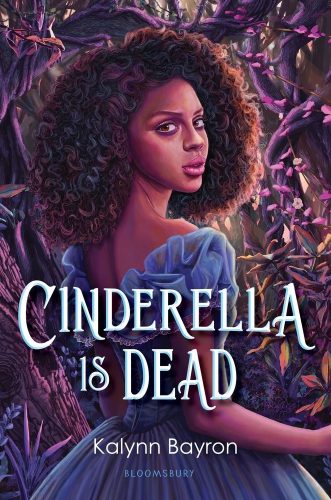
Fairy tales have long been structured around heterosexual relationships. Cinderella is Dead by Kalynn Bayron offers an intriguing re-imagining of the classic Cinderella story, and drives YA readers to dig deeper and challenge their societal expectations.
It’s 200 years after Cinderella found her prince, but the fairy tale is over. Teen girls are now required to appear at the Annual Ball, where the men of the kingdom select wives based on a girl’s display of finery. If a suitable match is not found, the girls not chosen are never heard from again.Sixteen-year-old Sophia would much rather marry Erin, her childhood best friend, than parade in front of suitors. At the ball, Sophia makes the desperate decision to flee, and finds herself hiding in Cinderella’s mausoleum.
There, she meets Constance, the last known descendant of Cinderella and her step sisters. Together they vow to bring down the king once and for all–and in the process, they learn that there’s more to Cinderella’s story than they ever knew. . . This fresh take on a classic story will make readers question the tales they’ve been told, and root for girls to break down the constructs of the world around them.
In this life-affirming, heartening and refreshing collection of interviews, young trans people offer valuable insight and advice into what has helped them to flourish and feel happy in their experience of growing up trans.
Speaking openly and candidly about their gender, their experiences of coming out, their aspirations, and their fears – accompanied by interviews and support from their parents and carers – this book is beautiful proof of the potential for trans children to live rich and fulfilling lives when given the support and love they need.
With their trademark candour and empathy, Juno Roche gives voice to a generation of gender explorers who are making gender work for them, and in the process, reveals a kinder, more accepting world, that we should all be fighting for.
Each place in the world has completely different sets of ideological beliefs. In The Pink Line, Mark Gevisser chronicles and investigates the roots of disparities in cultural practices of gender and sexuality around the world.
More than five years in the making, Mark Gevisser’s ‘The Pink Line: Journeys Across the World’s Queer Frontiers’ is a globetrotting exploration of how the human rights frontier around sexual orientation and gender identity has come to divide–and describe–the world in an entirely new way over the first two decades of the twenty-first century. No social movement has brought change so quickly and with such dramatically mixed results. While same-sex marriage and gender transition is celebrated in some parts of the world, laws are being strengthened to criminalize homosexuality and gender nonconformity in others. A new Pink Line, Gevisser argues, has been drawn across the world, and he takes readers to its frontiers.
Mirroring our current pandemic moment, Emma Donoghue’s The Pull of the Stars: A Novel chronicles the relationship between three nurses who work in the maternity ward of a small hospital during the influenza outbreak of 1918.
In an Ireland doubly ravaged by war and disease, Nurse Julia Power works at an understaffed hospital in the city center, where expectant mothers who have come down with the terrible new Flu are quarantined together. Into Julia’s regimented world step two outsiders–Doctor Kathleen Lynn, a rumoured Rebel on the run from the police, and a young volunteer helper, Bridie Sweeney. In the darkness and intensity of this tiny ward, over three days, these women change each other’s lives in unexpected ways. They lose patients to this baffling pandemic, but they also shepherd new life into a fearful world.
With tireless tenderness and humanity, carers and mothers alike somehow do their impossible work. In The Pull of the Stars, Emma Donoghue once again finds the light in the darkness in this new classic of hope and survival against all odds.
As always, if our list of LGBTQ releases missed an author or book, or if you have a book coming out next month, please email us.
Fiction
The Blue Star (Reissue) by Robert Ferro (Author), Andrew Holleran (Foreword), ReQueered Tales
One of the most widely held myths about the fight for LGBTQ equality is that it started at New York City’s Stonewall Inn during the summer of 1969. That uprising, while pivotal, was in reality preceded by a grassroots “homophile” movement that has been largely overlooked.
“Every single person who identifies as part of the LGBTQ+ community can thank Frank for for developing what we now celebrate each and every June, which is Pride.”
Eric Cervini, a historian, is trying to change that. His first book, “The Deviant’s War,” documents the efforts of gay activists during the late 1950s and ‘60s to plant the seeds that would eventually lead to decades of progress for the lesbian, gay, bisexual, transgender and queer community.
While Cervini notes that his book is not a biography, its central character is Frank Kameny, whose life and activism is the thread throughout its nearly 400 exhaustively researched pages. Though Kameny is not as well known as later activists like Harvey Milk or Marsha P. Johnson, his contributions to LGBTQ rights are at least — if arguably not more — important.
“Everyone should know his name,” Cervini said of Kameny. “Every single person who identifies as part of the LGBTQ+ community can thank Frank for for developing what we now celebrate each and every June, which is Pride.”
“The Deviant’s War” started as Cervini’s senior thesis at Harvard, where he graduated from in 2014, and continued into his PhD dissertation at the University of Cambridge, where he received his doctorate last year. A Texas native, Cervini, who came out in high school, said he “had not the slightest clue about what queer history was or who was important” while growing up.
“So much of this history just is not taught in high schools, very little of it is taught in colleges and so much of it is also hidden,” he said.
Cervini said his first introduction to LGBTQ history came from watching the 2008 film “Milk” starring Sean Penn while in high school.
“Starting from that moment, I said, “I want to learn more about my own past and my queer ancestors.’”
He initially set out to write about Milk for his undergraduate senior thesis but found that all the primary source materials were in San Francisco. But then in Harvard’s library database, he stumbled upon a name he had never seen before: Frank Kameny.
“He was so instrumental in those early years, and he had his hand in every part of the pre-Stonewall gay rights movement,” Cervini said. “Historians knew about him, they had long identified him as the ‘grandfather of the modern gay rights movement,’ but there hadn’t been any book written about him.”From astronomer to warrior
The meat of “The Deviant’s War” starts in late 1957, when Kameny, then a 32-year-old, Harvard-educated, Hawaii-based astronomer for the U.S. Defense Department, was summoned to the Army Map Service headquarters in Maryland and asked a question that would drastically alter the trajectory of his life: “Information has come to the attention of the U.S. Civil Service Commission that you are a homosexual. What comment, if any, do you care to make?”
It was a time when psychiatrists deemed homosexuality a “sociopathic personality disturbance” and consensual same-sex activity could be punished by “sexual psychopath laws,” and Kameny was fired, just two months after the launch of Sputnik. He would never work for the U.S. government again.
“He had lost absolutely everything,” Cervini said. But unlike most of the thousands of gay and lesbian federal employees dismissed during the so-called Lavender Scare, Kameny decided to fight back. So the end of his government career marked the beginning of over a half-century of activism.by TaboolaSponsored Stories
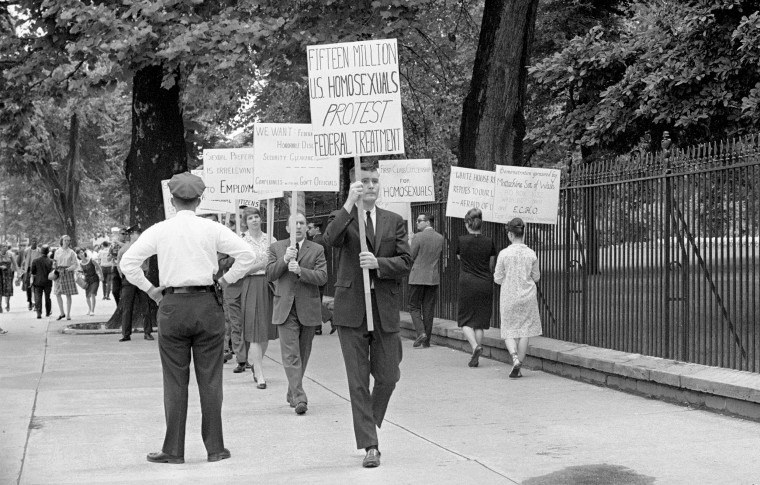
Frank Kameny participates in a group picket outside the White house on Armed Forces Day, May 21, 1965.Bettmann Archive
But Cervini notes that “The Deviant’s War” covers just a part of Kameny’s activism — from his government dismissal in the late ‘50s to just after Stonewall. To fully cover his contributions to the LGBTQ movement, Cervini added, would take volumes and much longer than the seven years he put into writing the book.
In just the early years of his activism, Kameny covered significant ground: He sued the federal government in what’s considered the first civil rights claim based on sexual orientation to be brought to the Supreme Court; he co-founded the Mattachine Society of Washington, one of the earliest LGBTQ rights groups; and he was among a small group that held what is thought to be the first gay demonstration outside the White House. Not long after, he decided to take on the American Psychiatric Association and its classification of homosexuality as a mental disorder.
After more than five decades of activism, Kameny died at the age of 86 on Oct. 11, 2011. His death fittingly coincided with National Coming Out Day, which has been celebrated annually since 1987.
While Kameny is undoubtedly the star of Cervini’s debut book, we also meet a number of other pre-Stonewall activists who were crucial to the LGBTQ rights movement, including Barbara Gittings, Kay Tobin Lahusen, Ernestine Eppenger (a.k.a. Ernestine Eckstein) and Randy Wicker. We also find out about the early contributions of some more well-known names, like Marsha P. Johnson, Sylvia Riveraand Bayard Rustin.
“Even though Frank’s photo is on the spine of the book, we’re using him as a lens for understanding not just his life but all the different diverse lives within the early movement that then allowed all of our success much later to occur,” Cervini said.An activism ‘guidebook’
While his book is focused on the mid-20th century, Cervini said there are many lessons in it today for today’s activists.
“It really is a guidebook for how activism works and also what doesn’t work when we’re dealing with an oppressive government,” he said. “Once again we’re fighting a lot of the same battles, and I think looking backwards and searching for templates for how we can combat persecution effectively and inclusively is so important, and that’s what I hope to do with this book.”
Another important lesson he hopes readers take away from “The Deviant’s War” is that Kameny and a number of his contemporaries “stood on the backs of those with the least to lose,” namely those who were not, like Kameny, white cisgender men.
“We are under attack once again,” he said, citing the transgender military ban and state-level policies pertaining to transgender youth. “Now we all have a moral obligation to be continuing the fight after the marriage successes, and after an openly gay viable presidential candidate. Now it’s our turn to return the favor and to fight for those with the least to lose.”
For today’s activists who are “continuing the fight” for LGBTQ equality, Cervini said they should recognize that they are currently making history and should follow the lead of Kameny, who saved tens of thousands of documents that enabled Cervini to tell his story.
“We need to make sure we’re not throwing out our emails when we’re planning marches and demonstrations against the current regime,” he said.
“The Deviant’s War” is available starting Tuesday, June 2, and Cervini will be participating in a virtual book tour through June 6, with guests including screenwriter Dustin Lance Black, who won an Oscar for his screenplay for “Milk,” and Pennsylvania state Rep. Brian Sims. Cervini also shares LGBTQ history lessons regularly on his Instagram account.
Though the Lambda Literary Foundation had to cancel its annual and in-person Lambda Literary Awards ceremony given the coronavirus, the organization announced winners Monday. Twenty-five LGBTQ books earned awards across categories like fiction and nonfiction, comics, romance and anthology.In this article
“Because of the pandemic, the list is even more vital because we’re feeling even more separated and isolated,” William Johnson, the deputy director of Lambda Literary, said. “I think the need to have some sort of communal celebration around queer art is only heightened as we’re operating under these extraordinary circumstances.”
Lambda Literary is the premier organization promoting emerging queer writers. As in previous years, the 2020 “Lammy Awards” recipients celebrate the “dynamic diversity” of the LGBTQ community, with categories ranging from transgender poetry to LGBTQ drama. More than 60 literary pros perused more than 1,000 submissions to determine the year’s best books — which came from more than 300 publishers. The list of finalists clocks in at 164, out of which Lambda selected the best 25.
Our list constantly evolves as the community becomes more expansive in terms of what queerness can contain and what queerness can hold
WILLIAM JOHNSON, DEPUTY DIRECTOR, LAMBDA LITERARY
“Our list constantly evolves as the community becomes more expansive in terms of what queerness can contain and what queerness can hold,” Johnson said. “We are brilliant, we are wonderful, we are talented. I want everyone to understand that that’s the actual power of queer creativity.
While in-person meetings, like the Lammy Award ceremony, have been curtailed, Johnson believes there is still ample opportunity for readers to find connection through rallying around books. If you’re looking for your next LGBTQ read, why not start with those that Lambda Literary has rated among this year’s best?2020 Lammy Awards winners
Below are the Lammy Awards category winners. Click the category to see the rest of its finalists.
Below are the finalists and winners of the 2020 Lambda Literary Awards, totaling more than 160 books across 25 categories. Some categories comprise as few as three finalists while the majority of categories include eight finalists.Lesbian Fiction
BUY THESE FROM YOUR LOCAL BOOKSTORE, PLEASE. COPPERFIELDS WILL DELIVER OR YOU MAY PICK THEM UP CURBSIDE.
1. “Cantoras” by Carolina De Robertis (pre-order, ships June 2)
Larry Kramer, the noted writer whose raucous, antagonistic campaign for an all-out response to the AIDS crisis helped shift national health policy in the 1980s and ’90s, died on Wednesday in Manhattan. He was 84.
His husband, David Webster, said the cause was pneumonia. Mr. Kramer had weathered illness for much of his adult life. Among other things he had been infected with H.I.V., the virus that causes AIDS, contracted liver disease and underwent a successful liver transplant.
Mr. Kramer was a founder of the Gay Men’s Health Crisis, the first service organization for H.I.V.-positive people, in 1981. His fellow directors effectively kicked him out a year later for his aggressive approach, and he returned the compliment by calling them “a sad organization of sissies.”
Jeane Slone will discuss her research of the Women Air Force Service Pilots (WASPs) from WWII. Jeane had the privilege of meeting some of these women who were members of an amazing and brave group of 1,074 pilots.
In the face gender discrimination these women made a valuable contribution to the war effort. WASPs ferried seventy-seven types of aircraft during the war to 134 army bases for men to fly into combat. The task did not come with risk and thirty-eight pilots died attempting to complete their mission. Q & A to follow.
This event is free it is sponsored by the National Women’s History Alliance. Please read the secure method below to attend. This event is publicized all over the US so register early because of limited space.
I am sorry it is involved to register but this is how they prevent hacking. Press register for event add book event to cart press check out press click here fill out new customer information (again for security) press submit at bottom submit order (it is free) You will get a confirmation in your email after registering and a link to attend. THANK YOU ALL FOR ATTENDING AND I PROMISE YOU WILL NOT BE DISAPPOINTED! Fondly, Jeane Please email me if you have any problems registering: info@jeaneslone.com
SEBASTOPOL: Mondays, Wednesdays, & Saturdays | 10:30am-1:00pm Call (707) 823-2618 or email sebastopol@copperbook.com for requests.
NEW!NAPA: Tuesdays & Saturdays | 11:00am-2:00pm
Call (707) 252-8002 or email napa@copperbook.com for requests. CALISTOGA: Tuesdays | 10:00am-1:00pm & Saturdays | 12:30pm- 3:30pm
Call (707) 942-1616 for requests.
Or visit copperfieldsbooks.com to browse new & classic books that we will ship right to your home. — Thank you to our amazing community for supporting local and we hope everyone is staying healthy!
Books featuring LGBT+ content are once again dominating the rankings of the most-banned books – with two trans kids’ books coming top.
The American Library Association’s Office for Intellectual Freedom collates an annual list of the most commonly banned and challenged books at libraries across the US, which has long shone a light on the ongoing censorship faced by authors who address LGBT+ themes.
This year’s list is no different, with a staggering eight of the top 10 books in the list targeted over LGBT+ content — the fourth consecutive year that queer books have made up more than half the list.
LGBT+ books continue to dominate the banned list
Topping the list is the novel George by Alex Gino, which was “challenged, banned, restricted, and hidden” in libraries across the country because it features a transgender character.
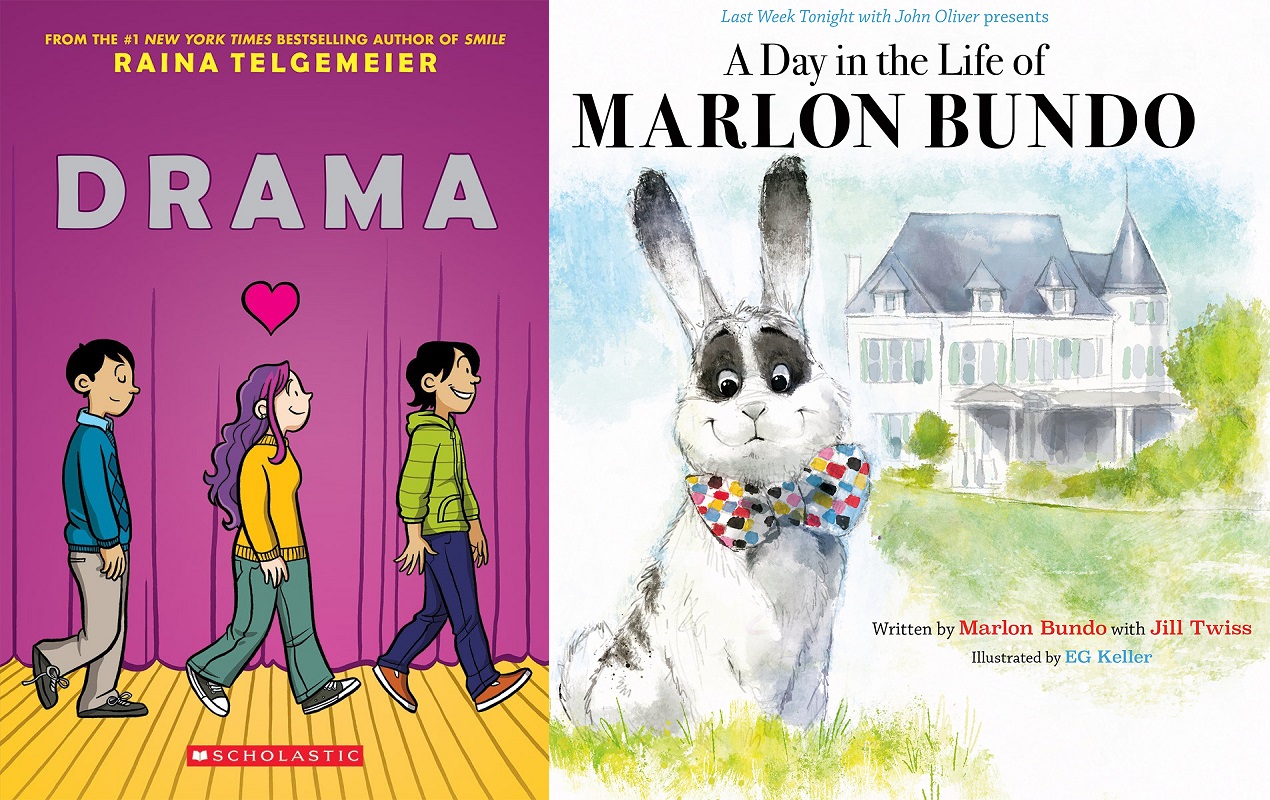
The second-placed book, Beyond Magenta by Susan Kuklin, is based on interviews with six transgender young adults. In third place is A Day in the Life of Marlon Bundo by Jill Twiss, which features a gay rabbit — and was produced for John Oliver’s topical TV show Last Week Tonight.
Also making the list are gay fairytale Prince & Knight, trans teen Jazz Jennings’ book I Am Jazz, Raina Telgemeier’s queer graphic novel Drama, and inclusive sex education resource Sex is a Funny Word.
A Day in the Life of Marlon Bundo by Jill Twiss and Raina Telgemeier’s queer graphic novel Drama are on the banned books list
The only non-LGBT+ books to make the list are The Handmaid’s Tale and Harry Potter — the latter of which does not contain any actual visible LGBT+ representation but is nonetheless reviled by evangelicals for its depiction of witchcraft.
American Library Association says LGBT+ books ‘misrepresented as pornographic’.
The American Library Association said: “Challenges to library materials and programs addressing issues of concern to those in the LGBTQIA+ communities continued unabated in 2019, with a rising number of coordinated, organised challenges to books, programs, speakers, and other library resources that address LGBTQIA+ issues and themes.
“A notable feature of these challenges is an effort to frame any material with LGBTQIA+ themes or characters as inherently pornographic or unsuitable for minors, even when the materials are intended for children and families and they are age and developmentally appropriate.
“For example, a pastor in Upshur, West Virginia, challenged the children’s picture book Prince & Knight, claiming that the fractured fairy tale ‘is a deliberate attempt to indoctrinate young children, especially boys, into the LGBTQA lifestyle.’
“Similarly, an organised group in Loudoun County, Virginia, protested the addition of diverse children’s and young adult books addressing LGBTQIA+ themes and characters to classroom libraries, claiming that the books advance a ‘political agenda’ endorsed by the LGBTQIA+ community.”
The ALA noted that “organised groups” with “conservative Christian beliefs about gender and sexual identity” have continued to protest and disrupt Drag Queen Story Hour events held in libraries, with more than 30 such challenges to Drag Queen Story Hours and other Pride events.
When we were four, many of us daydreamed about being a ballerina, astronaut or magician. But, mostly, we were clueless about what we’d be when we grew up.
That wasn’t the case with Thomas (a.k.a. Tomie) dePaola, the acclaimed, gay children’s author and illustrator, who died at age 85 in Lebanon, N.H., from complications from surgery after a fall. DePaola, whose award-winning work was beloved by children and adults, wrote and illustrated more than 270 books. If you’ve been spellbound by magical grandmas; bullied; eagerly awaited the arrival of a new baby brother or sister; or frightened by news that adults wouldn’t explain to you – you’ve found or will find a beautiful, comforting home in dePaola’s books.
DePaola knew what his life’s work would be before he started kindergarten. In an interview with readingrockets.org, he said, “I said, ‘Yes, I’m going to be an artist, and I’m going to write stories and draw pictures for books…I never, ever thought of considering any other profession.’”
From then on, dePaola never looked back. In second grade, dePaola told his art teacher “real artists don’t copy,” dePaola wrote in his series of memoirs about growing up in Meriden, Conn.
The teacher was so pleased with the picture the seven-year-old dePaola drew of her that she asked if she could keep it. “‘I told her, ‘Oh, no, no, no. I have to keep it. I might be able to sell it someday,’” he told readingrockets.org.
DePaola’s stories were often inspired by his memories of his family and childhood. “I’ve discovered that children most respond to books based on my own life,” he told The New York Times.
DePaola grew up in an Italian and Irish, Roman Catholic family. His early childhood was filled with Sunday dinners with his grandparents, dancing school recitals (he loved to dance like Fred Astaire!), Franklin Delano Roosevelt and the first years of World War II.
“Strega Nona,” one of his most beloved works is set in Calabria in Italy where his grandparents were from. It features a “grandma witch” who works magic with a pasta pot. DePaola received the distinguished Caldecott Medal for the book, which was banned by some libraries for daring to expose the young to magic.
Today, though much improvement is still needed in LGBTQ representation, a variety of children’s books — from “Heather Has Two Mommies” to “I Am Jazz” to “Harriet Gets Carried Away” — feature queer characters. This wasn’t so for kids’ book authors and illustrators of dePaola’s generation. Most children’s book writers couldn’t be openly queer then. “If it became known you were gay, you’d have a big red ‘G’ on your chest,” dePaola told T: The New York Times Style Magazine in 2019, “and schools wouldn’t buy your books anymore.”
DePaola’s work isn’t explicitly gay. Yet his picture books and chapter books have a particular resonance for queer readers. Though he didn’t come out until late in his life, his experience of being gay is reflected in some of his most seminal books.
“I was called a sissy in my young life,” dePaola said in a 1999 interview with the Times, “but instead of internalizing these painful experiences, I externalize them in my work.”
As a queer reader, I feel seen and heard as I read dePaola’s books. DePaola’s “Oliver Button Is a Sissy,” released in 1979, is the story of a young boy who’s bullied because he doesn’t like sports and wants to dance and dress in costume. It never says the word “gay,” but it’s queer quotient can’t be missed.
In his memoirs, dePaola writes of being a scared seven-year-old when Pearl Harbor was attacked and the United States entered World War II. He only knew that, as his mom said, “things will never be the same.”
Things won’t be the same after COVID-19. Thank you, Tomie dePaola for comforting us during our Pearl Harbor. R.I.P.
Women who lived radical, unflinchingly queer lifestyles played an essential role in Ireland’s Easter Rising of 1916, but most later had their commitment to independence erased. A new book tries to change that.
These women’s identities are explored in a new book by Niall O’Dowd. A New Ireland looks at how Ireland went from being one of the most conservative countries in Europe to one of the most socially liberal, examining social change over the last century and delving into the formative 1916 Rising.ADVERTISING
That year, Irish revolutionaries took to the streets of Dublin and seized important buildings in an armed uprising in protest against British rule. Pádraig Pearse, one of the leaders of the Rising, stood on the steps of the General Post Office (GPO) on O’Connell Street and read the Irish proclamation, which declared Ireland to be an independent state.
The Rising was ultimately quelled by British forces and many of its leaders were subsequently executed. Despite this, it was a formative moment that helped set in motion a campaign for freedom that culminated in the formation of the Irish Free State in 1922.
Many of the male revolutionaries who fought for Irish independence are well-remembered, but the role of women was largely forgotten. Among these women were lesbians who lived radical, unflinchingly queer lifestyles, as detailed in O’Dowd’s new book.
A lesbian couple volunteered in the Easter Rising, where they offered care to the wounded.
In an excerpt published by IrishCentral, O’Dowd details the lives of the queer women who later had their roles in the Easter Rising all but erased
He quotes historian Mary McAuliffe, who named Elizabeth O’Farrell as one of these revolutionary women in an interview with the Dublin Inquirer. O’Farrell and her partner Julia Grennan were both nurses and they volunteered in the GPO on O’Connell Street in Dublin during the Rising.
“They cared for the wounded, including James Connolly (the founder of the Irish Citizen Army),” McAuliffe said.
O’Farrell was ultimately tasked with carrying the surrender flag when the Irish revolutionaries realised that they were going to be defeated.
Elizabeth O’Farrell was literally erased.
“After days of fighting, the rebels moved to Moore Street, where Pearse decided to surrender,” McAuliffe said.
“When Elizabeth was going to bring out the surrender flag, Julia Grennan talks about the fact that she was terrified and anxious watching her step out onto Moore Street, where there were bullets whizzing around.
O’Farrell survived that moment, but her legacy was subsequently erased. She was famously airbrushed out of a photograph of 1916 commander Pádraig Pearse surrendering to the British Army — but whoever did so didn’t do a great job.
Her boots remained in the photograph, and the incident has become symbolic for the wider erasure of women and queer people from major historic events.
O’Farrell might have been erased from history, but that did not stop her from living a queer lifestyle. After the Rising she spent the rest of her life with Grennan, and when they died they were buried together in Glasnevin Cemetery. Their gravestone reads: “Elizabeth O’Farrell… And her faithful comrade and lifelong friend Sheila [Julia] Grennan.”
O’Garrell and Grennan were not the only queer women to play their part in the Easter Rising. 74 women in total fought for Irish independence in 1916, and there were at least two other queer women among their ranks.
Kathleen Lynn and Madeleine Ffrench-Mullan exchanged love letters following the 1916 Rising.
Dr Kathleen Lynn, a member of the Irish Citizen Army, served as Chief Medical Officer in the GPO and was also a notable suffragette. When she was arrested she described herself as “a Red Cross doctor and a belligerent,” according to O’Dowd.
She was imprisoned in Kilmainham Gaol alongside other women such as Constance Markievicz, the best-known woman of the Rising, and Madeleine Ffrench-Mullan.
McAuliffe said Dr Lynn and Ffrench-Mullan passed love letters to each other, and when they were released from prison they lived together for the rest of their lives.
Ireland was not a welcoming place for women and LGBT+ people both before and after independence, so it is perhaps no surprise that so many had their roles in the fight for independence erased. But without them, Ireland may never have won its freedom.
Five years after the Easter Rising, the Anglo-Irish Treaty was signed giving independence to 26 counties in Ireland. Those counties became known as the Irish Free State, and would later become the Republic of Ireland. The revolutionary period that led to that independence is among the most important in Irish history — but it is only in recent years that the role played by women has been remembered.