McBride will run for Delaware’s 1st Senate District, where incumbent Harris McDowell, a fellow Democrat, announced July 1 that he would retire in 2020. The district covers Bellefonte, Claymont and parts of Wilmington, the state’s largest and most populous city.
“I’ve spent my life fighting for people to have dignity, peace of mind, and a fair shot at staying afloat and getting ahead,” McBride said in a statement shared with NBC News. “Sen. McDowell’s retirement at the end of this term is a well-deserved cap on a remarkable career of public service, and now our neighbors need someone who will continue to fight for them.”
McBride, currently a spokesperson for LGBTQ advocacy group Human Rights Campaign, first made national headlines in 2012 while still a college student. A day after stepping down as American University’s student body president, McBride came out as trans in the school’s student-run newspaper. During her time in college, McBride also interned in the Obama White House, becoming “the first openly transgender woman to work in the White House in any capacity,” according to her campaign announcement.
Should McBride be elected next year, she would be America’s first openly transgender state senator. According to the Victory Institute, there are currently 715 openly LGBTQ elected officials nationwide.
A total of 206 companies have signed onto a legal brief urging the U.S. Supreme Court to find Title VII of the Civil Rights Act bars discrimination against LGBT people in the workforce.
The friend-of-the-court brief — organized by the Human Rights Campaign, Lambda Legal, Out & Equal, Out Leadership and Freedom for All Americans — is signed by the nation’s top businesses and argues anti-LGBT discrimination is a form of sex discrimination, thus illegal under the Title VII.
Among the signers are food companies like Domino’s Pizza and Coca-Cola Company, tech companies like Facebook and Mozilla Corp., and defense contractors like Northrup Grumman Corp.
“Even where companies voluntarily implement policies to prohibit sexual orientation or gender identity discrimination, such policies are not a substitute for the force of law,” the brief says. “Nor is the patchwork of incomplete state or local laws sufficient protection —for example, they cannot account for the cross-state mobility requirements of the modern workforce. Only a uniform federal rule can enable businesses to recruit and retain, and employees to perform, at their highest levels.”
According to the Human Rights Campaign, the brief has more corporate signers than any previous business brief in an LGBT non-discrimination case.
The brief was written by Quinn Emanuel Urquhart & Sullivan, LLP, a Los Angeles-based law firm that also represents the signers in the case along with Robinson Curley P.C. and Taylor & Cohen LLP.
Erin Uritus, CEO of Out & Equal Workplace Advocates, said in a statement the brief “exposes the lie that affirming Civil Rights protections for LGBTQ Americans is somehow anti-business.”
“The opposite is true,” Uritus said. “Equality is good for businesses and employees. And consumers — who are increasingly savvy and intentional about their spending power — are demanding equality. I’m inspired by all of the leaders who have joined with us today in submitting this brief. The Civil Rights Act needs to be affirmed in a way that serves and protects all Americans.”
A man serving 30 years for not disclosing his HIV status to sexual partners has been released 25 years earlier.
Former college wrestler Michael ‘Tiger Mandingo’ Johnson left Boonville’s prison, Missouri, yesterday (9 July).
In 2013, Johnson was the protagonist of what many defined a racially charged trial. His case was also one of the most relevant in the ongoing discussion about the criminalization of HIV transmission.
Criminalizing transmission
‘I feel great,’ Johnson told BuzzFeed as he left Boonville Correctional Center.
‘Leaving prison is such a great feeling.’
Police arrested Johnson, a black man, for ‘recklessly’ transmitting HIV to two men and exposing four others to it. Four out of these six sexual partners are white men.
The jury found him guilty of one of the two transmission cases and of all four exposure cases.
Johnson was serving 30 years
What struck many was the way Johnson’s trial was handled, particularly the fact that jurors were reportedly shown images of the man’s penis.
Johnson ended up receiving a lengthier sentence than Missouri’s average for second-degree murder, 30.5 years.
In December 2016, the Missouri Court of Appeals for the Eastern District overturned his conviction because prosecutors had waited until the last moment to disclose evidence.
To avoid another trial, Johnson took a no-contest Alford plea deal. He was later granted suspended parole.
Black men and HIV
Some argue that Johnson’s case proved that race plays a part in HIV transmission trials in the US.
The Centers for Disease Control and Prevention published research projecting that if current trends continue, one in every two black men who have sex with men in the US would become HIV positive in their lifetimes. This would happen despite them having ‘fewer partners and lower rates of recreational drug use than other gay men’.
On a global level, a disproportionate number of the roughly 1 million people a year who die of AIDS are black.
HIV transmission law in Missouri
Current state law in Missouri punishes HIV-exposure by up to 15 years in prison, or as many as 30 years if HIV is transmitted.
A Republican bill tried to change the law by reducing punishment for knowingly transmitting HIV from a felony to a misdemeanor. If passed, the new law would have taken into account several factors. Among these, whether the accused used a condom or was taking medication.
The bill’s sponsors say they will try again to get it passed in the next legislative session.
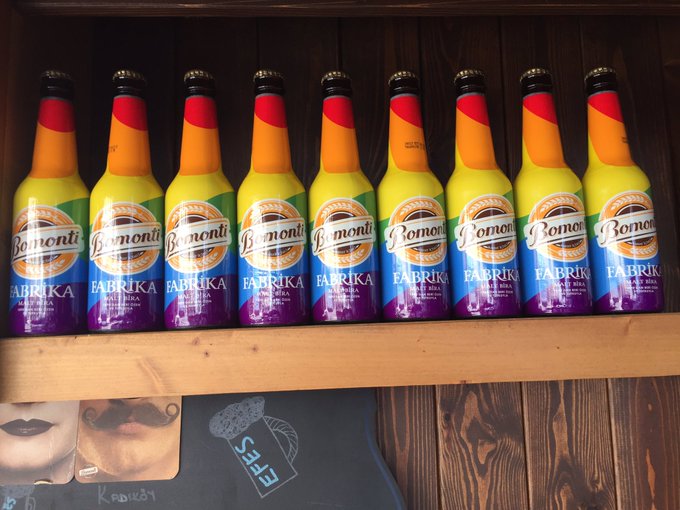
Established in Istanbul in 1890, Bomonti is Turkey’s oldest modern brewery and produces one of the country’s most popular lagers. The rainbow-coloured bottle was unveiled in an Instagram post by the head of Bomonti’s branding agency, alongside the caption: “We did it!”
It’s a bold move in a country which has been named the second-most restrictive on gay rights in Europe. Amnesty International previously told PinkNews in 2018 that Turkish LGBT+ people are “living in more fear than ever.”
Although courts ruled in April that the two-year ban on Pride parades could technically be lifted, Amnesty reported in May that “appalling” violence had been used against students holding a Pride march in the capital city of Ankara. Authorities also stripped the scholarships of students detained in the march.
And on Sunday (June 30) another Pride rally in Istanbul ended with tear gas and rubber bullets.
This current political climate makes Bomonti’s decision to embrace LGBT+ rights particularly significant — and while the commercialisation of Pride may be common in other countries, the Turkish LGBT+ community couldn’t be happier to see the beer brand following suit.
@zekibaskaya said, “I’m shocked! but really excellent idea,” @logolepsi said, “You’ve made us even more happy with rainbow marketing,” and @benimadimsencer said: “We’re so happy, so excited. For the first time in Turkey, a brand is investing in Pride and standing behind us like a door.”
LGBTI tour operator, Toto Tours, has decided to cancel their 16-day package tour to Ethiopia that was schedule for this October, amid concerns for the safety of their clients. The tour itinerary was to include visits to several religious sites.
The Ethiopian Orthodox organization, the Sileste Mihret United Association, alluded to violence.
The chairperson said: ‘Homosexuality is hated as well as being illegal in Ethiopia.
‘If Toto Tours comes to Ethiopia where 97% of Ethiopians surveyed oppose homosexuality, they will be damaged. They could even die.’
Toto Tours canceled Ethiopia trip after death threats
Dan Ware, owner of the company, decided to cancel the tour after consideration of the above statement, and also receiving several other threats of violence should the tour proceed.
According to reports from NBC Chicago, Ware explained: ‘We had descriptions of buried alive, burned alive; I had an ISIS-type video with a guy with a mask on his head, brandishing his sword saying we are going to cut your throat. It was not something to ignore.
Spokeswoman for the US Embassy in Ethiopia, Amanda Jacobsen, stated: ‘Our country specific information for Ethiopia notes the challenges American citizen LGBTI travelers to Ethiopia may face, including the fact that consensual same-sex sexual activity between adults is illegal and punishable by imprisonment.
‘There is no law prohibiting discrimination against LGBTI persons.
‘Ethiopians do not generally identify themselves as LGBTI due to severe societal stigma.’
Tour company still planning trips to countries where being gay is illegal
Ware stated that he hopes to one day still plan a tour to Ethiopia.
However, in the meantime, he’s refunding all clients who were booked on the October departure.
Toto Tours has been serving the LGBT community since 1990.
Their website states the name is derived from the Latin word meaning ‘all-inclusive,’ not in reference to Dorothy’s infamous dog from the Wizard of Oz. The company website still has trips planned to Botswana, Bhutan, and Egypt, all places where same-sex activity is illegal.
Amazon has removed books by a ‘gay cure’ conversion therapy author.
Joseph Nicolosi penned a book that spread the dangerous and harmful practice of attempting to ‘cure’ a person’s sexual or gender identity.
He was the co-founder of the National Association of Research & Therapy of Homosexuality (NARTH) and a prominent leader in the ex-gay movement.
His book, A Parent’s Guide To Preventing Homosexuality, is one of the most well known ‘conversion therapy’ books.
But now, it has been removed from the UK and US versions of Amazon.
Rojo Alan, from Peterborough, wrote to Amazon several times to get the book removed from listings.
He previously went through conversion therapy himself as a young child.
Failing to get the right response, he engaged with others to leave negative reviews on the website. Quickly, the rating fell from four stars to two stars.
‘I looked into the “rules of publishing” on Amazon, to see what sort of things they allow and don’t allow,’ he said.
‘Once I wrapped my head around that I started to look into the laws of conversion therapy. The legal side of things.
‘Once I gathered everything I went back to Amazon and I threw all the information I had at them in several conversations. Yet I was given the same “we will refer this to the relevant team”. Again it felt hopeless and I wasn’t too sure what else I could do.’
But, sure enough, Amazon removed all of the English language books by Nicolosi. It took Alan three months from the first email to removing the books.
‘Huge step’
‘These books were “how to” books,’ Alan told Gay Star News, also describing it as a ‘huge step in the right direction’.
‘These were books that were lying to parents on how they could cure their children from being gay or trans. It’s lying because it’s actually just a form of abuse.
‘The books went into ways in which you can mentally and physically abuse your child.
‘If this helps anyone from being harmed, that would be a good reason to do it.’
He was previously quoted in a documentary: ‘Everyone is heterosexual.’
‘The idea that some people are naturally homosexual, or naturally gay, is just a social construct.’
He also said: ‘So when you have individuals with same-sex attraction, we it as something went wrong developmentally and we try to resolve the issue and put them back on the path toward their natural heterosexuality.’
The World Psychiatric Association has condemned so-called ‘gay cure’ conversion therapy.
The group said they consider sexual orientation to be ‘innate’. They also said it is determined by ‘biological, psychological, developmental and social factors’.
‘WPA believes strongly in evidence-based treatment,’ they also said.
‘There is no sound scientific evidence that innate sexual orientation can be changed.
‘Furthermore, so-called treatments of homosexuality can create a setting in which prejudice and discrimination flourish, and they can be potentially harmful … The provision of any intervention purporting to “treat” something that is not a disorder is wholly unethical.’
As the U.S. — and many other parts of the world — celebrates the 50th anniversary of the 1969 Stonewall uprising, rainbow flags and LGBTQ-inclusive ad campaigns appear to be omnipresent, especially in big cities. The ubiquity of these Pride campaigns make it easy to forget that this was not always the case. While many point to corporate America’s embrace of LGBTQ inclusivity as a major sign of progress, others believe corporations are coopting the movement.
Advertisements geared toward gay and lesbian consumers began to appear in earnest in the 1970s, inspired in part by the energy of the Stonewall uprising, which is widely considered the spark that fueled the modern LGBTQ movement.
So-called “sin” products, like alcohol and tobacco, were the first marketed to gays. These companies had little or nothing to lose from a potential boycott by the religious right, according to Katherine Sender, a communications professor at Cornell University and author of “Business, Not Politics: The Making of the Gay Market.”
“Now, getting a gay boycott is a much worse thing than getting a boycott from the religious right.”
PROFESSOR KATHERINE SENDER
Absolut vodka was the first brand to build itself with an eye toward the gay market, featuring full-page ads in gay outlets, such as The Advocate. Other alcohol brands like Boodles Gin ran ads in gay publications, but most ad revenue came from local gay bars and businesses.
However, with the exception of Absolut, much of the advertising aimed explicitly at gays came to a halt in the 1980s because of the HIV/AIDS crisis and the stigma surrounding the disease.
Things changed in the 1990s. Marketing surveys, namely the 1988 Simmons Market and the 1990 Overlooked Opinions survey, presented an image of gays and lesbians as an affluent, untapped market. Marketers estimated the total annual income of the gay community at over $500 billion. The surveys, however, were not representative and helped to start what researchers have since described as the “myth of gay affluence.”
In 1994, Ikea launched the first television ad to feature a gay couple. In the commercial, the two men tease each other about their taste in furniture.
“I remember it extremely well, because it was radical,” said Bob Witeck, president of Witeck Communications, a firm specializing in LGBTQ marketing. The couple “behaved in every sense like a married couple, and it was radical because it was normal and natural,” he said.
Not everyone loved the ad. In fact, the backlash was swift and strong. The American Family Association staged a boycott, and an Ikea store in New York received a bomb threat.
That same year, AT&T launched a direct-marketing mail campaign, making them the first US phone company to openly target lesbian and gay customers (MCI ran an earlier campaign, but used suggestive statements and imagery rather than a direct appeal).
“They got a big pushback from the religious right,” Sender said.
Companies remained more focused on gay men, though a notable exception was Subaru. In the late ‘90s, Subaru undertook a very successful lesbian-focused marketing campaign after research revealed its sturdy, practical cars appealed to this demographic. “It’s not a choice, it’s the way we’re built,” a 2000 print ad boasted.
This new interest in the “pink dollar” coincided with a massive increase in gay and lesbian visibility in the media. Ellen came out on TV in 1997, which Sender called “a massive deal.” Shows like “The L Word,” “Queer as Folk” and “Queer Eye for the Straight Guy” ushered images and information about gays and lesbians into homes across the country.
Despite the increased visibility and a number of successful ad campaigns, even into the early 2000s mainstream companies still risked a backlash for gay and lesbian inclusivity, according to Sender. Many companies were still afraid to be labeled as selling a “gay product.” Representation of transgender people was almost always negative, relying on transphobic tropes of deceit or mistaken identity, according to Sender’s research.
FROM THE GAY MARKET TO THE LGBTQ MARKET
Rich Ferraro, chief communications officer at GLAAD, a national LGBTQ media advocacy organization, has been consulting on LGBTQ images in advertising since 2008. He sees a very different media landscape today.
“The backlash that once occurred if a brand had LGBTQ marketing campaigns is no longer,” Ferraro wrote in an email. “For instance, fringe organizations like Family Research Council, National Organization for Marriage and One Million Moms would start petitions (which never really reached large numbers), but now they do not.”
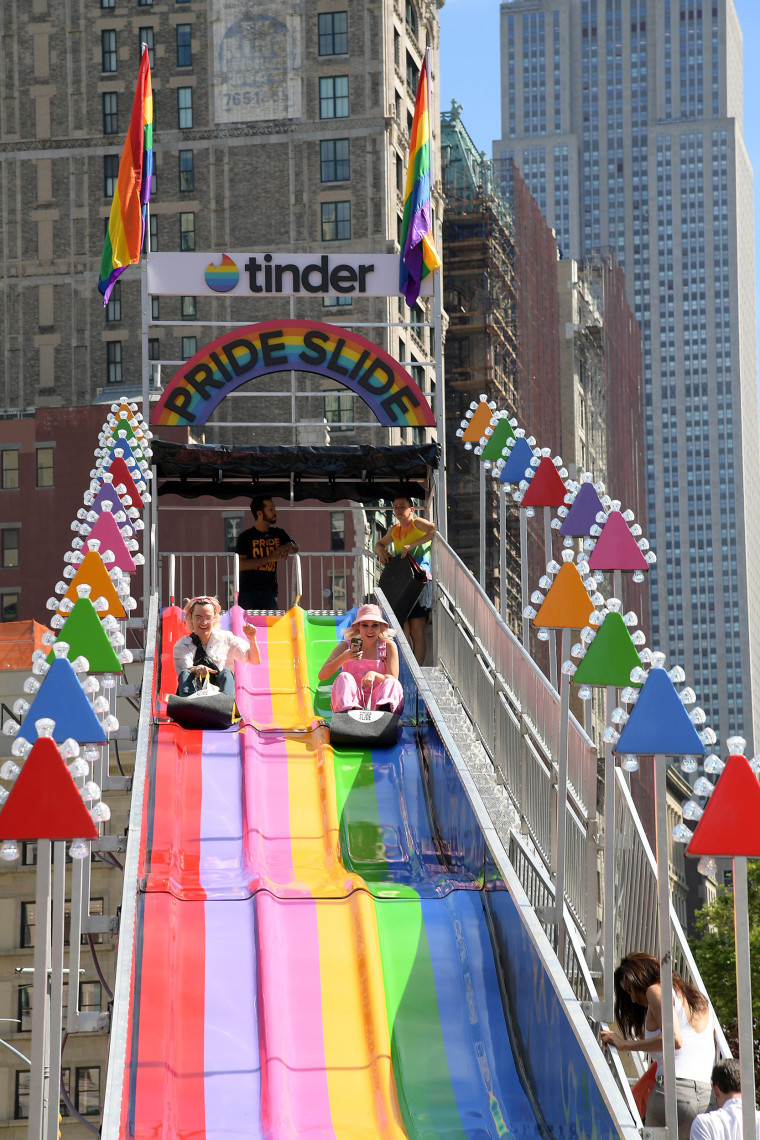
Chloe Pultar, right, slides down the Tinder Pride Slide in support of Equality Act kicking off WorldPride at Flatiron Plaza on June 24, 2019 in New York City.Michael Loccisano / Getty Images
Sender agreed, saying, “Now, getting a gay boycott is a much worse thing than getting a boycott from the religious right.”
More and more companies are engaging in LGBTQ-inclusive advertising, Ferraro said. “Categories have exploded — spirits and travel were typically leaders in LGBTQ-inclusive campaigns, but now it’s retail, cars, banking and financial services, food and beverages, youth-oriented brands,” he explained.
Witeck said “there is probably no more efficient way to say we are a contemporary brand” than to make your ad campaigns LGBTQ-inclusive.
For legacy brands, like Coca Cola, they must always be refreshed and made relevant, Witeck added. “LGBTQ marketing is an effective way to say, ‘We get it. We look and talk and act like we are in the 21st century.’”
However, Sender said that LGBTQ consumers are not only looking for inclusion in campaigns, but are holding companies accountable in their employment and production practices.
“Now, people are asking more questions, particularly around transgender polices and health care,” she said.
“What constitutes the responsibility of the advertising companies is expanding in ways that are really quite powerful,” Sender added, noting that consumers are asking questions like, “Are they buying products or services or in countries that have extremely bad policies and legal enforcement around LGBTQ people?”
Because of their resources, companies are also in a position to exert powerful political influence if they want to. Witeck mentioned the corporate boycotts of North Carolina after the passage of HB2 (the so-called “bathroom bill) that helped to precipitate its repeal and major companies’ outspoken support for transgender equality.
While historically there has been much less representation of transgender and gender-nonconforming individuals, this year examples of such campaigns abound: Raquel Willis for Express on a Times Square billboard, Gillette’s commercial featuring a young trans man and his dad, and Uber running a campaign featuring trans, genderqueer and bisexual pride flags.
“Traditionally, one or two campaigns are inclusive of transgender people, now it is a norm,” Ferraro said.
GAY INC.
Kristin Comeforo, associate professor of communications at Hartford College, worries that advertisers often take a “check-the-box approach” to the inclusion of gender and racial diversity, rather than a genuine engagement with intersectional experiences.
She also worries that corporate sponsorship can silence the voices of LGBTQ people who face intersectional marginalization.
Sender agreed, noting that “the 50th anniversary of Stonewall is such a big deal everyone wants a piece of that.” As a result, she added, Pride marches have become “a party for everybody.”
“What gets left behind are the very real struggles of LGBTQ people in this country — trans people in particular and people of color facing multiple layers of discrimination,” she added. “This ‘party’ suggests that being gay is just an excuse to have a lovely time, but there is still a long way to go.”
Nearly 2 million LGBTQ youths ages 13 to 24 in the United States consider suicide each year, according to research released Thursday by the Trevor Project.
Using data from a variety of sources, including the U.S. Census Bureau, the Centers for Disease Control and Prevention and its own National Survey on LGBTQ Youth Mental Health, Trevor Project researchers determined that LGBTQ teens were particularly at risk. Those 13 to 18 were approximately twice as likely to contemplate suicide as those 19 to 24.
Amy E. Green, the nonprofit’s director of research, told NBC News that although these numbers are harrowing, they are “conservative estimates.”
“These numbers are the bare minimum they could be because we used a conservative method to conclude our estimates,” Green said. “The fact that we still arrived at these huge astonishing numbers shows that this is a serious health problem.”
According to the mental health survey, released this month, there are multiple factors that can negatively affect the well-being of queer adolescents — the foremost being lack of acceptance.
More than 70 percent of respondents reported experiencing discrimination because of their sexual orientation or gender identity, and two-thirds of respondents stated that someone has tried to convince them to change those identities.
Though previous research has revealed that LGBTQ youth are more likely to experience thoughts of suicide, Green said these latest figures “provide additional context to just how widespread this problem is.”
A separate research released by the Trevor Project on Thursday offered some positive news, however. LGBTQ youth who report having at least one accepting adult in their lives were 40 percent less likely to report a suicide attempt in the past year.
“I hope this research will inspire the country to come together to change policies on the state and federal levels that affect LGBTQ youth’s lives, like ending the harmful practice of conversion therapy, as well as inspire other researchers who are looking into this area to study the factors and find solutions,” Green said. “We also need to support organizations that are doing the work to launch anti-bullying and suicide prevention efforts.”
Three high-school students in Connecticut have filed a federal discrimination complaint challenging the state’s policy of letting trans students compete on sports teams according to their gender identity.
The complaint was filed on behalf of the three girls on Monday (June 17) by the Alliance Defending Freedom (ADF), a conservative Christian organisation in the US that has also filed over 40 cases against Planned Parenthood.
Their complaint to the US Department of Education alleges that Connecticut’s policy violates Title IX, the federal civil-rights law that is meant to ensure students have equal access to opportunities regardless of their sex.
The complaint, which refers to trans girls as “biological males,” says that trans athletes should not be allowed to compete in the category corresponding to their gender identity because it’s unfair to cisgender girls.Free Antivirus Software Reviews 2019. Compare Free Antivirus Software Providers Side-By-Side.SEE MORE
Eliza Byard, executive director of GLSEN, a group dedicated to rights for LGBT+ students, said to CNN, “This is a serious lawsuit brought about by a parent and the Alliance Defending Freedom as part of a broader effort to bar trans students from equal access in sports.”
“Trans girls are girls, and they should have access to all parts of school,” Byard said.
All three girls making the complaint are teen track athletes. Two are unnamed and the third is Selina Soule.
“Girls deserve to compete on a level playing field. Forcing female athletes to compete against boys is grossly unfair and destroys their athletic opportunities,” said Christiana Holcomb, a lawyer with ADF, in an online statement.
“Title IX was designed to eliminate discrimination against women in education and athletics, and women fought long and hard to earn the equal athletic opportunities that Title IX provides. Allowing boys to compete in girls’ sports reverses nearly 50 years of advances for women under this law. We shouldn’t force these young women to be spectators in their own sports.”
ADF have other anti-trans lawsuits
The ADF’s mission statement is “defending religious liberty, the sanctity of life, and marriage and family.”
Its website says, “The abortion industry has been profiting from the deaths of infants for over 40 years,” and adds that the “good news” is that “a surging pro-life movement has forced the closure of 75 percent of surgical abortion businesses in America.”
Another lawsuit related to trans issues is detailed on ADF’s website in a post called“Two recent victims of the transgender movement.”
The lawsuit was filed by the ADF in November 2018 on behalf of a male professor who was given a written warning by a university for refusing to use she/her pronouns for a student who had informed him she was a trans woman.
“This isn’t just about a pronoun; this is about endorsing an ideology,” said Tyson Langhofer, a lawyer for ADF.
Complaint calls for ban on transgender students in girls sports
The high schoolers complaint in Connecticut calls for an investigation of Connecticut Interscholastic Athletic Conference (CIAC), the non-profit organisation responsible for high-school athletics regulations.
It also demands that trans girls track records are removed and for them to be denied access to women’s sports in Connecticut.
CIAC says that its policy follows a state-wide anti-discrimination law that requires students to be treated in school as the gender they identify with.
“The CIAC reviewed our transgender policy with the Office of Civil Rights in Boston earlier this school year to ensure compliance with Title IX,” said Glenn Lungarini, executive director of CIAC.
“In addition to reviewing the policy with our legal counsel, the CIAC also discussed our current policy with Connecticut’s Commission on Human Rights and Opportunities to ensure compliance with Connecticut legislation protecting students (and others) in their gender expression and identity.”
Alkyl nitrites, commonly known as poppers, pose very little chance of addiction, risky consumption habits or other psychosocial problems.
Many LGBTI people, but especially gay and bisexual men use poppers for recreational purposes or to enhance sex.
A new study found little evidence of typical dependency characteristics, including health, social, legal and financial problems. It also found no correlation between popper use and mental health or psychological stress.
Researchers at the University of Technology Sydney (UTS) surveyed more than 800 men aged 18 to 35. Lead researcher Dr Daniel Demant, welcomed the decision by the Therapeutic Goods Administration (TGA) to not ban poppers.
In 2018, the TGA issued a temporary ban on poppers. It put them onto Schedule 9 of the Poisons Standard – the same schedule as heroin.
But thanks to a vocal campaign from the LGBTI community and passionate submissions to the TGA, it backtracked on the ban. The TGA instead elected to classify them as a Schedule 3 drug. From February 2020, poppers will be available over the counter in pharmacies.
Poppers users will be made ‘overnight criminals’
Demant described the ban as creating ‘overnight criminals’ of the estimated more than 100,000 Australian users.
‘What we see with this research is that poppers are a very commonly used drug in the LGBT community, both recently and over their lifetime,’ Demant said.
‘Most of the users are already oppressed or marginalized based on their social identity as gay or bisexual men. This creates a question as to whether there would have been a discriminatory element in banning a substance with such a low risk profile.
Currently, poppers are available on prescription from pharmacies. But many people buy them illicitly at sex-on-premises venues or LGBTI bars. A vial for up to AU$50,(US$34.60/€30.63) despite costing a couple of cents to manufacture.
The new TGA decision to regulate poppers rather than banning them hopefully paves the way for some measure of quality control as well as the removal of the ‘extreme profit margin’ that exists now Demant said.
‘We could stop pretending that poppers are sold for anything other than getting people high,’ he said.
‘And once we do offer it in pharmacies, we would have something made to the highest standards for people to use.’