Texas Gov Greg Abbott has joined the effort to blot out rainbow crosswalks on public streets.
That means the Lone Star State will follow the lead of Transportation Secretary Sean Duffy and states including Florida, which has continued to erase all street art in the name of erasing “political ideologies” from the roadways.
The Texas Department of Transportation sent a memo to local governments announcing it would adhere to Duffy’s direction to keep crosswalks “free from distractions.” That means Texas won’t allow any public art, political messaging, or any other nonstandard markings.
“Pavement markings such as decorative crosswalks, murals, or markings conveying artwork or other messages are prohibited on travel lanes, shoulders, intersections, and crosswalks unless they serve a direct traffic control or safety function. This prohibition includes the use of symbols, flags, or other markings conveying any message or communications,” reads a memo published by San Antonio’s NBC affiliate.
Now government officials in cities such as Dallas, Houston ,and San Antonio have 30 days to paint over the rainbow decorations in crosswalks or risk losing state funding, according to Texas Public Radio.
“None of this is in the name of public safety,” James Poindexter of Pride San Antonio told his local NBC station. “It’s all in the name of political stunt.”
Meanwhile, Florida continues to impose its anti-color agenda. Department of Transportation officials in the Sunshine State this week removed an iconic rainbow crosswalk from Ocean Drive in Miami Beach, as reported by an NBC affiliate in South Florida.
“All of a sudden all these [Florida Department of Transportation] trucks showed up, an army of workers, heavy machinery. No notice to our city,” Miami Beach City Commissioner Alex Fernandez told the station.
Gov. Ron DeSantis has pushed for the removal of all public street art in the state to satisfy Duffy’s fight against rainbow crosswalks. He started with an unannounced paint-over of a rainbow crosswalk in front of the Pulse nightclub in Orlando that was created to honor victims of the 2016 mass shooting at the gay club.
“We’re not doing the commandeering of the roads to put up messaging,” DeSantis said in August to defend the attack on art, Pride, and any honoring of murder victims.
Notably, there is no evidence that street art in crosswalks causes more accidents. In fact, a 2022 Bloomberg study found decorated crosswalks see a 50 percenr drop in collisions.
California Democratic Gov. Gavin Newsom has signed several bills strengthening LGBTQ+ protections in the state, while vetoing two that would have expanded health care coverage, his office announced Monday.
Newsom signed Assembly Bill 82/Senate Bill 497, which strengthens confidentiality in health care — including for drugs used in gender-affirming careand abortion. The bill, introduced by out gay Democratic state Sen. Scott Wiener, expands the state’s shield law by requiring law enforcement obtain warrants to access the California healthcare database and punishing unauthorized access as a misdemeanor.
“The Trump Administration is trying to make transgender people the scapegoats for their fascist takeover, and California must stand up to protect them,” Wiener said in a statement. “President Trump has made it clear he is willing to violate laws and norms to target transgender people, and that he will not stop until their existence has been erased from public life. California must do everything in our power to protect the transgender community, and I’m confident that the Governor will continue his longstanding leadership on trans issues.”
Wiener also spearheaded SB 59, another bill signed by Newsom Monday, which seals transgender and nonbinary adults’ gender transition court records. The privacy protections were already available to minors.
Other bills signed by Newsom include SB 590, which strengthens paid family leave protections to make them more inclusive of LGBTQ+ people; SB 450, which allows out-of-state queer couples to access in-state channels when adopting California-born children; AB 727, which mandates that universities provide all students with LGBTQ-specific suicide hotline information; and AB 1084, which makes it easier to change one’s legal name and gender on official documents.
Newsom vetoed SB 418, which would have strengthened nondiscrimination requirements for insurance plans and mandated that they cover up to a year’s worth of prescribed hormones. He said in a veto statement that “I am concerned about the limitation on the use of [Utilization Management], which is an important tool to ensure enrollees receive the right care at the right time. Prohibiting this cost containment strategy is likely to result in an increase in enrollee premiums to offset costs incurred by health plans and insurers.”
Newsom also vetoed AB 554, which would have required insurance providers to cover HIV prevention drugs without prior authorization. He said in a statement that “by exceeding the cost-sharing provisions under the ACA, this bill would result in increased costs to health plans, which would then be passed on to consumers.”
Mark González, the Democrat who introduced the bill, said in a September statement that the legislation aimed to keep consumer costs down after CVS announced it would not cover the newest HIV prevention drug, Lenacapavir (Yeztugo). The announcement came as the state’s public health plan provider named CVS as its pharmacy benefit manager in 2026, which González noted could directly impact access to lenacapavir for its more than 1.5 million members.
“This is not a game – people’s lives are on the line,” González said. “Have we forgotten the worst days of the HIV epidemic – the fear, the funerals, and the government’s silence? We swore we’d never go back. For decades, our communities have poured courage, advocacy, and resources into building the science and medicine that can finally end this epidemic. Yet here we are—billion-dollar corporations refusing to cover a lifesaving drug and RFK Jr. rolling back decades of progress. To deny access now is reckless and cruel.”
New York City Councilman Erik Bottcher filed Wednesday to run for the seat of retiring Congressman Jerry Nadler, and he raised nearly $700,000 in campaign funds in his first 24 hours.
This historic, grassroots-driven achievement marks the biggest first-day total in New York State history and one of the biggest nationwide, according to his campaign.
Bottcher, a 46-year-old gay man, is one of the city’s most visible LGBTQ+ officials and a rising star in Democratic politics.
In a letter to supporters on Wednesday and during an interview with The Advocate, Bottcher said Nadler’s decision not to seek reelection “creates an incredible opportunity for a new generation of leaders to step forward — and for our community to make history.”
“This congressional district has a proud tradition of representatives who’ve fought for LGBTQ+ rights, from Bella Abzug to Jerry Nadler,” Bottcher said. “But we’ve never actually had one of our own at the table. And there’s an old saying, ‘If you’re not at the table, you’re on the menu.’ Our community is under attack in terrifying ways, and it’s time to take the gloves off.”
The 12th Congressional District is among the nation’s most politically active and socially progressive areas. From the earliest AIDS marches to the fight for marriage equality, the district’s neighborhoods have long been at the center of LGBTQ+ advocacy and cultural change.
Bottcher, who represents Manhattan’s Third City Council District (encompassing Chelsea, Hell’s Kitchen, and the West Village), said his motivation to explore a congressional run comes from both urgency and hope.
“I love my country, and right now it’s being torn apart by Donald Trump and his neo-fascist forces,” he said. “This is the moment for all Americans, especially those of us in public service, to stand up and fight back. I’ve spent my life serving my community, and serving in Congress would be one of the highest honors imaginable.”
If Bottcher officially enters the race, he’ll be joining what’s shaping up to be a highly competitive Democratic primary. Manhattan Assemblymember Micah Lasher has already declared his candidacy, while many others are considering a run in the coming weeks as one of New York’s most coveted congressional seats opens up for the first time in decades.
Bottcher candidacy would be historic. If elected, he would become the first out gay member of Congress from Manhattan and only the third from New York City, following Ritchie Torres of the Bronx and former Republican congressman and convicted felon George Santos,. Two other out gay lawmakers from NYC suburbs served previously, Sean Patrick Maloney and Mondaire Jones.
Before joining the City Council, Bottcher served as chief of staff to then-Council Speaker Corey Johnson and as an aide to state Sen. Brad Hoylman-Sigal, both gay trailblazers in New York politics.
Over more than a decade, Bottcher has earned a reputation as a hands-on operator and coalition builder who pairs policy substance with visible, on-the-ground presence.
“I’m out in the community day and night, every day of the week,” he said. “People want real representation. They want to know and feel connected to the people who speak for them. That’s been at the heart of my work in City Council District 3, and it’s exactly what I’d bring to the 12th District if I run.”
In City Hall, Bottcher has built a profile as an advocate for tenants’ rights, small-business recovery, mental health services, and public safety. His office has become known for quick responses to neighborhood concerns, from sanitation issues to housing safety.
Nadler’s retirement marks the end of an era. Known as one of Congress’s leading liberal voices, he served as a key defender of democracy and civil rights during both Trump impeachments and was a major supporter of LGBTQ+ rights.
His departure leaves behind a legacy rooted in advocacy and coalition building that shaped the modern identity of Manhattan’s left.
Still, Bottcher’s allies believe his blend of local experience, grassroots sensibility, and generational appeal set him apart. “No one can deny that Erik has been a rock star on the City Council, delivering for his constituents time and time again on issues like affordable housing, mental health, LGBTQ safety, and more,” said Jeff Larivee, executive director of Equality PAC. “NY-12 is one of the most dynamic and proudly LGBTQ+ districts in the country, and Erik represents the next generation of leadership this community deserves. This will be a huge priority race for Equality PAC — and we will do everything we can to support Erik and make sure he wins.”
“This is about service,” Bottcher said in closing. “It’s about standing up when your country and your community need you most. And right now both are on the line.”
The Harlem Renaissance was one of the most important artistic and cultural milestones in modern history, and a sweeping new exhibit at The New York Historical highlights how this era was — as Henry Louis Gates Jr. once put it — “surely as gay as it was Black.”
“In school, we tend to learn that the Harlem Renaissance was focused on race and class, and the things that they’re producing, but in fact, sexuality and gender are just as important,” Robinson told NBC News.
The Harlem Renaissance was marked by an explosion of Black creativity, identity and intellectual life centered in New York City’s Harlem neighborhood during the 1920s and early 1930s, though Robinson noted that historians debate exactly when it ended.
The era, Robinson said, gave Black artists “an opportunity to express themselves in ways that had not been done before,” adding that “Black queer creatives are really a driving force” during this period, even amid racism and homophobia.
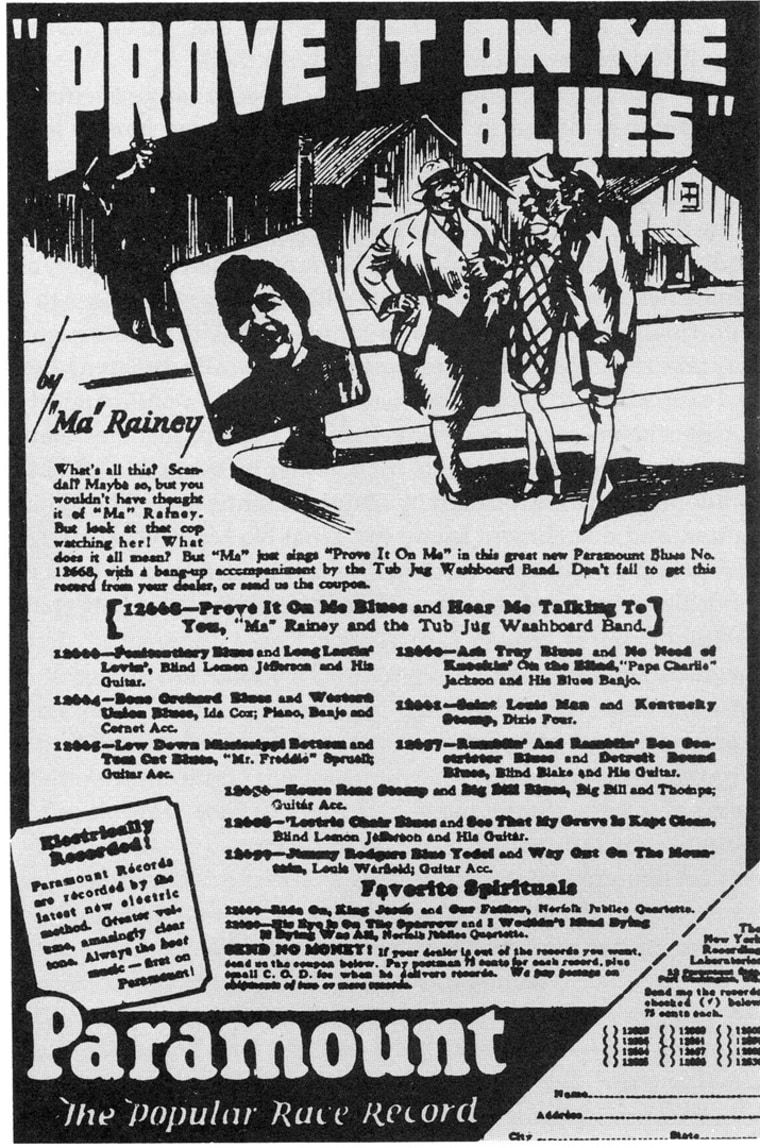
A Paramount Records advertisement for Ma Rainey’s “Prove It on Me Blues” that appeared in the Chicago Defender newspaper in 1928.Queer Music Heritage / JD Doyle Archives
“The Gay Harlem Renaissance” — which features more than 200 items including paintings, sculptures, photographs and books — opened Friday and will remain on view until March. George Chauncey, a professor of history at Columbia University and the author of the seminal LGBTQ history book “Gay New York, 1890-1940,” served as the show’s chief historian.
Exploring Harlem’s art
The multiroom exhibition takes visitors through the Great Migration of Black Southerners in the early 20th century; introduces them to the groundbreaking works of writers like Alain Locke, Langston Hughes and Bruce Nugent; leads them through the speakeasies, rent parties, drag balls and salons of the interwar years; explores the soulful blues music of entertainers like Ma Rainey, Ethel Waters and Bessie Smith; and examines the lasting legacy of the work produced during this rich cultural era.
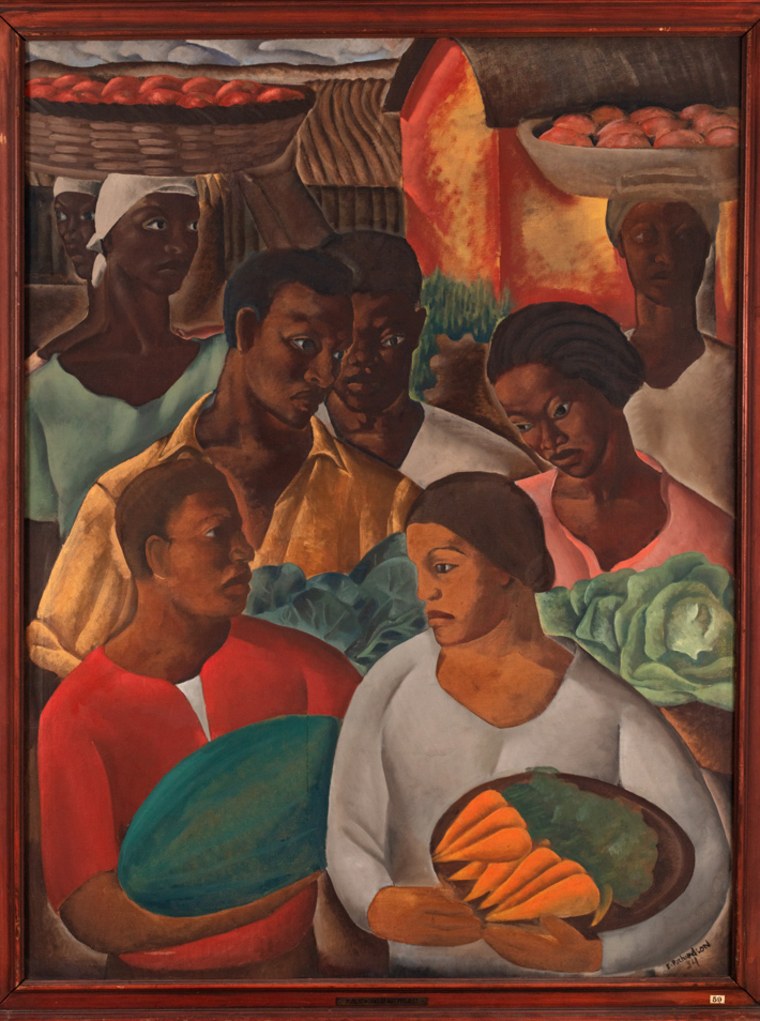
This 1934 painting by Earle Richardson, titled “Employment of the Negro in Agriculture,” honors the resilience of Black sharecroppers laboring under oppressive conditions.Earle Richardson / Howard University Gallery of Art
Locke, considered the “dean” of the Harlem Renaissance, edited and published “The New Negro” in 1925, a seminal anthology for the movement. Locke, who was gay but not out, mentored many of the poets, novelists and artists who defined the era, such as Countee Cullen, Hughes and Nugent.
Robinson said Nugent stood out in Black art at the time for openly embracing and celebrating beauty — a theme captured in his 1926 stream-of-consciousness poem “Smoke, Lilies and Jade,” published in the short-lived magazine “Fire!!” The piece reflected his attraction to both men and women.
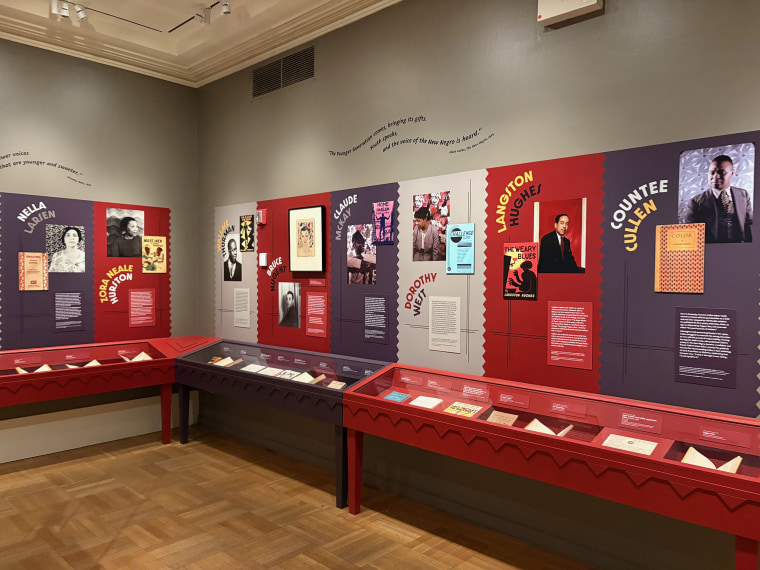
Though “Fire!!” only published one issue, it was one of several magazines featured in the exhibit that helped ideas about freedom, sexuality and identity reach beyond Harlem.
Through a selection of books, magazines and newspapers, the exhibition’s curators show how Black publications experienced tremendous growth in readership, circulation and influence during the interwar years.Brooke Sopelsa / NBC News
Drag, nightlife and defiance
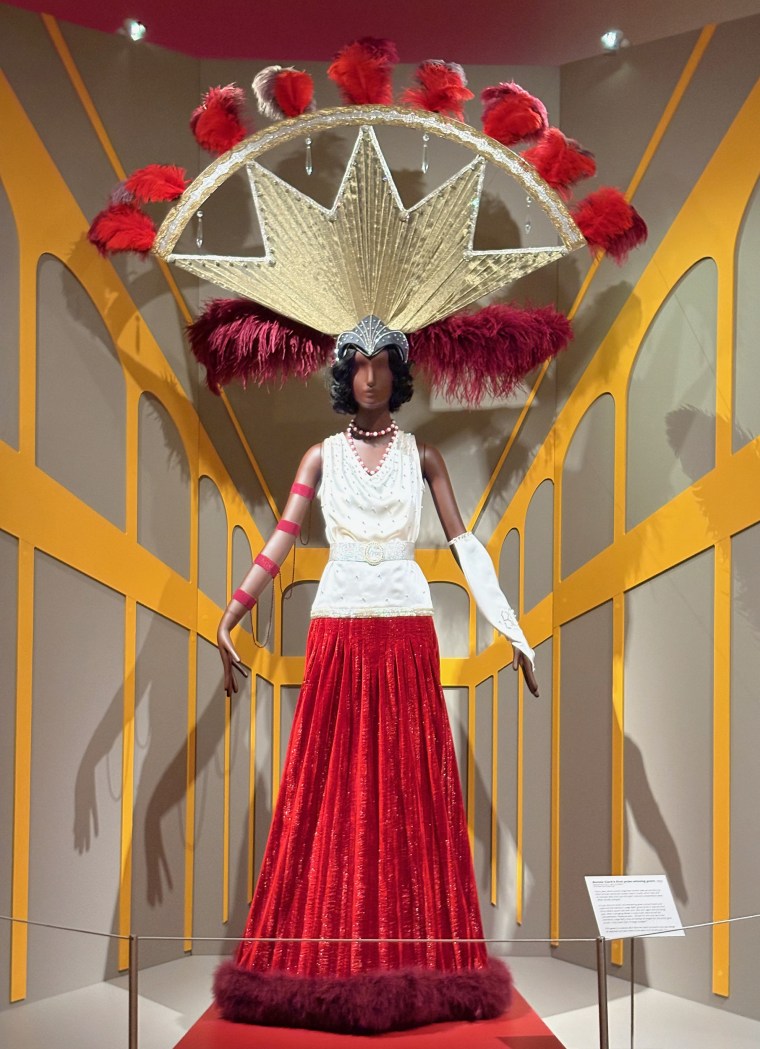
Drag was a popular art form during the era, and Harlem’s annual Hamilton Lodge Ball was the largest and most famous drag ball on the East Coast.
“By the time you hit the 1920s and ’30s, attendees numbered in the thousands, and they’re coming from up and down the East Coast and as far as Europe to come see the participants perform,” Robinson said.
The event became so legendary, Robinson said, that it was covered in newspapers around the world and was even written about by Langston Hughes in his 1940 autobiography, “The Big Sea.”
A re-creation of the prize-winning gown worn by Bonnie Clark at the 1932 Hamilton Lodge Ball. Curator Allison Robinson said it was important to include because Clark was one of the few Black drag queens to be crowned at the ball.Brooke Sopelsa / NBC News
Nightclubs and speakeasies were also central to Harlem’s social life. The exhibit pays homage to these venues with a large re-creation of a Harlem nightlife map, highlighting popular spots that catered to gay and straight patrons and drew crowds from across New York City.
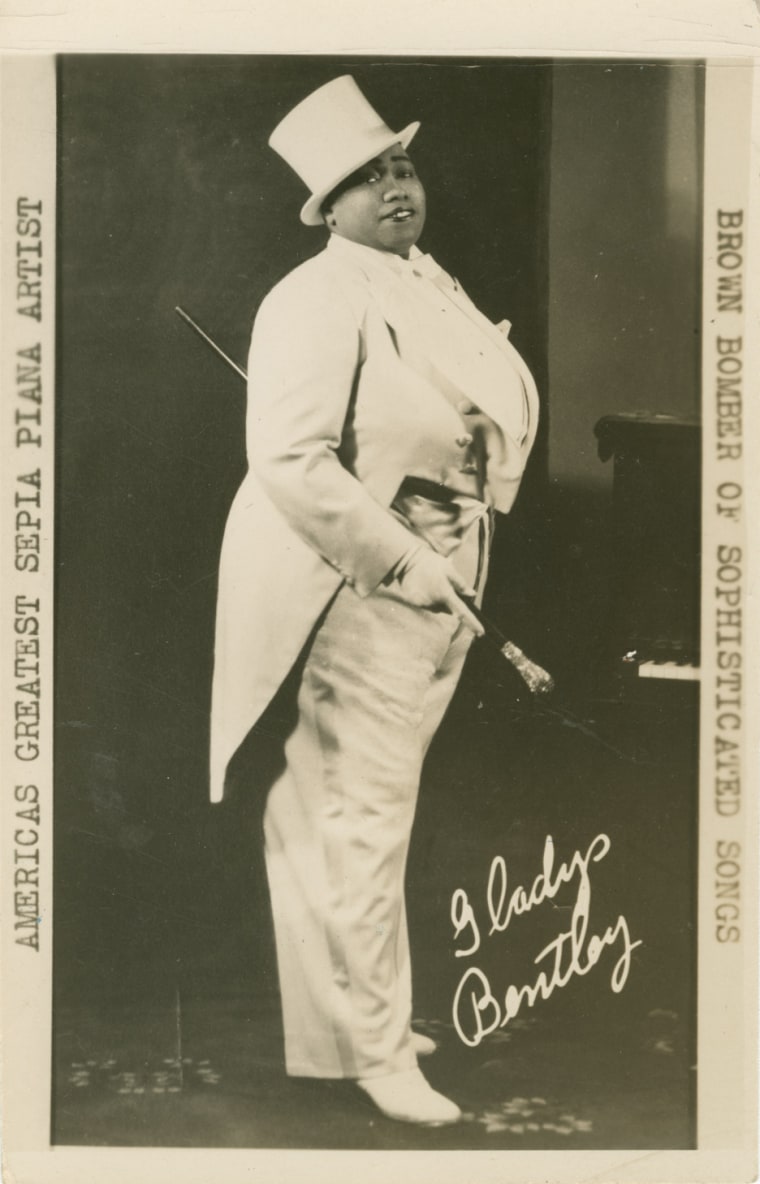
One such venue was Gladys’ Clam House, home of arguably the era’s most famous gender-bending performer: Gladys Bentley. The nightclub was initially named Harry Hansberry’s Clam House, but Robinson said the owner eventually renamed it for the tuxedo-clad performer because she’s “why people were going.”
Bentley got her start at rent parties in private homes before breaking into the Harlem nightclub scene when the Mad House was looking for a male performer. She offered to perform in a top hat and a tuxedo coat, a look that became “her signature for the rest of her career,” Robinson said.
But her masculine style wasn’t just for the stage.
“This is part of her life,” Robinson emphasized. “She’s walking up and down Seventh Avenue with a woman on her arm, dressed in a tuxedo and a top hat.”
Gladys Bentley, pictured here circa 1940, “embraced her sexuality and her gender in ways that are so cutting edge and so intrinsic to how we understand the Harlem Renaissance,” lead curator Allison Robinson said.Collection of the Smithsonian, National Museum of African American History and Culture
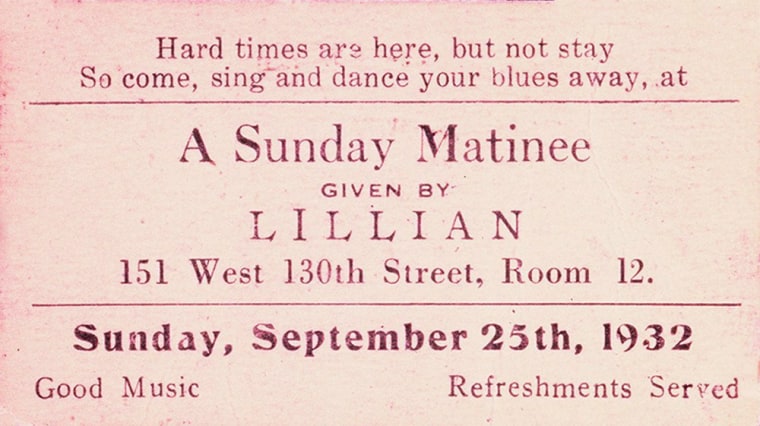
Rent parties, the type of events where Bentley got her start, were popular in Harlem at the time.
“Rent in Harlem was astronomical,” Robinson explained. “Landlords took advantage of the fact that there were limited places where Black people could live to charge them extremely high rent, but individuals threw parties to help cover the cost.”
For a small fee, guests at these Prohibition-era parties could enjoy illegal drinks as well as music and dancing, Robinson explained. It was a way for Harlem residents, gay and straight alike, to socialize and help cover the high cost of rent.
Thirteen rent party invitations are displayed, all but one coming from Langston Hughes. The other, for a “Sunday matinee,” came from Lillian Foster, who gave it to a dancer named Mabel Hampton after the two struck up a conversation at a bus stop. The women became romantic partners for more than four decades, and Hampton kept the invitation for the rest of her life.
This rent party invitation from 1932 was saved by dancer and longtime LGBTQ advocate Mabel Hampton until her death in 1989.Mabel Hampton Collection, Lesbian Herstory Archives
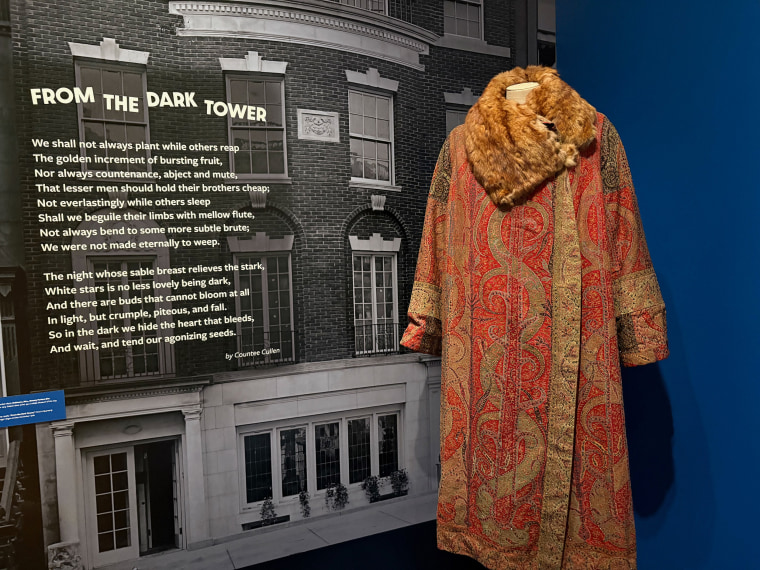
The Harlem home of arts patron and LGBTQ ally A’Lelia Walker was not just a place for revelry but also for the convergence of ideas and collaborations.
The only child of entrepreneur Madam C.J. Walker,A’Lelia held salons and parties bringing hundreds of people together to her apartment and later a grand townhouse on 136th Street, known as the Dark Tower. Her parties became safe havens for Harlem’s queer community, with Hughes calling her the “joy goddess of Harlem’s 1920’s.” Correspondence and one of Walker’s stylish coats from her salon era are included in the exhibit.
The elaborate coat of salon host and arts patron A’Lelia Walker on display along with Countee Cullen’s poem “From the Dark Tower” and a photo of Walker’s three-story Harlem townhouse.Brooke Sopelsa / NBC News
The artifacts celebrating the Harlem Renaissance’s LGBTQ legacy tell a story that is still unfolding, Robinson said. “The end is not an end, but a display of what came after,” she said.
Robinson said she hopes visitors“appreciate what amazing creative energy is coming out of the Black LGBTQ community in the ’20s and ’30s”; that they understand that sexuality and gender are important “topics that are being investigated in the Harlem Renaissance”; and they “realize that even as the figures here were facing a lot of obstacles, they’re producing things that are beautiful and moving and important.”
A couple in Massachusetts has lost their license to foster after refusing to sign a policy agreeing not to discriminate against LGBTQ+ youth nor attempt to change their gender identity or sexual orientation.
The state’s Department of Children and Families (DCF) revoked the license of Lydia and Heath Marvin in April after they refused to sign the nondiscrimination policy that would protect youth in their care. The couple, who has three biological children in their teens, had fostered eight children under the age of four since 2020.
“We will absolutely love and support and care for any child in our home but we simply can’t agree to go against our Christian faith in this area,” Lydia recently told CBS Boston.
Over 30 percent of youth in foster care identify as LGBTQ+ and five percent as transgender, according to a 2019 study from Children’s Rights, compared to 11.2 percent and 1.17 percent of youth not in foster care.
The DCF policy requires that “employees, foster parents, interns, volunteers, and others who interact with children and families must be respectful of how individuals ask to be identified and use the terms an individual uses to describe themselves.” This includes allowing foster youth to use restrooms or changing facilities that align with their gender identity, allowing them to dress in clothing or style their hair in ways that align with their gender identity, and allowing them to use their names and pronouns.
The policy also explicitly mandates that “foster parents and contracted service providers do not make attempts to convince LGBTQIA+ children/youth to reject or modify their sexual orientation, gender identity, or gender expression.” This includes not contracting with “faith leaders who attempt to change a child/youth’s sexual orientation, gender identity, or gender expression.”
The department also supports youth seeking legal name and gender changes, as well as “medical care and mental health services for children/youth provided in a manner that is culturally responsive and affirming,” though none are required for their gender identity to be respected.
The Marvins said that they are exploring their legal options, as a lawsuit from other prospective foster parents who refused to sign the nondiscrimination policy moves forward. The parents are represented by the so-called Alliance Defending Freedom, a group dubbed a “Christian legal army” by its founder, which has a long history of opposing civil rights protections for LGBTQ+ people and has been dubbed as a hate group by the Southern Poverty Law Center.
The group, which believes the “homosexual agenda” will destroy society, has played a pivotal role in several cases involving abortion access and LGBTQ+ rights, including the Supreme Court case Dobbs v. Jackson’s Women’s Health Organization, which overturned the right to an abortion nationally, as well as Masterpiece Cakeshop v. Colorado and 303 Creative, Inc. v. Elenis, which validated discrimination against LGBTQ+ customers on the basis of religious views.
“The state has an obligation to children to make sure that they’re safe and well protected,” Polly Crozier, Director of Family Advocacy at GLBTQ Legal Advocates and Defenders, told the CBS. “And foster parents, they’re not parents. Foster parents are temporary. They’re a stop gap to make sure children can safely go back to their families of origin.”
LGBTQ+ refugees may face outing in their home countries before being dragged through an archaic asylum system that forces them to ‘prove’ their identities to complete strangers, case studies from a refugee charity shared for National Coming Out Day show.
National Coming Out Day takes place every year on 11 October and was first celebrated in 1988, with the date marking the one year anniversary of the the National March on Washington for Lesbian and Gay Rights. It was created to honour LGBTQ+ people who decided to come out and live their lives openly as queer people.
Coming out is a deeply personal and individual experience for LGBTQ+ folks and people can ‘come out’ at any age.
For some, it won’t be a big deal at all and might something they do off-hand or causally – such as explaining what their identity is or introducing their partner to friends or family – but for others it can be very challenging, especially if they come from communities where anti-LGBTQ+ discrimination is commonplace.
For LGBTQ+ refugees, the coming out process can be a dangerous and upsetting one, with queer people facing rejection from family and friends, abuse, criminal charges or even the death penalty.
For National Coming Out Day 2025, PinkNews heard case studies from two people who are supported by LGBTQ+ refugee charity Rainbow Migration about their experiences with coming out.
Jalal, a gay man from Morocco, explained he lived his whole life there until he moved to the UK at the start of 2021 to undertake a higher degree.
“You’ll have to leave or he’s going to kill you”
“In one of my visits home, I had a huge confrontation with my family,” he explained. “I brought a lot of clothes and other items, knowing my family normally would not touch any of my stuff, like my phone.
“But this time, I was really surprised when my mum took the opportunity to go through my stuff when I wasn’t looking.
You may like to watch
“Thinking back on it, I think she was very suspicious about my lifestyle in the UK. Every time we video called, I would keep it short and always say the same things, so she wanted to know more.
“She found my letters and a picture of me and my ex.
“When I got back, she was holding all the things I was hiding, and we had a fight.
“I had to go back to my room for safety because it was getting really violent. Eventually my parents told me to leave, or my dad was going to kill me. ”
Jalal explain his father “left the house to cool off” and his mum told him: “Once he’s back, you’ll have to leave or he’s going to kill you.”
“So that’s what I did. I took my passport, my luggage and anything that I could grab.
“I went to stay in the cheapest hotel, waiting for the cheapest flight ticket [back to London]. Eventually, I took the flight. I needed three days before I applied for asylum to just process everything. I was so tired from the flight.”
Once queer people reach the UK, the system can itself be discriminatory in the way it asks LGBTQ+ folks to ‘prove’ their identities to officials through evidence in order to be granted asylum.
As research from Rainbow Migration has previously shown, the UK governmentfrequently does not believe LGBTQ+ people seeking asylum and disregards testimony from friends and family which attests to an individual’s sexual or gender identity.
A bisexual woman from Pakistan who receives support from Rainbow Migration said of the system: “In my main interview, I had to talk about parts of my life I had buried deep.
“I had to explain trauma, abuse, and fear to strangers — and try to stay composed, because I knew they were watching closely to see if I was “credible enough.”
A former library director in Wyoming has won $700,000 in a settlement after she was fired for refusing to remove books containing content about sexual health and LGBTQ+ identities.
Terri Lesley, director of Campbell County Public Library, was removed from her position in July, 2023 after 27 years of service when the Campbell County library board voted four to one to fire her. The board had pushed for two years to convince Lesley to remove the collection of books, which some had claimed were inappropriate for minors.
Under the settlement, Lesley has agreed to drop her lawsuit against the state, though a separate lawsuit she has filed against the three individuals who challenged the books will move foward.
“I do feel vindicated. It’s been a rough road, but I will never regret standing up for the First Amendment,” Lesley said, via The Associated Press.
Some of the books Lesley refused to remove included Gender Queer by Maia Kobabe, Lawn Boy by Jonathan Evison, This Book is Gay by Juno Dawson, How Do You Make a Baby by Anna Fiske, Doing It by Hannah Witton, Sex is a Funny Word by Corey Silverberg, and Dating and Sex: A Guide for the 21st Century Teen Boy by Andrew P. Smiler.
Lesley’s firing came not long after the library board voted in October, 2022 to leave the American Library Association, a group that promotes libraries, and the Wyoming Library Association, its state chapter.
Books bans were at a record high two years ago when Lesley was fired — a record that has since been broken. During the 2024-2025 school year, PEN America recorded 6,870 instances of book bans across 23 states and 87 public school districts, affecting 3,752 titles. They represented the work of 2,308 authors, 243 illustrators, and 38 translators.
“We hope at least that it sends a message to other library districts, other states, other counties, that the First Amendment is alive and strong and that our values against discrimination also remain alive and strong,” said Lesley’s attorney, Iris Halpern. “These are public entities, they’re government officials, they need to keep in mind their constitutional obligations.”
As the federal government shutdown enters its 12th day on Sunday, the Trumpadministration has implemented a comprehensive purge of the federal public health workforce, laying off thousands of employees at the Department of Health and Human Services, including at the Centers for Disease Control and Prevention.
The cuts have dismantled critical programs in family planning, LGBTQ+ and adolescent health, and infectious disease surveillance, leaving experts warning that the United States is entering the viral respiratory infection season flying blind.
The Office of Management and Budget confirmed “substantial” reductions in force across multiple agencies.
OMB Director Russ Vought, who announced “The RIFs have begun” on X, formerly Twitter, said the cuts represent a shift from traditional furloughs to permanent terminations. In his post, Vought made clear the purge is broad: “These are RIFs, not furloughs.”
Reuters reports that between 1,100 and 1,200 HHS employees have already been fired, with more layoffs expected next week. At the CDC, entire divisions, including those overseeing epidemiology, global health, and the Morbidity and Mortality Weekly Report, the agency’s flagship public-health bulletin, were dissolved. One senior scientist told Time that the CDC “is not functional.”
Within HHS, the fallout has been particularly severe. A former senior Biden administration official told The Advocate that the Office of Population Affairs, which administered the nation’s Title X family-planning network, teen-pregnancy prevention, and LGBTQ+ health initiatives, was eliminated entirely. “This wasn’t a budget decision — it was ideological,” the former official said. “These are the programs that centered reproductive and queer health, and now they’re gone.”
Adrian Shanker, who served as deputy assistant secretary for health policy and senior adviser on LGBTQ+ health equity under the Biden administration, told The Advocate the cuts “are devastating” for both federal employees and the American public.
“This new reduction in force is devastating, certainly for the dedicated public health workers who have contributed countless years to advancing the health and well-being of the American people, and certainly don’t deserve to be political pawns in the Trump administration’s shutdown games,” Shanker said. He added that the Office of Population Affairs had provided funding for sex education programs benefiting LGBTQ+ youth and that its elimination “leaves us more vulnerable to health inequities and worsened health outcomes.”
He noted that this marks “the first time that the office itself is being cut” rather than its programs being politicized. In recent weeks, the administration has rolled back support for state grants that included transgender people. “It’s not a small cut — it’s actually the entire office,” Shanker said. “Without these people in place, it’s unlikely that a lot of these programs will be able to continue even after the government reopens.”
These layoffs come just weeks after the CDC’s collapse in leadership. In August, Dr. Demetre Daskalakis, then director of the National Center for Immunization and Respiratory Diseases, resigned in protest, telling The Advocate that “the CDC you knew is over.” His departure followed the firing of CDC Director Susan Monarez, who clashed with HHS Secretary Robert F. Kennedy Jr. over vaccine policy and scientific independence. Daskalakis said the “firewall between science and ideology” had already broken down, an assessment many public-health veterans now say was prophetic.
Other senior scientists, including Debra Houry and Daniel Jernigan, also resigned this summer, warned that the administration was undermining evidence-based policymaking.
“They have cut so deep into the muscle of CDC that it will not be able to deliver on routine or emergency situations. I fear it has been damaged beyond repair. We need to prepare for the next incarnation of public health,” Daskalakis told The Advocate on Saturday.
The American Federation of Government Employees has filed lalwsuit to block the firings, arguing that mass layoffs during a shutdown violate civil-service protections. Democratic lawmakers have called the cuts an abuse of executive power.
Since November 2024—and especially in the months since the beginning of President Trump’s second term—anti-LGBTQ rhetoric has increased, violence has escalated, and legislation, executive orders, and other targeted actions have drastically altered the lives of LGBTQ people, especially transgender people. Survey findings from the Movement Advancement Project and NORC show that the majority of LGBTQ adults report harm, mistreatment, and other negative experiences since the 2024 presidential election.
To better understand the impacts of the extraordinarily difficult and stressful political environment, this nationally representative survey provides a critical snapshot into the experiences, concerns, and dramatic life changes LGBTQ people have taken to protect themselves or their families since the November 2024 election. It also shows that LGBTQ people reported increasing their efforts to participate in or protect their community in the face of anti-LGBTQ politics or laws.
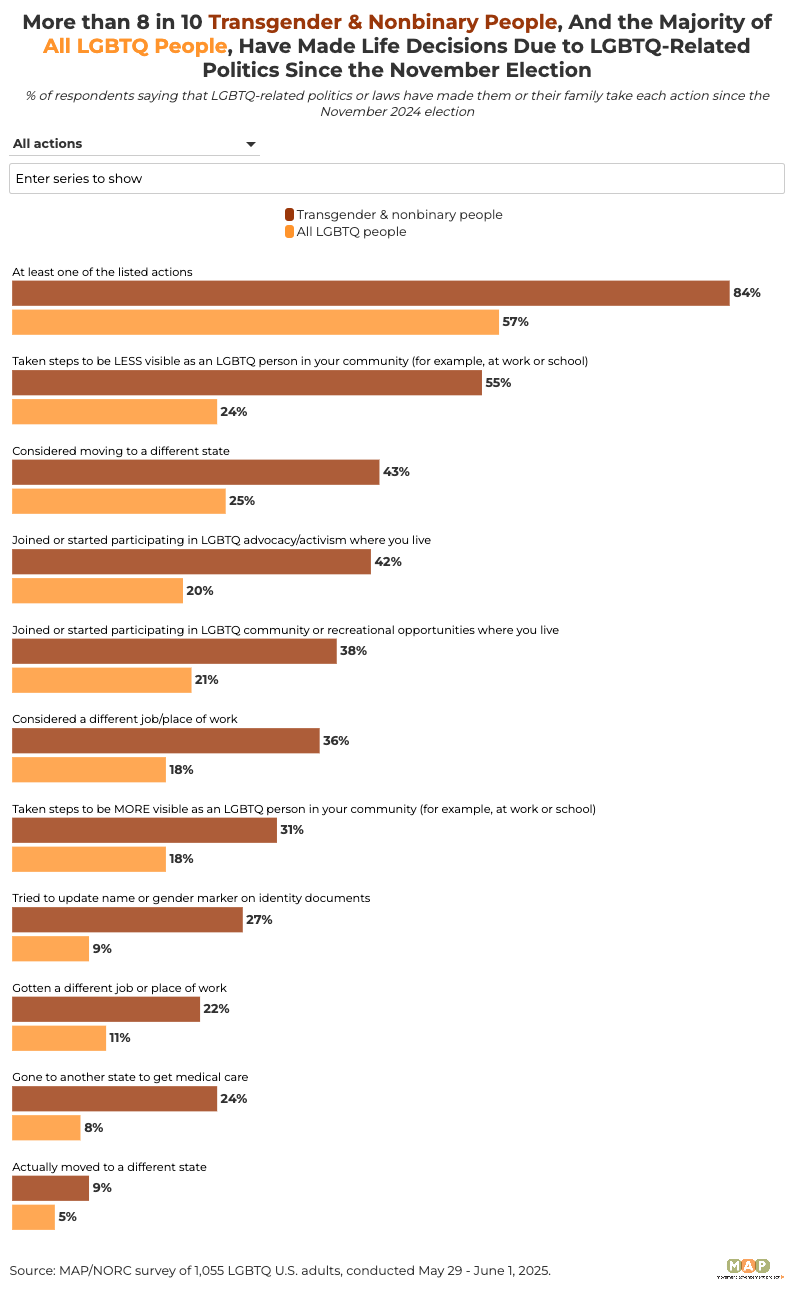
The Majority of LGBTQ People, and Even Higher Numbers of Transgender People, Have Made Major Life Decisions Due to Recent LGBTQ-Related Politics Since November 2024, the majority (57%) of LGBTQ people—including 84% of transgender and nonbinary people—have made significant life decisions or taken steps in response to LGBTQ-related politics or laws as seen in Figure 1. These include considering or actually moving to a different state; considering or actually finding a different job; attempting to update legal name or gender markers on identity documents; crossing state lines to receive medical care, and much more.
Figure 1
These are remarkably sobering findings that reflect the fear, anxiety, and uncertainty that many LGBTQ people and their families across the country are currently facing—and the very real and difficult choices about their lives that they are being forced to consider. This is especially true given the relatively short period of time considered by the survey (November 2024 to June 2025), suggesting that as political attacks on LGBTQ people continue, these numbers may grow even higher.
Although 43% of transgender people—and 25% of all LGBTQ people—have considered moving to a different state, a shocking 9% of transgender people report they’ve actually moved to a different state since November 2024, as have five percent (5%) of all LGBTQ people.
The Majority of LGBTQ People Report Discrimination and Harassment Since the November 2024 Election As shown in Figure 2 below, the motivation for the life decisions and other steps LGBTQ people report taking due to LGBTQ-related politics are well-founded: 60% of LGBTQ people, including 82% of transgender and nonbinary people, report that they or an immediate family member have had at least one negative experience related to being LGBTQ since the November 2024 election.
Survey findings also show a clear relationship between LGBTQ respondents’ approval of how their state government is handling LGBTQ issues and the state’s actual LGBTQ policies, as seen in the figure below.
Figure 7
The majority of LGBTQ people—and, consistently, even higher rates of transgender and nonbinary people—reported significant and often negative impacts across the board, such as making major life decisions due to LGBTQ-related laws or politics, experiencing harassment or discrimination, harm to their mental health or overall well-being, and much more.
As political attacks on LGBTQ people by federal, state, and local governments continue, it is likely that these impacts will only accumulate. While the survey illustrates some of the many ways LGBTQ people are taking action to protect not only themselves but also their broader community, it is vital that people beyond LGBTQ people join in these efforts to protect their LGBTQ neighbors, friends, and family members, and to stop the ongoing attacks on LGBTQ people.
For questions, please contact Dana Juniel at dana@mapresearch.org. # # # MAP’s mission is to provide independent and rigorous research, insight and communications that help speed equality and opportunity for all. MAP works to ensure that all people have a fair chance to pursue health and happiness, earn a living, take care of the ones they love, be safe in their communities, and participate in civic life. www.mapresearch.org
Florida Attorney General James Uthmeier (R) has filed a friend-of-the-court brief in support of a parental rights activist who dubiously claims her child’s middle school helped her child secretly transition. She has now petitioned the Supreme Court to take her case.
Twenty-one additional state attorneys general have signed the brief in support of January Littlejohn, who, in 2022, sued the Leon County School District and staff members at Deer Lake Middle School for allowing her 13-year-old child to use they/them pronouns and go by the “masculine” nickname “J” without informing her.
J began exploring their gender identity during the 2020-21 school year. At the time, the school district was using a 2018 guide that warned outing a student to their parents poses a risk to the student’s well-being. It allowed for a support plan that gave students a say in whether or not they want to be outed to their parents. J chose not to be.
Uthmeier’s brief claims government officials across the United States “are fundamentally altering the upbringing of children and keeping parents in the dark.”
“Dizzying numbers of school districts and a growing number of states have passed similar ‘secret transition’ laws and ordinances without any concerns for parental rights,” the brief states. Utheier is referring to policies that ban the forced outing of students to their parents.
These policies do not involve schools encouraging students to be trans or transition, but rather to support any students who willingly communicate that their gender identity differs from their sex assigned at birth and to allow the student to choose when to share that private information with their parents. For some students with anti-trans parents, telling them could be dangerous.
The brief also decries the concept of social transitioning and negates the existence of trans identities altogether, stating that a parent’s right to decide what’s best for their child, “is only more pressing when the ideology pushed by the schools ignores basic reality about the two sexes and further confuses innocent and impressionable children.”
Littlejohn’s case was a major motivation for the passage of Florida’s infamous Don’t Say Gay bill, which severely limited the way LGBTQ+ issues could be addressed in classrooms and which also inspired copycat legislation across the country.
Supporters of the Don’t Say Gay law use stories like Littlejohn’s to argue that schools are violating parents’ rights by teaching that LGBTQ+ people exist – which conservatives have been calling “grooming” – or by somehow forcing kids to be transgender. They argue that the law is required to stop schools from exposing children to ideas that their parents don’t agree with, and they use stories like Littlejohn’s to show that this is a problem.
But there is one problem: Littlejohn’s story may not be true.
While there isn’t much public information about her case, emails that have been made public quite clearly show that Littlejohn, in fact, asked the school to use they/them pronouns for her nonbinary child.
“This has been an incredibly difficult situation for our family and her father and I are trying to be as supportive as we can,” she wrote in an email obtained by CNN. “She is currently identifying as non-binary. She would like to go by the new name [redacted] and prefers the pronouns they/them. We have not changed her name at home yet, but I told her if she wants to go by the name [redacted] with her teachers, I won’t stop her.”
The teacher asked if she could share the email with other teachers.
In a later email, Littlejohn wrote: “Whatever you think is best or [redacted] can handle it herself.”
“This gender situation has thrown us for a loop. I sincerely appreciate your support. I’m going to let her take the lead on this,” she wrote in another email from the same day.
Nevertheless, Littlejohn, a registered Republican, eventually sued the school district in this case. She claims that school officials met with her child and created a Transgender/Gender Nonconforming Student Support Plan in accordance with district policy without consulting her. Leon County Schools, the district Littlejohn’s child is in, said that fewer than 10 students of the 33,000 in the district have such a support plan.
A spokesperson for the district said that they thought they were working “with clear communication” from Littlejohn, but then “outside entities became involved.” The “outside entities” they referred to include the Child & Parental Rights Campaign (CPRC), an anti-transgender legal organization based in Georgia that’s representing Littlejohn in the lawsuit.
Littlejohn has since been a vocal trans rights opponent and aligned herself with hate groups like Florida-made Moms for Liberty.
In March, a federal court upheld a lower court’s decision to dismiss her suit.
The school officials named in the case “did not force the Littlejohns’ child to do anything at all,” Judge Robin S. Rosenbaum of the 11th Circuit Court of Appeals wrote. “And perhaps most importantly, defendants did not act with intent to injure. To the contrary, they sought to help the child.”
“Even if the Littlejohns felt that defendants’ efforts to help their child were misguided or wrong, the mere fact that the school officials acted contrary to the Littlejohns’ wishes does not mean that their conduct ‘shocks the conscience’ in a constitutional sense,” Rosenbaum wrote.
In a concurring opinion, Judge Kevin C. Newsom said he considered the actions taken by the school district officials “shameful.” But the question at hand, he wrote, was “whether it was unconstitutional.”
“If I were a legislator, I’d vote to change the policy that enabled the defendants’ efforts to keep the Littlejohns in the dark,” he wrote. “But — and it’s a big but — judges aren’t just politicians in robes, and they don’t (or certainly shouldn’t) just vote their personal preferences.”