A gay asylum seeker from Jamaica is fighting to be released from ICE custody after he was detained before his asylum hearing.
Rickardo Anthony Kelly, 40, was arrested by ICE officers at an immigration courthouse in Manhattan on Monday morning while he was waiting for his prescheduled hearing, accompanied by his attorney. Agents offered him $1,000 to self-deport, and apprehended him when he refused, Kelly said in a writ of habeas corpus petition filed Wednesday and reported by Courthouse News Service.
Kelly said that he came to the U.S. on a tourist visa in 2021 shortly after he was the victim of a violent attack motivated by his sexual orientation, during which he was shot ten times. He warned that deporting him to Jamaica would put him at risk, and that keeping him in custody could cause him to experience “severe and quite possibly fatal” medical complications as a diabetic.
Kelly’s asylum attorney, Peter Schuur, said in a declaration of support that Kelly “does not pose any risk of danger or flight” and that he “is a hard-working man whose consistent goal since I began representing him in 2021 has been to remain in New York and be a productive member of society.”
Kelly currently works as a security guard in New York City. He was arrested under the Laken Riley Act, which mandates detention without bond for non-citizens charged with or convicted of theft, assault, or other violent crimes. Kelly has a pending third-degree assault charge that he said stems from a domestic dispute which prosecutors have not moved forward with. The case is expected to lapse this month under the Speedy Trial Act, according to Courthouse News Service.
Schuur said that he believes “if Mr. Kelly returns to Jamaica, he faces a grave risk of being killed or severely injured because he is gay.” To keep him in ICE custody could also be fatal, as Schurr asserted that he has “learned alarming information about his current conditions of confinement, which further heightens the need for his release.”
“Mr. Kelly is currently suffering ongoing and irreparable harm as a result of his unlawful detention — including the deprivation of his constitutional rights, heightened medical risks due to his diabetes, and severe psychological distress connected to both his past trauma and his present confinement,” Schurr wrote. “The government’s inability to promptly respond only underscores the rashness of its decision to detain Mr. Kelly in the first place, without adequate consideration or justification. At a minimum, any extension should be conditioned on his immediate release.”
The government has been given until Saturday to show just cause for detaining Kelly. Prosecutors have filed a petition asking Judge John P. Cronan to extend the deadline until Wednesday.
The U.S. State Department is redoing its human rights reports on other countries, omitting anti-LGBTQ+ persecution, gender-based crimes, and other information the reports have traditionally included.
Leaked drafts of reports reviewed byThe Washington Poston El Salvador, Israel, and Russia “strike all references to LGBTQ+ individuals or crimes against them, and the descriptions of government abuses that do remain have been softened,” the Post reports.
The drafts, which cover 2024, are significantly shorter than they have usually been, and they have been long delayed. The reports for the previous year are supposed to be sent to Congress by the end of February, and they are generally released to the public in March or April. Most of the reports for 2024 were nearly done by the time the Biden administration ended in January, current and former officials told the Post, but the Trump administration is now rewriting them.
Buckingham criticized Secretary of State Marco Rubio, who had praised the department’s human rights reports when he was a senator. “Secretary Rubio has repeatedly asserted that his State Department has not abandoned human rights, but it is clear by this and other actions that this administration only cares about the human rights of some people … in some countries, when it’s convenient to them,” Buckingham, who is now managing director at the Council for Global Equality, told the Post.
Also, the report on El Salvador minimizes the issue of prison violence, and the one on Israel downplays political corruption and surveillance of Palestinians.
The Advocate sought comment from the State Department, which referred us to a transcript of the press briefing conducted Thursday by Thomas Pigott, the department’s principal deputy spokesperson. One reporter asked him, “Can you explain why the State Department is rewriting the human rights report? I understand it’s coming out soon, but it’s been changed and that you’re dropping certain things like LGBTQ rights. Just explain why.”
Pigott said the changes are designed “to make it more readable, to make it more digestible, and also to reflect some of the changing priorities that we’ve seen from the previous administration to this one, priorities that were voted by the American people and we at the State Department are here to carry out and fulfill.”
The journalist then asked if the department sees human rights reporting “as a political tool.” Pigott replied, “It’s more of just making sure that we’re implementing the policy and priority of this administration. It’s not political in terms of how that was described.”
In 2024, law enforcement agencies sharing data with the FBI reported 2,278 single-bias hate crimes based on sexual orientation and 527 based on gender identity. For sexual orientation-motivated crimes, that’s a drop of 5 percent from 2023’s tally of 2,402. For crimes based on gender identity, that’s a drop of 3 percent from 2023’s total of 547. Crimes in both categories had risen from 2022 to 2023.
But the numbers are still unacceptably high, activists say, and anti-LGBTQ+ political rhetoric is often to blame.
There were an estimated 1,221,345 violent crimes nationwide, a decrease of 4.5 percent from the 2023 estimate, the FBI report notes.
There were 16,419 agencies participating in the FBI’s Hate Crime Statistics Data Collection program for 2024. Of those, 3,127 (19 percent) reported 11,679 incidents. The remaining 81 percent of agencies reported that no hate crimes occurred in their jurisdictions.
Of the 11,323 single-bias incidents reported, 17.2 percent were motivated by the victim’s sexual orientation. That was the third-largest category, with crimes based on race, ethnicity, or ancestry being first and religiously motivated crimes second. There were 4.1 percent based on gender identity bias, the fourth-largest category.
The crimes based on sexual orientation included 51.8 percent classified as anti-gay male bias; 37.1 percent prompted by anti-lesbian, gay, bisexual, or transgender (mixed group) bias; 8.1 percent classified as anti-lesbian bias; 2 percent classified as anti-bisexual bias; and 1 percent motivated by anti-heterosexual bias.
Of the single-bias crimes based on gender identity, 72.5 percent were anti-transgender and 27.5 percent were anti-gender-nonconformity.
The majority of all hate crimes were against people rather than property. Crimes against people included intimidation, simple assault, aggravated assault, rape, and murder. There were 21 rapes and seven murders reported.
“The FBI’s 2024 hate crime data has revealed a national emergency hiding in plain sight. Everyone deserves to be safe in this country and have the chance to thrive. But anti-equality politicians continue to spread lies about LGBTQ+ people, trying to push us out of more and more corners of society,” said a statementreleased by Human Rights Campaign President Kelley Robinson. “Those smears come with a cost. The FBI has exposed a chilling reality: our community remains a target of violence — and that is unacceptable. LGBTQ+ people, just like everyone else, should be free to live our lives, pursue our careers and education, build our homes and pursue our American Dreams, without the threat of violence hanging over our heads. This FBI data is clear: we need more support from our political leaders, not animosity and attacks that seek to demonize us.”
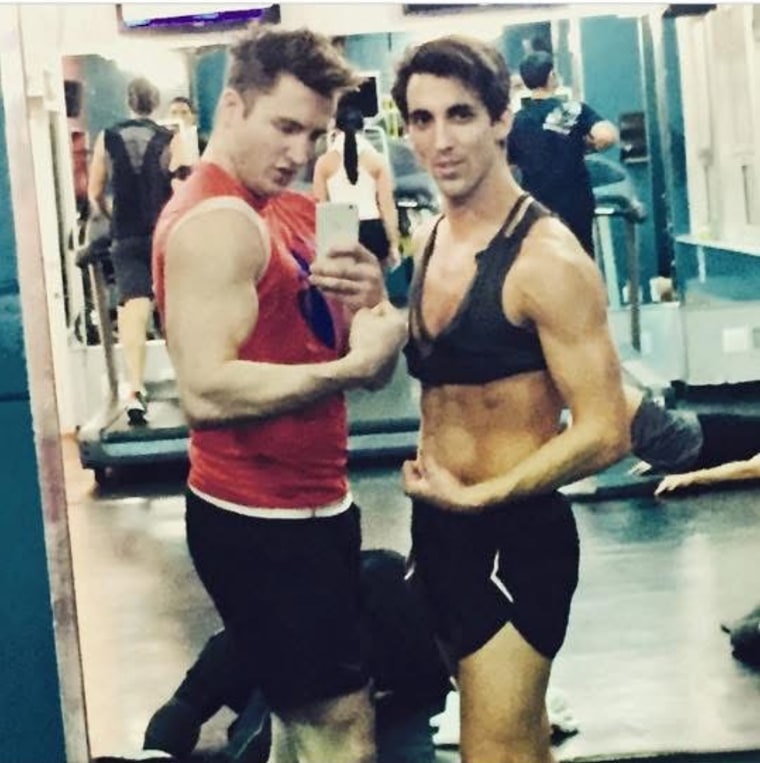
Jacob Zieben and Jacob Paulson were fast friends when they met in 2013. Aside from their shared name, the pair were both young gay men fresh out of college who recently moved to New York City.
After two years spent glued at the hip, Paulson said their dynamic quickly changed after his friend, a personal trainer from Texas, started dating model Donald Hood.
“He just vanished,” Paulson said this week in a phone interview, choking up. “I had no contact with him, and I just wanted him to be happy, and that’s all I really cared about. And I was hoping that he was.”
Although the loss of the friendship stung, Paulson said he moved on years ago. He didn’t attend his former friend’s 2020 wedding and was only aware from social media that Jacob and Donald both changed their last names to Zieben-Hood.
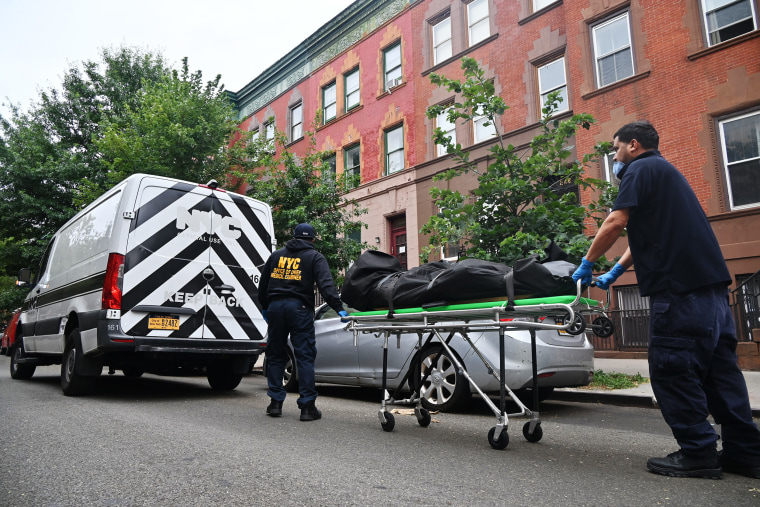
But Paulson was shocked and flooded with memories when, just two weeks ago, he saw his former friend’s name in the headlines after police found the 34-year-old dead inside his Harlem apartment.
When authorities entered the apartment on July 31 after Donald called for help, they found Jacob slumped over his toilet with a gash on his head and multiple stab wounds to the back of his leg, one deep enough to penetrate muscle, according to charging documents.
His death came after years of alleged abuse dating to 2022, detailed in a series of charging documents against Donald on felony counts including strangulation and menacing. Those charges remain pending.
Donald, a 40-year-old model with over 67,000 Instagram followers, was arrested on July 31 and charged with several crimes, including burglary. He is currently being held at Rikers Island without bail. Prosecutors have not charged anyone with murder or named a suspect for Jacob’s death, citing his pending autopsy, but said they are investigating the case as a homicide.
In the days since his death, Paulson and seven others who knew Jacob spoke with NBC News as they slowly learned about the personal trainer’s life over the last decade. And while his fatal stabbing comes as a shock, those who knew Jacob believe Donald cut out his friends — and potential lifelines — years before he truly needed them.
“I wish I had done more, but, in hindsight, what would you do?” said one of Jacob’s old friends, Marti G. Cummings.
Donald’s attorney declined to comment.
After studying biomedical sciences at Texas A&M University, Jacob moved to New York City in 2013 and quickly met Paulson and Joshua Baker.
Paulson and Baker said that the trio never went “anywhere without each other” and spent endless days cooped up in Jacob’s Hell’s Kitchen apartment, which they say overlooked Central Park, playing video games, eating fried food, and daydreaming about their futures.
“We were these cute little misfits that were trying to figure out where we fit in New York society,” Baker said.
Cummings met Jacob around the same time and gravitated toward his selflessness and desire for community. A prominent New York City drag queen who uses they/them pronouns, Cummings said Jacob would frequently walk them between gigs late at night to make sure they got there safely.
“He was a protector, which is why I think it makes this whole thing sadder,” Cummings said. “He didn’t get to be protected from this.”
Jacob Zieben with friend, Marti G. Cummings.Courtesy Marti G. Cummings
Lauren Foster, a friend of Donald’s since 2000, described him as “a good guy” and said that she was never under the impression that his relationship was troubled. She did, however, acknowledge that the roles Jacob and Donald played were clear.
“I don’t think he had a ton of friends,” Foster said of Jacob. “Don was kind of the alpha in the relationship.”
“There’s always one person that’s dominant in the relationship, and that was definitely Don,” she added. “I think Don would be the alpha in any relationship. He’s larger than life.”
Baker said that shortly after Jacob met Donald in the spring of 2015, Jacob began dodging invitations, declining phone calls, and ignoring text messages. Soon, Baker noted, Jacob started to even block his friends’ phone numbers.
Jonathan Starkey, a friend from Texas, recalled that in one conversation around that time, Jacob said that “a lot had changed, and that Donald was a little possessive and jealous and kind of restricted who he was in touch with.”
“Jacob wasn’t really someone who let people tell him what to do, which is why it’s so strange,” Starkey said.
Jacob’s abrupt silence prompted Baker to reach out to Donald.
“Jacob is doing very well,” Donald wrote to Baker in a November 5, 2015, direct message on Facebook, according to screenshots of the conversation provided to NBC News. “He’s decided to break away from his past, which unfortunately included his closest friends, in order to move forward with a healthy life.”
“He’s been very focused and is back on the right track in his life and in order to remain focused he will remain out of contact for the moment,” Donald added.
For years, the only updates Jacob’s friends received about their friend came through social media, where images from the couple’s Instagrams showed what appeared to be a happy couple who traveled the world and lived a glamorous New York life. The pair posted loving selfies, pictures from their wedding in 2020, and snapshots with their families.
But court documents paint a prolonged pattern of alleged abuse in the relationship that authorities say started in 2022.
Prosecutors said in the charging documents filed after Jacob’s death that Donald had nine domestic incident reports filed against him since 2022, but did not provide more details about the nature of the incidents or who filed them. In November 2024, an order of protection was issued in New York County Criminal Court that directed Donald to cease communication and stay away from Jacob, according to charging documents associated with Donald’s arrest in February.
In February, Donald was arrested and charged with strangulation, among several other charges, for allegedly attacking Jacob inside the Harlem apartment. Jacob “almost lost consciousness, and sustained swelling, substantial pain, and redness to his neck” from the incident, according to the charging documents. Donald pleaded not guilty to the charges in the case that is still pending.
A second court order of protection was issued in criminal court in April, which once again prevented Donald from seeing or communicating with Jacob.
Donald was arrested again in June and charged with criminal contempt and menacing, according to court documents. The court records allege that Donald held a knife in Jacob’s direction and said, “I will attack you.” He pleaded not guilty to the charges, and the case is still pending.
Paulson said that earlier this year, Jacob followed him on Instagram and gave him hope that the friends might reconnect after a brief exchange in March.
“I was so excited to have that prospect of him coming back into my life after I’d kind of let him go as a friend,” Paulson said. “And then to have it really just permanently end, it’s just devastated me. It’s really wrecked me.”
Members of the New York City Office of Chief Medical Examiner remove the body of Influencer model Jacob Zieben-Hood in Harlem, New York, on Aug. 1.Kyle Mazza / NurPhoto/Shutterstock
Donald called 911 on July 31 from Jacob’s one-bedroom apartment at West 138th Street and told them he found his husband dead on the toilet.
When police arrived, they found Donald sitting on their couch with three cuts to his arm that later required stitches, a black eye, and bite marks, according to a criminal complaint. He told authorities that Jacob had attacked him.
However, prosecutors say that Jacob called his father from the bathroom before the attack and allegedly told him that Donald “was coming at him with knives and preventing him from leaving the apartment,” according to the criminal complaint. During the call, Jacob’s father allegedly heard Donald screaming derogatory names at Jacob in the background, the complaint added.
Donald was arrested later that day and charged with burglary, aggravated criminal contempt, criminal contempt in the first degree and possession of a weapon. On Thursday, he was scheduled to appear in court, but a judge waived his appearance at the request of his attorney.
He is now set to appear on September 12, almost a month after Jacob’s funeral, scheduled for this weekend in San Antonio.
As authorities continue to investigate the case, Jacob’s friends have been connecting and sharing old memories of their late friend.
“Years can go by, but he was our family till’ the end,” Baker said.
Back in April, Uncloseted Media documented every move President Donald Trump made on LGBTQ issues in his first 100 days and uncovered a relentless and unprecedented attack against the community. That attack has only intensified. Here’s the Trump administration’s complete track record from days 101-200.
May 1, 2025
The Department of Health and Human Services (HHS) publishes “Treatment for Pediatric Gender Dysphoria: Review of Evidence and Best Practices,” a 409‑page report promoting “gender exploratory therapy.” The report’s nine authors are left anonymous in a move experts have called unusual. MIT philosophy professor Alex Byrne would later come forward as one of the authors, drawing criticism for his lack of medical expertise. Medical experts and advocacy groups criticize the review as biased, misleading and akin to conversion therapy.
The National Institutes of Health (NIH) cuts more than $800 million in research grants meant to study the health of LGBTQ people. The cuts abandon studies of cancers and viruses and setback efforts to defeat a resurgence of sexually transmitted infections, according to an analysis of federal data by The New York Times. They also eliminate swaths of medical research on diseases that disproportionately afflict LGBTQ people.
In termination letters, the NIH justifies the cuts by telling scientists that their work “no longer effectuates agency priorities.” In some cases, they say the research had been “based on gender identity,” which gave rise to “unscientific” results that ignored “biological realities.”
May 5, 2025
The Department of Justice (DOJ) removes all references to gender or gender identity from at least four federal surveys. The changes will make it nearly impossible to monitor crimes and other forms of violence experienced by transgender people.
May 7, 2025
The Supreme Court rules that President Trump’s ban on transgender troops serving in the military can go into effect immediately while the courts decide a final outcome. Alaina Kupec, a retired transgender U.S. Navy lieutenant, says the decision punishes people who are qualified and want to serve the country. “[This is] a really dark day for our country where basically we’re allowed to discriminate against a class of people.”
May 27, 2025
Trump threatens to withhold federal funding, “maybe permanently,” if California does not prevent high school junior AB Hernandez, a transgender track and field athlete, from competing in state finals. California would reject Trump’s demands, and Hernandez would go on to compete.
May 30, 2025
NIH cuts funding for the Center for HIV/AIDS Vaccine Development, a consortium of researchers from Duke University and Scripps Research. Researchers say that the program was close to a breakthrough and that the cuts could set HIV vaccine research back by as much as a decade.
June 2025
Trump does not acknowledge Pride month. White House Press Secretary Karoline Leavittsays, “There are no plans for a proclamation for the month of June, but I can tell you this president is very proud to be a president for all Americans, regardless of race, religion or creed,” notably leaving out the LGBTQ community and never using the word “Pride.”
June 3, 2025
Photo by Ted Sahl.
The Trump administration’s Department of Defense removes LGBTQ icon Harvey Milk’s name from a U.S. naval vessel and plans to rename it. Defense Secretary Pete Hegseth suggests ships should not honor civil rights leaders, saying, “People want to be proud of the ship they’re sailing in.” One defense official says Hegseth intentionally did this at the beginning of Pride Month.
Trump’s military ban goes into full force and the involuntary separation of transgender service members begins. Those who did not identify themselves will have their medical records surveyed and be involuntarilyseparated if it is discovered that they are trans.
June 9, 2025
NIH staffers issue the Bethesda declaration, stating that the Trump administration has forced the NIH to “[politicize] research by halting high-quality, peer reviewed grants and contracts” as well as “[censor] critical research” on subjects including health disparities, health impacts of climate change and gender identity. The declaration has been signed by at least 484 staffers.
NIH Director Jay Bhattacharya would later push back, saying the cuts align with the president’s agenda. “Making America healthy again involves deprioritizing research that doesn’t have a chance of making America healthy, [such as] a lot of ideological research.”
June 17, 2025
The Substance Abuse and Mental Health Services Administration (SAMHSA) announces that the 988 Suicide & Crisis Lifeline will shutter LGBTQ youth services on July 17, with the Trump administration saying the program promotes “radical gender ideology” without parental consent. In the announcement, SAMHSA notably drops the “T” in their references to the “LBG+” community.
The same day, a White House spokesperson attacks a federal judge’s ruling to block the Trump administration from disallowing transgender and intersex Americans to obtain passports aligned with their gender identity, calling it an attempt to “push radical gender ideology.” The judge rules that Trump’s executive order likely violates the Fifth Amendment as it discriminates on the basis of sex.
Reid Solomon-Lane, a transgender man and a plaintiff in Orr v. Trump, responds to the attacks: “I thought that 18 years after transitioning, I would be able to live my life in safety. … Now, as a married father of three … if my passport were to reflect a sex designation that is inconsistent with who I am, I would be forcibly outed every time I used [it] for travel or identification, causing potential harm to my safety and my family’s safety.”
June 18, 2025
In a landmark decision, the Supreme Court rules in favor of United States v. Skrmetti, upholding Tennessee’s SB1 law, which bans gender-affirming care for minors. As a result, 25 statewide bans on gender-affirming care remain in effect.
In an interview with Uncloseted Media, five trans youth speak out about the decision, with one saying, “Lawmakers don’t need to be involved in my doctor visits. … They’ve got a lane and they should stay in it.”
That same day, the acting chair of the Equal Employment Opportunity Commission admits at her confirmation hearing that transgender workers are protected under civil rights laws. Despite this, she defends dropping lawsuits on their behalf, saying the agency must follow Trump’s executive orders.
June 30, 2025
The Trump administration withholds nearly $7 billion in school funding as it investigates whether the funds support undocumented students or LGBTQ-inclusive education.
But after pressure led by Democratic Congresswoman Alma S. Adams, Trump administration officials would later announce that they will release the funds.
June 2025
Responding to Trump’s executive order that bans gender-affirming care for people younger than 19, major health networks and many regional centers begin suspending care. The lines drawn are arbitrary. At Stanford, patients as old as 18 are affected. Children’s Hospital Los Angeles (CHLA) announces that in July they will begin cutting off care for patients as old as 25. CHLA states that they were left with “no viable alternative” because they could not risk any cuts to their federal funding.
July 2, 2025
HHS orders teen pregnancy prevention programs to exclude LGBTQ content or lose federal funding, despite data showing higher pregnancy rates among LGBTQ teens. The directive affects 73 organizations.
July 4, 2025
Trump signs his “Big Beautiful Bill” into law. The sweeping package of tax breaks that largely benefits the wealthy includes major funding cuts to HIV and LGBTQ health care, as well as a number of support programs that disproportionately serve queer people.
July 9, 2025
The DOJ subpoenas over 20 health clinics and doctors for providing gender-affirming care to minors. A former DOJ official calls the move “highly unusual.”
July 10, 2025
Screenshot of Stonewall Website.
Mentions of bisexuals and bisexuality are removed from several parts of the National Park Service’s website on the Stonewall National Monument, though some would later be restored. This comes five months after mentions of trans people were erased.
July 17, 2025
Genna Brown used an LGBTQ crisis hotline for the first time when she was 10 years old. Photo by Kaoly Gutierrez for Uncloseted Media.
The Trump administration officially shuts down the LGBTQ-specific option on the 988 youth suicide hotline. Notably, there are no plans to shut down theother targeted hotline options, including the Veterans Crisis Line, the Spanish Language Line and the Native and Strong Lifeline.
Arden, who called when they were 16, told Uncloseted Media, “If it weren’t for the hotline, I would have killed myself.”
July 18, 2025
State Department officials tell the Guardian that nearly $10 million in U.S.-funded contraceptives, purchased for now-defunct foreign aid programs, are set to be destroyed after being unable to find any “eligible buyers,” in part due to a gag rule reinstated and expanded by Trump that bansfunding to overseas reproductive health, family planning and HIV-prevention programs as well as LGBTQ health initiatives. The contraceptives are currently being stored in a Belgian warehouse until their eventual demise, with the Washington Post reporting that, as of April, the stock included over 26 million condoms, millions of birth control packets, hundreds of thousands of contraceptive implants, nearly 2 million injectable contraceptive doses and more than 50,000 vials of HIV-prevention medication.
That same day, a federal judge issues a preliminary injunction against a law requiring clergy in Washington State to report child abuse disclosed during confession, finding the law likely violates the First Amendment by forcing priests to choose between their religious vows and civil obligations. The ruling, which upholds the absolute confidentiality of confession, follows the Trump administration’s DOJ joining a lawsuit on the side of the plaintiffs the month prior.
July 21, 2025
The U.S. Olympic and Paralympic Committee bans transgender women from competing in women’s Olympic sports. The committee claims they have an “obligation to comply with federal expectations,” citing Trump’s executive order, “Keeping Men Out of Women’s Sports.”
July 22, 2025
The Department of Homeland Security (DHS) dismisses abuse allegations from Andry Hernández Romero, a gay Venezuelan makeup artist the Trump administration deported to an El Salvadoran maximum-security prison, where he spent 125 days. Hernández Romero reports torture, sexual assault and other inhumane treatment. DHS labels him and others as “criminal, illegal gang members,” despite his clean record and lawful attempt to seek asylum in the U.S.
July 24, 2025
American painter Amy Sherald cancels a Smithsonian art show after the institution attempts to remove her painting “Trans Forming Liberty” that depicts a transgender woman as the Statue of Liberty. Sherald speculates that the Smithsonian’s decision was motivated in part by “institutional fear” of an anti-trans political climate.
Sixteen states and the District of Columbia sue the Trump administration for its attempts to institute a de facto national ban on gender-affirming care for transgender youth. “The federal government is running a cruel and targeted harassment campaign against providers who offer lawful, lifesaving care to children,” writes New York Attorney General Letitia James.
An Islamic court in Indonesia’s conservative Aceh province on Monday sentenced two men to public caning, 80 times each, after Islamic religious police caught them engaged in what the court deemed were sexual acts: hugging and kissing.
The trial at the Islamic Shariah District Court in Banda Aceh, the provincial capital, was held behind closed doors. Judges have the authority to limit public access in such a case and open it only for the verdict.
The two men, aged 20 and 21, were arrested in April after residents saw them entering the same bathroom at Taman Sari city park and reported it to police patrolling the area. The police broke into the toilet and caught the men kissing and hugging, which the court considered to be a sexual act.
The lead judge, Rokhmadi M. Hum, said the two college students were “legally and convincingly” proven to have violated Islamic law by committing acts that lead to gay sexual relations. The court didn’t publicly identify the men.
Prosecutors previously sought 85 strokes of the cane for each, but the three-judge panel decided on what they described as lenient punishment because the men were outstanding students who were polite in court, cooperated with authorities and had no previous convictions.
The judges also ordered the time they have served to be deducted from their sentence. It means the number of lashes will be reduced by four as they have been detained for four months.
The prosecutor, Alfian, who like many Indonesians uses only a single name, said he was not satisfied with the lighter sentence. But he said he will not appeal.
Aceh is the only province in Muslim-majority Indonesia allowed to observe a version of Islamic law. It allows up to 100 lashes for morality offenses including gay sex. Caning is also punishment for adultery, gambling, drinking and for women who wear tight clothes and men who skip Friday prayers.
Indonesia’s secular central government granted Aceh the right to implement the law in 2006 as part of a peace deal to end a separatist war. Aceh implemented an expansion in 2015 that extended the law to non-Muslims, who account for about 1% of the province’s population.
Human rights groups have criticized the law, saying it violates international treaties signed by Indonesia protecting the rights of minorities. Indonesia’s national criminal code doesn’t regulate homosexuality.
Monday’s verdict was the fifth time that Aceh has sentenced people to public caning for homosexuality since the Islamic law was implemented.
In February, the same court sentenced two men to public caning up to 85 times for gay sex after neighborhood vigilantes in Banda Aceh suspected them of being gay and broke into their rented room to catch them naked and hugging each other.
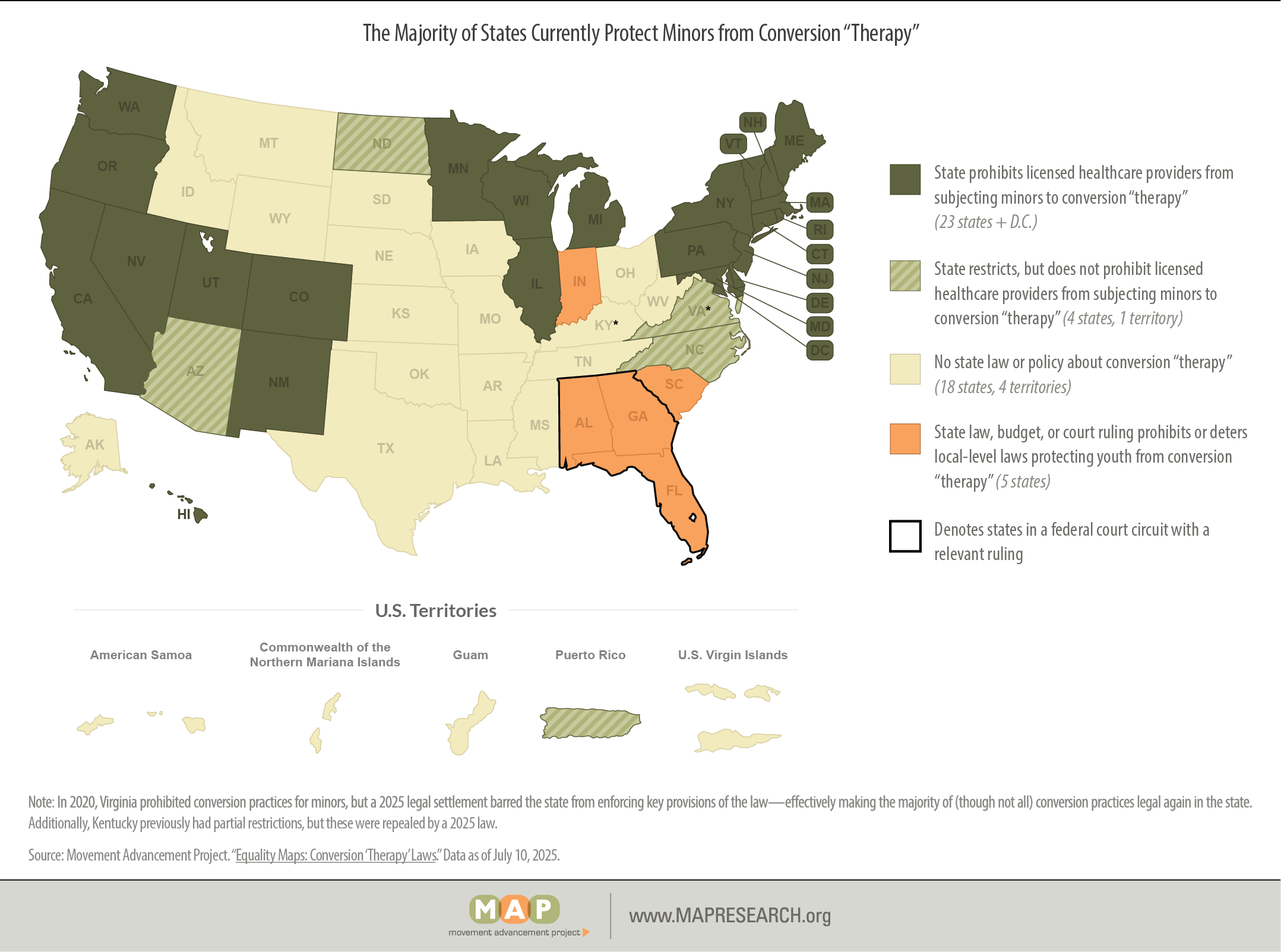
Today, the Movement Advancement Project (MAP) and The Trevor Project released a new report that spotlights the harms of conversion “therapy” and details the shifting landscape of efforts to protect LGBTQ young people against this abuse. With the U.S. Supreme Court set to hear a case this fall (Chiles v. Salazar) challenging the legality of these protections, this report offers a timely analysis into the history of these laws, the present landscape, and the importance of continuing to protect LGBTQ youth.
THE PREVALENCE OF CONVERSION “THERAPY” — AND ITS GROWING FOCUS ON TRANSGENDER YOUTH
Conversion “therapy” is a dangerous and discredited practice that attempts to change a person’s sexual orientation or gender identity. These practices have gone by many names and misleading euphemisms over many years, including “ex-gay therapy,” “reparative therapy,” and, more recently, “reintegrative therapy” or “exploratory therapy.” No matter the name, such practices share the fundamental premise that being LGBTQ is wrong, undesirable, and abnormal.
For decades, an unregulated industry masquerading as health care has used these tactics against LGBTQ people and their families—and they continue to do so today. Because these practices are often conducted in relative secret or under the guise of different names, they are difficult to track, and estimates may vary as a result.
This report includes national estimates from recent research and national surveys, which show how conversion “therapy” practices remain widespread today. MAP’s analysis also importantly explains how these harmful practices target transgender people’s gender identity, including transgender youth.
PROTECTING LGBTQ YOUTH FROM THESE HARMFUL PRACTICES
Historically, and continuing today, there has been widespread public support for protecting LGBTQ youth from conversion “therapy,” including across the political spectrum. For example:
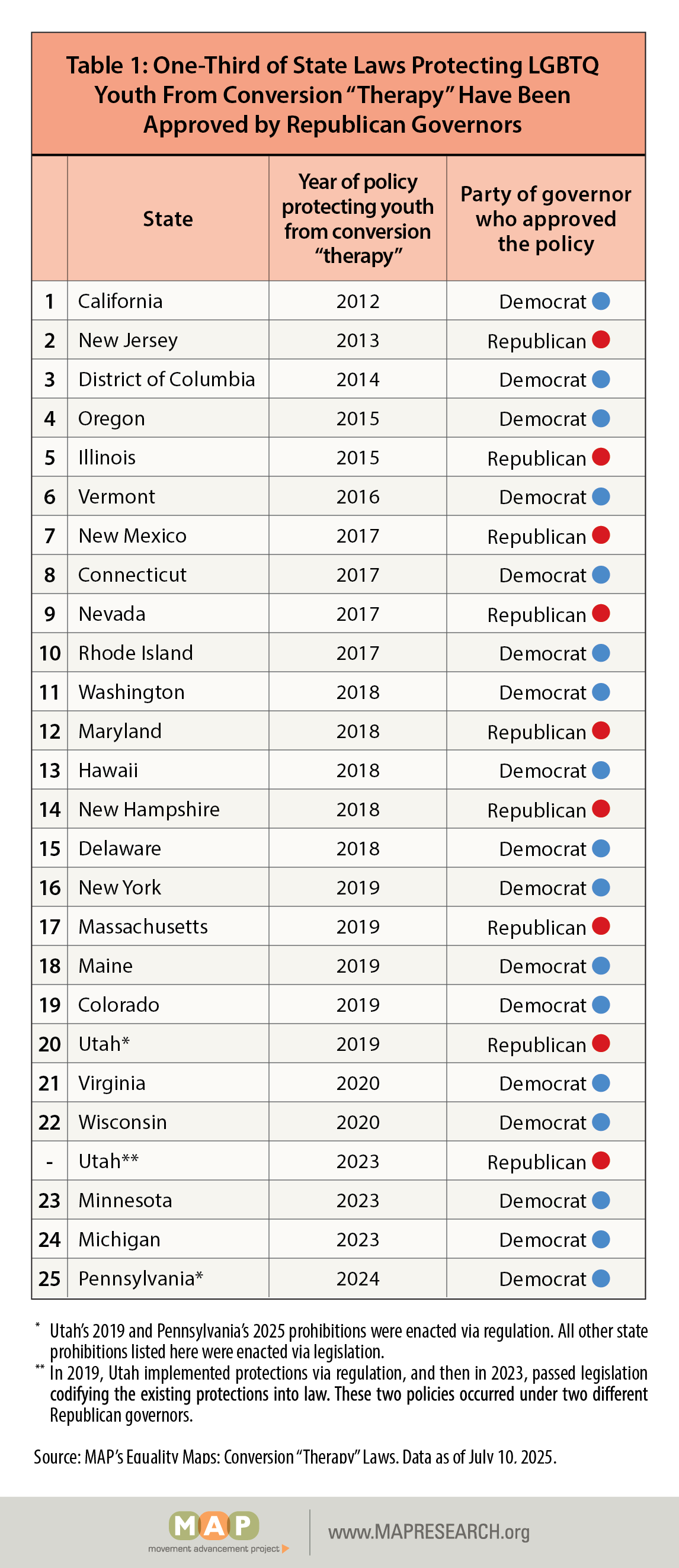
As of July 2025, state Republican lawmakers had sponsored or voted in favor of legislation protecting LGBTQ youth from conversion “therapy” at least 682 times.
One-third of existing state protections against conversion “therapy” were enacted by Republican governors.
Laws protecting LGBTQ children from conversion “therapy” have helped raise awareness and ensure that state-licensed therapists and medical providers are providing competent, evidence-based care and are not causing harm to those entrusted to their care.
A LARGER AND COORDINATED ATTACK ON LGBTQ PEOPLE—ESPECIALLY YOUTH
Since 2020, there has been a significant and dramatic escalation in political attacks on the LGBTQ community, with most of these attacks especially targeting LGBTQ youth and transgender people. This has caused startling shifts in the policy landscape, including new and escalating efforts to protect—and in some cases even promote—conversion “therapy.”
For example, in April 2025, the U.S. Department of Health and Human Services (HHS) released an anonymously authored report attacking evidence-based, medically necessary care for transgender youth, while repeatedly mentioning conversion “therapy” using the deceptive euphemism “exploratory therapy”. It did so both to promote subjecting transgender young people to these dangerous practices, and to further attack families’ ability to get a transgender child the medical care they need. This report details lawsuits challenging conversion “therapy” laws, as well as recent legislation that aims to push these harmful practices or challenge existing protections at both the state and local level.
RECOMMENDATIONS AND RESOURCES
The scientific research and personal testimonies of LGBTQ people who have been subjected to conversion “therapy” are clear: this is a dangerous and discredited practice—one that the government can and should restrict to protect its citizens.
States and municipalities should protect minors from harmful conversion “therapy” practices.
States and municipalities should fight against efforts to protect or promote conversion “therapy,” including attempted repeals of existing protections.
LGBTQ youth in crisis can contact The Trevor Project by calling 1-866-488-7386; texting “START” to 678-678; or starting a chat at www.thetrevorproject.org/get-help.
All youth deserve love, support, and acceptance. While the law cannot ensure that all youth have these vital needs met, it can protect them from the dangerous and discredited practice of conversion “therapy”—and promote an environment in which every young person knows they are safe, supported, and exactly who they were meant to be.
###
About MAP
The Movement Advancement Project (MAP) provides rigorous research, insight, and analysis that help speed equality and opportunity for all. MAP works to ensure that LGBTQ people and their families can live their lives with dignity, safety, and respect by focusing on three key areas: policy and issue analysis, movement capacity, and effective messaging. MAP’s work also covers a broad range of social justice issues that intersect with the LGBTQ movement, including racial justice, economic justice, and healthcare access. www.mapresearch.org
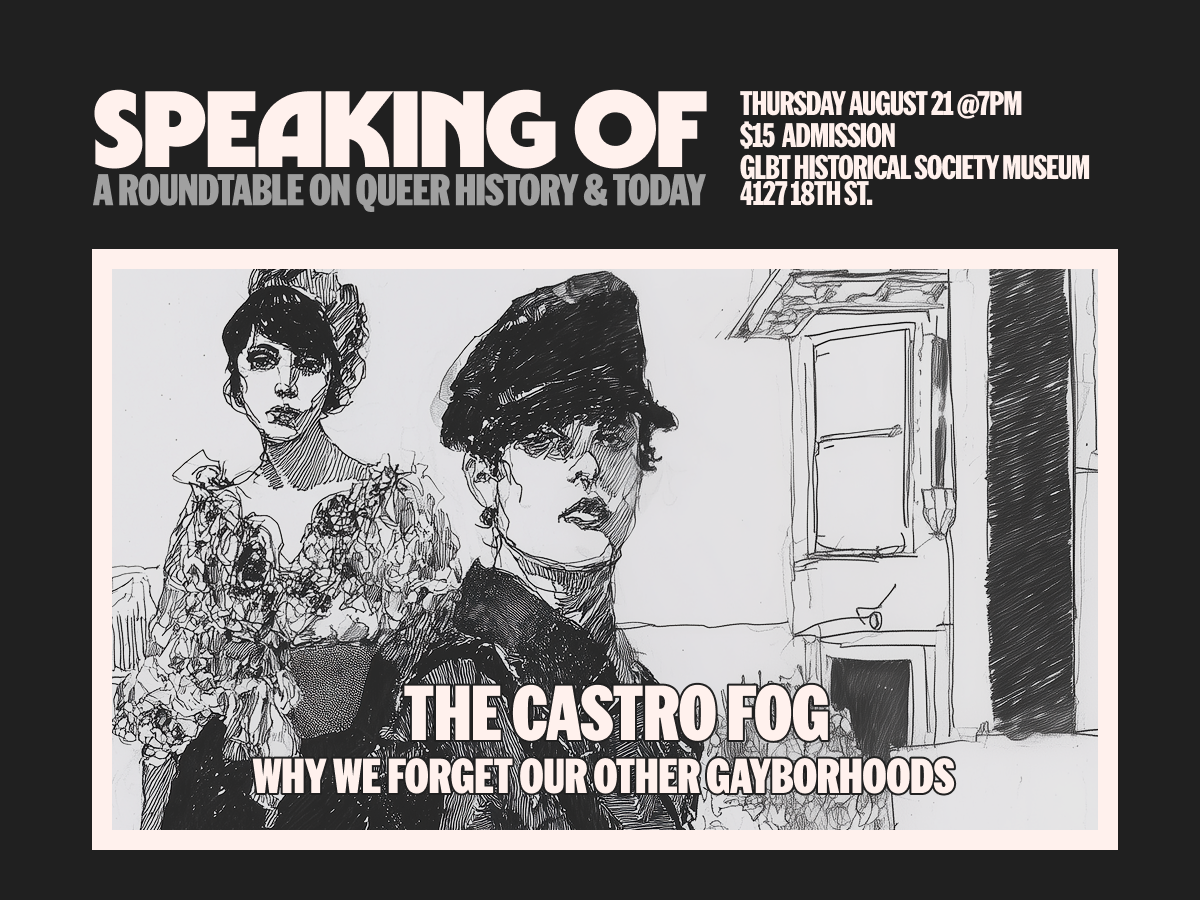
While every city’s neighborhoods change, few have experienced such thorough erasure from collective memory as San Francisco’s original gayborhoods. The gender-nonconforming stage acts of the Barbary Coast made North Beach home to some of the city’s earliest queer spaces. The Tenderloin was ground zero for the Gay Liberation Front and remains a hub for trans activism and culture. Polk Street hosted the discos of Sylvester, the drunken tales of Tennessee Williams, and more than a hundred queer-owned bookstores, clothing shops, bathhouses, and bars.
So why do we only talk about The Castro?
Join Unspeakable Vice’s Shawn Sprocket in conversation with Dr. Nan Alamilla Boyd, Marga Gomez, and Carolina Osoria as they discuss these often forgotten histories—and consider the reasons that have caused them to fade from public memory.
This program is part of Speaking Of, a new quarterly series from the GLBT Historical Society and Unspeakable Vice Walking Tours, bringing historians, researchers, and the community together to explore today’s questions through the lens of the past.
After two years of living with tuberculosis (TB), 38-year-old Selina Kimuto’s condition is worse than ever. A single mother living in Kibera—Nairobi’s biggest slum—Kimuto had been receiving medication to treat her infection. But in June, her hospital told her that they wouldn’t be able to give her any more until October, due to severe shortages caused by the sudden pull-out of U.S. foreign aid.
Since then, Kimuto’s condition has rapidly deteriorated.
Photo by Brian Otieno Storitellah for Uncloseted Media.
“I’ve really tried, but I can’t do it alone, to wash even my own clothes by myself,” Kimuto told Uncloseted Media. “Even the housework, I’m not doing it by myself. Sometimes I have to call my neighbors to come and help me.”
Kimuto’s medication had been funded in part by the President’s Emergency Plan for AIDS Relief (PEPFAR), the U.S. foreign aid program that has been a leading force in the global fight against the HIV/AIDS epidemic since it was launched by President George W. Bush in 2003.
But on day one of President Donald Trump’s second term, the program was hit with a stop-work order and a complete funding freeze on all foreign aid. While limited services have been restored, the State Department is reportedlydrafting a plan to shut down the program in its entirety, with some countries getting as little as two years’ notice before a complete withdrawal of services.
In June, Uncloseted Media reported that a cessation of PEPFAR funding could cause as many as 3 million preventable HIV/AIDS related deaths and 11 million new infections. But the impacts cut much deeper, especially in sub-Saharan Africa and other heavily impacted countries like Haiti and Ukraine.
In Kenya, HIV funding from the U.S. in fiscal year 2024 totaled $307.9 million, equivalent to almost a third of the country’s entire domestic health spending that year. In addition to HIV/AIDS, that money supports TB treatment, women’s and children’s health care, and even the electronic record-keeping for health systems as a whole.
“Health care is dependent on that aspect of the foreign aid to be able to function,” says Dr. Davji Atellah, secretary general of the Kenya Medical Practitioners, Pharmacists and Dentists Union. “A big population is affected, and it means that living conditions must change.”
The Impact on Tuberculosis
Like in many other countries, Kenya’s HIV care is integrated with care for TB because it is a very common infection for people whose immune systems have been weakened by AIDS. PEPFAR funding frequently supported efforts against both epidemics.
Over 23,000 Kenyans are estimated to have died of TB in 2023, with 124,000 cases overall. Dr. Atellah says that there has been a lot of fear in Kimuto’s neighborhood, where TB is particularly prevalent and medications are becoming harder to access.
TB can weaken the lungs, leading to chest pain, weight loss, fever and hemoptysis, or the coughing up of blood. When left untreated, it can be deadly.
Photo by Brian Otieno Storitellah for Uncloseted Media.
Since losing access to the TB medication Rifampicin, Kimuto—who also lives with HIV—now vomits frequently and has been too weak to do her usual work of selling vegetables and cleaning clothes, leaving her short on money, food and rent.
Photo by Brian Otieno Storitellah for Uncloseted Media.
“They told me in the hospital that they were under a shortage of the medicines,” she says. “They were telling us that the drugs were coming from outside the country, so it stopped.”
Anisha Parambi, an OB-GYN at Kenyatta National Hospital in Nairobi, says that Kimuto’s situation is common and that patients who previously could pick up their medication once a month now need to come twice as often as the hospital has been forced to ration supplies.
“Often they’re able to see less patients than they used to see because they don’t have the staff or resources,” Parambi told Uncloseted Media.
Women and Kids in the Crossfire
In addition to TB care, the Trump administration’s cuts are especially affecting women and children. PEPFAR previously supplied 24% of Kenya’s contraceptives, with its disappearance leaving a void which has led to shortages and heightened risks of unintended pregnancies. While some women’s health services, such as cervical cancer screenings, were reauthorized in February, local NGOs have reported that even these services have experienced disruptions and lack of funds.
In 2024, PEPFAR provided care to over 1.3 million survivors of gender-based violence, including rape kits, STI testing and PrEP. Multiple Kenyan sources told Uncloseted Media that these and other social programs had been disrupted since the start of Trump’s second term.
Photo by Brian Otieno Storitellah for Uncloseted Media.
Last year in Kenya, 127 femicides were reported, the most since the country started recording in 2016. The problem has only gotten worse now that gender-based violence programs are closing down: Kenya’s National Police Service reported that 129 women were killed from January to March of this year.
David Oduor knows this better than most. He says his mother suffered abuse and was treated “like an animal,” “beat” and “insulted.” He says the stress caused his mother to suffer from strokes, blood clots and heart failure. She ultimately passed away from complications with the conditions.
He now runs Joy Hope, an orphanage in Kibera, where he says that 90% of the kids he sees live with single moms due to gender-based violence. His organizations have worked to provide counseling for survivors and hold discussions to spread awareness in the community, and he says that the disappearance of aid organizations has made the weight they carry heavier.
Photo by Brian Otieno Storitellah for Uncloseted Media.
At the end of 2024, PEPFAR estimated that they were supporting nutritional, educational and psychosocial services for 6.6 million orphans, vulnerable children and their caregivers in 55 countries
Photo by Brian Otieno Storitellah for Uncloseted Media.
“These children are innocent, so we are just chipping in to help them,” Oduor told Uncloseted Media. “It is really really difficult, and it’s a burden, and we need some people to stand with us.”
The Kenyan government has had its own plan since 2023 to tackle what it calls the “triple threat”: adolescent STI infections, teen pregnancy, and sexual and gender-based violence. While the program had seen some success through providing education and community events for teenagers, one epidemiologist who spoke with Uncloseted Media says that the sudden loss of PEPFAR funding has made it challenging to market itself.
“You can’t bring teenagers together and not have something fun for them—they won’t turn up,” he says. “You have to have a bit of entertainment, or some refreshments, or some skit they can listen to, videos they can watch. All these have been hampered … so we are having challenges with bringing these teenagers together in a forum where … you can actually educate them on how to avert gender-based violence.”
In addition to medication, PEPFAR funding is estimated to have supported and trained 342,000 health workers as of 2024. But the cuts have had devastating effects on employment. In Kenya, roughly 54,000 people lost their jobs just over a month into Trump’s second term due to the U.S. foreign aid freeze.
“In a population of 56 million, when over 50,000 jobs are being lost, then there is a serious problem in terms of the population’s access to health care,” says Dr. Atellah, whose union has been scrambling to get laid-off workers new jobs. “Those who remain in services will be extremely overwhelmed, and therefore there is a need to ensure that there are alternative plans.”
One Kenyan epidemiologist, who specializes in treating especially difficult cases of HIV/AIDS, told Uncloseted Media that he’s been unable to find employment for months after being fired by a health care NGO. He says it’s because the Kenyan government rarely hires specialists, instead focusing on primary care doctors.
“You have to contend with just working as a general doctor, of which the government does not have enough slots for you,” he says. “So you work part-time in a few private health care facilities just to try as much as possible to bring food to the table.”
He says that because HIV and TB specialists like him are getting fired, patients with these conditions are being sent to general providers who aren’t trained to deal with these viruses.
He says this has caused intense disarray: Patients are being prescribed the wrong regimens; difficult and resistant cases are going unnoticed; people are falling out of care; and higher viral loads are contributing to more deaths.
“There’s no individualized care anymore, so the patients are running away from care, and some of them, if they stop taking their medication, they get sick at home,” he says.
The epidemiologist adds that it’s hard to know the scale of the epidemics because shortages and service reductions have limited the number of people who can get tested, often excluding the worst cases and thus skewing the data.
In addition, PEPFAR programs typically use their own information systems to manage health care data. But because these record-keeping systems are managed by the U.S., disruptions to PEPFAR are causing countries to lose access.
That happened in Kenya in March, when government officials reported that they had lost access to several health information systems, including those that track the spread of infectious diseases, vaccine stocks and even patients’ electronic health records. While the cloud storage for the systems has been restored, funding cuts have made it unreliable, with some facilities resorting to using paper documents.
Without good record keeping, “You’re blindly treating the patient, you don’t know the challenges, you’re starting from afresh,” says the epidemiologist. “The quality of care you’re going to offer the client is going to be heavily affected.”
Dr. Atellah says the Kenyan government may have to start developing a new system—a very real risk given that the State Department plans to defund billions of dollars in electronic record keeping despite the fact that, by their own admission, these systems “are in nearly every case unlikely to be financially sustained by the country government.”
Dr. Atellah says that the Trump administration’s removal of aid is disastrous for Kenya. He adds that Kenya’s dependency on the U.S. is so intense and the country’s government has been relatively slow and ineffective in their response, which exposes the flaws and corruption in their health system as a whole.
He says the Kenyan government should put more support into public health, PEPFAR or not, noting that the pilferage of public funds is one reason this isn’t happening.
“The Trump administration has said ‘America first,’ and therefore the time has come for the [Kenyan] government to put Kenya first,” says Dr. Atellah. “And there’s no possibility to do that if the access to health care for the over 2 million [people] living with HIV and over 100,000 people living with TB are not covered.”
Despite this, Dr. Atellah and the experts who spoke with Uncloseted Media agree that the Trump administration’s sudden and rapid cessation of aid is not a solution. In April, a group of 18 global public health experts published a policy proposaladvocating for a five-year plan to transition the leadership on the fight against HIV from the U.S. to the most impacted countries’ governments. But according to the State Department’s plans, PEPFAR would end in most countries in two to four years.
Photo by Brian Otieno Storitellah for Uncloseted Media.
The sudden cuts continue to be felt by Selina Kimuto in the Kibera Slums, whose condition is deteriorating because she can no longer access the appropriate amount of medication that can help her manage her TB, leaving her unemployed and struggling financially, physically and emotionally.
“The place that I stay right now, I’m really struggling to pay my rentals—when I get it, I try to at least pay it, but most of the time I don’t get it, so all I’m asking for is for you to help me.”
If objective, nonpartisan, rigorous, LGBTQ-focused journalism is important to you, please consider making a tax-deductible donation through our fiscal sponsor, Resource Impact, by clicking this button:
Under the Trump administration, the EEOC has abandoned trans workers, says the suit, in which FreeState Justice is represented by Democracy Forward and the National Women’s Law Center. It was filed in U.S. District Court in Maryland and names the EEOC and Acting Chair Andrea Lucas as defendants.
The EEOC, established in 1965 by Title VII of the Civil Rights Act of 1964, is tasked with investigating all forms of workplace bias. Filing a discrimination complaint with the EEOC is a precondition to filing a federal employment discrimination lawsuit. “The EEOC, in turn, serves those charges on the employers, investigates the charges, resolves matters through conciliation or settlement where possible, and, in some circumstances, files lawsuits in federal court to vindicate the charging parties and advance the public interest,” the suit notes.
“But the EEOC has now abdicated this core duty,” it continues. “In derogation of its statutory and constitutional obligations, the EEOC has foreclosed transgenderworkers from the full set of Title VII-mandated charge-investigation and other enforcement protections that all other charging parties enjoy.” The suit calls current EEOC policy a “Trans Exclusion Policy.”
Soon after Donald Trump became president, the EEOC moved to dismiss the employment discrimination complaints it had brought on behalf of trans people, according to the suit. “The cases that the EEOC sought to abandon concerned transgender workers who had been subjected to egregious conditions in the workplace: slurs and grossly derogatory statements, graphic sexual comments and unwanted physical touching, misgendering, unfavorable shift changes, and termination after disclosing their gender identity — often in combination,” the complaint says.
In April, the commission “directed that all charges of gender-identity discrimination be categorically classified as meritless and suitable for dismissal,” it goes on. Now it claims “to accept for processing only certain kinds of charges brought by transgender charging parties—standalone hiring, firing, and promotion claims — but no others,” the suit says.
The EEOC has interpreted Title VII’s ban on sex discrimination as encompassing gender identity and sexual orientation discrimination since at least 2011, the complaint says. The U.S. Supreme Court interpreted Title VII that way in Bostock v. Clayton County in 2020. “In other words, Bostock cemented protections for LGBTQ+ workers that the EEOC had already recognized for years,” the suit notes. But now, in keeping with the Trump administration’s denial that trans people exist, Lucas is ignoring gender identity discrimination, the document continues.
Before the EEOC became anti-trans under the Trump administration, Freestate Justice “typically advised clients wishing to file employment-discrimination charges to file with the EEOC rather than the Maryland Commission on Civil Rights,” the suit says, as “the EEOC provides charging parties with more information and engages in more resolutions of matters” than the state body. Now FreeState Justice refers clients to the Maryland commission, whose “charge-investigation process is not an equal substitute for the EEOC’s,” according to the complaint.
The Maryland commission has a broader mission than the EEOC — it investigates charges of discrimination in housing, public accommodations, and other area, not just employment — and it may soon stop investigating gender identity discrimination because the EEOC will not reimburse it for this work.
The EEOC’s “Trans Exclusion Policy” violates Title VII of the Civil Rights Act, the equal protection guarantee of the Fifth Amendment to the U.S. Constitution, and the Administrative Procedure Act, the suit alleges. It asks for the court to order the EEOC to end this policy and award FreeState Justice costs, attorneys’ fees, and other appropriate compensation.
“Policies like the EEOC’s undermine the law and endanger people. They force LGBTQI+ people and other marginalized communities to choose between their job and being true to who they are,” Lauren Pruitt, legal Director at FreeState Justice, said in a press release. “These harms show up in the daily lives of the communities we serve through our legal work, who are being pushed further into the margins. We are fighting back because no one should have to live in fear of discrimination or retribution just to go to work.”
“For over 60 years, the EEOC’s mandate has been to protect workers from discrimination, not to pick and choose who is deemed worthy of protection based on political interference,” added Skye Perryman, president and CEO of Democracy Forward. “The Trump-Vance administration’s unlawful effort to erase protections for transgender people is cruel, and a violation of the law and the Constitution. We are honored to be alongside our partners and clients to hold this administration accountable and ensure every worker is protected under the law.”
“Instead of serving its critical role to prevent discrimination in the workplace, the EEOC, under Andrea Lucas’ leadership, is actually promoting discrimination,” said Gaylynn Burroughs, vice president for education and workplace justice at the National Women’s Law Center. “Transgender workers deserve to be protected against harassment, and the EEOC is obligated to do so under law. But the Trump administration seems hellbent on bullying transgender people in every possible way and ensuring that they are pushed out of all forms of public life, including their workplaces, so we’re taking the administration to court.”