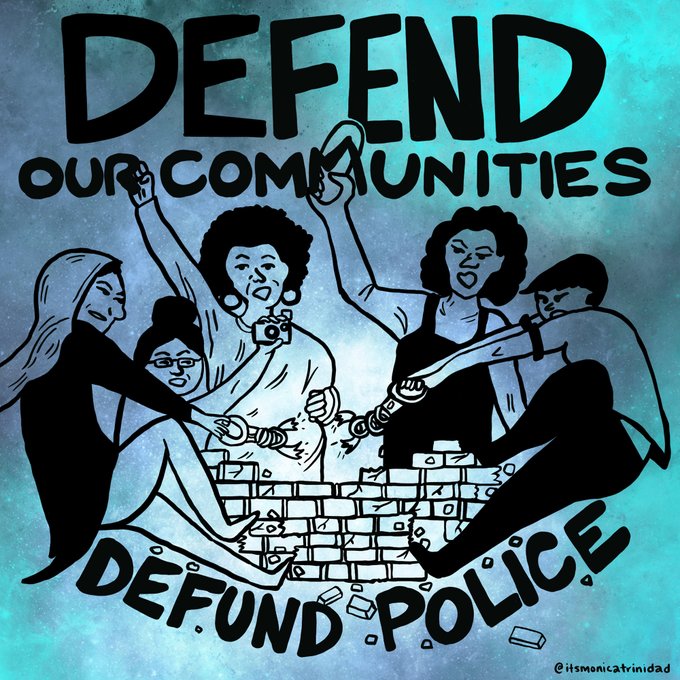
Last night over 100 folks who attended the vigil were arrested including some HPEACE volunteers. They are being placed in crowded cells, not given any hygiene supplies, and no one is cleaning up bodily fluids. We are hearing that county is planning to keep them up to another 11+ hours in detainment, just for breaking curfew. Many have not been allowed their one phone call to contact loved ones. Police are trying to keep these flaws to basic hygiene and sanitation quiet. THIS IS NOT SAFE.
There are also multiple eyewitness accounts of police officers NOT wearing masks while talking to and arresting protestors. This is also absolutely unacceptable. Masks are important for the protection of others!!!
Please call the Board of Supervisors at (707)565-2241 and attorney Karlene Navarro (707)565-1534 with IOLERO to report the above conditions and state that you are a clinician/concerned citizen and urge them to SPEED UP the process of those detained for curfew violations due to COVID-19 risks.
Please comment below when you have called!!!!
Thank you in advance for your quick response of support for folks fighting to make a change!
Sonoma County’s coastline is finally opening up, its beaches and trails beckoning inland visitors for the first time formally since health officials imposed stay-home orders back in March.
Sonoma County’s Doran, Stillwater and Gualala Point regional parks, including parking areas and restrooms, will reopen to the public on Wednesday. State parks on the coast and beaches will follow by Saturday, once a few logistical matters can be dealt with, officials said.
“I think we could be ready and open sometime Friday, or certainly by the weekend,” said Terry Bertels, California State Parks district superintendent for the Sonoma-Mendocino Coast.
Work crews still have to remove about 100 large cement blocks placed along the Sonoma Coast before Memorial Day in parking areas and turnouts to discourage visitors from flouting the park closure. That will take about two days, Bertels said.
In the meantime, Sonoma County Health Officer Sundari Mase said park users have demonstrated sufficient willingness to abide by masking and social distancing requirements to persuade her to take the next step.
Over the past several days, President Donald Trump has issued presidential actions proclaiming June as National Homeownership Month, Great Outdoors Month and Caribbean-American Heritage Month, among others. On Monday, amid protests across the country, the White House still managed to issue a statement recognizing June 1 as Global Coptic Day — but two days in, nothing, so far, for LGBTQ Pride month.
In the nearly four years since he has been president, Trump has acknowledged Pride Month once, last June, notably becoming the first Republican president to do so. But his acknowledgement was not in an official presidential proclamation, as President Barack Obama’s had been for all eight years of his presidency. Instead, it was a tweet that was later issued as a White House press releasepromoting the administration’s effort to decriminalize homosexuality around the globe.
“Let us also stand in solidarity with the many LGBT people who live in dozens of countries worldwide that punish, imprison, or even execute individuals on the basis of their sexual orientation,” Trump stated last June.
Trump did not acknowledge Pride Month in either proclamations or tweets in 2017 and 2018.
The Human Rights Campaign, the nation’s largest LGBTQ advocacy group, issued a statement Tuesday morning blasting Trump and Vice President Mike Pence for failing again to recognize Pride Month “to honor the history of the LGBTQ community and acknowledge the ongoing movement toward full equality.”
“In a global pandemic and national crisis highlighting ongoing racial violence and police brutality across the country — violence that particularly targets Black lives — Trump and his administration have stoked division, hate and anger with continued attacks on LGBTQ people, people of color, immigrants and other vulnerable communities,” Alphonso David, the group’s executive director, said in the statement.
A request to the White House for comment was not immediately returned Tuesday.
Over the past five years, during his presidential campaign and his presidency, Trump has mentioned the LGBTQ community only a few times. During his campaign, he frequently referred to the Pulse nightclub shootings in 2016 in Orlando, Florida, and promised to protect LGBTQ people from what he described as “the violence and oppression of a hateful foreign ideology.”
On his social media platform of choice, Twitter, he has mentioned the “LGBT” community only a few times in the past five years,transgender people once in July 2017 (when he famously announced he would reinstitute the country’s transgender military ban), and a few scattered comments about “gay” people over the past decade. Lesbians and bisexuals have gone unmentioned.
The Trump re-election campaign, notably, continues to sell rainbow-colored “Make America Great Again” T-shirts on its website for $25.
LGBTQ Pride Month was established by Bill Clinton in June 1999, though it was called Gay and Lesbian Pride Month. In his first proclamation recognizing Pride Month, Clinton said he was “proud” of his administration’s efforts to “end discrimination against gays and lesbians and ensure that they have the same rights guaranteed to their fellow Americans,” citing his signing in 1998 of executive order 13087, which made it possible for people of any sexual orientation to work in the federal government and to receive security clearances.
“Today, more openly gay and lesbian individuals serve in senior posts throughout the Federal Government than during any other Administration,” Clinton’s June 2000 proclamation stated.
George W. Bush declined to recognize June as Pride Month, and it was not until the election of Barack Obama that the tradition started again.
“All people deserve to live with dignity and respect, free from fear and violence, and protected against discrimination, regardless of their gender identity or sexual orientation,” Obama’s June 2015 proclamation read.
LGBTQ advocacy groups Monday hastily reoriented planned Pride Month programming, already significantly altered by the coronavirus pandemic, to address the anti-racism protests that have erupted across the United States.
In statements declaring support for #BlackLivesMatter protests against racism and police brutality, organizations including the Human Rights Campaign, the National Center for Lesbian Rights and GLAAD pointed to the radical roots of the early gay rights movement. They called for solidarity with the black and brown communities and many of them cited the now-iconic uprising at New York’s Stonewall Inn in June 1969, which led to the country’s first Pride marches the following year, and some groups also gave a nod to the lesser-known 1966 riot at San Francisco’s Compton’s Cafeteria.
“Today is 6/1, the official start to #PrideMonth. But right now we are reminded that the 1st #Pride wasn’t a party or celebration, it was a RIOT led by Queer POC,” NCLR tweeted, referring to queer people of color.
In a Monday appearance on MSNBC’s “Morning Joe,” Human Rights Campaign President Alphonso David spoke of George Floyd, Breonna Taylor, Ahmaud Arbery and Nina Pop, all black people who have been killed recently, and spoke of the “countless other names and faces” of victims who are still unknown “because there was no camera.” He then drew the connection between the current protests and Pride Month.
“We are celebrating Pride Month starting today, but we have to also remember Pride Month has its roots in the struggle, in protest,” he said.
On Friday, more than 100 LGBTQ civil rights organizations published an open letter condemning racial violence and affirming that they “recognize we cannot remain neutral, nor will awareness substitute for action.”
“We celebrate June as Pride Month, because it commemorates, in part, our resisting police harassment and brutality at Stonewall in New York City, and earlier in California, when such violence was common and expected,” the letter states. “We remember it as a breakthrough moment when we refused to accept humiliation and fear as the price of living fully, freely, and authentically.”
New York state Sen. Brad Hoylman, the body’s only openly gay member, called for a total overhaul of planned Pride Month celebrations — most of which were already canceled because of the coronavirus pandemic and tentatively replaced by a streaming eventscheduled for June 27.
“This is no time for a milquetoast, corporate Pride celebration that simply celebrates the progress we’ve made since 1969,” Hoylman wrote. “It would be unconscionable for the LGBTQ community to ignore that our black and brown neighbors are crying out for justice.”
Hoylman called for Pride 2020 to be replaced by a “return to our roots,” a “radical protest against bigotry, racism, homophobia, transphobia and police brutality.”
The National Center for Lesbian Rights tweeted that for this year’s Pride, the group “will be planning and taking part in events that have a focus on racial justice and anti-blackness, in order to help show how they are intersectional and intertwined with the #LGBTQ community.”
Sarah Kate Ellis, the president and CEO of GLAAD, a national LGBTQ advocacy group, promised that her organization will be “centering and lifting up the voices of Black LGBTQ people” this month. “There can be no Pride if it is not intersectional,” she said.
The actor and activist George Takei was among the LGBTQ celebrities to speak out about the need for a shift during Pride Month.
“You cannot remain silent today and celebrate Pride tomorrow” he said, endorsing #BlackLivesMatter. “We must stand today with our black brothers and sisters.”
Sen. Kamala Harris, D-Calif., a vocal LGBTQ ally, gave a nod to some of the queer movement’s most iconic black and Latino activists in her call for solidarity during Pride Month.
“Because Marsha P. Johnson, Stormé DeLarverie, Sylvia Rivera, and countless other LGBTQ+ people had the courage to stand up for their rights, we now celebrate #PrideMonth,” she wrote on Twitter. “Those pivotal events showed what we know to be true to this day: no one should be left to fight alone.”
Last week two Black men, George Floyd and Tony McDade, were killed by police, leading to countless people protesting around the world in support of Black Lives Matter.
George Floyd died after a police officer pinned him down by the neck using his knee until he went limp. Tony McDade, a trans man, was shot and killed by officers while being chased in connection with a fatal stabbing.
For people of color – gay or straight, trans or cis – these stories, sadly, aren’t unique. Frankly, they’re commonplace. Black people have been dying at the hands of police in horrifying numbers for centuries – only now, the internet is being used to share these stories more widely than ever before.
The police violence being directed at those protesting racism in Minneapolis and in other cities around the world is, again, nothing new. The Black Lives Matter movement and associated groups have been organising protests against police brutality since the 2014 killing of Michael Brown Jr, an 18-year-old Black man shot dead by a white police officer.
Before that, Black people have been asking police to stop killing us for as long as there have been police. But all too often these efforts are welcomed with tear gas, rubber bullets and further violence. And at the end of it all, Black people are still being killed.
Just as the LGBT+ rights movement – which, it pays to remember, was spearheaded by Black trans women and butch lesbians – has been bolstered by straight-cis allies, and has furthered LGBT+ rights by winning over the straight cis (mostly) men who run our world, the Black community needs allies of all races to stand with us. Our voices, our bodies and our actions alone aren’t enough – to affect change as quickly as possible, we need your help.
If you want to stand up and be counted, here is a non-exhaustive list of things you can do.
1. Call for accountability.
The most immediate thing allies can do is to sign petitions and contact political representatives to demand justice for both George Floyd and Tony McDade.
A petition calling for charges to be filed against all four officers involved in Floyd’s death has so far attracted 10 million signatures. The officer who knelt on Floyd’s neck has been charged with murder, but each additional name added will help build pressure for officials to take action against the other three.
A separate petition is simply calling for “Justice for Tony McDade”, and at the time of publication has been signed more than 430,000 times. McDade’s case is currently shrouded in uncertainties – signing his petition will help bring visibility and hopefully answers.
2. Protest.
If you feel safe doing so, consider joining a protest. Understandably not all queer people will be able to do this. If being in large groups and/or around police poses a danger to you, or if you are disabled and concerned about access/making a safe exit, do not feel compelled to protest. There are many lanes of resistance, and each of us can’t occupy all of them.
If you want to protest, it’s easy to find organised demonstrations through social media. Follow trusted Black organisers, protest with a buddy, and maintain social distancing. A widely-shared infographic has other good pieces of advice for protecting yourself.
3. Donate.
If you can afford to do so, there are many Black organisations that need funding at this critical time.
The Minnesota Freedom Fund – which, among other things, is working to free jailed protestors by paying bail and legal fees – has raised over $20 million in the past week and is now asking people to consider donating to other groups.
Its suggestions include the Black Visions Collective – a Black-led, queer and trans-centring organisation dedicated to Black liberation.
It also recommends people donate to Reclaim the Block, a coalition demanding that Minneapolis divest from policing and invest in long-term community alternatives, and the North Star Health Collective, which works with organisers to create safe and health events.
Further afield, there are local organisations working to free protestors across the US. The National Bail Fund Network is maintaining an updated thread of places where people can donate.
Saturday THREAD – So much solidarity from coast to coast! This is an updated thread on bail funds supporting people arrested for demanding justice for George Floyd, Breonna Taylor, & all victims of police violence. 1/#FreeThemAll
4. Educate yourself and others on being anti-racist.
Not being racist isn’t enough. Now as much as ever, it’s important to be vocally and actively against racism in all its forms.
If you aren’t sure what this means, or aren’t comfortable in your knowledge of these issues, take the time to educate yourself. Read books by Black authors, such as Why I’m No Longer Talking to White People About Race by Reni Eddo-Lodge, How to Be an Antiracist by Ibram X Kendi, or Back to Black by Kehinde Andrews.
Share what you learn with white friends, challenge them when you see or hear them making ill-informed statements, and further the conversation as much as you can.
5. Be mindful on social media.
As journalist Paula Akpan recently tweeted: “Being online right now as a Black person is f**king exhausting.”
Be mindful of sharing videos showing violence against Black bodies without a proper warning. Be considerate in who and what you are retweeting. While racists must be held accountable, there are ways of doing this without amplifying their message of hate – by reporting them to social networks and/or, when appropriate, by informing their employers.
If you are unsure about what to share on social media, often the best thing to do is to amplify the voices of the oppressed – in this case, Black people. Retweet posts and share articles. It’s fine to contribute your own words of course, but be mindful and open to constructive criticism. Above all, remember if you have a platform – even a small one – and want to make a difference, use it.
6. Check in on your queer Black friends.
Amid all of this, don’t forget to keep in contact with your Black friends as you would at any other time. Remember that we won’t always want to talk about race and racism, even when it is dominating topic in the media and online. When we do, be sure to listen more than you do speak, and try not to use us as a resource for your own development.
7. Keep the energy going.
Right now it’s impossible to predict what the future will bring. But regardless, remember to remain committed to anti-racism. Whether the current protests beget sweeping change or whether the status quo returns, continue to make your voice heard, improve your own learning, and support Black people and Black causes.
It all started with an impromptu march and a picnic. On June 27, 1970 a small band of hippies and “hair fairies” marched down Polk Street, then San Francisco’s most prominent LGBTQ area, to celebrate an event they called “Christopher Street Liberation Day.” The following afternoon, celebrants congregated for a “Gay-In” picnic in Speedway Meadows at Golden Gate Park. These two modest gatherings inaugurated the annual celebration we now know as San Francisco Pride.
As difficult as it is to believe that every single Pride participant in 1970 could fit into a small area of the park, it’s also remarkable that just ten years later, Pride was drawing some 250,000 participants and spectators. The foundational first decade of Pride is the subject of a new online exhibition, “Labor of Love: The Birth of San Francisco Pride 1970–1980,” opening June 15 on the GLBT Historical Society’s website. It’s the second of two exhibitions the society is organizing to commemorate Pride’s golden jubilee.
“Labor of Love” is curated by three LGBTQ historians who have worked with the society for many years: Gerard Koskovich, Don Romesburg and Amy Sueyoshi. To introduce the exhibition, each selected one item that will be on display and wrote a brief reflection about its significance:
Gerard Koskovich: The flyer for the 1970 Christopher Street Liberation Day Gay-In (top left) is one of many items of ephemera that stand out for me. It’s our first fragile historical document recalling an event that appeared to have little impact at the time. At the end of tumultuous 1960s, when enormous protests, sprawling counterculture festivals and massive full-on riots regularly dominated the news, a ragtag band of hippies and queens staging an informal march followed by a couple hundred queerfolk holding a picnic the next day didn’t strike much of anybody as meriting a headline.
The fact that this flyer survived likely tells us something important: Some of the people involved in the event thought of themselves as actors in history. In this case, the copy came to the archives with the papers of Charles Thorpe, an activist involved in the first glimmers of gay liberation in San Francisco. He carefully gathered this flyer and other materials documenting those efforts. For Thorpe, the flyer evidently wasn’t just designed to announce an event, then be tossed in the trash. It was a reminder of a manifestation of courage and celebration that should be handed along to the future.
Amy Sueyoshi: The logo for gay pride on the 1972 program (top right) features a raised fist with purple butterfly wings. It’s an odd image when you stare at it too long, but it reminds me of the explicit ties that the Gay Power movement had with other cultural nationalist movements such as Black Power. We know from Asian Americans activists that the alliances were far from perfect. Queers of color felt racism in dominantly white gay and lesbian spaces, and homophobia disabled full inclusion in the fight for Third World liberation. Still, the logo to me signals an aim for a liberation movement that explicitly articulates allyhood and intersectional identities, in its nod towards mariposa consciousness and a raised fist against white supremacy.
Don Romesburg: From its earliest years, people used Gay Freedom Day to express sameness and difference simultaneously. Unlike bars, organizations and neighborhoods, which served particular identitarian, political, cultural and erotic constituencies, the parade and festival were the only places where all of the community would experience its full collectivity. Yet many also used the gathering to assert the worth and pleasure of their particular facet of sexual and gender diversity. Gay Freedom Day became the annual reunion of one big queer dysfunctional family. Early Pride events showcased that we could all be an LGBTQ community, despite and through our differences.
That’s why I love this Marie Ueda photo of the Third World Gay Caucus (center), a coalitional organization for the liberation of queer people of color, marching in the 1977 parade. Black, Latinx and Asian American people assembled themselves under one banner, an exuberant solidarity in difference. And they gestured, through signs such as “Gay Rights Are Human Rights,” toward a universal call for all “gay” (what we’d now call LGBTQ) people to claim their full humanity in the face of racism, cis and hetero marginalization and erasure.
Michael Ely met his husband, James Taylor, at a Sunset Beach bar in 1971. Taylor, known as “Spider” to his friends, played guitar in a band, and Ely got involved as a singer. The couple lived in California until the emotional toll of the AIDS epidemic became too great. In the early ‘90s, they relocated to Tucson, Arizona, where Taylor worked as a jet mechanic for Bombardier and Ely took care of their home.
In 2007, Ely and Taylor had a commitment ceremony but could not be legally married in Arizona. Then in November of 2014, shortly after the state legalized same-sex marriage — and 43 years after they first met — the two men tied the knot. Six months later, Taylor succumbed to cancer.
“Being able to access survivors benefits can make the difference for whether someone can afford the basic necessities of life, like housing, food and health care.”
PETER RENN, LAMBDA LEGAL
Despite their decadeslong relationship and eventual marriage, the Social Security Administration denied Ely spousal benefits, because the couple had not been married for the requisite nine months.
This week, however, a federal court ruling changed that. The LGBTQ advocacy group Lambda Legal won a class-action lawsuit, Ely v. Saul,on behalf of same-sex couples denied Social Security Administration benefits because of gay marriage bans.
“Because same-sex marriage is a fundamental right, and the underpinnings of the duration-of-marriage requirement has relied on the unconstitutional ban of that right, it cannot be said to be rationally related to a legitimate interest to a surviving spouse such as Mr. Ely,” the U.S. District Court for the District of Arizona’s Wednesday ruling states.
Ely described the decision as a “huge victory” that’s “going to help a lot of people.” One of the Lambda Legal attorneys on the case, Peter Renn, agreed.
“It is impossible to overstate the significance of this victory, not just for the number of people it affects, but for vindication of their constitutional rights,” he said.
The other named plaintiffs in the case include Anthony Gonzalez, whose husband, Mark Johnson, died in 2014, and James Obergefell, whose husband, John Arthur, died in 2013. Obergefell was also the plaintiff in the 2015 landmark Supreme Court case Obergefell v. Hodges, which made same-sex marriage legal across the United States.
Renn said that despite the Obergefell decision five years ago, the widowers involved in Ely v. Saul “have been deprived the protections of marriage, and without the victory would have been deprived the protections” for the rest of their lives.
“This type of government denial is flatly unconstitutional, and the ruling provides this relief on a nationwide basis to everyone who was affected by this,” he said.
Following a request for comment, the Social Security Administration referred NBC News to the Department of Justice, which did not immediately respond.
Ruling’s impact
Because Ely v. Saul is a class-action suit, all couples in a similar position to Ely will be able to access survivors benefits.
In 2020, over 65 million Americans will receive over $1 trillion in benefits from the Social Security Administration, according to the agency. While there are no estimates available for the number of gay surviving spouses who will benefit from this week’s ruling, survivors benefits account for over 12 percent of SSA benefits paid. In a single month in 2019, 6 million survivors received $7 billion in benefits.
“Being able to access survivors benefits can make the difference for whether someone can afford the basic necessities of life, like housing, food and health care,” Renn said.
At 67 years old, Ely currently relies on his husband’s pension from Bombardier, but that will run out in a couple of years.
“I think I’m going to be around another 20 years, and this gives me that security that I won’t end up on the streets,” he said of the Social Security benefits he’s now entitled to.
Renn emphasized that Social Security benefits are “benefits we all pay for.”
“This is tethered to your earning history,” he said. “Michael’s husband paid in like everybody else.”
Ely said his husband was a “hard worker” who spent “over 40 years putting into Social Security.”
“To think that I, his partner, his husband, would be denied that money and the government would just keep it didn’t seem fair,” Ely said.
Ely said he expects the government to appeal the decision, but he isn’t allowing that to take the shine out of his victory.
“I am happy, and I know Spider would be happy,” Ely said. “I think he would be doing cartwheels, and I hope he is, somewhere.”
We are thrilled to inform you that our Santa Rosa office will open on Tuesday, June 2!
Our team has been working diligently to follow proper guidelines that will keep both our staff and clients safe.
Please note the following guidelines that will be in place:
Hours: Tuesday through Friday 9am-4:30pm Entrance through back parking lot only. Our front door will be kept locked. Masks must be worn inside building6ft. Social Distancing at all times
Restrooms are for staff only.
They will be closed to the public at this timeAppointments Only to meet with Case Managers.
Sorry we can not accept Walk-In’s at this timeSyringe Exchange will take place outside by rear door of buildingHIV testing will resume once we can safely do so
A man in Malaysia has won the right to challenge a religious state law banning gay sex in the mostly Muslim country.
According to Reuters, a lawyer for the man said on Wednesday (May 27) that Malaysia’s top court had him the go-ahead for the landmark LGBT+ rights test case.
The Muslim man in his 30s will remain anonymous for his protection and privacy.
He initially filed the lawsuit in 2018 after he was arrested for attempting gay sex, a charge that he denies.
He was arrested as part of a raid by by Islamic enforcement officers in the state of Selangor, after which five men pleaded guilty and were fined, jailed and caned on gay sex charges.
Gay sex punishable by up to 20 years in prison in Malaysia.
Homosexuality is doubly illegal in Malaysia as it is banned by the country’s secular, colonial-era legal code, as well as its special Islamic courts.
Punishment includes fines, corporal punishment and up to 20 years in prison.
LGBT+ people have no legal protections against discrimination in the predominantly Islamic country, and the government currently runs a gay ‘rehabilitation programme’, claiming last year that it had ‘cured’ 1,450 people of homosexuality.
The man is challenging the Islamic law in the state of Selangor, the site of his arrest, arguing that the state has no power to ban “intercourse against the order of nature” if civil laws already ban gay sex.
It will be the first case of its kind, and if successful could influence other states in Malaysia.
The man’s lawyer, Surendra Ananth, told Reuters that arguments should be heard by the end of 2020.
He said: “[If we win], the state law will be struck down and the criminal charges in the shariah court should be dropped.”
The Malaysian LGBTIQ+ Network said: “It is clear this state law is being used by authorities to disproportionately criminalise marginalised and persecuted communities based on sexual orientation and gender identity.”
A Polish prosecutor has charged an IKEA manager with religious discrimination for firing an employee who called homosexuality “an abomination” on the company’s internal website.
The employee at IKEA’s Krakow store was fired last year after quoting passages from the Bible referring to homosexuality on the company’s intranet and refusing to remove his comments, a spokesman for the Warsaw prosecutor’s office said.
IKEA said it was co-operating with the prosecutor to try to resolve the matter promptly.
“As an employer, we will provide all the help and support to our charged employee,” said a spokeswoman from Ingka Group, which owns most IKEA stores including those in Poland. She gave no further details.
At the time of the employee’s dismissal, Justice Minister Zbigniew Ziobro said the case was an example of using “legal and economic violence against those who do not share the values of homosexual activists.”
The prosecutor’s office said the employee’s rights may have been violated due to his religious beliefs. If convicted, the human resources manager who fired him could face a fine or up to two years in prison.
IKEA is also facing a civil lawsuit by the employee for wrongful dismissal.
Unlike nearly all western European countries, which have legalized same-sex marriage and the adoption of children by same-sex couples in recent years, the former Communist countries of the EU’s east have mostly held back on expanding gay rights.
Poland’s ruling Law and Justice party (PiS) says lesbian, gay, bisexual and transgender (LGBT) “ideology” is an invasive foreign influence that undermines traditional values in the staunchly Catholic country.
It made the issue a key battleground with the more liberal opposition before European elections last May and in a general election last October.