Across the UK, trans prisoners are individually assessed and, in most cases, housed in prisons that don’t relate to their gender identity.
The issue of where trans prisoners are housed has become a topic of debate following the case of Isla Bryson, a trans woman convicted by a Scottish court of raping two women prior to her transition.
It was reported that Bryson was held at the women’s prison Cornton Vale. Two days after she was found guilty, it was confirmed that she was being moved to a men’s prison.
First minister Nicola Sturgeon said: “I don’t see how it’s possible to have a rapist within a female prison, even the understandable public and parliamentary concern. …
“And I hope that provides assurance to the public presiding officer, not least to the victims, in this particular case.”
The Scottish Trans project has reported that Bryson was held in segregation at Cornton Vale while a risk assessment was carried out. As it explained, this is how the Scottish Prison Service’s policy works.
“The risk assessment decided, not surprisingly, that she [Bryson] should not be held in the women’s estate. This is what we would expect for a person convicted of rape,” Scottish Trans said on Twitter.
The service decides where to house trans prisoners on a case-by-case basis.
Scottish Trans added: “It is right that this should be decided on an individualised risk assessment basis.
“For example, a trans woman transitioned for 20 years, who is in prison for a non-violent offence like financial fraud, might pose no risk to other women in custody, but be at significant risk herself if accommodated on the male estate.”
It added that the risk assessments do not depend on whether or not the inmate has a Gender Recognition Certificate (GRC). This means Scotland’s vetoed Gender Recognition Reform Bill, which would make it easier to obtain a GRC, would not affect the prison service’s policy in Scotland.
Under the reforms, the Ministry of Justice has said transgender women with “male genitalia” – or those who have been convicted of a sexual offence – should no longer be held in general women’s prisons.
The ministry said this will “create a strong presumption” but also allow for exemptions to be considered by ministers on a “case-by-case basis”.
However, the department noted that only the “most truly exceptional cases” will be considered.
How many trans men and women are there in prison?
According to the BBC, as of September 2022 there were four trans men in Scottish prisons, one of whom was held in a men’s prison. Of the 11 trans women, five were in women’s prisons.
Data published in November 2022 by the Ministry of Justice shows there are 230 transgender prisoners out of a prison population of 78,058 in England and Wales.
Of these 230 prisoners, 168 identified as trans women, 42 as trans men, 13 as non-binary and seven identified in a different way or did not provide a response.
“Most transgender prisoners were in the men’s estates,” the report read.
“181 transgender prisoners were in male estates and 49 were in female estates. There were six transgender women in female establishments.”
While a full breakdown of which trans prisoners were held in the prison corresponding to their gender identity was not given, it is clear that of 168 inmates identifying as trans women, only six were housed in women’s prisons.
The report added that the figures of trans inmates are “likely to underestimate the true number”. The numbers do not include trans prisoners with a Gender Recognition Certificate, of which there are 11.
The end of the year or the start of a new one is typically called the “annual physical” season as most are trying to take advantage of the benefit of no-cost physicals provided by most insurance coverage. The good news for most of us is that if you are insured, it’s very likely your annual physical is 100 percent covered by insurance. The better news is that many types of diseases and cancers can be caught early in the annual physical with many treatment options that will not impact your life too drastically.
However, many men don’t actually undergo an annual physical or have one done properly, especially if they have a history or exclusively have sex with men (MSM). HIV-positive or HIV-negative, every human should be availing themselves to an annual physical. I do so regularly and as such caught a very early stage anal cancer caused by a tear and HPV prior infection. My primary care doctor, who happens to be gay, routinely performs things like pap smears on my anus and comprehensive blood panels to check everything from impact of my PrEP meds on my kidneys to PSA levels which can be early warning sign of prostate and other cancers. Like in my situation, my affliction was caught very early, cured with outpatient surgery, and didn’t even require chemo or radiation.
If you are planning or scheduling your annual physical, here’s what you should be asking or expecting from the doctor, according to leading gay gastroenterologist Dr. Carlton Thomas.
What are the basics every person should be getting assessed at their annual physicals? Bring up any specific concerns about any symptoms you might be experiencing. A good thorough physical exam with age specific checks for testicular, rectal, and prostate issues. Labs including CBC (complete blood cell count), CMP (comprehensive metabolic panel that looks at liver and kidney markers as well as electrolytes and glucose), thyroid studies, Prostate Specific Antigen (PSA) depending on age and family history, and lipid panel to look at your cholesterol and triglycerides. I also recommend testosterone levels. Discuss any age-appropriate cancer screening such as colonoscopy for colon cancer screening starting at age 45 or sooner if you have symptoms or a family history of colon cancer.
What are additional “must have” tests for men who have sex with men? Blood HIV panels including viral load and T cell counts if positive; Hep A, B, and C; syphilis studies — look for antibody titer changes if you were previously infected to check for reinfection — and herpes studies if unknown.
Urine tests help detect the very common and prevalent gonorrhea and chlamydia. Throat swabs and rectal swabs will also detect gonorrhea and chlamydia depending on how you play sexually. Anal Pap smears will help detect HPV and anal dysplasia, especially if you are HIV-positive due to the dramatically increased risk of anal cancer in HIV-positive men who also have HPV.
What vaccines should MSM discuss with their doctors? Here’s the checklist you should bring to each physical: • Hep A (if rimming is part of your sexual routine) • Hep B (if you’ve encountered blood or other body fluids) • Meningitis • HPV (now approved up to age 45) • Mpox • Age-appropriate pneumonia and shingles • Covid and flu updates if needed
What other common specialists should MSM discuss with primary care doctors to possibly add to one’s medical team? Some primary care doctors will redirect PrEP to prevent HIV and HIV-positive care to infectious disease specialists. If you are 45 and older and have not had a colonoscopy, then you should be referred to a gastroenterologist (GI) for colonoscopy screenings. Regular dermatologist screenings for the annual mole patrol and early skin cancer detection. Proctologists should be added for issues surrounding hemorrhoids, anal fissure (tears in the butt lining), and anal wart care. Urologists for anything concerning genital and urinary functions.
Why is it important for men to be open and honest with their doctor about their sexual preferences and habits, even if embarrassing? Your doctor needs to know what you do so they can make sure you get the tests, vaccines, and screening care you need. For instance, if they don’t know you bottom or have a history of bottoming, they don’t know to check you for potentially precancerous cells in your anal canal or to check rectal swabs for gonorrhea and chlamydia.
What else should we know in undergoing our annual physicals? Don’t be embarrassed to be honest. We have seen and heard it all. Don’t be shy about being examined. Your medical and personal information is always kept confidential due to HIPPA laws.
Researchers from San Francisco and Seattle have found that Doxy PEP is an effective strategy in reducing sexually transmitted infections (STIs) like gonorrhea, chlamydia, or syphilis. Doxycycline is an antibiotic traditionally used for other bacterial infections like acne and malaria, but when used as a post-exposure prophylactic within three days after unprotected sex, it reduces infections by more than 60%.
Can you take doxycycline to prevent STDs?
A clinical study conducted with the San Francisco Department of Health (SFDPH), Zuckerberg San Francisco General, University of California, San Francisco, and the University of Washington ended early when they found Doxy PEP to be effective among 554 men who have sex with men and transgender women living with HIV or taking an HIV pre-exposure prophylaxis (PrEP).
“PrEP transformed HIV prevention, and I think that Doxy PEP is going to transform STI prevention in a similar way,” says Hyman Scott, MD, MPH, Medical Director of San Francisco AIDS Foundation.
Until now, STI prevention strategies have been mostly behavioral, like wearing a condom or engaging in non-penetrative sex. Infection rates for STIs, mainly syphilis, gonorrhea, and chlamydia, have been rising for the last decade and increased even further during the COVID-19 epidemic. Syphilis cases increased by 26% from 2020 to 2021, the highest number since 1991. Gonorrhea and chlamydia are also on the rise. While these bacterial STIs can be spread through childbirth and breastfeeding, unprotected sex is one of the main paths to infection–and it’s on the rise.
While PrEP protects up to 99% against HIV, it doesn’t prevent other STIs. Further, HIV PrEP roll-out has been slow due to cost and access issues, but doxycycline won’t have the same problem. It’s an inexpensive medication that healthcare providers have been prescribing for years to treat acne and malaria. Now, it’s going to have a new purpose: slowing down the global rate of sexually transmitted infections.
Some cases of syphilis lead to hearing loss. Trachoma is a disease caused by the chlamydia bacteria and causes more vision loss and blindness than any other infection in the world. In under-resourced areas like sub-Saharan Africa, lack of access to proper health screenings and medication can perpetuate infections among those living in poverty and without proper public health resources.
“In retrospect, we’ve slow-walked PrEP rollout across the country, and we shouldn’t slow-walk Doxy PEP rollout. We’re still trying to play catch up with increasing access and addressing inequities in PrEP uptake. We have the opportunity to do things differently with Doxy PEP,” says Scott.
The Doxy PEP clinical trial findings were shared this summer at the International AIDS Conference to an audience of expecting medical and health professionals. 554 participants randomized to doxycycline PEP (Doxy PEP) had a 66% (HIV-negative and on PrEP) and 62% (PLWH) reduction in STIs compared to those randomized to standard care and no Doxy PEP. The STIs that were studied include syphilis, gonorrhea, and chlamydia.
How often do I take doxycycline for STIs?
In October, the San Francisco Department of Health followed up their study by publishing recommendations and guidelines on how to offer Doxy PEP for those at risk of contracting STIs. However, recommended protocol at the federal level has not happened yet. Providers in other cities across America are hesitant to offer doxycycline without from the CDC, who has released considerations but not yet a guideline. According to San Francisco’s guidelines, “200 mg of doxycycline should be taken ideally within 24 hours but no later than 72 hours after condomless oral, anal or vaginal sex.” Doxycycline is safe enough to take daily, depending on the frequency of unprotected sex, but no more than 200 mg should be taken within 24 hours.
Where can I get Doxy PEP?
Magnet, San Francisco AIDS Foundation’s sexual health clinic, is actively providing Doxy PEP as a safe and effective tool to prevent STIs to Magnet clients. It’s also available at San Francisco City Clinic. Even if your local clinic or provider isn’t offering it, it’s important for those at risk for contracting STIs to ask their doctors or clinicians.
“We want people to be empowered. Not everyone can wait in line for five hours to get a vaccine, but that doesn’t mean they’re at any less risk of acquiring an STI,” Scott adds concerning the equity is who has access to sexual health programs.
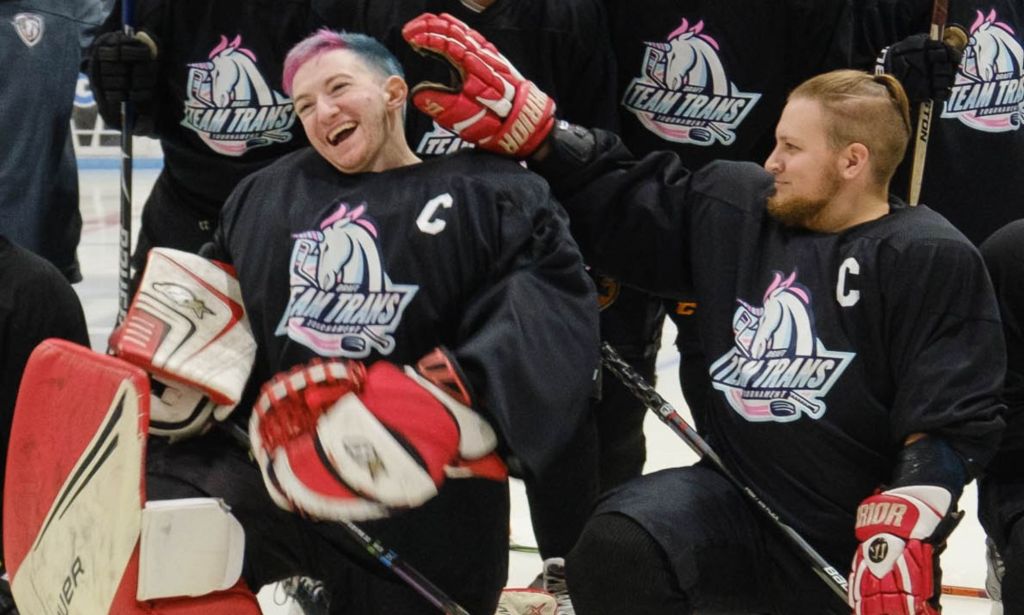
As soon as Team Trans’ hockey players first stepped onto the ice four years ago, they felt something life-changing. They’d found a family for life.
Mason LeFebvre joined Team Trans, an international collective of trans and non-binary hockey players, for its first event in Boston in November 2019. They played off against Boston Pride Hockey, an LGBTQ+ team that’s been around since the early 90s.
It meant to a lot to Mason, who’d been playing hockey since he was 10. Finally, he was “getting to play with other people who had similar experiences”.
“Up to that point in my life, I’d only ever played with, as far as I was aware, cis people,” he tells PinkNews. “It was just about wanting to have that experience, to get to know other trans hockey players, because I hadn’t been able to do that.”
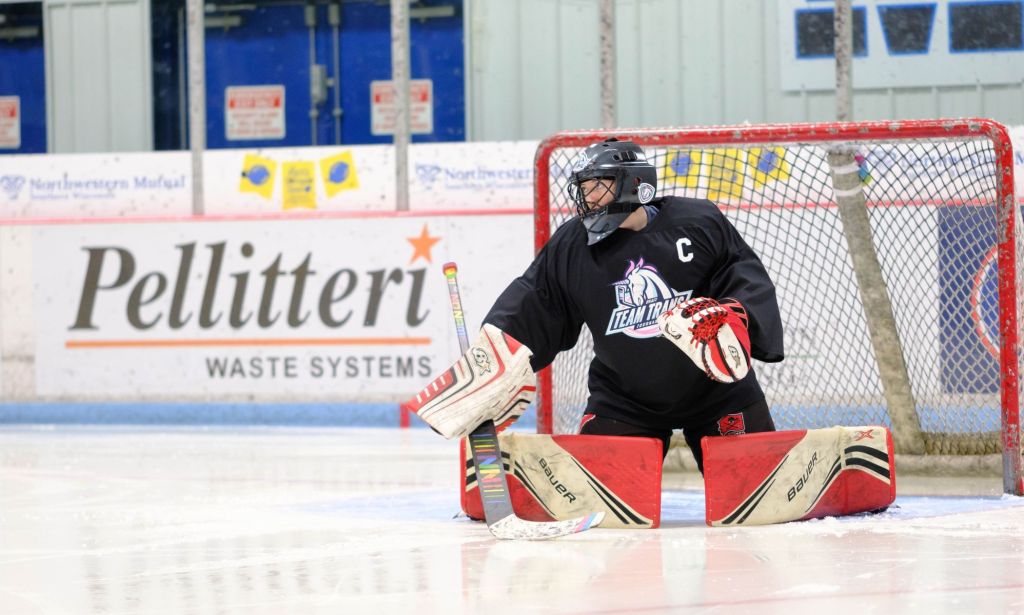
Goalie Mason LeFebvre says he never experienced the “concept of found family” until he joined Team Trans. (Ian DeGraff/Ian Steven Photography)
Team Trans primarily plays internal draft tournaments all over North America, with all-trans teams playing against each other.
It relies on donations to fund travel and hosting events. The National Hockey League (NHL) is a supporter, both financially and vocally, defending the club on social media from bigotry.
Having begun as a collective of a few players, it has over the years involved hundreds of players, who’ve formed tight bonds.
“I hadn’t experienced the concept of found family until I joined Team Trans, and now my found family is a couple hundred people strong,” Mason says. “I’ve invited these players to come stay with me in my house for a weekend at events we’re hosting or just an open ended invitation in general.”
When they’re together, Mason says, it “almost doesn’t matter” that they’re trans – they can simply exist as people. That 2019 event sparked a deep love within him for Team Trans, and he stuck with the club for years, eventually joining its board.
Mason LeFebvre and Danny Maki say they found a network of friends through Team Trans. (Ian DeGraff/Ian Steven Photography)
Danny Maki grew up in a “hockey family”. He started skating at age 2 – his parents tried to put figure skates on him, but he “absolutely hated them” – he wanted to play hockey like his older brothers.
They joined Team Trans through a hockey community in Minnesota after being off the ice for about 10 years.
“It was amazing, especially because when I joined I was already going through a hard time, and I didn’t have any trans friends that I could reach out to,” Danny says. “I was like hockey has always been good for me. I’ll start doing that again.”
Danny ended up becoming the vice president of the Twin Cities chapter. It’s “opened up possibilities for meeting tons of people” and “going places” that he never thought of before.
The locker room is often a serious obstacle for trans people, and Danny says one of his favourite things is being able to be comfortable with others in such a space.
“I drove together with one person to Toronto, and she’s never been able to show in the locker room before,” Maki says.
“She was able to do that without worry, and I was able to do that because nobody’s gonna care what I look like naked. Nobody gives a s**t, and just the general joy of – we didn’t do super well in Toronto – of still having fun.”
Mason LeFebvre says it was “powerful” to connect with the NHL because it made him realise “what an impact” Team Trans has “just by existing”. (Ian DeGraff/Ian Steven Photography)
There’s been some sadly predictable backlash to Team Trans, and Danny was mentioned in a few articles after getting injured on the ice. The headlines ran with the usual anti-trans voices disparaging trans inclusion in sports.
Danny describes these “nasty articles” as “absolute rubbish” that is “putting a target on us”. However, they fuel him to “keep pushing forward and keep representing the possibilities for trans individuals”.
“I imagine a young trans kid who loves hockey, they could see that we as Team Trans exist and will be available to them once they turn 18 (as of our policies right now),” they say.
“This negative media, as cruddy and at times hurtful as it is, will not stop me from playing the sport I love and the sport that has kept me alive more times than I like to admit.”
Mason feels the same – he’s energised too by the support and love coming from within the community and allies.
One of his highlights was received an email from the NHL, which wanted to film a Team Trans event he recalls thinking: “Holy s**t.”
“That was one of the most powerful things because it helped me realise what an impact we can and are having just by existing and showing there are more than just the 16 of us that originally showed up in Boston.”
After a long period of restoration, one of Italy’s most famous archaeological treasures — the House of the Vettii — is reopening to the public.
The house’s extensive collection of fresco wall paintings includes lots of erotic art. But while some commenters have claimed that the house’s original owners were preoccupied with sex or even running a brothel, a gay Roman historian has said that those claims show a misunderstanding about the role queer sex played in ancient Rome.
The house was originally constructed for two freed male slaves who were likely owned by the same master. These men became wealthy from selling wine, and their now-famous house included numerous scenes of sex and mythology, painted on wet plaster and preserved in wax.
Mount Vesuvius buried the house in volcanic ash in 79 AD, but it has since been restored, giving art history fans a time capsule of wealthy Roman social life.
The house’s entrance includes an image of Priapus, the god of fertility and abundance, showing off an uncut penis that’s as long and thick as his arm. It rests upon a scale, balanced by a bag filled with money. Other scenes show different couples having sex.
João Florêncio, a gay researcher who examines visual depictions of sexual cultures throughout history, says that it’s a mistake to assume that Roman men resembled modern-day gay men just because they owned art of a well-hung god and often had sex with other men.
“Roman sexuality was not framed in terms of the gender of partners but in terms of power,” he added. “An adult free man could have sex as the penetrating partner with anyone of a lower social status—including women or slaves and sex workers of both genders.”
The researcher said that evidence of same-sex intercourse has been preserved in Pompeii’s sexually explicit artifacts and graffiti, but a lot of it has been disavowed or at least purified by mainstream modern culture. A lot of these artifacts were designated as “pornography” and moved to “secret museums” in the early 1800s.
While a modern man wouldn’t likely display the image of a well-endowed man in his home unless he was gay, Florêncio points out that phallic imagery in Roman culture was associated with machismo. Some men might have desired Priapus’s large dong, but far more men would’ve likely envied it for their own, as a sign of their own potency and power.
Florêncio also noted that, while some historians believe the house doubled as a brothel, he said the sexual images may have just functioned as domestic symbols of power, wealth, and culture, especially since sex wasn’t taboo in Roman culture. Indeed, images of sex were “everywhere in Rome, including in literary and visual arts,” he writes.
LGBTQ Victory Fund, the only national organization dedicated to electing LGBTQ leaders to public office, named Danica Roem a 2023 LGBTQ ‘Spotlight’ candidate, a designation given to candidates with exceptional potential to be national leaders of the LGBTQ equality movement.
Roem, who currently serves in the Virginia House of Delegates, made history in 2017 when she became the first out-and-seated trans state legislator in American history. There are currently just nine trans state lawmakers serving in the U.S., according to LGBTQ Victory Institute.
“Danica is a remarkable leader who consistently shows both grit and compassion when delivering results for her community, from improving Virginia’s infrastructure to fighting for reproductive rights. As bigots in Richmond continue to introduce anti-LGBTQ bills – most of which target trans kids – we know Danica will not back down. We are proud to continue supporting Danica and are confident that come November, she will shatter yet another lavender ceiling and become the first trans person ever elected to a state Senate in the South,” said Mayor Annise Parker, President & CEO of LGBTQ Victory Fund.
_________________
LGBTQ Victory Fund
LGBTQ Victory Fund works to achieve and sustain equality by increasing the number of openly LGBTQ elected officials at all levels of government while ensuring they reflect the diversity of those they serve. Since 1991, Victory Fund has helped thousands of openly LGBTQ candidates win local, state and federal elections.
When Gad Yola hit the red carpet on December 20th, 2022, the 34-year-old Peruvian drag queen wanted to make a statement. Nearly 6,000 miles away from her home, Yola was far from the political crisis unfolding across Peru. So on her white dress, she bedazzled the words “25 Peruvians killed by the state”—a reference to the number of people who had died since protests erupted across the Andean nation.
Her dress quickly went viral on Twitter, and she received both messages of support and hate from Peruvians around the globe. Her artistic gesture is just one example of how LGBTQ+ Peruvians are making their voices heard in a political crisis that has persisted for nearly two months.
On December 7, 2022, former President Pedro Castillo rocked Peru’s democracy. Facing a vote for his impeachment, Castillo attempted a “self-coup”—a complete power grab by someone already in power. With trembling hands, the embattled president announced to the nation that he was unilaterally dissolving Congress and would rule the country by decree.
For Peruvians, this announcement was shocking, but it was not unprecedented. More than 20 years ago, former President Alberto Fujimori successfully pulled off this political machination and remained in power for another eight years. Fujimori, though, had the backing of the National Police of Peru and the Peruvian Armed Forces before he made this risky move; neither institution backed Castillo.
https://www.youtube.com/embed/nXyFgvCfyHI?feature=oembedPedro Castillo reads a statement announcing his decision to dissolve Congress and rule by decree.
Shortly after the announcement, ministers in his cabinet resigned, members of his political party, Peru Libre, denounced him, and his Vice President, Dina Boluarte, condemned the move. A couple of hours later, Congress successfully voted to impeach Castillo. Castillo was arrested and brought to a detention facility when he tried to seek asylum in the Mexican embassy; he currently remains in pre-trial detention.
Later that day, Boluarte was sworn in as President, and many members of Congress celebrated the ouster of an opponent they sparred with for the entire duration of his presidency.
Their celebration was short-lived.
On December 8th, just one day after Castillo’s arrest, protests began to sprout around the country.
Castillo was Peru’s 5th president in five years. He was also the first president to be of a peasant and indigenous background. His ouster, and Boluarte’s subsequent rightward shift, was taken as a sign by the historically marginalized groups of Peru that the country’s democracy is not an institution that works for them. Many believe Castillo was a victim of a conservative Congress hellbent on preventing an indigenous person from ruling effectively.
So they took to the streets.
In cities and towns all over Peru, aggrieved protesters began marching to demand political change. Their demands included the following: President Boluarte’s resignation, a constituent assembly to draft a new constitution, earlier elections, and for some, the liberation of Castillo.
From Cusco to Lima, protesters have been demonstrating their dissatisfaction with the state of their country. They have set up roadblocks and taken over airports. And in one case, a politician’s home was set on fire. Meanwhile, police have killed 46 people, some of whom were medics and bystanders, and injured dozens of others. One police officer was also killed due to the unrest, and at least ten people died in ambulances after being unable to reach hospitals due to blockades.
In addition to the anti-establishment protests, there have also been marches billed as “Marcha Por La Paz” or “March for the Peace.” These peace marches are right-wing and pro-police. And due to the march’s collaboration with the police, they have often inflamed tensions between the two sides.
Despite the assumption that LGBTQ+ rights are a left-wing cause, supporters and queer Peruvians are spread across the political spectrum. The political crisis has divided members of the queer community about how to resolve an increasingly intractable conflict.
Shortly after Boluarte was sworn-in, several LGBTQ+ activists and organizations condemned the violence at protests calling for her resignation.
Promsex, one of Peru’s most prominent LGBTQ+ and intersex rights groups, addressed the new president in a statement on Twitter.
“We demand that the Executive Branch guarantee the safety of all people, including that of law enforcement personnel, and that there be no more deaths in the democratic and legitimate exercise of the right to protest,” the organization tweeted.
However, since that statement was released, the violence has escalated, and so has the intensity of statements from left-wing LGBTQ+ groups. On January 21st, the Lima Pride March Collective released a statement calling for one of the primary demands of the anti-Boluarte protestors—new elections.
“As LGBTI people, we demand a prompt democratic exit [from this crisis] through the advancement of elections in the shortest term possible,” the statement said.
The Collective changed their name on Twitter to #NuevasEleccionesYa (new elections now), accompanied by the Peruvian and pride flags.
Jorge Apolaya, a spokesperson for the group, spoke to LGBTQ Nation about why he supports the marches.
“[LGBTQ+] organizers have the responsibility to speak out and denounce what is contrary to democracy and therefore to the rights of LGBT people,” he told LGBTQ Nation. “The government of the current president Dina Boluarte has become repressive and violent in the face of legitimate protests in the country. We cannot allow more deaths, and that is why there is a social consensus in the request for the resignation of the current president.”
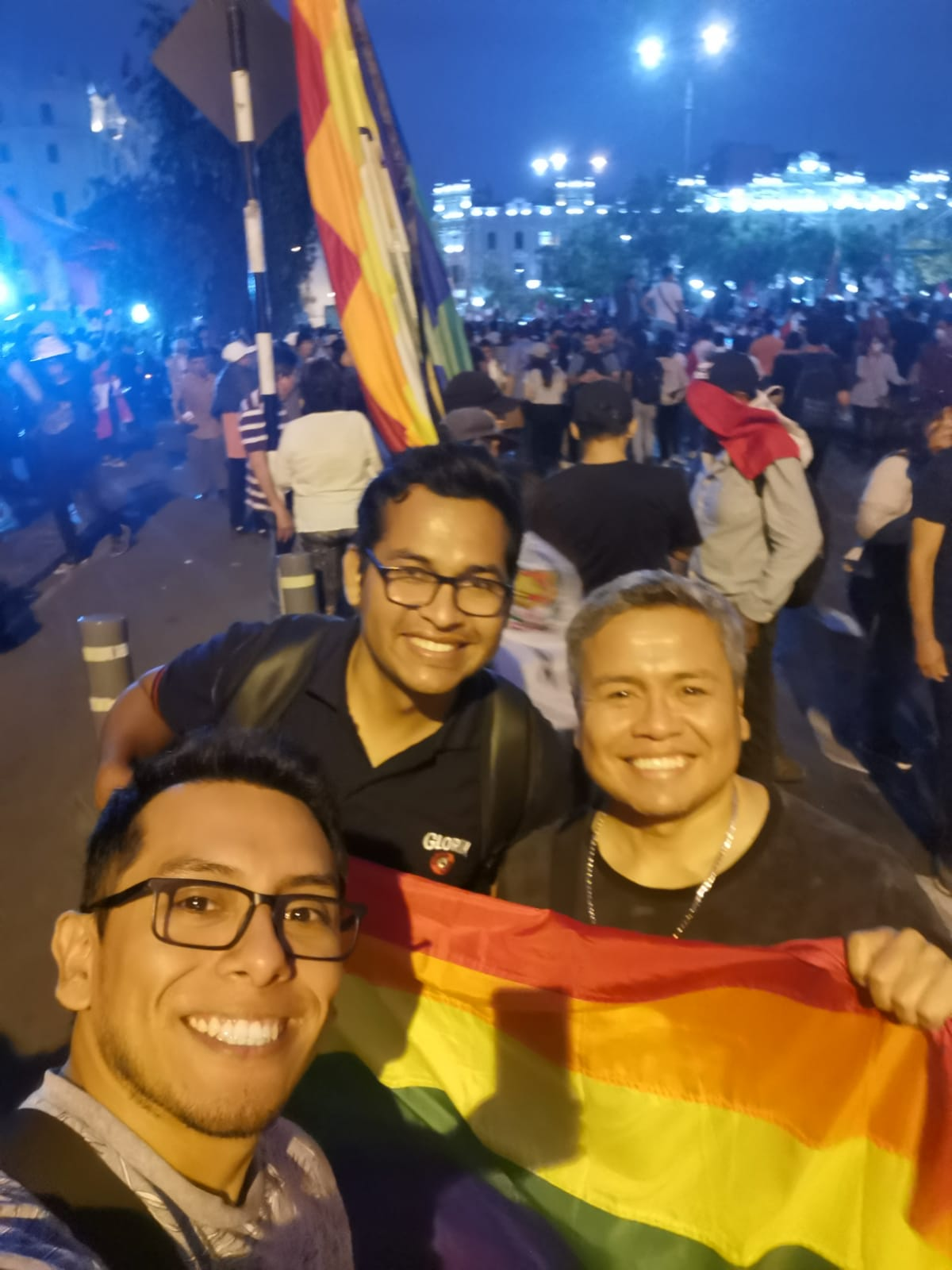
Jorge (right) at the protests at Plaza San Martin in Lima.
The consensus does not extend to all LGBTQ+ Peruvians. La Liga Libertad, a classically liberal group founded by LGBTQ+ people, has called the protesters’ demands, including the demand for Boluarte to resign, “anti-democratic.” They have described protesters’ attempts to take over national airports as “terrorism,” echoing Boluarte’s characterization of the ongoing unrest.
La Liga Libertad did not respond to LGBTQ Nation’s request for comment.
It is not only left-wing LGBTQ+ groups who favor Boluarte’s resignation. Popular Action (Acción Popular) is a centrist political party. One of its members, queer activist Manuel Siccha, spoke with LGBTQ Nation.
“Currently, the position [of the Party] is to request the resignation of President Dina Boluarte based on her lack of legitimacy to govern,” Siccha said. “You cannot govern without social legitimacy and she alone has been losing legitimacy little by little with the decisions she has made from actions which are dehumanizing and authoritarian.”
Siccha also told LGBTQ Nation that he believes the Boluarte administration does not have the capacity to respond to the urgent political needs and the agendas of vulnerable populations, including LGBTQ+ populations.
The division among the queer community is also visible among Peru’s two out members of Congress. Although both voted for Castillo’s impeachment in December, they diverge significantly in how they approach the conflict.
Susel Paredes is the first out lesbian to win a congressional election in Peru. A progressive member of Congress, she voted against giving Boluarte’s cabinet a vote of confidence two weeks ago due to the more than 50 deaths which have occurred since protests first broke out.
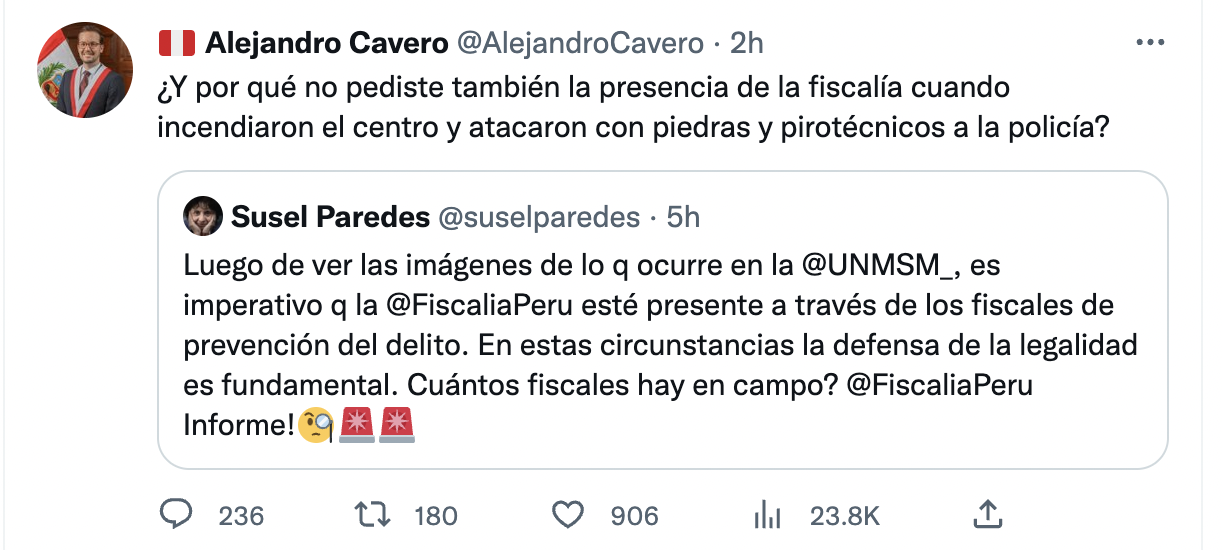
Alejandro Cavero, a conservative congressman from the Avanza Pais political party, has said he is “LGBT and proudly of the right.” While Cavero said he understands the “frustration and indignation of the South,” he also praised police reactions to the violent protests.
A Twitter interaction between Members of Peruvian Congress Paredes and Cavero shows the two arguing about an incident that occurred at San Marcos University on January 21, 2023.
Other LGBTQ+ Peruvians who spoke with LGBTQ Nation expressed a similar sentiment to Cavero.
“It’s definitely a midway support,” said Vero Mourou when asked if she supports the protests. Mourou is a drag artist from Iquitos, the largest city in the Peruvian Amazon. Like Cavero, she is sympathetic to the plight of the poor and indigenous Peruvians protesting. However, she blames the “communist left” for taking advantage of the situation.
“[The left] has caused innocent people to die like a cannonball for their own political interests, such as the constituent assembly. They use their pain and suffering for political purposes. I am against any act of violence disguised as protest…we cannot allow anarchy in Peru.”
As Peruvians inside the country express varying opinions on this conflict, many Peruvians abroad are also speaking out, including Yola. Based in Madrid, Yola spoke with LGBTQ Nation about why she supports the protests.
“Dina Boluarte has committed crimes against humanity, has murdered in the name of a false democracy that does not represent the inhabitants of the country, both in the provinces and in the capital,” she said.
Yola acknowledges that some on the left are homophobic and transphobic, including the former president. However, she believes that certain struggles must come before LGBTQ+ rights.
“Many gay people…do not see beyond the privileged reality of Lima, because they do not see that before being gay or lesbian, they are brown, descendants of indigenous people, of black people, that the agenda against the fight against poverty in the regions is, honestly, more relevant than same-sex marriage.”
Gad Yola wears a dress that says: “25 Peruvians killed by the state.”
One of the most conservative countries in South America, Peru does not have a stellar record on LGBTQ+ rights. Regardless of the outcome of this political crisis, the situation for queer and trans Peruvians is unlikely to change dramatically. However, as the nation struggles through nearly two months of unrest, LGBTQ+ Peruvians continue to make their voices heard and fight for their future.
I’m a teacher and writer, loves of mine since I was six. I went to film school to study storytelling, media violence, its effects on society, and root causes of real-life violence and crime. This research guides my values, civic engagement, and work in our classrooms.
I was born in Midwest City—where my mother lives as a retired registered nurse—and I’ve lived in OKC’s historic Paseo neighborhood since 2010, serving in Oklahoma City Public Schools at Jefferson Middle School as an AVID college preparation teacher, where I helped students strengthen their reading, writing, group work, organization, and critical thinking skills. The same year I started teaching with OKCPS in 2015, Mayor Mick Cornett appointed me to serve on OKC’s Central Oklahoma Transportation and Parking Authority (COTPA) Board of Trustees.
As a transit trustee, I learned 79 percent of OKC’s roads ranked as “poor or mediocre condition.” Two years after my appointment, I wrote an editorial for NonDoc, asking my OKC neighbors to vote “yes” on our 2017 general obligation (GO) bond package and MAPS 3 penny sales tax extension. GO bond votes occur only every 10 years, offering a rare opportunity for residents to invest our property taxes into city infrastructure—including rebuilding crumbling streets—so students, workers, and seniors can move safely around our neighborhoods and city. This investment is important because, otherwise, OKC relies on sales tax as our primary funding source. Together with the extension of MAPS 3’s 2009 temporary penny sales tax, we called this election Better Streets, Safer City.
With the NonDoc editorial, I argued Better Streets would put our people to work, investing in critical infrastructure improvements for our streets, sidewalks, bridges, bike lanes, libraries, drainage system, public transportation system, parks and recreational facilities, our civic center, our downtown arena, our fire and police-training facilities, our traffic control system, and our city maintenance facilities. These investments, I wrote, strengthen our city, improving our residents’ quality of life.
Voters agreed, approving nearly $800 million in historic street improvements and other infrastructure projects, including our upcoming Bus Rapid Transit service.
Starting Fall 2023, Northwest Rapid will provide public transportation from covered bus stations every 15-20 minutes—7 days a week—for the first time in OKC’s history. This service builds on OKC’s past, running from downtown along our old streetcar route on Classen Boulevard, travelling west on NW Expressway, and turning around at Expressway and Meridian at a new park-and-ride near Lake Hefner.
2017’s Better Streets, Safer City also includes revitalization of Ward 2’s historic Belle Isle Library, $10 million in attainable, affordable, median-income housing for our city’s workforce, and streetscape improvements for historic commercial corridors such as Paseo, Uptown 23rd District, 39th Street District.
The next year in 2018, I fought for and worked with my transit board to provide Sunday bus service from our annual budget for the first time since the 1964 Voting Rights and 1965 Civil Rights Acts. On five bus routes, we added our city’s first night service til midnight.
LGBTQ Victory Fund, the only national organization dedicated to electing LGBTQ leaders to public office, named Nick Hellyar and Mario Castillo 2023 LGBTQ ‘Spotlight’ candidates, a designation given to candidates with exceptional potential to be national leaders of the LGBTQ equality movement. Hellyar is running for Houston City Council, At-Large, Position 2 and Castillo is running for Houston City Council, District H.
Robert Gallegos is currently the only out LGBTQ elected official in Houston, according to LGBTQ Victory Institute. Since Council Member Gallegos is not running for reelection, the city is now at risk of losing LGBTQ representation in city government for the first time since 1998.
“Nick and Mario represent the best of Houston. They firmly believe that government works best when it reflects the diversity and strength of its people. Their fresh, exciting vision for the future is rooted in years of public service and community organizing, which is why voters are so enthusiastic about their campaigns. With anti-LGBTQ hate continuing to sweep across the state, strengthening LGBTQ representation in local government could not be more important. Nick and Mario are exceptional leaders and I am confident that under their leadership, all Houstonians will thrive,” said Mayor Annise Parker, President & CEO of LGBTQ Victory Fund.
“Houston has had an LGBTQ member on City Council since Annise Parker’s historic victory. Now, Houston is at risk of being the largest city in the country without LGBTQ representation. This is unacceptable. I am excited to work with LGBTQ Victory Fund to ensure our community’s voice continues to be heard at City Council and throughout Houston,” said Hellyar.
“LGBTQ leaders like former Mayor Annise Parker have transformed Houston for the better, and I will work hard every day to carry on that tradition. We all belong to many communities – I am a Houstonian, a cis gay man, a Latino, a nonprofit leader, and so much more. LGBTQ Victory Fund sees and helps elevate the intersectionality of all these communities. I am deeply honored to have earned their endorsement,” said Castillo.
_________________
LGBTQ Victory Fund
LGBTQ Victory Fund works to achieve and sustain equality by increasing the number of openly LGBTQ elected officials at all levels of government while ensuring they reflect the diversity of those they serve. Since 1991, Victory Fund has helped thousands of openly LGBTQ candidates win local, state and federal elections.
Throughout her childhood, Rep. Herod’s parents, an Army veteran and a police officer, emphasized the importance of serving one’s community, and that helping others is always the right thing to do. The noble teachings of her parents inspired her to encourage many students of color, LGBTQ+ students, and first-generation students at her college, the University of Colorado-Boulder, to run for student government. While in college, she became the Student Body President, managing a $36 million budget. After serving the students at her college, Leslie made an impact on the 2012 presidential election as President Obama’s Deputy Political Director for Colorado, and later gained government experience as the Governor’s Senior Policy Advisor. Finally, Rep. Herod ran for state House to help the people in her district, becoming the first out LGBTQ+ Black person elected to the Colorado legislature.
An experienced lawmaker and social justice reform advocate Rep. Herod has served with the mission of improving the lives of all Coloradoans and passed over 150 pieces of legislation in her tenure. Working with community activists and police departments, Leslie championed a successful alternative policing program that deploys trained mental health workers and paramedics to respond to 911 calls involving mental health crises and substance misuse. As the Chair of the Appropriations Committee and Joint Budget Committee, she has delivered a $36B balanced budget for Colorado. Now Rep. Herod is ready to bring that same approach of putting results over politics to the Denver Mayor’s office.
A trailblazer Having broken barriers by becoming the first out LGBTQ+ Black person elected to the Colorado legislature, Leslie hopes to continue breaking barriers in the Centennial State. If elected Mayor of Denver, Leslie will be the first woman ever elected as Mayor of Denver. The LGBTQ+ Victory Fund is proud to endorse Rep. Leslie Herod at the Spotlight level as she faces a crowded field in this race.