Polish mayor Pawel Adamowicz has died after being fatally stabbed at a charity event.
The LGBTI ally was stabbed in the heart and abdomen by an ex-convict who rushed onto the stage with a knife yesterday (13 January).
Blood donors flooded to hospitals in a bid to help save Adamowicz.
But Poland’s health minister Lukasz Szumowski has confirmed the mayor died, saying, ‘we couldn’t win.’
The attack happened in moments at the 27th annual fundraiser organized by the Great Orchestra of Christmas Charity.
Footage showed the Gdansk mayor on stage with a sparkler in hand, saying it had been a ‘wonderful day’.
The attacker then came towards him. Suddenly, the mayor collapsed and he grabbed his body.
After the knife attack, the assailant shouted from the stage he had been wrongly imprisoned by the previous national government led by Civil Platform.
The mayor formerly belonged to the party.
‘I was jailed but innocent,’ he said. ‘Civil Platform tortured me. That’s why Adamowicz just died.’
Police spokesperson Mariusz Ciarka said the attacker appeared to have mental problems. He also said the assailant appeared to have accessed the area with a media badge.
The man was arrested and under investigation.
Surgeon Dr Tomasz Stefaniak said Adamowicz suffered a ‘serious wound to the heart, a wound to the diaphragm and to the internal organs.’
Adamowicz served five terms as part of the Civil Platform party, and then was re-elected to a sixth term as an independent candidate.
He marched in last year’s Pride parade in Gdansk.
He said he dreamed of a time when ‘equality and fraternity can become a part of Poles’ daily lives’.
Adamowicz added he hopes of the day when ‘an asylum-seeker, an immigrant, a Roma person, an African American person and a Polish person will be able to sit together around a table in one, common house.’
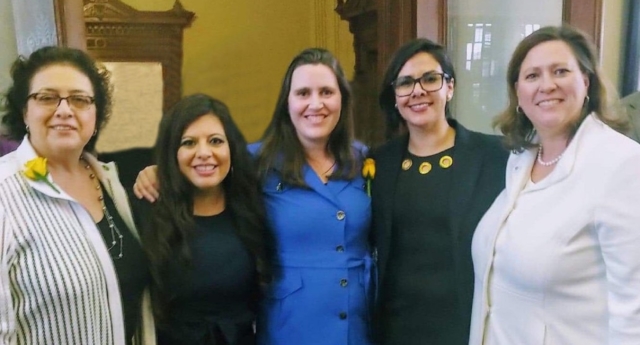
LGBT+ Texas lawmakers Celia Israel, Jessica González, Erin Zwiener, Mary González and Julie Johnson (Equality Texas)
Five out Democrats in Texas have formed the first LGBT+ caucus in the state’s legislature.
The five lawmakers came together to launch the first official LGBT+ caucus, which will fight for equal rights in the traditionally-conservative, Republican-controlled state.
The LGBT+ caucus will be chaired by state representative Mary González, who was only the second out lawmaker in Texas history when she was elected in 2012.
She will be joined by all of the state’s other out lawmakers—Celia Israel, who was elected in 2014, as well as Jessica González, Julie Johnson and Erin Zwiener, all elected in 2018.
The group has an uphill battle on the state legislature, where the Republican Party has held a majority since 2003.
Speaking to the Dallas Morning News, LGBT+ caucus chair Mary González said the group would have a “intentional and strategic agenda” to bring about progress in the state.
Noting the increased representation for LGB women in the chamber, she added: “If you would have told me that we would have five LGBTQ members in the Texas Legislature, I would have never believed you. And all women, and all in the House.
“I say this all the damn time. If you’re not at the table, then you’re on the menu.”
The newly-elected Erin Zwiener, who is bisexual, added: “It’s important that those of us who are members of the LGBTQ community stand together to make sure that all Texans are treated fairly.
“I’m glad Mary and Celia have some more company.”
In another unlikely sign of progress, the Texas Capitol flew a flag in “solidarity” with transgender Texans, after a request from the mother of a 10-year-old trans boy.
Democratic Rep. Donna Howard honoured the request, flying the Texas state flag for the occasion.
She told the Dallas Morning News: “My policy is to assist these requests so long as they are not discriminatory.
“I was honoured to help Amber do so in recognition of the inclusion of trans Texans and the fact that our representative government truly represents all Texans.”
The Texas Republican Party continues to be dominated by anti-LGBT views.
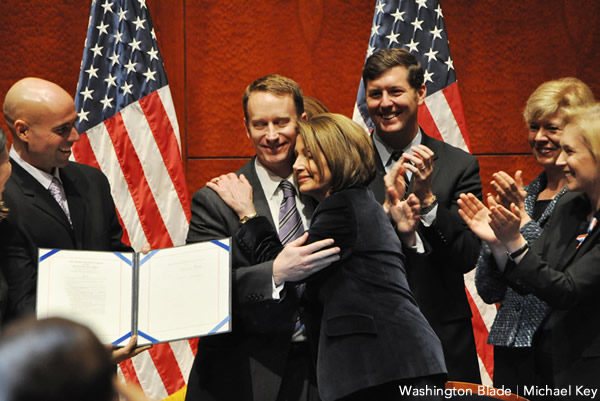
Speaker Nancy Pelosi hugs ‘Don’t Ask’ repeal activist Mike Almy at the Congressional Certification of repeal on Dec. 21, 2010. (Washington Blade photo by Michael Key)
Last week, Nancy Pelosi (D-Calif.) became the first person in 64 years to return to the position of Speaker of the House of Representatives. She’s the only woman to hold the office and the first person to repeat in the office since Sam Rayburn, who served a record 17 years as speaker over three different periods. She’s now second in line to the president and is the highest-ranking elected woman in U.S. history.
Pelosi’s credibility with LGBT voters is ironclad. In November, 102 LGBT leaders announced they “enthusiastically endorsed” her to return to the speakership. “There is no better ally to the LGBT community on Capitol Hill than Leader Pelosi, period,” the group said in a statement.
Here are some highlights — some wonky and serious, some lighter. In no particular order:
• Pelosi has long stood in favor of same-sex marriage. In 1996, Pelosi voted against the Defense of Marriage Act, a federal law that prior to being ruled unconstitutional, defined marriage as one man and one woman. In 2004 and 2006, Pelosi voted against a proposed Federal Marriage Amendment that would have amended the Constitution to define marriage federally as one man, one woman. And in 2008, Pelosi voiced opposition to Proposition 8, a successful ballot initiative that defined California marriage similarly. Pelosi told the Washington Post in 2012 that her Roman Catholic faith — despite official church teaching — compels her “to be against discrimination of any kind in our country.”
• Pelosi supported the Matthew Shepard & James Byrd Jr. Hate Crimes Prevention Act and helped it move through the House. It finally passed in 2009.
• Pelosi supported the “Don’t Ask, Don’t Tell” repeal in 2010. “Isn’t this a joyful day,” she said at the time. “(This measure will) change the law, improve the policy, make life better for many Americans and make our country stronger.” She then led a group sing of “God Bless America.”
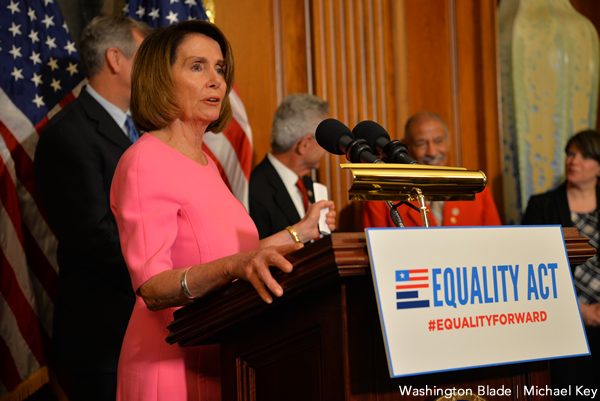
• Pelosi is a champion of the Equality Act, comprehensive LGBT rights legislation that would amend the Civil Rights Act of 1964 to include sexual orientation and gender identity. She has said last October advancing it will be a top priority with Democrats in control of the House. “It isn’t in our ‘For The People’ agenda because it doesn’t get that specific, but there’s one more because it’s personal for me that I really want to do, and it’s called the Equality Act,” Pelosi said. “The Equality Act expands ending discrimination against LGBTQ people and women and adding that to the Civil Rights Act.”
Nancy Pelosi (D-Calif.) as House Minority Leader signaled the Equality Act will be a “top priority” if elected Speaker. (Washington Blade photo by Michael Key)
• In May, 2014 at the White House, Pelosi helped unveil an official U.S. forever postage stamp commemorating slain gay rights leader Harvey Milk, who was killed in 1978 and was the first openly gay public official in California. Pelosi is, as was Milk, a long-time San Francisco resident.
• In February, 2015, Pelosi met with Cuban LGBT activist Juana Mora Cedeno of Proyecto Manos along with other human rights advocates during a trip with several House colleagues. They discussed education, health care and lack of access to antiretroviral medication for Cubans living with HIV.
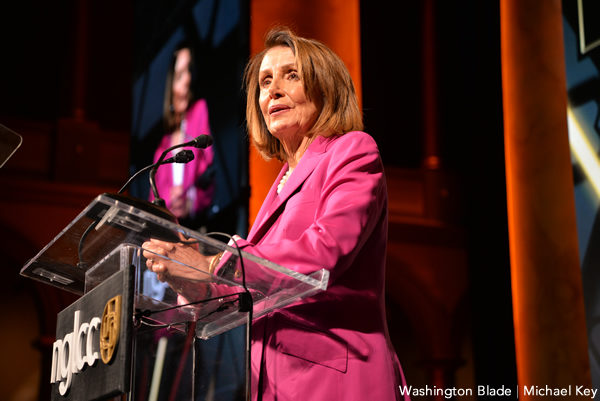
• Pelosi has appeared at many LGBT events over the years including a November, 2018 appearance at the NGLCC National Dinner, the 2007 HRC National Dinner, many appearances at San Francisco Pride (one year the car she was in broke down and she had to walk the rest of the parade route) and more.
Nancy Pelosi speaks at the National LGBTQ Chamber of Commerce National Dinner in 2018. (Washington Blade photo by Michael Key)
• On June 9,1987, Pelosi chose to address the HIV/AIDS epidemic in her first speech on the House floor and said she had come to Congress to fight AIDS. “Now we must take leadership, of course, in the crisis of AIDS. And I look forward to working with you on that,” Pelosi said. Those remarks stood in contrast to President Reagan’s inaction and failure to speak out on the disease.
• Contestants on “RuPaul’s Drag Race All Stars” season three were shocked when Pelosi made a brief appearance in the “werk” room of the hit reality competition show in March, 2018. Ru introduced her as a “strong woman who knows how to get things done” and a “champion for LGBT rights.” Presumably because of time, Pelosi, unlike most “Drag Race” guest celebrities, did not appear at the judge’s table. But she teased the appearance on social media saying she had “a fabulous time.” “I’m honored to be here,” Pelosi, wearing a white pantsuit, said. “You’re an inspiration, I hope you know. Because you really know your power. It’s about taking pride and that’s what you do. Take pride in yourselves.”
• When the NAMES Project AIDS Memorial Quilt was being developed, Pelosi took part in the some of the earliest meetings, sowing her own patch for a flower girl in her wedding who died of AIDS. Pelosi also secured permits from the National Park Service under the George H.W. Bush administration so the AIDS quilt could be shown on the National Mall. In April, 2012, Pelosi spoke at a Castro District ceremony marking the 25th anniversary of the Names Project AIDS Memorial Quilt, started by San Francisco volunteers in 1987. “We will keep fighting until there is a cure,” she said.
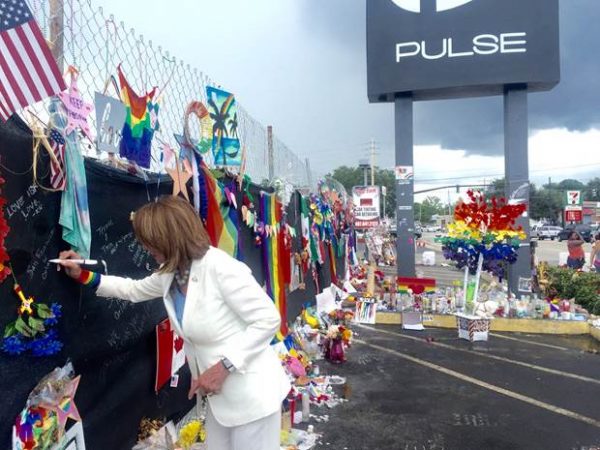
• In August 2016, Pelosi met with survivors of Orlando’s Pulse nightclub shooting and families of some of the 49 who died. She left flowers at a memorial outside the club and signed a wall.
Nancy Pelosi signs the makeshift memorial at the Pulse nightclub in Orlando, Fla., on Aug. 11, 2016. (Photo courtesy of Pelosi’s office)
• In July 2012, Pelosi danced to ZZ Top’s “Sharp Dressed Man” and “It’s Raining Men” at the reception for former U.S. Rep. Barney Frank’s marriage to Jim Ready. Pelosi’s partner was Terry Bean, a co-best man of the groom. Video of the dance went viral.
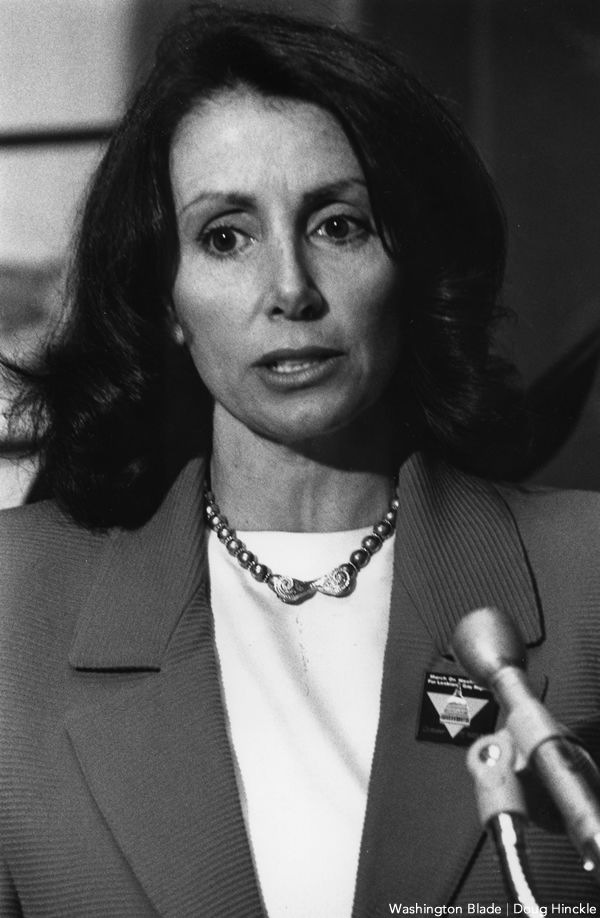
Nancy Pelosi wears a pin for the ‘March on Washington for Lesbian and Gay Rights’ in 1987. (Washington Blade photo by Doug Hinckle)
Over-the-counter contraceptives, such as condoms, are now free to Washington State residents with health insurance.
Following six years of Republican obstruction, the Reproductive Parity Act was finally passedlast year. Starting on 1 January 2019, Washingtonians with state-regulated health insurance (including Medicaid) can pick up over-the-counter contraceptives at their in-network pharmacies for no cost.
According to the Office of the Insurance Commissioner of Washington State, these contraceptives include ‘condoms, spermicides, emergency contraceptives, and sponges.’
Additionally, this new policy also covers sterilizations and vasectomies, as well as free abortions to those whose health plans cover maternity services.
HIV positive people with an undetectable viral load cannot sexually transmit HIV. That’s the unequivocal conclusion from one of the leading health agencies in the US.
Researchers from the National Institute of Allergy and Infectious Diseases (NIAID) undertook a review of recent research. Their conclusion is simple: Undetectable = Untransmittable (U=U). It’s the same message now backed by over 300 health agencies all around the world.
The results of the NIAID review were published yesterday in the Journal of the American Medical Association (JAMA). One of the reports co-authors is NIAID Director, Dr Anthony Fauci. He is widely regarded as one of the world’s leading HIV experts.
In a statement, NIAID called evidence for Undetectable = Untransmittable ‘overwhelming’. Not only does getting those diagnosed with HIV on to Antiretroviral Therapy (ART) ensure their long term health. But it also significantly reduces HIV transmission rates. This is because those with the virus suppressed in their body cannot pass it on.
The authors pointed to research that looked at over 77,000 examples of condomless sex between serodiscordant male couples. One half of the couple had HIV and the other did not. There was not a single transmission of the virus from the HIV positive person to the negative person.
Those taking medication must stick to their medication regimes.
It can take up to six months of ART treatment to bring viral load down to undetectable levels (less than 200 copies of HIV per ml of blood).
Those with HIV should have their viral load tested every 3-4 months for the first two years of treatment. If their viral levels remain suppressed, this can extended to every six months.
They noted that adhering to medication was essential. ‘When ART is stopped, viral rebound usually occurs within 2 to 3 weeks.’
‘The Centers for Disease Control and Prevention (CDC) reported that of the individuals with HIV in the United States in HIV clinical care in 2015, approximately 20% had not achieved viral suppression at their last test.
‘CDC also noted that 40% of the individuals in HIV clinical care that same year did not maintain viral suppression for more than 12 months.’
They say lack of access to consistent healthcare, among other factors, can impact viral load.
‘In summary, even though the clinical data underpinning the concept of U = U have been accumulating for well over a decade, it is only recently that an overwhelming body of evidence has emerged to provide the firm basis to now accept this concept as scientifically sound.’
It says U=U has implications on prevention. There are also legal implications. Currently, more than 20 states in the US make it a crime for someone with HIV to have sex without informing their partner they have the virus.
They also think promoting the U=U message may remove, ‘the sense of fear and guilt that a person may be harming someone else, as well as the feeling of self-imposed and external stigma that many people with HIV experience.’
Among those to welcome the report was Bruce Richman, Founder of Prevention Access.
Richman tweeted, ‘This is huge news and validation of #UequalsU from the greatest minds In the field and the world’s #3 medical journal!’
Matthew Hodson, Executive Director of NAM/AIDSmap told Gay Star News, ‘Dr Anthony Fauci is the most senior American scientist working on HIV. His unequivocal support of the U=U message is welcome.
‘HIV stigma remains a public health crisis resulting – in extreme cases – in murder and suicide. The understanding that someone with HIV on effective treatment does not pose a transmission risk has the power to dispel much of the fear that results in stigma.
‘It should now be a public health duty to inform all of us who are living with the virus, and all of those whom we may encounter, that effective treatment prevents transmission.’
Police were called to a shooting at 11pm on January 6, where they found Martin with a fatal gunshot wound in a car in a ditch.
The paper did not mention Martin’s gender.
However, LGBT+ activists in Montogmery told Attitude that she was a trans woman.
Meta Ellis and Harvey McDaniel, who work for Montgomery Pride United, told the publication that they have been in touch with police about using Martin’s correct gender.
The actual number, however, could be higher as there is no official data collection on crimes against trans people, and trans murder victims have been known to be misgendered by local press.
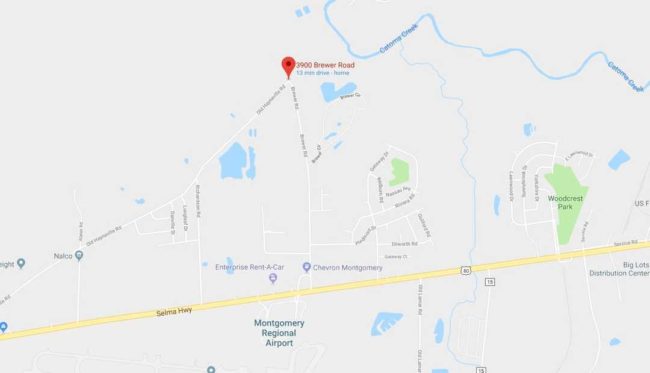
Dana Martin was murdered on the 3900 block of Brewer Road, Montgomery. (Google Maps)
In November, the Human Rights Campaign (HRC) released a report looking at the high levels of violence against America’s transgender community.
It found that 74 percent of identified transgender murder victims were misgendered (referred to using their birth gender) or deadnamed (referred to using their birth name) in initial police or media reports surrounding their deaths.
“Transgender people face devastating levels of discrimination and harassment in the workplace,” reads the report.
“These barriers are even higher for Black transgender people, who have double the unemployment rate of all transgender people, and four times that of the US general population.
“Transgender people face devastating levels of discrimination and harassment in the workplace.”
“With limited access to workplaces that are affirming and inclusive, transgender and gender-expansive people are put at greater risk for poverty, homelessness and involvement with criminalised work.
“Together, these factors put transgender people at an increased risk of violence and danger.”
Last year, the HRC Foundation and the Trans People of Color Coalition released a report documenting violence against trans gender people. It found that 2017 was the deadliest year on record for transgender people, particularly for trans women of colour.
Kevin Fret, a 24-year-old gay trap artist, has been shot and killed in Puerto Rico.
The musician was shot several times at around 5:30am local time on Thursday (January 11) while on his motorbike in the Santurce neighbourhood of San Juan, according to El Nuevo Dia.
Fret, who was hailed by many as the first openly gay Latin trap artist, died after being taken to the Medical Centre of Rio Piedras.
“Kevin was an artistic soul, a big-hearted dreamer”
— Eduardo Rodriguez, manager of Kevin Fret
Police on the American island have told CBS News that Fret’s murder is the 22nd reported homicide in the first 10 days of 2019.
Fret’s manager, Eduardo Rodriguez, told Billboard: “Kevin was an artistic soul, a big-hearted dreamer. His passion was music, and [he] still had a lot to do.
“This violence must stop,” he continued. “There are no words that describe the feeling we have and the pain that causes us to know that a person with so many dreams has to go.
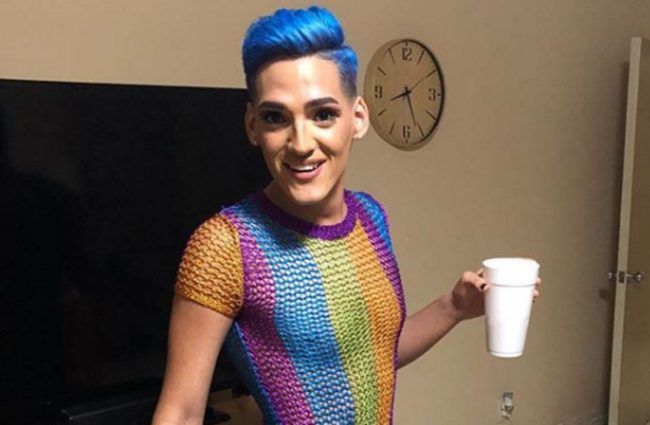
Kevin Fret was hailed as the first openly gay Latin trap artist (kevin fret/facebook)
“We must all unite in these difficult times, and ask for much peace for our beloved Puerto Rico.”
The “Soy Asi” singer had previously spoken out about wanting to open the door for queer musicians to make it as trap artists.
Fans pay tribute to Kevin Fret
The tributes have poured in for Fret after his tragic death, with fans writing comments like: “At a loss for words 💔 RIP Kevin Fret” and “My heart hurts 💔 I’m so sorry this happened to you. RIP #KevinFret.”
One person paid their respects by writing: “RIP to the incredibly talented Kevin Fret, the first openly gay Latin Trapero from Puerto Rico.
“His unapologetic presence meant so much for the LGBTQ+ community and the future of Latin Trap… Thank you for always speaking and living your truth Kevin. Te amo para siempre (I love you forever) ♥️.”
Kevin Fret was just 24 when he died (kevin fret/facebook)
Others explained more of what made Fret so special, with one fan tweeting: “Kevin Fret was known not only for his music style but also an image that was breaking gender norms in #PuertoRico and stigma about being gay, gender nonconforming, and expressing gender identity freely—in a country where gay people still get mocked, bullied and killed.”
His uncompromising approach to expressing his sexuality was praised, for instance by a fan who wrote that he was “a true inspiration to many.
“Some people need the confidence you had. You didn’t deserve what happened to you. Puerto Rico and many other people will miss you.
“Being openly gay where you were from had to be tough. We are glad of what u did 4 PR💟.”
A Canadian tech company has come under fire for allegedly providing filtering software censoring LGBTI content to anti-LGBTI governments.
LGBTI advocacy group All Out has teamed up with Mexican organization R3D, which defends human rights in the digital world, to shed a light on the issue.
The two have joined forces to urge Canadian company Netsweeper to stop providing LGBTI censorship filters to homophobic governments. Moreover, the LGBTI group wants to ensure that tech companies don’t use such technologies to violate human rights.
Activists started an online petition to put an end to this LGBTI-related content censorship. They addressed Perry J. Roach, Founder and Chief Executive Officer at Netsweeper Inc.
They also reached out to the Canadian government, which agreed to review their recommendations.
‘Helping countries like the UAE censor LGBTI content online, including life-saving information on HIV prevention, is a gross violation of international human rights guidelines,’ Senior Campaigns Manager at All Out Yuri Guaiana told Gay Star News.
‘We are glad the Canadian government agreed to review our recommendation that any additional financial support to Netsweeper will be made conditional on their commitment to human rights.’
Guaiana furthermore said that more than 27,000 people have signed the petition so far. They are asking Netsweeper to stop providing these filters censoring content identified as ‘Alternative Lifestyles’.
‘We’ll keep demanding that,’ Guaiana also added.
This is not the first time Netsweeper has faced criticism.
Last year, Citizen Lab, a security and human rights research group run out of the Munk School of Global Affairs at the University of Toronto, published a report on the use of Netsweeper in 10 countries cited for systematic human rights problems. They analyzed activities in countries such as Afghanistan, Bahrain, India, Kuwait, Pakistan, Qatar, Somalia, Sudan, UAE, and Yemen.
‘Netsweeper’s services can easily be abused to help facilitate draconian controls on the public sphere by stifling access to information and freedom of expression,’ said Ronald Deibert, who runs Citizen Lab.
The report also explains how the technology provided by Netsweeper works.
The software blocks Google searches for LGBTI-related keywords and non-pornographic websites by mischaracterizing them as sexually explicit.
A story dominating headlines in the United States right now is the wall President Donald Trump wants along the US-Mexico border. It has caused a government shutdown (going on three weeks) and numerous debates around the country.
While it may be understood this has nothing to do with the LGBTI community, that’s simply not true.
In fact, immigration (and related issues, such as refugees seeking asylum) is intrinsically linked to LGBTI issues.
This is everything LGBTI people should know about the current border wall debate in the US.
Background on the wall
Trump has been promising a border wall to curb illegal immigration since he first began his presidential campaign. In one of his first speeches, he referred to Mexicans as ‘criminals’ and ‘rapists’ as justification for the wall.
Barriers have existed along the border, aimed at preventing illegal immigration from Mexico, since the 1990s. These barriers are not one continuous structure, but numerous structures in certain areas.
Trump, however, has used fearmongering in an effort to rally support for a continuous, massive border wall.
In September 2016, he said: ‘On Day One, we will begin working on intangible, physical, tall, power, beautiful southern border wall.’
A message projected onto a prototype of Trump’s wall | Photo: Flickr/Backbone Campagin
Make no mistake: this call for a wall is racist.
From his day one comments about Mexican people, all of his rallying cries for a border wall have been steeped in negative stereotypes about Latinx and other people of color.
In his recent Oval Office address on the border wall, he linked drugs, violence, and terrorism to immigrants.
Multiple White House officials, including press secretary Sarah Huckabee Sanders and Vice President Mike Pence, claimed Customs and Border Patrol apprehended 4,000 known or suspected terrorists crossing the southern border.
In fact, between 2017 and 2018, only six were on the Terrorist Screening Database.
Further, multiple studies have shown illegal immigrants commit less crimes on US soil than US citizens themselves, and legal immigrants commit even less.
Amber Heard and other celebrities attended a protest at the border wall | Photo: Instagram @amberheard
Recent history
The US federal government is in its third week of a shutdown, leaving federal employees out of jobs without pay.
Despite once claiming he would take responsibility for the shutdown if funding wasn’t provided for the border wall, Trump now blames Democrats.
Democratic Congressional leaders Nancy Pelosi and Chuck Schumer have met with Trump multiple times. Each time, they’ve refused to give in to Trump’s demands.
This, however, does not mean Democrats are against border security.
In fact, when Democrats took control of the House of Representatives at the start of the year, they passed legislation which included $1.3 billion in border security funding.
In years past, Democrats also supported other border security measures. One measure was the 2013 Border Security, Economic Opportunity and Immigration Modernization Act. Another was the Secure Fence Act of 2006.
It’s different now because they simply won’t give Trump the $5.7 billion he demands for his racist and unethical wall.
How this affects LGBTI people
As previously mentioned, many federal employees are currently out of their jobs without pay due to the shutdown. This includes LGBTI federal employees.
LGBTI people south of the border are also severely affected by this.
It is no secret that LGBTI people of color face disproportionate rates of discrimination and violence worldwide. This is especially true in countries lacking protections or rights for LGBTI people.
Many of the refugees seeking asylum from Central and South America are LGBTI people. They’re escaping discrimination and violence in their home countries.
Roxsana Hernandez, the trans woman who died in the custody of US immigration, was only 33 | Photo: Facebook/Familia: Trans Queer Liberation Movement
In 2018, a transgender woman seeking asylum from the violence she faced in Honduras due to her gender identity, died in the care of US immigration.
Let’s not forget, as well, that the United States helped cultivate such violence and political corruption in Central and South America due to its involvement in numerous countries’ elections during the Cold War and beyond.
In Nicaragua, for example, the US backed and funded the Contras, right-wing rebel groups in the 1980s and 90s. These groups used terrorist tactics to commit thousands of human rights violations.
We should care
More than anything else, we should care about other marginalized groups – period.
It’s true that LGBTI people are among the caravans seeking asylum. Regardless, though, it is in the interest of fostering compassion and a progressive future to advocate for and heed the oppression of other minority groups in general.
The oppression of any marginalized community affects all others.
The fight for equality and rights, in the face of dictatorial forces of power, fails without intersectionality.
Students at Oxford University are calling for the firing of a law professor after he compared gay sex to bestiality.
More than 400 people have also signed a petition calling for John Finnis to be removed from teaching.
The 78-year-old is emeritus professor of law and legal philosophy at University College.
Finnis has said in 1994 homosexuality is ‘never a valid, humanly acceptable choice and form of life’.
He wrote in his collected essays, published in 2011, that it is ‘destructive of human character and relationships’.
He also added: ‘[Gay sex] treats human sexual capacities in a way which is deeply hostile to the self-understanding of those members who are willing to commit themselves to real marriage.’
Finnis, who converted to Catholicism in 1962, has previously advised the Vatican.
He has also called homosexuality ‘evil’, ‘destructive’ and similar to the abuse of children.
Finnis has also encouraged ‘gay cure’ therapy said approving of LGBTI rights is similar to approving terrorism.
Students signed a petition calling on Finnis to be removed from teaching compulsory lectures.
‘It puts a hugely prejudiced man in a position of responsibility and authority,’ they say.
‘It makes people who are affected by his discrimination question whether they should even attend these seminars…
‘University is a place to focus on education, not to be forced to campaign against or to be taught by professors who have promoted hatred towards students that they teach.’
Finnis told the Oxford Student: ‘I stand by all these writings. There is not a ‘phobic’ sentence in them.
‘The 1994 essay promotes a classical and strictly philosophical moral critique of all non-marital sex acts and has been republished many times.’
Alex Benn, one of the authors of the petition, said Finnis had ‘built a career on demonisation’.
Benn also told the Oxford Student: ‘Campaigns like this one often receive simplistic responses calling for tolerance or academic freedom. But law, employment and education already draw boundaries about what won’t be tolerated.
‘The humanity of disadvantaged people, including LGBTQ+ people, isn’t a debate …
‘I started this campaign not only to address the specific issue of Finnis’ role at Oxford, but to get Oxford to make up its mind – either it’s in support of equality or it’s not.”
A university spokesperson said: ‘Oxford University and the faculty of law promote an inclusive culture, which respects the rights and dignity of all staff and students.
‘We are clear we do not tolerate any form of harassment of individuals on any grounds, including sexual orientation.
‘Equally, the university’s harassment policy also protects academic freedom of speech and is clear that vigorous academic debate does not amount to harassment when conducted respectfully and without violating the dignity of others.
‘All of the university’s teaching activity, including that in the faculty of law, is conducted according to these principles.’