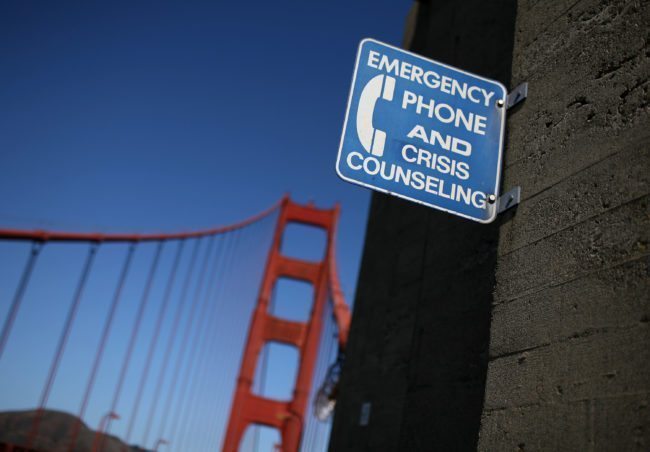
The Department of Justice wants to stop collecting data about the sexual orientation and gender identity of 16- and 17-year-olds, officials announced this week.
The National Crime Victimization Survey is a twice-annual report that collects the data of up to 135 thousand households to understand the “frequency, characteristics, and consequences” of crime in the United States, according to the Bureau of Justice Statistics. Since 2016, the NCVS has given participants 16 and older the option to confidentially list their sexual orientation and gender identity. The survey has been especially useful for acknowledging under-reported crimes.
In a statement released on Wednesday, the DOJ announced its intentions to raise the minimum age “due to concerns about the potential sensitivity of these questions for adolescents.”
The move drew a quick rebuke from advocacy groups, including the University of California-Los Angeles’ Williams Institute, a think tank dedicated to LGBTQ+ research and public policy. In a statement, the Williams Institute argued for the necessity of the data, saying it was essential for understanding violence against LGBTQ+ groups.
“The Bureau of Justice Statistics at the Department of Justice has been a leader in advancing knowledge about the LGBTQ+ population, but the Bureau’s new leadership seems to want to bury its head in the sand,” Director of Federal Policy Adam Romero says in the statement.
This point was echoed by another advocacy group, New York-based Gay, Lesbian & Straight Education Network. “What’s measured is what matters when it comes to public policy,” said executive director Eliza Byard to Mother Jones.
For instance, in August 2016, the Center for Disease Control and Prevention published data that detailed the health disparities and high rates of violence suffered by lesbian, gay, and bisexual high school students. The groundbreaking report has been “hugely important for designing public health programs run out of the CDC,” according to Byard.
On the CDC’s own website, the agency states, “Collecting information about students’ sexual identity and about the sex of their sexual contacts is necessary.”
While LGBTQ+ advocacy groups do not deny the sensitivity of the questions, they find the DOJ’s argument disingenuous. “Youth have been answering questions about their sexual orientation for years, in numerous studies, as well as on federal surveys,” said Kerith J. Conron, Blachford-Cooper Research Director and Distinguished Scholar at the Williams Institute.
Conron points out that two other national surveys have asked similar questions to even younger respondents. The 2015 Youth Behavior Risk Survey included respondents as young as 13, and the National Survey of Family Growth polls subjects as young as 15.
“We know that LGBTQ+ youth are more likely to be victimized, sometimes by their own families, and we need data from the NCVS to learn whether crimes are reported and how the criminal justice system is responding to young LGBTQ+ victims,” said Conron. “Instead of dropping these items from the NCVS, which were cognitively tested and performed well, the Department of Justice should focus on making it easier for youth to answer questions by investigating strategies to improve the data collection process.”
This latest move falls into a strategy of the Trump administration to ignore LGBTQ+ people into bureaucratic nonexistence, denying them use of government protection and services. For historically marginalized groups, the political nostalgia of “Make America Great Again” always represented a red flag of regressive policy. There is no “again” for racial, ethnic, sexual, or gender minorities; there is only the hard-won progress accrued over the last few decades and the current threat to that progress.
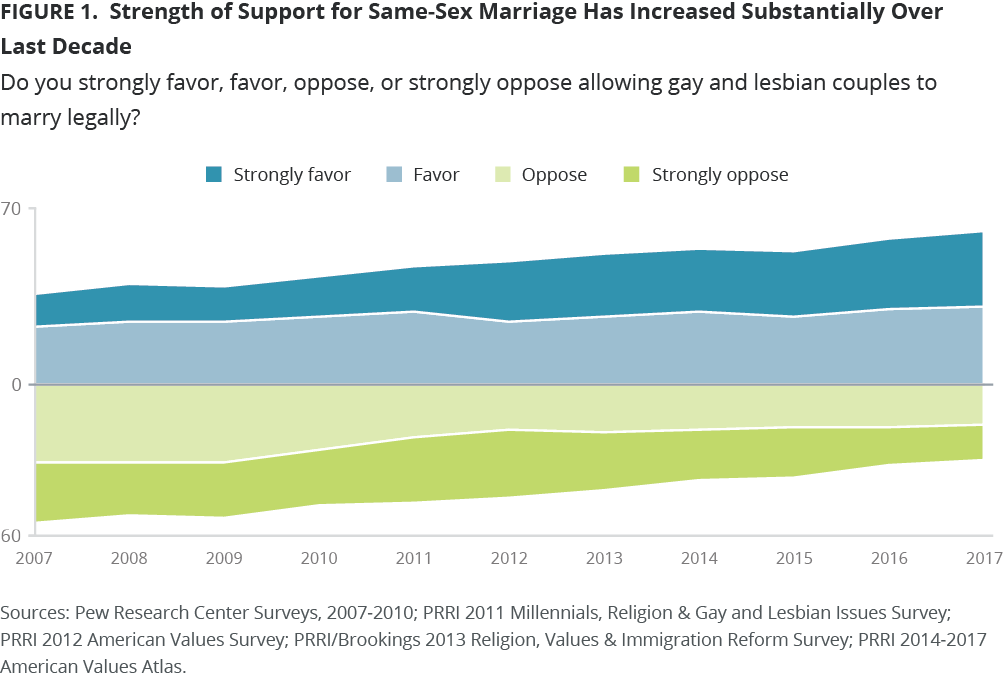
Since the U.S. Supreme Court ruled in 2015 that same sex couples have a constitutional right to marry, support for same-sex marriage has increased substantially. Currently, more than six in ten (61%) Americans say gay and lesbian couples should be able to marry legally, while only about half as many (30%) are opposed.
Strength of support for same-sex marriage has increased dramatically over the past decade, while strength of opposition has fallen in nearly equal measure. Today, Americans who strongly favor same-sex marriage outnumber those who strongly oppose it by more than a two-to-one margin (30% vs. 14%). In 2007, only 13% of the public strongly favored same-sex marriage, while nearly one-quarter (24%) strongly opposed it.1 Much of this shift has occurred within the last five years. As recently as 2013, more than four in ten (42%) Americans opposed same-sex marriage, including about one in four (23%) who strongly opposed it.2 Over the last five years, strong supporters of same-sex marriage increased only modestly, from 25% to 30%.
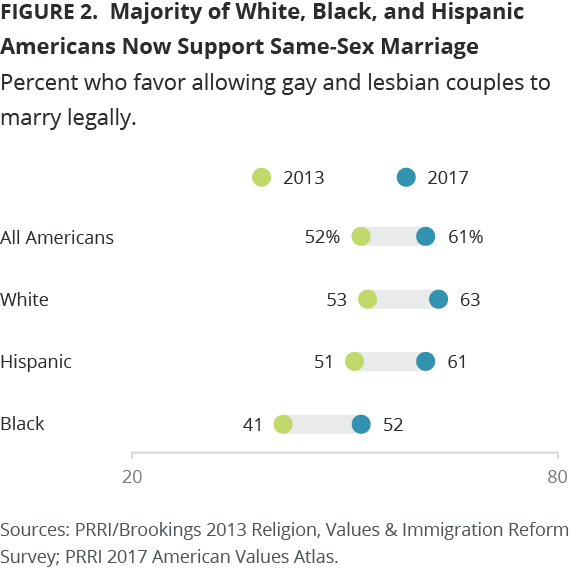
The rise in support for same-sex marriage, particularly over the last few years, has led to a milestone: Today a majority of all racial and ethnic groups favor allowing gay and lesbian couples to marry legally. Between 2013 and 2017, we have seen a double-digit increase in support for same-sex marriage among white (53% vs. 63%), black (41% vs. 52%), and Hispanic (51% vs. 61%) Americans.3 Currently, about four in ten (39%) black Americans, three in ten (30%) white Americans, and only about one-quarter (26%) of Hispanic Americans oppose same-sex marriage. Majorities of smaller racial and ethnic groups also support same-sex marriage today, including Asian-Pacific Islander Americans (72 percent), Native Americans (56 percent), and those identifying as multiracial or with another racial and ethnic group (66 percent).
Conservative Republican Holdouts
Partisan gaps in views of same-sex marriage persist, even as the public has become more supportive of the policy overall. Nearly three-quarters (73%) of Democrats and about two-thirds (66%) of independents favor same-sex marriage, compared to only 42% of Republicans. A slim majority (51%) of Republicans oppose same-sex marriage. However, opposition is mostly confined to conservative Republicans. Nearly six in ten liberal (58%) and moderate (59%) Republicans favor same-sex marriage, compared to only 36% of conservative Republicans. About six in ten (58%) conservative Republicans oppose it.
Among Democrats, as well, there is a considerable ideological divide. Nearly nine in ten (87%) liberal Democrats say same-sex marriage should be legal, compared to 67% of moderate and 52% of conservative Democrats. Four in ten (40%) conservative Democrats oppose same-sex marriage.
Liberal independents are roughly as supportive of same-sex marriage as liberal Democrats. More than eight in ten (82%) liberal independents favor same-sex marriage, compared to nearly three-quarters (73%) of moderate independents and fewer than half (49%) of conservative independents. More than four in ten (41%) conservative independents oppose allowing gay and lesbian couples to marry.
Declining Religious Resistance
Most religious groups in the U.S. now support same-sex marriage, including overwhelming majorities of Unitarians (97%), Buddhists (80%), the religiously unaffiliated (80%), Jewish Americans (77%), and Hindus (75%). Roughly two-thirds of white mainline Protestants (67%), white Catholics (66%), Orthodox Christians (66%), and Hispanic Catholics (65%) also favor same-sex marriage. A slim majority of Muslims (51%) favor same-sex marriage, but only 34% are opposed; 15% offer no opinion on this issue.
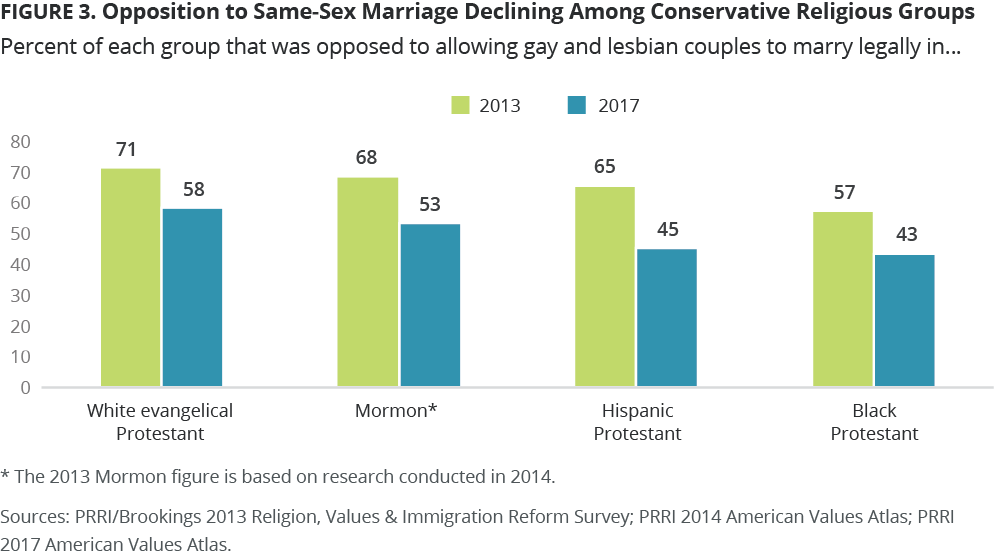
Over the last five years, opposition to same-sex marriage among nonwhite Protestants has dropped considerably. Most notably, black Protestants have moved from solid opposition to a plurality of support for same-sex marriage. In 2013, nearly six in ten (57%) black Protestants opposed same-sex marriage.4 Today just 43% oppose it, compared to nearly half (48%) who support it. Hispanic Protestants have moved from solid opposition to same-sex marriage to being divided over the policy. In 2013, nearly two-thirds (65%) of Hispanic Protestants opposed same-sex marriage. Today, 43% favor the policy, compared to 45% who oppose it and 13% who offer no opinion.
Opposition to same-sex marriage is now confined to a few of the most conservative Christian religious traditions. Only about one-third (34%) of white evangelical Protestants support same-sex marriage today, while nearly six in ten (58%) are opposed, including 30% who are strongly opposed. And just 40% of Mormons support same-sex marriage, compared to 53% who are opposed. Jehovah’s Witnesses, a racially mixed religious group, are the exception. Just 13% support the policy, compared to 63% who oppose it. However, nearly one-quarter (24%) of Jehovah’s Witnesses express no opinion on this issue.
Nevertheless, even those religious groups most opposed to same-sex marriage have become more accepting of it over the last five years. Since 2013, opposition to same-sex marriage has dropped 13 percentage points among white evangelical Protestants (from 71% in 2013 to 58% today).5 Over a similar time period, opposition among Mormons has dropped 15 percentage points (from 68% in 2014 to 53% today).6
Opposition to Same-Sex Marriage Declining Among Conservative Religious Groups
The Coming Generational Realignment
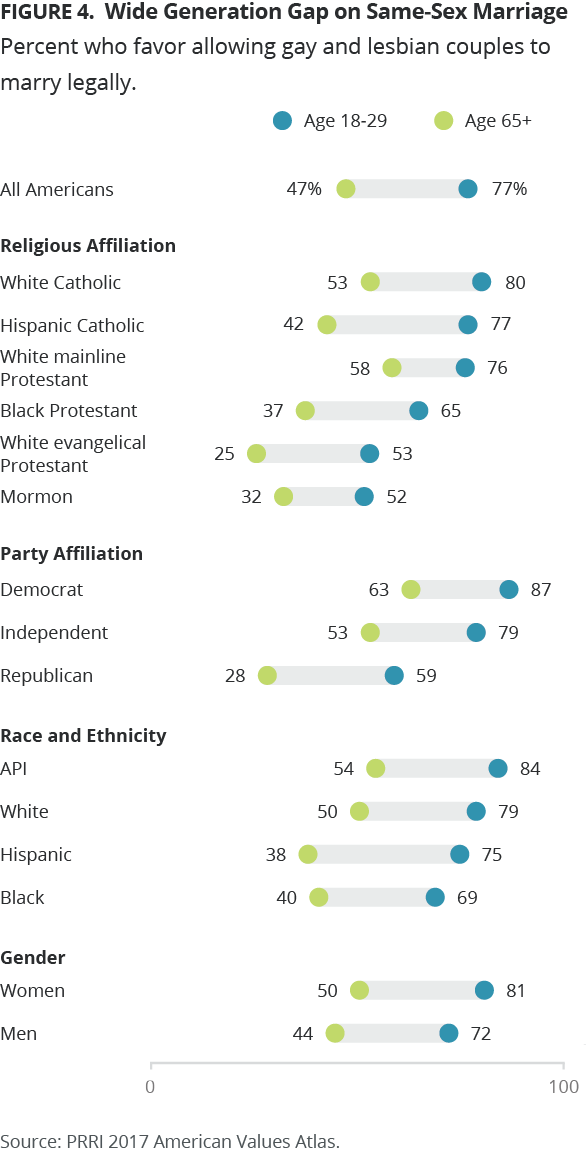
The issue of same-sex marriage is approaching consensus among young adults (age 18 to 29). More than three-quarters (77%) favor legalizing same-sex marriage, including nearly half (45%) who strongly favor it. Only 17% of young adults are opposed. In contrast, fewer than half (47%) of seniors (age 65 and up) say same-sex marriage should be legal, while about four in ten (42%) oppose it. Ten percent of seniors express no opinion on the issue. Notably, there is an increase in support at both ends of the generational spectrum, although more movement occurred among older Americans. Support for same-sex marriage among young adults is up five percentage points from 72% in 2013, and support among seniors is up 11 percentage points from just 36% in 2013.7
The generational divide cuts through every demographic group in the U.S. Even in groups most opposed to same-sex marriage, a majority of young adults favor this policy. A majority (53%) of young white evangelical Protestants favor legalizing same-sex marriage, compared to just one-quarter (25%) of white evangelical seniors. A majority (52%) of young Mormons also believe same-sex marriage should be legal, while only about one-third (32%) of Mormon seniors agree.8 While only 37% of black Protestant seniors favor same-sex marriage, nearly two-thirds (65%) of young black Protestants support it.
Wide Generation Gap on Same-Sex Marriage
The generation gap is larger among Republicans than Democrats. Young Republicans are more than twice as likely as senior Republicans to favor same-sex marriage (59% vs. 28%). In contrast, Democratic young adults and seniors largely agree on same-sex marriage (87% and 63% support it, respectively).
Among no racial or ethnic group is the generation gap wider than Hispanic Americans. Three-quarters (75%) of young Hispanics favor same-sex marriage, compared to only 38% of Hispanic seniors, a gap of 37 percentage points. Among white Americans, roughly eight in ten (79%) young adults favor same-sex marriage, compared to half (50%) of white seniors. And close to seven in ten (69%) young black Americans express support for same-sex marriage, compared to only 40% of black seniors. Finally, majorities of both young (84%) and senior (54%) Asian-Pacific Islander Americans favor same-sex marriage.
Enduring Gender Divides
More women than men in the U.S. support allowing same-sex couples to marry. Roughly two-thirds (65%) of women overall favor same-sex marriage, compared to fewer than six in ten (58%) men. The gender gap crosses lines of race and ethnicity, although its size varies substantially from group to group. Two-thirds (67%) of white women and fewer than six in ten (59%) white men favor same-sex marriage. Among Hispanic Americans, 64% of women favor it, compared to 57% of Hispanic men. And though support is much higher overall among API Americans than other ethnic groups, API women still express greater support than men (76% vs. 67%). Black Americans stand out here in not displaying a gender gap: Similar numbers of black women (53%) and men (50%) favor same-sex marriage.
Notably, the gender gap is slightly larger among young adults than older Americans. More than eight in ten (81%) young women favor same-sex marriage, compared to 72% of young men. The intensity gap is even larger among young people, with 52% of young women expressing strong support for same-sex marriage, compared to 38% of young men. Among seniors, the gender gap and intensity gap are somewhat more modest. Senior women are more likely to favor same-sex marriage than senior men (50% vs. 44%).
Most States Now Support Same-Sex Marriage
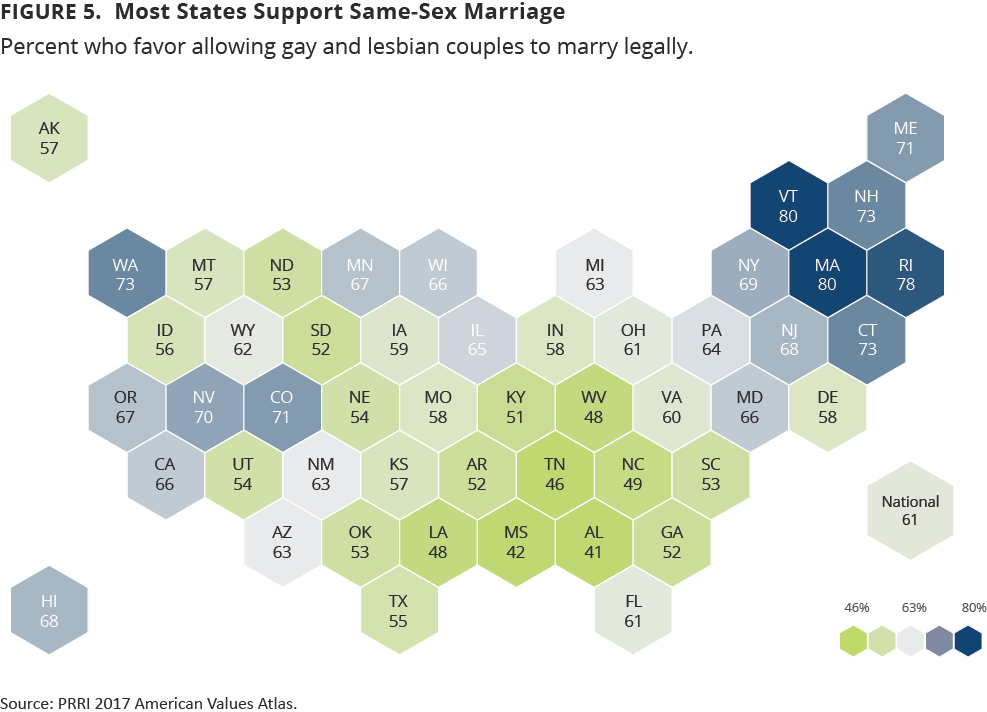
Recent dramatic shifts in support for same-sex marriage are also evident at the state level. Today, majorities in 44 states believe gay and lesbian couples should be allowed to legally marry, compared to only 30 states in 2014.9 In only six states does the issue of same-sex marriage garner less than majority support: Alabama (41%), Mississippi (42%), Tennessee (46%), West Virginia (48%), Louisiana (48%), and North Carolina (49%). But notably, only one state, Alabama, has a majority of residents who oppose same-sex marriage.
Substantial regional disparities in views of same-sex marriage are evident. New England is generally more supportive of same-sex marriage than any other region in the U.S. Roughly eight in ten residents of Vermont (80%), Massachusetts (80%), and Rhode Island (78%) support the policy. And nearly three-quarters of Americans living in Connecticut (73%), New Hampshire (73%), and Maine (71%) support it. A number of Southern states have only a slim majority expressing support for same-sex marriage, such as Kentucky (51%), Arkansas (52%), and Georgia (52%).
Religiously Based Service Refusals Remain Unpopular
Religiously based refusals of service to gay and lesbian people are relatively unpopular among the American public. Six in ten (60%) Americans oppose allowing a small business owner in their state to refuse products or services to gay or lesbian people if providing them would violate their religious beliefs. One in three (33%) Americans support such a policy. Eight percent offer no opinion. Attitudes have remained stable since 2015, when 59% of Americans opposed allowing business owners to refuse products or services to gay and lesbian people for religious reasons.10
Black Americans are more likely than any other racial or ethnic group to oppose religiously based service refusals. Nearly two-thirds (66%) of black Americans oppose them, compared to roughly six in ten Hispanic (61%), Asian-Pacific Islander (60%), and white (58%) Americans.
Women are more likely than men to oppose religiously based service refusals. Close to two-thirds (64%) of women oppose allowing small businesses to refuse to provide products or services to gay or lesbian people, compared to 55% of men. But the gender gap varies somewhat across racial and ethnic groups. It is most pronounced among white Americans: White women are far more likely to oppose them than white men (64% vs. 52%). Differences between black women and men (68% vs. 64% are opposed) and API women and men (58% vs. 61% are opposed) are much narrower. Hispanic women and men demonstrate a slightly wider gap than other nonwhite Americans, but still not as large a gap as that of white people: Sixty-four percent of Hispanic women oppose religiously based service refusals, compared to 58% of Hispanic men.
Only Mormons and White Evangelicals Support Religiously Based Service Refusals
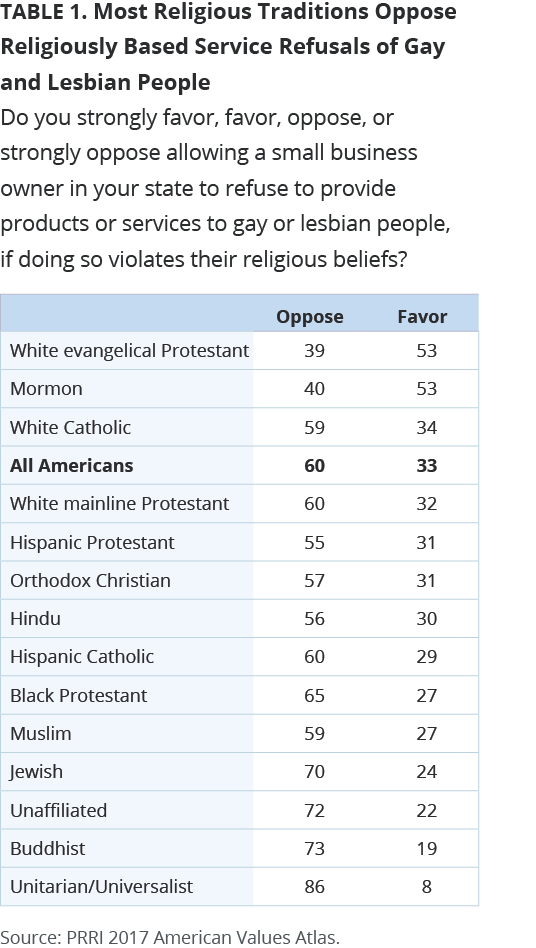
Most religious groups do not believe small business owners should be allowed to refuse service to gay and lesbian people for religious reasons. Nearly nine in ten (86%) Unitarians and at least seven in ten Buddhists (73%), unaffiliated Americans (72%), and Jewish Americans (70%) oppose such a policy. And roughly two-thirds (65%) of black Protestants and about six in ten white mainline Protestants (60%), Hispanic Catholics (60%), white Catholics (59%), and Muslims (59%) also reject a policy allowing religiously based refusals to serve gay and lesbian people. Majorities of Orthodox Christians (57%), Hindus (56%), and Hispanic Protestants (55%) are also opposed to the policy.
Only two major religious groups believe small business owners in their state should be allowed to refuse service to gay or lesbian people on religious grounds—white evangelical Protestants and Mormons. Notably, they support this position at the same rate—53%.
Although there are profound generational differences among white evangelical Protestants regarding same-sex marriage, on the issue of service refusals the generation gap is minimal. Roughly half (49%) of white evangelical seniors and half (50%) of young adults would allow small business owners to refuse service based on their religious beliefs, while 40% of seniors and 45% of young adults would not.
Sharp Political Divisions
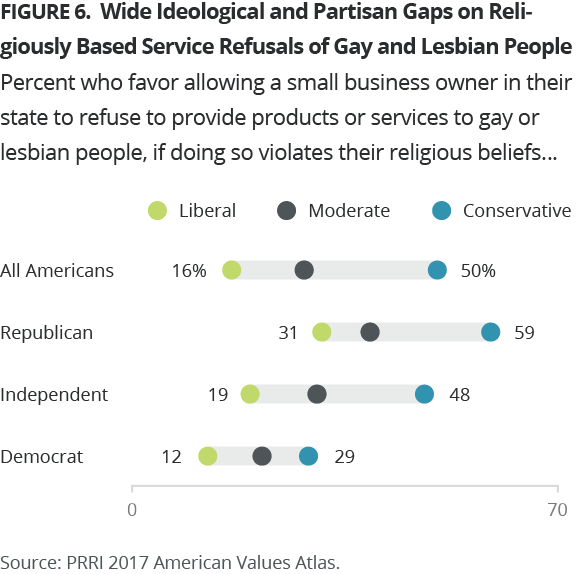
As with same-sex marriage, views on religiously based service refusals vary dramatically by political affiliation. More than three-quarters (76%) of Democrats and six in ten (60%) independents are opposed, compared to only 40% of Republicans. A slim majority (52%) of Republicans favor giving business owners in their state the right to refuse products or services to gay or lesbian people if providing them would violate their religious beliefs.
Among Republicans there are stark divisions by ideology. Nearly six in ten (59%) conservative Republicans say religiously based service refusals should be legal, compared to roughly four in ten (39%) moderate and about three in ten (31%) liberal Republicans. But a majority of moderate (55%) and liberal (63%) Republicans oppose such a policy.
There are also sharp ideological differences among independents. Conservative independents are roughly divided, with about as many supporting the right to religiously based service refusals as opposing (48% vs. 44%) it. In contrast, 63% of moderate independents and more than three-quarters (77%) of liberal independents do not think small business owners have this right.
Democrats are far more unified than Republicans and independents in their position on the matter. Majorities of liberal (85%), moderate (72%), and conservative (63%) Democrats oppose religiously based refusals to serve gay and lesbian people.
More Modest Generational Divisions
Although views on same-sex marriage are highly stratified by age, on the issue of service refusals there is greater consensus across age cohorts. A majority of Americans across generations oppose them. Two-thirds of young adults (67%) and a majority of seniors (53%) say small businesses should not be allowed to refuse to serve gay or lesbian people, even if doing so violates their religious beliefs. Only 36% of seniors say this should be allowed, while 11% express no opinion.
The Relationship Between Support for Same-Sex Marriage and Service Refusals
Even among Americans who oppose same-sex marriage, close to half (45%) are against allowing small business owners to refuse service to gay and lesbian people. A similar number (48%) would allow them this option if providing service violates their religious beliefs.
Opposition Across the Country
A majority of Americans in nearly every state believe small business owners in their state should not be allowed to refuse service to gay and lesbian people. Notably, state-level opposition to same-sex marriage or nondiscrimination protections for LGBT people does not reliably predict state-level support for religiously based service refusals. Whereas opposition to same-sex marriage and nondiscrimination protections is concentrated in the South, the states with the lowest levels of opposition to service refusals cluster in and near the Mountain West and Midwest. In three states—Utah (48%), North Dakota (49%), and South Dakota (49%)—fewer than half of residents oppose service refusals. A slim majority of residents of Idaho (51%), Oklahoma (51%), Nebraska (53%), and Montana (53%) object to them.
In contrast, New England states express the strongest objection to religiously based service refusals. At least two-thirds of residents of Vermont (74%), Massachusetts (70%), Rhode Island (69%), and New Hampshire (67%) oppose allowing small business owners to refuse gay and lesbian customers.
Americans Continue to Support Nondiscrimination Protections for LGBT People
Americans are broadly supportive of laws that would protect lesbian, gay, bisexual, and transgender (LGBT) people against discrimination in jobs, public accommodations, and housing. Seven in ten (70%) Americans favor such laws, including more than one-third (35%) who strongly favor them. Fewer than one-quarter (23%) of Americans oppose legal nondiscrimination protections for LGBT Americans.
Although there is broad agreement about nondiscrimination laws, there are still notable differences by age and gender. Younger Americans tend to be more supportive of legal protections than older Americans. Nearly eight in ten (78%) young adults (age 18-29) favor nondiscrimination protections, including 45% who strongly favor them. Even among seniors (age 65 and up), who tend to be less supportive of same-sex marriage, more than six in ten (61%) favor nondiscrimination protections for LGBT Americans, and only 29% oppose them.
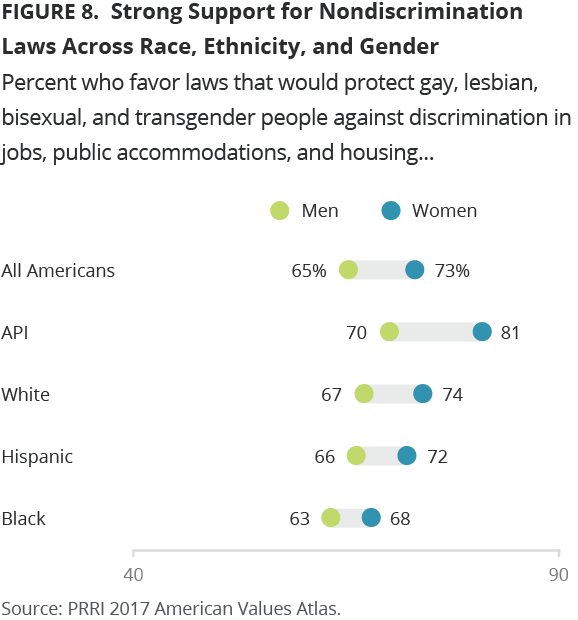
Gender differences on this issue are much more modest than with respect to same-sex marriage. Nearly three-quarters (73%) of women favor the passage of laws that would protect LGBT Americans from discrimination in jobs, public accommodations, and housing, compared to about two-thirds (65%) of men. But there is a considerable intensity gap: Four in ten (40%) women, compared to only about three in ten (29%) men, strongly favor nondiscrimination protections for LGBT people.
Americans, Regardless of Race and Ethnicity, Support Nondiscrimination Protections
There is only modest variation across racial and ethnic lines in support for nondiscrimination laws to protect LGBT Americans. About two-thirds (66%) of black Americans favor these protections, as do about seven in ten Hispanic (69%) and white (71%) Americans. Asian-Pacific Islander Americans demonstrate the highest levels of support, with 75% favoring nondiscrimination laws to protect LGBT Americans.
The gender gap is fairly constant across racial and ethnic groups, but there is considerable variation in its size. Black men express the lowest level of support for nondiscrimination policies aimed at protecting LGBT people, while API women express the greatest. More than six in ten (63%) black men favor nondiscrimination laws, compared to 66% of Hispanic, 67% of white, and 70% of API men. More than two-thirds (68%) of black women favor these policies, while more than seven in ten Hispanic (72%), white (74%), and API (81%) women say the same.
Support for Nondiscrimination Protections Transcends Partisan Boundaries
Nondiscrimination protections for LGBT people are broadly supported across party lines, although Democrats and independents register greater support for them. More than seven in ten independents (72%) and Democrats (79%) favor providing legal protections from discrimination for LGBT people, while nearly six in ten (58%) Republicans say the same. Notably, half (50%) of Democrats strongly favor these protections.
While political ideology also influences views on nondiscrimination protections for LGBT people, it plays a larger role in structuring the attitudes of independents and Democrats than Republicans. Six in ten (60%) conservative independents favor laws to protect LGBT individuals against discrimination in jobs, public accommodations, and housing, compared to about eight in ten moderate (77%) and liberal (82%) independents. Democrats demonstrate a similar pattern. While less than two-thirds (63%) of conservative Democrats support nondiscrimination protections, more than three-quarters (76%) of moderate and nearly nine in ten (87%) liberal Democrats say the same.
There are more modest ideological differences among Republicans. Roughly two-thirds of moderate (68%) and liberal (65%) Republicans support nondiscrimination protections for LGBT people, compared to 56% of conservative Republicans.
Near Consensus Among Religious Groups on Nondiscrimination Policies
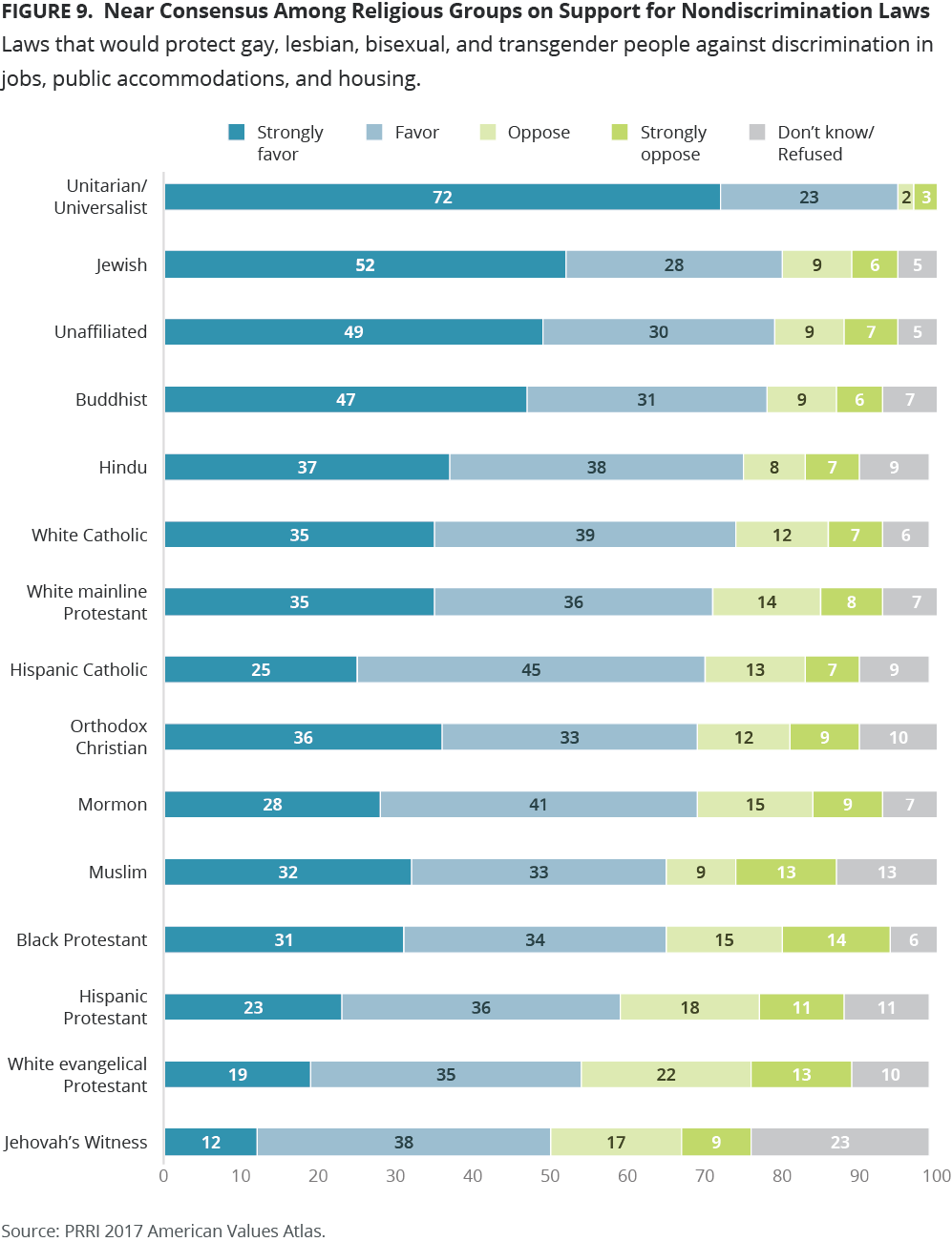
Majorities of nearly every major religious group support legal protections against discrimination for LGBT Americans, with non-Christian religious groups tending to be the most supportive. No religious group is more supportive than Unitarians, among whom 95% favor nondiscrimination policies. At least three-quarters of Jews (80%), religiously unaffiliated Americans (79%), Buddhists (78%), and Hindus (75%) favor laws that protect LGBT Americans against discrimination in employment, housing, and public accommodations.
Support is also robust among most Christian religious communities. At least seven in ten white Catholics (74%), white mainline Protestants (71%), and Hispanic Catholics (70%) support nondiscrimination protections for LGBT people. Approximately two-thirds of Orthodox Christians (69%), Mormons (69%), and black Protestants (65%) favor them, as well as a majority of Hispanic Protestants (59%) and white evangelical Protestants (54%). While only half (50%) of Jehovah’s Witnesses support nondiscrimination protections, just over one-quarter (26%) oppose these protections, and roughly as many (23%) express no opinion.
Mormon Exceptionalism
Mormons are unique among religious Americans in their outlook on same-sex marriage and nondiscrimination protections for lesbian, gay, bisexual, and transgender people. Only 40% of Mormons favor allowing same-sex couples to marry, yet nearly seven in ten (69%) support laws that would protect LGBT people from discrimination in housing, public accommodations, and employment—a 29-point gap. Among no other major religious group is the gap on these two issues larger.
Majorities of Residents of Every State Favor Nondiscrimination Protections for LGBT People
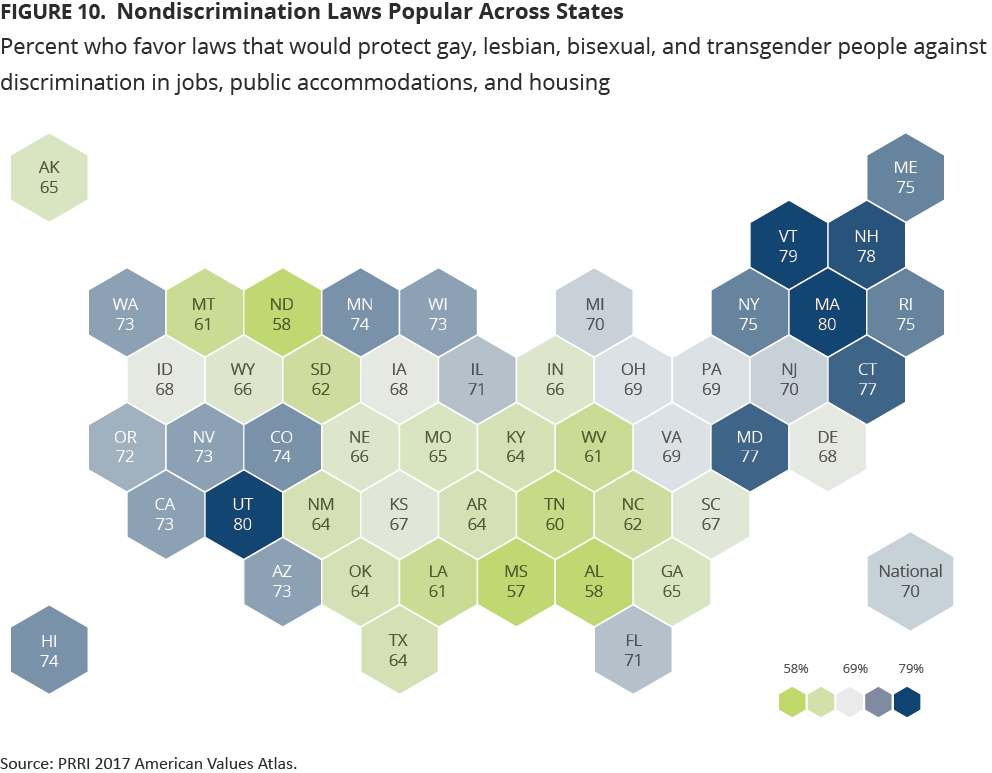
Majorities of residents of every state favor nondiscrimination protections for LGBT Americans. Predictably, New England states express the most robust support for laws designed to protect LGBT people from discrimination. At least three-quarters of the residents of Massachusetts (80%), Vermont (79%), New Hampshire (78%), Connecticut (77%), Maine (75%), and Rhode Island (75%) favor nondiscrimination protections for LGBT Americans.
Conversely, states with the lowest levels of support are primarily located in the South, as only about six in ten residents of Mississippi (57%), Alabama (58%), Tennessee (60%), Louisiana (61%), and West Virginia (61%) say LGBT people should be legally protected from discrimination.
States in the West tend to demonstrate high levels of support for nondiscrimination protections for LGBT individuals. More than seven in ten residents of the Western U.S.—including Washington (73%), California (73%), Nevada (73%), Arizona (73%), and Oregon (72%)—favor laws that would protect LGBT Americans from discrimination. Notably, despite the fact that only 54% of Utahans favor same-sex marriage, fully 80% say they would support laws to protect LGBT people from discrimination.
Survey Methodology
The 2017 American Values Atlas (AVA) is a project of PRRI. Results for questions on specific issues (e.g. LGBT issues) are based on a subset of 40,017 telephone interviews (including 23,903 cell phone interviews) conducted between April 5, 2017 and December 23, 2017 by professional interviewers under the direction of SSRS. The AVA was made possible by generous grants from the Evelyn and Walter Haas, Jr. Fund, the Gill Foundation, the Nathan Cummings Foundation, and the Unitarian Universalist Veatch Program at Shelter Rock.
Throughout 2017, at least 1,000 interviews were completed each week, with about 600 interviews conducted among respondents on their cell phones. Each week, interviewing occurred over a five-day period, from Wednesday through Sunday or from Thursday through Monday. The selection of respondents within households was accomplished by randomly requesting to speak with the youngest adult male or female currently living in the household.
Data collection was based on stratified, single-stage, random-digit dialing (RDD) of landline telephone households and randomly generated cell phone numbers. The sample was designed to represent the total U.S. adult population from all 50 states, including Hawaii and Alaska. The landline and cell phone samples were provided by Marketing Systems Group.
The weighting was accomplished in two separate stages. The first stage of weighting corrects for different probabilities of selection associated with the number of adults in each household and each respondent’s telephone usage patterns. In the second stage, sample demographics were balanced to match target population parameters for gender, age, education, race and Hispanic ethnicity, region (U.S. Census definitions), population density, and telephone usage. The population density parameter was derived from 2010 Census data. The telephone usage parameter came from an analysis of the January-June 2017 National Health Interview Survey. All other weighting parameters were derived from an analysis of the U.S. Census Bureau’s March 2017 Current Population Survey.
The sample weighting was accomplished using iterative proportional fitting (IFP), a process that simultaneously balances the distributions of all variables. Weights are trimmed so that they do not exceed 4.0 or fall below 0.25 to prevent individual interviews from having too much influence on the final results. The use of these weights in statistical analysis ensures that the demographic characteristics of the sample closely approximate the demographic characteristics of the target populations.
The margin of error for the sample is +/- 1.2 percentage points at the 95% level of confidence. The design effect is 1.4. Table 1 shows the margin of error and design effect for each weekly survey at the 95% level of confidence. Tables 2 and 3 show the sample sizes for each state and metro area. In addition to sampling error, surveys may also be subject to error or bias due to question wording, context, and order effects.
Bisexual people in the U.S. state of Utah report the most incidences of sexual violence, according to a new survey.
The shocking new survey analyzes responses from about 10,000 Utahan adults collected in 2016.
It reveals 45.5% of bisexual people in Utah have experienced sexual violence. It also said 33.6% of lesbian/gay respondents reported sexual violence.
This compares to just 8.7% for straight people.
According to the survey, sexual violence is ‘sexual activity (sexual touching, harassment or exposure to sexual content) that involves victims who do not consent, or who are unable to consent.’
Turner Bitton, executive director of the Utah Coalition Against Sexual Assault, said in a written statement: ‘Sexual violence is rooted in the inequities of our society and disproportionately hurts those who have been pushed to the margins.’
He also said: ‘Utah communities are counting on us to ensure that everyone is included in prevention efforts.’
Bitton calls for ‘culturally specific prevention programming’ in the state to combat the huge disparity.
Interestingly, other breakdowns of the statistics include disproportionate incidences among unemployed people, with 21.3%. ‘Student’ comes in second with 10.7% and ’employed’ with 10%.
Sexual violence in Utah breaks down to affecting 3.1% of the state’s male population and 16.4% of females.
While it’s been a long road toward advocacy for the LGBTQ+ community, one of the last frontiers unconquered remains the financialworld. No longer.At last, Superbia, a profit-for-purpose financial institution has entered the scene to offer service and counsel for LGBTQ+ folks. It’s long overdue when taking into account that the estimated combined buying power of those who identify in the aforementioned category is valued at one trillion dollars. Yet, of the $55 billion contributed to charitable grants each year, only $160 million is made in grants toward LGBTQ+ causes.
With the emergence of Superbia, all those lost contributions are at last being given the chance to be redirected back into the pockets of LGBTQ+ people. To boot, tailored products and services, as well as better rates and interest options, will be presented to those participating. Founded by financial services industry veteran Myles Meyers, who was inspired to start the credit union after experiencing discrimination first hand that so often leads to LGBTQ+ people being slapped with higher interest rates, credit judgment for health needs and student loan rejections, Superbia aims to make its clients feel comfortable and welcome.
Assisting in the establishment of Superbia as a tour de force is its relationships with key LGBTQ+ organizations including Hornet Networks and Stonewall Community Foundation. Superbia also has a partnership with Mastercard and CU* Answers to add further integrity to its fresh (and much needed) existence.
As Myles stated, “Our families, lives and financial journeys are not necessarily the same as those of other communities. The products we need and how we are communicated to should reflect our community, using our values, as we determine.” And so, finally, one of the final frontiers for LGBTQs is starting to be conquered. To find out more about the credit union or to donate to the cause, go here: superbiafinancial.com and indiegogo.com/projects/introducing-superbia.
With affordable, highly-effective hepatitis C (HCV) direct acting antiretroviral medications now available, innovative programs in San Francisco are reaching people who inject drugs with hepatitis C cure support and treatment. Clinicians and advocates who recognize the benefit of treating everyone with hepatitis C—regardless of their substance use—are advocating for a non-judgmental approach to this deadly infection.
Pierre-Cédric Crouch, PhD, ANP-BC
“We recently expanded our hepatitis C treatment program to the 6th Street Harm Reduction Center, which primarily serve people who are homeless or marginally housed, and who use substances including injection drugs,” said Pierre-Cedric Crouch, PhD, ANP-BC, nursing director of San Francisco AIDS Foundation.
“We are one of the only centers in the U.S. who are prioritizing people who use substances in hepatitis C treatment work. We’re proving that this approach works and that it’s helping the right people who need access to hepatitis C medications.”
“If we want to make a dent in this epidemic, you have to treat people who are actively injecting drugs,” said Annie Luetkemeyer, MD, from University of California San Francisco, at a recent HIV grand rounds at San Francisco General Hospital. “If you want to avoid new cases, you’re going to double the reduction in hepatitis C cases averted if you treat PWID [people who inject drugs] as opposed to just focusing on non-PWID.”
With these comments, Luetkemeyer addressed the resistance that some providers may have about treating people who are at risk for re-infection (through injection drug use) or who have difficult lives that may stand in the way of adherence (for instance, because they are homeless).
Erica*, a 22-year old from San Francisco, is one person who has been cured of hepatitis C through the San Francisco AIDS Foundation program at the 6th Street Harm Reduction Center.
“It was like I had the whole healthcare system behind me—all I had to do was show up to my appointments. Nobody judged me when I relapsed. I was still able to take the meds. Sometimes you relapse, but you still want to be cured of hep C. I think that’s very important that you can still be using and still get the meds,” she said.
There are likely three to four million people in the U.S. living with chronic hepatitis C, with about 34,000 new hepatitis C infections occurring every year. Hepatitis C kills more people in the U.S. than any other infectious disease that is reported to the CDC (including HIV). In 2015, nearly 20,000 people dying from hepatitis C-related causes. Most people living with hepatitis C have been infected through injection drug use (this blood-borne virus can live in needles and syringes but also on other equipment like drug cookers and filters).
In San Francisco, the End Hep C SF initiative estimates that there are 12,000 people with active hepatitis C virus in their bodies. These are people who are able to transmit hepatitis C to other people and who would benefit from treatment.
End Hep C SF recommends that you talk to your medical provider about testing for hepatitis C (HCV) if you have ever injected drugs, are a man who has sex with men, are a trans woman, or were born between 1945 – 1965.
New hepatitis C medications can lead to a cure with eight weeks of treatment, and are now priced more affordably for patients and health plans. Yet barriers stand in the way for people who use drugs which may prevent them from accessing hepatitis C medications and care.
What keeps people who use drugs from getting cured of hepatitis C?
Katie Burk, MPH, viral hepatitis coordinator for the San Francisco Department of Public Health, said that there are a variety of factors that can stand in the way of people accessing hepatitis C treatment.
People who have unstable lives—because of substance use but also from things like homelessness—can make accessing any kind of medical care seem out of reach.
“If you don’t have the basic necessities of life secured, it’s hard to take on any new goal or health intervention,” said Burk. “If you’re homeless, it’s difficult to make appointments or hold on to medications. It’s difficult to work on any goal besides your immediate survival, because you’re just figuring out where to eat and a place to sleep.”
On top of that, health systems barriers may prevent people who want to access treatment from actually being able to do so.
“Our systems aren’t really designed to accommodate the needs of people who need our services the most,” said Burk. “There are all these bureaucratic and logistical barriers inherent in traditional medical care. Maybe somebody is ready to see a doctor, but they can’t get an appointment for a couple of weeks. If folks are actually ready to take medication, they might have to go through a lot of time-consuming hoops in order to get them. Re-establishing insurance in a particular setting can be difficult for people who may be homeless and moving frequently from county to county.”
Burk also said that people who use substances oftentimes have “tenuous relationships” with the medical system. If people have been mistreated, stigmatized or dismissed by medical providers it he past, they may be less willing to seek treatment for hepatitis C even if it is available to them.
How can we make hepatitis C treatment accessible to people who use drugs?
Innovative programs in San Francisco are finding ways to bridge the gap between people who use substance and hepatitis C treatment—making cure regimens more accessible than ever before. Meeting people where they already are is one strategy being used to reach more people with medications and care.
“There are so many people who we would love to go to primary care, but it’s just not going to happen right now,” said Burk. “They won’t or can’t go consistently. But there are places in our system where they may be meaningfully engaged. It might not be where hepatitis C treatment has traditionally been offered, but if we can bring treatment to those places, then we have opportunities to treat folks where they’re already showing up. In San Francisco we’re developing treatment models in drug treatment programs, syringe access programs, sexual health clinics, and homeless shelters to meet these needs.”
With the right support, people living with hepatitis C who still use substances and who may also be experiencing homelessness do well in hepatitis C cure programs.
Although re-infection is a risk for people who use IV drugs, the rate of reinfection is relatively low (between 1 – 2%), and worry over re-infection shouldn’t prevent people from being able to access hepatitis C medications, said Luetkemeyer.
At San Francisco AIDS Foundation, 24 people have started hepatitis C medication through the Hepatitis C Wellness Program, with 11 people who have completed treatment. The program, which began in July 2017, enrolls clients at the 6th Street Harm Reduction Center, which serves high-needs clients accessing harm reduction and safer drug use supplies.
“Everyone who has reached week four has been fully suppressed, which shows that the program is working well,” said Crouch. “Many people we see are homeless and out of medical care. We’re treating people who would never get treated for hepatitis C otherwise. There are a very small number of people doing hepatitis C cure programs at syringe access sites, but this is absolutely the right place to meet people who need access to treatment.”
In addition to access to hepatitis C medications, people enrolled in the program meet once a week with Pauli Gray, hepatitis C program coordinator for San Francisco AIDS Foundation, to share breakfast and health and wellness information. On-site lockers are available to hold people’s medications, to eliminate the risk that people’s medications get stolen or lost.
Gray said that in addition to being cured of hepatitis C, clients have used the meetings to work on other goals related to health and well-being.
“I set a goal with each client early in the process, and stay in constant touch with them. Almost everyone makes a goal and meets it. We’ve seen people who have already been able to do things like find housing, stop or reduce their substance use, and re-connect with their children. Getting cured changes the trajectories of people’s lives. The efficacy of it is amazing. It shows them that life can be different. They feel so much better—usually very quickly—and get excited at being able to do things they couldn’t before,” said Gray.
“Pauli told me that he would help me do everything,” said Erica. “He made appointments for me, he told me when to show up. He made it so easy for me. At the beginning, I was in [drug] treatment, so it was really easy for me to get to my appointments. At the end, I started relapsing, but Pauli went out of his way to make sure I was still taking my meds.”
Erica’s* story
Erica found out she had hepatitis C when she was 18, and undergoing chemotherapy for uterine cancer. She contracted HCV from IV drug use with her then-boyfriend, who didn’t reveal to Erica that he had HCV.
“I was living in Sacramento at the time, and tried to get into treatment. But I wasn’t ready,” she said.
So Erica moved back to San Francisco, and spent two years without housing—living in a tent under an overpass. She quit heroin to finish chemotherapy, and then relapsed when her cancer treatment ended.
She connected with Gray at the 6th Street Harm Reduction Center when she was accessing safer drug use supplies, and sought help for an abusive relationship.
“He didn’t pressure me with the hepatitis C treatment right away,” she said. “He was just like, ‘let’s get you safe and stable, and then we’ll go from there.’ Pauli helped me reconnect with my mom, and he also helped get me into [drug] treatment.”
About a year ago, Erica decided she was ready to pursue hepatitis C treatment.
Gray set up the medical appointments, helped her access the three-month course of treatment for free, and checked in on Erica daily. When Erica started using again, Gray continued to check in on her and make sure she continued to take her medication. Erica attended the weekly support groups at the 6th Street Harm Reduction Center, and received individual counseling and support as well.
In July, Erica finished the course of medication, and found out that she was cured of HCV.
“I noticed that I have way more energy now. For [the medication] to be free, that was huge. I’m so young. I was so worried that this would affect my long-term health. So for me to have it treated so quickly was amazing.”
The 6th Street Harm Reduction Center offers syringe access and disposal, overdose prevention and naloxone, counseling, suboxone treatment, walk-in medical care, hepatitis C treatment. Visit Monday – Friday, 9 am – 5 pm, and Saturdays 7 pm – 11 pm at 117 6th Street at Mission Street in San Francisco.
The New York Times has addressed its poor history of covering HIV/AIDS during the AIDS crisis.
The newspaper came under heavily criticism from AIDS activists and the LGBT community over its “shameful” coverage of the AIDS epidemic in the 1980s, when New York City’s gay community was ravaged by the spread of the disease.
President Reagan did not mention AIDS in public until 1985, when 5000 people – primarily gay and bisexual men – had already died.
AIDS activist Larry Kramer was vocally critical of the New York Times for its coverage, attributing deaths to the paper’s actions.
In a piece published today, New York Times writer Kurt Soller addressed the newspaper’s coverage – more than 30 years on.
Soller wrote: “Any newspaper must, by definition, aspire to be the “paper of record,” and yet when it came to this newspaper’s coverage of gay people and AIDS in the early ’80s — when the disease was morphing into a national crisis, and when rights that had been won a decade earlier, after the Stonewall Riots, were once again being jeopardized — The Times’s own record was checkered at best.
“Information about the spread of illness was often scant, judgmental or distressingly vague — even while reporters on the Science desk were trying their best with an ever-evolving story. The social and emotional toll of AIDS and the resulting queer movement were, when covered, often buried in the back of the newspaper (on a page called Styles of the Times), far from national news stories that were deemed important enough for the front page.
“Famously, it would take President Ronald Reagan more than four years to acknowledge the disease publicly. And it took until 1983 for The Times to run an article about the disease on Page A1, two years after the first reports of symptoms.”
Economy reporter Natalie Kitroeff notes that “many employees felt that A.M. ‘Abe’ Rosenthal, the paper’s editor, was homophobic”, reflecting on internal battles over the use of terms like “admitted homosexuals”.
Media reporter John Koblin noted that there were 558 dead in the United States before the Times put the issue on the front page.
He added: “Roughly 700 editions of the paper had come and gone before AIDS, quickly turning into a full-fledged crisis, had earned a spot on Page One. It was never lost on AIDS activists just how vital the paper was — and for how long it did not pay serious attention to the disease.”
How Can Lawyers Get More Comfortable With Artificial Intelligence?
It doesn’t matter how AI works as long as it solves problems. Discover the 7 steps to understanding AI and becoming more comfortable with it
Ad by Thomson Reuters
David W. Dunlap, a reporter in the Metro section at the time, told him: “There were strong messages that you got that were not written on any whiteboard. You knew to avoid it. It was a self-reinforcing edict: Don’t write about queers.”
Koblin added: “By the time The Times did give AIDS front-page attention, it did so with a bit of a stiff arm. Though public health officials were now going on the record to discuss the disease’s devastation, there was reluctance to discuss whom it affected most. In that first front-page story, it took seven paragraphs — which appeared after the jump, or inside the paper — to mention how hard it was hitting gay men.”
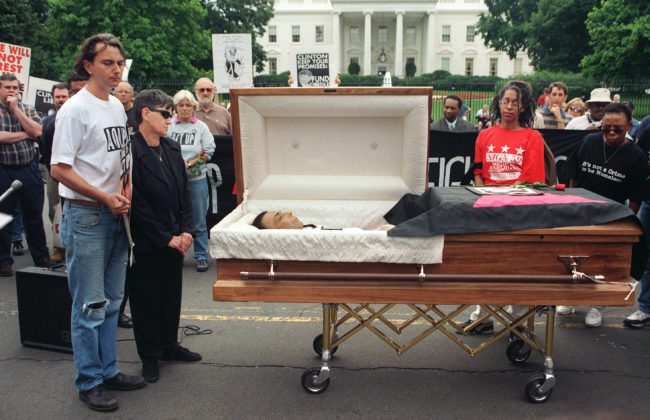
AIDS activists hold an open-casket funeral protest in front of the White House (JAMAL A. WILSON/AFP/Getty Images)
Washington correspondent Jeremy W. Peters wrote that even when it did cover the crisis, the newspaper often did unwitting harm.
He wrote: “They employed the same euphemisms, like ‘bodily fluids’, to substitute for words like semen, leaving the [false] impression that saliva from a kiss might infect you.”
Police are looking for three suspects in an anti-gay attack last week.
You’ve probably heard all about it by now, or even seen the horrific cell phone video capturing most of it. Just after midnight on Sunday, April 15, two gay men were viciously assaulted on the corner of Vermont Avenue and U Street. Sort of a strange place for such a thing to happen, given that it’s practically in sight of the entrances to three of the city’s busier gay bars, one of which, for better or worse, was recently named the best in the nation.
These instances are always jarring, especially when they happen in your own city, in stretches of pavement you pound with regularity. It’s even more jarring given the statistics surrounding it — LGBTQ hate crimes are on the rise here at home and around the world. It’s depressing. And I’m not so naive to think that Obama’s magic gay marriage wand would have done away with this sort of thing. But I was hopeful that it might help.
People are struggling to find a cause for this uptick in hate. D.C.’s own top cop Police Chief Peter Newsham admitted that, “it’s hard to say exactly what the increase is due to.” This much is certain, It seems to be an angry age we find ourselves in. And it’s certainly not just the queer community feeling the brunt of this. Hate crimes generally seem to be on the rise across the board. Even instances of anti-Semitism are up. Here in Washington, D.C., there were 66 instances of bias-related crimes in 2015 and 107 in 2016. Last year saw at least 163 instances. So where is it all coming from? Certainly, there is some from-the-top-down blame to go around.
When Obama announced in 2012 that he had ‘evolved’ on gay marriage, it provided a tone of acceptance that other Americans were able to draw from (just look to Maryland for an example of this). So, when it comes to tone and trendsetting, can the same be said for the current administration, meaning can this sort of thing cut the other way? Is President Donald Trump to blame for the uptick in bias-related hate crimes? Well, maybe. At the very least he might be an unindicted co-conspirator. And this is not all that farfetched. It’s been proven that the man and his rallies incite violence. Any cursory reading of his Twitter feed shows that he has no boundaries whatsoever. The man sitting in our highest office has no qualms about petty insults and name-calling. And this sort of hateful and reckless rhetoric tends to trickle down.
So what’s to be done? Know that soon, something has to give. And it will certainly break our way. But until then, take a cue from others. Yes, it is incredibly disheartening that someone posted the video of the assault on Twitter, as if to brag of it and further humiliate the victims. But at the end someone does come to their aid, and someone called for help. It’s in these worst of times that people can show the best in themselves. Take solace in the fact that the community raised over $20,000 for the two victims. And know that a local gay dentist volunteered his time and skill to repair their cracked smiles, charging nothing for his services. Know there’s a lot of love out there to counter this trickle down of hate.
In the long run, eventually something has to give. And if these waves of hate tend to come and go, the next crest may be ours. So until then, stay vigilant, stay active, and stay charitable.
And according to local publication The Nation, Thailand may beat Taiwan to that deadline.
The justice minister is set to present the final draft of the bill to the Cabinet for approval after a subcommittee is done with creating it, a source at the ministry’s Rights and Liberties Protection Department said.
It is expected to be passed before the next general election, which is set to be held in February 2019.
Ratthanan Prapairat, 38, said he had been with his partner for more than 20 years, and that together, the two men have bought a house and run a clothing business.
Prapairat said he would register under the proposed law, adding: “It is a must-have that should have been in place years ago as it would be very helpful in protecting the rights of same-sex couples.
“Same-sex couples are no different from straight couples. We have accumulated a lot of assets and heritage together. This law will be great for us.”
After 50-year-old Vitaya Saeng-aroon’s partner was taken into hospital earlier this year, he didn’t know of his death until a relative let him know.
(Taylor Weidman/Getty)
Saeng-aroon said the legislative shift would give same-sex couples the right to have a say over their partner’s medical care, and to be present with them in the hospital.
“I was not permitted to sign any document after he went into a coma,” he said. “I was not his relative, even though I had been taking care of him for over a year.
I had to wait for his brother from upcountry to show up. After a week in ICU, he passed away peacefully,” he added.
“I did not know about his death until his brother called me.”
He said that the law would legitimise same-sex relationships, and the LGBT people in general.
“It’s not only about equality, but also about humanity,” said Saeng-aroon.
“Gay people need to be recognised as common couples in every supporting aspect. That will bring wider understanding towards the true meaning of diversity.”
The unions carry some of the same benefits as marriage, especially relating to housing and hospital visits.
The city of 1.5 million people, located on the northern coast of the island of Kyushu, was the seventh city or ward in the country to legalise same-sex partnerships.
On Thursday, a 69-year-old man was convicted of criminally negligent homicide after stabbing his neighbour to death in 2015.
James Miller will serve 10 years probation after the death of his neighbour Daniel Spencer, in addition to six months in prison.
According to NBC, friends Spencer and Miller were together in Austin, Texas, when Spencer made a sexual advance on him.
“Hold it, I’m not a gay person,” Miller reportedly replied.
Spencer allegedly became aggressive after Miller rejected his advances, brandishing a glass at Miller.
The defence argued that Miller acted in self-defence.
However, the prosecution argued that Miller did not have “so much as a scratch on him.”
Miller reportedly told the jury: “He had height advantage over me, arm length over me, youth over me. I felt he was going to hurt me.”
Miller then stabbed Spencer before turning himself into the authorities.
In addition to the 10 years on probation, Judge Brad Urrutia added the maximum judge-imposed sentence of six months imprisonment as well as 100 hours of community service and $11,000 in restitution to Spencer’s family.
Prosecutor Matthew Foye said that the verdict showed that the self-defence claim was not successful in acquitting Miller.
Foye said: “It establishes that Daniel Spencer was a victim of a senseless killing by the defendant and he did not do anything to bring this upon himself.
Learn How to Turn Your Bedroom into a Relaxing Oasis with the IKEA Home Tour Squad
Follow the team of IKEA design experts who are on the road to help America achieve their dreams.
Ad by IKEA®
“Since the defence’s strategy was to argue self-defence, I think the jury’s verdict makes it clear that they did not believe it was self-defence.”
Miller’s representative Charlie Baird said he was disappointed with the decision to convict him of criminally negligent homicide.
“We thought that he should have been acquitted on the basis of self-defence,” Baird told NBC, before adding that he was glad Miller would not have an extended prison sentence.
Baird said: “The jury, they agreed with us and thought that Mr. Miller was no threat to the community or to society at large, and, therefore, they decided to place him on community supervision.”
Many are reporting that this case is a prime example of the so-called “gay panic” defence in action.
This legal defence means that assailants who attack gay men after seeing homosexual behaviour may argue in court that they could not reasonably control their actions.
It relies on a largely discredited medical idea that many men will have a natural, biological response of rage when witnessing gay behaviour, which will make their actions uncontrollable.
Monica Harrell, a chairperson for Equal Rights Washington, explained: “[The defence] is saying you’re surprised that somebody might be different than you, whatever that difference is, and that that would allow you to initiate violence, and in some cases, lethal violence. That should never be a defence.”
A study has warned about the link between suicide in LGB youth and religious teaching that does not support their identity.
The research published last month in the peer-reviewed American Journal of Preventative Medicine highlighted a significant link between anti-LGBT religious teaching and suicide in LGB youth whose religion is important to them.
One of the study’s co-authors John R. Blosnich told HuffPost that anti-LGBT religious groups could be highly damaging.
He said: “Religious groups who stigmatize LGBT people should be aware of the potential damage they can do to an individual and families, and honestly the damage they do to themselves as an organization.”
The study used data compiled by the University of Texas and surveyed over 21,000 university students.
Traditionally, a strong attachment to a religion is seen to decrease the risk of suicide in the general population, however this study finds that the opposite is true for LGB youth.
2.3 percent of the students surveyed identified as gay or lesbian, 3.3 percent identified as bisexual and 1.1 percent reported that they were questioning their sexuality.
Students were then asked how important their religion or spirituality was to their sense of self.
(zoeravenwood/Instagram)
The study found that lesbian and gay youths whose religion was very important to them had a higher risk of feeling suicidal. There was also a higher risk for a suicide attempt.
Students were asked about whether they had considered or attempted suicide, and whether they had recently experienced suicidal thoughts.
This was then compared with how important the students thought their religious beliefs were to their identities.
3.7 percent of heterosexual students in the study had reported recently considering suicide.
IKEA Home Tour Turns This Athlete’s Bedroom into the Perfect Place Place to Rest & Recover
Follow the team of IKEA design experts who are on the road to help America achieve their dreams.
Ad by IKEA®
(Photo by Justin Sullivan/Getty Images)
Rates of suicidal thoughts among LGB students were consistently higher than their heterosexual peers, with 16.4 percent of questioning students experiencing suicidal thoughts.
11.4 percent of bisexual students reported recently thinking about suicide, compared to 6.5 percent of lesbian or gay students.
When the data was compared, the study found that lesbians who said their religion was important or very important to their identities were 52 percent more likely to have recently thought about attempting suicide.
Students who reported that they were questioning their sexuality and thought their religion was important were three times as likely to have recently attempted suicide compared to their heterosexual peers.
This report alleged that homophobia from Church leaders make LGB people more likely to self-harm and even contemplate suicide.
A 2014 American study found that bisexual and lesbian girls were approximately half as likely to have been treated by a medical professional as a result of a suicide attempt.
(Photo: Creative Commons)
Much of the research regarding suicide within LGBT youth exclude transgender and non-binary youths, as data is often harder to gather.
In this recent study, 0.2 percent of those surveyed identified as trans, which did not provide a large enough sample for the study, though the survey listed transgender as a completely separate gender identity, which may have affected these numbers.